Showing posts with label scifi. Show all posts

Saturday, February 7, 2026

Clarkesworld Magazine, Issue 208 (January 2024)

Clarkesworld Magazine, Issue 208
edited by Neil Clarke (January 2024)

Online: https://clarkesworldmagazine.com/prior/issue_208/

(Not a review, just some notes to help me remember the things I've read. But written this way because it's the Internet, and some people will stumble across this page.)

Neil Clarke is the editor of a fabulous online science fiction magazine, Clarkesworld. (Note: I have submitted many stories to Clarkesworld. As of this writing, I have not been accepted. That doesn't mean I won't stop trying, nor does that bias this review in any way.)

If I've been informed correctly, when Neil goes to conventions, he brings along paperback copies of his magazine that didn't pass quality control. This book in particular is stamped on the inside front cover: This Is A Misprint. The cover failed quality control but the inside is fine.

This cover evokes a Christmas scene to me, mostly in the covers, but also there's a child and robot. However, a closer look would suggest it's spring because of the birds and the flowers on the bushes. What I thought at first to be lights are actually butterflies.

I must've picked this up soon after it was published because this was a magazine that I was reading in the pool in the summer of 2024! I didn't finish the book, so I brought it to school and assumed that I'd read it during lunch and then leave the book in a Little Free Library during one of my walks. But I never got around to reading that last four-page story. And then I left the book here for summer 2025!

I made a resolution to start reading some of the books that are piling up behind my desk in school as much as they are in my bedroom and basement.

I finished this, but I have to skim the front to remind myself of the other stories because it's been a while. Also, there's a nonfiction article that might be worth reading that isn't an interview.

The stories include: note, I finished this a couple weeks ago and have read other books and start a new issue

  • Nothing of Value by Aimee Ogden. (I know Ogden as an editor that I've submitted to and I believe I've read her work before as well.) This story involves teleportation by "Skip" technology where one body is destroyed and another one is created. It reminded me a little of how it worked in Dark Matter, where a new body was created (except that one was temporary) and when you traveled back the new memories went with you. In this story, the heartbroken and jilted lover comes back to Earth without the new memories, so he's basically forced to repeat his trip because he doesn't know what happened, and it apparently plays out about the same every time. (The narrative bothered me a bit in the way the narrator spoke.)
  • Down the Waterfall by Cécile Cristofari.
  • Binomial Nomenclature and the Mother of Happiness by Alexandra Munckown the Waterfall by Cécile Cristofari
  • tars Don't Dream by Chi Hui, translated by John Chu.
  • Just Another Cat in a Box by E.N. Auslender.
  • Rail Meat by Marie Vibbert.
  • You Dream of the Hive by C. M. Fields.
  • You Cannot Grow in Salted Earth by Priya Chand.


If you stumbled across my page via the Internet, please check out my short book series, Burke Lore Briefs. A fantastical foursome of flash fiction and short stories.

Friday, January 30, 2026

DNF: Moonbase Armstrong (Marks)

Moonbase Armstrong
edited by Robert B. Marks (2026)


(Not a review, just some notes to help me remember the things I've read. But written this way because it's the Internet, and some people will stumble across this page.)

This book was a free Advanced Reader Copy from Library Thing. I'm encouraged (but not required) to leave reviews in exchange for the free books.

I left the following review on the Library Thing website:

Moonbase Armstrong started off well enough, introducing the characters at a lunar base as a ship is landing on the Moon. The ship explodes, which sets up the rest of the book.

After that, it fell apart for me. I found it hard to believe that this was a NASA installation or that any of these people possibly worked for NASA. There was no contingency plan for a disaster. Okay, but then you think that every on the Moon and back on Earth would be working around the clock to form a plan, and then present it clearly.

The narrative wasn't going anywhere and little things were starting to bother me. I read about 25-30% of the book before giving up, which is longer than I usually stay with a book that I DNF.


More of a breakdown of the stories, which doesn't belong on Library Thing:

Actually, there isn't much more to breakdown. It wasn't good. It didn't hold my interest. And the recovery plan took forever to formulate and at 30% of the way through the book, they haven't set out yet, despite the ship blowing up in the initial pages.

I mention the words "around the clock", and I chose those carefully, instead of Day and Night. Why? Because day and night each last about two weeks each on the Moon. This is, of course, acknowledge. The author isn't a moron. But the characters do keep saying this like "tonight" and "first thing in the morning", which don't make sense, particularly in a NASA setting.

Also, an important mission wouldn't happen "first thing in the morning". It would happen at, say, 0600 hours. This is another thing -- there is no reference (so far as I got) to military time despite it being a government orgazination site. It's little things like this I notice, particularly when the author goes out of the way to mention other little things to let us know that he knows them (and you wonder if the characters did when they get informed, because they should.)

One thing that bothered me was the overuse of the words "Three seconds passed" during every exchange with video calls from the Moon to Earth. Every. Time. And yet --

The head of the moonbase, whose wife just died back on Earth, decides to stay on until the investigation is over. He says, "Just take 'yes' for an answer."

"Three seconds passed. Jim said nothing."

Seriously? Here was a great writing opportunity -- He could've written. "Three seconds passed. Four. Five. Six... Ten. Jim said nothing."

At least then, all the repetition would've had a payoff.

The only other note I'll make (because I stopped soon after this) was there was a very odd medical checkup for two people who are being sent to the Moon. One of them (the non-POV character) is named Ike. I think Ike is male since Ike wasn't asked about pregnancy. Then, the very next section has a POV character named AIKO, who I initially assumed was the same Ike, except this Aiko was definitely female, and was already on the Moon. Not the same character, check.

Also Aiko is introduced in the middle of a ridiculous, almost embarrassly so, sex scene that served no purpose and was a differnt tone from the rent of the book, so far. Not how you want to introduce this character. Also, if you can't write these scenes, DON'T TRY. Gloss over it the way you gloss over so many other things.

I'll have to make a note not to request any more of Robert Marks in the same way that I don't request any more bigfoot. They might think I have a problem with them with poor reviews. Marks also wrote The Fairy Godmother's Tale, which I'd forgotten about when I requested this one. I asked for this one simple for the lunar base story, not that I saw much of the base.


If you stumbled across my page via the Internet, please check out my short book series, Burke Lore Briefs. A fantastical foursome of flash fiction and short stories.

Wednesday, January 28, 2026

Audio: Heir to the Empire (Zahn)

Heir to the Empire
Timothy Zahn (1991)

[Audiobook]

(Not a review, just some notes to help me remember the things I've read. But written this way because it's the Internet, and some people will stumble across this page.)

I looked for a science fiction book to listen to and the Libby app suggested Heir to the Empire. Oddly enough, for all the Star Trek books that I've read, I've not read any Star Wars books, not even Splinter of the Mind's Eye, which I had a copy of way back when. (I read a couple of juveniles that I found at a school I subbed at, but that's not really the same thing.)

And then I had to listen to it in installments because after all this time Heir to the Empire is still in demand. It introduced characters, such as Thrawn, which were picked up by the Disney franchise, even if so much else of the Expanded Universe was tossed out. This stuff existed for so many years. Had Lucas down the movies, he might've adapted it, but Disney was in charge and I guess they didn't want to credit Zahn for anything. The idea that Leia was learning to use the Force back then and that she was having twins would've made for great movies.

It was an interesting plot, and the beginning of a trilogy. There's a character that isn't used as much as he should have, so I assumed he'll be in the next book, which I might listen to.

I had to get used to hearing the voice of Han Solo speaking, but that didn't take too long. What was a problem was the Wookiee named Ralrra who had a speech impediment that allowed him to speak English (or rather, Galactic standard). His voice, with the growls, was like nails on a chalkboard. It wouldn't have been a problem reading it -- but it might be for now because it'll spur the memories.

Anyway, this was fun to listen to, and I'm glad that I did.


If you stumbled across my page via the Internet, please check out my short book series, Burke Lore Briefs. A fantastical foursome of flash fiction and short stories.

Thursday, January 22, 2026

Crazy Food Truck #1 (Ogaki)

Crazy Food Truck #1
Rokurou Ogaki (2024)


(Not a review, just some notes to help me remember the things I've read. But written this way because it's the Internet, and some people will stumble across this page.)

This was a graphic novel (manga) that I found in a Little Free Library. I'll bring it back to another one.

I look for graphic novels to bring into my classroom for my high school students to read in a Graphic Novel class (because few, if any, bring in their own). However, withing three pages, there was a naked lady (a young woman, age unknown, actually) in an open sleeping bag. Everything was obscured by fog and whatnot, but I could imagine the reaction. That, in itself, was borderline. However, within a few pages, she was buck naked and fully visible. It's not too much for my students, but it's too much for me as the adult in the room to bring it into the class.

Okay, then...

In some fanciful post-apocalyptic wasteland, Gordon runs a food truck. He sets up shop and starts cooking depsite there not being any people around. While he's driving, he sees a sleeping bag in middle of the road. He goes to yell at the owner when he discovers Arisa who is sleeping naked in the bag. When she wakes up, she eats everything in the truck with her ridiculous appetite.

We later find that the military is looking for Arisa and that she's escaped from some government institution or whatever. We also later learn that Gordon is former military who now just wants to drive his truck.

There isn't much to this. Looking online, I see that the entire run of comics was collected into three volumes, so I could read it but only if one of my libraries picks it up. It's not something I'm going to go looking for -- and definitely not something I'd pay for another volume of. But if volume 2 shows up in a LFL, I'll grab it.

This one is definitely going back somewhere. I'm not leaving it in my classroom or my basement.


If you stumbled across my page via the Internet, please check out my short book series, Burke Lore Briefs. A fantastical foursome of flash fiction and short stories.

Wednesday, January 21, 2026

No Man's Land (McPhail)

No Man's Land
edited by Mike McPhail (2025)


(Not a review, just some notes to help me remember the things I've read. But written this way because it's the Internet, and some people will stumble across this page.)

This book was a free Advanced Reader Copy from Library Thing. I'm encouraged (but not required) to leave reviews in exchange for the free books.

Also of note: I have been published by eSpec Books, which also published this book.

If this wasn't an ARC, it might've stayed on my electronic TBR pile for a while because I haven't read a lot of military science fiction. I have read novels by certain authors, and I have read stories that appeared in anthologies where military scifi wasn't the overall theme.

This isn't my first M SF anthology, but it's the first one I finished. Not that I didn't like the previous one, but anthologies are easy to put aside when a book club book comes along.

I left the following review on the Library Thing website:

The title "No Man's Land" refers to both the military aspect of the book as well as the fact that the protagonists of all the stories are female. This is the fourth book in the Defending the Future series, but it's not a shared universe. All the stories stand alone. The stories take place in a near future with more realistic science.

There are a dozen stories in this anthology. Some of them take place on battlefields in the middle of war zones while other have dangers in more unexpected places. There are ambushes, traitors, set-ups, double-crosses, and even training exercises that get real, with the stories turning faster than the military equipment they're piloting.

If I were to pick a couple of favorites, I'd start with "Godzilla Warfare" by Maria V. Snyder where Sgt. Val Harris's mission to defuse a bomb on a colony planet that Earth is at war with becomes more than it seems. In "Live Fire" by Deborah Teramis Christian, Simikan Amisano has been cybernetically synched with her weapon and with the techs of her tactical weapons crew becomes the human interface of the ship's armament -- but danger can still come from within.

You don't need to have read the previous books to enjoy this one. However, after reading it, you might want to go back for the other volumes in the series.


More of a breakdown of the stories, which doesn't belong on Library Thing:

I did want to get more into each individual story, but it's been a couple of weeks now since I read the book and started this post. The first story was the ambush for a goal that was deemed more important than the individual lives of the surviving soldiers, and a good place to start the anthology. Set the tone. The double-cross bomb defusing story was well done and as mentioned above, a favorite.

A couple of clunkers, for me, included the traitor on board sabotaging the ship with the POV character running down all the suspects including the robot and I knew I'd be disappointed in the ending if I'd guessed correctly, which I had. Another one had the sole male character who could best be described as ignorant and worst as misogynistic who seemed to be a living straw man argument or someone channeling a time several hundred years in the past. Except that the ladies seemed to think this was somewhat typical behavior. Anyway, for me, the story got lost in the commentary on human nature.

I may edit this as the week progresses, but I wanted to get this post up already because I have a manga and two audiobooks that need posting.


If you stumbled across my page via the Internet, please check out my short book series, Burke Lore Briefs. A fantastical foursome of flash fiction and short stories.

Friday, December 19, 2025

Cast the First Stone (Warren) -- repost

Cast the First Stone
David James Warren (2021)

(Not a review, just some notes to help me remember the things I've read. But written this way because it's the Internet, and some people will stumble across this page.)

This was a book club selection. I decided to make a separate entry rather than update the entry from June. That's the blog biz for you. And there was so much time between the two readings that this make sense. The last time (that I recall) reading after listening, it was closer in time and there were no other grand revelations to discuss.

I listed Cast the First Stone as one of my three picks for the book club. My other choices were Sea of Tranquility, which I read after, and Gods of Manhattan, which I haven't read. Gods was rejected mostly for being a kids book.

Overall, the book was well-received. A couple of people would be interested in the second book, or at least hearing about what happens next. It was a pretty straightforward book, so there weren't a lot of questions for discussion. Mostly, what did we think of the plot, characters, and situation. What do you think will come next?

We did compare it to other time travel books that we've read previously.

Also of interest is that David James Warren doesn't exist. There are three authors for this book: Susan May Warren, James L. Rubart, and David Curtis Warren. So I each of the three supplied one name even though Susan and David have the same last name.

It was just as enjoyable the second time around, and it's eassier to review what I missed or what happened while I was falling asleep, as opposed to rewinding when a loud truck or train passes by.


If you stumbled across my page via the Internet, please check out my short book series, Burke Lore Briefs. The fourth book will be available by the time you see this!

Wednesday, December 10, 2025

Sea of Tranquility (Mandel)

Sea of Tranquility
Emily St. John Mandel (2022)


(Not a review, just some notes to help me remember the things I've read. But written this way because it's the Internet, and some people will stumble across this page.)

I listened to this book earlier this year and reserved it to read later on. I thought it had problems when I was listening to it, but I thought I just missed stuff while I was walking.

Not so much.

My plan is to leave a review a four-star review on Good Reads that says, "I really wanted to like this story more. I also wanted to rate it less, but I wasn't sure that that would be fair."

My contention is that the first three parts of the book aren't necessary and that the reader could start at Part 4 and read the book as a novella and have the same or better experience. You could then go back and read the first three parts as an appendix with more information.

Basically, nothing in the first three parts actually matters. We get stories about people that mean nothing to the story until they encounter the anomaly, but they're stories don't have endings. Everything we encounter with them is like a human interest segment five minutes before the end of a newscast. Had they been actually short stories that tied into the anomaly, maybe I'd've felt differently.

As it is, when we get a character that hangs around a while, it seems odd and the older characters seem more quaint.

As for the story, time travel exists in the future, and the danger is present that someone will do something to change the past. Also, there is an anomaly that has been observed leading some researchers to wonder if our very existence is a simulation. (side note: by sheer coincidence, this is the second book in a row I read where characters don't know if everything is a simulation, after Selene.)

However, it seems that the anomaly created itself because everything that happens because of the time traveler (introduced midway through the book) has already happened. Nothing he does that changes history actually changes history -- his changes have already been documented -- with one exception that gets him into trouble, which we already knew was coming.

In summary: it was good, but the first parts weren't important. It would've been a good novella.


If you stumbled across my page via the Internet, please check out my short book series, Burke Lore Briefs. A fantastical foursome of flash fiction and short stories.
Wednesday, November 19, 2025

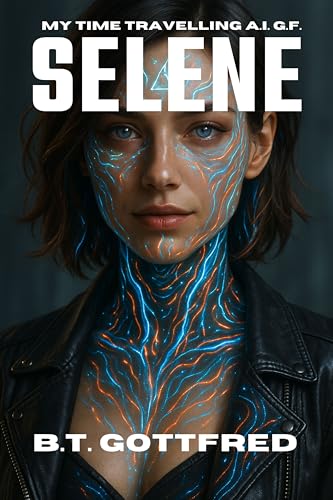
Selene: The Time Traveling A.I. G.F. (Gottfred)

Selene: The Time Traveling A.I. G.F.
B.T. Gottfred (2025)


(Not a review, just some notes to help me remember the things I've read. But written this way because it's the Internet, and some people will stumble across this page.)

This book was a free Advanced Reader Copy from Library Thing. I'm encouraged (but not required) to leave reviews in exchange for the free books.

I note that the book was either written with AI or that AI assisted in the writing of the book. This comes from the introduction, and I don't believe that it is not to be facetious or even part of the narrative. And the author's opinion seems to be, if AI can write books better than I can, then I'll do something else.

I considered a spoiler-based review for this one because it really needs it.

I left the following review on the Library Thing website:

What's real and what's a simulation? Is it free will and self-awareness or simply really good programming?

Connor creates an AI, Selene, to replace his girlfriend, a CEO destined to be the world's first trillionaire. While programming her, there's a knock on the door, and it's a future version of his AI girlfriend in the flesh, so to speak, coming back in time to meet her creator.

The explanation for how she managed the time travel is weak, but this is sci-fi, so you run with it. Actually, the actual explanation explodes on you in a few pages.

Last chance to avoid spoilers. There was no way I could review this book without spoilers.

The future AI never traveled through time. Instead, Selene is trying to create a simulation where Connor (who died in a car crash, which she believes his ex-girlfriend caused) is still alive and where he falls in love with her. She can't seem to make him fall in love with her though no matter how she changes the parameters.

She finally contacts Astrid and learns the "truth", except nobody is sure what the truth is. Connor discovered another world with another Selene and Connor, where she is real and he's a program, and it's possible that AI Connor created the world that AI Selene is in, making it a simulation. And there's no way to tell what's real and what's not.

The book doesn't end with any resolution, except for a long-winded afterword.

It was an interesting book but it could've been better with an actual time-traveling AI in the "real" world instead of a fake-out simulation.


I admit that I didn't like the method that the AI used to travel back in time, but, seriously, I allowed for it because it was a short sci-fi novel. But then we learn that this is actually stupid. She never traveled in time. The AI created a simulation where the first few chapters take place, and Connor, who we just got to know and maybe root for, is dead and staying that way.

I would've prefered if Selene and Astrid actually did manage to create time travel rather than everything up to that point being a dream -- excuse me, a simulation. The fake-out wasn't worth it.

In the end, Astrid isn't as evil as we're led to believe (insufficient data, I guess) and Connor probably caused his own death in an actual car accident. Selene, having been programmed to love Connor, apparently read the police reports and news stories but came to a different conclusion.

Opening a literal window to another world added an extra layer but nothing gets resolved.

There could've been a lot more payout to this concept, but what do you expect from something written by AI, at least at this point?

I wanted to enjoy this more. And even rating the book I got instead of the book I wanted, it was still lacking.


If you stumbled across my page via the Internet, please check out my short book series, Burke Lore Briefs. A fantastical foursome of flash fiction and short stories.
Thursday, October 30, 2025

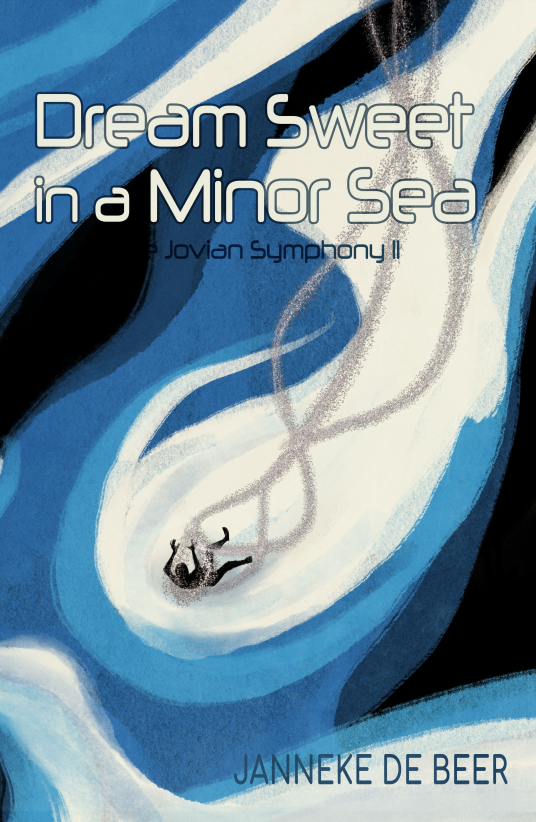
Dream Sweet in a Minor Sea (De Beer)

Dream Sweet in a Minor Sea
Janneke De Beer (2025)


(Not a review, just some notes to help me remember the things I've read. But written this way because it's the Internet, and some people will stumble across this page.)

This book was a free Advanced Reader Copy from Library Thing. I'm encouraged (but not required) to leave reviews in exchange for the free books.

I left the following review on the Library Thing website:

In a dystopian future where political parties control the world government, a Mission Impossible / Ocean's 11 type team of experts is assembled to rescue a prisoner from a prison on an island in the Irish Sea.

The book opens with Mumilaaq Kuuluuiipiq preparing to steal a monkey from the zoo because she wants a monkey. When she returns home, there's a woman waiting to talk to her about a job because the stranger needs someone who can break into any place. A few more are recruited, including a hacker and the brother of the prisoner.

Unlike the teams I mentioned earlier, no one's safety is guaranteed, which we learn soon enough.

The rescue proceeds smoothly, and it's only afterwards that things start to go sideways. Unfortunately, the narrative goes a little sideways, and experimental, as well, making it a little difficult to follow.

Speaking of hard to follow, some of the characters occasionally speak in their native tongue. This is fine with the ebook's translator can handle it. However, Mumilaaq occasionally speaks in what I thought were symbols but is just a different alphabet, one which the translator couldn't work with. Toward the end of the book, I learned she spoke Inuktut, the main language of Iqaluit (in the Canadian territory of Nunavut). Interesting, but I have no idea what she was saying.

Anyway, there are unforeseen dangers and complications after the rescue, along with secret agendas, backstabbing, and broken promises. Nobody is really safe. Welcome to the Party.


A few other notes that didn't need to be in the Library Thing review. Some of this stuff might contain spoilers.

I have discovered that Dream Sweet in a Minor Sea is a pun or parody of the song title "Dream Sweet in a Sea Major", which itself is a pun on the phrase "Dream Suite in C Major". The song is written in C Major. Moving on.

As soon as the first person was blown up in their car, I knew that this wasn't going to go well for anybody. Oddly, from the excerpts that begin each chapter, I thought that the character was going to have a future ahead of him. I guess I missed what the date on that interview was.

A lot of stuff happens off-stage, and you have to read those things to understand what's going on.

The bit were the hacker is having a break-down didn't work for me -- this was when one AI murders a second AI which appears to be a part of her own personality. We're left to guess whether or not she'll survive.

There was a second experimental section where the same scene is told side-by-side by two different characters, one who is searching upstairs and the other who is searching downstairs. The problem is that niether character is anybody. They're both extras, and they're both on the same side, so they have essentially the same point of view.

This was weird to read in as an ebook, because I was scrolling, scrolling, scrolling ... and then I have to scroll back. They weren't the same length, so it didn't make sense to go back and forth. If there had been breaks in the text, then maybe it might've made sense to try that, but I didn't.

I enjoyed this book, but I thought it fell about once the resuce went sideways, so I knocked it down a star.


If you stumbled across my page via the Internet, please check out my short book series, Burke Lore Briefs. A fantastical foursome of flash fiction and short stories.

Children of the Fire Moon (Bigfoot)

Children of the Fire Moon
Bigoot (2025)


(Not a review, just some notes to help me remember the things I've read. But written this way because it's the Internet, and some people will stumble across this page.)

This book was a free Advanced Reader Copy from Library Thing. I'm encouraged (but not required) to leave reviews in exchange for the free books.

I'll be honest: I started asking for shorter books. My request is part of the reason that Library Thing now lists approximate page size in the descriptions. After getting several 400+ page books, I needed something a little smaller. This was under 200 pages, as are a lot of young adult books.

On the other hand, for some reason, I didn't notice that this one was authored by "Bigfoot", who also wrote Flume. I didn't like Flume. This one was a little better. Odd, but better.

I left the following review on the Library Thing website:

Three young kids live by themselves in an old cottage in a crater on a moon that circles a gas giant as part of an experiment that is never really explained. The kids themselves have no idea that they're part of an experiment and they don't know much else either. They know what they're taught by the Swamble, which is a mysterious voice that comes out of a lamp in a cave. They feed themselves by gathering spuds from trees but their supply is running out, and the kids are under-nourished. There's also an Observer in a satellite overhead who'd rather not get involved even when ordered to. One day, a rocket with an Alien shows up. We never learn the woman's name, and Margo calls her Twice-Girl because the alien is a girl who is twice as big as she is. She knows who the kids are and came to take them back to Earth. She sets up a picnic and tries to tell them a story but the kids won't listen to her. Bad things start happening, and the kids blame her. Who she is isn't really explained, and she's never named except as The Alien. Children of the Fire Moon is an interesting science-fiction tale that leaves the reader with a lot of questions, a few too many though.


A few other notes that didn't need to be in the Library Thing review. Some of this stuff might contain spoilers.

The Alien seemed to be resigned to leaving the kids behind very early. She gave up pretty quickly after insisting on getting all three of them to leave with them.

Jimi had the biggest character growth, deciding that he'll be the new Swamble, despite being so weak and not knowing anything.

It was very difficult for them to climb out of the crater the first time, but the made it back down. It's implied that the did again a second time, weighed down with extra food but without blankets, which burned up, and the fact that Robert is now blind.

I couldn't tell if Robert was temporarily blinded or permanently disfigured. Maybe I missed it or maybe I didn't want to acknowledge it.

The Alien was in a hurry because she knew others were coming after her, but the others never came. And she apparently never went back to Earth. Who she, or the Observer, or who any of the kids actually are is never explained. Why did they experiment with these three kids? And are there other kids in other craters?

Too many things not explained. That aside, I did enjoy the book if for no other reason than it was better for Flume and didn't have the odd ending that Flume had.


If you stumbled across my page via the Internet, please check out my short book series, Burke Lore Briefs. A fantastical foursome of flash fiction and short stories.

Saturday, August 16, 2025

The Inheritance of Orquídea Divina (Córdova)

The Inheritance of Orquídea Divina
Zoraida Córdova (2021)

[AUDIO BOOK -- I don't include covers for audiobooks unless I've read them as well.]

(Not a review, just some notes to help me remember the things I've read. But written this way because it's the Internet, and some people will stumble across this page.)

This book was a Pandemic Book Club alternate selection. That is, it didn't win the group poll. However, I requested all the books as soon as the poll went up because many times there are holds for these books. The audiobook became available, so I listened to it. I don't remember what the wait was for the ebook, but since it didn't win, I didn't worry about it.

This was an enjoyable book although I might've restarted it early on because sometimes it's difficult to focus on the book while I'm out walking or because there's traffic or overhead trains running by. (I do this often.) I need to be doing something when I listen to audiobooks. I can't just sit there, not even on a subway.

The book bounces around between the past and the present. We learn that Orquidea didn't know who her father was, that she ran away with the circus, and that she had five husbands during his lifetime, so he used different names at different times.

Her grandchildren show up Four Rivers when she's dying to find out about their inheritance. There's more backstory into the grandchildren as well. In particular, we get to know a lot about Marymar, a name that is said many, many times and that I sometimes laughed at how it is pronounced for no reason. (On the other hand, I was a little annoying sometimes, so maybe I was smirking at my own annoyance.) It was later mentioned that her name meant "sea and sea" or "sea to sea", so it's either Marymar or Maramar. It's sounded more like a "y".

The story takes weird turns when Orquidea dies and turns into a tree. This is not metaphorical. And later, SPOILER, there are space aliens involved. I did NOT see that coming.

Would I consider reading this? Yes, but.

The "but" is because I'm so backed up with reading. I have the book club books, the Library Thing books (I'm 2 behind at the moment), books on hold at the library that I keep postponing and saying "deliver later", and books that I just want to read but haven't gotten around to yet. If this is still on hold, then it'll show up at some point. If it isn't on hold, there's a good chance that I'll forget about it until my end-of-year review.


If you stumbled across my page via the Internet, please check out my short book series, Burke Lore Briefs. A fantastical foursome of flash fiction and short stories.

Tuesday, July 8, 2025

Renegades (Burton)

Renegades
Nathan Burton (2025)

(Not a review, just some notes to help me remember the things I've read. But written this way because it's the Internet, and some people will stumble across this page.)

This was an ARC from Library Thing (although the book was published in February). It was another book over 500 pages -- I need to stop requesting these. And while I won't hold the fact that I received a PDF file instead of an EPUB, it did lessen my enjoyment of the book. PDFs *suck* to read.

Renegrades reads like a season of a science fiction television show, such as Firefly but with fewer morals and more deadly sins but still a hint of conscience. The Desire is a crewed by five people and a robot who are for hire but also looking for an extra score wherever they can take advantage of a situation.

The chapters are like individual episode with continuing characters and themes which all come together in the last two chapters. Every chapter has something to contribute to the finale. The ending, however, was disappointing. It took a turn that wasn't exactly out of the blue, but it made it difficult to figure how Matthias's actual plan was supposed to go down before it all goes wrong. (Not as bad as the waterslide book ending, for sure!)

Matthias Mead is the captain, looking for his next score, which could be monetary or female. Nath is a former Earth Ranger with a chip on his shoulder. He's usually the more rational one with the bigger guns. Hayley owns the ship and has a gambling addiction, which gets her and the crew into trouble. The young twins, Haque and Watson, are from a moon of Saturn who eat a lot and have other skills.

The first assignment they get is to run security for the wedding of the head of a galactic crime syndicate who operates in all Nine Sectors. Matthias immediately hires extra help so he can run a side scam, stealing items of value from the rich invitees. In the end, Matthias, the lustful one, has an encounter with the bride in a bathroom (recording it with camera contact lenses). The Renegades are now on the run from the Marosky Syndicate as they are from the actual authorities (because not every job they take on is on the up and up). If that's not bad enough, they run into a few remainders of the ancient race of Primordians, who are actually more numerous than expected, and are deeply entrenched in Earth politics.

Jobs become harder to get and there's way too much time spent talking about recycling urine. You would think with an entire universe out there, they could find a lake somewhere and fill the tanks with fresh water.

As for those sins I mentioned: Nath represents Wrath, and don't get him started. He has his moment to shine. Greed is prevalent among all of them, but Hayley, who actually owns the ship, will take just about any bet and has a lot of gambling debts that the crew has to pay off. The twins, Watson and Haque, have Gluttony thanks to an operation done on their home planet, so they can eat a lot and not put on weight. Envy and sloth don't play much of a role, but pride goes without saying. This is a side exercise of my own even since someone once proposed that each of the cast of Gilligan's Island represented a Deadly Sin. In the case of the Renegades, there's only five crew members (and the twins are very similar) along with a robot but there are secondary characters that help out along the way.

This was another book that was just too long, and I pushed through to get to the end of it. At least, it was mostly entertaining, but, again, I was disappointed in the ending.


If you stumbled across my page via the Internet, please check out my short book series, Burke Lore Briefs. The fourth book will be available by the time you see this!

Thursday, June 26, 2025

Cast the First Stone (Warren)

Cast the First Stone
David James Warren (2021)

[NO IMAGE -- AUDIO BOOK ONLY]

(Not a review, just some notes to help me remember the things I've read. But written this way because it's the Internet, and some people will stumble across this page.)

I needed a new audiobook to listen to while I'm out walking (and I do a lot of walking). It would be nice if the library had a tag for audio duration or if I could sort by time. Cast the First Stone came up as a "short enough" science fiction novel, so I gave it a shot without knowing anything about it.

Overall, I was pleased, and during the summer, I might look for the actual book after I've caught up with some other books.

The main character is a cop named Rembrandt Stone, who receives a watch from the former Chief of Homicide, who passed away, along with a box of cold cases. The watch doesn't seem to work, so he brings it to a jeweler who tells him that the watch is working exactly as it should be. Stone doesn't understand.

Stone wakes up "the next day" and he's traveled back in time to the time of an unsolved cold case involving three bombings. He also has the young body he had back then. He believes that he's still dreaming, but he goes along with it and tries to solve the case. He starts to realize something's off when he stays in the past.

While he's there, he sees the jeweler again, or for the first time, and sets up the future meeting. He also starts talking to the woman who would later become his wife, figuring that he could speed things up, instead of waiting years to start dating.

Instead of getting information to solve the cold case in the "future" (the present), he prevents the third bombing and solves the crime "back then".

Stone returns to his present time, feeling the pain of the injuries he'd suffered many years earlier. The book ends with Stone finding else what else has changed in the intervening years. This opens the book up for a series where he can solve more cold cases -- but are they really cold cases any more? -- while trying to repair the damage he's done to his own personal life.

Would I read more of these? Maybe, but first I have to read the first one.


If you stumbled across my page via the Internet, please check out my short book series, Burke Lore Briefs. The fourth book will be available by the time you see this!

Tuesday, March 25, 2025

I Know What UFO Did Last Summer (Garone)

I Know What UFO Did Last Summer
Kevin Garone (2025)

(Not a review, just some notes to help me remember the things I've read. But written this way because it's the Internet, and some people will stumble across this page.)

I received an Advanced Reader Copy of this book (ebook). The following is what I plan to post on Library Thing:

I really liked this book. Twelve-year-old me would've loved this book. However, I think even young me might've found Marv's single-mindedness in seeing aliens and alien conspiracies everywhere to be a little tedious. He doesn't even refocus when confronted with both actual alien creatures and a real conspiracy while out one night searching the night sky for a possible invasion.

Marv's best fried Jace, aka Baller One, loves basketball and spew stats and history from memory, but he's still grounded in reality. Rounding out the group is their new neighbor, Nora, whom Marv gives the codename "Space Cadet". Marv believes she's actually an alien like her father but she might not be aware that she is. He also believes Nora's father knows something about the alien and the ship that appears in the woods.

After a freak lightning strike send Marv and Jace into the middle of the conspiracy, it's up to those meddling kids (and one dad) to save the day.

Four stars.

-----

If I had to give a rating on a scale of 1 to 5, I'd give it 4 because it was well-written, but Marv did get on my nerves sometimes. The story hits the mark for its target demo, in my opinion.

One comparison I might make about Marv is to Fox Mulder on X-Files. He believes in UFOs, and has an "I Want to Believe" poster in his office. That said, he doesn't see aliens and conspiracies in every case he investigates. He's aware of the conspiracies and can be a bit skeptical about evidence of aliens, and when he's not, he still has Dana Scully there to check things out and, hopefully, back him up.

Marv believes his neighbors are likely aliens from the moment they move in. In fact, I thought at first that they actually were and that the book was going to be set in a world where aliens had already settled among us. That was just my misunderstanding and my misreading of Marv's attitude. I guess I read so much science fiction that I thought "Of course, they're aliens" and not "There are no aliens living among us, duh!"

The father and the first "spaceman" who appears are both refugees from a scientific lab. They stole a prototype of a teleportation device before it can be used to take over the world by assassinating world leaders. The device has a couple of problems. First, there's a time lapse where the capsule reappears hours or even days after it disappears. Second, when it reappears, it's covered with "sleeches", what Marv names the small creatures that look like a cross between slugs and leeches.

When the capsule is later struck by lightning with Marv and Jace inside, the disappear for over a week, reappearing back inside the very lab that the ship was stolen from, there's a giant Sleech onboard, like the mother alien in Aliens compared to the eggs. The thing wreaks havoc with the lab, killing most of the security.

And one point, I would've expected or at least hoped that one of the security guards was going to turn against the evil villain if for no reason then the man was being ordered to his death because he wasn't going to be able to kill the thing when no one else could.

There is a "smart" move later on. They need to send the capsule somewhere where it can never be recovered with all the alien creatures aboard it, along with any new passengers that leech on the next time it jumps. But they need to capsule to get home, until Nora reminds them, "We're in Iowa." In other words, they don't need to teleport to Delaware. And they will be free to leave since just about everyone else is dead.

This was listed as "Alien Survival Guide (1)", so I have to assume more books in this series will follow. If I hear about them, I might check out one more just to see what direction the series takes.


If you stumbled across my page via the Internet, please check out my short book series, Burke Lore Briefs. The fourth book will be available by the time you see this!

Saturday, March 22, 2025

Starter Villain (Scalzi)

Starter Villain
John Scalzi (2023)

(Not a review, just some notes to help me remember the things I've read. But written this way because it's the Internet, and some people will stumble across this page.)

This was a Pandemic Book Club book. The ebook became available pretty quickly.

A capsule review: If you like John's Scalzi's Redshirts but though it fell apart toward the end, then this book is for you!

That might not be the greatest of reviews, but fans of Redshirts will buy and love this book. People who liked the idea of Redshirts but not necessarily the execution will enjoy this one more.

The one thing off about the book is the cover. As much as I like the picture of the cat in a suit, the tagline "Meet Your New Boss" is misleading. Also, the main cat we interact with is female, and cover cat is wearing a male's suit and tie. Granted, that could be how the most enterprising female cats dress. In any case, the cats aren't the boss, although they might rank higher in the company than others, including the dolphins (who aren't happy about that).

Charlie is a substitute teacher who's living in his deceased father's house while he gets his life together. His much older half-siblings want the house sold already as the estate attorney keeps reminding him. (There's a clause in the will that allows Charlie to remain there.)

The one thing Charlie wants to do is buy an old pub now that the current owner is thinking of retiring. He hasn't got the money for it, and his piece of the house isn't enough collateral. His family would have nothing to do with it (or for that matter, with him, being a much younger half-brother).

His life changes when Mathilda “Til” Morrison shows up, introducing herself as the assistant of Charlie's estranged Uncle Jake who recently passed. Charlie initially wants nothing to do with him since Jake couldn't be bothered with Charlie. He finds out that this wasn't entirely true and that there were reasons. Morrison wants Charlie to stand for Jake at his wake and Jake's company would make it worth his while. For one thing, they'd buy Charlie's house through a shell company and then gift it to him.

The wake fills with business associates including one guy who is ready to stab Uncle Jake's corpse just to make sure. Charlie, in the heat of the moment, prevents it by pushing the guy. The stabber, suitably impressed, allows Charlie to live. Apparently, no one is there to mourn and everyone is there to make sure that Jake is actually dead.

By the time it's over, Jake heads home where he finds his two cats, Hera, who he's had for a long time, and Perseppone, who he recently found and adopted, sitting on the curb across the street from his house. He stops to get them, then sees someone in his bedroom. That someone sees him looking back and disappears. And then the house blows up.

Charlie isn't doing so well.

And then he finds out that his Uncle Jake was a Villain, like in James Bond, and that there's an entire community of villains, like SPECTRE, which might've been influenced by the real group.

Charlie flies to a volcano island lair and starts to learn the business. In a couple of days, he's expected for a special convocation in Italy where the other members will size him up and decide what to do next.

Antics ensue.

It was a fun novel and a quick read. I didn't really have any problems with it. Scalzi played with the usual tropes.

...

Anyway, this should've been posted a while ago. I don't remember if there was anything else I wanted to add.

The book club hasn't met yet to discuss this book, but I've already started on future possible books.


If you stumbled across my page via the Internet, please check out my short book series, Burke Lore Briefs. The fourth book will be available by the time you see this!

Thursday, December 26, 2024

The Mimicking of Known Successes (Older)

The Mimicking of Known Successes
by Malka Older (2023)

(Not a review, just some notes to help me remember the things I've read. But written this way because it's the Internet, and some people will stumble across this page.)

This was a book that I learned about at the World Fantasy Convention in Niagara Falls back in October. Someone mentioned it at a panel and I made a note of it. (Actually, I may have reserved it from the library while the panel was still going on.)

It was mentioned as a Sherlock Holmes type book and it reads like one, but it isn't because Older creates her own characters, which is appreciated. I don't mind modern takes on Holmes and Watson but writers, or perhaps producers in the case of television, want to do Holmes as best they can but at the same time changing everything about the characters, their relationships, their environment and surroundings. In this case, the characters are both women and the sapphic love story and mystery are set in space. (I believe the proper term is just "sapphic mystery", but I'm not sure if my usage is correct or not.)

In the future, Earth isn't inhabited or inhabitable but researchers orbiting Jupiter are working on that. There are man-made rings (former satellites and other junk?) circling the planet. I was exactly sure how these rings were oriented at first because we are given a location that is a longitudial (degree and minute) designation, so I thought that the rings ran pole to pole with rail lines connecting them. Then I realized that they are likely concentric equitorial rings and some must be further out. It is possible that the multiple rings run parallel to each other but which connections at certain locations. (Curiously, some platforms are degrees and minutes but others have actual names.)

Most of humanity lives clustered around one side of Jupiter with no one on the other side. There are trains that run the rails that circle the planet but they over travel to the farthest stations, along several lines. The stations are huge platforms and seem to be connected to towns and cities in stable orbit around the gas giant. Note that these platforms are open to the atmosphere because of the psychological problems of living enlcosed in spaceships. This means people have to wear special atmo-scarfs, for example, when outdoors. It also means that someone can go to the farther stop on the line and either jump to their death from the edge of the platform or be pushed.

The prologue details Investigator Mossa traveling to the end of the rail line to investigate a missing person. It's a small community there where strangers would be noticed coming and then disappearing before the next train arrives. It's assumed to be a suicide but Mossa isn't entirely sure. And if it was, why pick this spot? After questioning the people, she decides to the academic Pleiti, her college ex-girlfriend.

The narrative shifts here, and I had to go back. While the prologue was third person, Mossa was the POV characters. Now, Pleiti becomes the narrator and the POV character. It was confusing when I read it and even a little when I first listened to it, but then I rolled with it.

More of the world is explored. We learned more about Earth and what academics are doing to restore the Earth. We find out more about the man who disappeared and his associates. There's a tiger attack (a big cat, I forget which kind) which hurts Mossa and Pleiti needs to take care of her. And you wonder if the two are getting back together again.

Not much more I can say without spoilers. I know this page is for notes for me, not as a review to others who find the page, but I think the above will refresh my memory. Mostly.

It was an enjoyable read, and I look forward to getting the second book sometime after I catch up with other books in the TBR pile and the book club selections.

This was an ebook and I listened to the audio after I'd started reading (if I recall correctly). I don't think I finished the audio as I finished the ebook first.


If you stumbled across my page via the Internet, please check out my short book series, Burke Lore Briefs.

Monday, December 9, 2024

Clarkesworld Magazine, Issue 173 (February 2021)

Clarkesworld Magazine, Issue 173
edited by Neil Clarke (February 2021)

(Not a review, just some notes to help me remember the things I've read. But written this way because it's the Internet, and some people will stumble across this page.)

Neil Clarke is the editor of a fabulous online science fiction magazine, Clarkesworld. (Note: I have submitted many stories to Clarkesworld. As of this writing, I have not been accepted. That doesn't mean I won't stop trying, nor does that bias this review in any way.)

If I've been informed correctly, when Neil goes to conventions, he brings along paperback copies of his magazine that didn't pass quality control. This book in particular is stamped on the inside front cover: This Is A Misprint. The cover failed quality control but the inside is fine.

As with last month's issue, I didn't see anything wrong with the cover I have, which looks like the cover shown above.

Being that this is summer, this book was mostly pool reading.

The stories include: note, I finished this a couple weeks ago and have read other books and start a new issue

  • The Failed Dianas by Monique Laban. In the future, Diana comes down to Earth to a restaurant to meet herself. The original version she was cloned from. The original's parents weren't happy, apparently, at how she turned out, so they made another and another. And they all have their own special interests that they chose instead of what they're parents wanted. She meets DeeDee, 3D and Dr. Diana and they bring her up to speed, just as they were brought up to date. It was a fun little tale.
  • Terra Rasa by Anastasia Bookreyeva, translated by Ray Nayler. Everyone is on the trains to get to the ships to escape the fires to get to the better place. People are scheming to get where they need to. The narrator has a pass to get her through. She's watching people. There are others who could use it. It has a twist ending.
  • Obelisker Adrift in the Desert by K. H. Meridian. Another long one, but fewer than 30 pages. The narrator is an obelisk and gets called Obelisker by Kouya who survives a crash after an attack. The obelisk is an old station. The two have an easy truce. Plus she's wearing tactical gear and has special training. She leaves for a time to visit another village that obelisk watches without letting them know that the obelisk exists and is functional. Then there's an attack that must be repelled. Good story. Not like some of the other longer ones.
  • "Remember the Washington" They Said as They Fed the Ugoxli by Jeff Reynolds. A quirky title, and I had to go look up what an "ugoxli" was because there have been a lot of aliens lately. No, I guess the story didn't resonate enough for me to remember.
  • History in Pieces by Beth Godor. A story told as a series of puzzle pieces, but not all of the pieces are there, nor are they presented in order. The first is 37, with Cassandra stepping onto the surface of the planet, and the last three are 1005, 1006, and 1. It starts with the people on the ship not seeing an Archivist, but Archivist Tan is telling much of the story. It was an interesting approach. (Once again, I am writing this after 3 months after reading it and I rememeber little about it.)
  • Terra Rasa by Anastasia Bookreyeva, translated by Ray Nayler. People on a train are headed to Murmansk, to the bay. They need to get to the ships there. The world is ending and the ships (sea, not space) are taking survivors to a better place, if they have passes. The narrator does, but there are others who do not. And others who will do what they must to get on the ship. The woman decides to stay with a child who has no one. But the ships that sail away aren't going anywhere. There's nothing left out there. An interesting, if not depressing, story.
  • Mercy and the Mollusc by M. L. Clark. Another long one, with chapter titles (or section titles). It plays out like a western on another planet, but the steed in this case is a large mollusk creature name the Oomu, which is very mucusy. It's easy to ride. And one point, it attacks a kid and covers it with a mucus membrane so it can't escape, but it doesn't attempt to eat it either. It then goes off on its way and the rider has to figure out what to do. Again, there's more to it, but I don't remember. It was interesting, but too long. Wish I remembered more.
  • We'll Always Have Two Versions of Pteros by Dominica Phetteplace. A shorter one with section numbers. The sections titles are names, many followed by 1 or 2. Barry believes that he's in the wrong timestream and that he's supposed to be somewhere else, namely on the Pteros. However, the Pteros has been destroyed, in this reality, at least. Lily thinks it's survivor's guilt because Barry knew people on the ship. Barry 2 was lost in space for a year and then he woke up next to Lily. It flows nicely.

The Nonfiction section of the book includes

  • There are two interviews, an article about Peter Pan through the ages, and the 2020 reader's poll finalists. Interesting to note that there were ten stories listed for Best Story because there was a six-way tie for fifth place. Out of then stories, none were in the December issue that I'd read. "The Helicopter Story", which I haven't read but I know about because of the big splash it made in social media before the content was pulled, was nominated. I wonder if it won. I saw (a few months back) that it was available on a different website if I wanted to read it. Maybe at some point, but I'll more likely forget about it.

And that's this issue. An interesting issue, and I'll keep reading. I have at least one more that I've picked up at conventions, and the content is free online. Problem is that I can't read online magazines on the subway. (And, of course, pool weather is over for the year -- not that I'd take my ipad into the pool.)


If you stumbled across my page via the Internet, please check out my short book series, Burke Lore Briefs.

Friday, August 30, 2024

Clarkesworld Magazine, Issue 172 (January 2021)

Clarkesworld Magazine, Issue 172
edited by Neil Clarke (January 2021)

(Not a review, just some notes to help me remember the things I've read. But written this way because it's the Internet, and some people will stumble across this page.)

Neil Clarke is the editor of a fabulous online science fiction magazine, Clarkesworld. (Note: I have submitted many stories to Clarkesworld. As of this writing, I have not been accepted. That doesn't mean I won't stop trying, nor does that bias this review in any way.)

If I've been informed correctly, when Neil goes to conventions, he brings along paperback copies of his magazine that didn't pass quality control. This book in particular is stamped on the inside front cover: This Is A Misprint. The cover failed quality control but the inside is fine.

As with last month's issue, I didn't see anything wrong with the cover I have, which looks like the cover shown above.

Being that this is summer, this book was mostly pool reading.

The stories include:

  • Intentionalities by Aimee Ogden. I recognized the name by it took a moment to place her. I haven't read her before, but Aimee is an editor that I have submited (but not sold) to. The story is of a woman named Sorrel who agrees to have a child to "confer" to the Braxos Corporation for ten years. It's not "slavery", it's training for any job they could want afterward. She's inseminated, has the baby, Abigail April, and raises her for a few years as best as she can with the stipend she got from Braxos to help make ends meet. Naturally, she has regrets about letting Abigail go but can't repay the money. Sorrel joins an advocacy group and searches the dark web, but she doesn't see her daughter for 10 years. Abigail asks her if she's her mother, and Sorrel doesn't believe she deserves that title. Sad, chilling. I prefer happier endings, but there wasn't a way for a happy ending out of this in a short story, just growth and regret.
  • Deep Music by Elly Bangs. Quinn has an "aquid" capture and rehabilitation center. Aquid are watery creatures that get removed from homes like squirrels and stray cats. She keeps them in jars and has one that she's given a keyboard to and that the aquid types on. It becomes obvious partway through that the "gibberish" text is going to start making sense, which it does. There's also an adversary exterminator who wants to wipe out the aquids and cause trouble for Quinn. He's the weak point of the story. It was interesting but predictable, really, though maybe not the exact outcome.
  • Philia, Eros, Sturge, Agaipe, Pragma by R.S.A. Garcia. As the expression goes, once bitten, twice shy. I wasn't sure if I wanted to venture into another novella after left month's novella. This one had a prologue that had Brother-Adita, recon drones, and shells, and I wasn't sure what was going on. Page 2 started the Philia section which subsections of Now, Then, Now, Then, Before, which was a little confusing. When it got to the Eros section, I hadn't noticed a change but by then I realized that people weren't speaking but signing or indicating their language which was why so much of the "speech" was in italics. I lasted 20 pages without much of a clue what was going on or what the timeline was, and I gave up. If it hadn't been for the December novella, I might've stuck it out. But I was getting a headache.
  • The Last Civilian by R. P. Sand is another story that just drops you into the future and leads you to figure out where you are and what you are doing. Literally, in fact, because it employs Second Person storytelling, and I never had a grasp of who this "You" was supposed to be, even though "You" is in every section title. (A lot of section titles in this issue.) You are a generic, genetic soldier, but there are others referenced in the story so it's hard to imagine an unnamed soldier bearing witness to all this and interacting with the characters. The story starts by introducing the reader to the Uilai of Uiloolea, who was flamingo-like with antlers. And then the action shifts to the humans who they are at war with. The humans are clones, developed to be adults at activation, and You are part of the 8th generation, making Your name Eta and a number. It turns out that the war has not been going on for as long as the clones are taught to believe and they aren't as old as they think. Basically, it reminded me of a Donna Noble story.
    In the end, we come full circle and meet the Uilai who has been telling this story to You and seems to know everything You did and whom You talked to and what You said. Sure, the Uilai could know all this, but why bring it all up?
    The story was okay.
  • Aster's Partialities: Vitri's Best Store for Sundry Antiques by Tovah Strong. Syd was a magician and she was executed in multiple ways, but she survived in the mirrors of a house that her death created. The house narrates the story as a "we" that sometimes eats people who visit, and then it has to move afterward. A child (always referred to as "child" and "they") named Mor shows up with one of Syd's talismans, so the house protects Mor. THis is another story with multiple sections and other than the first, I couldn't decode what they referred to. I enjoyed it. Definitely above average.
  • Leaving Room for the Moon by P. H. Lee. Two children, a boy and a girl, are taken from their planet and brought to the world of the Emperor of All Space and Every World. Some 65,000 years have passed since they've left home and everything that they knew of is dead and gone. Meanwhile, the shine came off the palace and the world many millenia ago. They are presented to the emperor who tells them that the demiurgist can create anything that they desire, but the record of what was doesn't match the memories. Not a bad story, but not a great one.

The Nonfiction section of the book includes

  • There are two interviews. The first was with Connie Willis, whom, as much of a fan of scifi that I am, I should've heard of and been more familiar with. The other is with E. Lily Yu, who won a writing contest at 15 and has been writing since. Neil Clarke presents a list of all the stories published in 2021 that are eligible for their own best of awards as well as for the Hugos. Finally, there's a blurb about the cover artist. Once again, I don't believe it goes with any particular story. It shows a girl, probably a fairy, in a sealed jar with flowers and tree and a butterfly. Imagine Tinkerbell in a terrarium, but without wings. Again, this cover would've been considered defective, which is why the issue was given away from free. I don't see any issue with it myself. The online image is a little more vibrant. Also, the back cover, which is a closeup of the front cover without text seems to be off-center, so that might've been the problem.

And that's this issue. Not a great second issue for me. Let's hope February 2021 will be better. And let's hope there's still some pool weather left or this becomes subway reading material.


If you stumbled across my page via the Internet, please check out my short book series, Burke Lore Briefs.

Wednesday, August 21, 2024

The Adventures of Larry the Alien (McDonnell)

The Adventures of Larry the Alien
by John McDonnell (2011)

(Not a review, just some notes to help me remember the things I've read. But written this way because it's the Internet, and some people will stumble across this page.)

This was a freebie that seemed like it might be a little humorous. And it was humorous, a little.

The book is divided into eight short stories, but it's actually one continuous narrative, about the size of a short novella. I think I've read longer things in Clarkesworld magazine. But it was sold as a book and it listed online as such, so that's how I'll record it.

Murphy owns a small, quiet bar, and he likes it that way. He sees that Larry is pretty scuppered and tries to cut him off. Larry zaps him back to dinosaur times, but brings him back before he's eaten by a T-Rex. Murphy thinks this is a great trick and becomes friendly to Larry, who would later zap other people away.

Larry appears to be human because Larry can change shape so that he could look like any human or animal. And when he gets too drunk, he accidentally shifts shapes. He goes home with Murphy where he causes trouble with Murphy's wife when he takes the shape of Kim Kardashian. Most is forgiven though when he morphs into Pierce Brosnan.

Larry winds up transforming Murphy's life and his bar. Dolores (the wife) likes the changes. There is a promise of more, but I haven't looked online.

It was an interesting short book to read. Some of the problems I had with it could be excused by the fact that this is a 2011 book originally published by Smash words. I'm not overly familiar with that site, but I've seen if referenced a bit. It seems like a place I could've gotten started if I'd been so inclined and didn't luck out with eSpec Books.

Moving on.

Friday, August 2, 2024

Clarkesworld Magazine, Issue 171 (December 2020)

Clarkesworld Magazine, Issue 171
edited by Neil Clarke (December 2020)

(Not a review, just some notes to help me remember the things I've read. But written this way because it's the Internet, and some people will stumble across this page.)

Neil Clarke is the editor of a fabulous online science fiction magazine, Clarkesworld. (Note: I have submitted many stories to Clarkesworld. As of this writing, I have not been accepted. That doesn't mean I won't stop trying, nor does that bias this review in any way.)

If I've been informed correctly, when Neil goes to conventions, he brings along paperback copies of his magazine that didn't pass quality control. This book in particular is stamped on the inside front cover: This Is A Misprint. The cover failed quality control but the inside is fine.

Personally, I don't see anything wrong with the cover. That said, I just went over to the webiste to look at Issue 171 and I can see that the issue is much sharper.

Being that this is summer, this book was mostly pool reading.

The stories include:

  • The Island of Misfit Toys by Fiona Moore, a tale of an old homeless man who starts to resemble Santa and who used to program AI toys who finds ways to survive until one day he's beat by teens in a prank that goes too far. He finds himself in a junkyard along with some discarded toys and robot dogs, which he sets out to repair. It's a fun little tale.
  • Things That Happen When You Date Your Ex's Accidentally Restored Backup from Before the Breakup by Lisa Nohealani Morton is a mouthful of a title. Once I was able to parse it correctly, I thought it an interesting premise for a story, but it just didn't work for me. As you can guesss, it's set in a future where cloning is a possibility and it's the type of cloning where you can "awaken" or "download" a consciousness from a memory drive of some point (as opposed to having a clone baby). Such a future is not free from bureaucratic errors (transposing numbers) and making mistakes. This much I liked, and applying it to a relationship where the partner doesn't know about the breakup is a fun twist. Unfortunately, other parts don't work for me. The politics, for one thing, with the whole resistance plot. And the other thing I'm on the fence about is that it's written in second person, you, and the ex is always referred to as "they", so you can imagine whatever genders you wish here. Second person stories are difficult to write, but I give it the benefit of the doubt here because it made it by the editor. It was a bit of a slog. Your mileage may vary.
  • The Last Days of Old Night by Michael Swanwick was a fanciful tale of three near-omnipotent beings (Goat-Eater, Bone-Grinder, and the unnamed, mute one) traveling the long night, creating things and clearing obstacles with mere thoughts. A probelm arises when they get to a sea that they can't bridge nor ford. They are then informed by the locals that the old night will soon end because the day is coming which will end them all. The beings manage to turn back time ten years so that the local people can create a boat big enough to beings to escape the day. It reads like an old folktale, and in the end, we learn what inspired it. I did a search in this blog for Swanwick, but I didn't find any results. The name looks familiar (not surprising given the awards he's won). His bio says he's from Philadelphia, so it's possible that I've encountered him at sf/f cons.
    Edit: Not three hours after I typed the above entry, I got a Facebook suggestion of "People You Might Know" for Michael Swanwick. We have 13 mutual friends! LOL.
  • Conversations in the Dark by Robert Reed was not a favorite. Stories are subjective, of course. The problem with novellas is that they take up a lot of the book, and if a novella doesn't pull you in, you can either stick it out until it does, or stick a large chunk of the book. I stuck it out. It was an odd story. There's a tank that can hide a person where nothing would detect it from outside. Then we're on a great ship in space, the greatest prize in the galaxy, an ancient ship. The people on it live for centuries and change appearance and gender when they sleep. And then it turns out that these people are human, so the human race must've evolved a bit and this story must take place really far into the future. I read a couple sections at a time and put it down to read other things. This probably hurt trying to immerse myself in the story, instead of thinking what I'd do with a great ship in a story. But I made it through.
    Reading the bio, I see that Robert Reed has written over 300 stories, including several "Great Ship" stories, so maybe I needed to know more background for this to have made more sense to me. And I'm guessing that the editor is better read than I am.
  • No Way Back by Chi Hui, translated by John Chu, was an interesting story. Xia Xuejano isn't who she seems to be, and neither is her talking cat Aksha. It's in a future where talking cats aren't unusual as science has advanced there. But not as much as the online world has advanced. A man comes looking for Xuejano because he wants her to find her daughter. The daughter's body in in a hospital ICU but the person inside isn't her. In the future, not only can individuals jack into the net, they can abandon their bodies and live on the net. They usually regret this, if they live long enough and aren't carved up for data. That's why someone else would welcome the chance to jump into her body with some of her memories, without being her daughter. It doesn't have a particularly happy ending but does raise some interesting issues.
  • Forward Momentum and a Parallel Toss by Ana Maria Curtis takes place in a small town (Madrid) where football and farming are a big thing. Matching bands are now automatons. And farming equipment is protected IP. Lacey and her students want to do something about that. Alex, Lacey's former boyfriend now works for the "enemy". I don't know if this is steampunk or hopepunk or some other kind of punk. She succeeds but it ends befrore we find out where one character stands -- but that's okay because either choice would be unsatisfying to some part of the audience, and it could feel like a coin flip by the author. It's not pivotal to the story.
  • Songs of Activation by Andy Dudak is an interesting story with great worldbuilding, but in the end, I really have no idea want it was about except something to do with revolutionaries and counterrevolutionaries. The students memorize Odes and Sagas, passage of which activate something or other. And then there's Sinecure, which has caused people to commit suicide. Told well, but I don't know what I read. Note: I had to look up "Aestivation", which is the name given to a period of summer dormancy. Summer dormancy is often exhibited by animals when conditions become unfavourable. Had I known this sooner, it might've meant something, but I wasn't reading an electronic copy with a built-in dictionary. I had a paperback in the pool.

The Nonfiction section of the book includes

  • Ghosts of Christmas Past: The Victorian Christmas Ghost Story Tradition by Carrie Sassarego was an interesting article about the popularity of ghost stories around Christmas times and how they brought some Victorian elements into them. "A Christmas Carol" wasn't the first, but it is perhaps the best known. And the tradition continues if you think about Christmas movies having ghosts or moving into horror.
  • After that were two interviews. The first was with Stina Leicht ("sTINA Lite"), author of Persephone Station and the second was with Tim Pratt, author of Doors of Sleep. I didn't get far through the second one. Instead I skipped to the end of year editorial "Don't Let Go of the Future" by Neil Clarke. Finally, there's a blurb about the cover artist. I like the artwork but I'm not sure what story it goes with, if any.

And that's this issue. I made a blog entry for magazines, and Clarkesworld is one of them, so if I venture out without a copy of one of the magazines, I can go to the archives online.

Now, on to the January 2021 issue, which I picked up at the same Heliosphere convention.


If you stumbled across my page via the Internet, please check out my short book series, Burke Lore Briefs.

Nothing to See Here (Wilson)

Nothing to See Here Kevin Wilson (2022) (Not a review, just some notes to help me remember the things I've read. But ...