Showing posts with label political. Show all posts

Thursday, October 30, 2025

Dream Sweet in a Minor Sea (De Beer)

Dream Sweet in a Minor Sea
Janneke De Beer (2025)


(Not a review, just some notes to help me remember the things I've read. But written this way because it's the Internet, and some people will stumble across this page.)

This book was a free Advanced Reader Copy from Library Thing. I'm encouraged (but not required) to leave reviews in exchange for the free books.

I left the following review on the Library Thing website:

In a dystopian future where political parties control the world government, a Mission Impossible / Ocean's 11 type team of experts is assembled to rescue a prisoner from a prison on an island in the Irish Sea.

The book opens with Mumilaaq Kuuluuiipiq preparing to steal a monkey from the zoo because she wants a monkey. When she returns home, there's a woman waiting to talk to her about a job because the stranger needs someone who can break into any place. A few more are recruited, including a hacker and the brother of the prisoner.

Unlike the teams I mentioned earlier, no one's safety is guaranteed, which we learn soon enough.

The rescue proceeds smoothly, and it's only afterwards that things start to go sideways. Unfortunately, the narrative goes a little sideways, and experimental, as well, making it a little difficult to follow.

Speaking of hard to follow, some of the characters occasionally speak in their native tongue. This is fine with the ebook's translator can handle it. However, Mumilaaq occasionally speaks in what I thought were symbols but is just a different alphabet, one which the translator couldn't work with. Toward the end of the book, I learned she spoke Inuktut, the main language of Iqaluit (in the Canadian territory of Nunavut). Interesting, but I have no idea what she was saying.

Anyway, there are unforeseen dangers and complications after the rescue, along with secret agendas, backstabbing, and broken promises. Nobody is really safe. Welcome to the Party.


A few other notes that didn't need to be in the Library Thing review. Some of this stuff might contain spoilers.

I have discovered that Dream Sweet in a Minor Sea is a pun or parody of the song title "Dream Sweet in a Sea Major", which itself is a pun on the phrase "Dream Suite in C Major". The song is written in C Major. Moving on.

As soon as the first person was blown up in their car, I knew that this wasn't going to go well for anybody. Oddly, from the excerpts that begin each chapter, I thought that the character was going to have a future ahead of him. I guess I missed what the date on that interview was.

A lot of stuff happens off-stage, and you have to read those things to understand what's going on.

The bit were the hacker is having a break-down didn't work for me -- this was when one AI murders a second AI which appears to be a part of her own personality. We're left to guess whether or not she'll survive.

There was a second experimental section where the same scene is told side-by-side by two different characters, one who is searching upstairs and the other who is searching downstairs. The problem is that niether character is anybody. They're both extras, and they're both on the same side, so they have essentially the same point of view.

This was weird to read in as an ebook, because I was scrolling, scrolling, scrolling ... and then I have to scroll back. They weren't the same length, so it didn't make sense to go back and forth. If there had been breaks in the text, then maybe it might've made sense to try that, but I didn't.

I enjoyed this book, but I thought it fell about once the resuce went sideways, so I knocked it down a star.


If you stumbled across my page via the Internet, please check out my short book series, Burke Lore Briefs. A fantastical foursome of flash fiction and short stories.

Monday, September 27, 2021

Don't Burn This Book (Rubin)

Don't Burn This Book: Thinking for Yourself in an Age of Unreason, by Dave Rubin (2020)

(Not a review, just some notes to help me remember the things I've read. But written this way because it's the Internet, and some people will stumble across this page.)

Walking from the anime shelf at the library toward the science fiction books, I was passing by the 300 section when I spied the words DON'T BURN THIS out of the corner of my eye. Stickers were covered the word "BOOK" on the spine. I stopped and pulled it from the shelf. I saw the title with the unlit wooden match on it. A striking cover (so to speak) that caught my attention. The subtitle "Thinking for Yourself" goes against the grain of all social media (and a lot of mainstream media) unless what you think for yourself agrees with without everyone else thinks.

The oddest part was that I didn't know who Dave Rubin was. I recognized the name, probably heard it online. The funny thing, I thought, was that if he was the person I was thinking of, he was a liberal. A title like this I'd expect from someone more right-leaning. (The jokes write themselves -- my first thought was to type Mark Levin here, but he wouldn't have a title that was so imflammatory. He's more on the nose with a title, I believe.)

So I checked it out, and as I suspected, Dave Rubin of the Rubin Report is, in fact, a liberal, but one of the Ed Koch mold. Ed used to bill himself as a "liberal with sanity" and who believed if you agreed with him more than 90% of the time, you should get your head examined.

Rubin states his opinions right off the top, what he believes and why he believes it. Some of these positions could have him dismissed as an "alt-right loonie" from the people he's not in line with. The rest are classical liberal positions. And by classical liberal, he's going back a few years.

It was an interesting read, particularly when illness nearly sidelined him and the "Rubin Report" and how a side comment to a guest led to a year-long tour on the lecture-circuit as the opening act to a self-help guru. It changed his life.

There wasn't anything in the book that was life-changing for me, but plenty of it was life-affirming, such as knowing that there are other people who would rather discuss and debate then name-call and cancel.

Sunday, August 15, 2021

An old Year-end Review for 2005

While cleaning up my hard drive, I found files where I kept track of the books I read for a given year. Someone had given me the idea (back in the 90s, I believe) to open a text file, and add the name of the book I'd read. What follows below looks like an "end of the year" post made to a bulletin board somewhere. It's past my time on Usenet. Many of these may have appeared elsewhere in this blog, if not the entire post itself. I'll post these files one per month.

It looks like 2005 was an old year. I don't remember even having some of these let alone reading them. Quite a few were library books, particularly the political ones, which were right next to the science fiction section at my local branch.

2005: The Year in Review

Horseclans #1: The Coming of the Horseclans,

Star Trek #29: Dreadnought, Diane Carey

Big Trouble, Dave Barry

At Any Cost: How Al Gore Tried to Steal the Election,

Sky Captain and the World of Tomorrow, K. J. Anderson

Defcon One, Joe Weber

Sword and Shadow, Anne Marston

Star Trek: the Return, William Shatner

Men in Black: How the Supreme Court is Destroying America, Mark Levin

Peanuts: A Golden Celebration, Charles M. Schulz

3001: The Final Odyssey, Arthur C. Clarke

The Light Fantastic, Terry Pratchett

Harry Potter and the Half-Blood Prince, J. K. Rowling

The Lion, the Witch and the Wardrobe, C. S. Lewis

100 People Who Are Screwing Up America, Goldberg

1776,

The Wizard of Oz, L. Frank Baum

Magazines Anthologies: (some old issues that I had but never read)

The Magazine of Fantasy & Science Fiction, July 2000

What strikes me is that I not only have no recollection of Horseclans #1, but I didn't even remember reading it. It was a GURPS worldbook back in the 80s or 90s, which is had I would have even been aware of it. Likewise, I don't remember reading Dreadnought, or even owning a copy, or than the pair of books I bought as a Christmas present from a friend many years before this. The 1776 entry is also a head-scratcher, especially since there's no author attached to it -- ah, a quick net search shows it was written by David McCullough. I remember that now. I remember reading the bits about the Gowanus swamp and the Battle of Brooklyn because it happened in my backyard -- LITERALLY.

Interestingly, I don't seem to have tags for Pratchett or C. S. Lewis.

Tuesday, October 17, 2017

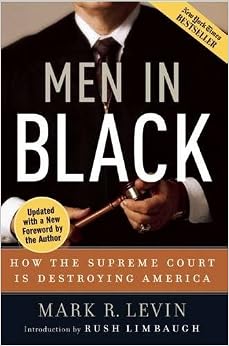
Men in Black (Levin) -- Summer Reading Challenge

Men in Black: How The Supreme Court Is Destroying America Mark Levin (2005)

In my first pass on the 300s shelf, I spotted a book by Mark Levin, a brilliant legal and Constitutional scholar, who iscurrently a talk-show host and pundit, but was chief of staff for Attorney General Edwin Meese in the Ronald Reagan administration. (Basically, he knows what he's talking about.) Anyway, it wasn't one I was interested in reading, but since it would fill a spot on my reading challenge, I placed a hold on Men in Black, which I'd heard about years ago, but never read.

Men in Black has nothing to do with Will Smith or aliens or secret government agencies. Quite the opposite -- it has to do with the one branch of government that always comes from and center in the headlines every June when it delivers a boatload of decisions and opinions. Levin has read all the major ones going back over 200 years.

Levin goes through many of the jurists who have sat on the bench and the influence that they've had in shifting the legal system, how they've expanded rights and taken others away, how they've pushed toward statism and away from federalism. And how they sometimes perform judicial acrobatics to achieve the ends they want, regardless of the legacy it leaves and the precedence it creates.

And let's not forget about the emanations and penumbras.

You'll read about the people who have sat on the bench for decades. The ones who wore black robes during the week and white robes (with matching hoods) on the weekends. The bad decisions, which were later overturned. The bad decisions which haven't been. The good decisions which were overturned.

Surprisingly, he actually faults SCOTUS for getting involved with Bush v Gore. While he understands that it was necessary to rein in a runaway, rogue Florida Supreme Court, Levin holds that it was unnecessary. Under Florida Constitution, it would have ultimately come down to the Florida legislature, which was controlled by the Republican Party. Gore never had a chance. However, by inserting itself under whichever rationale, they have set precedence for future challenges in elections, which will play out eventually.

I wouldn't mind seeing an addendum to this book, say, 15 years later, in which Levin points out the trends he'd predicted which came to pass or are almost here, and new ones likely to occur. I don't know if he'd want to revisit the same topic, and he'd likely wait until the effects of Trump appointments are seen.

I enjoyed reading this book, and it was good for sitting in an inner tube floating in the pool in the yard for a hour or so in the afternoon sun.

Book number: 347.7314 L

Rediscovering Americanism and the Tyranny of Progressivism (Levin 2017)

At the same time I placed a hold on Men in Black, I put one on Levin's latest book, Rediscovering Americanism, a topic he's passionate about. Levin is an outspoken proponent of Federalism (state's rights), as opposed to Statism (the country as one state). While he prefers the term "statist", he uses "progressive" because that's the common vernacular.

The book became available sooner than I had expected. I enjoyed his introduction, but I had a problem getting through Chapter 2 of the book. Basically, it's sixty pages long, about one-quarter of the book. It sets up all the arguments for progressivism, from its roots to the present, and it does it using the original words from the original texts. The problem, for me was that it was just too much already. I don't mind reading history, but this wasn't the history I wanted to read -- at least not in this quantity, all at once.

Honestly, I wouldn't be surprised if I enjoyed the rest of the book if I skipped to chapter three, but I just felt like I needed a break from 100-year-old speeches and essays. Maybe I'll give it another try in the future, maybe not.

Since I didn't get through the book, I'm not including it as a summer reading challenge book, although it's another 300s book.

Tuesday, August 4, 2009

Let Freedom Ring (Hannity)

Let Freedom Ring: Winning the War of Liberty over Liberalism, Sean Hannity, 2004

The syndicated, radio-talk-show host and Fox News commentator's first book is filled with his opinions, which you are free to disagree with, and facts, which you aren't, although how you interpret those facts might vary. If you're a fan, or just like-minded, you'll probably find a lot to like in this book. If you're not and you're still reading this, you're probably seething by now.

Feel free to read this as opposition research. Read it to find the "flaws" and "fallacies" and the stuff that he's just making up. However, also note that everything is sourced. I didn't check the sources, but if you think he's lying, you're free to do so. I'm sure many did back in 2004 when this book was first published.

The Red Jack Society (French)

The Red Jack Society by John L. French (2026) (Not a review, just some notes to help me remember the things I've r...