Showing posts with label steampunk. Show all posts

Sunday, November 1, 2026

The Red Jack Society (French)

The Red Jack Society
by John L. French (2026)


(Not a review, just some notes to help me remember the things I've read. But written this way because it's the Internet, and some people will stumble across this page.)

This book was a free Advanced Reader Copy from Library Thing. I'm encouraged (but not required) to leave reviews in exchange for the free books.

I've fallen a little behind with my reviews (both here and on Library Thing). I read this a few weeks ago.

I left the following review on the Library Thing website, along with a five-star rating:

The Red Jack Society takes place in an alternate Victorian England that is steampunk but light on steampunk elements. It takes place around the time that Scotyard Yard put an end to Jack the Ripper. Detective Adrian Hope and his canine companion Grace O'Malley, with some help from friends in high places, have to find if the Yard was wrong or if there's one or more copycats running about London.

It was a great police procedural and a fun read. And I loved Gracie -- who doesn't love dogs?

This is the first Hope and Gracie story that I've read, and it stands on its own. I didn't feel like I was missing anything by not reading anything prior to this book.


This is billed as a "Hope and Gracie mystery" as if it's a series. I haven't read one of these before. The Library Thing page doesn't mention a number in a series. A little investigation reveals that there was a story in A Cry of Hounds, which I haven't read but probably own. That was a steampunk anthology, which explains the steampunk elements in this book.

This also explains why Queen Victoria already knows who they are. Well, actually, it doesn't -- it just means that I need to read the earlier story.

I'm not a big horror reader, but this was fine by me. It wasn't all blood and guts. I seem to enjoy police procedurals, so maybe I'll read more of those, and I guess being "noir" helps. As for steampunk, the story does take place in a steampumk universe, but none of that seemed vital to this particularly story. That said, there were some things that "speculative" things that might play a significant role in future stories.

I see that there's another story in "A Curiosity of Cats" but I don't know if it comes before or after this novel. I guess I'll find out.


If you stumbled across my page via the Internet, please check out my new book series that starts with, 7 Flashes of Science Fiction, seven glimpses into possible futures for our world and the worlds around us.


Also, check out my other short book series, Burke Lore Briefs. A fantastical fivesome of flash fiction and short stories. (Amazon only shows the first three books in the image. Go figure.)

Thursday, March 12, 2026

Fantastic Tales of Steampunk (Lyman)

Fantastic Tales of Steampunk
by Jeffrey Lyman (2025)


(Not a review, just some notes to help me remember the things I've read. But written this way because it's the Internet, and some people will stumble across this page.)

This book was a free Advanced Reader Copy from Library Thing. I'm encouraged (but not required) to leave reviews in exchange for the free books.

Also of note: I have been published by eSpec Books, which also published this book. Final note: I've had a copy of "The Troll King" for a couple of years, having earned it as a bonus story for some eSpec Kickstarter event. I hadn't read it yet mostly because of its size -- I've been reading all those stories in older of size in my computer folder directory.

I left the following review on the Library Thing website:

Fantastic Tales of Steampunk has five great stories. The stories range wide from creating bridges to other places to ships locked in ice and wary of sea monsters to a photographer taking photos for a police investigation aboard a dirigible that flew through the Harrow.

My favorites were "The Troll King" and "The Ring of Hours and Seconds" . The Troll King is protected by steampunk armor and has an army of similarly suited ogres. Forty-eight young men of the kingdoms must survive three challenges against ogres taking place on land, in the air, and underwater. Few are expected to survive, but ogres can be beaten. The question becomes, can the Troll King be beaten as well?

The Ring of Hours and Seconds is owned by a necromancer and must be stolen by Toten to pay off his girl's gambling debts. The necromancer makes a counter-offer, asking Toten to take on a different challenge, which could clear the debt if successful, or possibly kill him.

A nice, varied collection of stories showing what steampunk can do. Great for readers new to steampunk.

Other notes:

The first story with the bridges was a little confusing to me at first, but it picked up. The Troll King was definitely the winner with its Hunger Games vibes -- I left that out of the LT review on purpose. The arctic story was a nice change of scenery. I can't think of two many stories set in a similar location. I didn't follow the Camera story as well, but there are ghost in the blimp remaining from the Harrow, which in itself is an interesting concept.

The necromancer story has a great setup with airships taking people to different skyscrapers.


If you stumbled across my page via the Internet, please check out my short book series, Burke Lore Briefs. A fantastical foursome of flash fiction and short stories.

Thursday, August 1, 2024

Tequila Sheila and Other Tall Tales (Lucci)

Tequila Sheila and Other Tall Tales
by Jessica Lucci (2021)

(Not a review, just some notes to help me remember the things I've read. But written this way because it's the Internet, and some people will stumble across this page.)

This was a book from a recent Kickstarter. It's not labeled "Kickstarter edition" but this ebook has a plain blue cover, not the one pictured above (which is quite nice). Also my copy is 85 pages on Kindle (keeping in mind, I fiddle with the font size) but Good Reads says it's 102 pages. In any case, I enjoyed the book.

The main story is about Cleo Westwind, lover of a woman named Tequlia Sheila, who starts by transporting pigs across the river, but has to dump them overboard when a police submarine rises out of the water. Realizing that she's in trouble and will be responsible for the cost of the lost pigs, Cleo runs off. Later on, Cleo brings down a bear with her pistol as the same time that Zonta, a Lakota hunter, attacked it with a spin-bow. She's befriended by the Lakota, stays with them for a while before going on her way. She learns that there's a reward for the wild boars running around the county, so she starts tracking them, but not so quickly, because she wants to stay gainfully employed for a while. Tragedy happens. Cleo gets revenges, but has to flee again. And then there's more betrayal.

A fun novella with some steampunk elements. I'm enjoying reading more steampunk because at some point, I'm going to have to try writing some.

The second half of the book is comprised of shorter stories. "Instellar Games" is about space Olympics and dragons. "Watch Your Back" is a cautionary flash tale. "Sugar Skull" is labeled "Chapter 4" for some reason, but I guess it's the fourth story in the book and the tag might've been a mistake. It starts with a dog licking her face and I'm not sure where it went after that. "Mary Baker Eddy" was a fun one about restoring old phones to their original state and working order. There's a problem though because there seems to be a phone missing, and they have to find it to make it work. There's a little bit of a Twilight Zone ending to this one, which it didn't need, but gives it a little more oomph. Finally, "Prince Charming" takes place six years into the pandemic (and at the time it was written, I'm sure it seemed like it might last that long) where a female representative of a sticker company goes to a Hollywood hotel and winds up having an encounter with Prince Harry, along with some rude woman.

A fun, quick read.

Notes: The Good Reads page states that this book was published by Indie Woods. Again, I received it as a bonus book from an eSpec Books Kickstarter. This particularly Kickstarter included my book, A Bucket Full of Moonlight.

Saturday, September 9, 2023

Steampunk Leap Year / Steampunk New Year (Lucci)

Steampunk Leap Year
by Jessica Lucci (2019)

Steampunk New Year
by Jessica Lucci (2020)

(Not a review, just some notes to help me remember the things I've read. But written this way because it's the Internet, and some people will stumble across this page.)

These two steampunk collections were included in a recent eSpec Books Kickstarter campaign. I'm still fairly new to Steampunk, as a reader as well as a writer, so I can appreciate short stories that hit different aspects of the genre.

I read the two of them back to back, each one having 12 stories or poems, and all quite short. (My experience with the second book might've suffered for this.) In the first book, the stories should've corresponded in some way (some more obvious than others) to the month of the year. In the second book, I couldn't tell if this was still an overall theme or not.

The stories in the first book were:

  • Steampunk Leap Year: on old man kidnaps a young baby. It's the old year and the baby new year. The old man has a mechanical heart which is supposed to be removed and implanted in the baby.
  • Stupid Cupid: Cupid has a mechanized harness and if you're shot with his arrows you may find love or you may bleed out. At this point, we are 1/3 of the way through the book. The rest of the tales will be shorter.
  • Mr. Caibleir: Until I just typed that, it didn't dawn on my that it was 'cobbler', or for that matter, close to 'Keebler'. It's a retelling of the cobbler and the elves, but with Leprechauns and a downer of an ending. The steampunk element feels almost tacked on at the end, almost replaceable with a different ending.
  • Steamy Stpring: The steampunk elements are there along with flying mutated pigs, Persephone and Hades. Weird.
  • Each Other and Your Mother: A lot of candles and blood. I have no idea what was going on in this one.
  • Summer Vacation: The idyllic town of Gustover has robots taking care of everything so the townpeople can enjoy their leisure. They have two problems though: children getting underfoot during summer vacation (and the school marm won't reopen the school), and the rats from developing the town. An absurdist pied piper retelling that takes care of some of the town's problems.
  • Parade: A photographer at a parade trying to get a picture of the young girl who is dressed as the Statue of Liberty. I read this on the moring subway so maybe I missed something here.
  • Last Lobster Rolls: A submarine and lobsters. What could go wrong?
  • Silver and Orange: A girl with a magical wand (or a steampunk-y wand) and an inversion of Peter, Peter, Pumpkin Eater.
  • Cheaper By the Dozen: A man buys a rose every day. The florist tells him that they are cheaper by the dozen. That refrain will come back later.
  • Over the River and Through the Woods: A poem, which could be sung to the title tune, which I know thanks to the Charlie Brown Thanksgiving special. This version has "hover the smokestack and blast the past..."
  • Steampunk Little Christmas: Amy is in 5th grade and she's embarrased by her little clockwork sister.

Overall, I enjoyed more than I didn't, and there were only a couple that I just didn't get. (I can't say I couldn't get through any of them since they're so short, but they might've left me scratching my head. Not enough to dwell on them though.)

I didn't fare as well on the second book and, in retrospect, I probably shouldn't have read them back to back. It's lighter on the steampunk elements and doesn't keep to the monthly format of the first book.

The lead story has 3 girls, A, B, and C, along with dragon fire and steam trains, and is a retelling of Cinderella, which the exception that the Queen is looking for a bride for the princess. The next has a submarine which becomes and airship which gets caught by a black hole and leads the crew on a trip to eternity that ends a little abruptly. The next is about humans and dragons coexisting in the Scottish Highlands until Baron Von Rectom ruins it. A poem (or song) Thundersnow follows. And then more. I won't go through them all because I've forgotten a lot about them. There's a Chupacabra Choo-Choo with a character named Chupie. A coronavirus poem. A trio of guys who could be the 3 Stooges (and who fare as well as you might expect.) It ends with a "Festivus" story as a real holiday, not just people celebrating it from TV. It took me a couple mentions to realize that Santina was actually Santa (no last name). Jack Frost and the Grinch have supporting roles in this Festivus Eve tale.

The one thing I noticed is that men don't fare well in the books with the exception of Father Time (the old new year) in the first book, and the Grinch in the last tale. The rest seemed to have sad or bad endings or just weren't nice people in the first place. Que sera. There's probably a reason for it.

Quick reads. On to the next books from one Kickstarter or another before I get back to the Book Club pick.

Wednesday, November 23, 2022

Steampunk!

Steampunk!: An Anthology of Fantastically Rich and Strange Stories edited by Kelly Link and Gavin Grant (2011)

(Not a review, just some notes to help me remember the things I've read. But written this way because it's the Internet, and some people will stumble across this page.)

I wish I'd written this one up sooner, but I hadn't written earlier books yet. Also, I hadn't thought at the time that I might want to write something about the individual stories.

There was a call for story proposals for an upcoming steampunk anthology which will be published for an upcoming Steampunk convention. It will be handled by eSpec Book, which has published stories that I've written. I would've liked to have proposed a story. However, to be honest, I don't know much about Steampunk. I know the gears and the clockwork stuff and the flying ships and the steam and goggles and stuff, but not what actually makes a Steampunk story.

So I went looking for an anthology. Actually, I looked for novels first, but I kept finding romances with steampunk settings. When I discovered the anthology, I realized that I could get a bunch of different takes on what makes a steampunk story. Basically, a lot of things. For one thing, anything done by Jules Verne is fair game. Also, "The Island of Doctor Moreau" (H. G. Wells) isn't off-limits either.

Stories can be Victorian up through World War I. I don't remember any set in the Wild West, but there are analogues (read elsewhere) between Edwardian/Victorian England and the upper crust of the American West. This is good to know for writing, because I might want to set it in the American West. On the other hand, Long Island, NY was underdeveloped at the time and yet so close to NYC. But I digress.

I did find a review which broke down the list of stories. I rememeber from the authors' bios that all of them have multiple credits to their name. The ones I remember, I will comment on. Unfortunately, the book has already gone back to the library, so I can't go back and peek at it. Also, I read the stories in the book over a period of a couple of months while I was reading other things, so some of the details of the earlier stories may be fuzzy.

n particular:

"Some Fortunate Future Day" by Cassandra Clare set the stage for the book. It took place during the war (WWI). A girl, Rose, is home alone in her mansion, cared for by automatons built by her father, who also built friends for her (life-sized dolls). An injured soldier comes to the house that she (and the robots) care for. She fantasizes that the soldier will take her away and that they will live happily ever after. The soldier sees her as a child, however. The girl then uses a time travel device of her father's (not out of the realm of possibility given the setup), to go back a few days so that she can try to win the soldier all over again. When she goes back, the device remains where it was, so it can be used again. (I don't recall if that means that there will be two instances of the girl now.) I enjoyed the story. If this were the benchmark for the series, then it was set high, say 4 out of 5.

"The Last Ride of the Glory Girls" by Libba Bray. I think it took a while before I realized that this was set on another planet and not in the old West. There are Pinkerton detectives, so I assumed it was some alternate history with gadgets. Not an issue, but it threw me a little. The girl is good with gadgets, and you know she will not recognized by many for her talents because she's female. She overcomes a bad situation. Good story.

"Clockwork Fagin" by Cory Doctorow is, I imagine, a steampunk "Oliver Twist". I say, I imagine, but I've never read it or seen a film (or musical), just adaptations into other mediums and genres. There's a horrible orphange filled with kids with injuries from jobs that kids shouldn't be performing, but did back then. The new kid kills the creepy man who runs the place, but which clockwork technology, they manage to fool people into thinking he's alive until they can come up with another plan. The problem they face is, if discovered, no one knows who would take over the orphange (could be worse) or if the kids would wind up worse off. A pretty good story and made use of clockwork stuff in a belieavable way. The stuff exists, and they adapt it.

"Seven Days Beset by Demons" by Shawn Cheng was a seven-panel comic which was a little difficult to read in kindle. Each day is a deadly sin. It didn't do much for me as it was a concept story/art piece.

"Hand in Glove" by Ysabeau S. Wilce. Okay, this one I think I remember. It was weird. There's a detective and a constable solving murders. The constable wants to use fingerprints but the detective doesn't like the modern methods. The fingerprints indicate that a dead man was a murderer. The investigation leads to a Frankenstein-like setup. If I recall correctly, the mad scientist is an uplifted chimp (the term "uplifted" is not used -- in fact, I don't recall if they address it at all). The doctor is re-animating bodies, but the problem is that most bodies have something wrong with them usually related to the cause of or the aftermath of their death. So parts get taking from multiple bodies. (If I'm remembering correctly, a hand is animated and walks alone, and it might've been the murderer's hand. Again, it was a while ago.)

"The Ghost of Cwmlech Manor" by Delia Sherman was a little odd from where it started and then where it went, but that isn't a bad thing. Unexpected, which isn't bad. Victorian setting and the name is definitely Welsh. (I googled how to pronounce it.) A young maid helps her young master with the help of the ghost of one of her ancestors. She works as a housekeeper because there's no future for a blacksmith's daughter -- certainly not as an engineer.

I don't mind stories that bring this to mind, so long as the entire anthology isn't filled with them -- unless, of course, that's the theme of the anthology, as opposed to "steampunk" -- so long as this is woven into the plot and not a soapbox placed on top of the plot's throat.

This was one of the more enjoyable stories. The can never be certain when you have a ghost story because you expect the ghost to be real, but then if it is, you expect that it has some rules or at least reasons for its actions or lack of actions.

"Gethsemane" by Elizabeth Knox. I really don't remember much about this at all, which is odd because I know it's religious allegory and I usually remember those. (Particularly if really good or really bad. Maybe it was neither?) It takes place (Google search) on a fictional island in the South Pacific, part of the Shackle Islands (which aren't real, either). I think there was magic and mysticism and making people blind and dependent on you and stuff I wouldn't associate with stemapunk. But there was something steampunk-y about it, I'm sure.

"The Summer People" by Kelly Link. I don't remember much about this one either. I could be confusing this one with the previous one. Maybe the summer people have all that power. I don't remember.

"Peace in Our Time" by Garth Nix. I don't remember hating it, so there's that. An end of the world story, I think. (This is why I need to make notes sooner.)

"Nowhere Fast" by Christopher Rowe. In the future a lot of stuff is outlawed by the government, and some people like it that way because that stuff was bad (like oil and cars and stuff). Not much to say about it.

"Finishing School: A Colonial Adventure" by Kathleen Jennings is a comic about a girl who built a flying machine. I don't remember much about it becasue (again) comics in kindle are difficult to read.

"Steam Girl" by Dylan Horrocks. Two young misfits fall in love.

"Everything Amiable and Obliging" by Holly Black. I believe that this is the story with the young woman who rejects all suitors because she's in love with her personal automaton. That machine is connected to the house. When there relationship is severed, the house reacts badly to the point where the house, which is supposed to serve and please everyone, only cares for the one mistress. In the end, she weds the automaton. This story couldn't have been written 100 years ago. Actually, it could have been written by Verne or Wells but it would've ended differently. This ending would never have sold. The house would've burned down instead with the maid inside the house, or being dragged out over the shoulder of her father or one of her many suitors. The automaton might have even pushed her into whichever man's waiting arms. Actually, I could write that -- except that I'm rubbish with romance stories, not to mention Regency settings.

"The Oracle Engine" by M.T. Anderson. Steampunk in Ancient Rome. The Romans were brilliant engineers and this kicked that up a notch. It's a story of revenge of a young boy against the rich and powerful Crassus, who allowed the boy's home to burn and his father to die because the father could not afford Crassus's price to douse the flames and save the house. The boy grows up to be an engineer and approaches Crassus about building an Oracle Engine that could, given all the needed information, foresee victory or defeat in the future. And he's willing to build it for the fame that his engine will bring. Crassus heads to the Middle East on a campaign that traditional omens predict doom. He lets the enemy move about freely while awaiting the Oracle's programming to be completed. He has it tested, and then kills the young man who built it so he could make no more. He tells them that he knows who he is. Before Crassus finally launches his campaign, he has the engine checked for sabotage and finds a coin, with no memory of giving that coin to the young boy who would grow to make the engine. The coin would have altered the results. Instead Crassus hears prophecies that he believes means victory but are actually the kinds of things said by the gods and oracles to the players in tragedies before they fall. And his company falls. Revenge is had. (SPOILER, sorry)

So I can see why it took me a while to finish becuase there was a dry spell in the middle with a handful of stories that didn't do much for me, and which I barely remembered. It did finish strong, however, with the Crassus tale. Ancient Rome i not what I think of when I think "steampunk", but as I mentioned before, given Roman engineering, it actually makes a lot of sense to place a story there. Probbably moreso than in any other place at any other time in history, outside of the traditional origins.

So now I have a slightly better understanding of steampunk, except that the story I had in mind doesn't fit with any of these. I'm happy to see zeppelins, but I wanted to see flying ships, actual ships that flew. And maybe I'll still write that.

Thursday, March 3, 2022

Armored Saint (Cole)

Armored Saint, Myke Cole (2018)

(Not a review, just some notes to help me remember the things I've read. But written this way because it's the Internet, and some people will stumble across this page.)

I had to do some research on this book. It's been in the kindle app on my iPad for a long time, but I couldn't Archive it to make space. I could only Delete it. I found an email from Tor.com for a free download late in 2018. However, I don't have a copy of the book on my hard drive that I can find. Either I deleted it from my Downloads without storing it elsewhere, or I never downloaded it at all. It's possible, I guess, that I may have downloaded it straight into the kindle app from the mail app on the device.

The other thing that stands out is that I have an uncle by this name, except that he spells it differently.

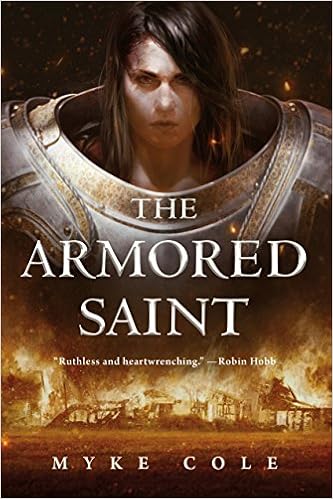
The cover of the book shows the head of a woman (or a long-haired boy) poking out of the top of an oversized suit of armor. The bottom of the page shows a town on fire.

So, it was an okay book. It was different, not your standard run-of-the-mill fantasy. I thought it was going to be steampunk, when the Tinker and his family appeared. I haven't really read any steampunk to speak of. There were machines with engines that ran with seethstone which produced steam when it got wet to run the engines. And then nothing like that appeared for about 60-70% of the book.

The story centers around a girl almost a woman grown but not yet betrothed named Heloise, who is the daughter of Samson Factor, who writes letters (among other things). His name is Factor because it's related to his job (although I wasn't familiar with the occupation). She's headstrong and speaks her mind, even when it might get her into trouble. You know, a teenager.

Except in this world, it's hard to believe that she's still alive given how she acts and the things she says. That said, a great number of the deaths in the book and the trouble caused can be attributed to her acting out. But she'll come out as the hero in the end.

We meet Heloise and her father, Samson, on the road to Hammersdown. They are approached by Pilgrims riding on horses and led by a Sojourner who are agents of the Emperor, who is Holy and responsible for all good things. They ride up to the two Factors and ask directions. Samson cautions Heloise to be still and hold her tongue. She does neither.

The Pilgrims, who are dragging two bodies behind them which are no longer recognizable, and for food or drink. Samson says that their is no food, open ink and paper. A Pilgrim turns the bag upside down to prove it. Paper falls in the mud and Heloise moves to retrive it and keeps trying to explain herself, getting herself into further trouble. One finally checks Samson's eye for a portal of light which would allow devils through. The Pilgrims ride off following Samson's directions so they can reach their destination before nightfall.

At Hammersdown, we meet some of the town residents, including a girl around Heloise's age. There is also someone who has basically lost his mind. He utters nonsense and starts proclaiming that he is a wizard. Samson refuses to do business there and tells the people that they need to turn the crazy man out because he's a risk to the entire town, even if he's not really a wizard.

They return home, we meet the Tinkers (father, mother, two strong boys, and a daughter Basina), and then we meet the Ranger Clodio who trades supplies with Samson so he can create special ink. In payment, he wants Samson to write a letter for him, even though Samson thinks it's pointless. It's a love letter for someone who no longer acknowledges him.

Clodio disappears when the Pilgrims show up. It's not easy to catch a Ranger who doesn't want to be caught. Brother Thone makes a point to mention Clodio's homosexuality as being a sin against the natural order or whatever. (I don't remember, I just wondered when the lecturing would come in.)

The folks of the town participate in a Knitting to fix the Veil who that devils cannot get through. Basically, they are all armed with spears and they travel to Hammersdown. The townspeople's job is to kill anyone who gets past the Pilgrims as the burn the town down (because of the mental guy). In the process, they have to kill the young girl we see earlier. Samson lets her pass, and Thone tracks her down and kills her. This sets Thone and Samson against each other for the rest of the book. Thone will have his vengence. Yada yada.

After this the Factor family needs to be hidden, in separate houses, and the town will say that they ran away. Most of the town owes the lives to Factor who had their backs in the last war. Samson says with the Sigir, the Mayor. His wife stays with the Herbalist. And Heloise stays in the Tinker's vault. This is great for Heloise because she has realized that she wants to be more than just best friends with Basina, who is betrothed to a man we don't know.

While she is in the vault and bored, she starts looking at the Tinker's special projects for the Emperor, which includes the set of armor from the cover. This is the first time we hear of it. Heloise is playing around climbing inside it when she hears the signal that danger is coming. She's tangled in the straps, so she covers herself with a blanket. Thone appears in the doorway and asks questions. Tinker is surprised that the girl is missing but sees the blanket and explains it away.

After the Pilgrims ride off, Heloise spends some time with Basina. She convinces Basina to let her kiss her like her husband might kiss her. Basina agrees but tries to break it off while Heloise is still leaning in, not letting go. Basina is upset and Heloise runs off into the night. She comes across Clodio who camps under the stars. We learn that he is actually a wizard and wizards aren't bad. He has the ability to shape plants into his furniture. He demonstrates this for Heloise.

We then get preached to like it's 80s or 90s basic cable or a Very Special Episode of some sitcom. This goes on for quite a while. It takes a while for Clodio to get Heloise to return to her village even though he knows peope will be stumbling in the dark looker for her. She finally goes back but instead of facing the Tinkers, she decides that she will go see the Mayor to see if she can see her Dad for just a minute. At this point, the Pilgrims are returning and there's no place for her to go.

Instead of returning to the woods (which it would seem might have been possbile), she gets herself captured by Thone. This brings the father out of hiding to protect his daughter from torture. The father and the entire town are now in danger AGAIN but along comes Clodio who actually has must greater magic that he can work. Trees grow and move and take on the Pilgrims, who turn scared and run.

After this Clodio collapses from overusing his abilities. Many in the town are ready to turn Clodio over to the Pilgrims because he is a wizard. Samson believes that Clodio will be needed if they come back again. Samson and Heloise try to help Clodio, except for one thing...

He open a portal allowing a devil to come through. He transforms into a six-armed thing which is unstoppable -- until Heloise runs back to the vault and climbs inside the armored suit. She takes a lot of damage but manages to kill Clodio. She wakes up in bad shape.

At this point, the father wants to see her protected. The Tinker is proclaiming her as a Palantine and wants her to lead. They know the Pilgrims will be back and they have no wizard to save them.

And the book is over.

It was okay as a book. I would've like more of the steampunk in action. Less of the Very Special Preaching. The wizard reveal about 50 pages earlier (maybe halfway through the book), and whatever is going to happen in book 2 to happen at the end of book 1.

Anyway, I can now remove this from my iPad. I'm not likely to look at for the next book. I read the author's story about how this story was trunked and revived. And I am happy for him that this found a home at Tor instead of going the self-publishing route. But I can't describe it as better than okay. It didn't suck, so this could serve as a benchmark for other books.

Monday, March 18, 2019

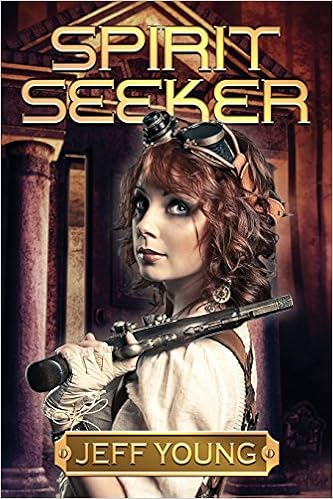
Spirit Seeker: The Kassandra Leyden Adventures (Young)

Spirit Seeker: The Kassandra Leyden Adventures, by Jeff Young (2016)

Maybe had I read a cover blurb, I might've known in advance that this was an alternate history and not some post-apocalyptic future where society is rebuilding. This impression came from the mix of technology, plus references to New Britain and Londinium. after reading the last entries in the book, I saw that this was actually an America that was founded after the Plague was followed by a worse Black Death, causing survivors to flee across the ocean. (Actually, at the very beginning there is a short blurb about the plague that arrived during the reign of Edward the third of his name -- but it didn't occur to me that that was referring to the actual King Edward III of England, who obviously preceded Edward VIII of the 20th century.)

What I thought was going to be a novel was actually a series of short stories, not tied together other than by the lead character, although the last one calls back the first one.

Kassandra Leyden's was a well-known adventurer, and her father was a spiritualist. She has a bit of both of these, but definitely the ability to communicate with the dead. (They can't talk, per se, but she can read their lips.) Her first adventure involves her mentor Levhoi and following her mother's spirit to a crypt where she makes a shocking discovery (I'll leave out spoilers for people who stumble upon my page.) This is followed by a story where she apprentices to Madam Foss, a medium, where she learns to hone her skills. In the very next story, "Fox Chase", Leyden is already a medium in her own right.

The following story, "Drinking Down Death", was the story that I thought the book was about, because of a blurb on the internet. Mediums are disappearing and Leyden investigates. She encounters Constable Cobham Peckwith, and they solve the other-worldly goings-on and uncover a nefarious plot. Peckwith shows up again in the following story, which takes place, in part, on dirigibles, and the story after that, where the spirits actually affect the real world.

The final story has Leyden back on her own, but her mother Anastasia is whispering in her ear and guiding her along the way.

Overall, an enjoyable collection of stories, including the brief history. Should more adventures be published, I'll likely pick those up as well.

I've read some of Jeff Young's work before. He's had stories published in other anthologies by the same publisher (eSpec Books). The is the first solo book of Young's that I've read. (And I think it may be the only one, at the time of writing.)

Monday, January 4, 2016

What Else Have I Been Reading Besides Books?

Rounding out the things I've read recently:

When I was in the pool, I generally had an old magazine, such as Analog or The Magazine of Fantasy & Science Fiction, which I was might be momentarily upset, but not devastated, by its loss should it slip into the water.

And one point I had, again, picked up the Stars anthology, which contained stories by science fiction authors based on the songs of Janis Ian (At Seventeen). The few I read were a mixed bag. The book was won, not bought, so I can't say that it's something I might've chosen to begin with, but with the line-up, I know why I held onto it. I'm not sure where I put the book, so I didn't get to finish it.

I've also been raiding the library for copies of Phil & Kaja Foglio's Girl Genius series, to find out what all the hubbub was about. So far I've found and read

  • Volume 4: Agatha Heterodyne and the Circus Of Dreams (128 pp)
  • Volume 5: Agatha Heterodyne and the Clockwork Princess (112 pp)
  • Volume 6: Agatha Heterodyne and the Golden Trilobite (150 pp)

The library has a problem with people defacing these. In one book, the splash page was torn out and a character's face was cut out of another page.

Volume 4 was the earliest that I could find (other than looking and reading online), so I started there. Thrown into the middle of things, as it were, but I figured out the storyline as best as I could.

It's an interesting Steampunk tale of Sparks and is vividly illustrated. My only problem with the artwork is that the protagonist, Agatha Heterodyne, seems to go through extreme mood swings from one panel to the next. Indeed, several characters seem to encounter this. Now, a lot is going on very quickly, but sometimes it's abrupt. When I first started reading, I wasn't always sure it was the same character because someone went from, say, devious to innocent, or vice-versa, in the space of someone's word balloon.

I've enjoyed the series and haven't minded people watching me reading it on the subway. In fact, I was reading it at 2 am on a Sunday morning when two young twenty-somethings sat down next to me and started a conversation -- not even about the comic. They were new to Brooklyn, and forgot how to get home. Would've been helpful had they been on the correct train.

Speaking of trains, I'm currently reading a book about great train robberies in history. Hopefully, that will be up on the blog in short order.

The Red Jack Society (French)

The Red Jack Society by John L. French (2026) (Not a review, just some notes to help me remember the things I've r...