Showing posts with label alternate history. Show all posts

Wednesday, May 20, 2026

1634: The Baltic War (Weber / Flint)

1634: The Baltic War, David Weber and Eric Flint (2008)

I found a draft for this entry that was dated Jul 25, 2018.

I found it on May 18, 2026.

Apparently, I read this and never wrote it up. I honestly don't remember reading it. However, as I type this, I vaguely recall how this book had only half the cast of the previous books because this was the point where Flint started publishing multiple books per year -- year as in 1634.

What makes this discovery more amusing is that I picked up a copy of this at Philcon last November. Charles E. Gannon was doing a "coffee talk" that I attended and he had freebies that he gave away. Someone got the "Gazette" before I could reach it -- these have stories by various writers that are set in the world of the Ring of Fire, and some of these stories are incorporated into the main timeline. It's a way to find out what else is happening in the world without burdening the main books. Anyway, with that gone, I went with the book with the earliest date, so I could get to it sooner. It's sitting on my dresser, waiting to be read.

I guess I don't have to read it now.

The funny thing is that I wanted to read more of this series because it is interesting. There was too much of it to absorb to get to write for the shared world portion of it -- and now with Flint gone, I don't know what's going to happen with that anyway. But the books are thick, and it'd be a while before I could reread those first three books to get ready for book four. With a book club and Library Thing plus my own interests (and graphic novels), there just isn't time.

There isn't anything to add. I don't remember the book at all other than that I enjoyed it and planned to read more -- which I haven't done in the past six years.

Tuesday, December 30, 2025

Audio: A Natural History of Dragons (Brennan)

A Natural History of Dragons
The Memoirs of Lady Trent #1
Marie Brennan (2013)

[Audiobook]

(Not a review, just some notes to help me remember the things I've read. But written this way because it's the Internet, and some people will stumble across this page.)

A random audiobook to listen to while walking. It had a slow start (but then, I find most audiobooks have a "slow start" to get my attention, and I often listen to the first chapter a second time). It was enjoyable.

In this alternate history Victorian novel, dragons exist and usually keep to isolated mountains. Isabella (the Lady Trent of the subtitle) has already had a fascination with them and read any book that she could get access to, which would've been frowned upon. After Isabella meets Jacob Camherst, he courts her mostly because of her fascination with dragons instead of his wealth.

This is also the reason she manages to work her way into an expedition to the perilous mountains of Vystrana to study them, where she proves vital in discovering why the dragons have turned on the human population that they usually avoid.

This was a good audiobook, but, for once, I wonder if I would've enjoyed the printed version (or the ebook) because parts of the science might've been a slog to read through but a pleasure to listen to a voice reciting it. Granted, I don't know how much of it that I recall.

The book is told as a memoir of an older woman who became the foremost authority on dragons at a time that few women had such august positions. That does tell you that she will survive a long time and that there may be many more books to come.

On the other hand, this book is from 2013, and I hadn't heard of it before the library suggested it to me.


Just for giggles, I'll include what Google AI said about the book when I was looking up the publication date:

A Natural History of Dragons is the first book in Marie Brennan's Lady Trent Memoirs, a Victorian-era fantasy series about a woman who defies convention to become a renowned dragon naturalist, blending adventure, science, and fantasy as she recounts her early expeditions. The story follows the young, bookish Isabella as she pursues her passion for studying dragons, a pursuit that leads her on perilous journeys and ultimately to a career that brings the study of dragons out of myth and into modern science.

Key aspects of the book:

Genre: Science fantasy, with a tone reminiscent of Victorian natural history writing.

Protagonist: Isabella, Lady Trent, a strong-willed and intelligent woman who challenges societal expectations for women of her time.

Plot: The book details Isabella's early life, her forbidden passion for dragons, and her first expedition to study them in the wild, which is fraught with danger and discovery.

Series: It is the first book in The Lady Trent Memoirs, a series that chronicles her life and adventures.

Themes: The novel explores themes of scientific inquiry, adventure, and a woman's place in a restrictive society, all through the lens of dragon biology and behavior.


If you stumbled across my page via the Internet, please check out my short book series, Burke Lore Briefs. A fantastical foursome of flash fiction and short stories.

Thursday, November 5, 2020

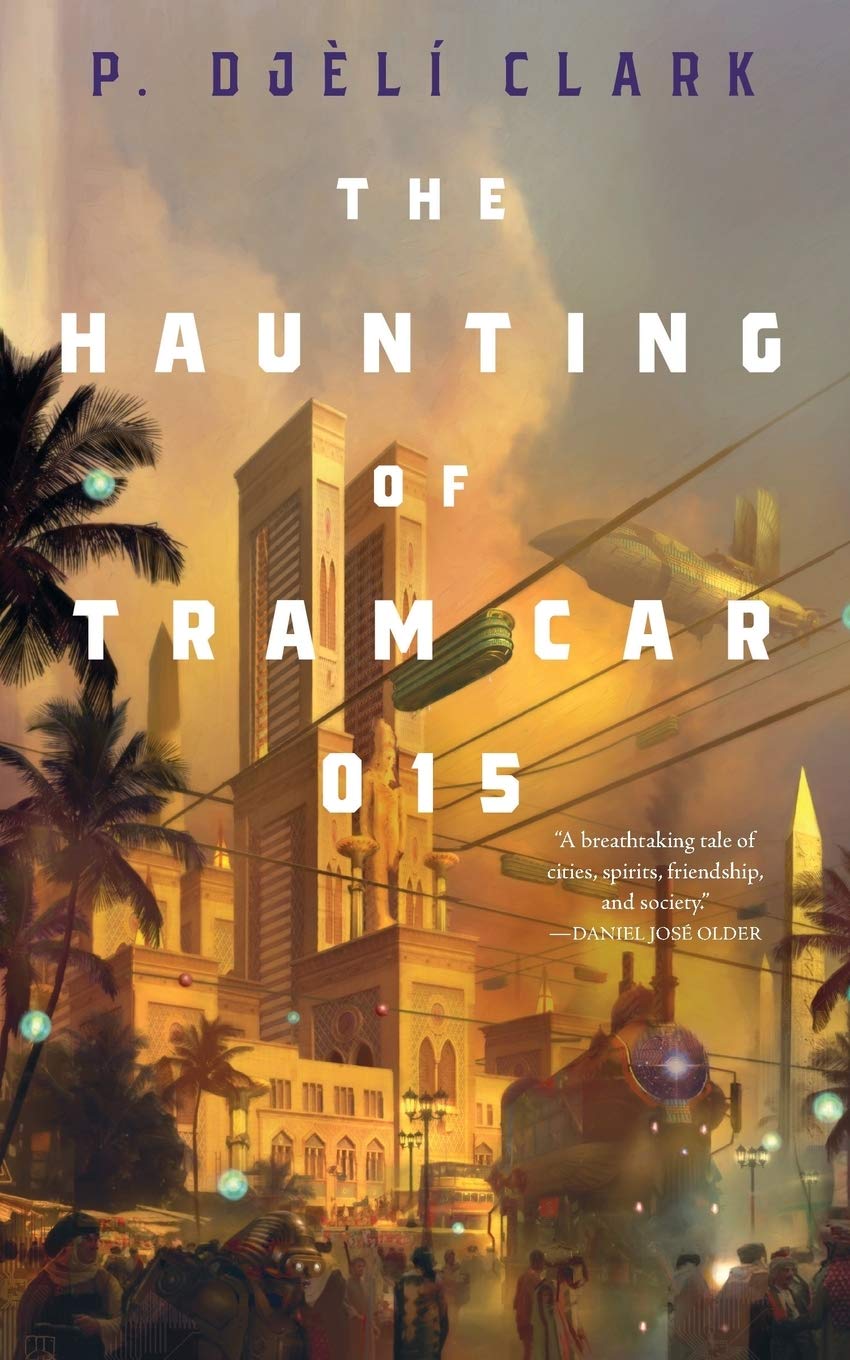
A Dead Djinn in Cairo, and The Haunting of Tram Car 015 (Clark)

A Dead Dinn in Cairo, by P. Djeli Clark (2016)
The Haunting of Tram Car 015, by P. Djeli Clark (2019)

(Not a review, just some notes to help me remember the things I've read. But written this way because it's the Internet, and some people will stumble across this page.)

First off, these are both novellas. The two of them together merit a separate entry as a single unit. The second book was released as part of Tor.Com's book of the month club almost impossibly coincidentally right after I read the original novella. Out of nowhere, I decided to look at my iBooks app instead of the Kindle app, then I opened Some of the Best of Tor.Com 2016, which I presumably downloaded close to four years ago. (It was likely released in early 2017.) And I started reading that novella even though I had skipped over an earlier novella in the collection because of the length. (I'll get back to it.) By the time I realized my mistake, I was committed to the story.

That book will get an entry when (and if) I finish it.

"Djinn" tells the story of Fatma el-Sha’arawi, special investigator with the Egyptian Ministry of Alchemy, Enchantments, and Supernatural Entities, who has to solve the mystery surrounded a large dead djinn. (I just looked up the department name to make sure I got it right.) She dresses "exotically" in English clothes, rather than standard Egyptian wear. Her partner for the case is Inspector Aasim Sharif, police liason with the Ministry.

The story is set in an alternate Cairo, 1912, some decades after the walls connecting realities was punctured and djinn and other supernatural creatures were able to come through. The other creatures include things that call themselves Angels but aren't really Angels. And there's something called The Rising that seem about to happen, but would be a good idea to prevent.

"Tram Car" is set in the same universe, but is not a sequel.It takes place a few months after the previous story, with a backdrop on a women's suffrage movement. Fatma gets mentioned early on, but doesn't get involved with this case. The Ministry of Alchemy, Enchantments and Supernatural Entities has to deal with a haunted tram car. Alternate Cairo has a very complex system of semi-intelligent tram cars running about the city, thanks to the presence of supernatural djinn. However, one of the cars appears to be haunting and attacked a mechanic and a female passenger. Agent Hamed Nasr and his new partner Agent Onsi Youssef are assigned to check it out. They soon learn that it's something that hasn't been catalogued before. Hamed is the department veteran, while Onsi is the new guy, who has his own unusual background and talents. Hamed tolerates most of that.

Their plan to exorcise the creature involves hiring a djinn, who don't work cheaply. The minister of transportation declines to pay for it and then informs them of the change in the law that requires MAESE needs to bear the cost. This sends Hamed and Onsi looking for alternatives as that would take a huge chunk out of their budget and leave them behind a desk for months. (The djinn haven't introduced air conditioning.)

Twists and turns lead to the discovery of what this creature is, where it came from, and how it got there -- and who is responsible for it getting there. Then there's the matter of getting rid of it, which leads to some interesting undercover work.

Both were interesting reads which immerse you into the setting. Of the two, I prefer the second, so they get better as you go.

Monday, March 18, 2019

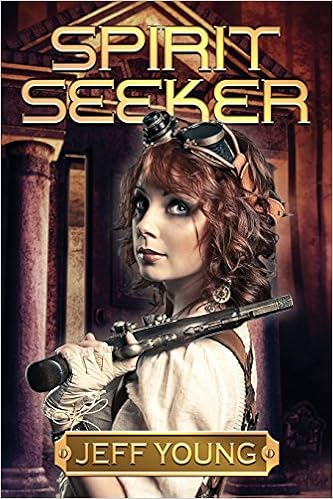
Spirit Seeker: The Kassandra Leyden Adventures (Young)

Spirit Seeker: The Kassandra Leyden Adventures, by Jeff Young (2016)

Maybe had I read a cover blurb, I might've known in advance that this was an alternate history and not some post-apocalyptic future where society is rebuilding. This impression came from the mix of technology, plus references to New Britain and Londinium. after reading the last entries in the book, I saw that this was actually an America that was founded after the Plague was followed by a worse Black Death, causing survivors to flee across the ocean. (Actually, at the very beginning there is a short blurb about the plague that arrived during the reign of Edward the third of his name -- but it didn't occur to me that that was referring to the actual King Edward III of England, who obviously preceded Edward VIII of the 20th century.)

What I thought was going to be a novel was actually a series of short stories, not tied together other than by the lead character, although the last one calls back the first one.

Kassandra Leyden's was a well-known adventurer, and her father was a spiritualist. She has a bit of both of these, but definitely the ability to communicate with the dead. (They can't talk, per se, but she can read their lips.) Her first adventure involves her mentor Levhoi and following her mother's spirit to a crypt where she makes a shocking discovery (I'll leave out spoilers for people who stumble upon my page.) This is followed by a story where she apprentices to Madam Foss, a medium, where she learns to hone her skills. In the very next story, "Fox Chase", Leyden is already a medium in her own right.

The following story, "Drinking Down Death", was the story that I thought the book was about, because of a blurb on the internet. Mediums are disappearing and Leyden investigates. She encounters Constable Cobham Peckwith, and they solve the other-worldly goings-on and uncover a nefarious plot. Peckwith shows up again in the following story, which takes place, in part, on dirigibles, and the story after that, where the spirits actually affect the real world.

The final story has Leyden back on her own, but her mother Anastasia is whispering in her ear and guiding her along the way.

Overall, an enjoyable collection of stories, including the brief history. Should more adventures be published, I'll likely pick those up as well.

I've read some of Jeff Young's work before. He's had stories published in other anthologies by the same publisher (eSpec Books). The is the first solo book of Young's that I've read. (And I think it may be the only one, at the time of writing.)

Thursday, July 26, 2018

1634: The Baltic War (Weber / Flint)

1634: The Baltic War, David Weber and Eric Flint (2008)

This was a welcome and wonderful conclusion to 1633.

The thing you might notice is the colon in the title. The 1632 universe had taken off by this point. There are multiple books set in the year 1634 and they happen concurrently, but not as oddly as, say, A Feast for Crows and A Dance with Dragons.

If you are starting this series, and this universe, I recommend that you read this book immediately after 1632 and 1633 before branching out. One of the complaints I had about 1633 was its cover depicting a warship on its cover, but the warship wasn't ready to go by the end of that book.

In this book, Admiral Simpson finally launches his ironclads and sails off to the Baltic to win Denmark for Sweden. In the meantime, the Grantville delegation in the Tower of London needs to be rescued, along with Oliver Cromwell.

But the natives of the time period have not been idle as winter set in. They had started to emulate the up-timers, for once they see that a thing is possible, then their own scientists can try to make such things happen. It also helps that up-time books, particularly books on technology, are sold at a premium on the black market. Thankfully, for the people of Grantville, and the members of Emperor Gustavus Adolphus's army, navy or air force (yes, he has an air force!), mass production is not in place yet, so superior weapons will be limited to a few companies of soldiers.

I wish I had written this up in a more timely manner, so I could've listed more about the characters and the story lines, which is really why I have this blog in the first place more than reviews. (I mean, who is actually reading this?)

This one took a while, mostly because I was lugging a huge hardcover on the subway, and it isn't the greatest thing to hold onto when I'm falling asleep. There's also a lot to keep track of, but it's worth the effort. History is getting rewritten and the timelines are diverging. People aren't dying when they were "supposed to". The painter Reubens is aware of the masterpieces he created in the "other" universe and now has no interest to create them here because they would be derivative.

I'm taking a break from this for a while now, but I wouldn't be opposed to read more.

Side note: Eric Flint was a Guest of Honor this past spring at HeliosphereNY, a new science-fiction convention in Rye, NY, held in March 2018. I was in attendance. There was a "1632 Mini-Con" occupying one of the conference rooms for the entirety of the weekend. There were discussions on the tech, the world, and, of course, writing. Many newcomers have been published in the Grantville Gazette. The idea did intrigue me, but I needed to get more familiar with the world. (Not the characters, those are reserved.) It's something to consider, but I need to familiarize myself with more of what has already been written.

Tuesday, June 30, 2015

1633 (Weber, Flint)

1633, by David Weber and Eric Flint, 2014

The second in the Ring of Fire series, 1633 offers a lot of promise with its gleaming cover comprised of a knight on horseback backed by a naval vessel, ready for war. It delivers on the action, but it doesn't (quite) on that image. However, it does give you an idea where this is going.

After the events in the first book, the Powers Than Be in Europe have stopped blaming deviltry and witchcraft and accept the fact that Grantville is here and that a new entity, the United States, now exists in Germany. They have brought weapons and technology from the future. They also brought back history textbooks. (And other library books with more information than your average high school history text might actually have.)

Having the knowledge of a possible future changes the course of "present" events. France and Spain, seeing that the results of a pointless, prolonged conflict, skip the Franco-Spanish War of 1635-59 and turn their attention to other targets. Richelieu is still cunning and angling for power.

At the start of the novel, representatives of Grantville are scattered about the continent on diplomatic missions, which go about as well as one could imagine in those troubled times. War is inevitable. However, Grantville hasn't rested on its laurels. It started developing an Air Force (by first reinventing the airplane) as well as a Navy, under the direction of John Simpson, who goes from mere antagonist to major player.

If you liked 1632, you'll probably like this one as well as it takes Grantville and its people to the next step. (If you didn't like 1632, then don't waste your time. If you didn't read 1632 then go back and find it because this one won't make any sense.)

It isn't as standalone as the first one. Obviously, you need the background from the prior book, but also there's a bit of a soap opera feel, making sure that the favorite characters are there, even if there isn't much to do. There are the brushes with historical people and events, which either have to be mentioned/acknowledged as happening or setting up future events. Where the first book had a satisfying finish but was open-ended for the series, this one has a major finale that doesn't disappoint but it doesn't end the story that it started. It's one battle: the war is still going on, and the steps Grantville is planning haven't been taken yet. Yes, I wanted to see the Old World's shock at seeing the full force of the United States Navy, instead of just a few speed boats with guns. (Not that there's anything wrong with that.) Again, look at the cover of the book!

I'll probably take some time off to read other things before getting back to the series. But, yeah, I will probably be back to this series, at least for another book. The major question in this chaotic shared-world series may ultimately be: Just which book is the next one?

Tuesday, April 7, 2015

1632 (or The Ring of Fire) (Flint)

1632 (or The Ring of Fire), by Eric Flint, 2000

In the year 2000, a freak occurrence, referred to as The Ring of Fire, sent the town of Grantsville, Virginia back through time and space, swapping places with a plot of land in central Germany in 1632, in the middle of the Thirty Years War. The small mining town quickly realizes the unlikeliness of a second cataclysm putting right what had been torn apart and sets out to acclimate to their way of life. And, of course, survive. Their weapons and technology give them a great advantage, but they no longer have the industry to produce that technology. Nor do the have the industry to produce the industry ...

An alternate timeline is born as the United States of America is founded 144 years early (and on a different continent). History plays on around them.

The book divides its time between brutal battles fought across Germany, building a new society and some overlong passages on just how well the Americans are getting along with their new neighbors and each other. Putting a new government together has its growing pains. By the end of the book, you get a sense that things will go well even though there's much more to do and more dangers to face, but you'll be satisfied that you weren't left hanging until the next book.

1632 is the first of a series, but is a fine standalone read. It has launched a shared world of sorts, with other established authors writing stories. The first sequel will be on my "To Read" list before I decide how much farther I'll go with the series.

Sunday, August 23, 2009

Star & Stripes Triumphant (Harrison)

Star & Stripes Triumphant, Harry Harrison (2001)

The satisfying conclusion to an excellent trilogy finds the United States at war with Great Britain, with Ireland playing an important role. The rules of engagement have changed as warfare has moved into a new age.

Saturday, August 22, 2009

Stars & Stripes in Peril (Harrison)

Stars & Stripes in Peril, Harry Harrison, 2000

Book two of this alternate Civil War tale finds the Union and the Confederacy taking the fight to Great Britain and the rode to freedom may well be in Ireland.

Very well done. Excellent read.
(I believe I give my copy to the guy who loaned me the other two books because he couldn't find his copy.)

Wednesday, August 19, 2009

Star & Stripes Forever (Harrison)

Stars & Stripes Forever, Harry Harrison, 1998

Standing on line at Barnes & Noble's, I glanced over at the discount books and saw a book called Stars & Stripes in Peril, an alternate history book set during the Civil War, that takes the Union and the Confederacy into Ireland. Sounded interesting, so I scooped it up. It looked so interesting, that I hadn't noticed that it was book two of a trilogy. This was pointed out to me about an hour later by a couple of friends. The first reminded me that he had told me about the series at least a year earlier. The second was the one whom I gave the Net Force books to, and he in return loaned me the other two books in this trilogy. This is the first.

Harry Harrison does an excellent job with alternate history, and this is no exception. The premise is simple: what if Prince Albert had died a month earlier than he actually did. That is no small change for history. Prince Albert was key in defusing a standoff between Great Britain and President Lincoln, which could have ended in the United States fighting a war on two fronts.

Naturally, this would've ended badly for the Union and very quickly, so Harrison adds an extra twist. The British intend to attack Mississippi under cover of darkness. Unfortunately, the ships get lost in the fog and when they invade, they realize too late that they have actually attacked Louisiana, committing unspeakable acts.

The British decide that they'll have to take it all. The Confederacy can only respond by putting aside their differences and joining forces with the Union. And, no, I didn't give away the ending to the book. This happens around the middle, if I remember correctly.

I enjoyed this book. If you like alternate history novels or stories set in the Civil War or just have an interest in General Sherman, read this.

Sunday, January 18, 2009

Pastwatch: the Redemption of Christopher Columbus (Card)

Pastwatch: the Redemption of Christopher Columbus, Orson Scott Card, 1995


Apparently a result of anti-Columbus propaganda from 1992 (the 500th anniversary), but it was an interesting premise nonetheless. A science group can observe the past and find that under certain circumstances, they can affect the past in small ways. They start a group dedicated to pinpointing when Columbus made his decision to sail west so that they can change history and prevent suffering. What they discover is that someone has already changed history so that Columbus went west instead of going to Constantinople on a Crusade.
Interesting theories about the American Indians rising up from the ashes of the fall of the Aztecs to eventually take over Europe (having been innoculated by a small group of Portuguese that land in Brazil).
Interesting historical "footage" of Columbus.
And a nice association of Noah, the Great Flood and Atlantis (and the last Ice Age).
Enjoyable book.
Long, but good.


The Red Jack Society (French)

The Red Jack Society by John L. French (2026) (Not a review, just some notes to help me remember the things I've r...