Thursday, January 5, 2023

Eating to Extinction (Saladino)

Eating to Extinction:
The World's Rarest Foods and Why We Need to Save Them
by Dan Saladino (2022)

(Not a review, just some notes to help me remember the things I've read. But written this way because it's the Internet, and some people will stumble across this page.)

Note that this was finished a couple months ago, in 2022, but for some reason didn't write the blog entry.

WOW I actually read a 2022 book in 2022. It must've been brand-new when I heard about it on NPR and first got it from the library.

I heard Saladino interviewed on NPR on Saturday morning (on The Splendid Table, I believe -- I was out walking). THe book sounded interesting so I reserved a copy. The ebook might not have been available yet, so I had the hardcover, which I carried back and forth to work for a while and even sat in my yard over the summer reading it. Then I learned that the ebook existed, and I finished the book faster after that.

Basically, the book traces the history of food (grains, animals, sweets, beer, etc) over the past 12,000 years. There are "landrace" grains that have survived for millenia that are being squeezed out and destroyed by development and by the Green Revolution of the 20th century, which meant to maximize food output by specializing in just a handful of seeds at the expanse of existing foods. Once seeds are lost, we can never get them back. There have been attempts over the past century to save and catalogue these food varieties.

By homogenizing our food system, we not only lose variety, but we open the food supply up to blights and other diseases that could spread like wildfire. Meanwhile, the displaced seeds survived hardships for 12,000 years.

Wednesday, January 4, 2023

The Life and Adventures of Santa Claus (Baum)

The Life and Adventures of Santa Claus by L. Frank Baum (1902)

(Not a review, just some notes to help me remember the things I've read. But written this way because it's the Internet, and some people will stumble across this page.)

Note that this was finished in 2022, but I didn't catch up on the final reviews of the year.

I grew up at the perfect time to watch all the Rankin/Bass Christmas (and other holiday) specials. And yet despit that, I only saw The Life and Adventures of Santa Claus for the first time just a few years ago. It's the pinnacle of their storytelling ability. No songs, just pure fantasy. Some time after this, I discovered that it was based on a book by L. Frank Baum (the Oz guy, don't you know).

This year I decided to get a copy. It's been in public domain for a while.

A baby is found by Forest of Burzee by Ak, the Master Woodsman of the World. Burzee is home to immortals and no human has ever set foot there. He places the baby in the care of the lioness Shiegra (who had thought the baby might make a good snack before then). The baby is then adopted by the Wood Nymph, Necile. He's given the name "Claus", meaning "little one", but gets called "Neclaus", meaning Necile's little one.

He grows up with the Nooks and Ryls and the nymphs and the animals until Ak decides to take him on a trip about the world to see others of his kind. He leaves the immortals and starts making toys for children. The immortals aid him in this. There are villains, in the form of the Awgwas, which are creatures who could turn invisible, who steal his toys. They are eventually defeated.

When Claus ages to the point of death, the immortals meet to grant the mantle of immortality onto Claus. There is only one that could be given in all of history. It was made to be bestowed, and if one such as Claus isn't worthy of it, no human ever would be. So it is a unanimous decision among the immortals.

I copied this list from Wikipedia (which got it from the text) just because I love the variety of it: a council, headed by Ak (Master Woodsman of the World), Bo (Master Mariner of the World), and Kern (Master Husbandman of the World) gathers together the Gnome King, the Queen of the Water Spirits, the King of the Wind Demons, the King of the Ryls, the King of the Knooks, the King of the Sound Imps, the King of the Sleep Fays, the Fairy Queen, Queen Zurline of the Wood Nymphs, and the King of the Light Elves with the Princes Flash and Twilight, to decide the fate of Santa Claus.

Also amusing was a song that Claus would sing. It reminded me of the song sung in the Merry Old Land of Oz, and with good reason. I wonder if the lyricists used Baum's other works for inspriration. I don't recall a similar song in the text of the Wizard of Oz.

I enjoyed this. Maybe I'll read it again next year. Maybe not -- I tend not to reread books because I have so many "to be read".

Monday, January 2, 2023

2022: Year in Review

It was an interesting year for reading. It started one way and morphed into something else. I read a lot of short stories early on, and moved on to more novels. And there were things from the past that came back, some of which weren't listed in the blog last year, but will get a mention here.


Novels, Novellas, and Short Story Collections/Anthologies

Of the 25 books listed below, all but 1 was read to completion. And one was utter garbage. A few were anthologies and a couple were novellas in book form. I think every single one of them was an e-book, except for The Dream Peddler which was partly read in paperback and mostly listened to as an audiobook. Surprisingly, only 8 of them are Book club selections, and one was the runner up for a book from the previous year. I don't know why it's only 8. The Expanse series mucked up my schedule a little bit.

  • Miracle of Deck 34 and Other Yuletide Tales (Olsen/Ashby)
  • The Witch of the North Pole (Snow)
  • Beyond the Waterfall Door (Cooper)
  • Steampunk!
  • My Best Friend's Exorcism (Hendrix)
  • John Dies at the End (Paragin)
  • The Dream Peddler
  • Abaddon's Gate (Corey)
  • Caliban's Way (Corey)
  • Leviathan Wakes (Corey)
  • The Graveyard Book (Gaiman)
  • The School for Good Mothers (Chan)
  • The Deep (Solomon)
  • The Easy Life in Kamusari (Miura)
  • The Guest List (Foley)
  • Envy of Angels
  • Me & the Monkey
  • The Book of Koli (Carey)
  • An Ignorant Witch (Graham)
  • Armored Saint (Cole)
  • Southern Spirits (Fox)
  • Reincarnation Blues (Poore)
  • Super City Cops #1: Avenging Amethyst (DeCandido)
  • Foe (Reid)
  • Greegs and Ladders (Mitchell and Mendlow)


Middle Grade and Children's books

These three came from mailing lists or from Amazon's World Book Day:

  • Puzzled (Nichols)
  • Jerry the Squirrel, Volume 1 (Robinson)
  • The Caiman (Manrique/Paris)


Old Magazine

I really wanted to keep the magazine thing going.That is, I liked the idea of reading 50-year-old sci-fi magazines. I even thought I could expand it by alternately Galaxy and If. It was too much. What finally did it in, besides the fact that I was never going to be principled enough to convert this into a column for Tor or someone else, were the Expanse books, which took a lot of time, and that silly counter in Kindle showing that I've read for nearly 500 days in a row. The problem is that the counter doesn't seem to count PDF files as reading books, so any day I read Analog, I had to read something else, too. I never actually finished July's issue, and I didn't go back and read the serials for this year. Maybe I'll try again in 2023, but I'm not pendiling them in just yet.

I thought I actually read one issue of "IF", but if I had, I didn't make an entry in the blog for it.

  • ANALOG PLUS 50: Analog Science Fiction/Science Fact July 1972
  • ANALOG PLUS 50: Analog Science Fiction/Science Fact June 1972
  • ANALOG PLUS 50: Analog Science Fiction/Science Fact May 1972
  • ANALOG PLUS 50: Analog Science Fiction/Science Fact April 1972
  • ANALOG PLUS 50: Analog Science Fiction/Science Fact March 1972
  • ANALOG PLUS 50: Analog Science Fiction/Science Fact February 1972
  • ANALOG PLUS 50: Analog Science Fiction/Science Fact January 1972
  • Galaxy PLUS 50: Galaxy Magazine, January-February 1972


Other Short Stories

In January, I tried collecting all the stories that were published by Daily Science Fiction and Flash Fiction Magazine, using the links that they email me daily or weekly (respectively). I think I even managed to make an ebook out of DSF. Two problems with this were that it was time-consuming to collect them all in book form, and I tried to coment on each individual story, which wasn't practical. I have since tried to get published in Flash Fiction, but reading one month of their stories, I could tell that I wasn't writing what they were looking for. (And I wasn't writing specifically for them because if I didn't sell the story, what would I do with it?).

Daily Science Fiction will soon cease publication. They stopped accepting manuscripts a while ago. I may go back through my email to read the old stories. All of them are on the website, but they aren't categorized in a way that makes it easy to access them. This is likely by design.

The stories from The Arcanist are the winners, runners-up and also-rans of themed contest for the past five or six years. So about 40 stories total.

Finally, there was a second collection of stories from eSpec Books' Kickstarter campaigns. As I've read them from shortest to longest, most of the short stories are done with and I'm at the short novel level. That's not to say more short stories won't pop up as new campaigns come along.

  • "The Arcanist" story collections (multiple)
  • A Bushel and a Peck of eSpec Stories
  • Daily Science Fiction, February 2022
  • Flash Fiction Magazine, January 2022
  • Daily Science Fiction, January 2022


Manga


There were two entries covering My Hero Academia Volumes 22 Through 31 and Volume 32 became available at the end of the year. It got very dark.

Not listed on the blog was One-Piece, which took me some time to find the last book that I read. I remembered some things but not others. I finally got to the shipbuilders at Water Seven, which seemed familar but I couldn't remember the ending. I read two volumes of One Piece, after skimming the three before them.

Non-fiction

Fewer than usual, I think. I carried Eating to Extinction back in forth on the subway in hardcover for a month before giving up on it. Then I borrowed the ebook from the library. Interesting reading, probably my favorite book of the year.

The rest include a very old humor book, writing tips, selling tips, a cookbook (with "Geometry" and "Pasta" in the title), random legends, and information on whiskey.

  • Eating to Extinction
  • The Geometry of Pasta (Hilderbrand, Kenedy, Vandy)
  • The Literary Handyman: More Tips from the Handyman (Ackley-McPhail)
  • Famous Legends From Portugal (Abrantes)
  • At Wit's End (Bombeck)
  • Exactly How I Promote and Sell Books (Dee)
  • Whiskey (Diller)


Gaming Books

There were a few gaming books, but not enough to merit a blog entry yet. Most of those were from Philip J. Reed. There were a couple others, which will go in a different post when it gets to enough pages.


Summary

So there were about 50 blog entries dedicated to reading. They include 25 books (plus 1 more), 7 (or 8?) magazines, 5 bundles of flash fiction or short stories, about 14 volumes of manga, and 6 (plus 1) nonfiction books. Not a bad year.

Saturday, December 31, 2022

"The Arcanist" story collections (multiple)

The usual dislainer: Not a review, just some notes to help me remember the things I've read. But written this way because it's the Internet, and some people will stumble across this page.

The Arcanist is a magazine that prints flash-fiction (roughly 1,000 words, I believe). They publish one story a week, so you can imagine the competition for that one slot. The magazine also runs flash fiction contests, which the winner gets paid and gets published, along with the runners-up. Disclosure: I have submitted a few times, but I have not been published by them. My rejections have been generic and usually happen with 1-2 months. I have not submitted to any of their contests because they have an entry fee, a small one, but a fee nonetheless. I'd rather take my chances on the slush pile.

Recently, the magazine sent an email about the latest collection of stories it had for sale. It also had stories from previous years available for free.

Another disclosure: probably 5-10 or more years ago, I thought about the idea of self-publishing, since it was just catching on. The problem was that I had nothing in the way of novels to publish and no time to write and rewrite one. (I was "too good" for an editor, so I could save money. Ha!) I thought about the idea of putting out collections of flash fiction, until I thought, "No one is going to pay for a book with 7,000 words. That's a short story!" Turns out I was wrong, and it isn't just the Arcanist doing it.

End of digression.

Below are the books I've read, so far. I may amend this post if I read more this calendar year. Otherwise, I'll make a new post in 2023.


Welcome to Camp Arcanist (2021)

Stories about camping.

  • "The Monster of Lake Gregg" by Kara Pogos was cute, with an unexpected ending. Part monster, part ghost story. First place winner.
  • "Take Me Back to The Giants" by Connor Smith was the second place winner. I might've enjoyed it more if it hadn't reminded me of a better (longer, naturally) story from Analog in the late 80s/early 90s. The camping part is incidental, and it could've been replaced with a different theme alongside the other half (the twist) of the story.
  • "Special Order" by Aeryn Rudel was third.

Yeah ... this didn't work out. At some point, I'll go back and list the stories. But let's face it, I probably won't. Here's a list of the rest of the books I read, each about seven stories long, some better than others. I hope I got the years right. I got this from the email which didn't list the years, but I think they went in order.

Hunger Flash (2020)


Tales From the Weird Weird West (2019)


Monster Flash (2018)


Magic, Monsters, and Mayhem (2017)


The Arcanist Presents: Ghost Stories (2016)

Friday, December 23, 2022

Miracle of Deck 34 and Other Yuletide Tales (Olsen/Ashby)

Miracle of Deck 34 and Other Yuletide Tales by Kaki Olsen and Scott Ashby (2021)

(Not a review, just some notes to help me remember the things I've read. But written this way because it's the Internet, and some people will stumble across this page.)

Last year and this year, I participated in a Santa Book Exchange, where someone buys a copy of my book, and I buy a copy of someone else's book. It's all done mostly randomly. Last year, I included my "In A Flash 2020" in the fantasy category, so this year, I picked science fiction, since the book is roughly half of each.

The book I had to buy was Miracle of Deck 34 and Other Yuletide Tales, which worked out well for my December Christmas reading. It doesn't appear to be on Good Reads, so I may have to add it. However, I don't want to be the first one to rate it.

There are 24 stories (which, I admit, I didn't notice at first because I didn't read the blurb). This means that I could've read it like an advent calendar, except that I didn't get it until the second week of December.

(Side note: I did tweet out an Advent Calendar of my own because I have 24 published stories that I own the rights to, plus my first story, which was a work for hire.)

The book started well enough, but little things wore on me after a while. The writing isn't quite there. You could watch an episode of Star Trek or The Love Boat or any cop show to know how to talk to a captain. And some of the stories aren't really stories. Something is going to happen, and then it happens. And then the story just stops. In several instances, the ending is given away in the title and once we get to that reveal, it's done.

Speaking of titles, most are puns or take-offs on Christmas songs, lyrics or movies. Note the "Deck 34" of the title referencing Miracle of 34th Street. Santa appears in a few of the stories.

The pair started with the titles and wrote the stories, so some are most "prompt-ish" than others. I can recognize this because some of my prompt stories suffer from it. There have been times that by the time I'm done with the setup, the prompt that spurred the story is out of place and needs to be removed. One story spent a lot of time explaining how to make a fire in the rain and when it was done, oh, look, a shelter was built at the same time.

And, I'll confess here in fairness, I've been told by an editor that some of my stories were good but they just stopped. (I even noticed that when I read one in particular in front of an audience. My voice was high like I was about to read another sentence, but there was no more to read.

The book was enjoyable, but I wish it had had another round of editing to punch it up a little.

Thursday, December 22, 2022

The Witch of the North Pole (Snow)

The Witch of the North Pole by Eden Snow (2017)

(Not a review, just some notes to help me remember the things I've read. But written this way because it's the Internet, and some people will stumble across this page.)

Looking for books to get me into a Christmas mood, I went looking for free Christmas-themed ebooks (that weren't "bodice-rippers"). There seem to be plenty of "cozy" mysteries with witches, elves or whichever. The funny thing is from the thumbnail, I thought she was sitting on a chimney, not a bag of toys. Also, I didn't realize right away that the author's name was "Eden Snow" -- I thought it was a subtitle for the book!

The book is also listed as Cinnamon Mercy Claus 1. The main character doesn't like to be called Cinnamon, because she used to be teased that it was a spice name. Mercy was somehow better.

Mercy, a strong, indepedent woman, who works in an office with lots of spreadsheets but little interaction with people, is ill-prepared for a visit to her grandparents, whom she doesn't know. Her parents are away for the holidays, leaving her no place else to go. She's farther North than she's ever been. In fact, she's at the North Pole. And her grandfather is Santa, the actual Santa Claus.

The problem is that her grandmother isn't happy with the whole "Santa" situation and is leaving him. She's also leaving running the entire operation in the hands of Mercy.

Oh, and Mrs. Claus is a witch.

And, by the way, so is Mercy, even if she doesn't know it.

The entire "Santa" business, how old he is, the family line, the replacement Santas, can all be accepted as part of the narrative. That's the setup for the story and it's internally consistent. It gets a little problematic with Mrs. Claus, angry as she is, bailing out and leaving her granddaughter in charge without any training whatsoever. Or telling her about her witchy background and not helping there either.

There is some help in the form of a single spell, which a helpful elf, Ginger, tells her should be cast away from everyone, but indoors, so no one else is affected by it. Unfortunately, the elves captured a human who saw them and was holding him in the same warehouse where Mercy read the spell. He is affected with the same Christmas cheer, and agrees to help Mercy break into the Christmas Command Center and access the computer with the Naughty List. (Those on the Naughty List get a special present that gives them a chance to turn their lives around. The list includes the man's daughter.)

Unlike a Hallmark movie, the two do NOT become a couple by the end. However, it's a book series, so it might be something to expect in the next few books.

It was a cute book. If there's one drawback, it ended abruptly. The story's told but there's not denouement, no day after, nothing. On the other hand, there was the first chapter of Book 2. I don't normally read those, but in this case, I made an exception and read far enough to see how the ending would have played out. And then stopped because I don't normally read these.

Update: In the time it took me to write this up, Amazon sent an email that included the second book for free, so I downloaded it. It probably won't be read until after Christmas. I'm reading something else right now and then I have a Book Club book to get to.

Monday, December 19, 2022

Beyond the Waterfall Door (Cooper)

Beyond the Waterfall Door: Stories from the High Hills by Brenda Cooper (2015)

(Not a review, just some notes to help me remember the things I've read. But written this way because it's the Internet, and some people will stumble across this page.)

I got this one in an eSpec Books Kickstarter campaign. It's been in the electronic TBR pile for a while.

Previously, according to a quick blog search, I've read Brenda Cooper's novel Post and two short stories, "The Street of All Designs" and "Trainer of Whales". (Both short stories were bonus stories from other kickstarters.)

This book is a collection of six short stories, most of which were previously published. There were (according to the intro) some modifications for the sake of the narrative. It still felt a little disjointed.

The first story opens with a boy named Jack who lives in the High Hills, which is a world similar to ours, but it has magic and is less advanced technologically. We are introduced to Jack as he is driving horses. He spots two oddly dressed girls and follows them. They crossed through a rock wall. He emerges behind a waterfall at an Arts festival in Laguna Beach, CA, which occupies the same place as the High Hills in a different dimension. Jack becomes "The Handyman's Apprentice", and will figure into all of the stories to come in some way.

The doorway operates only when the waterfall is operating, which is only during the summer when the festival is running. (There is an exception for the Halloween festival ("All Hallows in the High Hills") that happens one year.) Only a person of a certain mindset is able to get through although it seems that a person can be helped through if Jack or someone else is holding them.

The second story, "Singing Backup" starts a little weird. Not only is Jack not the narrator or focal character, but the woman who is is not one of the two from the previous story. This isn't a problem, but it was a little jarring to the narrative. Again, these are separate stories that were collected into one volume. Jack has gotten older, and is involved with one of the singers at the festival. Someone else from the High Hills is there often as well, checking out the other singer. Jack and the woman are a couple, but the festival is coming to an end, and Jack will be returning to the High Hills, and she will be off to college. Such is life as people have to grow up and move on.

The stories were all enjoyable, although the final story "The Back of the Drum", which is the longest of the bunch and the only new story, is more serious and a much heavier story. I almost wish that there were one more story, even a short one, to end on a lighter note. It could've even wrapped around to the first story in some way, or introduced a new "Jack" for some future volume that may or may not ever be written.

Short verson: I enjoyed this book.

Wednesday, November 23, 2022

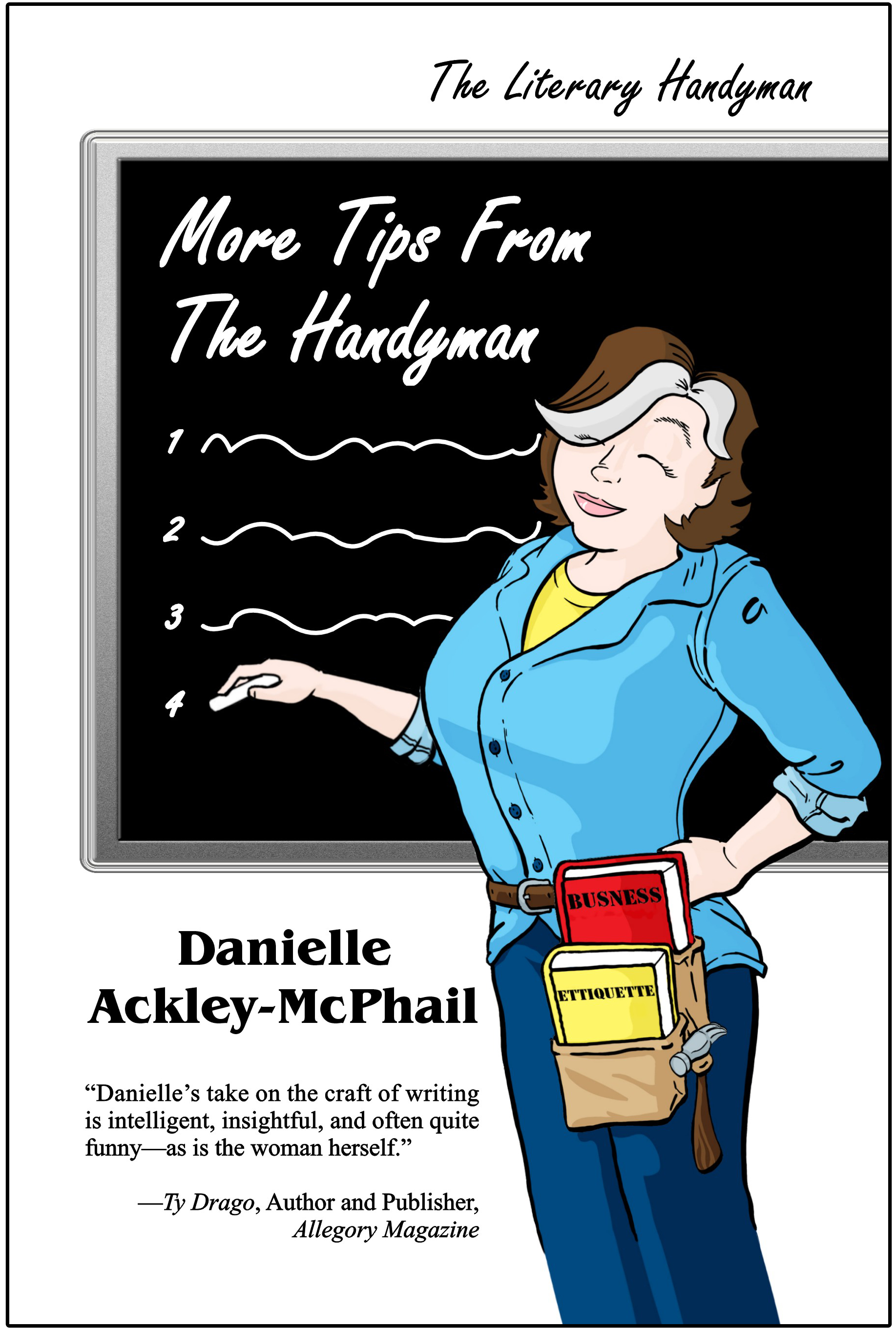
The Literary Handyman: More Tips from the Handyman (Ackley-McPhail)

The Literary Handyman: More Tips from the Handyman by Danielle Ackley-McPhail (2021)

(Not a review, just some notes to help me remember the things I've read. But written this way because it's the Internet, and some people will stumble across this page.)

Why would a published author need more tips on writing? Honestly, I don't remember if I got this one free in a Kickstarter campaign, or if I bought it extra. But the advice is worth the price.

Disclaimer: Danielle Ackley-McPhail is the editor of my book In A Flash 2020 and is the publisher of eSpec Books, which published my book.

Amsuing anecdote: This past weekend, I was at Philcon in Cherry Hill, NJ (across the river from Philadelphia). I did show her that I was reading her book. It had been in my kindle app for a while. While I was there, I mentioned a story of mine that a mutual acquaitance had read as the assistant editor of a magazine. She sent me an email saying she liked it and was passing it to the editor for review. In the end, unfortunately, the editor didn't agree, and I didn't make the cut. But I when I discovered that she (the one who liked it) was at a con, I introduced myself and thanked her for the kind words. She actually seemed to remember the story from a comment she'd made. (That had been six months earlier, at least.) Anyway, Danielle told me to send her the story. They (that is, eSpec) is planning their next anthology, whatever it may be. When I got home from the weekend trip, I did just that.

The next day, I'm reading about shooting yourself in the foot by not doing everything you can to help yourself and your manuscript, and to not give the editor an excuse to reject your manuscript without reading it. (They get a lot, and sometimes they're overwhelmed.) One of her pet peeves were when authors leave out the personal information on the top of the first page. Sometimes authors she's friends with and has worked with before are guilty of this, too, not just newbies.

When I got home from work, I updated the file to include that information, and resent it. I later realized that I don't know if I included page numbers or not. I usually don't. I think I turned them off when one editor mentioned it in their guideines, and I don't think I ever put them back on again. It's something that was obvious when I was typing manuscripts, as opposed to using a word processor.

Anyway, rookie mistakes like this are good reasons to reason "how to" books occasionally, just to make sure you're still doing what you should be doing.

Ackley-McPhail includes numerous examples of what she's talking about, both from her own works and new entries created for this text.

A great guide. I reccomend both editions.

She also has one for book publishing, but I'm not "there" yet. And I would really only be interested in electronic publishing, not print copies, first because print would take even more of an investment, and I would more likely be aiming for the Kindle Unlimited audience if I went that way.

Steampunk!

Steampunk!: An Anthology of Fantastically Rich and Strange Stories edited by Kelly Link and Gavin Grant (2011)

(Not a review, just some notes to help me remember the things I've read. But written this way because it's the Internet, and some people will stumble across this page.)

I wish I'd written this one up sooner, but I hadn't written earlier books yet. Also, I hadn't thought at the time that I might want to write something about the individual stories.

There was a call for story proposals for an upcoming steampunk anthology which will be published for an upcoming Steampunk convention. It will be handled by eSpec Book, which has published stories that I've written. I would've liked to have proposed a story. However, to be honest, I don't know much about Steampunk. I know the gears and the clockwork stuff and the flying ships and the steam and goggles and stuff, but not what actually makes a Steampunk story.

So I went looking for an anthology. Actually, I looked for novels first, but I kept finding romances with steampunk settings. When I discovered the anthology, I realized that I could get a bunch of different takes on what makes a steampunk story. Basically, a lot of things. For one thing, anything done by Jules Verne is fair game. Also, "The Island of Doctor Moreau" (H. G. Wells) isn't off-limits either.

Stories can be Victorian up through World War I. I don't remember any set in the Wild West, but there are analogues (read elsewhere) between Edwardian/Victorian England and the upper crust of the American West. This is good to know for writing, because I might want to set it in the American West. On the other hand, Long Island, NY was underdeveloped at the time and yet so close to NYC. But I digress.

I did find a review which broke down the list of stories. I rememeber from the authors' bios that all of them have multiple credits to their name. The ones I remember, I will comment on. Unfortunately, the book has already gone back to the library, so I can't go back and peek at it. Also, I read the stories in the book over a period of a couple of months while I was reading other things, so some of the details of the earlier stories may be fuzzy.

n particular:

"Some Fortunate Future Day" by Cassandra Clare set the stage for the book. It took place during the war (WWI). A girl, Rose, is home alone in her mansion, cared for by automatons built by her father, who also built friends for her (life-sized dolls). An injured soldier comes to the house that she (and the robots) care for. She fantasizes that the soldier will take her away and that they will live happily ever after. The soldier sees her as a child, however. The girl then uses a time travel device of her father's (not out of the realm of possibility given the setup), to go back a few days so that she can try to win the soldier all over again. When she goes back, the device remains where it was, so it can be used again. (I don't recall if that means that there will be two instances of the girl now.) I enjoyed the story. If this were the benchmark for the series, then it was set high, say 4 out of 5.

"The Last Ride of the Glory Girls" by Libba Bray. I think it took a while before I realized that this was set on another planet and not in the old West. There are Pinkerton detectives, so I assumed it was some alternate history with gadgets. Not an issue, but it threw me a little. The girl is good with gadgets, and you know she will not recognized by many for her talents because she's female. She overcomes a bad situation. Good story.

"Clockwork Fagin" by Cory Doctorow is, I imagine, a steampunk "Oliver Twist". I say, I imagine, but I've never read it or seen a film (or musical), just adaptations into other mediums and genres. There's a horrible orphange filled with kids with injuries from jobs that kids shouldn't be performing, but did back then. The new kid kills the creepy man who runs the place, but which clockwork technology, they manage to fool people into thinking he's alive until they can come up with another plan. The problem they face is, if discovered, no one knows who would take over the orphange (could be worse) or if the kids would wind up worse off. A pretty good story and made use of clockwork stuff in a belieavable way. The stuff exists, and they adapt it.

"Seven Days Beset by Demons" by Shawn Cheng was a seven-panel comic which was a little difficult to read in kindle. Each day is a deadly sin. It didn't do much for me as it was a concept story/art piece.

"Hand in Glove" by Ysabeau S. Wilce. Okay, this one I think I remember. It was weird. There's a detective and a constable solving murders. The constable wants to use fingerprints but the detective doesn't like the modern methods. The fingerprints indicate that a dead man was a murderer. The investigation leads to a Frankenstein-like setup. If I recall correctly, the mad scientist is an uplifted chimp (the term "uplifted" is not used -- in fact, I don't recall if they address it at all). The doctor is re-animating bodies, but the problem is that most bodies have something wrong with them usually related to the cause of or the aftermath of their death. So parts get taking from multiple bodies. (If I'm remembering correctly, a hand is animated and walks alone, and it might've been the murderer's hand. Again, it was a while ago.)

"The Ghost of Cwmlech Manor" by Delia Sherman was a little odd from where it started and then where it went, but that isn't a bad thing. Unexpected, which isn't bad. Victorian setting and the name is definitely Welsh. (I googled how to pronounce it.) A young maid helps her young master with the help of the ghost of one of her ancestors. She works as a housekeeper because there's no future for a blacksmith's daughter -- certainly not as an engineer.

I don't mind stories that bring this to mind, so long as the entire anthology isn't filled with them -- unless, of course, that's the theme of the anthology, as opposed to "steampunk" -- so long as this is woven into the plot and not a soapbox placed on top of the plot's throat.

This was one of the more enjoyable stories. The can never be certain when you have a ghost story because you expect the ghost to be real, but then if it is, you expect that it has some rules or at least reasons for its actions or lack of actions.

"Gethsemane" by Elizabeth Knox. I really don't remember much about this at all, which is odd because I know it's religious allegory and I usually remember those. (Particularly if really good or really bad. Maybe it was neither?) It takes place (Google search) on a fictional island in the South Pacific, part of the Shackle Islands (which aren't real, either). I think there was magic and mysticism and making people blind and dependent on you and stuff I wouldn't associate with stemapunk. But there was something steampunk-y about it, I'm sure.

"The Summer People" by Kelly Link. I don't remember much about this one either. I could be confusing this one with the previous one. Maybe the summer people have all that power. I don't remember.

"Peace in Our Time" by Garth Nix. I don't remember hating it, so there's that. An end of the world story, I think. (This is why I need to make notes sooner.)

"Nowhere Fast" by Christopher Rowe. In the future a lot of stuff is outlawed by the government, and some people like it that way because that stuff was bad (like oil and cars and stuff). Not much to say about it.

"Finishing School: A Colonial Adventure" by Kathleen Jennings is a comic about a girl who built a flying machine. I don't remember much about it becasue (again) comics in kindle are difficult to read.

"Steam Girl" by Dylan Horrocks. Two young misfits fall in love.

"Everything Amiable and Obliging" by Holly Black. I believe that this is the story with the young woman who rejects all suitors because she's in love with her personal automaton. That machine is connected to the house. When there relationship is severed, the house reacts badly to the point where the house, which is supposed to serve and please everyone, only cares for the one mistress. In the end, she weds the automaton. This story couldn't have been written 100 years ago. Actually, it could have been written by Verne or Wells but it would've ended differently. This ending would never have sold. The house would've burned down instead with the maid inside the house, or being dragged out over the shoulder of her father or one of her many suitors. The automaton might have even pushed her into whichever man's waiting arms. Actually, I could write that -- except that I'm rubbish with romance stories, not to mention Regency settings.

"The Oracle Engine" by M.T. Anderson. Steampunk in Ancient Rome. The Romans were brilliant engineers and this kicked that up a notch. It's a story of revenge of a young boy against the rich and powerful Crassus, who allowed the boy's home to burn and his father to die because the father could not afford Crassus's price to douse the flames and save the house. The boy grows up to be an engineer and approaches Crassus about building an Oracle Engine that could, given all the needed information, foresee victory or defeat in the future. And he's willing to build it for the fame that his engine will bring. Crassus heads to the Middle East on a campaign that traditional omens predict doom. He lets the enemy move about freely while awaiting the Oracle's programming to be completed. He has it tested, and then kills the young man who built it so he could make no more. He tells them that he knows who he is. Before Crassus finally launches his campaign, he has the engine checked for sabotage and finds a coin, with no memory of giving that coin to the young boy who would grow to make the engine. The coin would have altered the results. Instead Crassus hears prophecies that he believes means victory but are actually the kinds of things said by the gods and oracles to the players in tragedies before they fall. And his company falls. Revenge is had. (SPOILER, sorry)

So I can see why it took me a while to finish becuase there was a dry spell in the middle with a handful of stories that didn't do much for me, and which I barely remembered. It did finish strong, however, with the Crassus tale. Ancient Rome i not what I think of when I think "steampunk", but as I mentioned before, given Roman engineering, it actually makes a lot of sense to place a story there. Probbably moreso than in any other place at any other time in history, outside of the traditional origins.

So now I have a slightly better understanding of steampunk, except that the story I had in mind doesn't fit with any of these. I'm happy to see zeppelins, but I wanted to see flying ships, actual ships that flew. And maybe I'll still write that.

Monday, November 21, 2022

My Best Friend's Exorcism (Hendrix)

My Best Friend's Exorcism by Grady Hendrix (2016)

(Not a review, just some notes to help me remember the things I've read. But written this way because it's the Internet, and some people will stumble across this page.)

This was a Book Club selection. it was also a it of an odyssey in finding a copy of the book. The novel has been made into a movie, so copies are hard to come by. I was told by two libraries that the estimated wait time would to 10-12 weeks for a copy .

As a result, I started to use the Internet Archive, which had a copy, but I was only able to borrow it for one hour at a time, until a 14-day copy became available. Adding to the insanity, the Internet Archive is, naturally on the Internet. I couldn't download anything to read on the subway. As a result, before getting on the train, I needed to buffer the next dozen pages or so to read until I got somewhere I could buffer more. And I couldn't launch any other apps that might've cleared memory.

And it was a quick read, so I flew through chapters faster than I expected to.

So the story ... It takes place in the 90s and a lot of 80s reference are sprinkled throughout the text, some of them carefully placed with a sledgehammer. I lived through the 80s, and it wasn't all that 80s-ish that much all the time. Basically, it's product placement with 80s refs instead of actual ads. The chapter titles are 80s songs, which usually fit the chapters thematically, so it's occasionally a stretch. The funny thing about this is that the book reads like one of those 80s "TV Movies of the Week" that the networks would use to fill out their schedules. The fact that it's a current movie is a little more boggling.

When Abby was 10, she had a birthday party, but only Gretchen came because Margaret announces her party on the same day and its at a horse-riding ranch. None of their classmates make it back, but Gretchen didn't go because Abby asked first. References to E.T. abound.

Fast-forward a bunch of years and they are in high school. Abby's father is out of work, so they live in the poor part of town in a scary-looking house, but Abby has a scholarship to her private school. She's still friends with Gretchen, along with Margaret and another girl Glee. They're popular.

While at Margaret's lake house, the girls try LSD. Gretchen goes skinny dipping in the dark and disappears. The others look for her in the woods, and Abby finds a creepy cabin and runs off. They find Gretchen the next day.

Over time, it's obvious that the experience changed her, but Abby starts to believe that Gretchen is possessed by a demon thanks to a cult in the building. And, in fact, she was. At first, she creepy, but suddenly she seems fine and normal, and Abby is the one on the outs. Demon Gretchen is set on destroying the girls' futures and almost succeeds.

The fancy prep school has many assemblies, and one of them is a family of exorcists. One of the sons recognizes the demon within Gretchen. At some point after, Abby contacts him about saving Gretchen. This should be the strongest part of the book, given the title, but it becomes the goofiest. Christian doesn't bring his father because he doesn't believe his father is strong enough to do this any more. But Christian has performed an exorcism and he has lots of notes (which turn out to be useful to Abby). His attempts to force the demon out would result in serious harm to and the possible death of the host, and he has to be forced to back it down a little. Before it's over, he abandons the girls, leaving Abby to save Gretchen before the police arrive.

This is where it get really over-the-top Movie of the Week. When viewed in that light, it makes up for the less than stellar exorcism scene. However, it doesn't end there, as the movie might have. It tells us what happens for the rest of their lives and how the two friends drift apart. (The other two girls will never be the same again.) None of that is necessary except to comment how difficult it is to stay from forever, particularly if someone moves away and put physical as well as emotional distance between them.

So this wasn't scary, and it wasn't funny. It was pretty much straight-forward about the girls and fitting in, especially with Abby suddenly being poor.

The book wasn't terrible, which doesn't sound like much, but I had a sense of dread going into it because I didn't know what kind of graphic demonic possession would be in the forefront. That part wasn't so bad. Parts of it were clever, but I won't spoil those.

I've been told my several members of the book club that the movie is awful an I should skip it.

Note: I didn't use the "Teen" tag, because even though the characters are teens, I wouldn't recommend this book for teens. They wouldn't appreciate all the 80s references anyway. At least when I watch Happy Days, the 50s were only 20 years earlier.

Saturday, November 19, 2022

John Dies at the End (Paragin)

The Dream Peddler by Jason Pargin (aka David Wong) (2007)

(Not a review, just some notes to help me remember the things I've read. But written this way because it's the Internet, and some people will stumble across this page.)

This was a Book Club selection. I had never heard of it before, despite the 20-year later commentary added to this version. Honestly, I couldn't tell you which author name was on the cover. It was Jason Pargin on the Good Reads page. Apparently, it was a movie, too.

The fact that this started as a web serial in 2001 was interesting, and also explained the choppy nature of it (even if he did go back and edit it). Back in 2001, something like this was possible. It would be like the folks who pioneered self-publishing for a living on Amazon or who do serials now on their new service. It's something that I would've loved to have done had I had the time and the discipline to keep writing. Granted, I probably would've been lost in the shuffle and never advertised for readers.

Anyway, David Wong is being interviewed about some of the crazy stuff that he's seen, along with his friend John. Most of it defies the laws of physics as well as time and causality. It mostly has to do with this inky black gunk that gets into them and allows them to see things that other people don't notice. There's another dimension that's going to burst into this one and kill everyone. And they have to stop it.

It's strange, really out there, hard to follow (except, oddly, for the parts where people are erased and no one remembers them, including someone who would've been a main character in the beginning of the book, but he was erased in Las Vegas, but someone remembers shouting their name).

Spoiler: John never dies at the end. On the other hand, a lot of other people do. And many of them are replaced with shadows from the other dimension, except that they don't know that they are. The replacements appear to be exactly who the person looking at them expects them to be -- but if that person had never seen them before, their head fills in their own details. These may not match what others see, so that's one way to detect them.

This isn't a book I would've picked up. And if I had, I probably would've nave stayed with it if it weren't for the book club meeting ... which I missed because Family Movie Night ran long, and I don't skip out on Family Movie Night. That's me.

The next book was creepy, but I blew through it pretty quickly.

Thursday, November 17, 2022

The Dream Peddler

The Dream Peddler by Martine Fournier Watson (2019)

(Not a review, just some notes to help me remember the things I've read. But written this way because it's the Internet, and some people will stumble across this page.)

This was a Book Club selection, and it put me in a bit of a quandry. There was no ebook available at either library. I eventually was able to get a print edition. I kept putting off reading it for odd reasons. Starting new books is always a little on the difficult side for me, but lately print is worse. I can't adjust the font size any more. (Actually, i've made my ereader font smaller because I thought it was too large!) Adding to this, I read on the subway in the morning, but I usually have a coffee in one hand, so holding a book can be difficult. Coming home the trains are crowded, so standing and trying to read a paperback is even more ridiculous. And reading a paperback by lamplight in bed only gets me so far (maybe a page or two) unless I'm really drawn in.

And then comes the dumbest excuse of all: my kindle app has a daily reading counter. Yes, I wanted to keep my streak going, to a year, to 400 days, to whatever number I can get it to. I don't know what I'll do if I finally miss a day. Take a break, maybe. But that meant reading other things, even if only for a half hour, every day.

In the end, I got the book on tape, unabridged and nine hours long. It wasn't the sort of thing I could just sit and listen to. That actually started putting me to sleep. So I'd listen while walking, when I didn't have my radio. And I'd listen when I was standing in the train. For a while, I would read later to catch up, but that didn't last long, and she was reading the entire text.

In the end, I didn't finish before the book club meeting, but I wound up out the house that night.

It's a small town before everyone had cars. A lot of walking and wagons. A young boy, Benjamin Dawson, goes missing. And a stranger, Robert Owens comes to town. He finds a room at Vi's boardinghouse where he sets up his supplies. He's a dream peddler. He sells dreams, or rather potions that will make you have dreams.

The first to buy one -- Owens gives it away for free -- is a tenn, Toby Jenkins, who wants to have a dream about girls. He passes the word along to other boys. No one believes that selling dreams is possible and that he must be a charlatan, but people come to see him. Mr. Dawson wants a dream that might tell him where to look for Toby -- Owens doesn't think it'll work but maybe his subconscious will tell him something.

After the boy's body is found beneath the ice in the river (no foul play expected), Owens avoids his mother, Evie. She finally corners him, not to ask for a dream of her son, but not to dream at all.

A teen girl, Christina Blackwell, wants to dream of her future husband, which again isn't exactly possible. He ends up dreaming of somone other than who she'd hoped. That get her and her friend Cora Jenkins to try to shape the future so that the right boy is looking at her. It turns out that he's a bit of jerk (a big jerk by the end) and the other boy isn't all that bad, so that dream may come to pass after all.

The peddler only stays in one place for a while and then moves on. It's a great business, but there's a problem. People have to tell their secrets to him when explaining their dream. After a while, Owens says, they can start to resent you knowing so much.

It plays out a little differently here with people using dreams for the wrong purposes, with results not what they're expecting. On top of that, Cora Jenkins develops a crush on Owens, who isn't interested, and even if he was, he knew that he could settle down and go on the road. And constant traveling would be no life for Cora (or anyone else). You almost hope that something would develop between Owens and Vi (but, again, I'm listening, so I may have missed details about Vi's age). Evie obviously develops feelings even though she's happily married.

In the end, he's chased away because of the preacher and because of the scuttlebutt involving Cora (who, SPOILER!, miscarries).

I did plan on reading the last chapter or two of the book, but that didn't happen despite having the book in my bag for a couple of weeks. I passed it on to the next library reader. I hope the book wasn't worse for wear in my bag.

It was a good story. I do wish I'd read it instead of listened (or both) just because it's sometimes confusing which character is speaking. And if I ever wanted a good definition of "speculative fiction", this is it. Everything is normal, except for this one speculative element, "What if a person could sell dreams?"

I should check out what else Watson has written... that's available as an ebook.

One Piece, Volumes 30-40 (Oda)

One Piece , Volumes 30-40, Eiichiro Oda, 1997-2003 (Not a review, just some notes to help me remember the things I've read. But ...