(Not a review, just some notes to help me remember the things I've read. But written this way because it's the Internet, and some people will stumble across this page.)
As previously mentioned, I've been aware of Bourbon Penn from the Submissions Grinder, but I hadn't actually seen a copy until a couple of conventions ago. Now I have three print editions (perfect for pool reading). A quick check tells me that the stories in this issue are available online for free (https://www.bourbonpenn.com/issue/30), so I could read these whenever I'm at my desk, which isn't quite as good as in the pool.
This was another interesting collection (over 150 pages long), and I enjoyed most of them (as well as pool time). Not all of these stories had "speculative elements". Some were just odd.
A quick rundown of the stories:
- "The Demon Lord of Broken Concrete" by Alex Irvine seems to be a standard white-trash, coming-of-age story of a young man, Zack, who gets smacked around too much by life and his father. There's a slow kid named Tim that Zack knows, and Tim is killed by the second page. The story isn't about Tim. It's about life sucking. There is no real Demon Lord of Broken Concrete, but you can see why someone would create him along with the Marquess of Daddy's Eighth Beer, Our Lady of What Did You Just Say to ME?, He Who Reigns over White Panel Vans, Our Lord of Kindly Men Who Want to Show You a Puppy, the Archfiend of This Will Hurt Me More Than It Does You, the Earl of The Looks You Get When You Use Food Stamps at the Grocery Store, the Duke of Home from School to an Empty Fridge. Also mentioned are the Viscount of Rust and the Baroness of Shattered Glass.
I'm not making fun with that passage. Actually, I admired how creative it was and how smoothly it read despite extending the metaphor well past the point other writers might've stopped. It shows both the mindset of Zack and the life of those around him. Unfortunately, there wasn't much more to the story. I didn't hate it, but there isn't much I remember about it a couple of weeks later. - "Polar Shift" by Mir Seidel also is less speculative and more weird. Unless I missed something, it's about two Russians who are stationed in a cabin near the magnetic north pole who have to track the pole whenever it shifts. Their relief has been delayed and their are freezing and starving. The only thing speculative is that one of them is convinced that he's met the other before, and I didn't understand what was going on there.
- "Bachelard Forgets the Kitchen" by Cedric May is another odd entry that isn't exactly speculative. It stats with a woman (she tries out a few names) having a bad dream, which is what "He" grunts before rolling over and going back to sleep. The narrator that philosopizes about Jorge Louis Borges who belived that the waking world and the dream world were pages of the same book. The woman ponders how things would be better it we knew what kind of book it was and if we could jump around the pages. (This actually is a decent setup for an urban fantasy story, but alas...) Seven scenes follow, and she doesn't like what she sees. She's awoken by the man, who says, "Holy sh*t, Janie. You're were screaming." He goes back to sleep and (oops, spoiler), she goes to the kitchen to get a knife. (The implied subtext is that she's going to stab her husband who's obviously the root of all evil in her life.) I had to look up Bachelard to find out what kind of philosopy he practiced and wrote about, and it wasn't anything that I could summarize in two sentences.
- "Strange Eons" by Keira Perkins gives us a Lovecraftian horror in the sky. Time has stopped except for the things that haven't stopped without rhyme or reason (or whatever doesn't fit into the story, which actually doesn't bother me, but it's addressed). Again, a good setup, and then it goes into something about abortion -- the narrator (I scanned for a name, I didn't see one) had an abortion and she believes the monsters in the sky are her punishment. Since time is frozen, she hasn't fully healed and she's still bleeding. This leads her to believe that her blood is feeding the cicadas that are waking up and flourishing way ahead of schedule. They swarm of to join the elder god. Her boyfriend, Jaxon, arrives and protests that he could've taken care of her and the baby even though he's going away to college -- he's basically shallow and clueless. The author works in a dig at Lovecraft calling him "a racist and giant weenie" who got some things right about giant space aliens that drive you a little mad. I guess people like to write Lovecraftian but if they acknowledge him, the disclaimer needs to be added.
Shockingly, I've never read any Lovecraft. (I once picked up a book of "Lovecraftian horror" and it turned out to be an essay about what makes good horror along with a collection of stories he mentioned or ones that were similar in nature.) I will at some point. - "Partial Transcript from the Great Brexit Baking Show" by Rich Larson: when I saw the title, I thought that there's no way that this isn't going to be something political and that there's little chance this might be some middle-of-the-road, burn-all-sides, screwball comedy. Well, it wasn't exactly. It was supposed to be a future reality baking show when the heat outside is ridiculously hot and where one of the judges is a spheroid AI version of a deceased judge. No one is allowed to criticize anything British nor complement France or other places. The story is told in script form, which I compliment the magazine for accepting (although you can't accept these often), but the story itself is of an unscripted bake-off. A "transcript" would've made more sense.
As for the story itself, like the competition itself, falls flat and leaves a bad taste. It just ends with a random fire and some smoke. - "It Tastes of Rot" by Margaret Roach is the second "experimental" format story in a row, this one being told as journal entries starting at Day 40 since she last left his apartment to venture out into the declining state of the outside world. She makes an allusion to the Lord in the desert, and that sets the stage. Her husband (the wonderful Mr. Wright!) is long absent and returns wearing a hazmat suit that he doesn't remove.
The woman, who later becomes Jezebel, is the quintessential unreliable narrator as she is slowly going nuts from her isolation, which could've been inspired by Covid as much as by environmental disaster. (There's black sludge.) In the beginning of the story, she's making bread and considers the dough her son. The son grows and even bites a finger off her hand, which the "mother" gives up willingly. She gets a job with an orgazination with the acronym SATAN, which has nothing to do with newts. She is supposed to release the rot onto the world. This is the way her live is supposed to be. Until it isn't.
It was an interesting story as her sanity flees and the threat increases. It actually ends before one year passes, which is something I expected, so points for subverting expectations there. - "Clown’s Balloons" by Sam Rebelein is the kind of story that I'm glad I didn't read when I was younger. It starts off well enough with its premise: a clown shows up one day on the corner across the street from Selene's office on her birthday. She assumes its an office prank, but no one admits to it. The clown has three helium balloons he holds all day and just stares at her all day. Others can see the clown, and people on the street walked around the clown to avoid it. He continues to appear daily, and she can't explain something -- maybe he's getting helium every night, and maybe he can train himself to stand there, but he doesn't ever blink. Selene takes time to figure out how he's doing everything to the point that she can almost do this herself (at her office, mind you), but her solution to the non-blinking is a bit extreme and thankfully happens off-camera. She does return to the office (at this point one wonders how she still has a job) to "watch" the clown. Along the way, we discover from the clown's POV that it's an alien and it isn't even biological, at least in the alien sense. When it landed, it thought trains were sentient and the passengers were parasites. Its world has been destroyed by worms. Anyway, it started off interesting but didn't have a payoff, or rather, it did, but not one that I was looking for.
Once again, I didn't recognize any of the authors' names from any other magazines or from conventions. (One of them had a story adapted for an episode of Love, Death, Robots, which won an Emmy.)
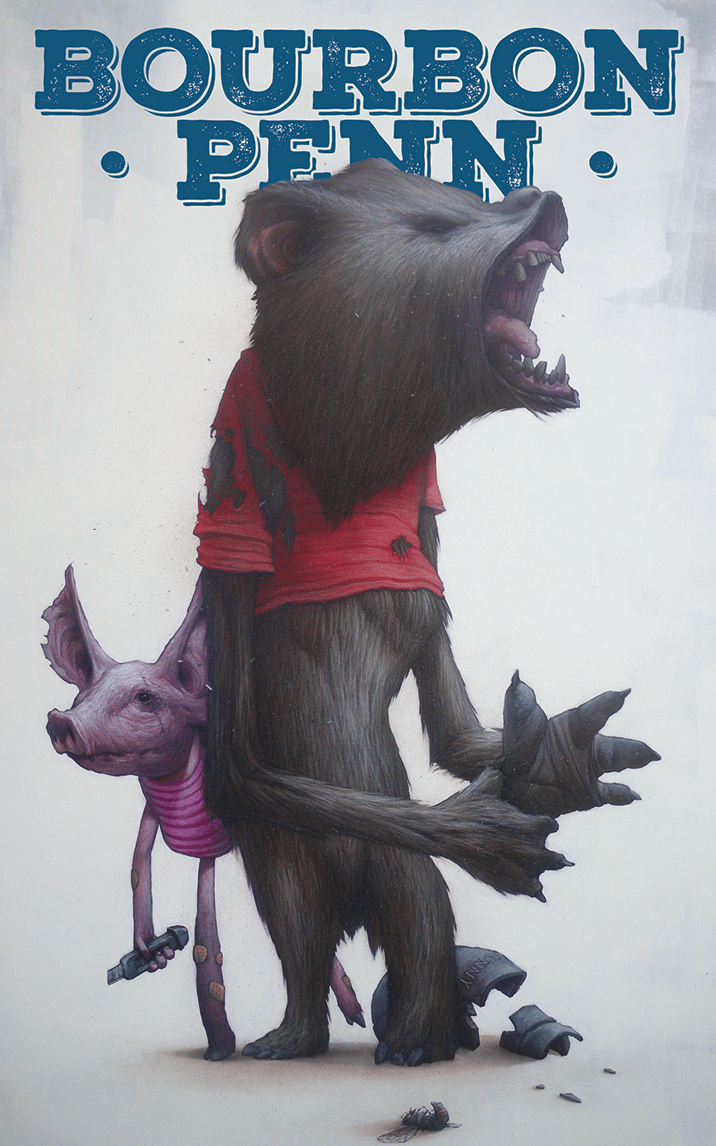
Once again, the cover doesn't go with any story. Amusingly, I was so focuses on the bear's face as it growled (and I wasn't exactly sure that it was a bear) that I never noticed that the creature hiding behind it was a piglet standing on its hind legs wearing a pink jumper. And the bear is wearing a short ill-fitting red shirt. Bom K.'s cover art is entitled "The Real Winnie" as Winnie the Pooh entered into the public domain in (I'm inferring) 2023, and the artist wanted to get a horror feel for the characters. (Piglet's holding a sharp, pointy weapon.) This is a little confusing because the clothing indicates the Disney versions, which are NOT PD yet.
Final words: I started writing up stories as I read them, so I wouldn't forget the details (which is part of the point of this blog in the first place).
I almost read this issue first because, I think, it was the first one I picked up. Then I realized that one of the others came first sequentially, not that it should matter. However, in this case, it might have because this issue was not for me. Had I read this first, I would've put the others on the bottom of the TBR pool magazines pile. (So to be a Subway TBR pile, or a pile that gets shoved away until next summer.)
I have one more of these, but I'll probably switch magazines.
This one will be going into a Little Free Library in the neighborhood, but not the one in front of the elementary school.
If you stumbled across my page via the Internet, please check out my short book series, Burke Lore Briefs. A fantastical foursome of flash fiction and short stories.


