Tuesday, February 28, 2023

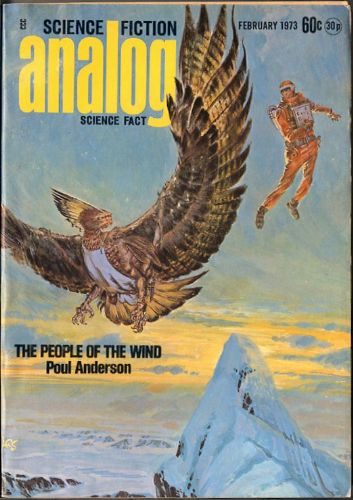
ANALOG PLUS 50: Analog Science Fiction/Science Fact February 1973

ANALOG PLUS 50: Analog Science Fiction/Science Fact, February 1973

Update the photo

January went well, so let's do it again.

A new serial (maybe I'll get to it) and a Spider Robinson story.

The February 1973 issue of Analog has a new serial (maybe I'll get to it) and a Spider Robinson story.

The usual explaination: For anyone finding these reviews, my purpose is two-fold: enjoying some "classic" sci-fi, and looking for stories that I think could be adapted for TV broadcast since so much of what shows up on anthology shows is rough to awful. Additional Note: I do NOT work in television. I just watch it.

In this issue:

Guest Editorial: "Beyond the Citizen" by R. G. Cleveland. I haven't read it yet. I'll get back to it.

Serial: "The People of the Wind" (Part One of Three Parts), Poul Anderson, with an illustration by John Scoenherr showing a man with a tennis racket bending over to get something from a bag and a large round floating robot with three arms. The back hand has a tennis ball, the second has a racket and the third is stetching off to the top of the opposite page. After reading the story, I'm wondering if that's a cable to the ceiling. The caption reads, The most difficult thing to understand in the universe of man is -- the mind of man!

I hope I get to read this.

Short Story: "Biological Peacefare", by W. Macfarlane, with an illustration by Kelly Freas, showing a background banner that says (one supposes) Peace of Earth, with a couple of cartoony, happy people walking with flowers in their hands. More prominent is the large round thing with a scaly belly, wings and a long bill, plodding along. The caption reads, "Sometimes a demonstration can be unexpectedly successful. And when it is, the need for such demonstratons disappears -- even though something else will soon be "bugging" the demonstrators."

Wilbur Hines works in a lab. Protestors smash the lab, calling him "Biological swine" and "bacteriological pig". Hines is studying gnats, and they escape as if Pandora's Box had been opened. He thought that they wouldn't be a problem but he was wrong. They mutated.

They were fruitful and multiplied, and have become a nuisance. More people stayed at home, avoiding going out. Some people are immune (unappetizing).

At some point, she was given the name Westbrook because that's the location were she lives.

Romee has to go to the jungle to get roots to sell to the Earth people to get money for the damn-TV and to buy chocolate. She's addicted. The new government wants to ban the sale of chocolate because they think it's unhealthy for the Notcid, and it could be why so many are dying in the jungle.

Romee meets a woman who is looking for people for a series of tests on response to envrionmental stimuli for a modest stipend. Romee applies.

The test turns out to be a little cruel. It uses the machine-sounding noises that the Noctid hear in the jungle and usually don't survive. Most of the time, their response is to jump away from the noise. By the time she's heard the noise twice, she's flattened to the ground, scared out of her wits. This continues until the experiment is stopped by a senior official who is not amused. He mentions "damage money" that Romee will be awarded ... but that won't be for quite a while.

Since she still needs money, she goes off the jungle and finds some of the roots she needs. While she's crawling around, she hears the noises roaring above her. She flattens to the ground and waits for the end to come. But nothing happens. The noise keeps repeating, over and over, until there are new sounds, a creak and a crack. It was a swinging tree limb, and it kept swinging so long that it finally cracked and fell. Worse for the tree, it fell into the very trap the limb would have pushed Romee into had she jumped into the air instead of flattening to the ground.

She now knew how to beat the tree. She wanted to tell others but their instinct would still be to jump. So she starts by training her family the way she was trained.

This was a cute story and should be easily filmable. Hollywood would likely screw it up because makes the capitalists friendly but hardly ever polite, while the government people are polite but hardly ever friendly. Too much of the current output leans in favor of the government over any private enterprise, even when it acknowledges government's shortcomings.

Casting, as written, there are two big parts for women, but you only need a few background characters in hairy suits, one main character and four humans. I'd watch it.

Howard L. Myers has written several stories that I've read already.

Short Story: "The Guy with the Eyes", by Spider Robinson, with an illustration by Vincent di Fate, showing a bartender (Callahan)behind his bar, some glasses and decanter on the bar, and two patrons. There are some spheres odd to the side, which could be taken as planets that are meant to be inferred but not actually in the scene. The caption reads, The job of a scout is difficult and dangerous. He must determine the nature and disposition of the enemy, its weak points, and its strengths. But when the scout starts to feel sorry for the enemy...

I was hyped to read an early Callahan story. I took the paperback Time Travelers Strictly Cash from the library back in high school. My oldest brother enjoyed it immensely. I read about half of it. I wasn't the greatest of readers back then, which is why I'd take multiple books out -- I'd hope one would "click" with me. I also playtested the GURPS supplement. "Mild Hangover" Advantage? That was mine. "No Hangover" was already there.

Anyway, I haven't read a lot of Spider, even though I'm always meaning to. This story seems like it's set in his universe and there's more going on. It gives the general location and the setup of the bar routines. Doc Webster is there telling bad puns. And people get up to make toasts.

There's stuff with "this Janssen kid" whose known for trouble. There's mention of heroin (he toasts "skag") and the war (it's 1973). But he's not the guy with the eyes. He's over in the corner listening, but has no answers.

Some pontificating happens, as is wont to happen in 70s stories and beyond.

The man with the eyes wore a black suit, a Joliet Special and his shoes didn't look right. He orders 10 drinks, makes 10 toasts to his profession, and then announces that he's an advance scout from many light-years away. Callahan knows he's neither drunk nor lying. A message is going to his Masters that he can't prevent, and for the first time, he has regrets. He's surprised when the bar regulars don't attack and kill him on the spot.

It petered out toward the end with a Mickey Finn reference but no solution to either problem.

Obviously, filming this would be a big deal because Callahan's is a long running series of stories and books. It could be a series of its own about a bar where everyone knows your name or something, but in Long Island, NY. Why it hasn't been made, who can say? (Well, Spider could, and probably folks who follow Spider on social media...) I don't know who I'd cast for any of the parts. And, of course, the storylines would have to be updated since they started in the 70s and lasted for many years after.

Short Story: "Modus Vivendi", by William Walling, with an illustration by Vincent di Fate, showing a large planet (Jupiter, there's a spot), some moons and a ship. The caption reads, The most critical step in any medical experiment is going from test animals to human trials. Usually this step is taken very carefully. But sometimes ...

I read the caption a while back before I read the story. It's funny reading it now as it telegraphs the ending in a way.

Clancy Bevvins, Lee Gresham, and Thaddeus Frye are scientists and researchers on a space-based station orbiting Jupiter. There's a base on Ganymede. Much of the research is of the hush-hush variety, so most have nothing to say about their work to the others. The one thing is that Bevvins has three gibbons with him. He says he's in deep space to avoid radiation and to be in zero g.

There's an accident that pushes them out of their orbit and whatever it is has breached both oxygen systems. The three of them and the gibbons are the only survivors. Time is against them. They won't spin into Jupiter before Ganymede is in range to call for help but they will run out of oxygen with no way to recycle it. There isn't enoug for one man let alone three

That's where the gibbons come in. One of them has something in their system (I was a little murky on the details) that allows her to recycle the carbon dioxide or breathe oxygen. Bevvins uses his experiment to keep the three of them alive. But there are consequences.

This was a good story, and only require a cast of 3 that can be as fiverse as you want them to me. It would also need three gibbons, briefly, which could be trained animals or could be cgi. Probably cheaper to get an animal trainer for a day of shooting, but what do I know? Only a couple of interior sets are needed, but the wreckage, and exterior would likely require CGI. I'd watch it.

Science Fact: "The Third Industrial Revolution" by G. Harry Stine, with an illustration of industry on the Moon that appears to be credited to "General Electric". The caption reads Conclusion. When you want to have our cake and eat it too, you're in a dilemma. When you want to continue a high-level technolog without further gutting Mother Eart for resources, you have to move your industrial base out of this world.

I followed a bit of this and then skimmed the rest. Gravity wells are issues for get resources and materials up into space. Slingshoting from the Moon or Mars would be easier, as would be mining asteroids. And you wouldn't have to worry about heating the environment.

If I knew enough about manufacturing in general, let alone space manufacturing, this could be a good resource to revisit for writing. The problem is that unless I want to write hard science fiction, most of this can be hand-waved.

Novellette: "Force Over Distance", by Tak Hallus, with an illustration by Jack Gaughan, showing a man working at a table, where there's a large box and a vertical ring. On either side of him are men with sombreros and guns. In the forground, there appears to be an object floating in a ball of light. The caption reads, The military-industrial state can sometimes amount to nothing more than two or three men with a common purpose. They don't even have to like each other.. just have a common purpose.

I've read Tak Hallus before at least twice. (I did a quick blog search.) This story is filled with Mexican banditos and revolutionaries.

Federico Jenson is a physicist who goes to Mexico and has his tire shot. He discovers this when he replaces it with the spare. As soon as he's done, the banditos steal the car and intend to strand him on the roadside. He wants his briefcase with his life's work in it. They refuse. So he says that he's going, too. So he's a hostage for ransom that he basically agreed to (insisted upon).

He tries to work out a math eqaution in the dust because he doesn't have paper but he insists on continuing his work. Juan, the guard, asks about it, calls him crazy for all the work he does to get a "cero" (the sequence should converge to zero). This sums up the opening illustration.

Jenson is being held prisoner by the revolutionary el Buitre, the Vulture. El Buitre isn't dumb -- he is good at strategizing and planning. He has Jenson demonstrate his transporter, which moves something to the other end of a table. El Buitre wants him to build a "beeg one", as big as a room. Jenson says what that would require.

This is no problem for El Buitre because his people can steal whatever they need. People die along the way. Jenson isn't happy about this, but on the other hand, he doesn't want their deaths to mean nothing. They're already dead and the project can move forward. He's almost as obsessed about his life work as El Buirtre is about his revolution.

His men make it into Tucson to get tantalum, and they kidnap construction engineer Harold Wright. Wright refuses to opperate for several days. El Buitre is about to kill him when Jensen intervenes. So El Buitre decides to kill him first. At this point, Wright agrees to help (although he nearly gets himself killed for calling El Buitre "Buzz").

The two complete the machine even though Wright is trying to stall it because he believes that they'll be killed before it's done. Finally they plan to escape through the device, with Wright worrying that Jenson might stay behind for "science" and his life work. Their plan is thwarted by the fact that Juan is smarter than he's been letting on.

The banditos go through the device (which seems like a large stargate) but they're in for a surprise when they get there.

An enjoyable story. It could fill an hour-long episode of an anthology show. I don't know how well the Mexican bandito angle would play unless it's done in a retro style, as in this actually happened in the 70s. The cast would require a handful of revolutionaries, El Buitre, and a physicist and an engineer. Women don't have a lot to do in this story. The ending requires a lot of extras and motorcycles, but it could just be a handful, and then cut away to Jenson and use a lot of sound effects and smoke and rattling boards.

Note: there is a very odd interior art piece which looks like El Buitre is riding a motorized unicycle. There's smoke to obscure the missing parts of the bike (and his arms because there are no handlebars) but you can see the far legs which should be on the other side of the motorcycle, out of sight. I found it amusing.

Short Story: "Trade-Off", by R. A. Beaumont

This entry appears to have been deleted. I must've typed it at work and didn't "save" it. Or it was lost the last time my computer froze and I had to do a hard boot.

Until it's restored: I wasn't thrilled with this story. It's filmable, but I don't it could/would be made into a segment on an anthology series.

Short Story: "Trade-Off", by R. A. Beaumont with an oval-shaped illustration by John Schoenherr, showing what appears to be a bunch of silos (or cylindrical objects) on a field at night and there are lots of bubble. The caption reads, There are times when the cure is worse than the disease. But when the cure triggers other diseases ...

I just started reading this. It appears to be told in a series of top secret memos. I didn't get far.

I have libary books to finish, so I may or may not get back to this.


The Reference Library , by P. Schuyler Miller. Opens with a discussion of books about on-screen SF. Reviews include The Overman Culture, by Edmund Cooper; The Wrong End of Time, by John Brunner; The Reality Trip, by Robert Silverberg; Pstalement, by Lester del Rey; and The Darkness of Diamondia, by A.E. van Vogt.

Brass Tacks: In July, there was an article on the future of automotive plants. Analog received a lot of responses, so they printed a reply by the writer, R. G. Cleveland first. I don't remember the article and the issues involved are 50 years old, so I didn't miss much skimming this.

I got an early start on this, whih was good, but then my book club and other library books took my attention away for a couple weeks, and February ended before you knew it.

Monday, February 27, 2023

What Moves the Dead (Kingfisher)

What Moves the Dead by T. Kingfisher (2022)

(Not a review, just some notes to help me remember the things I've read. But written this way because it's the Internet, and some people will stumble across this page.)

This was a book club selection. I read it a month before the meeting, so I may update this with group thoughts.

TV Tropes, of all places, tells me that T. Kingfisher is a pen name of Ursula Vernon.

This was the thinnest of the nominees for the monthly selection and I don't remember if it was my first choice. It might not have been because I'm sure Good Reads would've told me that it was an update on "The Fall of the House of Usher". I wasn't aware of this when I started reading it, but as soon as we get to the decrepit mansion owned by the Ushers, I had an inkling.

I'm sure that I read the original story, that is to say, it was read aloud in class, in 11th grade English class, but I couldn't remember any particular details, except for allusions to the story in various sci-fi books and stories, and possibly snippets of a Vincent Price film. (Just checked. Price did a film in 1960, so it would've been on local TV stations many times in my childhood, and my oldest brothers would've likely watched it every time.)

The book starts a little awkwardly because the narrator isn't identifited much beyond a soldier and a friend of Maddie. There is a little confusion with pronouns, which are used before they are explained, so when I saw a phrase like "under kan heel", I didn't realize that "kan" was a pronoun in that case. I thought "kan heel" actually meant something as an expression. "Under one's heel" went straight out of my mind.

In the kingdom of Gallacia, where the narrator in from, va and van refer to he/she and his/her, respectively, for children. This continued to confused me because I see va and van and I think of Spanish 1, where those are verb conjugations. Then there's ka and kan which is reserved for the military. And during the war, they started allowing women to join, but didn't add new pronouns. After one leaves the service, one has the option of keeping "ka" or reverting back to whatever.

This preface is to criticize the fact that unless there were subtle references that flew by me, it was a good chunk of the book before you discover the former soldier narrating the book is, in fact, female. I think it was a reference no longer to binding "kan" breasts, or something similar. Alex is actually Alexandria. This also explains why she's such good childhoos friends with Madeline, but not her brother Roderick, who was in Alex's unit in the war.

The other thing that throw me was the year. References to the war had me thinking World War I, originally, but it was older than that. The appendix places it (from the story's context) to be in the late 1800s.

That confusion dealt with, it was an interesting update on the story (as much as I remember the original). A fungus expert is introduced, fairly knowlegdable but considered an amateur because women can't be mycologists in England.

All I can think of now is all of the tropes, because I hit the page. There isn't much to say that isn't a spoiler for something or other. Madeline is so sick so wouldn't survive traveling from the ancestral home of the Ushers in the remote countryside of Ruritania off to, say, Paris. But the house will be the death of her. Seriously. There are strange goings on in and around the house, like rabbits that don't act like rabbits shot -- even after you shoot them in the head.

Cool new word: tarn, which is the biolumimescent lake outside the house which was infected with a fungus.

This was a very quick read. Luckily, I put the ebook on hold as soon as we knew what the choices would be, so it was available early. I enjoyed it. I may go back and reread the beginning before the meeting, if I still have a copy of it.

As it turns out, all three choices became available so I checked them out. Now I have to read them quickly because I don't know which I'll be able to renew. Not really a problem. I'm already enjoying the next book, which will show up on the blog sooner or later.

Friday, February 24, 2023

The Atlas Six (Blake)

The Atlas Six by Olivie Blake (2022)

(Not a review, just some notes to help me remember the things I've read. But written this way because it's the Internet, and some people will stumble across this page.)

This was a book club selection.

Since it's a recent book, getting an ebook wasn't easy to do. I managed to get the audiobook, which I didn't have time to finish, and then picked up the hardcover to finish it. That was an interesting ride. I listened to the first two chapters twice each to make sure I'd heard everything. My mind can wander while listening and I can put myself to sleep. I put myself to sleep with print and electronic books, too, but with those, you don't miss anything. I was about 2/3 of the way through when I had to return it and couldn't renew it. So I took over with the hardcover where I started with Chapter 3 so I could reread a lot of what I'd heard.

There were six readers, but they each took a POV, so it wasn't a "full cast" recording. Some were better than others, but I still heard them while I was rereading the parts I'd heard. Their voices faded a little at the end, but I still heard one male and one female voice in my head. Listening can be confusing, as the dialogue can run together and you can't always be sure who said what. Worse, you might believe the wrong character said something.

There was also a problem just in the structure. Someone's POV chapter would start and they would be with another character, and they would recount an event that happened with a different character during a time covered by a different POV section, and then the present character would speak, and I'd forget that they were even there. The chronology is just messy.

So the story: A man named Atlas approaches six people about a chance at joining a secret, ancient organization. It's the Library of Alexandria, which still exists. Okay, so now I'm thinking about The Librarians from cable TV, which I've only seen a few episodes of. After one year, five of them will move on and one will not, so there's some competition, even though they are supposed to be creating a team. We later discover that the one who doesn't make it will be killed. Now I'm thinking about Scythe, which I read last year (Link pending), and wondering how are they going to get around this. The characters are too well-developed and there's too much backstory to just pick one to eliminate, especially since there are sequel books.

Of the six of them, two of them have power over physical forces, Nico de Verona and Libby Rhodes, there's one, Reina, who has power over plants and can hear them all the time, someone, Tristan, who sees through illusions and sees the very nature of things, a mentalist, Parisa, who's a mind-reader and sexpot, and an empath, Callum, who can influence people, and is the other side of the coin from Parisa. There isn't much interesting or compelling about any of them, and you won't find yourself rooting for any of them (and if you do, it won't last long). Additionally, there is Nico's roommate Gideon, who is part mermaid and his mother is looking for him, and Ezra, Libby's boyfriend/ex-boyfriend. And there's Dalton, who has been living at the library for the past 10 years, since the last cycle, and seems like he can't leave.

There was an online review that said if you read the first and last chapter, you didn't miss anything. That sums it up very well. A lot of stuff goes on in the book but nothing happens. One of the people in my book club decided to read the entire series and (when I spoke to her) was in the middle of the second book. She mentioned that some of the threads from the first book pop up in the second. That's all fine and well, but there was too much in the book that either went nowhere (or was never mentioned again) or was setting up the next book.

The shocking twist, which wasn't much of one, was introduced at the end of the book and wasn't resolved. If anything, more questions were raised, but I don't want to sit through the answers.

Of the characters, Libby had a complex and couldn't be as good as she should be. Parisa tells her this much right before seducing her into a threesome. I was waiting for Libby to assert herself and walk away. (This was also an interesting section to hear narrated.) Libby could have overcome and be a hero. Then there's Nico who thinks too much of himself. He might've found some humility and then course-corrected. Tristan seemed to be the most timid, even more than Libby, and the most powerful once you learn of his nature. If I understand it correctly, he could change the nature of atoms, which means he could transmute one metal into another. Maybe this comes up again. Finally, Reina never seemed to use her power over plants except to hear them talking to her and telling her when they're suffocating and such. It seems like she could be more powerful than everyone except Tristan.

As for Parisa and Callum, they seemed to be set up as which one do you hate more and which one do want to see die. Whereas Nico and Libby are "frenemies" who can work together, Parisa and Callum are enemies, or at least antagonistic to each other from the start. Despite the references to Nico and Libby having the same power, so one of them is expendable, it's Parisa and Callum you want to see go. I wasn't on either team.

We find out that the house is basically sentient, or even alive, and it needs the sacrifice of magic every ten years. I thought it would turn out that Dalton actually died 10 years ago and is the living embodiment of the library. That wasn't the case. We also learn that this has been subverted with apparently no consequences. Maybe there are in the sequel. I won't be reading it.

There were some missed opportunities here, like maybe Callum influencing Libby to have Tristan do something that Callum would then know about in advance. Or just about anything, really.

Final judgment from the book club: not overwhelmed, didn't understand the hype, thought it dragged and nothing happened until the end to set up the next book, which all but one have no intention of reading, so she spoiled some of it for us, just to answer some questions.

Friday, February 17, 2023

ePulp Sampler, Vol 1

ePulp Sampler, Vol 1 created by John Picha (2013)

(Not a review, just some notes to help me remember the things I've read. But written this way because it's the Internet, and some people will stumble across this page.)

This was a freebie online while I was searching for "dieselpunk". I didn't realize how old it was. It says "edited by Kilroy" but everything online credits it to John Picha. The splash page says created by John Picha, Matthew J. Davies and Russ Bopp, and N. R. Grabe. The copyright notice show those four wrote the five stories (Picha writing two).

There are five stories contained of varying lengths, with may be launchpads for other series. I haven't gotten to the point of checking that out yet.

"Rurik of the Demonwatch: Arena of Death", Russ Bopp. We never really find out what the demon watch do (other than watch and battle demons). Rurik is traveling through someone's realm when he's captured and put into the arena for the queen's amusement. He defeats one foe and is about to be beset with more with the queen's son jumps into the ring to challenge the queen. Rurik is told to leave but not come back through the realm again. Not much to it.

"Dead Reckoner: October 21, 1917", Matthew J. Davies. A man falls victim to an African tribe and its with doctor and suddenly finds himself in WWI (decades later). Trench warfare and mustard gas. He seems to die at the end. I thought he would go from battlefield to battlefield, continually suffering. It seemed incomplete.

"Wild Marjoram: The Pill", John Picha. In an alternate timeline, WWI lasted a lot longer, so science and innvation continued. Basically, dieselpunk. The Germans have taken over parts of New York City, and the French have a stronger presence in Canada. Majoram is a mechanic in Chicago where there are still gangs, including one for women. THis makes sense because most of the young men are needed for the war effort. It seems that women are also needed to have babies for the war effort, which seems to imply that no one believes that the war will end in the next two decades. The Pill in the title refers to an actual birth-control pill, but its one made of heavier metals, so it has side effects of discoloring eyes to gray, and well as providing something akin to Popeye eating spinach (to a lesser extent) and damaging bones. Women who take the pill won't have children, which is helpful when the gang girls work in a brothel. The "anti-Slates" attack, and there are moves by foreign gangs to take over Chicago, so a group makes their way to Canada.

Maybe it was less convulted than I'm making it sound, or maybe it's more. It seems more of an excerpt of a bigger story rather than a standalone story. I would've ended it sooner. I didn't hate it.

"Pandora Driver: Blind Luck", John Picha. The Green Hornet, but a girl in black, like a black cat. The story follows a Charm School girl who sneaks out of a dance with a charming boy who turns out to be a serial killer who can get away with what he does (he's interested on how a body's insides work) because no one interferes. No one responds to screams. Pandora arrives and fires a tranq gun but it doesn't penetrate the guy's coat. He flees and Pandora has to get the girl to the hospital. Meanwhile, a nearly blind homeless man hears the screams, is aware of the fleeing man, and fires a flare gun at him that wounds the man in the shoulder. The two end up at the same hospital. The girl doesn't know the boy's real name, but the police bring him in, telling the nurse that he's important (son of a senator or somesuch). Pandora gets lucky. The girl survives, gets to meet the homeless vet, and decides to give up on charm school.

Interesting story. I could read more of them before I decide. There was something there.

"Skyracos: Set Adrift", N. R. Grabbe. Rocketmen versus alien bugs. I skimmed to the end. A lot of action but I lot interest.

The collection was a mixed bag. I did appreciate the intros to all the stories by whoever "killroy" is. If he's one of the authors included, that would make some sense. If there are more free samplers available, I might check them out before I spend money on any of them. These are "old" now, so it's possible.

Sunday, January 29, 2023

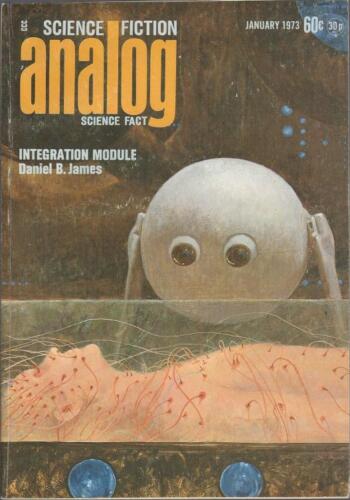
ANALOG PLUS 50: Analog Science Fiction/Science Fact January 1973

ANALOG PLUS 50: Analog Science Fiction/Science Fact, January 1973

Update the photo

I am trying this again. I gave up in July because I couldn't keep up with it and read other things -- in particular, I started the Expanse series. And if there's a double whammy to be found, it's this: I currently have a 500+ day streak of reading on my Kindle app. I know, it's stupid to track this, but it is being tracked and I want to see how long I can keep it up. Keep in mind, I have be away to weekend conventions and keep the streak going. However, the app doesn't seem to count reading PDF files as reading. I thought that had changed, but I found out a few days ago that I was mistaken. Luckily, I discovered this by 11:30 pm, so I had some time left.

As for the issues that I missed, I imagine that they are going to stay missed. The most likely -- and it isn't very likely -- is that I skim through for familiar names and read a handful of stories from the six previous issues. Serials are right out, I think.

The January 1973 issue of Analog ...

The usual explaination: For anyone finding these reviews, my purpose is two-fold: enjoying some "classic" sci-fi, and looking for stories that I think could be adapted for TV broadcast since so much of what shows up on anthology shows is rough to awful. Additional Note: I do NOT work in television. I just watch it.

In this issue:

The Editorial: "With friends like these". Basically, the experts are the last people who want to go to with a brand-new ideas. They'll tell you why it can't be done. The new guys, who don't know that it can't be done, will do it. Or at the very least, will come up with some interesting ideas. (Note: I've only read half so far. It continues at the end of the magazine.)

After the break, at the end of the magazine, this segues into the SALT talks, destroying nations, and the fact that numerical limits on weapons put an emphasis on having the best weapons possible under that limit, and to have weapons not covered by the treaty.

Novellette: "Integration Module", Daniel B. James, with an illustration by John Scoenherr showing a man with a tennis racket bending over to get something from a bag and a large round floating robot with three arms. The back hand has a tennis ball, the second has a racket and the third is stetching off to the top of the opposite page. After reading the story, I'm wondering if that's a cable to the ceiling. The caption reads, The most difficult thing to understand in the universe of man is -- the mind of man!

Joseph has just beaten Beta two matches out of three. Joseph has worked at the Beta Project for 23 years now, and given that the year is 2047, he's going to get hired soon! Beta isn't you're typical robot/android/artificial intellignece. In fact it has the mind of a man. Literally. This is stated very early on, and we even check in on the body of the man who lies there, integrated into Beta. We meet Joseph's wife, Eleanor, and a reporter named Mullroy, who tries to get the scoop on the project, questioning it in every way. Beta, can be very sarcastic with reporters. He learned from a book. Beta is schedule to be expanded and used more by the government. Beta calls Joseph with a concern. The integration has figure out that if he is present in so many places and only has access to certain data, then there has to be a certain repository, a device that is certral to his being, to his consciousness. He doesn't know where it is, but he knows that it must exist. He convinces Joseph to bring him to it.

I enjoyed this story. A quick search of my blog didn't turn up a mention of Daniel B. James.

This is ripe for an adaptation, given the moral and philosophical questions involved. It can be played as retro future or adapted for the past 50 years. Casting is wide open for Joseph and the reporter. The spouse could be expanded or removed for time. But hopefully not a funny voice for the robot. I don't see any problems there.

Science Fact: "The Third Industrial Revilution", by G. Harry Stine, with an illustration of industry on the Moon that appears to be credited to "General Electric". The caption reads Part One of Two Parts. The first industrial revolution freed man from physical slavery. The second is beginning to liberate man's mind from the numbing drudgery of repetitive tasks. And the third ...

This was interesting and I stuck with it longer than I do with a lot of science articles. The unfortunate thing is that I expected something about the computer revolution and the coming Information Age, which was forseeable in the early 70s, at least by visionaries. This is not that article.

Stine refers to industrialization in SPACE. We are running out of room here and we will run out of material, but there is plenty of material in space ripe for the picking and the vacuum will hardly notice our waste heat. What is unfortunate is where he predicts that we could be in the next 50 years, when costs and time will be cut dramatically.

Sigh.

The reasons for it stand out. The best vacuum you can find it up there. And you can get extreme temperatures cheap. The Earth can produce really hot, but making really cold is expensive.

I'll read part two next month.

Short Story: "Health Hazard", by Howard L. Myers, with an illustration by John Schoenherr, showing the back of a hairy biped with a sack in its left hand and what looks like a square monitor or CRT under its right arm. There are three others (an adult and two children?) in the background. They all seem to be heading for some kind of hut or mound. The caption reads, "Sometimes high-minded scientists with the best of good will, can be remarkably obtuse -- while by mistake doing something useful!"

The main character is Romee, a chimee from Notcid. The chimos and chimees are just about as human as men and women of Earth.

Romee Westbrook wants to get her "damn-TV" set working and goes to the Trading Center, or the Cultural Exchange Center. There are new Earth people running things now. The old ones were the exploiters (the traders/capitalists), and the new government people are here to help. Most of the traders are gone, but people like the repair guy aren't important enough to bother with.

At some point, she was given the name Westbrook because that's the location were she lives.

Romee has to go to the jungle to get roots to sell to the Earth people to get money for the damn-TV and to buy chocolate. She's addicted. The new government wants to ban the sale of chocolate because they think it's unhealthy for the Notcid, and it could be why so many are dying in the jungle.

Romee meets a woman who is looking for people for a series of tests on response to envrionmental stimuli for a modest stipend. Romee applies.

The test turns out to be a little cruel. It uses the machine-sounding noises that the Noctid hear in the jungle and usually don't survive. Most of the time, their response is to jump away from the noise. By the time she's heard the noise twice, she's flattened to the ground, scared out of her wits. This continues until the experiment is stopped by a senior official who is not amused. He mentions "damage money" that Romee will be awarded ... but that won't be for quite a while.

Since she still needs money, she goes off the jungle and finds some of the roots she needs. While she's crawling around, she hears the noises roaring above her. She flattens to the ground and waits for the end to come. But nothing happens. The noise keeps repeating, over and over, until there are new sounds, a creak and a crack. It was a swinging tree limb, and it kept swinging so long that it finally cracked and fell. Worse for the tree, it fell into the very trap the limb would have pushed Romee into had she jumped into the air instead of flattening to the ground.

She now knew how to beat the tree. She wanted to tell others but their instinct would still be to jump. So she starts by training her family the way she was trained.

This was a cute story and should be easily filmable. Hollywood would likely screw it up because makes the capitalists friendly but hardly ever polite, while the government people are polite but hardly ever friendly. Too much of the current output leans in favor of the government over any private enterprise, even when it acknowledges government's shortcomings.

Casting, as written, there are two big parts for women, but you only need a few background characters in hairy suits, one main character and four humans. I'd watch it.

Howard L. Myers has written several stories that I've read already.

Short Story: "A Thing of Beauty", by Norman Spinrad, with an illustration by Kelly Freas, showing a slight, bent, bald man in a silk robe in the foreground, overlooking in the back a Japanese village, and behind that, a headless Statue of Liberty. The caption reads, "Lo, all our pomp of yesterday is one with Nineveh and Tyre ..." Days of greatness may fade just as London Bridge came tumbling down. But enterprising men can still make life worthwhile, and even enjoyable.

This takes place in far enough in the future that the Insurrectionists have brought the US low, and possibly elsewhere as well. There are a lot of ruins and things are for sale.

Mr. Ito of Ito Freight Boosters is a very rich man and can spend as much as the national debt with blinking. He comes to visit Mr. Harris, the POV character. Harris works for the government, and sells things including landmarks to people who have the money.

Ito wants something to be a centerpiece of his garden, something big and obstentatious to run in the face of his wife and in-laws who look down upon his industrialist standing as unrefined, even though he could buy and sell them a thousand times over.

A hover-car (jumper) takes them around the city. First, we see the Statue of Liberty, but that's too sad to take, and the UN, but that's an insult to Japan, and finally Yankee Stadium. Ito spends hours telling Harris all about Yankee history. He then declines because his wife and in-laws wouldn't be impressed over baseball. Harris is dejected because he wasted a day, and any other landmarks are outside of his territory, and he won't get a commission.

They hang a lampshade on what he finally does sell him. In the epilogue, Ito sends Harris a bonus gold brick. Harris says he doesn't get the reference Ito is trying to make.

Enjoyable story, except for the last line. If he didn't get the joke, why even mention that there was a joke there he wasn't getting. Just acknowledge it like the other one.

This story could be entertaining, but I don't know what could be done with matte work and what needs CGI. That could bring the costs up. Otherwise, it's basicaly two people talking and flying around inside of jumper.

I know that I've read some Norman Spinrad in the past, but I couldn't say what. There isn't anything in this blog.

Short Story: "Proud Guns to the Sea", by Norman Spinrad, with an illustration by Kelly Freas, showing a pirate ship with Jolly Roger flying and sails unfurled, in the background. In the foreground, there's a bumpy, lizardy humanoid with a large jaw with extended teeth. He appears to be holding a space gun. The caption reads, The necessary characteristic of a troubleshooter is his ability to solve insoluble problems -- even if he does it with his own neck!

This story didn't do much for me. Nothing wrong with it, and others might enjoy it, but it didn't do much. The pirate ship in the illustration doesn't exist. It's space pirates.

In the 26th century, there's a colony world called Hallway, which seems to be a stopover point from Terran space to Keroni space (and there's a conflict?). It goes through Sheekathyrn space, and there are colonies a few light year from the star bridge. All interesting, if I kept it straight.

Jack Kellney is in charge of the colony of a few thousand people when they get word (though a message torpedo) of a pirate attack. Not an invasion, but piracy. Jack takes a ship and goes into space, and while he's gone, the ship attacks Hallway and takes Jack's girlfriend hostage.

With know options, he plays on the honor of the species attacking to declare that their captain issued a personal challenge when he kidnapped the girlfriend. It gets to the point where there's supposed to be a duel, but then there isn't one. And the two get away.

Anyway, it didn't do much for me, and I'm probably not doing it justice. Big shock there.

Is it filmable? Yes, but it'd need several sets. Something for the interiors of the colony base and of two ships. Plus the hull of the ship (docking footage?) and establishing shots. Most of the people would be dressed as lizard men, except the two humans.

Short Story: "One Plus One Equals Eleven", by G. C. Edmondson, with an illustration by Leo Summers, showing a man in coveralls with tools in each hand, kneeling next to a tool box, apparently working on some kind of circuitry. There are images of computer memory boards and light displays in the air, giving the impression of big computer. The caption reads, Even though they've been called "thinking machines," computers can't think. At least not on the human level. But, there are some forms of human endeavor that don't require thinking -- on a human level.

I wondered at first if this was going to be a story of the computer developing some kind of literate intelligence, similar to a story I read last year. It went a different way.

There are two characters in the story, and the best I can tell through scanning, neither are actually named. (It's in first person.)

So the narrator is a technician who puts on his coveralls and goes inside a super computer to clean it out and keep it running. Interestingly enough, the references might seem dated but there's no reason to believe that this story couldn't have taken place 50 years ago inside one of the nation's supercomputers that many users paid a lot of money to get a little bit of time on, and sometimes had to wait for a lull in processing to get their jobs executed.

While cleaning the "idiot machine" out, there's a printout which appears to have poetry lacking meter and rhyme. The narrator isn't much for poetry, but thinks this is terrible. He doesn't know who would be wasting valuable resources inputing this stuff. More starts coming out. He tries to inquire who is writing this, going as far as to shut down all input. If he can't fix this (I'm not sure what needs fixing), he'll lose his weekend fixing the machine.

It starts getting better, but still seems odd, even with a title. Then later it turns into more gibberish. In the end, a secondary character comes in. The "poetry" is pieces of his essay. He can't get a PhD without remedial English. He thought all this had been deleted, but shows a printout of the later essay draft. (It still reads badly, honestly. It's about the race of spermatozoa and people saying they didn't volunteer to be born.)

Not a lot of bang for the buck with this one. It might have had more of bite 50 years ago, but doesn't seem to offer much. It could be rewritten to make the POV character a little paranoid about the AI getting smarter and more creative -- and the story does suggest that the computer did edit some of what it had to work with.

Otherwise, not a top candidate for adapting for my hypothetical anthology series.

Short Story: "Proud Guns to the Sea", by Duncan Luna

This entry appears to have been deleted. I must've typed it at work and didn't "save" it. Or it was lost the last time my computer froze and I had to do a hard boot.

Until it's restored: I wasn't thrilled with this story. It's filmable, but I don't it could/would be made into a segment on an anthology series. The pirate ship in the illustration has nothing to do with the pirates in the story.

There's a corridor in space between to regions, and there is a colony called Hallway. Pirates come to take over. Meh.

Short Story: "Year 3 of the Shark", by Joel S. Witkin with an illustration by Jack Gaughan, showing a man in black with folders/papers in each hand, walking among the rubble of a building of some kind. (There could be a rank and insignia on his arm and shoulder). The caption reads, Some soldiers are not warriors. But it takes all types to make an army -- or a world.

Chief Master Sergeant Miltner is more than a pencil pusher. He's an eight-stripe pencil pusher. The war is in its third year (Year 3 of the Shark), and Miltner is one who is keeping it organized. He does his duty because he must. His former CO said as much. That man didn't care about work because he joined to avoid the draft. He knew that Miltner couldn't not do it, and knew that when he rose up he'd still do the job because he needed to be doing his job.

Miltner even reorganizes the troops as the strength dwindles in certain units. His voice has more weight than a major's. He meets with Tech Sergeant Donalo and Sergeant Cruze who mostly humor Miltner is his obsession to keep doing his duty, with the folders and the filing.

A colonel comes in asking about troop strength of Unit Four. It's been deleted and 17 men have been reassigned to Unit Eight. But 300 men are needed to fill a gap. There's probably 50 and possibly a few more. Miltner has some difficult decisions to make, and after he makes one, the colonel comes in to say that the war is over.

Cruze and Donalo leave. Miltner is ready to leave to ... but he can't because he can't leave the paperwork half done.

Quick little story about behind the scenes in a war. I enjoyed it. Filming it would require a couple of exterior shots, and the rest can be shot on a couple of sets. It needs a five-person cast, which could even be four if you combine Cruze and Donalo. Easily filmable. The futility of war is a universal concept.


The Reference Library , by P. Schuyler Miller. Opens with the Hugo Awards. Reivews include Flash Gordon: Into the Water World of Mongo by Alex Raymond, The Edge of Forever by Chad Oliver, The Outposter by Gordon R. Dickson, which was serialized in Analog, and which I read the novelization of, The Infinite Cage" by Keith Laumer (a new I've seen before in these reviews), The Molecule Men by Fred Hoyle and Geoffrey Hoyle, The EGorgon Festival by John Boyd, Other Eyes, Other Days by Bob Shaw, and The Byworlder by Poul Anderson (apparently a hard-shelled conservative, but not so much here).

Brass Tacks: A letter proposing a hp tax on cars to fight pollution, a proposal for a canal (730 feet wide, 50 feet deep) from Lake Superior to the Pacific Coast (30 years, $100B) -- Ben Bova responds that more Congressional support could be had if the canal wound through as many states as possible, but the Rockies and the environmental effects could be a problem), corrections to the editorial about McCarthy, a complaint about the change in tone of the editorials and the editorial tone since Campbell's passing, and more.

This seemed to be a quicker read than usual. I finished before the end of the month, after a late start, and I'm usually rushing to finish. I'll continue for another month.

Friday, January 20, 2023

The Sea Beast Takes a Lover: Stories (Andreasen)

The Sea Beast Takes a Lover: Stories by Michael Andreasen (2018)

(Not a review, just some notes to help me remember the things I've read. But written this way because it's the Internet, and some people will stumble across this page.)

This was a book club selection.

On Good Reads, I gave this three stars. I would've gven it 2 but it's written better than any of the dreck I've given 2 stars to. But it sits in the "What the Hell Did I Just Read?" pile. Here's what I remember of the stories (after refreshing my memories with the Good Reads reviews):

The lead-off story is "Our Fathers At Sea", which I was reading thinking it had something to do with the Sea Beast of the book's title. It does not. Once I got past that, I was just trying to comprehend the whole "crating" ceremony, which turned out to be exactly what it sounded like. When men get to a certain age, they are boxed up and dropped into the sea "in an undisclosed location" -- that last part was mentioned several times, just to emphasize the "hilarity" of it, or "absurdity" or something. I kept waiting for something to happen, and then nothing happened. It just ended.

The TV show Dinoaurs did this better.

"Bodies in Space" I've already forgotten that was the title. It thought it was Man of the Future. A man and a woman are snowed in in a car, aliens grabbed them and returned them. She's making the most of it. He wants his wife back. The two weren't a couple by an affair was happening. They're being poked and probbed by scientists because they have lights embedded in the head. He hears voices asking him questions sometimes. And then the story just stops.

The titular "The Sea Beast Takes a Lover" is by defintion "weird". It's weirder in that it takes place modern day, given the technology and the references, but otherwise, you might've thought that they were Long John Silver Age pirates. The sea beast is slowly dragging the ship, the Winsome Bride, under, but the admiral is too busy eating the other officers. Meanwhile, mermaids are waiting for the men to drown. Also, they all carry effigies, and I'm not exactly sure why. In the end, one effigy sails off, and the story just ends.

"The king's teacup at rest" follows the King of Retired Amusements, who travels with two assistants to enjoy old neglected amusement parks, including eating the aging food and relish. The assistant gets things running and the King gets sick but persists. Their guide seems to be on some sort of spiritual journey listening to a bear that is balanced on a giant ball.

"He is the rainstorm and the sandstorm, hallelujah, hallelujah" It was about a disturbed child and twisted maternal instincts. Unfulflling. An open ending didn’t work well for this one. I'm not remembering it too much. Maybe the group will remind me. A young girl, old enough to bottle feed a baby but too young to understand how breast milk is made, lives with her mom, her "aunt" and her aunt's baby boy. It's important that no one knows that the aunt and the boy are there. There are people that come to the house, and the mother is always suspicious that they are trying to ascertain if the baby is there. They are afraid that the father is coming for the child. The daughter sees that the child is getting all the attention and is jealous, standard stuff that a writer could work with. She resents the baby and at the same time tries to breast feed the baby. (She enjoys the sensation until it hurts.) In the end, she doesn't kill the boy or give it away but she decides to bring the boy closer to heaven. The two women are frantic that the baby is missing and they're worried that he's been abducted, but instead the girl put him inside a third-story window flower box. It ends before you find out if he's found or if he dies from falling or exposure.

The group just mentioned putting the baby in the box. That detail reminded me of the story, which I'd completely forgotten, until it all flooded back.

"Rockabye, Rocketboy" has some of the most clinical robotic porn ever. Rocketboy is a kid with a jet pack who never seems to land, and he has a fan club, which includes a porn actress who seems to think she's just an actress, or else, porn isn't a big deal in this word. She's the "plug detective" and gets "plugged" by a robot in every episode.

"The saints in the parlor" did not appeal to me in the slightest. You can be irreverent without being sacriligious. This was neither funny nor insightful, but wasn't written well enough to be considered an attack. But it just mocked people of faith and their iconography.

"Andy, lord of ruin" The kid explodes and becomes a giant rock monster. I dn't remember hating it. But it just didn't have anything more to it.

"Jenny" is a girl born without a head. Her brother prechews her food for her. The mother does her best to keep things normal. (Dad is dead.)

"Rite of baptism" reads like a bad Monthy Python sketch that went on too long. It's presented as a script and the names are all omitted for no reason (other than the script format). It didn't get more absurd. It got really stupid. And again devoid of meaning and we never learn about the world that they are in, despite allusions to Moses and John the Baptist.

Blunderbuss -- a time travel story with a museum and conference room filled with students. A time leak makes things going crazy. This one had something going for it, and could have actually been made into a serious attempt at a sci-fi story that could've been published in any of the magazines out there now.

I pushed my way through it, got to the end. It seems that several in my group didn't or couldn't finish it, so yeah, me. I didn't enjoy it.

In summation, a group that included several educators couldn't find anything worthwhile about this book or anything resembling a theme or a moral or a position the author is advocating. They did touch on a lot of religious aspects -- maybe he has issues with this -- in the disturbed child story, the saints, and baptism and some of the others as well. They also commented on how not a single person in this entire book is likable or sympathetic. None of them are nice people and they all blame their problems on other people. It's always someone else's fault.

Not a good book.

Thursday, January 5, 2023

Eating to Extinction (Saladino)

Eating to Extinction:
The World's Rarest Foods and Why We Need to Save Them
by Dan Saladino (2022)

(Not a review, just some notes to help me remember the things I've read. But written this way because it's the Internet, and some people will stumble across this page.)

Note that this was finished a couple months ago, in 2022, but for some reason didn't write the blog entry.

WOW I actually read a 2022 book in 2022. It must've been brand-new when I heard about it on NPR and first got it from the library.

I heard Saladino interviewed on NPR on Saturday morning (on The Splendid Table, I believe -- I was out walking). THe book sounded interesting so I reserved a copy. The ebook might not have been available yet, so I had the hardcover, which I carried back and forth to work for a while and even sat in my yard over the summer reading it. Then I learned that the ebook existed, and I finished the book faster after that.

Basically, the book traces the history of food (grains, animals, sweets, beer, etc) over the past 12,000 years. There are "landrace" grains that have survived for millenia that are being squeezed out and destroyed by development and by the Green Revolution of the 20th century, which meant to maximize food output by specializing in just a handful of seeds at the expanse of existing foods. Once seeds are lost, we can never get them back. There have been attempts over the past century to save and catalogue these food varieties.

By homogenizing our food system, we not only lose variety, but we open the food supply up to blights and other diseases that could spread like wildfire. Meanwhile, the displaced seeds survived hardships for 12,000 years.

Wednesday, January 4, 2023

The Life and Adventures of Santa Claus (Baum)

The Life and Adventures of Santa Claus by L. Frank Baum (1902)

(Not a review, just some notes to help me remember the things I've read. But written this way because it's the Internet, and some people will stumble across this page.)

Note that this was finished in 2022, but I didn't catch up on the final reviews of the year.

I grew up at the perfect time to watch all the Rankin/Bass Christmas (and other holiday) specials. And yet despit that, I only saw The Life and Adventures of Santa Claus for the first time just a few years ago. It's the pinnacle of their storytelling ability. No songs, just pure fantasy. Some time after this, I discovered that it was based on a book by L. Frank Baum (the Oz guy, don't you know).

This year I decided to get a copy. It's been in public domain for a while.

A baby is found by Forest of Burzee by Ak, the Master Woodsman of the World. Burzee is home to immortals and no human has ever set foot there. He places the baby in the care of the lioness Shiegra (who had thought the baby might make a good snack before then). The baby is then adopted by the Wood Nymph, Necile. He's given the name "Claus", meaning "little one", but gets called "Neclaus", meaning Necile's little one.

He grows up with the Nooks and Ryls and the nymphs and the animals until Ak decides to take him on a trip about the world to see others of his kind. He leaves the immortals and starts making toys for children. The immortals aid him in this. There are villains, in the form of the Awgwas, which are creatures who could turn invisible, who steal his toys. They are eventually defeated.

When Claus ages to the point of death, the immortals meet to grant the mantle of immortality onto Claus. There is only one that could be given in all of history. It was made to be bestowed, and if one such as Claus isn't worthy of it, no human ever would be. So it is a unanimous decision among the immortals.

I copied this list from Wikipedia (which got it from the text) just because I love the variety of it: a council, headed by Ak (Master Woodsman of the World), Bo (Master Mariner of the World), and Kern (Master Husbandman of the World) gathers together the Gnome King, the Queen of the Water Spirits, the King of the Wind Demons, the King of the Ryls, the King of the Knooks, the King of the Sound Imps, the King of the Sleep Fays, the Fairy Queen, Queen Zurline of the Wood Nymphs, and the King of the Light Elves with the Princes Flash and Twilight, to decide the fate of Santa Claus.

Also amusing was a song that Claus would sing. It reminded me of the song sung in the Merry Old Land of Oz, and with good reason. I wonder if the lyricists used Baum's other works for inspriration. I don't recall a similar song in the text of the Wizard of Oz.

I enjoyed this. Maybe I'll read it again next year. Maybe not -- I tend not to reread books because I have so many "to be read".

Monday, January 2, 2023

2022: Year in Review

It was an interesting year for reading. It started one way and morphed into something else. I read a lot of short stories early on, and moved on to more novels. And there were things from the past that came back, some of which weren't listed in the blog last year, but will get a mention here.


Novels, Novellas, and Short Story Collections/Anthologies

Of the 25 books listed below, all but 1 was read to completion. And one was utter garbage. A few were anthologies and a couple were novellas in book form. I think every single one of them was an e-book, except for The Dream Peddler which was partly read in paperback and mostly listened to as an audiobook. Surprisingly, only 8 of them are Book club selections, and one was the runner up for a book from the previous year. I don't know why it's only 8. The Expanse series mucked up my schedule a little bit.

  • Miracle of Deck 34 and Other Yuletide Tales (Olsen/Ashby)
  • The Witch of the North Pole (Snow)
  • Beyond the Waterfall Door (Cooper)
  • Steampunk!
  • My Best Friend's Exorcism (Hendrix)
  • John Dies at the End (Paragin)
  • The Dream Peddler
  • Abaddon's Gate (Corey)
  • Caliban's Way (Corey)
  • Leviathan Wakes (Corey)
  • The Graveyard Book (Gaiman)
  • The School for Good Mothers (Chan)
  • The Deep (Solomon)
  • The Easy Life in Kamusari (Miura)
  • The Guest List (Foley)
  • Envy of Angels
  • Me & the Monkey
  • The Book of Koli (Carey)
  • An Ignorant Witch (Graham)
  • Armored Saint (Cole)
  • Southern Spirits (Fox)
  • Reincarnation Blues (Poore)
  • Super City Cops #1: Avenging Amethyst (DeCandido)
  • Foe (Reid)
  • Greegs and Ladders (Mitchell and Mendlow)


Middle Grade and Children's books

These three came from mailing lists or from Amazon's World Book Day:

  • Puzzled (Nichols)
  • Jerry the Squirrel, Volume 1 (Robinson)
  • The Caiman (Manrique/Paris)


Old Magazine

I really wanted to keep the magazine thing going.That is, I liked the idea of reading 50-year-old sci-fi magazines. I even thought I could expand it by alternately Galaxy and If. It was too much. What finally did it in, besides the fact that I was never going to be principled enough to convert this into a column for Tor or someone else, were the Expanse books, which took a lot of time, and that silly counter in Kindle showing that I've read for nearly 500 days in a row. The problem is that the counter doesn't seem to count PDF files as reading books, so any day I read Analog, I had to read something else, too. I never actually finished July's issue, and I didn't go back and read the serials for this year. Maybe I'll try again in 2023, but I'm not pendiling them in just yet.

I thought I actually read one issue of "IF", but if I had, I didn't make an entry in the blog for it.

  • ANALOG PLUS 50: Analog Science Fiction/Science Fact July 1972
  • ANALOG PLUS 50: Analog Science Fiction/Science Fact June 1972
  • ANALOG PLUS 50: Analog Science Fiction/Science Fact May 1972
  • ANALOG PLUS 50: Analog Science Fiction/Science Fact April 1972
  • ANALOG PLUS 50: Analog Science Fiction/Science Fact March 1972
  • ANALOG PLUS 50: Analog Science Fiction/Science Fact February 1972
  • ANALOG PLUS 50: Analog Science Fiction/Science Fact January 1972
  • Galaxy PLUS 50: Galaxy Magazine, January-February 1972


Other Short Stories

In January, I tried collecting all the stories that were published by Daily Science Fiction and Flash Fiction Magazine, using the links that they email me daily or weekly (respectively). I think I even managed to make an ebook out of DSF. Two problems with this were that it was time-consuming to collect them all in book form, and I tried to coment on each individual story, which wasn't practical. I have since tried to get published in Flash Fiction, but reading one month of their stories, I could tell that I wasn't writing what they were looking for. (And I wasn't writing specifically for them because if I didn't sell the story, what would I do with it?).

Daily Science Fiction will soon cease publication. They stopped accepting manuscripts a while ago. I may go back through my email to read the old stories. All of them are on the website, but they aren't categorized in a way that makes it easy to access them. This is likely by design.

The stories from The Arcanist are the winners, runners-up and also-rans of themed contest for the past five or six years. So about 40 stories total.

Finally, there was a second collection of stories from eSpec Books' Kickstarter campaigns. As I've read them from shortest to longest, most of the short stories are done with and I'm at the short novel level. That's not to say more short stories won't pop up as new campaigns come along.

  • "The Arcanist" story collections (multiple)
  • A Bushel and a Peck of eSpec Stories
  • Daily Science Fiction, February 2022
  • Flash Fiction Magazine, January 2022
  • Daily Science Fiction, January 2022


Manga


There were two entries covering My Hero Academia Volumes 22 Through 31 and Volume 32 became available at the end of the year. It got very dark.

Not listed on the blog was One-Piece, which took me some time to find the last book that I read. I remembered some things but not others. I finally got to the shipbuilders at Water Seven, which seemed familar but I couldn't remember the ending. I read two volumes of One Piece, after skimming the three before them.

Non-fiction

Fewer than usual, I think. I carried Eating to Extinction back in forth on the subway in hardcover for a month before giving up on it. Then I borrowed the ebook from the library. Interesting reading, probably my favorite book of the year.

The rest include a very old humor book, writing tips, selling tips, a cookbook (with "Geometry" and "Pasta" in the title), random legends, and information on whiskey.

  • Eating to Extinction
  • The Geometry of Pasta (Hilderbrand, Kenedy, Vandy)
  • The Literary Handyman: More Tips from the Handyman (Ackley-McPhail)
  • Famous Legends From Portugal (Abrantes)
  • At Wit's End (Bombeck)
  • Exactly How I Promote and Sell Books (Dee)
  • Whiskey (Diller)


Gaming Books

There were a few gaming books, but not enough to merit a blog entry yet. Most of those were from Philip J. Reed. There were a couple others, which will go in a different post when it gets to enough pages.


Summary

So there were about 50 blog entries dedicated to reading. They include 25 books (plus 1 more), 7 (or 8?) magazines, 5 bundles of flash fiction or short stories, about 14 volumes of manga, and 6 (plus 1) nonfiction books. Not a bad year.

Saturday, December 31, 2022

"The Arcanist" story collections (multiple)

The usual dislainer: Not a review, just some notes to help me remember the things I've read. But written this way because it's the Internet, and some people will stumble across this page.

The Arcanist is a magazine that prints flash-fiction (roughly 1,000 words, I believe). They publish one story a week, so you can imagine the competition for that one slot. The magazine also runs flash fiction contests, which the winner gets paid and gets published, along with the runners-up. Disclosure: I have submitted a few times, but I have not been published by them. My rejections have been generic and usually happen with 1-2 months. I have not submitted to any of their contests because they have an entry fee, a small one, but a fee nonetheless. I'd rather take my chances on the slush pile.

Recently, the magazine sent an email about the latest collection of stories it had for sale. It also had stories from previous years available for free.

Another disclosure: probably 5-10 or more years ago, I thought about the idea of self-publishing, since it was just catching on. The problem was that I had nothing in the way of novels to publish and no time to write and rewrite one. (I was "too good" for an editor, so I could save money. Ha!) I thought about the idea of putting out collections of flash fiction, until I thought, "No one is going to pay for a book with 7,000 words. That's a short story!" Turns out I was wrong, and it isn't just the Arcanist doing it.

End of digression.

Below are the books I've read, so far. I may amend this post if I read more this calendar year. Otherwise, I'll make a new post in 2023.


Welcome to Camp Arcanist (2021)

Stories about camping.

  • "The Monster of Lake Gregg" by Kara Pogos was cute, with an unexpected ending. Part monster, part ghost story. First place winner.
  • "Take Me Back to The Giants" by Connor Smith was the second place winner. I might've enjoyed it more if it hadn't reminded me of a better (longer, naturally) story from Analog in the late 80s/early 90s. The camping part is incidental, and it could've been replaced with a different theme alongside the other half (the twist) of the story.
  • "Special Order" by Aeryn Rudel was third.

Yeah ... this didn't work out. At some point, I'll go back and list the stories. But let's face it, I probably won't. Here's a list of the rest of the books I read, each about seven stories long, some better than others. I hope I got the years right. I got this from the email which didn't list the years, but I think they went in order.

Hunger Flash (2020)


Tales From the Weird Weird West (2019)


Monster Flash (2018)


Magic, Monsters, and Mayhem (2017)


The Arcanist Presents: Ghost Stories (2016)

Friday, December 23, 2022

Miracle of Deck 34 and Other Yuletide Tales (Olsen/Ashby)

Miracle of Deck 34 and Other Yuletide Tales by Kaki Olsen and Scott Ashby (2021)

(Not a review, just some notes to help me remember the things I've read. But written this way because it's the Internet, and some people will stumble across this page.)

Last year and this year, I participated in a Santa Book Exchange, where someone buys a copy of my book, and I buy a copy of someone else's book. It's all done mostly randomly. Last year, I included my "In A Flash 2020" in the fantasy category, so this year, I picked science fiction, since the book is roughly half of each.

The book I had to buy was Miracle of Deck 34 and Other Yuletide Tales, which worked out well for my December Christmas reading. It doesn't appear to be on Good Reads, so I may have to add it. However, I don't want to be the first one to rate it.

There are 24 stories (which, I admit, I didn't notice at first because I didn't read the blurb). This means that I could've read it like an advent calendar, except that I didn't get it until the second week of December.

(Side note: I did tweet out an Advent Calendar of my own because I have 24 published stories that I own the rights to, plus my first story, which was a work for hire.)

The book started well enough, but little things wore on me after a while. The writing isn't quite there. You could watch an episode of Star Trek or The Love Boat or any cop show to know how to talk to a captain. And some of the stories aren't really stories. Something is going to happen, and then it happens. And then the story just stops. In several instances, the ending is given away in the title and once we get to that reveal, it's done.

Speaking of titles, most are puns or take-offs on Christmas songs, lyrics or movies. Note the "Deck 34" of the title referencing Miracle of 34th Street. Santa appears in a few of the stories.

The pair started with the titles and wrote the stories, so some are most "prompt-ish" than others. I can recognize this because some of my prompt stories suffer from it. There have been times that by the time I'm done with the setup, the prompt that spurred the story is out of place and needs to be removed. One story spent a lot of time explaining how to make a fire in the rain and when it was done, oh, look, a shelter was built at the same time.

And, I'll confess here in fairness, I've been told by an editor that some of my stories were good but they just stopped. (I even noticed that when I read one in particular in front of an audience. My voice was high like I was about to read another sentence, but there was no more to read.

The book was enjoyable, but I wish it had had another round of editing to punch it up a little.

Thursday, December 22, 2022

The Witch of the North Pole (Snow)

The Witch of the North Pole by Eden Snow (2017)

(Not a review, just some notes to help me remember the things I've read. But written this way because it's the Internet, and some people will stumble across this page.)

Looking for books to get me into a Christmas mood, I went looking for free Christmas-themed ebooks (that weren't "bodice-rippers"). There seem to be plenty of "cozy" mysteries with witches, elves or whichever. The funny thing is from the thumbnail, I thought she was sitting on a chimney, not a bag of toys. Also, I didn't realize right away that the author's name was "Eden Snow" -- I thought it was a subtitle for the book!

The book is also listed as Cinnamon Mercy Claus 1. The main character doesn't like to be called Cinnamon, because she used to be teased that it was a spice name. Mercy was somehow better.

Mercy, a strong, indepedent woman, who works in an office with lots of spreadsheets but little interaction with people, is ill-prepared for a visit to her grandparents, whom she doesn't know. Her parents are away for the holidays, leaving her no place else to go. She's farther North than she's ever been. In fact, she's at the North Pole. And her grandfather is Santa, the actual Santa Claus.

The problem is that her grandmother isn't happy with the whole "Santa" situation and is leaving him. She's also leaving running the entire operation in the hands of Mercy.

Oh, and Mrs. Claus is a witch.

And, by the way, so is Mercy, even if she doesn't know it.

The entire "Santa" business, how old he is, the family line, the replacement Santas, can all be accepted as part of the narrative. That's the setup for the story and it's internally consistent. It gets a little problematic with Mrs. Claus, angry as she is, bailing out and leaving her granddaughter in charge without any training whatsoever. Or telling her about her witchy background and not helping there either.

There is some help in the form of a single spell, which a helpful elf, Ginger, tells her should be cast away from everyone, but indoors, so no one else is affected by it. Unfortunately, the elves captured a human who saw them and was holding him in the same warehouse where Mercy read the spell. He is affected with the same Christmas cheer, and agrees to help Mercy break into the Christmas Command Center and access the computer with the Naughty List. (Those on the Naughty List get a special present that gives them a chance to turn their lives around. The list includes the man's daughter.)

Unlike a Hallmark movie, the two do NOT become a couple by the end. However, it's a book series, so it might be something to expect in the next few books.

It was a cute book. If there's one drawback, it ended abruptly. The story's told but there's not denouement, no day after, nothing. On the other hand, there was the first chapter of Book 2. I don't normally read those, but in this case, I made an exception and read far enough to see how the ending would have played out. And then stopped because I don't normally read these.

Update: In the time it took me to write this up, Amazon sent an email that included the second book for free, so I downloaded it. It probably won't be read until after Christmas. I'm reading something else right now and then I have a Book Club book to get to.

Bourbon Penn 30, August 2023

Bourbon Penn 21, July 2020 (Not a review, just some notes to help me remember the things I've read. But written this way ...