Thursday, December 12, 2024

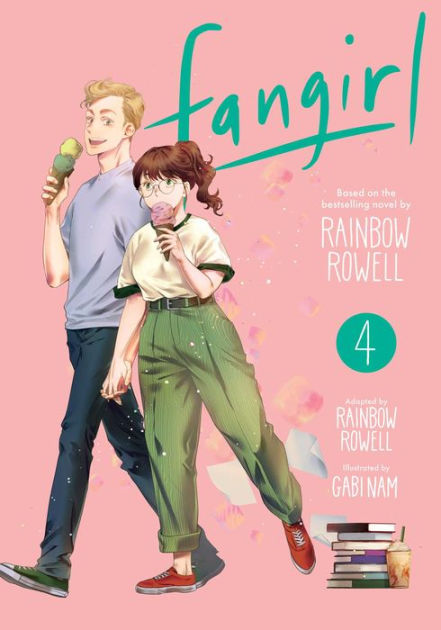
Fangirl: the Manga (Volume 4)

Fangirl: the Manga (Volume 4)
Manga adaptation of Rainbow Rowell's Fangirl by Sam Maggs (2024)

(Not a review, just some notes to help me remember the things I've read. But written this way because it's the Internet, and some people will stumble across this page.)

Looking for random manga and the New York Public Library website recommended "Fangirl", which was a four-part adaptation of a novel, which I wasn't familiar with. So I started reading it. What I wasn't aware of at the time was that the fourth and final book has not been published yet. Arg.

The fourth book came out and I borrowed it. I read it a couple months ago.

Nothing much to add to my previous post. Cath and Wren are together again. Wren gets better (or at least gets help). Cath keeps writing, both in her Creative Writing class and her fanfic. In both cases, she's racing to beat deadlines: the end of the semester, and the publication of the final book about Simon and Baz, which will close the door on the series.

It was fun to read. The manga format, however, was a bit annoying. Once again the pages read from back to front, but the pages themselves were read from left to right, except when there was a two-page layout that had to appear as it was. This is likely confusing to both manga readers and comic book readers.


If you stumbled across my page thanks to a random search result, please check out my short book series, Burke Lore Briefs.

Wednesday, December 11, 2024

What Kind of Mother (Chapman)

What Kind of Mother
by Clay McLeod Chapman (2023)

(Not a review, just some notes to help me remember the things I've read. But written this way because it's the Internet, and some people will stumble across this page.)

This wwas a Pandemic Book Club pick. Otherwise, I'm not much into horror. For this month, the book selected was one of several that were written by Clay McLeod Chapman, who joined us for most of our book discussion. I participated and had a few things to say without trashing it.

Madi Price has returned to Brandywine, Virginia where she grew up. She is the mother of a 17-year-old daughter who is currently living with the girl's father who didn't want anything to do with her for many years. He's doing well, but Madi is living in a room in an old motel that was converted into a strip mall (and not a particularly good one). Madi goes to the weekly market to read fortunes like her mother used to. She doesn't have any gift. But as soon as she meets old boyfriend Henry McCabe, she has a vision associated with his missing son.

Henry's wife killed herself and his son disappeared. He's sure that he's still out there somewhere. He hangs up posters with computer technology aging his son's image.

Madi finally gives Henry a reading and leads him out into the waters around Brandywine, whether they come across a duck blind -- and Skyler, who has been missing for five years.

But, of course, it's not really Skyler. Henry doesn't want the authorities involved and Madi is freaked out. She wants to get away and take this boy to a hospital to be checked out. But it's not even a real person.

And that gives away enough. I had plenty of problems with this, such as the fact that Henry knew from the start that his son wasn't still out there despite being so convincing and hanging up flyers for five years and putting up with things people say. Henry finally does a 180 in his opinion, which almost seems organic but it's overshadowed by Madi going off the deep end in suddenly choosing Skyler, who'd she'd been suspect of, at the expense of her actual daughter. Her turn is overexpected. And then it gets crazier by the ending.

So, no, as well-written as it may have been, I didn't enjoy the book at all. Others into creature-based horror with mommy issues might feel otherwise.

This was an ebook and I didn't listen to too much of the audiobook.


If you stumbled across my page via the Internet, please check out my short book series, Burke Lore Briefs.

Tuesday, December 10, 2024

The Benevolent Society of Ill-Mannered Ladies (Goodman)

The Benevolent Society of Ill-Mannered Ladies
by Alison Goodman (2021)

(Not a review, just some notes to help me remember the things I've read. But written this way because it's the Internet, and some people will stumble across this page.)

This was recommended on the Brooklyn Public Library page as something that I might be interested in. I read it and listened to most of it. If I finish reading first, I'm less likely to finish the audio before it needs to be returned.

Note that the cover is inaccurate because even though the two sisters are twins, one is several inches taller than the other.

The book is a high society amateur detective story set in the heart of Regency London. Several stories in fact. Lady Augusta Colebrook, “Gus,” is determinedly unmarried, bored by society life, and tired of being dismissed at the age of forty-two. She and her twin sister, Julia, who is grieving her dead betrothed, need a distraction. One soon presents to rescue their friend’s goddaughter, Caroline, from her violent husband.

Along the way, they are attacked by and manage to subdue a highwayman, who isn't exactly what he appears to be. They use the man to pose as their brother, who they claim was wounded by a highwayman, to get to Caroline. When the man awakes, he sees no choice but to continue the ruse and is instrumental in getting away. Gus is terribly smitten with him as she's never been before, but he knows that they could never be together for it would ruin her, and he would surely hang.

They eventually get reunited for another case, and Gus becomes determined to prove the man's innocence.

This was an enjoyable (though a little long) book. I would read another in the series.


If you stumbled across my page via the Internet, please check out my short book series, Burke Lore Briefs.

Monday, December 9, 2024

Clarkesworld Magazine, Issue 173 (February 2021)

Clarkesworld Magazine, Issue 173
edited by Neil Clarke (February 2021)

(Not a review, just some notes to help me remember the things I've read. But written this way because it's the Internet, and some people will stumble across this page.)

Neil Clarke is the editor of a fabulous online science fiction magazine, Clarkesworld. (Note: I have submitted many stories to Clarkesworld. As of this writing, I have not been accepted. That doesn't mean I won't stop trying, nor does that bias this review in any way.)

If I've been informed correctly, when Neil goes to conventions, he brings along paperback copies of his magazine that didn't pass quality control. This book in particular is stamped on the inside front cover: This Is A Misprint. The cover failed quality control but the inside is fine.

As with last month's issue, I didn't see anything wrong with the cover I have, which looks like the cover shown above.

Being that this is summer, this book was mostly pool reading.

The stories include: note, I finished this a couple weeks ago and have read other books and start a new issue

  • The Failed Dianas by Monique Laban. In the future, Diana comes down to Earth to a restaurant to meet herself. The original version she was cloned from. The original's parents weren't happy, apparently, at how she turned out, so they made another and another. And they all have their own special interests that they chose instead of what they're parents wanted. She meets DeeDee, 3D and Dr. Diana and they bring her up to speed, just as they were brought up to date. It was a fun little tale.
  • Terra Rasa by Anastasia Bookreyeva, translated by Ray Nayler. Everyone is on the trains to get to the ships to escape the fires to get to the better place. People are scheming to get where they need to. The narrator has a pass to get her through. She's watching people. There are others who could use it. It has a twist ending.
  • Obelisker Adrift in the Desert by K. H. Meridian. Another long one, but fewer than 30 pages. The narrator is an obelisk and gets called Obelisker by Kouya who survives a crash after an attack. The obelisk is an old station. The two have an easy truce. Plus she's wearing tactical gear and has special training. She leaves for a time to visit another village that obelisk watches without letting them know that the obelisk exists and is functional. Then there's an attack that must be repelled. Good story. Not like some of the other longer ones.
  • "Remember the Washington" They Said as They Fed the Ugoxli by Jeff Reynolds. A quirky title, and I had to go look up what an "ugoxli" was because there have been a lot of aliens lately. No, I guess the story didn't resonate enough for me to remember.
  • History in Pieces by Beth Godor. A story told as a series of puzzle pieces, but not all of the pieces are there, nor are they presented in order. The first is 37, with Cassandra stepping onto the surface of the planet, and the last three are 1005, 1006, and 1. It starts with the people on the ship not seeing an Archivist, but Archivist Tan is telling much of the story. It was an interesting approach. (Once again, I am writing this after 3 months after reading it and I rememeber little about it.)
  • Terra Rasa by Anastasia Bookreyeva, translated by Ray Nayler. People on a train are headed to Murmansk, to the bay. They need to get to the ships there. The world is ending and the ships (sea, not space) are taking survivors to a better place, if they have passes. The narrator does, but there are others who do not. And others who will do what they must to get on the ship. The woman decides to stay with a child who has no one. But the ships that sail away aren't going anywhere. There's nothing left out there. An interesting, if not depressing, story.
  • Mercy and the Mollusc by M. L. Clark. Another long one, with chapter titles (or section titles). It plays out like a western on another planet, but the steed in this case is a large mollusk creature name the Oomu, which is very mucusy. It's easy to ride. And one point, it attacks a kid and covers it with a mucus membrane so it can't escape, but it doesn't attempt to eat it either. It then goes off on its way and the rider has to figure out what to do. Again, there's more to it, but I don't remember. It was interesting, but too long. Wish I remembered more.
  • We'll Always Have Two Versions of Pteros by Dominica Phetteplace. A shorter one with section numbers. The sections titles are names, many followed by 1 or 2. Barry believes that he's in the wrong timestream and that he's supposed to be somewhere else, namely on the Pteros. However, the Pteros has been destroyed, in this reality, at least. Lily thinks it's survivor's guilt because Barry knew people on the ship. Barry 2 was lost in space for a year and then he woke up next to Lily. It flows nicely.

The Nonfiction section of the book includes

  • There are two interviews, an article about Peter Pan through the ages, and the 2020 reader's poll finalists. Interesting to note that there were ten stories listed for Best Story because there was a six-way tie for fifth place. Out of then stories, none were in the December issue that I'd read. "The Helicopter Story", which I haven't read but I know about because of the big splash it made in social media before the content was pulled, was nominated. I wonder if it won. I saw (a few months back) that it was available on a different website if I wanted to read it. Maybe at some point, but I'll more likely forget about it.

And that's this issue. An interesting issue, and I'll keep reading. I have at least one more that I've picked up at conventions, and the content is free online. Problem is that I can't read online magazines on the subway. (And, of course, pool weather is over for the year -- not that I'd take my ipad into the pool.)


If you stumbled across my page via the Internet, please check out my short book series, Burke Lore Briefs.

Friday, November 22, 2024

The Hidden Palace (Wecker)

The Hidden Palace
by Helene Wecker (2021)

(Not a review, just some notes to help me remember the things I've read. But written this way because it's the Internet, and some people will stumble across this page.)

This was a sequel to a pandemic book club selection. I listened to it as well as read it. I actually finished it before we had the online meeting for the previous book.

Most of the cast of characters from the previous book is back again, with some in surprising ways.

Unlike the first book which took place over the course of a single year, this novel spans a couple of decades and we see some major events in New York City (and beyond) history unfold. We also see other characters age while the two titular characters do not. This means that there has to be some kind of shake-up, or else others would start to realize that something is wrong.

The book also introduces a younger female djinn and a second golem that gets created from the notes of the deceased rabbi. So you have to wonder if there will be some kind of love rectangle at work here as the title characters have their own relationship issues to work through.

Also back is Sophia, the heiress that Ahmed falls for in the first book. She travels all over the Middle East like some adventurer out of the Age of Exploration, traveling with two Pinkertons for protection. She leaves home with her father's blessing. She's looking for a cure to the affliction that you might've thought would've faded on its own at the end of book 1. She travels for YEARS, missing major events for her family, until she's finally forced home due to lack of funds. She helps bring the female djinn to the U.S.

There's a bit of a disconnect between the two books. For one thing, it starts with Ahmed finding his own people, but none can free him from his shackles. When he returns alone, the neighborhood is curious because they figured he'd return with a mother or a new bride. It seems that the boy he took to the Middle East is mostly forgotten.

Not forgotten, but not important, is the (spoiler for book one) wizard from the first book, who is imprisoned in the oil flask. He is connected to Chava, and she can sometimes hear him, but he's not a factor in the book other than mentioning that he's still out there.

The scope of the book is broader, too, because so much time passes in this one, allowing the author to work in the Triangle Shirtwaist fire, the sinking of the Titanic, World War I, and the women's suffrage movement. This also allows time for Anna's son, and the daughter of the rabbi who created the second golem, to grow up to become adults.

I don't see where there's room for another sequel because many doors were closed here. Many human characters either died (from old age or other means) or moved out of the neighborhood. Little Syria must give way at some point. Honestly, I wouldn't want book three to be about the wizard coming back again or even seizing the hidden palace, which also doesn't play a big part in the book.

I enjoyed this book. If a sequel comes out, I'd likely read it even though I'm satisfied with the two books as they are.

This was an ebook and audiobook.
Thursday, November 21, 2024

The Golem and the Jinni (Wecker)

The Golem and the Jinni
by Helene Wecker (2013)

(Not a review, just some notes to help me remember the things I've read. But written this way because it's the Internet, and some people will stumble across this page.)

This was a pandemic book club selection. I listened to it as well as read it.

I labeled it as a "historical fantasy" even though it takes place "only" 100 years ago or so in New York City. (I just double-checked, and it's set in 1899-1900.)

A man has a golem made as a wife who will accompany him on his trip to America. The golem is shipped in a box and is to be awoken in NYC, but the man activates her at sea. He then dies from an untreated illness leaving the golem alone at sea. When it's discovered that she doesn't have a ticket, she jumps ship, sinks down in New York harbor and walks to shore. She winds up in Little Syria in Lower Manhattan. She is befriended by a rabbi, who names her Chaya, and who tries to teach her to ask human as a disguise.

Around the same, a tinsmith, also in Little Syria, accidentally releases a djinn from a flask when he breaks the decorative markings. The djinn, who is given the name Ahmed, immediately demands to find the magician who imprisoned him, only to discover that not only is he half a world away (across an ocean of fire-killing water) but centuries have passed in the meantime. The djinn is wearing iron bracelets that he can escape from which prevent him from leaving the human form he took before being captured.

It's only a matter of time before the two meet. But one is (literally) hot-headed, while the other is more forgiving and submissive. Their personalities, as much as they have them, clash a bit. Along the way, Chava gets a job at a bakery when she befriends Anna (who hates how perfect and quick Chava is), and the rabbi's nephew, Michael, a bit of an irrelegious radical, starts to develop feeling for Chava, unaware of her true nature.

I enjoyed the book although in the beginning there are quite a few info dumps, detailing the background of various characters, a couple of whom make you wonder, why am I reading this. Those background characters will turn out to be more important to the story.

I was okay with the ending although several in my book club thought it was a little too pat. They wouldn't have minded parallels with the world centuries ago, but too much of it came back.

Our meeting was delayed, so by the time we spoke, I'd already read the sequel. This meant I had to sit out any speculation until we were done before I could tell those who wanted to know what would happen next.

I both read and listened to this book although I didn't listen to the end after I finished reading it.

Tuesday, October 8, 2024

Remarkably Bright Creatures (Ven Pelt)

Remarkably Bright Creatures
by Shelby Van Pelt (2022)

(Not a review, just some notes to help me remember the things I've read. But written this way because it's the Internet, and some people will stumble across this page.)

This has been sitting as a draft since July. I honestly thought I'd posted it. Oops.

This was a pandemic book club selection. I listened to it as well as read it.

This was a first novel, and it was a very good one. What put it over the top was that portions of the book were narrated by a Giant Pacific Octopus named Marcellus (McSquiddles, but he's not a squid) who can escape his tank and wander around the aquarium. Thankfully, Van Pelt realizes that too much of a good thing would be bad, and Marcellus's chapters are more like short interludes.

That said, Marcellus makes the book. Without his point of view, the rest of the book would be a little monotonous and "by the book" with coincidences and missed chances. The octupus elevates it. Also, at one point, Marcellus lets out a large spoiler, which is good, because it was obvious where that story line was going. (Basically, if it didn't go there, most of Cameron's story wouldn't be needed.)

Tova Sullivan is a widow who works the night shift cleaning up the aquarium. Her son died in a boating accident for which she doesn't have any sufficient explanation. She befriends Marcellus who she discovers has found a way out of his tank. Unfortunately, he's trapped himself and needs her help or he'll perish. She never reports this. Marcellus has been know to move around and sample the fish in the other tanks.

Cameron lives in California with his aunt. His mom left a box of stuff for him. It's mostly junk but she finds a class ring that he believes belongs to the father he never knew. Suddenly, down on his luck and basically lazy and good for nothing Cameron is on his way to Seatle.

Paths cross, things are slowly (very slowly) revealed, and the first one to notice in the octopus.

Some stuff is resolved but some mysteries remain because there's no way to get a full explanation. But there's closure, so maybe that's the next best thing.

I enjoyed this book. It was one of the better club picks and such an improvement of the Witches book. (No link -- you wanna know, go find it!)

Friday, August 30, 2024

Clarkesworld Magazine, Issue 172 (January 2021)

Clarkesworld Magazine, Issue 172
edited by Neil Clarke (January 2021)

(Not a review, just some notes to help me remember the things I've read. But written this way because it's the Internet, and some people will stumble across this page.)

Neil Clarke is the editor of a fabulous online science fiction magazine, Clarkesworld. (Note: I have submitted many stories to Clarkesworld. As of this writing, I have not been accepted. That doesn't mean I won't stop trying, nor does that bias this review in any way.)

If I've been informed correctly, when Neil goes to conventions, he brings along paperback copies of his magazine that didn't pass quality control. This book in particular is stamped on the inside front cover: This Is A Misprint. The cover failed quality control but the inside is fine.

As with last month's issue, I didn't see anything wrong with the cover I have, which looks like the cover shown above.

Being that this is summer, this book was mostly pool reading.

The stories include:

  • Intentionalities by Aimee Ogden. I recognized the name by it took a moment to place her. I haven't read her before, but Aimee is an editor that I have submited (but not sold) to. The story is of a woman named Sorrel who agrees to have a child to "confer" to the Braxos Corporation for ten years. It's not "slavery", it's training for any job they could want afterward. She's inseminated, has the baby, Abigail April, and raises her for a few years as best as she can with the stipend she got from Braxos to help make ends meet. Naturally, she has regrets about letting Abigail go but can't repay the money. Sorrel joins an advocacy group and searches the dark web, but she doesn't see her daughter for 10 years. Abigail asks her if she's her mother, and Sorrel doesn't believe she deserves that title. Sad, chilling. I prefer happier endings, but there wasn't a way for a happy ending out of this in a short story, just growth and regret.
  • Deep Music by Elly Bangs. Quinn has an "aquid" capture and rehabilitation center. Aquid are watery creatures that get removed from homes like squirrels and stray cats. She keeps them in jars and has one that she's given a keyboard to and that the aquid types on. It becomes obvious partway through that the "gibberish" text is going to start making sense, which it does. There's also an adversary exterminator who wants to wipe out the aquids and cause trouble for Quinn. He's the weak point of the story. It was interesting but predictable, really, though maybe not the exact outcome.
  • Philia, Eros, Sturge, Agaipe, Pragma by R.S.A. Garcia. As the expression goes, once bitten, twice shy. I wasn't sure if I wanted to venture into another novella after left month's novella. This one had a prologue that had Brother-Adita, recon drones, and shells, and I wasn't sure what was going on. Page 2 started the Philia section which subsections of Now, Then, Now, Then, Before, which was a little confusing. When it got to the Eros section, I hadn't noticed a change but by then I realized that people weren't speaking but signing or indicating their language which was why so much of the "speech" was in italics. I lasted 20 pages without much of a clue what was going on or what the timeline was, and I gave up. If it hadn't been for the December novella, I might've stuck it out. But I was getting a headache.
  • The Last Civilian by R. P. Sand is another story that just drops you into the future and leads you to figure out where you are and what you are doing. Literally, in fact, because it employs Second Person storytelling, and I never had a grasp of who this "You" was supposed to be, even though "You" is in every section title. (A lot of section titles in this issue.) You are a generic, genetic soldier, but there are others referenced in the story so it's hard to imagine an unnamed soldier bearing witness to all this and interacting with the characters. The story starts by introducing the reader to the Uilai of Uiloolea, who was flamingo-like with antlers. And then the action shifts to the humans who they are at war with. The humans are clones, developed to be adults at activation, and You are part of the 8th generation, making Your name Eta and a number. It turns out that the war has not been going on for as long as the clones are taught to believe and they aren't as old as they think. Basically, it reminded me of a Donna Noble story.
    In the end, we come full circle and meet the Uilai who has been telling this story to You and seems to know everything You did and whom You talked to and what You said. Sure, the Uilai could know all this, but why bring it all up?
    The story was okay.
  • Aster's Partialities: Vitri's Best Store for Sundry Antiques by Tovah Strong. Syd was a magician and she was executed in multiple ways, but she survived in the mirrors of a house that her death created. The house narrates the story as a "we" that sometimes eats people who visit, and then it has to move afterward. A child (always referred to as "child" and "they") named Mor shows up with one of Syd's talismans, so the house protects Mor. THis is another story with multiple sections and other than the first, I couldn't decode what they referred to. I enjoyed it. Definitely above average.
  • Leaving Room for the Moon by P. H. Lee. Two children, a boy and a girl, are taken from their planet and brought to the world of the Emperor of All Space and Every World. Some 65,000 years have passed since they've left home and everything that they knew of is dead and gone. Meanwhile, the shine came off the palace and the world many millenia ago. They are presented to the emperor who tells them that the demiurgist can create anything that they desire, but the record of what was doesn't match the memories. Not a bad story, but not a great one.

The Nonfiction section of the book includes

  • There are two interviews. The first was with Connie Willis, whom, as much of a fan of scifi that I am, I should've heard of and been more familiar with. The other is with E. Lily Yu, who won a writing contest at 15 and has been writing since. Neil Clarke presents a list of all the stories published in 2021 that are eligible for their own best of awards as well as for the Hugos. Finally, there's a blurb about the cover artist. Once again, I don't believe it goes with any particular story. It shows a girl, probably a fairy, in a sealed jar with flowers and tree and a butterfly. Imagine Tinkerbell in a terrarium, but without wings. Again, this cover would've been considered defective, which is why the issue was given away from free. I don't see any issue with it myself. The online image is a little more vibrant. Also, the back cover, which is a closeup of the front cover without text seems to be off-center, so that might've been the problem.

And that's this issue. Not a great second issue for me. Let's hope February 2021 will be better. And let's hope there's still some pool weather left or this becomes subway reading material.


If you stumbled across my page via the Internet, please check out my short book series, Burke Lore Briefs.

Wednesday, August 21, 2024

The Book of Genesis

The Book of Genesis

(Not a review, just some notes to help me remember the things I've read. But written this way because it's the Internet, and some people will stumble across this page.)

Not kidding.

A couple of years ago, I decided -- and I don't remember if any conversation provoked this -- that I could download a bible onto my kindle app, which I could read between books. Also, I arrive at Mass on Sunday mornings 10-15 minutes early so I can get my usual seat, and I tend to read before the service begins. As much as this sound like a reverent thing to do to reflect on God's word before Mass, it's mostly because the current book I'm reading might not be the most appropriate thing to dwell upon inside a church.

That said, I read most of this on subways, I believe. And, in any event, I read a bunch a year or two ago, and only recently decided to finish this (meaning Genesis, not the entire Bible). I didn't scan back to the Tower of Babel or Sodom and Gommorrah, which I read then.

First off, I've read sections of bible in school, but never anything in depth. And I read along with the same readings each year for many years.

Genesis has 50 chapters, which right there said commitment. A number of chapters are straight genealogies, and sometimes this information is repeated. It's a lot of names, with a lot of variation among them, but others which are quite similar. How Bible scholars remember them all is beyond me.

Among the stories are the two creation stories, and then Adam and Eve, and Cain and Abel. Noah and the Great Flood are Chapter 6 -- if this was a movie, it would almost be "blink and you miss it". It's more "story" and less "history" at this point.

The rest of the book is Abraham, Issac, Jacob (Israel) and Joseph. Joseph being sold to slavery and his rise to power in Egypt is the last quarter of the book.

Next up is Exodus and Moses.

The Adventures of Larry the Alien (McDonnell)

The Adventures of Larry the Alien
by John McDonnell (2011)

(Not a review, just some notes to help me remember the things I've read. But written this way because it's the Internet, and some people will stumble across this page.)

This was a freebie that seemed like it might be a little humorous. And it was humorous, a little.

The book is divided into eight short stories, but it's actually one continuous narrative, about the size of a short novella. I think I've read longer things in Clarkesworld magazine. But it was sold as a book and it listed online as such, so that's how I'll record it.

Murphy owns a small, quiet bar, and he likes it that way. He sees that Larry is pretty scuppered and tries to cut him off. Larry zaps him back to dinosaur times, but brings him back before he's eaten by a T-Rex. Murphy thinks this is a great trick and becomes friendly to Larry, who would later zap other people away.

Larry appears to be human because Larry can change shape so that he could look like any human or animal. And when he gets too drunk, he accidentally shifts shapes. He goes home with Murphy where he causes trouble with Murphy's wife when he takes the shape of Kim Kardashian. Most is forgiven though when he morphs into Pierce Brosnan.

Larry winds up transforming Murphy's life and his bar. Dolores (the wife) likes the changes. There is a promise of more, but I haven't looked online.

It was an interesting short book to read. Some of the problems I had with it could be excused by the fact that this is a 2011 book originally published by Smash words. I'm not overly familiar with that site, but I've seen if referenced a bit. It seems like a place I could've gotten started if I'd been so inclined and didn't luck out with eSpec Books.

Moving on.

Friday, August 2, 2024

Clarkesworld Magazine, Issue 171 (December 2020)

Clarkesworld Magazine, Issue 171
edited by Neil Clarke (December 2020)

(Not a review, just some notes to help me remember the things I've read. But written this way because it's the Internet, and some people will stumble across this page.)

Neil Clarke is the editor of a fabulous online science fiction magazine, Clarkesworld. (Note: I have submitted many stories to Clarkesworld. As of this writing, I have not been accepted. That doesn't mean I won't stop trying, nor does that bias this review in any way.)

If I've been informed correctly, when Neil goes to conventions, he brings along paperback copies of his magazine that didn't pass quality control. This book in particular is stamped on the inside front cover: This Is A Misprint. The cover failed quality control but the inside is fine.

Personally, I don't see anything wrong with the cover. That said, I just went over to the webiste to look at Issue 171 and I can see that the issue is much sharper.

Being that this is summer, this book was mostly pool reading.

The stories include:

  • The Island of Misfit Toys by Fiona Moore, a tale of an old homeless man who starts to resemble Santa and who used to program AI toys who finds ways to survive until one day he's beat by teens in a prank that goes too far. He finds himself in a junkyard along with some discarded toys and robot dogs, which he sets out to repair. It's a fun little tale.
  • Things That Happen When You Date Your Ex's Accidentally Restored Backup from Before the Breakup by Lisa Nohealani Morton is a mouthful of a title. Once I was able to parse it correctly, I thought it an interesting premise for a story, but it just didn't work for me. As you can guesss, it's set in a future where cloning is a possibility and it's the type of cloning where you can "awaken" or "download" a consciousness from a memory drive of some point (as opposed to having a clone baby). Such a future is not free from bureaucratic errors (transposing numbers) and making mistakes. This much I liked, and applying it to a relationship where the partner doesn't know about the breakup is a fun twist. Unfortunately, other parts don't work for me. The politics, for one thing, with the whole resistance plot. And the other thing I'm on the fence about is that it's written in second person, you, and the ex is always referred to as "they", so you can imagine whatever genders you wish here. Second person stories are difficult to write, but I give it the benefit of the doubt here because it made it by the editor. It was a bit of a slog. Your mileage may vary.
  • The Last Days of Old Night by Michael Swanwick was a fanciful tale of three near-omnipotent beings (Goat-Eater, Bone-Grinder, and the unnamed, mute one) traveling the long night, creating things and clearing obstacles with mere thoughts. A probelm arises when they get to a sea that they can't bridge nor ford. They are then informed by the locals that the old night will soon end because the day is coming which will end them all. The beings manage to turn back time ten years so that the local people can create a boat big enough to beings to escape the day. It reads like an old folktale, and in the end, we learn what inspired it. I did a search in this blog for Swanwick, but I didn't find any results. The name looks familiar (not surprising given the awards he's won). His bio says he's from Philadelphia, so it's possible that I've encountered him at sf/f cons.
    Edit: Not three hours after I typed the above entry, I got a Facebook suggestion of "People You Might Know" for Michael Swanwick. We have 13 mutual friends! LOL.
  • Conversations in the Dark by Robert Reed was not a favorite. Stories are subjective, of course. The problem with novellas is that they take up a lot of the book, and if a novella doesn't pull you in, you can either stick it out until it does, or stick a large chunk of the book. I stuck it out. It was an odd story. There's a tank that can hide a person where nothing would detect it from outside. Then we're on a great ship in space, the greatest prize in the galaxy, an ancient ship. The people on it live for centuries and change appearance and gender when they sleep. And then it turns out that these people are human, so the human race must've evolved a bit and this story must take place really far into the future. I read a couple sections at a time and put it down to read other things. This probably hurt trying to immerse myself in the story, instead of thinking what I'd do with a great ship in a story. But I made it through.
    Reading the bio, I see that Robert Reed has written over 300 stories, including several "Great Ship" stories, so maybe I needed to know more background for this to have made more sense to me. And I'm guessing that the editor is better read than I am.
  • No Way Back by Chi Hui, translated by John Chu, was an interesting story. Xia Xuejano isn't who she seems to be, and neither is her talking cat Aksha. It's in a future where talking cats aren't unusual as science has advanced there. But not as much as the online world has advanced. A man comes looking for Xuejano because he wants her to find her daughter. The daughter's body in in a hospital ICU but the person inside isn't her. In the future, not only can individuals jack into the net, they can abandon their bodies and live on the net. They usually regret this, if they live long enough and aren't carved up for data. That's why someone else would welcome the chance to jump into her body with some of her memories, without being her daughter. It doesn't have a particularly happy ending but does raise some interesting issues.
  • Forward Momentum and a Parallel Toss by Ana Maria Curtis takes place in a small town (Madrid) where football and farming are a big thing. Matching bands are now automatons. And farming equipment is protected IP. Lacey and her students want to do something about that. Alex, Lacey's former boyfriend now works for the "enemy". I don't know if this is steampunk or hopepunk or some other kind of punk. She succeeds but it ends befrore we find out where one character stands -- but that's okay because either choice would be unsatisfying to some part of the audience, and it could feel like a coin flip by the author. It's not pivotal to the story.
  • Songs of Activation by Andy Dudak is an interesting story with great worldbuilding, but in the end, I really have no idea want it was about except something to do with revolutionaries and counterrevolutionaries. The students memorize Odes and Sagas, passage of which activate something or other. And then there's Sinecure, which has caused people to commit suicide. Told well, but I don't know what I read. Note: I had to look up "Aestivation", which is the name given to a period of summer dormancy. Summer dormancy is often exhibited by animals when conditions become unfavourable. Had I known this sooner, it might've meant something, but I wasn't reading an electronic copy with a built-in dictionary. I had a paperback in the pool.

The Nonfiction section of the book includes

  • Ghosts of Christmas Past: The Victorian Christmas Ghost Story Tradition by Carrie Sassarego was an interesting article about the popularity of ghost stories around Christmas times and how they brought some Victorian elements into them. "A Christmas Carol" wasn't the first, but it is perhaps the best known. And the tradition continues if you think about Christmas movies having ghosts or moving into horror.
  • After that were two interviews. The first was with Stina Leicht ("sTINA Lite"), author of Persephone Station and the second was with Tim Pratt, author of Doors of Sleep. I didn't get far through the second one. Instead I skipped to the end of year editorial "Don't Let Go of the Future" by Neil Clarke. Finally, there's a blurb about the cover artist. I like the artwork but I'm not sure what story it goes with, if any.

And that's this issue. I made a blog entry for magazines, and Clarkesworld is one of them, so if I venture out without a copy of one of the magazines, I can go to the archives online.

Now, on to the January 2021 issue, which I picked up at the same Heliosphere convention.


If you stumbled across my page via the Internet, please check out my short book series, Burke Lore Briefs.

Thursday, August 1, 2024

Tequila Sheila and Other Tall Tales (Lucci)

Tequila Sheila and Other Tall Tales
by Jessica Lucci (2021)

(Not a review, just some notes to help me remember the things I've read. But written this way because it's the Internet, and some people will stumble across this page.)

This was a book from a recent Kickstarter. It's not labeled "Kickstarter edition" but this ebook has a plain blue cover, not the one pictured above (which is quite nice). Also my copy is 85 pages on Kindle (keeping in mind, I fiddle with the font size) but Good Reads says it's 102 pages. In any case, I enjoyed the book.

The main story is about Cleo Westwind, lover of a woman named Tequlia Sheila, who starts by transporting pigs across the river, but has to dump them overboard when a police submarine rises out of the water. Realizing that she's in trouble and will be responsible for the cost of the lost pigs, Cleo runs off. Later on, Cleo brings down a bear with her pistol as the same time that Zonta, a Lakota hunter, attacked it with a spin-bow. She's befriended by the Lakota, stays with them for a while before going on her way. She learns that there's a reward for the wild boars running around the county, so she starts tracking them, but not so quickly, because she wants to stay gainfully employed for a while. Tragedy happens. Cleo gets revenges, but has to flee again. And then there's more betrayal.

A fun novella with some steampunk elements. I'm enjoying reading more steampunk because at some point, I'm going to have to try writing some.

The second half of the book is comprised of shorter stories. "Instellar Games" is about space Olympics and dragons. "Watch Your Back" is a cautionary flash tale. "Sugar Skull" is labeled "Chapter 4" for some reason, but I guess it's the fourth story in the book and the tag might've been a mistake. It starts with a dog licking her face and I'm not sure where it went after that. "Mary Baker Eddy" was a fun one about restoring old phones to their original state and working order. There's a problem though because there seems to be a phone missing, and they have to find it to make it work. There's a little bit of a Twilight Zone ending to this one, which it didn't need, but gives it a little more oomph. Finally, "Prince Charming" takes place six years into the pandemic (and at the time it was written, I'm sure it seemed like it might last that long) where a female representative of a sticker company goes to a Hollywood hotel and winds up having an encounter with Prince Harry, along with some rude woman.

A fun, quick read.

Notes: The Good Reads page states that this book was published by Indie Woods. Again, I received it as a bonus book from an eSpec Books Kickstarter. This particularly Kickstarter included my book, A Bucket Full of Moonlight.

The Dungeon Anarchist's Cookbook (Dinniman)

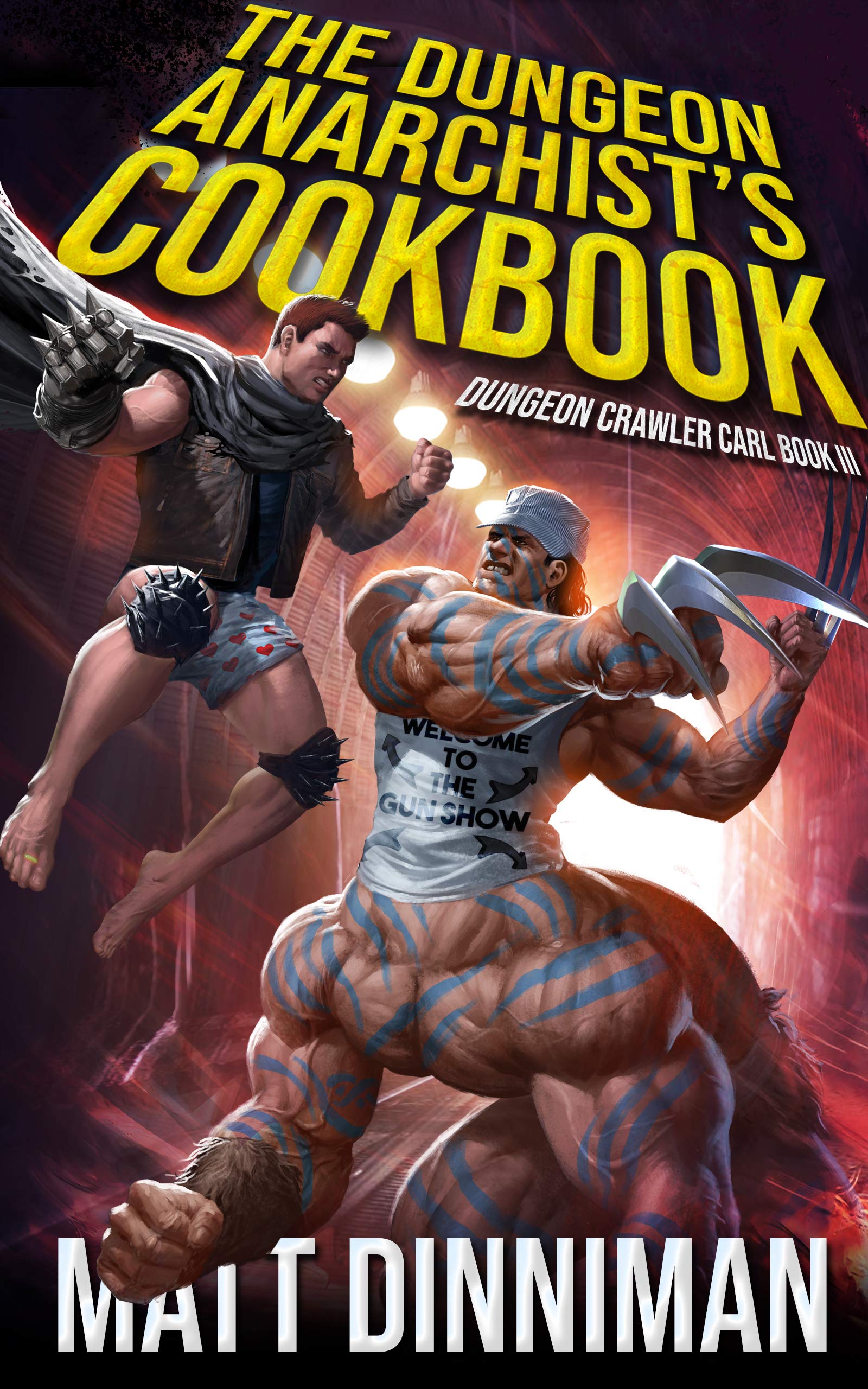
The Dungeon Anarchist's Cookbook Dungeon Crawler Carl Book 3 by Matt Dinniman (2021) (Not a review, just some notes ...