Monday, April 20, 2015

The First Chronicles of Druss the Legend (Gemmel)

The First Chronicles of Druss the Legend, by David Gemmell, 1994

This book is labeled The long-awaited sequel to Legend, but it is, in fact, a prequel. First Chronicles is not the first book in the series. It isn't even the second. However, if you picked up this book, there is little you would miss or would have to wonder about. In other words, you could read this before Legend, if you wanted to read them chronologically, but I wouldn't.

In fact, prior to this, I read The King Beyond the Gate, which was a sequel (or follow-up) to Legend. I was impressed by it enough that I loaned it to my brother and told him to read it now. I wanted someone to talk to about the book. He finally did -- and then turned around and bought the other three book in the series at that time. So I got to read his copies of Legend, and after rereading King, Quest for Lost Heroes, which is farther in the future, and finally Waylander, which is a the earliest in the timeline for all of these, so far, predating Druss's adventures in what are collectively known as the Drenai Saga.

Somehow I moved on to other things and put reading more David Gemmell on the back burner, which is a shame. He passed away several years ago after writing so many other things, not just in this series.

This book takes us back to when Druss was a young man, before he became a Legend. (And the plot of Legend was that he had retired from it long ago and was being called back in -- and had to live up to that status.) You meet his father and learn of his grandfather and the origin of his great axe. The book follows Druss's search for the only woman whom he has ever loved and who loves him, Rowena, after she is kidnapped by raiders along with the rest of the young woman of his village. It's not a shorty story; it's a long journey across the land and the sea and into war to find her and win her back.

It's a satisfying read. There's little magic but there are other fantasy elements, including spirit realms and demons, but the focus is on the men and women. And the axe. Don't forget about the axe.

I actually read this book before some of my earlier entries. When I was catching up, I went through the recently read entries on my e-reader, forgetting that I've had this paperback sitting on a shelf for quite some time. (True story: I started this book during the summer while lounging in the pool, but I switched to magazines which I wouldn't care if they fell into the water.)

Friday, April 10, 2015

Doctor Who: Engines of War (Mann)

Doctor Who: Engines of War, by George Mann, 2014

The Time Lord who rejected the name "The Doctor" nonetheless picks it up again, mostly because readers need to call him something. Likewise, so do the rest of the Time Lords on Gallifrey, including Rassillon, the Daleks, and, of course, his latest companion.

Taking place in the middle of the Great Time War, the Doctor is part of an attack fleet that's ambushed by Daleks. He crash lands on the planet Moldox, infested not only with Daleks, but with Skaro Degradations with new weapons. The Temporal Cannon removes the target from history, though gaps seem to remain. Even though a soldier never existed, his cot is still there, even if you can't remember whose cot it was. (Problems like this occurred with the crack in the universe in the first Matt Smith series.)

The Doctor and "Cinder", whose family was killed by Daleks when she was a child, head off to Gallifrey where the Council decides to kill the Daleks by destroying the Tantalus Spiral and annihilating billions of lives (along with Daleks), which are acceptable losses to save trillions of others. Oh, and kill the Doctor. The Doctor does his best to make sure that neither of those happen.

Long time fans of the series (from before the revival) will be rewarded, but no viewers won't be left scratching their heads.

It reads like a long episode, and that's not a bad thing. It's a satisfying read, but it doesn't really give us more insight into the War Doctor, except that he's already tired of War. He rejects the name Doctor, but that's all he ever seems to be. Again, not that that's a bad thing.

Thursday, April 9, 2015

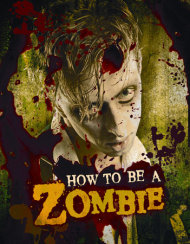
How To Be a Zombie (Valentino)

How to Be a Zombie, by Serena Valentino, 2010

After years of vampires and werewolves hogging the moonlight, zombies have finally found their place in the sun (which the creatures of the night avoid anyway). This book, published in 2010, is a How-To guide for the recently deceased/recently risen on how to be the best zombie possible. It's written like a series of click-bait articles you might find online, but this is something different.

For one thing, the reader isn't assaulted by pop-up advertising. For another, Serena Valentino knows a lot about the different types of zombies that have appeared in popular culture, and it shows.

The book is a bit of a balancing act. For one part, it's written for the undead to adapt to their new life and gives tips on how to fit into society. This part is actually well-researched for something that isn't real. (Or is it?) The other part is for zombie fans who want to cosplay zombies, but these could also be geared toward friends of the undead wanting to help their zombie friends fit in and give them a sense of belonging. Tips on how not to get eaten by your buddies are included (along with tips on not eating your buddies, of course).

It was a fun little read. I picked up the book in a lot that I won at a raffle. It was the only book in the pile that didn't seem to be a paranormal teen romance, so that's what I started with.

Wednesday, April 8, 2015

Yo Mama Jokes for Kids (2015)

Yo Mama Jokes for Kids: Large collection of over 200 funniest Yo Mama jokes for Kids!

I won't bother mentioning the author. Not fair? Probably not. Then again, I didn't have to list this book, either, but I'm trying to keep a list of the things I've read.

Years ago, people used to post a lot of dumb stuff in usenet. (For all I know, they still do.) Everything now and then, someone would gather up material into a "canonical" list that went on for pages. It could be amusing ... or it could be extremely repetitive.

This book is extremely repetitive. Once you get one joke on a topic, you don't need half a dozen more just like it. (By the way, some of the jokes are repeated verbatim a page later, so 200 jokes is an incorrect figure.)

Worse, many of these jokes are old. "How old are they?" They're so old Joan Rivers told them about Elizabeth Taylor. They're so old that Cain told them to Abel because he wasn't self-aware. (The latter, not so much, but the former, absolutely.) Granted, there are a handful that refer to recent events, technology or pop culture, but for the most part, you could find most of these reading social media for an afternoon.

I might've raised an eyebrow once or twice, but never laughed out loud or snorted.

Likewise, 200 one-liners is barely a book, so don't pay for this one.

Tuesday, April 7, 2015

1632 (or The Ring of Fire) (Flint)

1632 (or The Ring of Fire), by Eric Flint, 2000

In the year 2000, a freak occurrence, referred to as The Ring of Fire, sent the town of Grantsville, Virginia back through time and space, swapping places with a plot of land in central Germany in 1632, in the middle of the Thirty Years War. The small mining town quickly realizes the unlikeliness of a second cataclysm putting right what had been torn apart and sets out to acclimate to their way of life. And, of course, survive. Their weapons and technology give them a great advantage, but they no longer have the industry to produce that technology. Nor do the have the industry to produce the industry ...

An alternate timeline is born as the United States of America is founded 144 years early (and on a different continent). History plays on around them.

The book divides its time between brutal battles fought across Germany, building a new society and some overlong passages on just how well the Americans are getting along with their new neighbors and each other. Putting a new government together has its growing pains. By the end of the book, you get a sense that things will go well even though there's much more to do and more dangers to face, but you'll be satisfied that you weren't left hanging until the next book.

1632 is the first of a series, but is a fine standalone read. It has launched a shared world of sorts, with other established authors writing stories. The first sequel will be on my "To Read" list before I decide how much farther I'll go with the series.

Saturday, January 24, 2015

Dirty Machines (Olson)

Dirty Machines, by David Matthew Olson, 2014

Dirty Machines is a story that puts forward a lot of ideas and doesn't develop any of them, which is a shame because some of them could have been good. Starting from the beginning where the main character's name is omitted and references to it are jarring to say the least. (Seriously, it's "[Del]" or "[Del]'s" or similar and it wasn't until much later that I realized that it was supposed to be a reference to the "Delete" key.) Not that it matters what his name is because he'll change it when he goes into the future.

The plot centers on the head of the world's only Time Travel company (which replaces the letter "T" with stylized crosses everywhere!) personally comes back a few decades to convince our nameless protagonist to journey into the future. Here's the hook: if he doesn't, history says he's about to die from a stray bullet while minding his own business. However, they can replace him with some poor shlub from the past who is genetically similar and dressed up in a matching outfit. The doomed man, who would've died alone in the past and never have been found, gets a quick death and spares a life. The catch: now that he knows, he can't avoid his fate because they can hit a magic Reset button and he'll be back on the subway before the offer was made with no memory of the meeting and blindly unaware that he'll be on his way to his death.

Naturally, he agrees after considering if this is some kind of gag. And smoking some weed. And whining and complaining about stuff.

Never answered is why Jim Doors (a reference to things hidden behind doors or to Jim Morrison of the Doors?) is so interested in the protagonist. Yes, a reason is given, but it isn't a satisfactory one, so you figure that there must be more to it. The most important, most powerful man in the world takes a special interest in some random pothead, stand-up comedian because he thinks he can write click-bait articles to get the world reading more? What?

The time travel at the center of the story is even more confusing. Everyone is free to travel back in time to visit important events as spectators, but no one may change The Course because that would be bad. But with all these people going into the past (there are mandatory trips), where are they? Only a handful are ever present at an event, such as a bus filled with witnesses to a major milestone in time travel history could be seen by the people of that Era and yet it's always the same bus. Does the trip get Reset? But then why is it there to be seen in the Past.

The title "dirty machines" refers to unauthorized time travel machines and isn't referenced until at least three-quarters of the way through the book. It could have been a separate plot in itself (and probably should have). And then there's the ending, which I won't mention, except to say that that scene should have taken place a hundred pages sooner with the story going on from there.

I could go on nitpicking some pretty sizable nits, and not just the massive numbers of typos. The narrative is disjointed, randomly switching point-of-view characters. There are no chapters, just breaks in the text. An entire section is crossed out -- I guess to symbolize that it didn't take place. Details of the future are sketchy and are poorly delivered. The main character is lost without his iPhone but hesitates to use Current tech to the point that others have to keep filling him in. The book touches real life with a flyer for Stephen Hawking's party for time travelers and circles back to it with time travelers having a party across the street and observing Hawking through his window all alone. Hawking could never know the "truth" of the matter. Ultimately, he got the better end of that deal.

Final note: the book suffered from not having an editor or a copy editor.

Friday, January 23, 2015

Shards of the Glass Slipper: Queen Cinder (Mauritsen)

Shards of the Glass Slipper: Queen Cinder, by Roy A. Mauritsen, 2012 I was first drawn to this story by a series of paintings hanging in the Art Room at Lunacon (a long-running Northeastern science fiction convention, usually held in Rye, NY), each with its own vignette, giving a new twist on each of the fairy tale characters that were more in line with the original interpretations than the 20th-century incarnations. The artist was Roy A. Mauritsen, and his book uses these characters.

His incarnations flow together very nicely with a few odd twists among them, most of which are enjoyable. (I have a couple of quibbles about how some of the characters, and their relationships to each other, but they work within the story.)

I don't want to give anything away -- I'd rather let the characters reveal themselves as the story progresses, even if you think you know who's coming next, as you get caught up in the tales of those grim days after the Beanstalk War when Cinderella has to ascend to the throne. Fairy magic is on the wane and with it the power of witches, but is there another source of power that can be tapped into?

My only complaint was that the subplot was actually the build-up to the sequel, which I now have to find. (Like I wasn't going to get it anyway!)

Thursday, January 22, 2015

365 Things I Learned the Hard Way (So You Don't Have To) (The Digital Writer, Jonathan Wondrusch)

365 Things I Learned the Hard Way (So You Don't Have To), by The Digital Writer (Jonathan Wondrusch), 2012

A free ebook on the writing business by a writer. Quick! What's he trying to sell me? Actually, he isn't selling me one thing -- he's selling me on a lifestyle, a workstyle, a way to make it all click, if that's what I want. And that should be what I want.

The Digital Writer puts together and presents information in a usable way, heavy on the discipline, easy on the hard sell. He recommends ways to establish your presence, your brand, online in social media, and the ways to monetize it. Because if you aren't monetizing, then what are you doing? He also tells you when to pay for others to do the work for you -- specifically, hiring an editor and paying for good cover design.

A good chunk of the book is dedicated to writing copy, which is a promising field to get into that pays well when jobs are available, as well as making ebooks starting with information that's readily available by consolidated so that the reader doesn't have to research it, and search engine optimization, because you want users to find you when you know that they aren't going to look at that second page on Google.

Ebooks, by the way, are a great source of steady income once you build a following. There's a good discussion on pricing, which has recently changed as Amazon has changed its terms.

The final part of the book is a Q & A from letters he received on his Digital Writer blog. They get a little repetitive with the rest of the book and with other questions, but it's definitely worth skimming. One thing that impressed me was that he recommends two great books to learn how to write copy -- and they aren't his. They're the ones that he learned from and he recommends them. You have to admire that. If nothing else, it definitely improves his brand.

Wednesday, January 21, 2015

The God in the Clear Rock (Randolph)

The God in the Clear Rock, by Lucian Randolph, 2011

I "purchased" The God in the Clear Rock as a free download after seeing it promoted on Reddit or, perhaps, some other site listing free ebooks. I'm glad I didn't waste any money on it, and I'm certainly not going to spend a dime on any of the sequels.

Full disclosure: I didn't get far beyond Chapter 1, but had I kept trying, I'd still be reading this book weeks later. I'm stunned by how poorly it's written. This isn't a case of misspellings and glaring typos. The prose itself, the descriptions, the dialogues, the analogies used in the exposition need serious work. The writing is terrible. The dialogue is terrible. The odd metaphors describing actions and objects are more distracting than helpful.

One of the dangers of self-publishing is that you try to do everything yourself and don't get good feedback. One piece of advice I've seen repeated is spend the money you need to on an editor and good cover art. The cover art is decent. The absence of an editor is obvious.

The writing was so distracting that I couldn't stay with it long enough to discover if the story (which the author states in the Foreward would be a cliffhanger in each part) was worth trying to follow. The other reviews I saw on sites such as GoodReads tell me that I made the correct choice.

The one bright side of this: I'm curious how many of these books his put out and what his sales are like. If this guy can make enough money on ebooks to write six novels, then anybody can.

Thursday, July 31, 2014

Realm of Measure (Asimov)

Realm of Measure From the yardstick to the Theory of Relativity, by Isaac Asimov, 1960 Removed from circulation from my school library and regulated to the trash pile before I spotted the circa-1960 photo of Isaac Asimov on the back cover (looking younger than I've ever seen him before, so I surprised myself by recognizing him), serendipity brought Realm of Measure: From the yardstick to the Theory of Relativity into my possession.

I'm happy that it did. Though billed as an exploration of mathematics, he veers off a bit into scientific measurements, but I'll still count this toward my goal of reading one interesting book on math each summer, and this one does it without spinning out of control with endless, overly-complicated and overly-ridiculous equations.

Asimov goes into the history of measurements and how certain units came about and how the different units relate to one another. Not only did lengths like palms and feet have to be standardized from person to person and town to town, but also in relation to each so that they could be divided more evenly among people without formal education but who could count and compute the basic operations.

Asimov pushes for the metric system often throughout the book, as it's used a lot in science (where he was quite at home), not to mention in most of the non-English-speaking world. (He doesn't actually mention the measure of the English-speaking world using British units.)

The biggest problem with his arguments is that he presented the beauty of American/British system in its origins. If you were a wordsmith, you might be interested in the etymology of words, where they came from and how they came to be. You wouldn't stand for simplified spellings that are attempted from time to time. (Benjamin Franklin had a serious plan to change the language and simplify spelling, for instance.) When you read the origin of who's foot we use and who's armlength, and why a furlong is 1/8 of a mile, there is a wonder to it that goes beyond, "You see, there's this stick, and it has these two marks in it...."

Further, the system of divisions make sense. Think of the times. Think of the people and how they lived. If they split things, they likely halved them. If they had to quarter something, they halved it again. How often did someone come along with nine of his friends and need things sorted out evenly among them. And for all those divisions, 10 isn't a great number to work with: you can only divide it by 2 and 5, but not 3 nor 4. Dividing 12 by 2, 3, 4 and 6 proved more convenient, if it you lose 5. Moreover, metric conversion is easy in that you can switch units simply by moving the decimal point, but first you had to invent the decimal point! And that didn't happen to, what, the sixteenth century?

Oddly enough, I can sit here and argue that the time for the metric system has passed. We're living in a computer age, ruled by binary and hexidecimal. The number 10 really doesn't fit well into that scheme. And once you get passed 11th year math, base 10 goes out the window in favor of natural logs and e.

Not that any of this took away from my enjoyment of his book, which I heartily recommend to all with the proviso, "Don't try to read it in bed when you're really tired."

And I'll close by considering how close NYC came to allowing 16-ounce soft drinks while banning 500 milliliters. Metric: not even once.


Apparently, this is the first Asimov book I've reviewed, as his name was not one of the tags, which is odd because I have read some of his books since I started this blog, or at least since I kept track of the books in my paper journal. The most recent Asimov book I read which comes to mind was The Currents of Space. It's an Empire book and I remember wondering when the Robots would show up because I had Caves of Steel on my mind.

Tuesday, July 15, 2014

Guilty Pleasures (Hamilton)

Guilty Pleasures (Anita Blake, Vampire Hunter #1), by Laurell K. Hamilton, 1993

Before Buffy was slaying vampires on television, Anita Blake was executing them in a series of novels.

Anita is an Animator, she has the ability to raise the dead, creating zombies who can, briefly, retain their memories and personalities. She also kills vampires, but there's a catch. Vampires have are people, too, you know. They have rights, and they can only be put down by court order. Otherwise, they stay and operate in their own districts of the city. Guilty Pleasures is just your typical vampire nightclub. It isn't hiding anything nefarious. Of course, it's not.

As the story opens, Anita is being hired by a vampire whom she recently knew as a person. They want her to look into a series of unsanctioned vampire killings. She's not a private detective, but they think that she knows her stuff. Who better than someone who kills vampires to deal with another vampire killer.

Oddly enough, even though she isn't a private detective, that didn't stop me from reading the book if, in fact, she were. Actually, in my mind, the narrator had the same voice as the woman who reads the Sue Grafton, "Kinsey Millhone" audiobooks. It made for an interesting but unintended mash-up. I enjoyed the book, although I wasn't riveted. I took my time, mostly reading it on the trains, and occasionally before sleeping. I would recommend it if you like your vampires straight-up evil, manipulative and oozing with power. They may have the rights of humans, but they aren't trying to be human.

I found the first five books in the series on a shelf at the Salvation Army Thrift Shop. Unfortunately, I only picked out the first book because I didn't want to spent that much money upfront on a series that I knew nothing about, hadn't heard of before. For all I knew, I was buying "chick lit". You may like that sort of thing, but it's not high on my summer reading list (even if I did buy it in the springtime). It's probably better this way because buying the first book forced me to read it sooner so I could decide to go back for the others before it was too late. A good plan, but I didn't move quickly enough -- someone picked up the rest of them before me.

By the way, had I bought all of them, they could still be sitting there on my shelf. I have bought quartets of books only to return them a year or two later, unread.

Two notes about the series:

First, they seem to have been popular, despite my not having heard of them. I asked online if anyone nearby had copies of the books. I got quite a few responses. Two guys I might've expected had had them, but they're too far away to borrow the books (the tolls just to Jersey are over $20, and let's not forget the gas!). And two women who I wouldn't have suspected both told me that they had read them when they came out, but neither had them any more.

Second, be warned that the series changes after the fifth or sixth books. Fans debate whether or not the change was for the better. What was the change? I don't know, but I could guess. And if I couldn't, my sister's response of "LOL! Oh, yeah, they changed!" tells me that it's probably not in a direction I'm wanting to follow.

That said, if I can find these books, I might have 4 or 5 more good reads this summer.

Tuesday, September 10, 2013

Letters to His Son on the Art of Becoming a Man of the World and a Gentleman, 1746-47 (Chesterfield)

Letters to His Son on the Art of Becoming a Man of the World and a Gentleman, 1746-47, by Earl of Philip Dormer Stanhope Chesterfield, 1747

I am not kidding about either the title of the book by the Earl of Chesterfield or the fact that I read his letters. There were quite interesting, illuminating even, although I wish I'd had the Internet handy more often when reading it to look up some archaic words or translate some French, German or Latin phrases.

I saw the e-book while perusing the freebies on Amazon.com. This one caught my attention, and I'm glad it did -- so glad, in fact, that I don't mind posting that website, which I usually shy away from doing.

Two reasons to read it: first, a little historical lesson couldn't hurt (and it didn't); second, what better way to write the part of a gentleman than to have one explain to his son how to become one (this worked for me). A couple of the chapters were boring, but others were instructive or downright amusing (and not always intentionally).

It's a short, free book, and I recommend it.

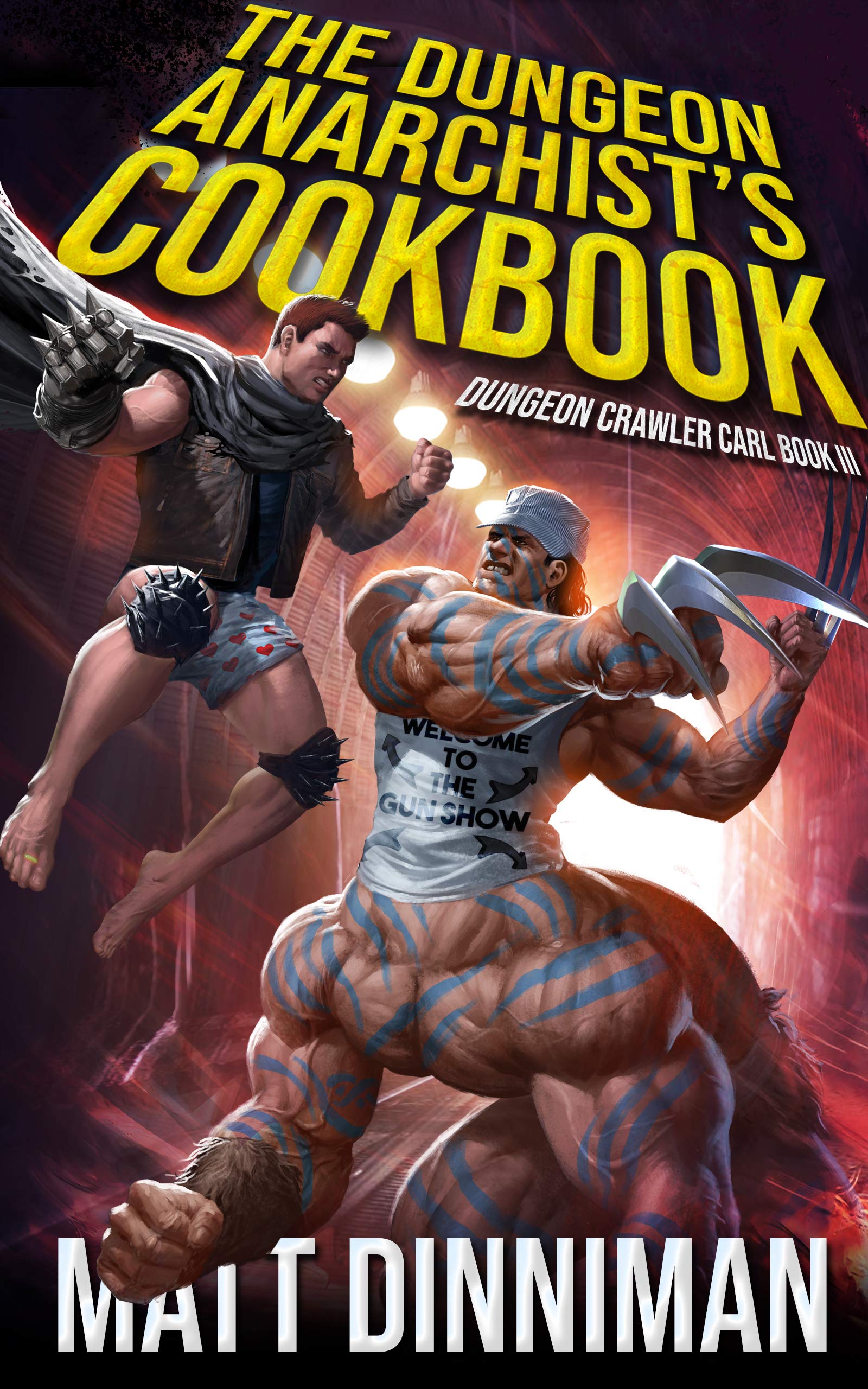
The Dungeon Anarchist's Cookbook (Dinniman)

The Dungeon Anarchist's Cookbook Dungeon Crawler Carl Book 3 by Matt Dinniman (2021) (Not a review, just some notes ...