Monday, April 10, 2017

The Happiness Handbook (Sonne)

The Happiness Handbook, Lisa T.E. Sonne, 2015

Not my usualy read. This is basically a collection of 1-2 page long affirmations, to be read daily or all at once. Listed with no apparent order or theme. No chapters to speak of, nor any appendix or list of references at the end.

This book was a gift I received at an after-the-holidays birthday gathering. I didn't want to put it off because, if asked, I'd like to say, yes, I read it. I figured that I could probably get through it in a couple of mornings on the train. Instead, I found myself playing games on my iPad a little more often rather than reading.

There wasn't anything too deep within the pages beyond the expected "you can be happy"/"you should be happy" vibes. Despite some interesting quotes from people, I would be hard-pressed to tell you any specific idea presented within the pages.

Fluff. Worse: it turns out I never finished it. I found my bookmark just before I started writing this. (I read the book in February.) I quickly tried to skim the last 20 or so pages and ... stopped.

Moved on to the next book.

Statistics: hardcover, approx 220 pages, non-fiction, inspirational, self-help

Monday, April 3, 2017

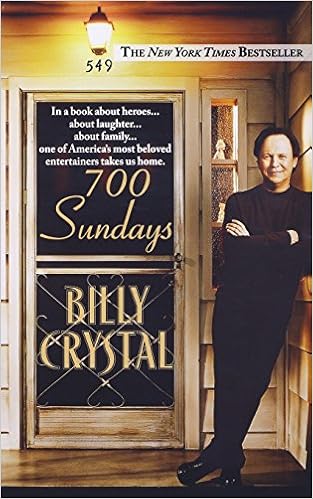
500 Sundays (Crystal)

500 Sundays, Billy Crystal, 2005

Catching up on this year's readings, so far. Not that there's much of it.

500 Sundays was the name of Billy Crystal's one-man Broadway show, telling stories about growing up with his father, and life after that. The title comes from the fact that his father's one day off was Sunday, which he spent with his kids. Unfortunately, he died when Billy was only 14, which meant that they only had about 500 Sundays together. He doesn't go into every one of these. In fact, there's plenty that happens on weekdays at the Commodore Music Store in Manhattan.

I saw Crystal's show, so reading this was almost like reading a transcript of the show. I remembered quite a few of the stories, in particular, the fact that the first time he was in a movie theater, he was sitting on Billie Holiday's lap. Dad was in the music biz, particularly around Jazz. Billy Crystal grew up in that show-biz environment.

A lot of heart-warming stories are contained within, and it's an interesting contrast to two biogrpaphies I read recently: one by Don Rickles and the other by Martin Short. I guess I like reading about funny guys, even when their lives aren't all that funny.

The book continues past the 500 Sundays of the title and continues with his growing up, getting into show business, and, of course, life with his mother. The end of the book comes with two tragic events. I'm not giving much away to say that dealing with the grief of his mother's passing is the first one. The other is 9-11. Actually, there was anecdote from the show abut 9/11 that he left out of the book. Maybe it wasn't a good note to end the book on. (I think it came earlier in the show, because it involved meeting then-President Bush.)

One of the reasons I remember his story involving Bush and, believe it or not, Regis Philbin, was because I heard him tell it on a morning radio show in the months after 9/11. When he told it in the show, he changed the payoff line, which admittedly wasn't incredibly funny in its original form, to one that took a shot at Bush. That might've been funny in 2005, but it would not have been something he could've said to the President during a World Series game in 2001. It's just as well he omitted it.

Anyway, it's a sweet, fun read that drops quite a bit of names and gives you a bit of background about Crystal.

For my own notes: this was a hardcover book, not an ebook. I picked it up at a library sale.

Saturday, December 31, 2016

2016 Reading Challenges (Don't Call Them Goals)

Back at the beginning of the year, I saw a challenge to set a goal of reading 60 books in a year. I laughed it right off. Sorry, but as much as I like to read, I don't often get the chance. My two prime slots from reading are commuting by train and falling asleep, the latter being particularly hazardous with hardcovers and ebooks. For the first half of the year (and most of the fall), I commuted by car, losing almost 2 hours round trip daily.

So I found some other Challenges which I list in this this post. I considered them something to shoot for, and maybe to influence my choices in this past year, but calling them goals? I ruled that right out. Sorry, I'm in it for the fun. Putting a goal in front of it makes it a little more work. The journey is more important the finish line right? (With my eyesight, and age, I'll never win Indy, so yeah.)

(By the way, ignore the hashtag. It was already there, so I wasn't making a new one.)

In the first batch, I can say I caught up with a book I've been meaning to read, one given by my spouse, one published before I was born. A few of the books had been in the house for quite a while before I read them.

I don't usually get recommendations from booksellers (although I do own two such books -- I asked for opinions before getting them signed by Mary Higgins Clark and Carol Higgins Clark). No banned books or high school/college books this year, but I have gone back to those. I can't say book intimidate me, except for math books that get really theoretical about halfway through. And with so many books to get through, revisiting old ones doesn't generally happen. (I did double-check to see if I'd read or even listened to one of the Sue Grafton books this year, but no, I hadn't.)

As to the second reading challenge, it's a little longer, so I'll just hit the highlights:

I read books under 200 pages, but not over 500 (no GRRM, Tom Clancy or Stephen King). Curious Incident won many awards, though I don't now about National Book Award. Ditto for Tuesdays. I read a couple of graphic novels (however those are defined) as well as manga, but I didn't list those -- maybe I should? Several female authors with female protagonists, particularly the aforementioned Grafton, as well as those teenage paranormal romances, all of which had protagonists with different lifestyles than I have. No essays or poetry, but a collection of short stories, which had some essays, that I put aside and didn't get back to, but will. There was science fiction to be found, but not much in the way of self-improvement this year.

Will I continue with these challenges in 2017? Maybe. It depends on what new challenges I find, and how "reasonable" I think they are.

Thursday, December 29, 2016

Vampire Academy (Mead)

Vampire Academy, Richelle Mead, 2007

Okay, for starters: There are two types of Vampires: the Moroi, who are living, breeding vampires, and the Strigoi, who are your more traditional evil vampires. There are also Dhampirs, which are the offspring of Vampires with humans or dhampirs. Dhampirs are mules, unable to reproduce on their own, so they owe their existence to the Moroi. If you search online, you'll find that these are creatures from Romanian folklore, which is a plus for me. Mead takes something existing, which I'm at all familiar with, and makes it her own.

The Moroi aren't your typical vampires. Besides having families, and vampirism being hereditary, they also go to church every week, even if just to learn about St. Vladmir, the patron of the academy. One of the characters is even named Christian, which seems odd at first blush.

This book is the last in a pile of books I won, which included How to Be a Zombie, A Great and Terrible Beauty, and Catching Fire, which I'd previously read but don't seem to have an entry for. (I donated that one to the hotel's library by the pool.) I wish I could say that I left the best for last, but that really, I left the one that looked like I'd least enjoy for last.

First off, I'm not the target demographic for this book. I joke around about Teenage Paranormal Romance, but they are a big sub-genre. They don't have to appeal to everyone. Like Bray's Great and Terrible Beauty, there was a bit of "Mean Girls" to it, but unlike it, the fantasy elements just didn't make it worthwhile for me.

Not to compare it to Harry Potter, but as an example, we don't expect Harry to defeat Voldemort in Book 1, but we expect that he'll make an appearance. In Vampire Acadmeny, much is made about the Strigoi and while I don't expect Rose to take one down (any one, but a powerful one, or the "main" one, if there is such a creature), you might expect on to show up at some point. Basically, the book was long on Academy and short on Vampire.

So little, in fact, that halfway through it, I imagined a "What If...?" where I replaced the Moroi, Strigoi, and Dhampirs into High Elves, Dark Elves and Half Elves. I could write it -- I wouldn't, but perhaps I could.

Again, I'm not the target audience here, so if anyone found my blog and this is your genre, don't let me turn you off from the adventures of Rose and Princess Lissa as they learn how to protect vampires or just be a vampire.

Would I read farther into the series? Probably not, unless the sequel showed up in another book raffle.

Sunday, November 20, 2016

So You Think You're Irish (Kelleher)

So You Think You're Irish, Margaret Kelleher, 1988

This book, published originally in 1988, and reprinted in 2014, was an impulse buy at a discount store. (Note the blurred price tag in the photo.) I'm not aware of any updates to the book for the new edition. Oddly, I never checked when it was published until I was typing this entry. This might explain why my knowledge of history was so rusty, considering that there isn't anything from the past 30 years or so, which would be most of my adult life when I might've been paying attention to such things.

I'll come right out and say this book was a bit of a disappointment, but it was an impulse buy. I shouldn't flipped through the pages a little bit before making the purchase.

The book consists of some 500 multiple-choice questions about Ireland, divided into categories: Irish History, Irish-American History, Beliefs and Legends, Entertainment, Words, Food, etc. The questions were a little too picky, and sometimes several focused on the same event (in some case, inadvertently giving away answers). I'll admit that I don't know the names and contributions of every famous Irish man and woman in each of two countries (and a few around the world).

What I found missing was any sense of cohesion tying the entire book together. Maybe an introduction into each chapter. Perhaps a little more information woven into the answer keys that followed. Something to make reading about random events, people and facts a little bit more interesting.

I'd almost put the book aside before I'd gotten to the chapters on Words and Food. I did pretty well in those, having heard quite a few of those terms over the years, from my family, old movies and even music. As a bonus, the Answer Key to the Food chapter actually included some recipes. I'll likely photograph the bunch of them and try one or two of them out sometime. (Likely not the soda bread -- my wife already makes a good soda bread. No reason to try something new.)

So it was interesting in bits, but overall, not what I was looking for. Sadly, I think I have something else in the closet that's similar. I won't mind if it refers to things I might have heard of or can reason out. But this was just guess, guess, move on, etc.

Final notes: I had a Post-It for a bookmark (two, actually: one for the answers). I scribbled down a few notes to look up, which so far, I haven't. So in case I lose the note, here are the entries:

  • Lough Derg ("Lou Derg")
  • Hy Brasil
  • Femoril
  • "keener"
  • Giants Atrium (cooling lava)

The parenthetical "Lou Derg" was (I think) me thinking that that would be a good name from a character in a story, having a little inside joke in his name.
Giants Atrium is a place formed by cooling lava, and I wanted to research it because it has the natural feel of a fantasy story location. (Maybe for Lou Derg?)

Final verdict: don't waste your time, even if it's only an hour.

Saturday, November 19, 2016

History Bytes (Vulich)

History Bytes: 37 People, Places and Events That Shaped American History, Nick Vulich, 2015

I don't remember how I found this one. Maybe it was posted as a free ebook on Reddit. I don't know.

It was well-written and the bibliography, with some very old sources, shows that it was well-researched, too. If anything, however, I would have liked some references to the bibliography in the text. The tone, at times, is conversational, so it would be nice to know where some of this information is coming from.

This wasn't a book of little-known events, and for history buffs, there probably isn't much here. There was some interesting tidbits, but nothing that made me say either "I never knew that!" or "That can't be right!" But there was information about from Colonial times, the Revolution, the Civil War, western expansion and outlaws. Why 37 events? No answer, but why not?

(Aside: sure, there were probably things that, had I'd ever learned before, I'd forgotten about, but nothing so incredible to amaze me.)

Interestingly, there was some overlap with Great Train Robberies of the Old West, which I reviewed back in February. Nothing here contradicted anything from that one.

You might be able to find a lot of this information online, should you care to look for it. Question is: would you?

Quick read. Enjoyed it.

Friday, November 18, 2016

The Pirates Who's Who (Gosse)

The Pirates Who's Who, Philip Gosse, 1924

The Pirates Who's Who was written by Philip Gosse in 1924, but through the magic of the Internet, it lives on as a Project Gutenberg ebook. Also, the fact that it's so old adds to its authenticity that it was likely more researched than anything that might be published for the first time as an ebook today. This doesn't read like a lengthy version of some click-bait article.

That said, what it does read like is an encyclopedia because that's what it is. Now, there isn't anything wrong with that, except that the document format of the particular version I have could be greatly improved if it had cross-referencing hyperlinks. This is one of those times that paper beats electronic -- flipping back and forth with fingers holding your place.

Okay, so why choose this book? Subject matter, obviously. Did I realize that it would be an encyclopedia when I downloaded it? No. Was that a problem? No.

Gosse included an introduction to the book which was interesting in itself and while some entires are extremely brief, others contain stories, adventures, rises, falls and final judgments of many colorful characters. That's the heart of the book.

That said, it obviously wasn't meant to be read cover to cover, and I made it 28% of the way before moving on. Important to note: 1) I will get back to it, 2) I stopped because I had some writing to do. There was a flash fiction contest on the topic of pirates. I had thought, but I wanted some authentic background, other than looking up the differed between a buccaneer and a Corsair. I found some inspiration with stealing anyone's tales.

Unfortunately, the first draft was worse than usual, and I didn't have proper time for a second. I thought I might be able to sneak it in by, say, nine the next morning (because pirates break rules!) but the contest was already judged by that point! I guess there weren't any last minute entries.

Added note: I will get around to finishing that story. Hopefully before I finish this book.

Unfinished. I will return to it, which means either editing this entry or giving it a second one.

Thursday, November 17, 2016

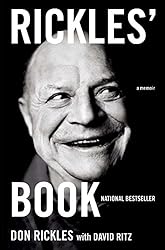
Rickles' Book: A Memoir (Rickles, Ritz)

Rickles' Book: A Memoir, Don Rickles, David Ritz, 2007

I was taking lunch, walking down Pennsylvania Ave in Brooklyn when I passed a Thrift Shop with stacks of books outside. I saw Don Rickles' face on a cover with a sticker price of a dollar. For less than a cup of coffee, I had my subway reading. I picked up the book and then perused most of the rest of the shop (as long as I was there).

A quick flip through the book showed that it was written in 2-3 page chapters or vignettes. I assumed that they would be a collection of funny anecdotes and jokes, but it wasn't. Some were serious. Some were amusing but didn't exactly end in a punchline.

This book might be of interest to long-time Rickles fans, but I doubt the appeal would go much further. Little is mentioned about his life before comedy. He was a kid for a couple of chapters, then in the U.S. Navy, and then trying to establish himself in comedy. Along the way, he drops a lot of names. He talks Vegas, and mentions Hollywood. Oddly, I had only recently seen the clip from The Tonight Show when Rickles broke Johnny Carson's pencil box when Johnny wasn't there and the following night, Carson marched across the hall to the studio where CPO Sharkey was filming and confronted him. That story is included. Also mentioned is the longtime friendship with Bob Newhart, his connections to the Rat Pack and even Elvis.

And, of course, there's a story about his grandkids and Mr. Potato Head from Toy Story.

The one other amusing connection with this book is that while I was reading it, Rickles appeared on Jimmy Kimmel's show along with John Stamos, and then proceeded to talk a lot about Bob Saget.

Last amusing thought: the "other books by" page notes that David Ritz has written about a dozen "autobiographies" featuring the lives of a dozen different people. I think I need to look up that word because I'm not sure that that is the correct meaning of the word.

Wednesday, November 9, 2016

The Darwin Awards: Intelligent Design (Northcutt)

The Darwin Awards: Intelligent Design, Wendy Northcutt, 2000

While covering for another teacher, I glanced at the books on her shelf, and I spotted this little gem of humor. The Darwin Awards are famous and shouldn't need an explanation. I read posts when they show up on social media, but I've never been to the actual websites where stories are posted, discussed and voted on. Nor have I read an entire book of them before.

THere are some amusing stories within these pages. On the other hand, they are also a bit sad. As you chuckle at others' misfortunes, you remember that these were real people, some of whom did very foolish things. And when they are grouped together by categories, they can get repetitive in nature. Maybe that's why I preferred some of the "Honorable Mentions" -- a person gets one of those, generally, by living through their spectacular lapse of judgment.

In addition to the anecdotes, each section has an actual science article as an introduction. It provides some insight as well as a needed distraction.

A quick read. Glad I read it, but I'm not quickly running out to find another one.

Tuesday, November 8, 2016

The Magazine of Fantasy & Science Fiction (Van Gelder, ed)

The Magazine of Fantasy & Science Fiction, March 2002, Gordon Van Gelder, editor

Catching up on my reading list, this is the first of several posts in the days ahead. >P?First off, okay, it's not a usual book. However, at 160 pages of mostly fiction, this one issue of the long-running genre magazine has more reading material than some of the actual books that I read.

I have quite a few SF/F magazines in the house. Most of them are issues of Analog because I had a subscription for a number of years, and I never could keep up with them. Where this issue of Fantasy & Science Fiction came from, I'm not sure. There's nothing to indicate that it was mailed to me (no label, or glue), so my guess would be that it was a freebie at a science fiction convention somewhere, most likely Lunacon, which is held (almost) every March.

I have a pool in my yard. I don't sit in read by the pool very often. On the other hand, I've started to like reading in the pool. This means no ebooks (obviously) and no books that I would care about if I "lost". That is, if they took the plunge. These decade-old magazines fit the bill nicely.

I can't say that I was ever a regular read of F&SF but this had a decent selection of stories. Also of note: there wasn't an editorial column up front, and of the "departments", Paul Di Filippo's Plumage From Pegasus: Press One For Literature read like another short story. Added bonus: to my knowledge, I've never read anything by Di Filippo before, but I have two novels in my closet in yet another "To Be Read" pile.

The stories covered a broad spectrum of the genre. There was a religious-based story, which I didn't quite understand, but didn't hate, and a cute retired superhero tale.

On the downside, the novella "Coelacanths" by Robert Reed left me scratching my head.

Albert E. Cowdrey's novelette left me wondering what I missed in his previous writing. This entry, "Ransom", was his third story in F&SF. It started in a different century than his prior two, so I thought I was safe. However, it quickly time-traveled farther into the future, into territory I felt that I should have been more familiar with. I must've put it down a few times before the actual story got going.

So there was some good, some bad, some ugly, but nothing to stop me from picking up another issue. Except that the summer is over, the pool is covered and I have stacks of books to read.

Tuesday, September 13, 2016

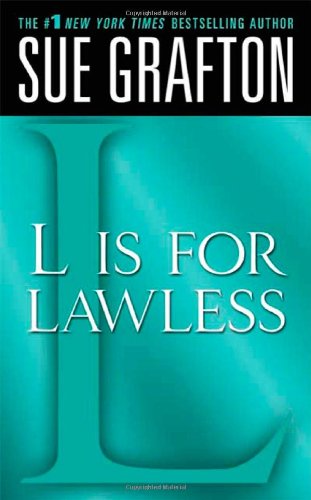
L is for Lawless (Grafton)

L is for Lawless, Sue Grafton, 1995

This is the 12th book in the series, in case you're counting letters of the alphabet on your fingers. After being a little disappointed by the ending of the K is for Killer, I went straight into the next book. I knew from the start, it wasn't going to be a good time for Kinsey, but at least this time, that fact is telegraphed in the opening comments before the story begins.

For the second time in four novels, Kinsey is involved in a wedding party. (You can't say always a bridesmaid, never a bride, because she'll bring up her two past marriages.) And as with the last time, she gets caught up in events that take her away despite the upcoming event. The last time, it was against her will and she wasn't free to go.l This time, she's following a duffel bag of stolen goods and she can't let her only lead vanish.

And as Kinsey points out at the start, for everything she's going through, she's not even getting paid.

The story begins with landlord Henry Pitts asking Kinsey to help out the family of a deceased neighbor down the street. The family has been trying to get death benefits paid for the grandfather, who had served in World War II. The only problem is that the military keeps saying that they've never heard of him. She volunteers to help look for information in his records that might provide some missing key information that would identify to prove to military service, so they can claim the few hundred dollars they believe he's entitled to.

While searching through old military books, she meets Ray Rawson, an old acquaintance of the deceased Johnny Lee from back East. Ray is looking to move to California and wants to rent the apartment. It doesn't told long to figure out that both Johnny and Ray are full of secrets, the first of which being that Johnny was never in the military -- that's just the story that was told to cover up his two-year absence.

After the apartment is later ransacked, Kinsey follows the thief all the way to the airport, where he gives a duffel bag to a woman who is boarding a plane for Florida. Kinsey buys a ticket and follows, with only what personal items she has in her bag, and a credit card that's nearly maxed out after the airfare. A wrench gets puts in the plans when the woman gets off the plane in Texas.

The mysteries unfold as we find out where Johnny had been, how Ray knows him and the connection to Gilbert Hays, who is both ruthless and persistent.

A satisfying read, and while the ending wasn't given away in the intro, you know it's not going to be the best outcome for Kinsey. On the other hand, it's probably the only one that would make sense, as it extricates her from some events of dubious legality.

As for the continuing elements: obviously there's the wedding between Rosy and Henry's brother, and his whole family is present for it. Also, there's some movement on Kinsey's newfound relatives.

This was an ebook loan from the libary.

Sunday, September 4, 2016

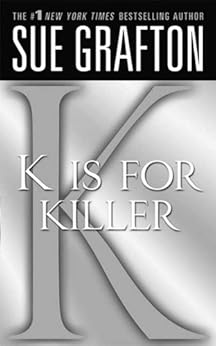
K is for Killer (Grafton)

K is for Killer, Sue Grafton, 1994

This is probably the fastest I've read any book in the series to date, having extra time on my hand. (I finished a few days ago, but I had connectivity problems.) It's also the first one where I was disappointed in the ending. I won't give it away because there are a few people besides me reading this blog.

One thing I can say for the series is that they don't all end the same way. There isn't a shoot-out in every book. The guilty party doesn't end up always end up dead (although truth be told, I do prefer mysteries where the guilty party is named and caught, and not left flying in the wind).

Let me back up a bit. This novel takes places less than a year after the events of J is for Judgment. Kinsey takes on a cold case after she gets a visit in her office from a woman who a support group that meets in the same building after the woman spotted Kinsey's name on the building's directory.

Janice Kepler's daughter, Lorna, was found dead ten months earlier in an isolated cabin located some distance behind the main house on the owners' property. Her body was discovered a couple weeks after her death, and the state of the corpse made determining cause of death impossible. They couldn't even tell if it was a murder or an accident.

What makes the mother seek answers now is that she suddenly received a video in the mail, a professionally-made porno film, in which Lorna was the star. Why did someone send it to her now after all this time? And did it have something to do with her death?

Kinsey isn't sure that there is anything that she can do after all this time, but she agrees to look into the investigation (which is technically still open), going so far as traveling to San Francisco to talk to the people who made the movie. Likewise, finding out that Lorna was a prostitute, Kinsey finds and befriends another lady of the evening who knew the dead woman.

And to top it off, Lorna worked part-time at the water treatment plant, which was a cover for all her other activities. She had to make some honest money somewhere -- although she made sure to pay the IRS taxes on everything!

There's plenty to follow in the story, but it takes a sideways turn when a mysterious, shadowy figure is introduced who you know will play some part in the ending either for good or for ill. The character gets mentioned so little in the rest of the novel that it could have been excised entirely.

But that brings me back to the ending, where Chekov's Mysterious Figure must return. That in itself might not be so bad, but how he comes back bothered me.

I don't think Grafton wrote herself into a corner and chose to add this extra character to handle things. Other resolutions were possible, even some which wouldn't copy what she's done before. Likewise, I can't say that it was a lazy ending. After all, this is the eleventh book in the series and she plans to write fifteen more. I just not happy where the characters went.

On the continuing saga parts of the story, Rosie and William (Henry's brother) move things along, but Kinsey's newfound family don't make any appearances.

This was a library e-book loan, which I finished in just a few days. Record time for me.

I still enjoyed the book, even if I questioned its resolution. Hoping for better next time.

Next up, installment 12. L. I've already started it.

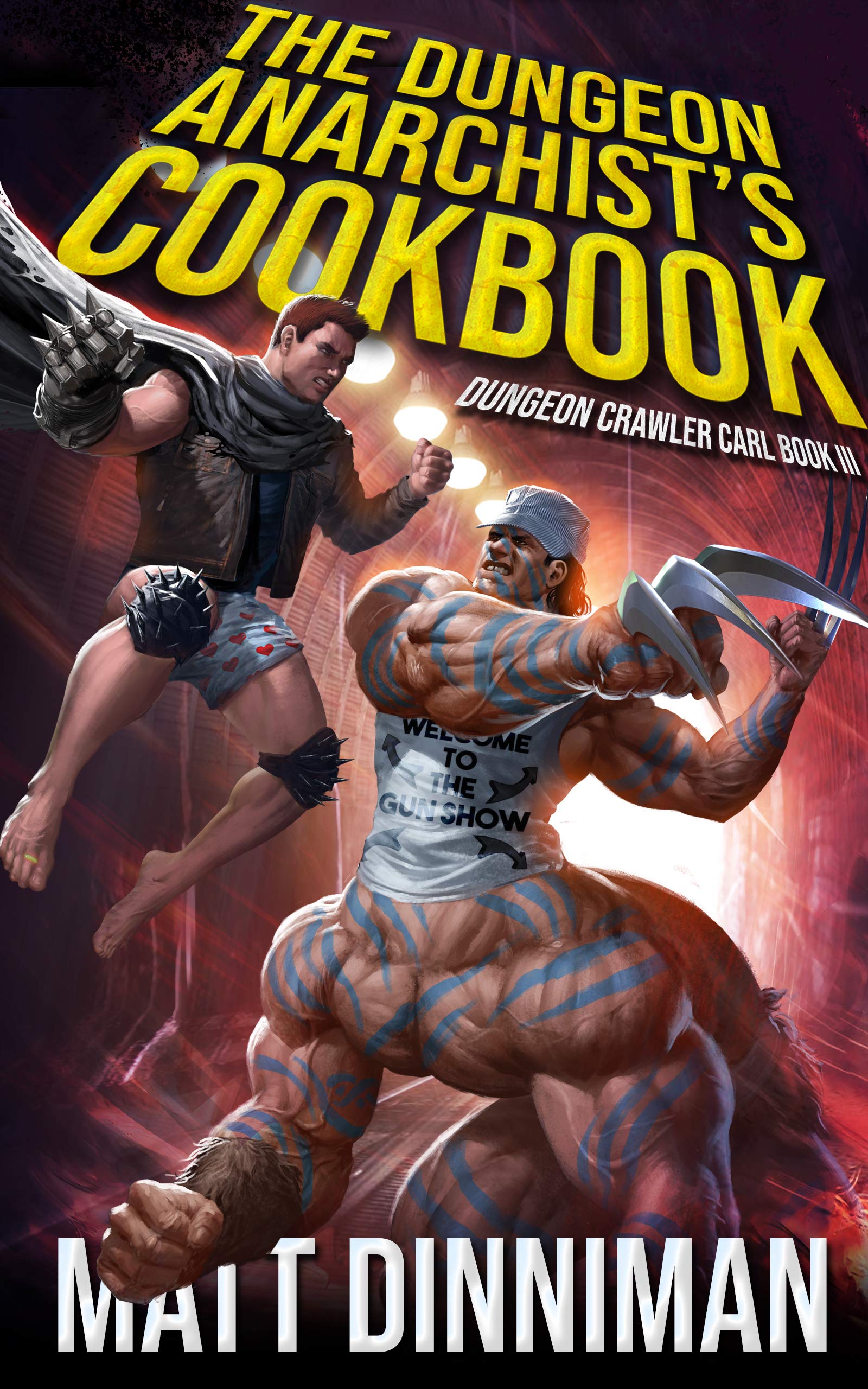
The Dungeon Anarchist's Cookbook (Dinniman)

The Dungeon Anarchist's Cookbook Dungeon Crawler Carl Book 3 by Matt Dinniman (2021) (Not a review, just some notes ...