Monday, May 6, 2019

Gryphon Precinct (DeCandido)

Gryphon Precinct , Keith R.A. DeCandido (2013)

Not a review. Just a reminder of what I read recently. Read this a month or so ago.

Spoilers from previous books in the very first paragraph.

The end of Goblin Precinct was marked by the death of Dru's partner, Lieutenant Hawk, as well as the Lord Albin, who had been sick with more than allergies.

Albin's son, Lord Blayk comes in and immediately starts making changes. First, he gives both Captain Osric and Lt Iaian full pensions to retire. Then he makes Grovis the new Captain based purely on his status as the son of a Cliff's End banker. Blayk expects Grovis to be his mouthpiece and do whatever he's told. This doesn't play well with Torin, Danthres, Dru or even the new lieutenants.

Blayk splits up Torin and Danthres, so they can take each train new partners. He also doesn't want them investigating Albin's death. However, his mother overrules this and wants Danthres to investigate.

The entire castle is being upended, and Torin and Danthres figure out why. Grovis, in the meantime, realizes what a pickle he's been put in, to the point that he finds a retired Iaian, living alone now that he bought a nice house for his wife, to talk out his problem. Iaian has always hated Grovis, but can't argue one piece of logic: Grovis can't talk to anyone in the department about what's going on, but he needs to talk to someone who understands the department. That's Iaian, who tells him, basically, keep his head down and mouth shut if he wants to survive. That's how Iaian survived.

Verdict: an improvement over "Goblin".

Friday, May 3, 2019

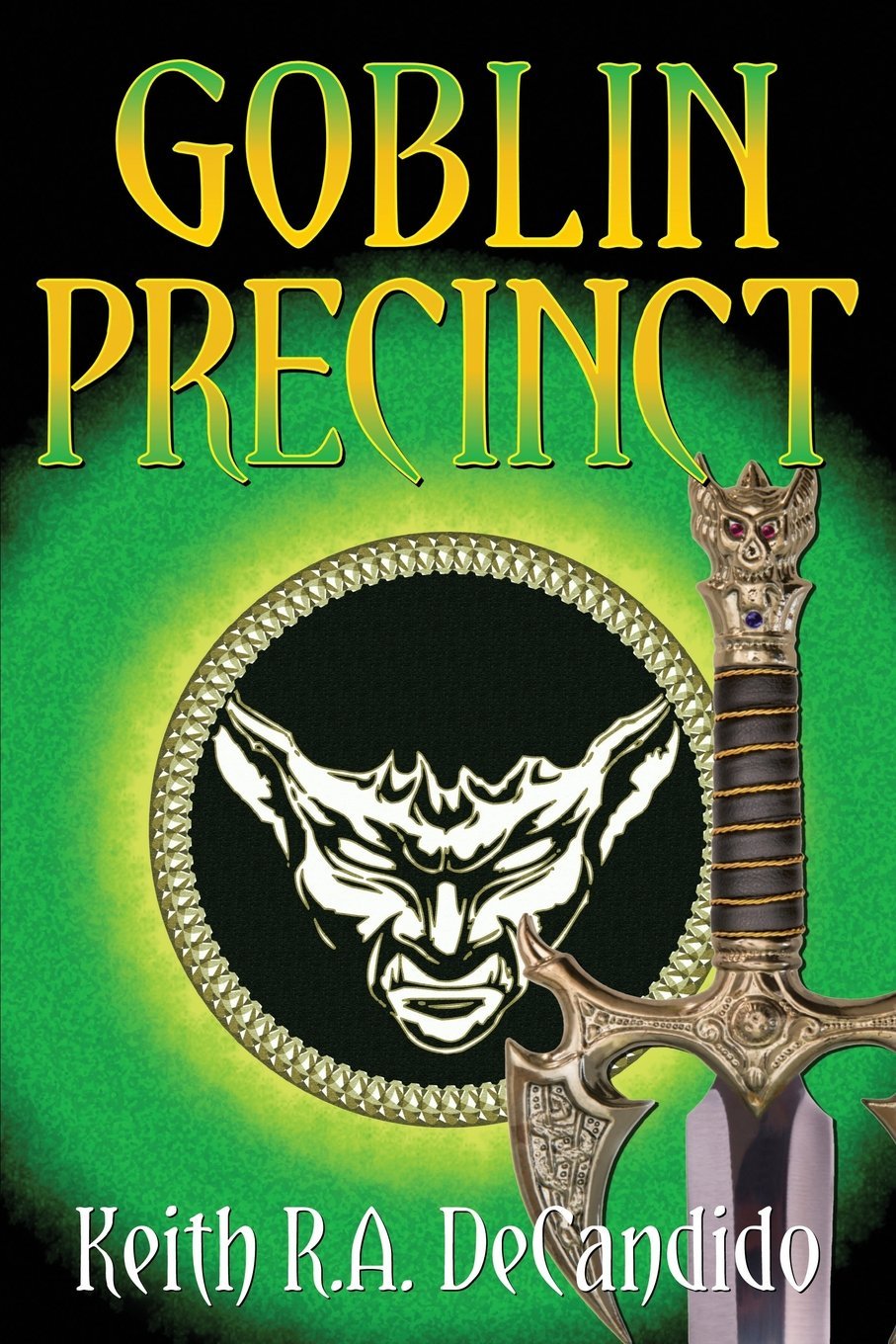
Goblin Precinct (DeCandido)

Goblin Precinct , Keith R.A. DeCandido (2012)

Not a review. Just a plot summary, for future reference. Read this a couple months ago.

The third book in the series brings us to another precinct. The book opens with a former aristocrat in Elven society, one who had been close to the Elf Queen and who fled when the end was near, is now a poor beggar in Cliff's End, having never found a new way to support himself. In the end, he gives in and tries a new drug called "Bliss", which makes the user happy beyond belief. He's instantly hooked, but the high never lasts as long, and it's a short matter of time before he overdoses.

Not exactly murder. And not something that would merit the involvement of the Castle Guard detectives. However, when another Elven aristocrat shows up looking for the first one to try as a war criminal. Using his credentials, he forces the Castle Guard to find the body and prove cause of death, to make sure it wasn't a politically motivated murder. (Note: the reader already knows that it was not.)

The investigation uncovers the fact that the drug, Bliss, was created through magical means. Now the Brotherhood of Wizards will have a problem with this. In fact, the "Brotherhood" will have a bigger problem by the time the whole thing is over.

Among the other revelations, Danthres discovers that Sorlin, the city she sought refuge in as a half-breed, has disbanded because the purity laws elsewhere have been repealed. (In Unicorn, Torin ban Wyvald's father had shown up to bring him home to Myverin. We should be out of homelands now.)

No spoilers for anyone accidentally finding my blog, but there will be staffing changes by the end of the book.

Final take: Goblin suffers from lack of a murder, and from knowing the cause of death from the beginning without any real twist. There is one twist regarding the magical creation of the drug, and even that isn't resolved as well as it should have been.

Saturday, March 30, 2019

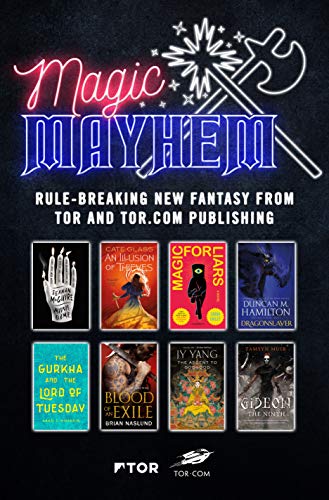
Magic & Mayhem Sampler (2019)

Magic & Mayhem Sampler: Rule-breaking new fantasy from Tor and Tor.com Publishing, Seanan McGuire, Cate Glass, et al. (2019)
I've downloaded free books from Tor.com before and enjoyed them to varying degrees. (Not everything is for everybody.) I did learn a lesson a few years ago when I was reading the first story in a "Best of" whichever year it was. I was getting to the end of a novelette and it didn't seem to be winding down. That's because it was a novel excerpt, which was stated upfront in plain text and I had missed it. I skipped later excerpts because I was enjoying this and didn't want to stop reading the anthology while I hunted down a copy of the book. (At this point, I don't even remember what book it was.)

I went into this knowing beforehand that there were six novel excerpts. I read two of these before moving back to other books. They were different, to say the least, the first more than the second.

Middlegame, by Seanan McGuire

Middlegame was unusual in that it had two prologues before the main story got started, and I wondered if they shouldn't've been left out of the excerpt just for clarity. It starts with "FAILURE", five minutes too late, thirty seconds from the end of the world. There are two characters, Roger and Dodger, and Dodger is injured and bleeding out. Roger can't go on alone -- and this seems to be literal. It's the end.

This is followed by a children's tale (in different type) about two children who lived on the same block but never knew each other, as they went to different schools, and such. The excerpt is from "Over the Woodward Wall" by A. Deborah Baker. Then there's a passage from an address on the Doctrine of Ethos from Asphodel D. Baker to the American Alchemical Congress in 1901. One can assume that they are the same person, even though it is revealed later in the text that not everyone knows this.

The story jumps from 1886 to 1986 pretty quickly, as Baker creates a human being, James Reed, who must kill her to carry on her work. He in turn brings life to the Doctrine. Literally. Creating a boy formed from guiding principles of the universe made flesh. And the experiment was a failure. This leads to the conclusion that the Doctrine must be two individuals, a boy and a girl. Three sets of siblings are produced over three years, and he splits the six up to grow apart (as in the children's tale), to see which pair is the actual Doctrine.

Interesting ideas, but it lost me a few times. If I run into someone else who's read this and liked it, I might seek it out so I'll have someone to talk to about it.

An Illusion of Thieves, by Cate Glass

Not your typical fantasy setting -- it's more Italian-based than medieval England or France. Except that it's Year 987 of the New Millennium: Spring Quarter, in the lands of the Costa Drago, with independencies rules by wealth and arms. Alessandro (Sandro) di Gallanos is a Mayor, but also, il Padrone, the Master, the Shadow Lord.

The viewpoint of the story is il Padrome's concubine Cataline, who was bought from a house of ill repute, which bought her from her mother for a few pieces of silver, back when she was just Romy, the oldest sibling, living in the slums. Romy is cursed with magic, which is bad. Only one of her siblings, Neri, is cursed likewise. Should anyone find out about it, it would mean death.

Romy finds out that Neri stole some gems. The father is accused (because he was the only one to know of them), but Neri took them through magic. The father confesses, to save his son -- and indeed the entire family -- because if the sniff for magic, Neri will be killed. But the father is sentenced to lose his hand and then be exiled. The family may starve after that.

It turns out that Neri had been a bit of a rabble rouser and Sandro had had him watched. He throws "Catalina" out of his home and orders her to be her brother's keeper, lest they both suffer a horrible fate.

I don't know where this one is going, but I might look for a copy of it.


Update: Since I originally posted this a month or so ago, I've seen Middlegame promoted a couple of times as something new and different, and an example of interesting word-building. Maybe. I'm still not sure that I'm going back to it. Also, both of those mentions came in my email, which is influenced by the fact that I subscribe to Tor.com's mailing list.
Friday, March 22, 2019

The Battle of Dorking (Chesney) DID NOT READ

The Battle of Dorking, George Tomkyns Chesney (1871)

I don't remember where this recommendation came from, and someone I must've thought that it was one of those History channel books.

This was a disorganized, rambling mess that couldn't hold my interest for 4 pages. It was only 40-page chapter without visible breaks, and I quit somewhere in the middle of a six-page paragraph. (Not kidding.)

Now that I'm aware that this was written in 1871, maybe I'll give it another chance, but I'll likely skip ahead 20 pages or so to get to whatever action there is.

Thursday, March 21, 2019

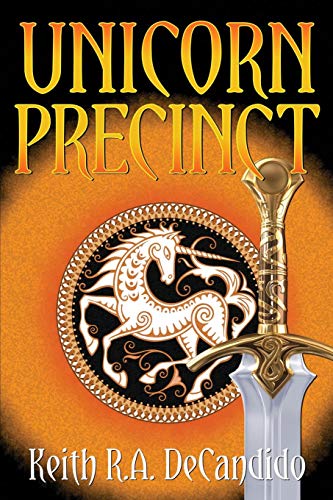
Unicorn Precinct (DeCandido)

Unicorn Precinct , Keith R.A. DeCandido (2004)

Okay, so Unicorn Precinct is where the rich live, and it's usually a cushy assignment, so rookies on the Guard get sent there. Dragon Precinct is where the middle class dwell, and includes the area where Gan Brightblade's murder took place. Goblin Precinct is the slums, mostly the poor live there, and with smaller homes, some of the denizens there are nonhuman (dwarves and gnomes). Mermaid Precinct is the dock area. And in the Castle itself, where the detectives work, is Gryphon Precinct.

While there isn't a map, there is a description of the neighborhoods and street boundaries. Most of the streets have been mentioned at some point, so it's safe to assume that they're "major".

The main case, for Torin and Danthres, is the murder of the daughter of a nobleman as she is preparing for her wedding.

Dru and Hawk have the least to do in this story, and they are somewhat stymied by the negative reaction to the guard members in Mermaid Precinct to the investigation into corruption by Iaian and Grovis. Grovis is committed to rooting out law breakers. This becomes problematic when it reaches closer to home -- his home. Grovis's cousin, Cam Grovis was the betrothed of the dead girl, and he isn't telling everything he knows.

Iaian has his own secrets, too, and that's not sitting well with Avilar Grovis (who now has a first name).

I kind of guessed the who early on, but not the why and the how (or even the "what"), so it was still good reading.

The bonus story, which was nearly a third of the book, was the first case of Torin and Danthes, and how he came onto the force and they became partners. Some other familiar faces were around then as well, only ten years younger.

Fun book. I'll likely read something different before moving onto

Goblin Precinct

.

Monday, March 18, 2019

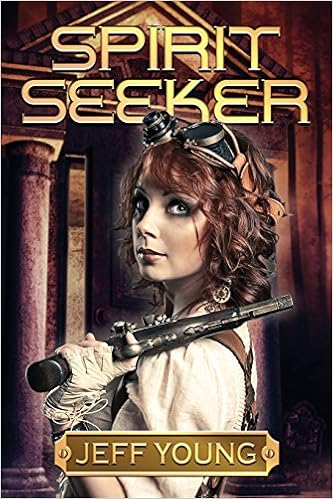
Spirit Seeker: The Kassandra Leyden Adventures (Young)

Spirit Seeker: The Kassandra Leyden Adventures, by Jeff Young (2016)

Maybe had I read a cover blurb, I might've known in advance that this was an alternate history and not some post-apocalyptic future where society is rebuilding. This impression came from the mix of technology, plus references to New Britain and Londinium. after reading the last entries in the book, I saw that this was actually an America that was founded after the Plague was followed by a worse Black Death, causing survivors to flee across the ocean. (Actually, at the very beginning there is a short blurb about the plague that arrived during the reign of Edward the third of his name -- but it didn't occur to me that that was referring to the actual King Edward III of England, who obviously preceded Edward VIII of the 20th century.)

What I thought was going to be a novel was actually a series of short stories, not tied together other than by the lead character, although the last one calls back the first one.

Kassandra Leyden's was a well-known adventurer, and her father was a spiritualist. She has a bit of both of these, but definitely the ability to communicate with the dead. (They can't talk, per se, but she can read their lips.) Her first adventure involves her mentor Levhoi and following her mother's spirit to a crypt where she makes a shocking discovery (I'll leave out spoilers for people who stumble upon my page.) This is followed by a story where she apprentices to Madam Foss, a medium, where she learns to hone her skills. In the very next story, "Fox Chase", Leyden is already a medium in her own right.

The following story, "Drinking Down Death", was the story that I thought the book was about, because of a blurb on the internet. Mediums are disappearing and Leyden investigates. She encounters Constable Cobham Peckwith, and they solve the other-worldly goings-on and uncover a nefarious plot. Peckwith shows up again in the following story, which takes place, in part, on dirigibles, and the story after that, where the spirits actually affect the real world.

The final story has Leyden back on her own, but her mother Anastasia is whispering in her ear and guiding her along the way.

Overall, an enjoyable collection of stories, including the brief history. Should more adventures be published, I'll likely pick those up as well.

I've read some of Jeff Young's work before. He's had stories published in other anthologies by the same publisher (eSpec Books). The is the first solo book of Young's that I've read. (And I think it may be the only one, at the time of writing.)

Saturday, March 9, 2019

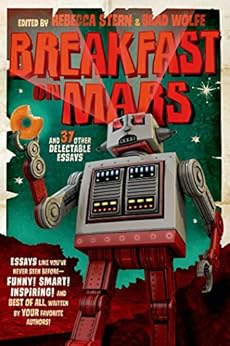
Breakfast on Mars (Stern & Wolfe, ed)

Breakfast on Mars And 37 Other Delectable Essays, Edited by Rebecca Stern & Brad Wolfe (2013)

The cover states "Essays like you've never seen before -- Funny! Smart! Inspiring! And Best of All written by YOUR Favorite Authors"

The last part is overblown in that not only are they not my favorite authors, I don't think I've ever heard of any of them, let alone read any. That said, soe of them were funny and smart. Inspiring? Maybe about my writing, but not about the subject matter.

I picked up this book in a box at a school I was working at in the fall. The idea of the collection is that students tend to be bored with essay writing, and there isn't a lot of inspiring essays out there that are relatable for students. So this book is intended for teachers to use with students, so that the students will respond. Each essay, whether personal, persuasive, or information, is based on a response to a different writing prompt. And each should be fun to read.

Some of them were fun. Some were just odd, but that was okay. But a few seemed like standard essays, and a couple seemed like they'd been written before they even saw the prompt.

The overall affect was like catching up on an eclectic bunch of TED Talk podcasts, with topics all over the place. I enjoy some of those, while I listen to others on double speed, or skip through them entirely.

And while the personal stories were interesting, the introduction promised breakfast on Mars, showering with spiders, and humans needing tales. That's what I wanted to read. "It's on Like Donkey Kong" was a nice bonus. (That phrase is so well-established in my circles that we can parody it into something else). Likewise the comparison of Princess Leia and Queen Amidala. So of the other entries, I've already forgotten, even when I like back at the table of contents page.

I did like reading the prompt at the top of each essay, and I toyed with repeating them either here or on my (private) writing blog, but do I really want to type up 39 prompts? One-handed, while holding the book open with the other? Probably not.

For anyone who stumbled upon my personal reading blog, if this sounds interesting, check it out.

Wednesday, February 20, 2019

Dragon Precinct (DeCandido)

Dragon Precinct , Keith R.A. DeCandido (2004)

I've seen Keith R. A. DeCandido at science fiction conventions, particularly the possibly-defunct Lunacon and the newly-christened Heliosphere. He's had a long career and yet I don't think I've read any of his work before. Maybe a short story in an anthology? Thankfully, I'm remedying this!

I've never read any police procedural novels before that I remember. Mysteries, sure. Stories with cops, sure. But the written equivalent to Law & Order or C.S.I., no. (And for all I know, a different show might be a better analogy.)

This was a fun book to read, with one little caveat. The Prologue introduced a host of characters, one of which, Gan Brightblade, we know will be dead before Chapter 1 even begins. The prologue gave quite a bit of background and introduced a cast of characters of some renown: Gan, the great human fighter; Olthar, the elven wizard who betrayed the Elf Queen; Urbarlig, the dwarf fighter; Bogg, the barbarian; Mari and Nari, twin halfling thieves; and Genero, the human priest, who called them all together.

They arrive in Cliff's End ready to hire a boat to take them to see an old nemesis, whom many believe to be dead. Instead, Gan's neck is broken, unnaturally, in his room. Murder, but not by magical means. This is like the opening scene before the credits.

Where I had a little problem was with the first Chapter. We start in the police precinct with has parallels to a modern police station (as far as I know). Many of the characters for the series are introduced, along with a lot of dropping of place names and history. There wasn't a map to refer to, so I just went with it. Also, using the ebook (for me) is difficult to keep flipping back and forth, so it was a while before I got a handle on which first and last name went with each other.

Anyway (this is for me, this isn't part of a review), the main characters aren't those heroes, but the officers: Danthres Tresyllione is half-elf (hated by both races) and Torin ban Wyvald in human, and they are lieutenants on the Castle Guard. (They have Griffins, not Dragons, on their uniforms.) Two other lieutenants are Dru and Hawk, who are chasing down bad spells sold on the black market. Iaian is a veteran officer, two years from retirement, and he's paired with Grovis, a rookie who fails to be intimidating whenever he tries.

The biggest obstacle to writing a fantasy mystery, similar to science fiction mysteries, is determining what the rules are. In sci-fi, you need to know what tech is available. In fantasy, there's magic. Not a problem here.

There's a magical medical examiner, on loan from the Brotherhood of Wizards, who checks crime scenes for magic use. Oddly here, he doesn't detect any, which makes sneaks sneaking up on such a hero even more unbelievable. So if there is magic being used, it's been covered up expertly.

This was a fun read -- once I got past the first chapter, that is. And I'm glad that I picked up most of the series during a recent $.99 sale by eSpecbooks. (I usually visit their blog more than their homepage.

I'm looking forward to reading more, probably every other ebook I read for a while. (Print books are a separate matter.)

Monday, February 4, 2019

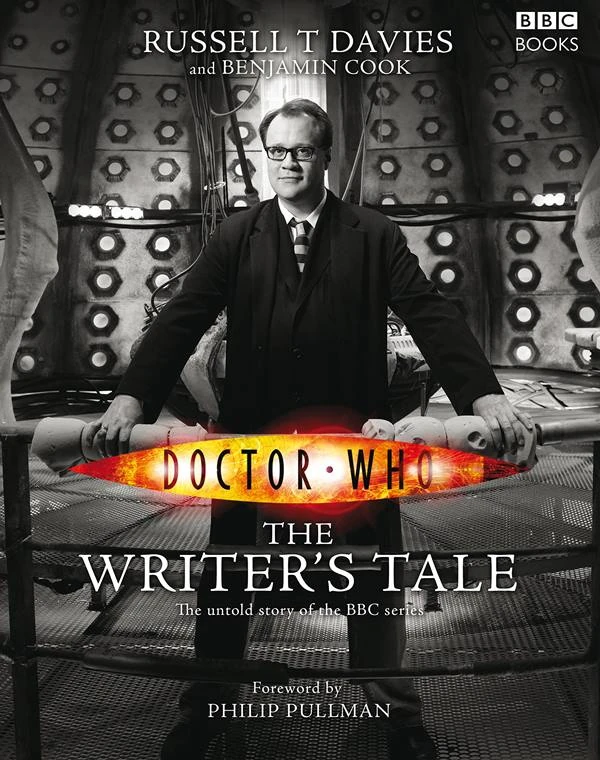
Doctor Who: The Writers Tale -- The Final Chapter (Davies, Cook)

Doctor Who: The Writers Tale -- The Final Chapter , Russell T Davies and Benjamin Cook (2010)

The second part of the ebook continues the correspondence between Davies and Cook past "The Journey's End" and through "The End of Time". For the uninitiated, that would be the last episode of Series 4 of Doctor Who through the last of the specials that followed that series, in place of a fifth series.

Once more you see the trials and tribulations of trying to run such a massive series. Lots of trivia, quite a few setbacks. Plenty of talk about Davies' old work, the search for a new Doctor, and the final shots of David Tennant as the Doctor.

And, of course, working with lots of secrecy, much of which gets blown one way or another (such as the careless reveal of Timothy Dalton in costume, leaving little wiggle room for whom he could be playing or what was coming back.)

Enjoyable to read, although I did want to skip to the end of some of the longer emails, particularly ones that didn't involve Doctor Who primarily.

Tuesday, January 22, 2019

Amulet, Volumes 1 - 8 (Kibuishi)

Amulet , by Kazu Kibuishi (2010-8)

A couple of months ago, there was a Scholastic book fair at the school that I'm currently assigned to. While I wasn't officially "working" the book fair, it took place in the room I usually spent my free time in, so I did lend a hand, mostly straightening up piles. There were a number of graphic novels on one of the tables, and one of these (particularly one of the ones that had Volume One on the table) was Amulet. The cover looked interesting and a quick flip of the pages showed some great color artwork. I took a picture of the first book and made a note to look into it.

Fast forward a couple weeks, and I find myself regularly in an English classroom where there is a pile of these books. Basically, almost a class set of book 1 and two copies of the rest. I spent the next couple weeks reading them, 50 minutes at a time. It wasn't until I was on book 5 that I realized that there were more than six books in the pile. (I thought only six were shown on the inside back cover.) There were seven. Nope, wait, there were eight. (Someone must've borrowed it.)

As you can tell, I enjoyed it enough to keep reading. And I enjoyed it enough to be annoyed to find that there is a NINTH book, which the teacher didn't have. So I checked the library website, and they didn't have it either. And then I did a little research and discovered something:

Volume 9 hasn't been published yet!!

I haven't had this feeling a series of books in a long time. And it's worse because most of the story has (or seems to have) wrapped up in Volume 8, and we are promised that it will "conclude" in Volume 9. When I saw that the first book was published in 2010, I didn't think it was still being created, unless it was an open-ended story. Who knew? Other than fans who have been reading it from the beginning, and waiting one or two years between each edition. And considering that volume 8 was only released this past September, I probably have a while to wait for it.

Okay, so the brief notes for me to review when book 9 comes out:

It starts with a family and there's a car accident, but the father doesn't make it out and falls into the darkness with the car. A grim start, but one that gets reference much later on, so it isn't gratuitous. (Seriously, some books, particularly ones written for kids, could start after these events and refer to them in flashbacks.) Mom takes the two kids, Emily and Navin, to an old house in the woods that belonged to her grandfather, Silas Charnon. And this is where the weird stuff begins.

Emily and Navin find an amulet in Silas's old library. That night, the mother gets kidnapped by giant spider-like things and brought to another realm. The kids follow. They're eventually rescued by the rabbit creature from the cover of the first book, which turns out to be a robot that Silas built. Silas, who is still alive, but barely, is a "stonekeeper". Before he dies, he passes the stone on to Emily, along with all its power, responsibilities and its curse. (There's a voice within the stone that talks to Emily and tries to gain control.)

Mom is rescued within a couple of books, but there's a bigger story involving the Elves, who are the "bad guys" of this series, being at war with the "humans" for many years. I put humans in quotes, because many of them have begun to look more animal-like because of an affliction. And then there's Trellis, the son of the Elf King, who knows there's something wrong and wants Emily to join him to help overthrow his father. (The Elf King has no problem seeing Trellis dead if he cannot perform certain actions.)

Lots going on, both in the past and the present, in one world and in the void.

Great artwork, particularly on the splash pages. I can see why it takes so long to finish each book. And I want to finish the next one already.

I'm counting this as eight books for any "goals" I decide on, because I can.

Tuesday, January 15, 2019

Doctor Who: The Writers Tale (Davies, Cook)

Doctor Who: The Writers Tale , Russell T Davies and Benjamin Cook (2008)

First book of the new year, and I'll count it as two because it was originally published as two books, even if the ebook collects them together. Plus, I'll only have time to read the first before the library loan expires.

I only recently became aware that this book exists, and it was available at the New York Public Library website. It contains correspondence between Russel T. Davies, the Doctor Who showrunner (writer, producer, multi-hat person), and Benjamin Cook, a writer for Doctor Who Magazine, which took place from the time that Series Four was being conceived (and Series Three was to begin airing) through production of the Series Four finale, not counting the specials which came afterward.

If nothing else, this book was fun for the trivia -- Note: SPOILER ALERTS for Series Four, both here and in the book. For one thing, Donna Noble was not supposed to be the Companion for the entire series, but was supposed to return in the finale along with many of the others. In fact, the character, Penny Carter, who appears as a reporter in the season opener gets her name from the would-be Companion. (Not that this character, or the actress, were ever set to be the Companion. Likewise, the return of Wilf (Bernard Cribbins) was brought on by tragedy. He was made Donna's grandfather after the fact (along with an excuse at why he wasn't at the wedding).

But the big draw here is seeing what went into creating Series Four, the writing process, the rewriting process, editing, FX days, meetings, and oh so many struggles. The veil gets lifted from some of those pieces that looked like they were so carefully planned and laid out, and yet there is so much that happened by circumstance, or just worked out that way. Granted, it takes a master to leave dangling threads that can be grasped later, or work together similar plot points into an intended pattern.

Also there's a lot of talk about other shows that Davies was involved in, most of which I've never seen, and aren't likely to.

Fascinating, interesting book. I'm likely to read Book Two (The Final Chapter) which runs from The Next Doctor to the end of his (and David Tennant's) time with the program.

Note: not a book to read if you are offended by a gay man constantly thinking about sex, particularly with certain actors on his sets, or by the overuse of the word "Arse".

Monday, January 7, 2019

2018: Year in Review

Last year, I seemed to avoid keeping track of what I was reading, giving the sparse use of the blog until the very end of December.

Also, I seemed to avoid reading altogether, considering how long it took me to get through some of these entries.

According to the sidebar, there were 26 entries for the entire year. Of those, three were not about specific books. On the other hand, there were a lot of graphic novels, particularly in the summer, and manga, particularly near the school library. So my book total was closer to 35. This comes with a little bit of a caveat: I counted the ROM comics as 4 graphic novels because I believe that's how they were available, even as I read 14 issues. Likewise, Clean Room, which had its review deleted by accident, and will get restored at some point, counted as 1 book, even though it was the first six comics in the series. Most of the graphic novels were similar to this.

Additionally, there was at least one One Piece book in there, but I was going to wait until I'd read a bunch more of those ... which I then didn't do. At the very least, I'll wait until the end of the present story line. But I have other things to get to.

It was an odd year for me. I see that there were only two science fiction books: 1634, which is alternative history, without a lot of sci-fi once you've accepted the premise, and Space Team, which I don't need to rehash.

There was a bit of nonfiction, including biography and essays, as well as some poetry and one old self-help book.

And again, two more Sue Grafton mysteries. I should just read through and close out the series.

One book does appear to be missing. I read a book about The Beatles, a behind-the-scenes book that I picked up in the school library, either in late 2017 or early 2018. I thought it was around the time I read the Maya Angelou book. (Interesting pairing, right? They were in the same pile on the same desk.) For whatever reason, I didn't log it.

Lots of books, real and electronic, on deck to be read. Once again, I'm commuting by car (and I could actually walk), so most of my reading is at bedtime, and sometimes at meals. When I'm not all over social media, that is.

Goals for 2019?

More than 2018, for sure.
Read or discard a lot of books in the basement.
Alternate more between paper and ebook.
Read older stuff before downloading new (sometimes "old") stuff.
Expand a bit -- find other topics and genres to visit.
Do a mini-run on a series or two: I've started Sue Grafton, Jim Butcher, Laurel K. Hamilton, and some things I didn't care for. And there's an entire world of Eric Flint's 1632. (See the sidebar -- I'm not hotlinking everything.)

Carl's Doomsday Scenario (Dinniman)

Carl's Doomsday Scenario: Dungeon Crawler Carl Book 2 by Matt Dinniman (2021) (Not a review, just some notes to help...