Wednesday, August 30, 2023

A Terrible Fall of Angels (Hamilton)

A Terrible Fall of Angels
by Laurell K. Hamilton (2009)

(Not a review, just some notes to help me remember the things I've read. But written this way because it's the Internet, and some people will stumble across this page.)

This was a book club pick. It received mixed reviews. I listened to it while walking, and then read the ebook when I was done with the previous one. This made the reading go a little faster. Reading it did clear up one point, a little.

I've previously read a single book in Hamiltion's Anita Blake series, which may or may not be in this blog. (There was a several year gap when I didn't maintain this page.) But I was game to start a new series.

The book started strong and introduced a lot of elements. Then it dropped the ball on most of them. I slogged through the middle to get to the end. If this book had been a ten-episode Netflix series, the beginning would've been two episodes, the ending would've been two episodes and the six episodes in between would've been a lot of world-building and filler.

Don't get me wrong: I liked the world-building, but it seem like much of it was presented for future use. Likewise, many of the characters we're introduced to in the beginning just fade into the background. Others we just wished had do soon. (In particular, no one in the book club liked his estranged wife. While we all appreciated the break in the action to have couples' counseling, the wife didn't come off as a likeable character after that.) Another problem with the worldbuilding (as pointed out but a book club member) is that she retconned the rules in the same book. She didn't wait until, say, book three or four to change the rules.

Personally, I thought it got a bit repetitive, sometimes repeating information within the same chapter. A couple of those chapters, with side characters out of nowhere, just dragged on too long.

One thing, I won't forget that the main character's name is Havelock, because I was reading the Expanse book where a different Det. Havelock made an appearance. (He's in books 1 and 4 of the Expanse, and that's as far as I've gotten there.) I wouldn't say the other characters aren't important enough to list, but I've fallen behind in posting these mini-reviews (it's September, but I'm backdating it to the month I read it in for my own personal records), and if I really needed to know, I'm sure I can find it on that wiki -- you know the one.

Would I read another one? Maybe, but I would hope it's a little tighter than this one was.

Tuesday, August 29, 2023

Eggs Benedict Arnold (Childs)

Eggs Benedict Arnold
A Cackleberry Club Mystery

by Laura Childs (2009)

(Not a review, just some notes to help me remember the things I've read. But written this way because it's the Internet, and some people will stumble across this page.)

I decided to try another one of these. I could only get it as a paperback from the Brooklyn Public Library, so I made it my pool book. It was a fun, quick read.

The Cackleberry Club is back, and only a few months have passed since the events of the first book. more to come.

Monday, August 28, 2023

Cibola Burn (Corey)

Cibola Burn
by James S. A. Corey (2014)

(Not a review, just some notes to help me remember the things I've read. But written this way because it's the Internet, and some people will stumble across this page.)

I read this nearly a month ago, or at least it seems that way. Once again, I watched the show first which might've made this book go by a little faster. That said, there were enough differences between them.

For starters, most of the book takes place on and above the planet Ilus or New Terra, depending upon who's talking. Any of the shows subplots that take place in the Sol system are absent here. There is also some rewriting of settlers.

Belters and Outer Planets people (such as refugees from Ganymede) managed to get through the Ring and settled on an inhospitable planet that has a lot of lithium, which they are mining to sell to hire lawyers to stake their claim to "Ilus". They've already been there for a while when a UN/Mars backed team of scientists, backed by corporate interests, come in to claim the planet. Some of the Belters already there decide to blow up a landing pad (which they built for the UN group) to prevent them from landing. Unfortuantely, it's too late and the shuttle is already descending. The shuttle takes damage so it can't lift back up into space. It crashes, killing many people, including the new Governor. This basically leaves Murtry, the head of corporate security, which is basically running the ship, in charge on the planet.

Conflict ensues. James Holden and his crew are sent to mediate. Unfortunately, he brought Miller along (along with a piece of the protomolecule on his ship), and the planet starts to wake up. There's an explosion on the far side of the planet which causes high winds and a tsunami. Everyone makes it into one of the ancient structures, and everyone, for the moment, helps each other.

This all falls apart as everyone but Holden starts going blind, and they discover slugs that are deadly to touch. Miller appears to tell Holden that they need to shut the entire planet off. Murtry wants to protect his company's interests, even if it kills him. The original pioneers didn't last long, but they opened the frontiers for everyone else. Basically, he's nuts.

Miller realizes that there's stuff on the planet that he can't see, so it must belong to whatever killed the beings that made the protomolecule, so he can use that to shut down the planet.

When the book's over we discover that there's a problem with Mars. Now that there are new words to be explored, there's no reason to live underground on Mars while it takes a century to terraform.

I'll give it a few months and then I'll request the next book. I've already started the series, and I imagine that some of the stuff from this season of The Expanse will happen in the next book.

Tuesday, August 15, 2023

Cupcakes, Trinkets, and Other Deadly Magic (Doidge)

Cupcakes, Trinkets, and Other Deadly Magic
(The Dowser #1)

by Meghan Ciana Doidge (2013)

(Not a review, just some notes to help me remember the things I've read. But written this way because it's the Internet, and some people will stumble across this page.)

I'm pretty sure that this was a freebie in a Book Bub mailing list, but it might've been a random search result when looking for free paranormal cozy mysteries. I don't remember.

It was mostly a quick read, and I rushed to finish it because a library book became availalbe and I wasn't go to be able to renew that.

As it was, I practically forgot that I'd read it, until I noticed the title again on my phone. (My iPad is loaded with a lot of recent stuff which gets downloaded automatically.)

This is the first book in the "Dowser" series. The main character, Jade, is half-witch, half-human, and she knows nothing about her father. Her mother never chose to tell her anything, and she's not around for most of the book. Neither is her Grandma, but her presence is felt, and at times, we're waiting for Grandma to arrive and save the day, since she's so powerful a witch. It turns out, that her father wasn't human, but what he was (or is?) is not revealed in this book. What is a "Dowser"? It's a person who uses a diving rod to find underground water, but in context with this book, it's a person who detects magic.

Jade runs a bakery in Vancouver, which seems to have a fair amount of magic activity despite comments that it doesn't. While working there one day, she notices a vampire lurking about outside (in daylight) looking through the window. The vampire later confronts Jade trying to get her to confess to a crime and informs her that as soon as the council clears it, he will bite her and compel her to tell the truth. Apparently, there are rules that have to be followed. A vampire has been killed and one of Jade's trinkets had been found. Jade have an assortment of odd rings that she joins together. Her adopted sister likes to use them. The rings link the crime back to Jade who has no idea what's going on.

Jade was enjoying a night out at a club when a pack out humans, who are werewolves start dancing with her. The alpha wolf tries to get her attention, but she declines. She later flees into the night to avoid all these creatures. She goes to the gym the next day, and the pack arrives and places their mats around her. Now she notices that Mr. Alpha Wolf is a bit of a hottie. They start talking and have a date. But he never shows up for it. And then he's dead, too.

Jade gets caught up in this with the pack and the vampire, until they figure out what's going on.

It was a pleasant read. There's a series. The next book has a very similar title, but I doubt it will be available from the library and it's not something that I *really* need to read and thus pay for. The series has plenty to work with, even if the author did knock off quite a few characters in this one.

Sunday, July 23, 2023

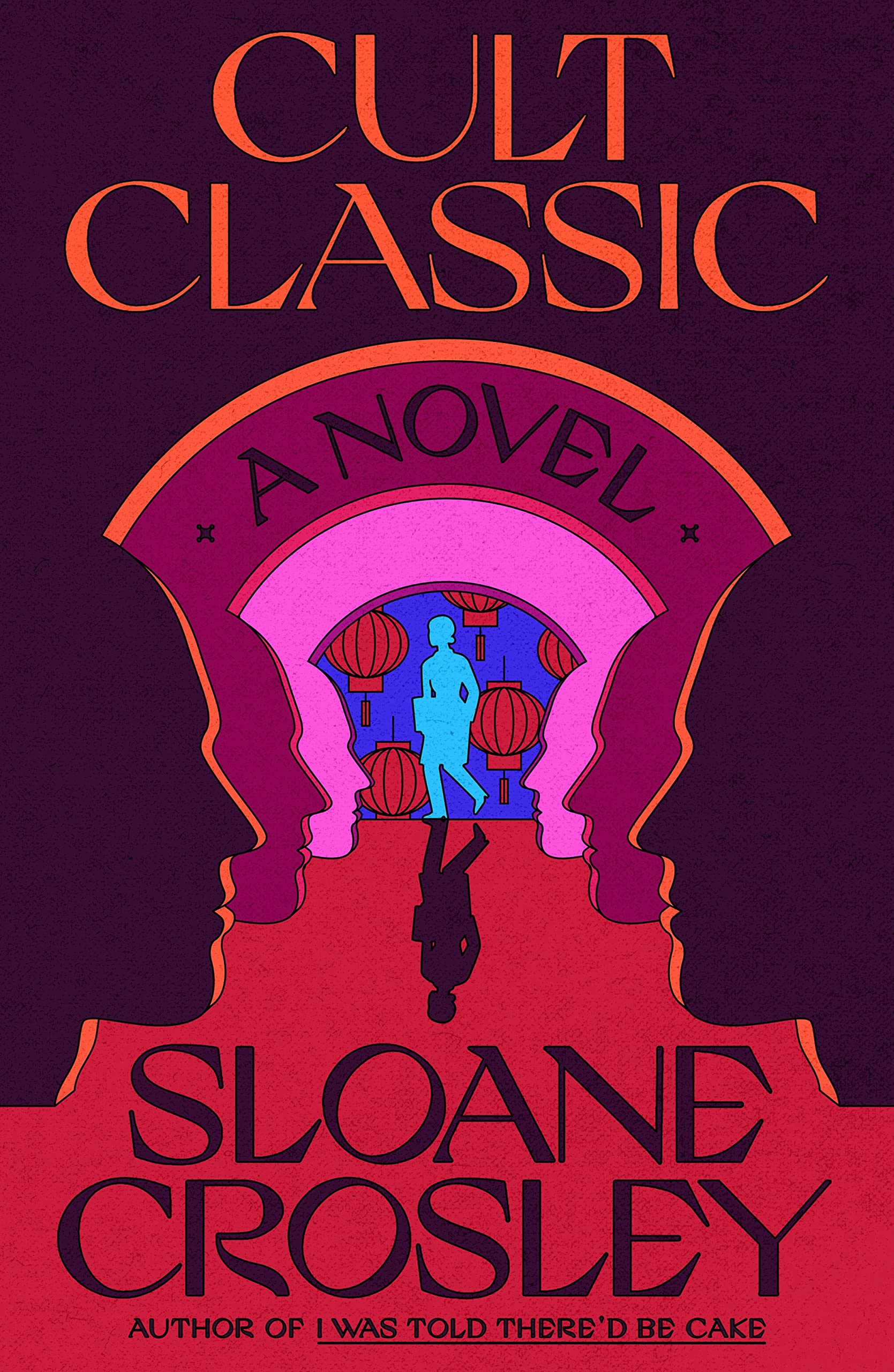
Cult Classic (Crosley)

Cult Classic
by Sloane Crosley (2022)

(Not a review, just some notes to help me remember the things I've read. But written this way because it's the Internet, and some people will stumble across this page.)

This was a Pandemic Book Club selection

We haven't had the zoom call yet, but advance word in the messenger chat is that it's a thumbs down, all around.

I don't know what to expect from many club books because I tend to read them electronically, so I don't have the back cover like I used to have. I did read a synopsis on Good Reads when I voted (and I think I voted for this book -- I honestly don't remember), but I'd forgotten whatever it said.

Basically, think of me as a scifi/fantasy guy who watches a lot of only movies, a lot of "classics", some of which have a "cult" following. So I didn't know what this was really going to be about. About nothing I would've expected.

The prologue goes on about ghosts waiting their turn, winning a lottery, to return to Earth for three minutes, and wait could they do with those three minutes. This has absolutely nothing to do with the rest of the book, unless it's supposed to be an allegory for some of the old boyfriends she runs into.

Next up is a brutal Chapter 1 that runs for about 45 pages when every other chapter is a more reasonable 10-15. Within each chapter, the narrator, Lola, goes off on many tangents, digresses about whatever, recalls weird events and comes back to the present. It's lmost like there's a string of short stories with the most tenuous of connections holding them together that gets woven into the story. The story itself is one that will leave you wondering for about 80% of the book what they actual story is.

The book isn't terrible. It's just not good.

Lola used to write for Psychology Today, working for Clive, who was a typical cheap rich person. In the beginning of the book, in that long into or in the prologue, we discover that Clive is dead. The story that is told is about when he was alive, so I'd forgotten that he was dead by the end of the book. One of those things. Actually, it's probably better that she was upfront about it, otherwise, the ending might've seem too convenient.

Lola's friend is named Vadis, but I found from the audiobook, it's pronounced "Voddy", rhymes with "Toddy". And the author reads the book, so she should know. (Of course, she should be more interested in what she's reading, too. Sometimes, she sounds like it's dull.) Vadis and Clive bring Lola to an old synagouge where they have a cult of some kind working. Vadis knows that Lola is having second thoughts about her engagement to "Boots", who I kept forgeting was her finance and kept thinking was her cat.

Lola had run into two of her ex-boyfriends in the past couple of nights. Clive says that that's because he is making Lola a test case for his new program. Each night she'll walk around Chinatown and she'll attract one of her former boyfriends and see if she still has any feelings for them. She can work through her anxieties to see if she really wants to marry Boots.

Lola doesn't buy into this nonsense, and she's the one calling it a cult. Clive is definitely the spiritual leader, and everyone is working for him for free.

After another boyfriend appears, Lola starts to believe that there might be something to it, so she keeps returning to the synagouge (Clive has a weird name for it based on a weird old painting), and answering questions.

The story doesn't actually present itself until it's nearly over. Basically, there's a twist, but it's not like there was much to twist in the first place.

Is this the worst book the book club has covered? Far from it. Was it good? Not really.

UPDATE: General consensus from the Zoom call was the book was not well-liked and the protagonist was not well-liked. (Note that the participants were majority female, 5-3.)

Friday, June 30, 2023

T is for Trespass (Grafton)

T is for Trespass
by Sue Grafton (2007)

(Not a review, just some notes to help me remember the things I've read. But written this way because it's the Internet, and some people will stumble across this page.)

I freely admit that I'm backdating this review to June 30 because I read it last month, and I want it in my tally for the first six months of the year.

Back to this series for the first time in a while. It was so long that I checked out the wrong book first. I listened to the prologue and thought, I'd heard this before.

I listened for a bit and then I picked up the ebook and caught up to where I had listened to. I take walks, and I sometimes listen to books on tape during the walks, but I got to the point where I shot ahead with the text, so I abandoned the audiobook.

This was an interesting book because it has a lot of "pays the bills" work going on while there is a problem brewing right under Kinsey's nose. By the time she realizes it, it might be too late.

Kinsey's neighbor Gus takes a fall and winds up in the hospital. He needs home care. Kinsey finds a niece in New York who comes out to make arrangements. Kinsey's does an overview background check (nothing deep) and gives Solana Rojas a pass. The problem is that Solana Rojas is a fake who has assumed the identity of the real Solana Rojas who is also a nurse, but one with better qualifications, and who earns better pay because of it.

I was a little confused at first, because I thought that they were both named Solana Rojas before the identity assumption happened, but that was just an editorial way to not divulge her real name then. It also seems that there was another case where she scammed an elderly client, but it seems like she had had an assumed identity then as well, so Solana wasn't the first time she'd decided to do this. Maybe I heard it and read it wrong.

The other patient was mentioned early on, but later becomes a little "deus ex machina" for the story. Every time Kinsey thinks of something, Solana has outmaneuvered her. But then luck comes in the form of the former client's granddaughter (or daughter? I don't remember), seeing Solana at the mall. She pursues her and starts to investigate herself. After that, she runs into Kinsey and offers to help, which is vital to rescuing Gus.

One other thing that does happen: Solana Rojas gets a restraining order against Kinsey, but at no time does it come up that it isn't valid because she's not Solana Rojas. Granted, I don't know the law, and if that would invalidate a restraining order of one party against a second party.

Of the minor cases she's working to pay the bills, one is a couple that needs to be evicted for non-payment. Kinsey is supposed to do a walkthrough for the security deposit. The couple bails, destroying the apartment along the way. It will turn out that Solana Rojas lives in this complex later one.

And then there's a car accident where Kinsey is trying to locate a witness who could corroborate one driver's testimony. The car accident was definitely a setup with a car speeding up and crashing into another that pulled out in front of it. What was never mentioned was that Kinsey pulled a similar stunt in an earlier book, but not for the same reasons, and not with the same results. Again, a little bit of luck broke the case with the insurance fraud, but the kindly old gentleman turned out to not be a kind person after all.

I enjoyed this one because we get a sense of what else Kinsey does between books. And because this was another mystery that she investigated and solved that she wasn't getting paid for. If there was a downside, it was that she didn't contact Det. Nolan (or the police) because of her past relationship. She didn't want to go running to her ex-boyfriend, even though she should have. She knows this, because she mentions it in the text, basically hanging a lampshade on the mistake she made.

I have other things to read before I get to U. (As of this writing, I listened to the opening chapter, and that was about it before the audiobook went back to the library.)

Thursday, June 29, 2023

Fire With Fire (Gannon)

Fire With Fire
by Charles E. Gannon (2014)

(Not a review, just some notes to help me remember the things I've read. But written this way because it's the Internet, and some people will stumble across this page.)

This is a book that I should've read quite a while ago. I've met Chuck Gannon on a couple of occasions. The second time, he remembered me from the first time, and even congratulated me on being published, which was something that I'd been trying to do the first time. The group discussion we had might've contained some spoilers, but I'm sure I'll forget them by the time I get that far into the series.

Update: Okay, it's been almost a month and I haven't gotten back to this or to the books that came after it. Real life gets in the way. Luckily, this is a popular series, so synopsies can be found online. My main reason for having this blog is to remind myself about the books I read in the past when I don't recall the details. (Hell, there are books that I don't even remember reading contained in this blog.) This novel isn't likely to become one of those.

At the very basic level, Caine Riordan is a "polymath", a person who can sees a lot of things and assemble facts out of them. He sees things differently from other people, but not in any science fictiony way. He is found someplace he shouldn't be, and we are to assume that he could be a spy or saboteur or something, so the captain of that ship puts him in deep freeze, suspended animation for long voyages. He is this placed in a different deep freeze and kept there for over a decade. This causes memory issues, and he doesn't remember anything about the last day before he was arrested.

He's promised that he'll be told about it, but he's needed to do some work for the government. He's sent to a planet and finds evidence of extra-terrestrial life, which is inconvient to the megacorporation that's doing work there. Several attempts on his life later, and he's reporting in that the life he found there couldn't have built the structures that he found. They had to have been built by humans thousands of years ago. He further deduces that another alien species must've brought humans and the creatures that he met there thousands of years ago.

It's finally revealed to him that there are alien caretakers in space, and they have been in contact. And now Riordan is part of a diplomatic team that is going to some kind of galactic United Nations where they define borders and boundaries of space and such. Diplomatic problems ensue. This is the second part of the book, and almost feels like a second book, but it comes back to Earth, and old threads are picked up.

Throughout the book, there is a mysterious man who likes to eat olives who has a box with a button on it. He presses the button and someone (a specific target) dies. At first, I thought it was going to be some kind of nanobot thing associated with other people eating olives, but it's even more sciencey than that.

I have book two out of the library and just need time to sit and read it. This next one will be a trade paperback, which are slower reads for me these days.

I enjoyed it, and it really picked up once I got into it. I don't know why I had a few false starts with this book in the past.

Wednesday, May 31, 2023

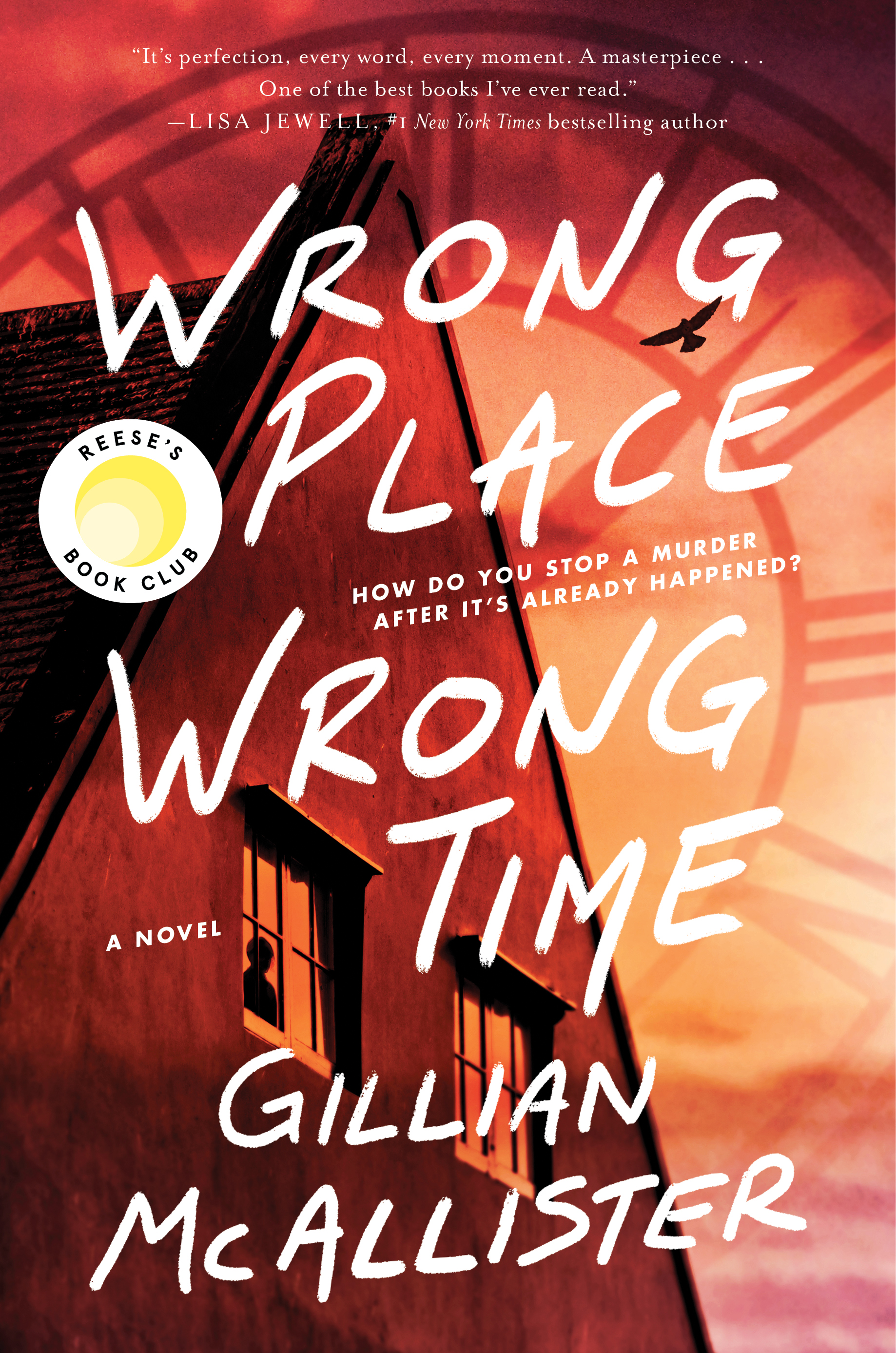
Wrong Place, Wrong Time (McAllister)

Wrong Place Wrong Time
by Gillian McAllister (2022)

(Not a review, just some notes to help me remember the things I've read. But written this way because it's the Internet, and some people will stumble across this page.)

This was a Pandemic Book Club selection, but I would have read it anyway. As a matter of fact, I started it before it was actually selected by the group. (The final vote was 4-3, so I "lucked out", but I would've read the other book if I needed to.) I heard my daughter describe the book to her mother (my wife) and it sounded interesting to me, with a nice little fantasy/sci-fi twist to it. The book had been recommended by Reese Witherspoon, so there was a wait for the ebook -- about 10 weeks or so. I put the paperback on hold when I was afraid I might not finish the book in time, but I did. Still I'm curious how long it will be.

It starts on a Friday evening at the end of October 2022. Jen finished carving the Halloween pumpkin when without warning or explanation, her son Todd stabs and kills a man out the street outside the house. He's arrested and Jen and her husband Kelly are off to the police station. What caused this to happen?

Next morning, Jen wakes up confused to find that it's the same day again, and the day repeats. She does what she can to make sure that Todd doesn't leave the house and can't kill the man. Meanwhile, she wants to know what would cause her son to do this in the first place.

The next morning, she wakes up and it is a day earlier. This continues for several days where she relives those days but nothing carries over. She's getting younger, not older. She learns more about her son and and her husband's secret behavior. She also find some information about about a cop named Ryan and a poster about a missing baby.

Interspersed with these chapters, there are Ryan POV chapters. Ryan is a young cop who becomes an undercover cop and starts working on a car theft ring case. His chapters are told forward in time, but when exactly they take place compared to the Jen chapters isn't stated. Speaking of Jen chapters, looking at the chapter titles themselves is a bit of a spoiler, which I'm about to spoil.

After about a week, Jen starts jumping farther and farther back. She jumps back a year and then a few years to the day her father died and farther back than that, all measured by the number of days. She found a professor who can explain some of this to her, but she has to prove herself to him every time.

We learn more about Ryan and the secrets Kelly is keeping. There's a woman named Nicola whose number shows up on a burner phone. There's this man named Joseph who's nosing around, asking questions, who, it turns out, was in prison and who will become the murder victim. There's Joseph's daughter Clio who was dating Todd before they broke it off. And there's something connecting all of it.

It mixes Groundhog Day with Quantum Leap as Jen thinks that there is something that she needs to put right, but she doesn't know what it is. She just continues learning the pieces of the puzzles that she needs to know to eventually fix things way back in the past. (Note: the author herself admits that she conceived this after watching Russian Doll, which also has a Groundhog Day effect to it.)

I enjoyed the book but I'm not 100% on the final resolution and how things play out afterward, back in the present day. (She doesn't have relive all those years.) Whatever "science-y" explanation could be posited for the energy to cause this time travel, it doesn't explain waking up again in 2022, a leap of many years, with very little fallout. There is no "Butterfly Effect". The changes are very narrow, which works fine for the narrative (although a little too pat in one regard). Considering she went back and changed how she and Kelly first met and changed the nature of their relationship, the fact that their son was still born at the same time (and is the same person) means that there's something more to this guiding the outcome (as Sam would've said on Quantum Leap).

A minor quibble, but I can imagine some people might feel let down by what needed to be changed to not only prevent her son from becoming a murder, but all of the extenuating circumstances and ancillary factors, and then how little actually changed in the end.

I might have to check out some of Reese Witherspoon's other picks ... but the older ones, which might actually be available from the library.

Tuesday, May 30, 2023

Eggs in Purgatory (Childs)

Eggs in Purgatory
Cackleberry Club #1

by Laura Childs (2008)

(Not a review, just some notes to help me remember the things I've read. But written this way because it's the Internet, and some people will stumble across this page.)

This was a book club selection. The person who chose this (and two others) wanted to try a "cozy mystery" and this author had a couple of series going. To be honest, I didn't look at the publication date until I started writing this entry. I know that there are several books in the series.

I listened to this book twice. I got a copy of the paperback from the library when I was almost done the second time, so I only read a few chapters. By that point I already had the voices in my head. It's a quick read and probably reads faster than 8 hours of audio.

I gave it a second listen because I thought I'd missed a few things along the way, but it turns out that many of the others in our book club had issues with the book as well. Overall, we did enjoy it, and there was a feeling that it could rate 3.5 as a novel, and maybe a 4 as a cozy mystery.

I was one of the few who had read cozies before but, as I pointed out, this is the first one that I've read without any witches or elves or ghosts. Even some of the discussion questions were skipped because they addressed any paranormal elements of the book. I almost missed them, but it didn't need them.

The biggest complaint with the book was too many characters, not enough information about the crime/mystery, a lot of talk about food, and a "side quest". Most of us enjoyed the side quest but it didn't distract/detract from the main story. One of the reasons I listened a second time was when the murderer was revealed, I was totally "huh?". I wasn't alone. The second time through I paid more attention. Even with that, there is a confrontation in the restaurant that ends when a character named Junior comes flying through the door. Not only had I forgotten about Junior when this scene occured the first time through, I'd forgotten about him again the second time, even though I knew how the scene would turn out.

So some notes:

There are three women, Suzanne, Toni, and Petra, who are all widows. Suzanne is the POV character. Her husband ran a gas station in Kindred and after he died, it couldn't stay a gas station because she was getting squeezed by suppliers. The Cackleberry Club was born. The place becomes something of a community center with a restaurant (with a prixe fixe menu), a book nook, a yarn/knitting/quilting area, etc. One morning, Suzanne's lawyer is found dead in his car with eggs in purgatory on his face and blood on his chest.

Suzanne looks into the mystery. The local Sheriff Roy Doogie is overly accomodating with spilling information at times (although the voice acting is awful). He's not an idiot, though.

Also in the cast of characters are the romance-novelist widow of the deceased lawyer, the lawyer's secretary, the former partner of the Suzanne's deceased husband and that man's wife, who is on the Library Council (yeah, it's a thing), the Rev. Yoder on the old, local church down the road, and a religious cult not far away but technically one county over. And there are some people who sell produce and folks who are of interest because of the tires on their trucks.

THere were some good characters, but it was a little too much and the ending wasn't entirel satisfying. Also, the print edition (not the audio) had a handful of recipes. I considered making Eggs in Purgatory over the Memorial Day weekend, but I was alone each morning and I had other food in the fridge. I did end up making Toad in the Hole, but the baking dish was too big and the amount of sausage required was too little. Since there were no pictures, I didn't understand how to arrange the sausage in the baking dish. I looked online after the fact and saw that a square dish might've worked better.

Anyway, it was a good book for a cozy mystery. A non-paranormal cozy mystery. I will probably read more, if not this series than of others. I know I have downloaded a few of them from Amazon (freebies) before I put a halt to it. Summer is coming and I'll have some reading time.

Monday, May 29, 2023

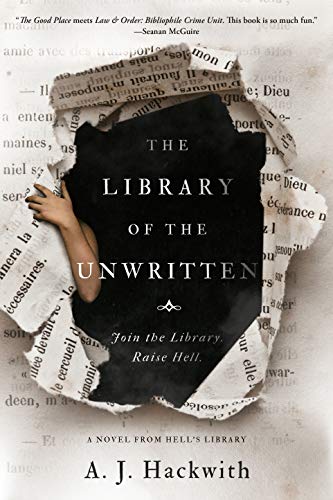
The Library of the Unwritten (Hackwith)

The Library of the Unwritten
(A Novel from Hell's Library)
by A. J. Hackwith (2019)

(Not a review, just some notes to help me remember the things I've read. But written this way because it's the Internet, and some people will stumble across this page.)

This book was one of three that was our book club was to choose from, but it didn't win the vote. After the previous month, where the ebooks were difficult to come by, I placed holds on all three books before we even voted. Since the winning book was short, and since this one seemed to be of interest, I gave it a shot. I'm glad I did. I did have to pause reading this one to read the next month's book, but I immediately came back to it.

There is a library situatied in Hell, but it isn't part of Hell and doesn't serve it. It is filled with books that were never written. It was a librarian, Claire, who used to be human, before she died. And she replaced the previous librarian, Bjorn, who is now in the halls of Valhalla (which will get visited).

Sometimes books get restless, and characters step out of them. They usually have to be sent back. Luckily, characters can't stray to far from their books, but they can take their books with them if they sneak off.

When the novel starts, a book is missing and it's made its way to Seattle. The character, who later takes the name Hero, meets his author and tries to persuade her to finish the book. This works against him because that writer started to fall from him, since she wrote him to an ideal, and when he leaves here (to go back to Hell), he leaves some pages from the manuscript. She burns them. He doesn't feel well after this. Claire attemps to repair the book with fresh pages, hoping that the story will mend/rewrite itself. In the meantime, the book rejects Hero and doesn't let him back in.

Just before they go to Seattle, a man dies but somehow manages to bring a piece of a book to Heaven. Waiting outside of the gates of Heaven, reviewing all of the souls, is the angel Ramiel, who fell with Lucifer. He's tried to redeem himself ever since, but he's been denied Heaven. He recognizes what the fragment is and brings it to an Archangel, in this case, Uriel. Uriel is portrayed as female and somewhat overwrought with emotion because the Creator has gone away (voluntarily, it would seem). The pages are from a codex written by Satan. Uriel sends Ramiel to find the rest of it, believing that the magic encased in such a book would be powerful enough to summon back the Creator to Heaven.

When Ramiel gets to Earth, he crosses paths with the Librarian, who assumes is part of the conspiracy, and depends the book. Claire, Hero, and Leto (a demon in the guise of a human on Earth) are perplexed what the fallen Watcher would want with some romance book. Before they quickly depart, Leto snatches the fragment Ramiel has, and they're back to Hell.

And now the chase is on to find the rest of the codex before its magic can be used to upset the balance of power in the afterlife.

It was an enjoyable read, with only a couple of nitpicks, but they're ones that will always bother me, like a Geometry classmate poking me in the back of the neck with the point of a metal compass.

First, every chapter starts with a journal entry, written by some librarian from present day, going back over two thousand years. Each chapter has a POV character in the title, most of whom, don't author journal excerpts. It's a little bit of a disconnect. The annoying part, for me, is that the entries are dated BCE and CE. I guess Hell has a problem with B.C. and A.D., the latter one being understandable, but the substitituion is silly. It would be just as to use After the Fall or some other metric. Otherwise, why even use Christian dating in the first place.

Moreover, rather than create their own Heaven and Hell, the author simulates a Christian version of it. Ramiel and Uriel appear in apochryphal text, and Ramiel is a fallen Watcher. Uriel can be identified as a cherub or an archangel, usually an angel of repetance, and can be shown to be as pitiless as any demon. Archangels tend to be shown as males=, so switching the gender of one (particularly when maybe they shouldn't have gender) is reasonable. I didn't envy the choice: the Betrayer, or the pitiless, emotion boss lady who seems on the verge of running afoul of a Deadly Sin or two.

Nope, the thing that bothered me, for all the re-creation, was that the "Creator", whom I don't recall ever being mentioned as "God" with a capital "g", is referred times as "she", generally by Uriel. The only God references are the titles of the two archangels who are "______ of God". But not "God" "herself".

Again, that's my nit to pick and many others wouldn't be bothered by it. If I come across this entry at the end of the year, I might think about looking for the next book in the series.

Note: the above was written on May 11. I don't know why I didn't publish it sooner.

Monday, May 8, 2023

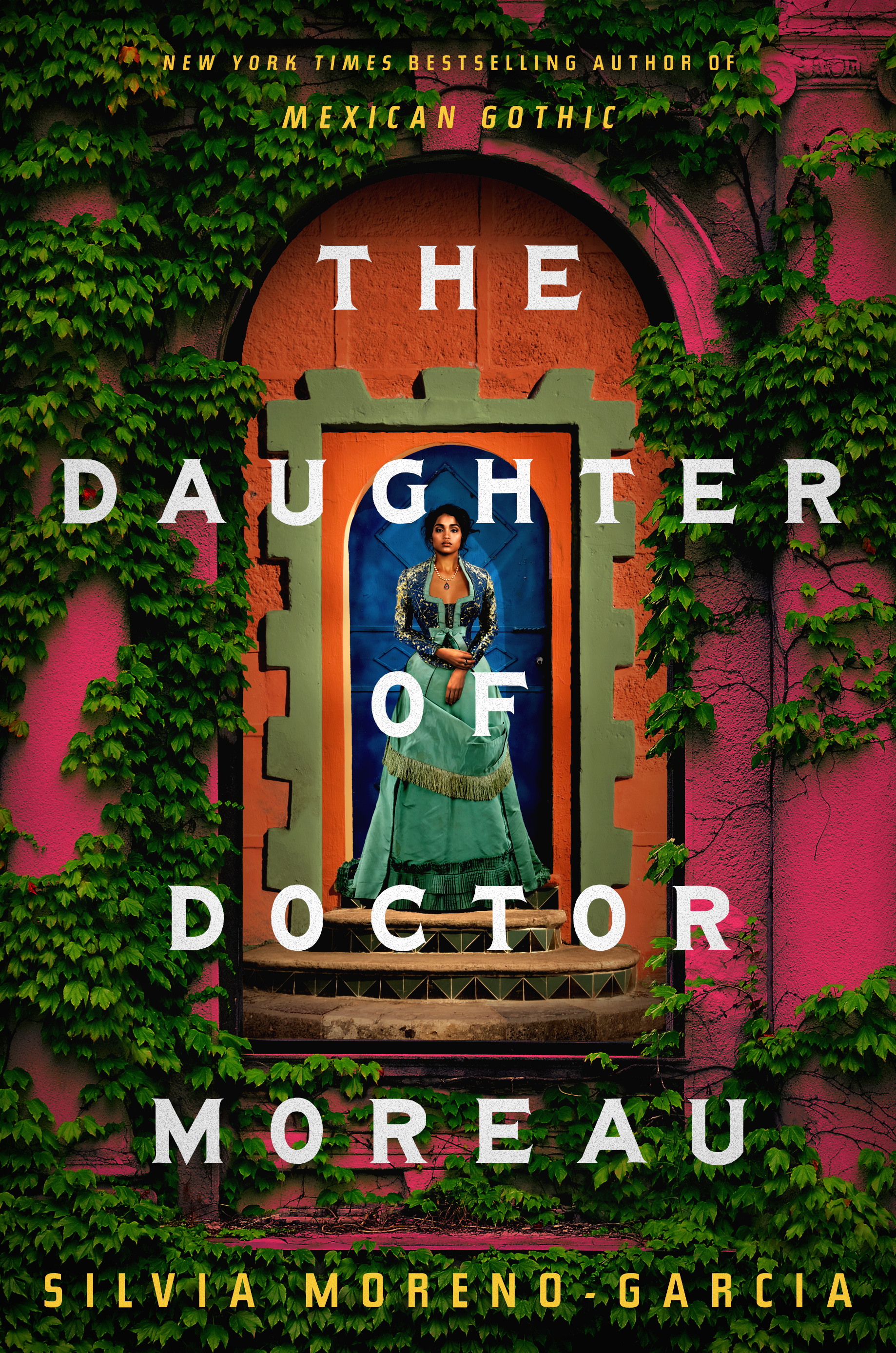
The Daughter of Doctor Moreau (Moreno-Garcia)

The Daughter of Doctor Moreau by Silvia Moreno-Garcia (2022)

(Not a review, just some notes to help me remember the things I've read. But written this way because it's the Internet, and some people will stumble across this page.)

This was a book club selection. We discussed it in a zoom call while was away at HeliosphereNY, a sci-fi con in Piscataway, NJ. That was amusing.

Despite my interest in science fiction, I have never read the original "The Island of Doctor Moreau". In fact, I've never read any Jules Verne. I attempted in college but was thrown by the old writing style. (Similarly, it took me a few tries to get through Frankenstein.) Basically, all I had to go on was the movie adaptation The Island of Lost Souls. I have not seen any of the remakes.

This book takes the original tale and sets it in the Yucatan in the 19th century and makes a historical romance out of it. I don't know what I was expecting from the title, but what I got wasn't it.

Carlota Moreau is the Doctor's daughter. When we first meet her, she's a child, and hangs out with two of the "hybrids" that the Doctor had created. I originally thougt she was younger from her childish behavior (with the other two), but she's nearly an adult when the narrative jumps 6 years forward.

Moreau's patron is a man named Lizalde, who has provided the Yaxaktun property and funding so that Moreau can produce hybrids that Lizalde can use as workers. Moreau has to overcome physical limitations and increase their longevities. Lizalde brings in Montgomery Laughton, who owns money and is basically an indentured servant, to manage the property because Moreau doesn't have a head for this. Laughton is also a hunter, and occasionally hunts jaguars for Moreau (not an easy thing to do).

Side note: Charles Laughton played Moreau in The Island of Lost Souls. That was the first thing that popped out at me.

Years later, Carlotta is grown. Lizalde's sons come to check out the property (and to find revolutionaries hiding in the area). The Doctor hopes that Carlotta would enamor one of the sons to secure his funding and her future (likely in that order). Eduardo Lizalde falls for her. Laughton isn't thrilled with this, but he's always been like an uncle, so it isn't a love triangle, but it's sometimes written as one.

Stuff happens, including a reveal which wasn't much of a reveal. In fact, I was hoping that the opposite would be revealed. Or that the truth had been revealed in Chapter 2, and let the narrative flow from there.

The consensus of the book club is that we would've like more of the hybrids. Why use "Doctor Moreau" if not for the hybrids. I, personally, would've like to have seen the daughter have more agency. If the book was the "Daughter of...", I would've liked more than a typical historical romance. Either Carlotta should've been a doctor in her own right, following in her father's footsteps after relocating to Mexico, or the Doctor could've died in the early chapters, and she could've assumed control of the hybrids. Either of these could work whether Carlotta was a human or a hybrid (such as Lota, in the Lost Souls movie).

One member who has read more of Moreno-Garcia's work suggest we read Mexican Gothic, saying that was a superior work. That's a possiblity, but it's not at the top of my list at the moment, and I have a large TBR list.

I'd give it a rating of 3 out of 5. It was enjoyable for what it was, but it could've been more.

Monday, March 27, 2023

ANALOG PLUS 50: Analog Science Fiction/Science Fact March 1973 (not much read)

ANALOG PLUS 50: Analog Science Fiction/Science Fact, March 1973

Update the photo
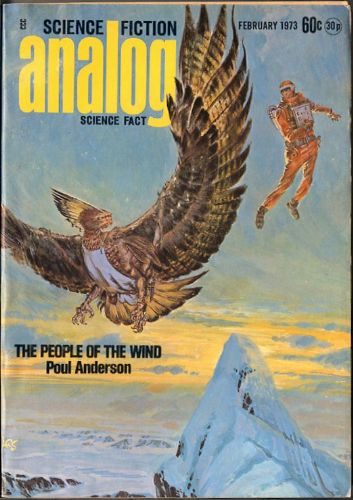
I had a lot of books to read in March, and I enjoyed most of them. Consequently, I didn't start Analog until March 27, so not much of it got read.

The usual explaination: For anyone finding these reviews, my purpose is two-fold: enjoying some "classic" sci-fi, and looking for stories that I think could be adapted for TV broadcast since so much of what shows up on anthology shows is rough to awful. Additional Note: I do NOT work in television. I just watch it.

In this issue: There's part two of a serial, two novellettes, and two short stories, one of which is really flash. The kind of thing that would one day be called "Probability: Zero" in Analog.

Editorial: "Law & Order" by Ben Bova. The 15th anniversary of Sputnik had passed without notice. Satellites are now orbiting the Earth. The Russians established the rule of "Freedom of Space" by launching over countries airspace and not asking permission, as when flying planes. This harkens back to the old "Freedom of the Seas" which was enforced by the British and then the U.S. Navy, and was kept in effect as long as it benefits those with the most power. Once laws are no longer beneficial, they tend to get ignored and fall be the wayside. Could that happen in space? (In the 50 years since, you know that it has, with space-based weapons platforms.)

Novelette: "Who Steals My Purse", John Brunner, with an illustration by John Scoenherr showing . The caption reads,

I haven't read it yet. John Brunner is a name that I could find in my basement, but I can't say that I've actually read anything. I hope to get to it, even in April.

Short Story: "Death of God", by Herbie Brennan, with an illustration by Kelly Freas, showing a background banner that says (one supposes) Peace of Earth, with a couple of cartoony, happy people walking with flowers in their hands. More prominent is the large round thing with a scaly belly, wings and a long bill, plodding along. The caption reads, "Sometimes a demonstration can be unexpectedly successful. And when it is, the need for such demonstratons disappears -- even though something else will soon be "bugging" the demonstrators."

Wilbur Hines works in a lab. Protestors smash the lab, calling him "Biological swine" and "bacteriological pig". Hines is studying gnats, and they escape as if Pandora's Box had been opened. He thought that they wouldn't be a problem but he was wrong. They mutated.

They were fruitful and multiplied, and have become a nuisance. More people stayed at home, avoiding going out. Some people are immune (unappetizing).

At some point, she was given the name Westbrook because that's the location were she lives.

Romee has to go to the jungle to get roots to sell to the Earth people to get money for the damn-TV and to buy chocolate. She's addicted. The new government wants to ban the sale of chocolate because they think it's unhealthy for the Notcid, and it could be why so many are dying in the jungle.

Romee meets a woman who is looking for people for a series of tests on response to envrionmental stimuli for a modest stipend. Romee applies.

The test turns out to be a little cruel. It uses the machine-sounding noises that the Noctid hear in the jungle and usually don't survive. Most of the time, their response is to jump away from the noise. By the time she's heard the noise twice, she's flattened to the ground, scared out of her wits. This continues until the experiment is stopped by a senior official who is not amused. He mentions "damage money" that Romee will be awarded ... but that won't be for quite a while.

Since she still needs money, she goes off the jungle and finds some of the roots she needs. While she's crawling around, she hears the noises roaring above her. She flattens to the ground and waits for the end to come. But nothing happens. The noise keeps repeating, over and over, until there are new sounds, a creak and a crack. It was a swinging tree limb, and it kept swinging so long that it finally cracked and fell. Worse for the tree, it fell into the very trap the limb would have pushed Romee into had she jumped into the air instead of flattening to the ground.

She now knew how to beat the tree. She wanted to tell others but their instinct would still be to jump. So she starts by training her family the way she was trained.

This was a cute story and should be easily filmable. Hollywood would likely screw it up because makes the capitalists friendly but hardly ever polite, while the government people are polite but hardly ever friendly. Too much of the current output leans in favor of the government over any private enterprise, even when it acknowledges government's shortcomings.

Casting, as written, there are two big parts for women, but you only need a few background characters in hairy suits, one main character and four humans. I'd watch it.

Howard L. Myers has written several stories that I've read already.

Short Story: "The Guy with the Eyes", by Spider Robinson, with an illustration by Vincent di Fate, showing a bartender (Callahan)behind his bar, some glasses and decanter on the bar, and two patrons. There are some spheres odd to the side, which could be taken as planets that are meant to be inferred but not actually in the scene. The caption reads, The job of a scout is difficult and dangerous. He must determine the nature and disposition of the enemy, its weak points, and its strengths. But when the scout starts to feel sorry for the enemy...

I was hyped to read an early Callahan story. I took the paperback Time Travelers Strictly Cash from the library back in high school. My oldest brother enjoyed it immensely. I read about half of it. I wasn't the greatest of readers back then, which is why I'd take multiple books out -- I'd hope one would "click" with me. I also playtested the GURPS supplement. "Mild Hangover" Advantage? That was mine. "No Hangover" was already there.

Anyway, I haven't read a lot of Spider, even though I'm always meaning to. This story seems like it's set in his universe and there's more going on. It gives the general location and the setup of the bar routines. Doc Webster is there telling bad puns. And people get up to make toasts.

There's stuff with "this Janssen kid" whose known for trouble. There's mention of heroin (he toasts "skag") and the war (it's 1973). But he's not the guy with the eyes. He's over in the corner listening, but has no answers.

Some pontificating happens, as is wont to happen in 70s stories and beyond.

The man with the eyes wore a black suit, a Joliet Special and his shoes didn't look right. He orders 10 drinks, makes 10 toasts to his profession, and then announces that he's an advance scout from many light-years away. Callahan knows he's neither drunk nor lying. A message is going to his Masters that he can't prevent, and for the first time, he has regrets. He's surprised when the bar regulars don't attack and kill him on the spot.

It petered out toward the end with a Mickey Finn reference but no solution to either problem.

Obviously, filming this would be a big deal because Callahan's is a long running series of stories and books. It could be a series of its own about a bar where everyone knows your name or something, but in Long Island, NY. Why it hasn't been made, who can say? (Well, Spider could, and probably folks who follow Spider on social media...) I don't know who I'd cast for any of the parts. And, of course, the storylines would have to be updated since they started in the 70s and lasted for many years after.

Short Story: "Modus Vivendi", by William Walling, with an illustration by Vincent di Fate, showing a large planet (Jupiter, there's a spot), some moons and a ship. The caption reads, The most critical step in any medical experiment is going from test animals to human trials. Usually this step is taken very carefully. But sometimes ...

I read the caption a while back before I read the story. It's funny reading it now as it telegraphs the ending in a way.

Clancy Bevvins, Lee Gresham, and Thaddeus Frye are scientists and researchers on a space-based station orbiting Jupiter. There's a base on Ganymede. Much of the research is of the hush-hush variety, so most have nothing to say about their work to the others. The one thing is that Bevvins has three gibbons with him. He says he's in deep space to avoid radiation and to be in zero g.

There's an accident that pushes them out of their orbit and whatever it is has breached both oxygen systems. The three of them and the gibbons are the only survivors. Time is against them. They won't spin into Jupiter before Ganymede is in range to call for help but they will run out of oxygen with no way to recycle it. There isn't enoug for one man let alone three

That's where the gibbons come in. One of them has something in their system (I was a little murky on the details) that allows her to recycle the carbon dioxide or breathe oxygen. Bevvins uses his experiment to keep the three of them alive. But there are consequences.

This was a good story, and only require a cast of 3 that can be as fiverse as you want them to me. It would also need three gibbons, briefly, which could be trained animals or could be cgi. Probably cheaper to get an animal trainer for a day of shooting, but what do I know? Only a couple of interior sets are needed, but the wreckage, and exterior would likely require CGI. I'd watch it.

Science Fact: "The Third Industrial Revolution" by G. Harry Stine, with an illustration of industry on the Moon that appears to be credited to "General Electric". The caption reads Conclusion. When you want to have our cake and eat it too, you're in a dilemma. When you want to continue a high-level technolog without further gutting Mother Eart for resources, you have to move your industrial base out of this world.

I followed a bit of this and then skimmed the rest. Gravity wells are issues for get resources and materials up into space. Slingshoting from the Moon or Mars would be easier, as would be mining asteroids. And you wouldn't have to worry about heating the environment.

If I knew enough about manufacturing in general, let alone space manufacturing, this could be a good resource to revisit for writing. The problem is that unless I want to write hard science fiction, most of this can be hand-waved.

Novellette: "Force Over Distance", by Tak Hallus, with an illustration by Jack Gaughan, showing a man working at a table, where there's a large box and a vertical ring. On either side of him are men with sombreros and guns. In the forground, there appears to be an object floating in a ball of light. The caption reads, The military-industrial state can sometimes amount to nothing more than two or three men with a common purpose. They don't even have to like each other.. just have a common purpose.

I've read Tak Hallus before at least twice. (I did a quick blog search.) This story is filled with Mexican banditos and revolutionaries.

Federico Jenson is a physicist who goes to Mexico and has his tire shot. He discovers this when he replaces it with the spare. As soon as he's done, the banditos steal the car and intend to strand him on the roadside. He wants his briefcase with his life's work in it. They refuse. So he says that he's going, too. So he's a hostage for ransom that he basically agreed to (insisted upon).

He tries to work out a math eqaution in the dust because he doesn't have paper but he insists on continuing his work. Juan, the guard, asks about it, calls him crazy for all the work he does to get a "cero" (the sequence should converge to zero). This sums up the opening illustration.

Jenson is being held prisoner by the revolutionary el Buitre, the Vulture. El Buitre isn't dumb -- he is good at strategizing and planning. He has Jenson demonstrate his transporter, which moves something to the other end of a table. El Buitre wants him to build a "beeg one", as big as a room. Jenson says what that would require.

This is no problem for El Buitre because his people can steal whatever they need. People die along the way. Jenson isn't happy about this, but on the other hand, he doesn't want their deaths to mean nothing. They're already dead and the project can move forward. He's almost as obsessed about his life work as El Buirtre is about his revolution.

His men make it into Tucson to get tantalum, and they kidnap construction engineer Harold Wright. Wright refuses to opperate for several days. El Buitre is about to kill him when Jensen intervenes. So El Buitre decides to kill him first. At this point, Wright agrees to help (although he nearly gets himself killed for calling El Buitre "Buzz").

The two complete the machine even though Wright is trying to stall it because he believes that they'll be killed before it's done. Finally they plan to escape through the device, with Wright worrying that Jenson might stay behind for "science" and his life work. Their plan is thwarted by the fact that Juan is smarter than he's been letting on.

The banditos go through the device (which seems like a large stargate) but they're in for a surprise when they get there.

An enjoyable story. It could fill an hour-long episode of an anthology show. I don't know how well the Mexican bandito angle would play unless it's done in a retro style, as in this actually happened in the 70s. The cast would require a handful of revolutionaries, El Buitre, and a physicist and an engineer. Women don't have a lot to do in this story. The ending requires a lot of extras and motorcycles, but it could just be a handful, and then cut away to Jenson and use a lot of sound effects and smoke and rattling boards.

Note: there is a very odd interior art piece which looks like El Buitre is riding a motorized unicycle. There's smoke to obscure the missing parts of the bike (and his arms because there are no handlebars) but you can see the far legs which should be on the other side of the motorcycle, out of sight. I found it amusing.

Short Story: "Trade-Off", by R. A. Beaumont

This entry appears to have been deleted. I must've typed it at work and didn't "save" it. Or it was lost the last time my computer froze and I had to do a hard boot.

Until it's restored: I wasn't thrilled with this story. It's filmable, but I don't it could/would be made into a segment on an anthology series.

Short Story: "Trade-Off", by R. A. Beaumont with an oval-shaped illustration by John Schoenherr, showing what appears to be a bunch of silos (or cylindrical objects) on a field at night and there are lots of bubble. The caption reads, There are times when the cure is worse than the disease. But when the cure triggers other diseases ...

I just started reading this. It appears to be told in a series of top secret memos. I didn't get far.

I have libary books to finish, so I may or may not get back to this.


The Reference Library , by P. Schuyler Miller. Opens with a discussion of books about on-screen SF. Reviews include The Overman Culture, by Edmund Cooper; The Wrong End of Time, by John Brunner; The Reality Trip, by Robert Silverberg; Pstalement, by Lester del Rey; and The Darkness of Diamondia, by A.E. van Vogt.

Brass Tacks: In July, there was an article on the future of automotive plants. Analog received a lot of responses, so they printed a reply by the writer, R. G. Cleveland first. I don't remember the article and the issues involved are 50 years old, so I didn't miss much skimming this.

I got an early start on this, whih was good, but then my book club and other library books took my attention away for a couple weeks, and February ended before you knew it.

Heracles: The Hound of Hades (Kin)

Heracles: The Hound of Hades by Kin (2026) (Not a review, just some notes to help me remember the things I've read....