Tuesday, June 30, 2015

1633 (Weber, Flint)

1633, by David Weber and Eric Flint, 2014

The second in the Ring of Fire series, 1633 offers a lot of promise with its gleaming cover comprised of a knight on horseback backed by a naval vessel, ready for war. It delivers on the action, but it doesn't (quite) on that image. However, it does give you an idea where this is going.

After the events in the first book, the Powers Than Be in Europe have stopped blaming deviltry and witchcraft and accept the fact that Grantville is here and that a new entity, the United States, now exists in Germany. They have brought weapons and technology from the future. They also brought back history textbooks. (And other library books with more information than your average high school history text might actually have.)

Having the knowledge of a possible future changes the course of "present" events. France and Spain, seeing that the results of a pointless, prolonged conflict, skip the Franco-Spanish War of 1635-59 and turn their attention to other targets. Richelieu is still cunning and angling for power.

At the start of the novel, representatives of Grantville are scattered about the continent on diplomatic missions, which go about as well as one could imagine in those troubled times. War is inevitable. However, Grantville hasn't rested on its laurels. It started developing an Air Force (by first reinventing the airplane) as well as a Navy, under the direction of John Simpson, who goes from mere antagonist to major player.

If you liked 1632, you'll probably like this one as well as it takes Grantville and its people to the next step. (If you didn't like 1632, then don't waste your time. If you didn't read 1632 then go back and find it because this one won't make any sense.)

It isn't as standalone as the first one. Obviously, you need the background from the prior book, but also there's a bit of a soap opera feel, making sure that the favorite characters are there, even if there isn't much to do. There are the brushes with historical people and events, which either have to be mentioned/acknowledged as happening or setting up future events. Where the first book had a satisfying finish but was open-ended for the series, this one has a major finale that doesn't disappoint but it doesn't end the story that it started. It's one battle: the war is still going on, and the steps Grantville is planning haven't been taken yet. Yes, I wanted to see the Old World's shock at seeing the full force of the United States Navy, instead of just a few speed boats with guns. (Not that there's anything wrong with that.) Again, look at the cover of the book!

I'll probably take some time off to read other things before getting back to the series. But, yeah, I will probably be back to this series, at least for another book. The major question in this chaotic shared-world series may ultimately be: Just which book is the next one?

Monday, June 29, 2015

How to Make Your First App (Philabaum)

How to Make Your First App, by Ben Philabaum, 2014

This was an unusual ebook in terms of its content. While the idea of making my own app for my iPad intrigues me, this book is missing one little detail that may seem crucial to completion of this task: how to make an app!

Now before you cry foul, or con, or bait and switch, let me tell you that it does give you everything you need if you want to have an app to sell and make a few extra bucks -- and by a few, I mean a few, not a few million or possibly not a few thousand. At least, not with your first app.

There is more to creating, publishing and successfully marketing an app than just writing some code. In fact, the code might be the least important part because you can pay someone else to write it for you.

Again, this isn't a cop out. Think about it. The creators/owners of many businesses don't actually make their own product. They just come up with the idea, get it made, and then market it. Better marketing will increase sales, and if you get someone who makes it better than you, even better.

There are people who will write code for you for a flat fee, and the book includes a few places where you can go. Keep in mind that most of the examples the author uses for very simple limited apps that fill a need. Starting small can help you build a client base. And can keep your losses down if it turns out that this isn't for you.

So this was an interesting read, but a little disappointing. I used to be a programmer, so, yes, I was hoping for coding tips, or even instructions. However, Philabaum does deliver on the promises in his introduction, even if the book's title is a little misleading.

Again, this was another "book to read between books". Actually, I started reading this because I left the print book I was reading home, and this was on the device I was carrying on the train.

Sunday, June 28, 2015

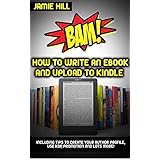
BAM! How to Write an Ebook and Upload to Kindle (Hill)

BAM! How to Write an Ebook and Upload to Kindle, by Jamie Hill, 2014

This ebook was basically a book to read between books. Something quick and possibly interesting before I decide where I want to go next.

If where you want to go in making ebooks on Kindle, then this might be the book for you. On the one hand, Jamie Hill has five titles available, so something is going right. On the other hand, I downloaded it for free, so maybe so, maybe not. On the gripping hand, I'm talking about it, so there is that.

The book is more than just instructions for uploading. It's about picking a topic, one that others might be looking for, creating an outline, sticking to a schedule and doing your research. Instruction on how to format your Word file so it translates into kindle's format are there, too. Covers are tricky -- so don't make your own. There are websites to go to where you can get one done cheaply enough.

Overall, some good information, much of which can crossover to other types of projects, and I couldn't be the price (although I think it's $.99 now).

Quick read, worth your time if you're thinking about getting into e-publishing.

Monday, April 20, 2015

The First Chronicles of Druss the Legend (Gemmel)

The First Chronicles of Druss the Legend, by David Gemmell, 1994

This book is labeled The long-awaited sequel to Legend, but it is, in fact, a prequel. First Chronicles is not the first book in the series. It isn't even the second. However, if you picked up this book, there is little you would miss or would have to wonder about. In other words, you could read this before Legend, if you wanted to read them chronologically, but I wouldn't.

In fact, prior to this, I read The King Beyond the Gate, which was a sequel (or follow-up) to Legend. I was impressed by it enough that I loaned it to my brother and told him to read it now. I wanted someone to talk to about the book. He finally did -- and then turned around and bought the other three book in the series at that time. So I got to read his copies of Legend, and after rereading King, Quest for Lost Heroes, which is farther in the future, and finally Waylander, which is a the earliest in the timeline for all of these, so far, predating Druss's adventures in what are collectively known as the Drenai Saga.

Somehow I moved on to other things and put reading more David Gemmell on the back burner, which is a shame. He passed away several years ago after writing so many other things, not just in this series.

This book takes us back to when Druss was a young man, before he became a Legend. (And the plot of Legend was that he had retired from it long ago and was being called back in -- and had to live up to that status.) You meet his father and learn of his grandfather and the origin of his great axe. The book follows Druss's search for the only woman whom he has ever loved and who loves him, Rowena, after she is kidnapped by raiders along with the rest of the young woman of his village. It's not a shorty story; it's a long journey across the land and the sea and into war to find her and win her back.

It's a satisfying read. There's little magic but there are other fantasy elements, including spirit realms and demons, but the focus is on the men and women. And the axe. Don't forget about the axe.

I actually read this book before some of my earlier entries. When I was catching up, I went through the recently read entries on my e-reader, forgetting that I've had this paperback sitting on a shelf for quite some time. (True story: I started this book during the summer while lounging in the pool, but I switched to magazines which I wouldn't care if they fell into the water.)

Friday, April 10, 2015

Doctor Who: Engines of War (Mann)

Doctor Who: Engines of War, by George Mann, 2014

The Time Lord who rejected the name "The Doctor" nonetheless picks it up again, mostly because readers need to call him something. Likewise, so do the rest of the Time Lords on Gallifrey, including Rassillon, the Daleks, and, of course, his latest companion.

Taking place in the middle of the Great Time War, the Doctor is part of an attack fleet that's ambushed by Daleks. He crash lands on the planet Moldox, infested not only with Daleks, but with Skaro Degradations with new weapons. The Temporal Cannon removes the target from history, though gaps seem to remain. Even though a soldier never existed, his cot is still there, even if you can't remember whose cot it was. (Problems like this occurred with the crack in the universe in the first Matt Smith series.)

The Doctor and "Cinder", whose family was killed by Daleks when she was a child, head off to Gallifrey where the Council decides to kill the Daleks by destroying the Tantalus Spiral and annihilating billions of lives (along with Daleks), which are acceptable losses to save trillions of others. Oh, and kill the Doctor. The Doctor does his best to make sure that neither of those happen.

Long time fans of the series (from before the revival) will be rewarded, but no viewers won't be left scratching their heads.

It reads like a long episode, and that's not a bad thing. It's a satisfying read, but it doesn't really give us more insight into the War Doctor, except that he's already tired of War. He rejects the name Doctor, but that's all he ever seems to be. Again, not that that's a bad thing.

Thursday, April 9, 2015

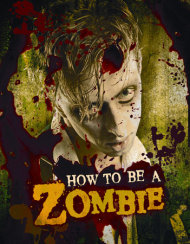
How To Be a Zombie (Valentino)

How to Be a Zombie, by Serena Valentino, 2010

After years of vampires and werewolves hogging the moonlight, zombies have finally found their place in the sun (which the creatures of the night avoid anyway). This book, published in 2010, is a How-To guide for the recently deceased/recently risen on how to be the best zombie possible. It's written like a series of click-bait articles you might find online, but this is something different.

For one thing, the reader isn't assaulted by pop-up advertising. For another, Serena Valentino knows a lot about the different types of zombies that have appeared in popular culture, and it shows.

The book is a bit of a balancing act. For one part, it's written for the undead to adapt to their new life and gives tips on how to fit into society. This part is actually well-researched for something that isn't real. (Or is it?) The other part is for zombie fans who want to cosplay zombies, but these could also be geared toward friends of the undead wanting to help their zombie friends fit in and give them a sense of belonging. Tips on how not to get eaten by your buddies are included (along with tips on not eating your buddies, of course).

It was a fun little read. I picked up the book in a lot that I won at a raffle. It was the only book in the pile that didn't seem to be a paranormal teen romance, so that's what I started with.

Wednesday, April 8, 2015

Yo Mama Jokes for Kids (2015)

Yo Mama Jokes for Kids: Large collection of over 200 funniest Yo Mama jokes for Kids!

I won't bother mentioning the author. Not fair? Probably not. Then again, I didn't have to list this book, either, but I'm trying to keep a list of the things I've read.

Years ago, people used to post a lot of dumb stuff in usenet. (For all I know, they still do.) Everything now and then, someone would gather up material into a "canonical" list that went on for pages. It could be amusing ... or it could be extremely repetitive.

This book is extremely repetitive. Once you get one joke on a topic, you don't need half a dozen more just like it. (By the way, some of the jokes are repeated verbatim a page later, so 200 jokes is an incorrect figure.)

Worse, many of these jokes are old. "How old are they?" They're so old Joan Rivers told them about Elizabeth Taylor. They're so old that Cain told them to Abel because he wasn't self-aware. (The latter, not so much, but the former, absolutely.) Granted, there are a handful that refer to recent events, technology or pop culture, but for the most part, you could find most of these reading social media for an afternoon.

I might've raised an eyebrow once or twice, but never laughed out loud or snorted.

Likewise, 200 one-liners is barely a book, so don't pay for this one.

Tuesday, April 7, 2015

1632 (or The Ring of Fire) (Flint)

1632 (or The Ring of Fire), by Eric Flint, 2000

In the year 2000, a freak occurrence, referred to as The Ring of Fire, sent the town of Grantsville, Virginia back through time and space, swapping places with a plot of land in central Germany in 1632, in the middle of the Thirty Years War. The small mining town quickly realizes the unlikeliness of a second cataclysm putting right what had been torn apart and sets out to acclimate to their way of life. And, of course, survive. Their weapons and technology give them a great advantage, but they no longer have the industry to produce that technology. Nor do the have the industry to produce the industry ...

An alternate timeline is born as the United States of America is founded 144 years early (and on a different continent). History plays on around them.

The book divides its time between brutal battles fought across Germany, building a new society and some overlong passages on just how well the Americans are getting along with their new neighbors and each other. Putting a new government together has its growing pains. By the end of the book, you get a sense that things will go well even though there's much more to do and more dangers to face, but you'll be satisfied that you weren't left hanging until the next book.

1632 is the first of a series, but is a fine standalone read. It has launched a shared world of sorts, with other established authors writing stories. The first sequel will be on my "To Read" list before I decide how much farther I'll go with the series.

Saturday, January 24, 2015

Dirty Machines (Olson)

Dirty Machines, by David Matthew Olson, 2014

Dirty Machines is a story that puts forward a lot of ideas and doesn't develop any of them, which is a shame because some of them could have been good. Starting from the beginning where the main character's name is omitted and references to it are jarring to say the least. (Seriously, it's "[Del]" or "[Del]'s" or similar and it wasn't until much later that I realized that it was supposed to be a reference to the "Delete" key.) Not that it matters what his name is because he'll change it when he goes into the future.

The plot centers on the head of the world's only Time Travel company (which replaces the letter "T" with stylized crosses everywhere!) personally comes back a few decades to convince our nameless protagonist to journey into the future. Here's the hook: if he doesn't, history says he's about to die from a stray bullet while minding his own business. However, they can replace him with some poor shlub from the past who is genetically similar and dressed up in a matching outfit. The doomed man, who would've died alone in the past and never have been found, gets a quick death and spares a life. The catch: now that he knows, he can't avoid his fate because they can hit a magic Reset button and he'll be back on the subway before the offer was made with no memory of the meeting and blindly unaware that he'll be on his way to his death.

Naturally, he agrees after considering if this is some kind of gag. And smoking some weed. And whining and complaining about stuff.

Never answered is why Jim Doors (a reference to things hidden behind doors or to Jim Morrison of the Doors?) is so interested in the protagonist. Yes, a reason is given, but it isn't a satisfactory one, so you figure that there must be more to it. The most important, most powerful man in the world takes a special interest in some random pothead, stand-up comedian because he thinks he can write click-bait articles to get the world reading more? What?

The time travel at the center of the story is even more confusing. Everyone is free to travel back in time to visit important events as spectators, but no one may change The Course because that would be bad. But with all these people going into the past (there are mandatory trips), where are they? Only a handful are ever present at an event, such as a bus filled with witnesses to a major milestone in time travel history could be seen by the people of that Era and yet it's always the same bus. Does the trip get Reset? But then why is it there to be seen in the Past.

The title "dirty machines" refers to unauthorized time travel machines and isn't referenced until at least three-quarters of the way through the book. It could have been a separate plot in itself (and probably should have). And then there's the ending, which I won't mention, except to say that that scene should have taken place a hundred pages sooner with the story going on from there.

I could go on nitpicking some pretty sizable nits, and not just the massive numbers of typos. The narrative is disjointed, randomly switching point-of-view characters. There are no chapters, just breaks in the text. An entire section is crossed out -- I guess to symbolize that it didn't take place. Details of the future are sketchy and are poorly delivered. The main character is lost without his iPhone but hesitates to use Current tech to the point that others have to keep filling him in. The book touches real life with a flyer for Stephen Hawking's party for time travelers and circles back to it with time travelers having a party across the street and observing Hawking through his window all alone. Hawking could never know the "truth" of the matter. Ultimately, he got the better end of that deal.

Final note: the book suffered from not having an editor or a copy editor.

Friday, January 23, 2015

Shards of the Glass Slipper: Queen Cinder (Mauritsen)

Shards of the Glass Slipper: Queen Cinder, by Roy A. Mauritsen, 2012 I was first drawn to this story by a series of paintings hanging in the Art Room at Lunacon (a long-running Northeastern science fiction convention, usually held in Rye, NY), each with its own vignette, giving a new twist on each of the fairy tale characters that were more in line with the original interpretations than the 20th-century incarnations. The artist was Roy A. Mauritsen, and his book uses these characters.

His incarnations flow together very nicely with a few odd twists among them, most of which are enjoyable. (I have a couple of quibbles about how some of the characters, and their relationships to each other, but they work within the story.)

I don't want to give anything away -- I'd rather let the characters reveal themselves as the story progresses, even if you think you know who's coming next, as you get caught up in the tales of those grim days after the Beanstalk War when Cinderella has to ascend to the throne. Fairy magic is on the wane and with it the power of witches, but is there another source of power that can be tapped into?

My only complaint was that the subplot was actually the build-up to the sequel, which I now have to find. (Like I wasn't going to get it anyway!)

Thursday, January 22, 2015

365 Things I Learned the Hard Way (So You Don't Have To) (The Digital Writer, Jonathan Wondrusch)

365 Things I Learned the Hard Way (So You Don't Have To), by The Digital Writer (Jonathan Wondrusch), 2012

A free ebook on the writing business by a writer. Quick! What's he trying to sell me? Actually, he isn't selling me one thing -- he's selling me on a lifestyle, a workstyle, a way to make it all click, if that's what I want. And that should be what I want.

The Digital Writer puts together and presents information in a usable way, heavy on the discipline, easy on the hard sell. He recommends ways to establish your presence, your brand, online in social media, and the ways to monetize it. Because if you aren't monetizing, then what are you doing? He also tells you when to pay for others to do the work for you -- specifically, hiring an editor and paying for good cover design.

A good chunk of the book is dedicated to writing copy, which is a promising field to get into that pays well when jobs are available, as well as making ebooks starting with information that's readily available by consolidated so that the reader doesn't have to research it, and search engine optimization, because you want users to find you when you know that they aren't going to look at that second page on Google.

Ebooks, by the way, are a great source of steady income once you build a following. There's a good discussion on pricing, which has recently changed as Amazon has changed its terms.

The final part of the book is a Q & A from letters he received on his Digital Writer blog. They get a little repetitive with the rest of the book and with other questions, but it's definitely worth skimming. One thing that impressed me was that he recommends two great books to learn how to write copy -- and they aren't his. They're the ones that he learned from and he recommends them. You have to admire that. If nothing else, it definitely improves his brand.

Wednesday, January 21, 2015

The God in the Clear Rock (Randolph)

The God in the Clear Rock, by Lucian Randolph, 2011

I "purchased" The God in the Clear Rock as a free download after seeing it promoted on Reddit or, perhaps, some other site listing free ebooks. I'm glad I didn't waste any money on it, and I'm certainly not going to spend a dime on any of the sequels.

Full disclosure: I didn't get far beyond Chapter 1, but had I kept trying, I'd still be reading this book weeks later. I'm stunned by how poorly it's written. This isn't a case of misspellings and glaring typos. The prose itself, the descriptions, the dialogues, the analogies used in the exposition need serious work. The writing is terrible. The dialogue is terrible. The odd metaphors describing actions and objects are more distracting than helpful.

One of the dangers of self-publishing is that you try to do everything yourself and don't get good feedback. One piece of advice I've seen repeated is spend the money you need to on an editor and good cover art. The cover art is decent. The absence of an editor is obvious.

The writing was so distracting that I couldn't stay with it long enough to discover if the story (which the author states in the Foreward would be a cliffhanger in each part) was worth trying to follow. The other reviews I saw on sites such as GoodReads tell me that I made the correct choice.

The one bright side of this: I'm curious how many of these books his put out and what his sales are like. If this guy can make enough money on ebooks to write six novels, then anybody can.

Bourbon Penn 30, August 2023

Bourbon Penn 21, July 2020 (Not a review, just some notes to help me remember the things I've read. But written this way ...