Friday, January 5, 2018

A Reminder for People Finding this Blog through Search Engines

Thank you for visiting my blog. This blog is a list of my recently read books. It's actually meant for me to keep track of the things I've read with a few notes about what the book was about or the characters involved.

That's how it started. I don't mean for it to be a "book review" site, although it will sometimes read like that. I try to avoid spoiling ending or anything in case someone stumbles onto this page by accident. Once I remind myself what a book was about, I should remember the ending. And if I don't, well, then it wasn't worth remembering.

Comments are welcome, as are suggestions based on other things I've read.

Fact checking is welcome, as well, as I type from memory. For the purpose of this blog, while I desire accuracy, it is not mandatory. However, corrections can be made if I'm way off on something.

-- Christopher Burke

O is for Outlaw (Grafton)

O is for Outlaw Sue Grafton (1999)

Up until now, we've only had glimpses into the earlier life lived by Kinsey Milhone before she became a detective, and we've even discovered, as she did, that what we knew wasn't totally true. We know she'd been orphaned, and raised by her aunt. We know that she'd been a cop, and married twice. We thought we knew that she had no other living relatives, until they suddenly showed up and we learned more about them.

Now we get to learn more about her ex-husband from her short-lived first marriage. First off, his name is Michael Macgruder, aka Mickey, and secondly, well, we learn about his past more than his present. He doesn't get to say much in the here and now.

Kinsey doesn't have a case this time. She's on her own. In fact, she'll even be a suspect before it's over. The novel opens with Kinsey getting a call from someone who has a box of her old possessions, report cards, yearbooks and the like. The caller had bid on the contents of an unpaid storage locker in the hopes of finding treasure, and now he's offering to sell Kinsey back her stuff so he can make back what he overpaid. Kinsey realizes that the locker must've belonged to Mickey, her first husband, who she walked out on. This bothers Kinsey because Mickey was always good with managing money, so, she believes, he must've fallen on hard times. This spurs her on to investigate, if she can just get a fix on where he's living, because he's also good at hiding in plain sight.

To further complicate matters, in with her possessions is a note from an old acquaintance from 15 years earlier, pretty much admitting that she had had an affair with Mickey during their brief marriage, but also that it coincided with an infamous incident that got Mickey kicked off the police force. Mickey had an alibi for a death that Kinsey thought he might've had a hand in. Mickey even wanted her to lie for him regarding the events (without telling her the truth of where he was). That was the end of the marriage.

Now feeling guilty, she starts tracking down the folks who hung out at the old bar back then. It isn't long she finds out that Mickey has been shot with a gun that he had bought her but that she had left behind. He's on life support, and she is a suspect. Now she has more reason to find out what happened to Benny Quintero, a Vietnam vet, that night 14 years earlier.

As with the rest of Grafton's books, you have to keep in mind when they take place. Even though it was 1999 when published, it takes place in the mid-80s. In fact, there's even a reference to the events of L is for Lawless happening only a few months earlier. In this case, the action takes place 14 years after some events that occurred during the Viet Nam War.

Go with it, and you won't find yourself "doing the math" when she's in Louisville, Ky (on her own dime), looking through high school yearbooks.

As with her other books, I enjoyed reading it. I did put it down for a couple of weeks in the middle (due to real world events, really). I would have liked a little more information about Mickey, maybe some exchange between him and Kinsey, closure or whatever, but I won't complain about what we got.

On a sad note, I finished it one night at the end of December, right before bed, and the next day, I read that Sue Grafton had passed away. I don't know if she had planned a finale for the characters in any way, or if "Z is for Zero" would have been just another case, but now we'll never know. I wouldn't want Kinsey's swan song ghost-written by someone else. Better than it remain unpublished.

Wednesday, January 3, 2018

2017 -- The Year in Review

One of the problems I always have with lists of the "best" books of any given year is that I rarely get to read books in the year that they are published. I guess I rely so much on word of mouth for new things, and if they are popular, I won't see a copy of it.

Secondary problem, I'm at a point where I have way too many books, so I don't purchase too many. I might get a new book as a gift, or if I'm getting it signed by the author, which hasn't happened for a new release since I worked in midtown Manhattan.

My reading time could be summed up as follows: before bed, on the subway (not buses), and lying around in the pool. (Yes, in the pool, so my choices are limited -- no ebooks, obviously.)

Looking at this blog, there were 20 entries from 2017. One of those had two books, and another mentioned 30 volumes of manga read over a 12-month period. Assuming half of those were read in 2017, that's 35 books, which isn't bad.

Add to that a few more books that weren't written up yet, and that brings the total to 40. Not horrible, actually.

I think that my summer challenge turned into an interesting experiment, but too many of the books at my local library were reference books, not suitable for summer reading, and I found myself picking up quite a number of "young adult" selections. Nothing wrong with that, in general, but at least one was aimed at a middle school audience.

I'm not looking into any "goals" or "challenges" this year. If one comes along that interests me, fine. Otherwise, that's fine, too.

The books that I've been reading are generally large, and my time devoted to them (especially if I'm driving) is short. Not a good combo if the plan is to read N number of books. I mused the thought of tracking pages, but even this is silly given some content. For example, last year I read a book of poetry, a photo essay, and a book with large print. For that matter, I couldn't say how many pages ebooks have because it depends upon the font size.

So, no goals. Plans? Well, I have to read some more Eric Flint before Heliosphere, NY this year, where Mr. Flint will be one of the guests of honor, and a mini-1632 convention will take place within the larger sci-fi convention.

I will continue to read more of the recently departed Sue Grafton, eventually, though not likely in 2018, getting to Y is for Yesterday, which will, sadly, be the final letter of the alphabet.

I will finish at least two books of fairy tales that I've started but put aside because I can only read so many before my mind wants something else.

I will get more of the paper books off my shelf and out of the house even as I bring in my electronic ones.

There will be more manga and more math books, and possibly a manga math book!

There will be words, pictures, poetry, and whatever may come along that strikes my interest.

And there will be write-ups, summaries and reviews, even as I re-evaluate just who I'm writing this blog for.

Looking forward to 2018, which has already started, and I'm already reading.

Wednesday, December 6, 2017

N is for Noose (Grafton)

N is for Noose Sue Grafton (1998)

After a couple of false starts going through some "between books" books, I returned to Sue Grafton, starting the second half of the alphabet. (I'd say the end is in sight, but, of course, the last two books have yet to be written.) As always, the action takes place a few months after the previous installment, so even though the book was published in 1998, the action takes place sometime in the 80s. Specific dates aren't mentioned, but you have to keep in mind the technology. Granted, even if it were 1998, Kinsey likely would not have had a cellphone (or even a Blackberry) and pay phones would still be around. The Internet, as we know it, would be in its infancy. But that doesn't exist here.

The story opens in Nevada, for a change, as Kinsey Millhone is caring for her boyfriend, Robert Dietz, who is recovering from surgery. Once he's able to get around on his own, there isn't any need for Kinsey to play the domestic, so she prepares to drive home to Santa Teresa, California. On the way back, she stops at Nota Lake, California to check in with a possible client, referred to her by Dietz.

Selma Newquist is a recent widow after her husband, Tom, who worked for the local sheriff's department, died out on the road. There's no murder mystery here -- Tom died of a heart attack. There isn't anything to suggest it was anything more that that. However, Selma is convinced that something was bothering Tom in recent months, and she hires Kinsey to investigate to see if she could find what troubled him. She reluctantly agrees, figuring that if no leads turn up in a few days, she'd call it off and go home.

Her inquiry has two sides: interviewing friends, family members and coworkers at the Sheriff's department, and going through the papers and bills in his office at home. The interviews review that Tom was well-liked, but Selma? Not so much. Also, there may or may not have been another woman involved. People are happy to help, but in a small town, no one likes a snoop.

The main clues are phone bills showing out-of-town calls, a missing police notebook and some doodles and numbers on a desk blotter, which include a noose, as in the title. Coincidentally, the odd phone calls go to Santa Theresa, giving Kinsey reason to go home. Another reason to go home: someone follows her car around the neighborhood one night, and then breaks into her rented room and breaks her fingers. So there's definitiely something there that someone doesn't want found, likely dealing with Tom's last case, but his notes are missing -- not in his house, the car, the scene of his death, or the sheriff's office.

There are minimal appearances by the usual Santa Teresa players, and the newfound family members don't get a mention this time. No weddings or any personal, non-investigation events of any consequence.

A murder in Santa Teresa links up with another five years earlier in Nota Lake. The victim in the second case was a person of interest in the first. But by the time Tom got there, he'd already run off. Next anyone heard, his body was found, months after his death.

So I enjoyed this one like I enjoy most Kinsey Millhone stories. Grafton usually finds a different take on a story instead of a straightforward procedural. (Her first novel in this series had her solving a crime for someone who had already been found guilty and served the sentence.) However, this one seems to lead Kinsey around until the facts fall into place when they're needed to. For instance, she interviews one hotel clerk, who has some information about another man who visited, but she didn't get to talk to the other one before being called back to Nota Lake. So a key piece of information isn't gathered -- in this case, a description of the man, where even knowing black or white could telegraph the ending. Likewise, when the notebook is finally found, along with the phrase "the key is on the desk", it's readily apparent that the "key" is a cipher key, not a physical one to a lockbox somewhere. (Because any physical key or physical safe would have been previously found and vetted by this point.)

Kinsey also "hangs a lampshade" on the fact that so many of the people she'd met in Nota Lake had five-letter names. I wish she hadn't. While she's trying to figure out want this string of coded numbers might mean, it might've been neon lights saying, It's a Name!

And I may not be the greatest sleuth, but I crack the code using the info provided at least a chapter before Kinsey. Granted, she might not have been at 100% at the time.

As with the last book, when the ending came, i thought it unraveled a little too quickly, and I might've like a little bit more of an epilogue. Sure, the case is over, but for all the added info in the middle of the story unrelated to the case, maybe a little explanation after the fact would be nice. Or even just a deputy showing up and making arrests? Maybe that's just television bias.

Moving on to O is for Outlaw soon. I'll check the library for an ebook.

Tuesday, December 5, 2017

Bleed, Blister, Puke, and Purge (Younker) -- Summer Reading Challenge

Bleed, Blister, Puke, and Purge: The Dirty Secrets Behind Early American Medicine J. Marin Younker (2016)

My Summer Reading Challenge was technically over, as was summer itself, but how could I pass up a title like this one?

This is definitely a case of Know our Audience. I'm sure there are pretty of kids interested in all the gruesome details when explained in such an icky way.

It was a quick read, and a quick look into how America was lagging in the field of medicine from the founding right through the Revolution. In many cases, the "cure" or "treatment" was worse than the illness, and patients were likely better waiting out a disease.

The colonies (and the States afterward) didn't have great medical schools, or medical training, or medical libraries, etc.

Spoiler: Things got better, of course. But in the meantime....

Library catalog number: YA 610.97 Y

Thursday, October 19, 2017

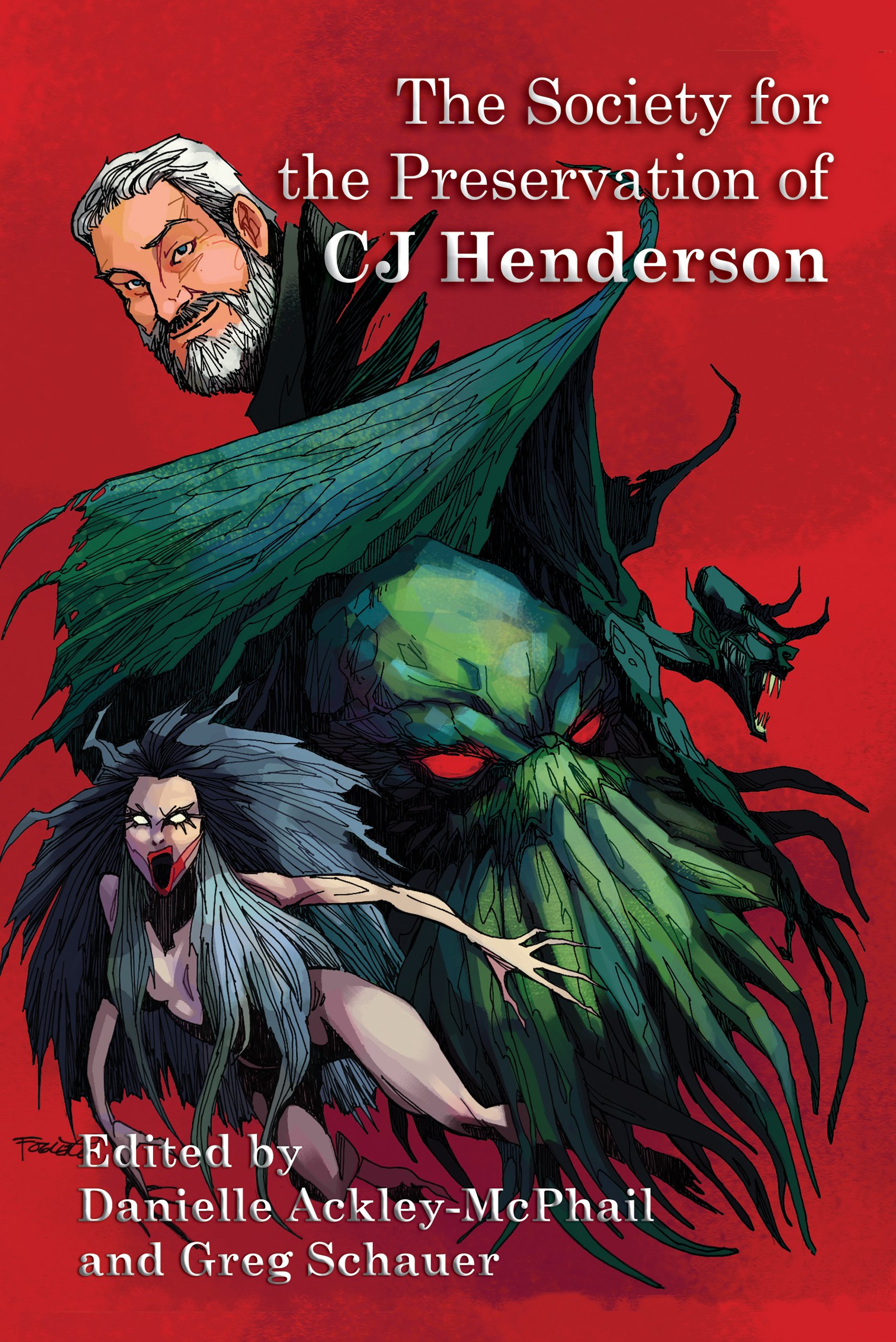
The Society for the Preservation of CJ Henderson (Ackley-McPhail & Schauer, ed)

The Society for the Preservation of CJ Henderson Danielle Ackley-McPhail & Greg Schauer, ed (2014)

Disclosure: I've met CJ Henderson. I would have to say I knew of him, more than that I knew him. He was a fixture at a science fiction convention I'd gone to almost every year for over two decades. I can't say how much I'd actually talked to him in that time, but he was a person you could talk to, whether in the Dealers Room during the day or the Con Suite in the evening.

I can also add that in 2014, I was in his house with many other people, but he was only there in spirit. When CJ died in 2014, family and friends held an "Afterlife Launch Party" in his honor. The family had hoped for a large turnout, but many that he knew from the convention circuit lived anywhere in the tristate area as well as up and down the Eastern seaboard (and elsewhere, too, but those were the ones likeliest to make it). I also learned that he lived about a 15 minute walk from my house. So I made the trip, and met a lot of familiar faces, and a few not-so-familiar. I discovered a couple days after that I'd met a favorite artist of mine without knowing it was him. But I digress.

This anthology was put together when CJ was ill. He had even seen most (if not all) of it but didn't get to see it published. Shame on me for waiting three years to finish it, but I have a habit of putting down anthologies in the middle (because I can), reading something else that came along, and then getting back to the first book. (In my defense, Danielle, if you're reading this, some of those books were other eSpecbooks!)

The anthology includes stories by John L. French, Jean Rabe, Patrick Thomas, David Boop, Danielle Ackley-McPhail, Jeff Young, Leona Wisoker Robert M. Price, Leona Wisoker, and James Chambers, and CJ's presence is felt in all of them. Stories are inspired by his works or his mythos and feature either a character based on one of his or a character based him CJ himself. (He appears in one story as himself, in another as a bard who is the son of Hender, etc.). All of pleasant to read -- with one exception. The foreword for one story included a warning that Henderson himself would've found the story disturbing, and warns the reader might wish to skip that one. I prefer to avoid disturbing things -- I have enough trouble sleeping -- so I skipped over that one.

Hard to pick a favorite, but I might possibly pick the lead-off story just for setting the tone for the rest of the book. But a later story hits home the theme of perseverance, particularly if you want to be a writer. If I didn't want to be a writer, I might not be writing these reviews. I'm not always sure whom I'm writing this reviews for: myself or the wandering web surfer? Never count out the flying monkeys.

Enjoyable anthology, possibly disturbing.

Tuesday, October 17, 2017

Men in Black (Levin) -- Summer Reading Challenge

Men in Black: How The Supreme Court Is Destroying America Mark Levin (2005)

In my first pass on the 300s shelf, I spotted a book by Mark Levin, a brilliant legal and Constitutional scholar, who iscurrently a talk-show host and pundit, but was chief of staff for Attorney General Edwin Meese in the Ronald Reagan administration. (Basically, he knows what he's talking about.) Anyway, it wasn't one I was interested in reading, but since it would fill a spot on my reading challenge, I placed a hold on Men in Black, which I'd heard about years ago, but never read.

Men in Black has nothing to do with Will Smith or aliens or secret government agencies. Quite the opposite -- it has to do with the one branch of government that always comes from and center in the headlines every June when it delivers a boatload of decisions and opinions. Levin has read all the major ones going back over 200 years.

Levin goes through many of the jurists who have sat on the bench and the influence that they've had in shifting the legal system, how they've expanded rights and taken others away, how they've pushed toward statism and away from federalism. And how they sometimes perform judicial acrobatics to achieve the ends they want, regardless of the legacy it leaves and the precedence it creates.

And let's not forget about the emanations and penumbras.

You'll read about the people who have sat on the bench for decades. The ones who wore black robes during the week and white robes (with matching hoods) on the weekends. The bad decisions, which were later overturned. The bad decisions which haven't been. The good decisions which were overturned.

Surprisingly, he actually faults SCOTUS for getting involved with Bush v Gore. While he understands that it was necessary to rein in a runaway, rogue Florida Supreme Court, Levin holds that it was unnecessary. Under Florida Constitution, it would have ultimately come down to the Florida legislature, which was controlled by the Republican Party. Gore never had a chance. However, by inserting itself under whichever rationale, they have set precedence for future challenges in elections, which will play out eventually.

I wouldn't mind seeing an addendum to this book, say, 15 years later, in which Levin points out the trends he'd predicted which came to pass or are almost here, and new ones likely to occur. I don't know if he'd want to revisit the same topic, and he'd likely wait until the effects of Trump appointments are seen.

I enjoyed reading this book, and it was good for sitting in an inner tube floating in the pool in the yard for a hour or so in the afternoon sun.

Book number: 347.7314 L

Rediscovering Americanism and the Tyranny of Progressivism (Levin 2017)

At the same time I placed a hold on Men in Black, I put one on Levin's latest book, Rediscovering Americanism, a topic he's passionate about. Levin is an outspoken proponent of Federalism (state's rights), as opposed to Statism (the country as one state). While he prefers the term "statist", he uses "progressive" because that's the common vernacular.

The book became available sooner than I had expected. I enjoyed his introduction, but I had a problem getting through Chapter 2 of the book. Basically, it's sixty pages long, about one-quarter of the book. It sets up all the arguments for progressivism, from its roots to the present, and it does it using the original words from the original texts. The problem, for me was that it was just too much already. I don't mind reading history, but this wasn't the history I wanted to read -- at least not in this quantity, all at once.

Honestly, I wouldn't be surprised if I enjoyed the rest of the book if I skipped to chapter three, but I just felt like I needed a break from 100-year-old speeches and essays. Maybe I'll give it another try in the future, maybe not.

Since I didn't get through the book, I'm not including it as a summer reading challenge book, although it's another 300s book.

Sunday, October 15, 2017

M is for Malice (Grafton)

M is for Malice Sue Grafton (1996)

Each summer, I try to revisit the Sue Grafton series? Why just the summer? Because I don't think I could stick with a series through 26 volumes (even if only 24 are published at this time). This series is popular enough that I had over a monthlong wait for the ebook from the public library even though it's over 20 years old!

I discovered the series on audiobooks when I was commuting an hour each way back in the 90s, listening to whichever volumes were available. At some point in this century, I decided I would read them in order, unabridged. There's a slightly dated feel to the books because each one takes place a few months after the prior entry even though they are written a year or two apart. On top of that, Kinsey is a little behind the times with her portable typewriter and lack of technology. Even the fact that she doesn't have a cell phone seems a little jarring, but it was the 90s.

I've started to notice a turn in the storytelling in the past few volumes. Kinsey is a private investigator and former cop, but has decided not to carry a weapon any longer. She has used a gun in earlier novels, but thankfully they didn't all end up in shoot-em-ups with the suspect dead or dying. The other change is the presence of previously unknown family members trying to work their way into her life. It's a slow process that will play out over the next few entries, I'm sure.

The biggest difference about this book is the case itself. Kinsey's cousin Tasha is an attorney and hires Kinsey to locate a missing heir to a local businessman, Bader Malek, who passed away. The son, Guy, was constantly in trouble and left home 20 years ago. His father gave him his inheritance at the time and wrote him out of the will. Problem is that the new will is missing, so the prior one, with Guy included, will be entered into probate. His share of the estate will be worth millions now.

Finding Guy turns out not to be a difficult task. He would have been reasonably easy to find, but no one looked for him. Guy was happy to know that a PI was hired to find him, but saddened that it was for the wrong reasons. All of this occurs within the first third of the book, so you can imagine things aren't going to end well for the family.

There's still some bad blood between Guy and his brothers Donovan, Bennet and Jack. Guy goes to visit them, against Kinsey's advice. Soon after, Guy is dead, the brothers are implicated. Kinsey gets attorney Lonnie Kingman, from whom she rents office space, on the case, and Lonnie hires her to investigate. And so we're back on the case.

The ending plays out well, and the pieces do fall into place, explaining everything. However, when it finally does all unravels, it seems a little abrupt. Also missing is the usual "respectfully submitted", which makes sense given that there were really two different cases going on here. An enjoyable read, and I learned a little bit about rock quarries. Book "N" will be in the "to be read" pile very soon.

Sunday, September 3, 2017

Brooklyn: A Personal Memoir (Capote) -- Summer Reading Challenge

Brooklyn: A Personal Memoir, With the Lost Photographs of David Attie, Truman Capote (2015)

With an afterword by Eli Attie.

The 800s shelf: Literature, which includes plays, poems and essays. I saw that it was about Brooklyn and then I flipped through and saw the pictures, and I had to check this one out.

First off, I've never read anything by Truman Capote, nor was anything ever assigned to be read. I remember a copy of In Cold Blood sitting on my bookshelf when I was a kid, but I didn't pick it up.

Second, the Afterword was actually the most fascinating part of the book. If you pick up this book, you might want to read it first. Or you can save it for last, and it will change your opinion of the entire book.

From the Introduction, I learned when this essay was originally written and where it was published. From Attie's addendum, I discovered that this Memoir was published as a book in 2002 without the photos. The photography of David Attie, someone you've probably never heard of, were still "lost" at that time.

Eli Attie is David's son and was researching the work his father had done. It turned out that Capote could be credited with launching the elder Attie's career. David even found photos of Capote along with many taken in a walk around Brooklyn Heights in the late 50s (1958, according to the text).

The collected photos (I'll let you read the story) were set to be a book on their own, but as these things go, the set was combined with a second edition of Brooklyn. Both works benefit from this.

Capote had a flair for writing (I guess I'm speaking the obvious to many) which I guess fits what I know of his personality from TV and movie appearances (not to mention impressions by people like Rich Little). However, anyone who walks around Brooklyn Heights and the area down by the Brooklyn Bridge will recognize some of the buildings and streets and structures in these photos. And if you were around there back in, say, the 70s or 80s, you might recognize even more. It's a walk down memory lane to see these places along with the people.

Library reading challenge. Catalogue number 813 C

Friday, September 1, 2017

The Luck Archive (Menjivar) -- Summer Reading Challenge

The Luck Archive: Exploring Belief, Superstition, and Tradition, Mark Menjivar (2015)

The 300s shelf: Social Sciences, which I already did, but I saw another book that looked interesting.

In brief, the author was interested in stories about things, objects, and rituals that people believe are lucky or will bring luck. He even visited stores that had some kind of luck in the title. Many of those stories, along with pictures, are gathered in this one volume. He doesn't try to validate the stories, nor disparage them. More of a simple celebration of the things people do to make luck go their way. (Or to make bad luck just go away.)

A quick little read. I saw it on the shelf, and I thought it might be interesting. It was, but not overly memorable. Nothing much to make a note of.

For fun, here are some of the other options I had, which seemed to have a lot to do with Vampires and Zombies. The English Folk Tales book is one I might revisit later. There was also a book on "Social Q's" as well as a wedding planner (could you imagine me reading that on a train?), as well as some on topics I didn't care to read entire books about.

Library reading challenge. Catalogue number 398.41 M

Thursday, August 31, 2017

Remember the Alamo (Rattle and Vale) -- Summer Reading Challenge

Remember the Alamo: Everything You've Ever Wanted to Know About American History With All the Boring Bits Taken Out, Alison Rattle and Allison Vale(2009)

My summer reading challenge took me to the 900s, which is History and Biography. I went for something short and easy to read. In fact, in researching this book to put on this blog (I already returned it to the library), I discovered another version of it with a shorter title about "Bite-Sized pieces".

Rattle and Vale (who spell their first names differently, so I can't call them "the two Al(l)isons") present snapshots of American history from the Pilgrims to Watergate, all in one-page snippets. Obviously, some topics require more pages to tell the complete story, but it's easy to break things like the Revolution into separate topics and events.

Likewise, one-page biographies of important people are included and inserted into the otherwise chronological narrative at the time it would most sense. Placing Thomas Jefferson's biography, for example, at either the point of his birth or his death would be silly and not relevant to the timeline.

If you just want a primer which the basics, this isn't bad. But it's obviously a starting point if you want to learn more about anything. Also, just reading their take on the first Thanksgiving had me wondering how much I could trust their "slant" with the rest of the book. For the record, the Pilgrims, a group that came over to these shores for religious freedom and who, according to this text, believed that the Church of England hadn't broken far enough away from Roman Catholicism, held their first Thanksgiving to give thanks to God, not to the Indians for helping them through the harsh winter. Now, the authors are the historians here and they could argue the point with me if they wanted to, but God doesn't even get a mention.

What else aren't they telling me? Well, quite a lot, actually, because this is the "Cliff's Notes" version of history. And, oddly, I would have expected a little more about the Alamo, considering the title.

Library reading challenge. Catalogue number 973R.

Tuesday, August 29, 2017

The Bradys and the Girl Smuggler (Doughty)

The Bradys and the Girl Smuggler; or, Working for the Custom House, Francis W. Doughty (1900)

Note: This novel appeared inside the collection 8 Dime Novels.

Back around the turn of the 20th century, there was a series of dime novels named Secret Service about agents who do a lot more than just protect the President. This series featured an agent known as "Old King Brady" who was joined by a sidekick/apprentice who shared his surname even though they were not related. The latter became known as "Young Brady". The stories featured the byline "A New York Detective", which was Francis W. Doughty.

The Bradys had a knack for solving problems when no one else could. At least that's what I figured was the reputation that they had. The novel I read was number 79 in the series.

The story opens in the port of New York in lower Manhattan, an area I've been familiar with since I was a child, but that was long, long after. (Two world wars and then some!) Still, it's amusing when I read the street names as they pursue a suspect that I can make a mental map of the route.

The Custom House of the story has to do with declaring valuables being brought into the country when getting off a steam ship so taxes can be paid on them. Someone has been smuggling diamonds into the country right under the noses of the Custom House agents, and no one seems to know how it is being done. The Bradys are called in to take the case.

The villain of the piece is named La Croix and his French accent is sometimes difficult to work out. ("Eet es deef-e-cult!") He's tricky and won't stop short of trying to kill the agents (bold move for a smuggler -- that's ups the game somewhat). It does become a family affair, as you can tell from the titular "Girl Smuggler".

The story takes them up to Canada and back again, riding trains because that's the fastest method of transportation and communicating through telegrams to places where the other person should be and may go to because that's just the way it was.

With nothing else to compare this story to, I can't say if it's a great example of a dime novel, but I did enjoy it (other than the phonetic accent). Would I read more? If I could download another story in a format that was easier to read, maybe.

One of the interesting things about the book was that it seemed to be reproduced in the manner that it was originally published, complete with the splash page (shown in the photo above). The novelty of that will wear off after a while, particularly with older eyes viewing it.

I don't believe that I'll plan on reading the first 78 to catch up to wear I am.

Fairest of All (Valentino)

Fairest of All by Serena Valentino, Illustrated by Fiona Marchbank (2023) A Villains Graphic Novel Adapted from Serena Valentino's b...