Saturday, December 29, 2018

Pedro & Me (Winick)

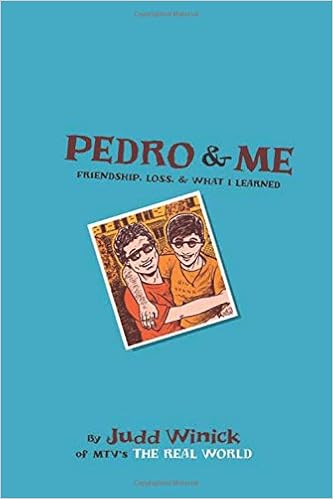
Pedro & Me: Friendship, Loss & What I Learned, by Judd Winick (2000)

This edition contains a foreword written in 2008, and was published in 2009.

For all my recent complaints about graphic novels, I finally found out that was actually what it was supposed to be, and it's been in a "to be read" pile for years now. Pedro & Me came to me from the Port Chester-Rye Brook Public Library, most likely through a nearby science fiction convention. (That would've been the recently departed Lunacon. Sigh.)

Pedro is Pedro Zemora, who along with Judd Winick (the "Me" of the title) and others, was a part of The Real World: San Francisco in 1994. I didn't watch it, and I had no interest in the series or the ones before it. Frankly, I couldn't tell you the difference between the Real World and, say, Big Brother. But Pedro's story is worth reading.

Judd is a cartoonist from Long Island. He applied for the Real World, and when MTV called, one of the questions they asked was if he'd have a problem with a housemate who was HIV positive. That shook his world a little bit. What shook it more was when he was accepted onto the program and that housemate was his roommate.

What follows are some of the struggles Pedro faced as his illness progressed, and the friendship that was forged. It's wonderfully written and illustrated and makes great use of the medium.

How good is it? It's not a book that I thought I'd be interested in. Not something I thought I would pick up. But I sat in an inner tube in the backyard pool reading it morning after morning. (Okay, full disclosure -- I usually only bring things into the pool that I wouldn't mind losing should it get blown or dropped into the drink.) It was worth reading.

Friday, December 28, 2018

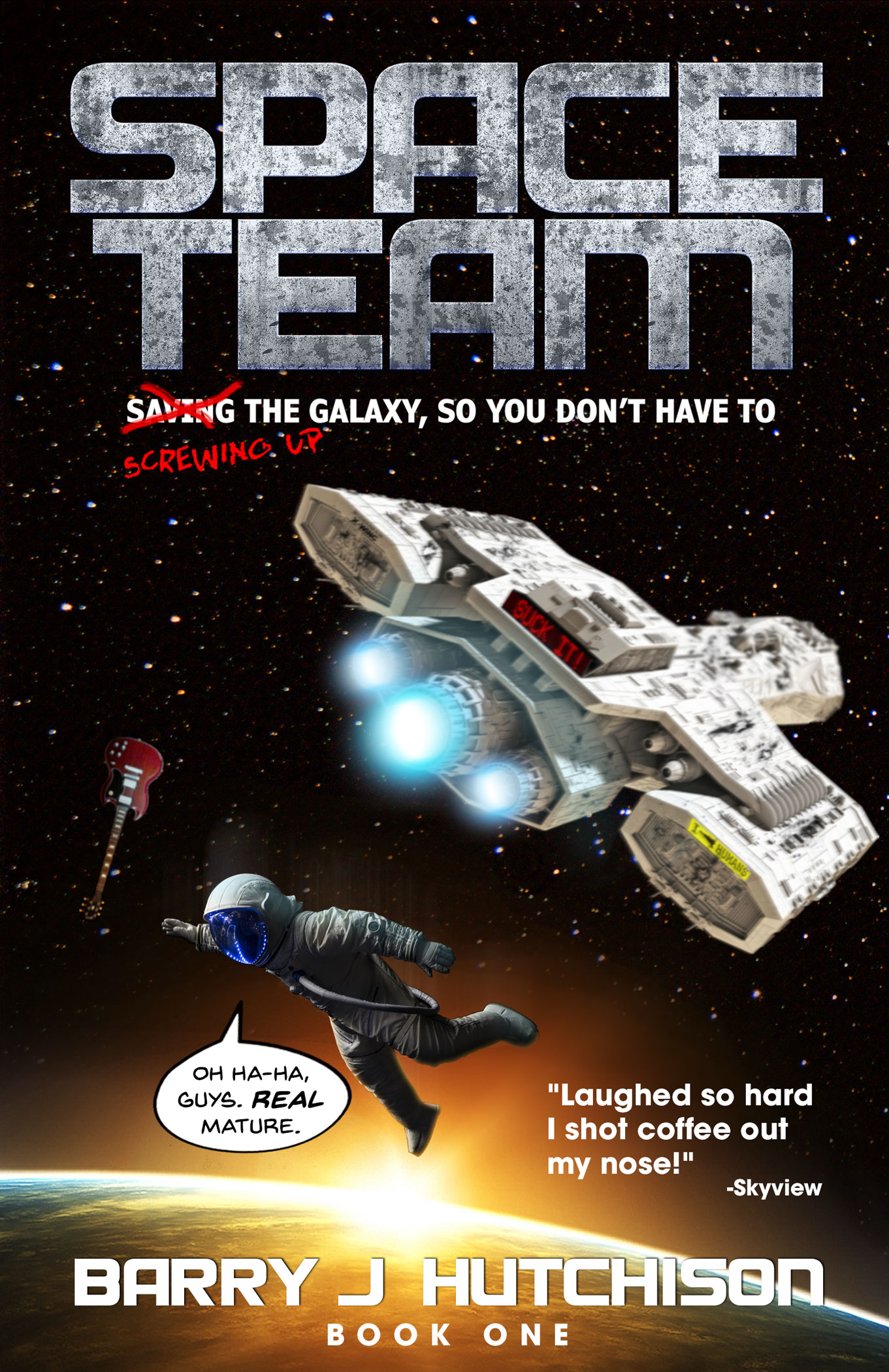
Space Team (Hutchison)

Space Team, by Barry Hutchison (2016)

The full title of the book is Space Team: Screwing Up the Galaxy so you don't have to!, and I believe I got the capitalization and punctuation correct. An editor might've suggested different.

This book was downloaded as a freebie. If I remember correctly, it was probably one of those "first book in the series is free" deals, to get you to read one and buy the rest. Nothing wrong with that, so long as the books are good. Wellllllll ....

So how many books are in this series? I just checked, and it seems, as of this writing, that there are 13 of them. In three years.

If they're making money, more power to him. Maybe it's a model to try out for my own writing.

Okay, so the story starts off like some is trying too hard to be Douglas Adams or Terry Pratchet or just, you know, funny. It isn't too clever, but it's what's there, so let's so with it. Cal Carver is a criminal, and he's in prison, but a mistake was made and he's been set to a maximum security facility. His next mistake is ticking off the warden. Because there aren't any buses available to transfer him until the morning, he'll have to stay the night. And because Carver was a pain in the ass, the warden puts him in a cell with an overly-large cannibal, who Hutchison describes in great detail as the man has no pants on. Hutchinson waxes poetic about his member.

Anyway, just about the point where Cal is about to be killed in the cell (which the Warden could have easily have anticipated, so he's a pretty sucky guy himself because Cal wasn't that big a pain in the ass), the prison is attacked and Cal is abducted. By space aliens. Who mistake him for the cannibal. (Yes, I will keep referring to him as "the cannibal" because I'm too lazy to scroll through my kindle to find the name, and despite the number of books in the series, every site I checked has the same stupid two paragraph synopsis of the book.)

Next thing you know, we're in a room with the president of the galaxy and a bunch of other criminals, and we're playing, "I bet you're wondering why I called you all here." Seriously, he says that. Or something just like it.

Out of the entire galaxy, he needs this handful of weird criminals from various planets, to come together to be a team to go on a mission for him. To Hutchinson's credit, he does, at the end, give a rationalization for exactly why these people are here, and what they bring to the secret agenda that the president has.

Oh, and Earth was destroyed, quite by accident really. It wasn't like it was in the way so the Vogons destroyed it or anything. (And I'd already had the Hitchhikers-wannabe comparison in my head before he got around to telling us Earth was killed during the prison break.)

A lot of silliness, some of which isn't as silly as it could or should be, follows. They save the day. And they ride off together because they have no place to go.

Would I read more of this? If someone handed me a stack of books and I knew I was going to be stuck on a subway. Maybe.

In the end, it didn't suck, but it wasn't all that great.

Thursday, December 27, 2018

The Alienist (Carr)

The Alienist, by Caleb Carr (1994)

Like many, I saw the series, The Alienist on television, and then decided to find a copy of the novel. Like many, I decided to get it from the library, so there was a wait. Still, I managed to read it earlier in the year (before summer vacation), but I didn't get around to writing it up until the year was almost out. So I don't remember everything about it. That's the main reason I try to write these things in a timely manner.

Having seen the show, I put faces to many of the characters in advance, which is usually helpful (except in those instances where someone is woefully miscast). The story tells the tale of a serial killer in 19th century New York City, during Teddy Roosevelt's tenure as Police Commissioner. He charges Dr. Lazlo Kreizler with solving a set of grisly murders involving a disaffected portion of the underclass of society. Namely, poor immigrant boys that dress up like girls for the benefit of "gentlemen" of lower Manhattan.

Anyway, the first impression from the book was that I was glad that it started in the middle of things. The book opens with the third murder, with the reader being informed of the two prior. The show started with the first (although it was the same one depicted at the start of the book), and this dragged out the story a bit. Then again, they had ten or twelve episodes to fill.

The book also allows us to read, and reread, if necessary, things, like jargon or science explanations, that might've gone by too fast on TV. And you got a better handle on the characters.

This was the first work of Carr's I've read, and I wouldn't be opposed to reading more. And then possibly writing them up in a more timely manner.

(Note for anyone finding this page through a search engine: this blog isn't really meant to be a review page. More of a reading log for myself so I can keep track of things that I've read and maybe a few details besides. Comments are welcome, but please be polite.)

Wednesday, December 26, 2018

The Great Passage (Miura)

The Great Passage, by Shiwon Miura (2011)

This was another of the books that Amazon allowed to download that time when they had 12 world books available for free.

The story was a little confusing at first. In the beginning, we are introduced to Kohei Araki, who as a boy was fascinated with words and loved the dictionary. Next thing we know, he's close to retirement after having worked on dictionaries for Gembu Books for thirty-seven years. Although we begin with him, it isn't his story.

Araki needs to find a replacement who can continue his work, and bring his dream project, The Great Passage, to publication. Thanks to Nishioka, one of the few employees in the dictionary department of Gembu, Araki finds Mitsuya Majime, an odd fellow who works in the sales department. After an interview, they discover that they are kindred spirits in the love of and fascination with words, and how to define them precisely.

Majime is introverted and awkward, which makes it difficult to approach Kaguya Hayashi, his landlady's granddaughter. The awkward love letter he writes her becomes a running gag of sorts. There is even a version of it appended to the end of the book, but it, thankfully, doesn't run the fifteen pages it's supposed to. (It always includes a running commentary by Nishioka and Midori Kishibe, a character that seems oddly inserted into the drama after an equally odd time-skip).

I also want to mention Professor Tomosuke Matsumoto, just so I don't forget the name. He also consults on the dictionary, even after Araki retires, during the time jump between chapters, which shows you what a labor of love this project is. It also shows that while dictionaries are important projects, they are also money sinks and often get put on the back burner for other projects. (These other projects help to fund the dictionary, so they do what they have to.)

I did enjoy the book, although it probably isn't something I would have sought out on my own. In preparing to write this, I discovered that there was both an anime version and a movie that was submitted, but not nominated, for the Oscar for Best Foreign Film.

If I had any problems with it, it would be the shift in focus and the weird time skipping. Possibly the addition of the new primary character halfway through the book to replace a different character, who is still there, but moved to a different department. Worth reading.

Tuesday, December 11, 2018

The Black Tides of Heaven (Yang)

The Black Tides of Heave, by Jy Yang (2017)

The Black Tides of Heaven was a free ebook from the Tor.com Book of the Month Club. It amounts to one of two twin novellas, which establish the world of the Tensorate series, by Jy Yang.

I was drawn to it because it seemed different, and, yes, because it was free. Likewise, as part of a "book club", I thought it might lead to a discussion, either now or when I see some like-minded friends at a up-coming convention. That's not likely to happen at this point.

While I'm glad I read it, I had a problem immersing myself into the fantasy world being created. On the very first page, we encounter the word "slackcraft" as something not to be used by the Great Abbot Sung to climb the 800 steps of the Great High Palace. I let this slip by in the first instance, not knowing whether that was some kind of magical incantation or transport. Later uses of the term "craft" also left me wondering if they were talking about an actual vehicle or crafting some kind of energy, which comes from the Slack. Only the basics were covered, but I went with it as much as I could.

However, what probably would've had me put the book aside if I hadn't been predisposed to reading it, was the overuse of the singular "they" in the first few chapters. The reason behind it made a compelling case, but the execution was maddening.

Basically, children are born of neutral gender and stay this way until they declare themselves (or are declared, in the case of a three-year old?) to be either male or female. This is done well enough in the case of the first such character introduced, Sonami, the youngest of the Protector's children, was wearing the gender-neutral colors of a child, without overtly stating that the character itself had no gender. I believe I had assumed in my mind that the character was female, and, in fact, a chapter later was. From my reading, it seems that choosing a gender also includes the ability to bear children.

My problem came from the twin babies that are introduced. I just used "it" to refer to a "character". The novella choose to use the singular "they", which is something that is gaining popularity in English. This was fine (though initially odd) when used with Sonami. But here's the rub, there are two twins, each referred to, individually and collectively, as "they". And since "they" are usually together during this period of "their" lives, it bogged down my reading.

Seriously, I haven't been that confused since I first read Ayn Rand's Anthem the summer before high school. (Note: this book is in no way similar to Ayn Rand's Anthem!)

The novella spans 35 years and feels too short, as if important parts have been left out. The Venerable One, the Great Abbot, had gone to the Palace to settle a debt. The Protector owed him one of her children for the Monastery in payment for his help during an uprising the year before. He expected to get Sonami, the only child whose future hadn't yet been spoken for. He hadn't counted on the Protector bearing extra children, specifically, a pair of twins. She gives him both as she has no need for the spare. The Abbott is forced to accept this arrangement, as well as leave them in her care for the next six years because the Monastery has facilities for babies. (And the Protector would not allow any children of hers to be raised in any home below their station in life.)

The children, Mokoya and Akeha, finally move into the monastery but it is a temporary situation. Within a few years, it is discovered that Mokoya's dreams about the future, like a prophet, and the dreams will come to be. Once this is learned, the Protector wants the child back, allowing the Abbot to keep Akeha as payment for the debt. High Abbot Sung sends both children back, bringing their time at the monastery to a close.

Next thing you know, they are adults, declaring their genders and parting ways pursuing their destinies, which, when it comes to the Slack, may already be laid out before them.

I didn't know when I started reading it that it was one of two twin novellas, and I don't know if this accounts for the gaps. The first chapter of the other book was included at the end of this one, but I declined to read it. Well, not true, I did skim it and discovered a little more background about the five aspects of Slack.

The resolution seemed too quick and easy to have been a final resolution.

At some point I might revisit the series when there's more to it available, and if I have more friends who have read it and want to talk about it. Maybe I'll have them explain to me how the magic works first.


* * *


Note: I previously left the following review on GoodReads when I had finished the book:

Felt incomplete, parts left out, like it was the trailer for a longer novel. Then at the end is the first chapter for another novella—I skimmed it for a little more background on how the magic worked. I stuck with it longer than I might have were it a different book, openly because it was recommended to me, and I wanted to read something different.
Thursday, December 6, 2018

P Is For Peril (Grafton)

P is for Peril, by Sue Grafton (2001)

The sixteenth installment of the Kinsey Milhone series finds Kinsey mixed up in two mysteries, as the background 'B' story takes up a good portion of the book.

The main mystery involves a missing persons case. Dr. Dowan Purcell disappeared nine weeks earlier and hasn't been located yet. His first wife is started to get worried now because he had gone missing once before but eventually returned. Kinsey briefly ponders if he'd faked his own death, as happened in an earlier case of hers. But Fiona, the first wife, believes that he may still be alive because his passport is missing, along with a bit of money.

Add in possible trouble at home with wife number two, Crystal, and mounting evidence of medical billing fraud, and it doesn't look good.

While all this is going on, Kinsey is once again looking for a new office. She's been renting space from Lonnie Kingman, but they are relocating. She finds a space at a reasonable rate nearby -- she can literally see it from her current office building -- and agrees to lease it from two brothers. They turn out to be bad news, as they were suspected in the fiery death of their parents. Investigators have been watching them as they blew through their insurance settlement to see if they'll fence any of the jewelry believed to be in their possession that would provide the evidence linking them to the crime. One of the brothers takes a liking to Kinsey and tries to attach himself in a way that a soon-to-be abusive boyfriend might, despite the difference in their ages.

Of the two plot lines, the main one wraps up neatly enough, although not spectacularly, with answers to the location of Dr. Purcell, the missing money, billing fraud, and, without saying too much, "who did it" and why. The other involving the sons along with a woman who is trying to use Kinsey to investigate them is a little underwhelming.

Tuesday, November 20, 2018

A River in Darkness (Ishikawa)

A River in Darkness: One Man's Escape from North Korea, by Masaji Ishikawa (2000)

Earlier this year, Amazon ran a promotion for twelve (specific) free ebooks from writers around the world. A River in Darkness was one of them, and the first one I indulged in. It tells the life story of Masaji Ishikawa, first growing up in post-war Japan being half-Korean. Life was difficult enough until the Koreans brought over during the war are promised a better way of like in the newly-created country of North Korea, under the leadership of Kim Il-sung.

The promises didn't work out, as one might have expected.

What follows are the hardships for his family as he grows into manhood, and then for his own family. North Korea was not a happy place to be, but don't dare say that. Everything is poorly run by the government, but you participate the way the government tells you, even if it means all the crops will fail. But hard work isn't rewarded. Just expected.

The book opens with a grown Ishikawa standing on the banks of the river across from China, contemplating escape, knowing that he'd likely be shot, if he didn't drown.

As the story unfolds and we finally get to that point, we know that he is leaving his children behind to make this escape, hopeful that someday, somehow, he can get to Japan and get his children out of North Korea.

The fact that this book was written tells you that he managed to escape, but don't expect a happy ending. Although it was published in 2000, it was translated in 2017 and contains an epilogue. It doesn't really get happier and leaves you feeling sorry for his remaining children.

Note: read this early in the summer, but I've been away from writing in the blog. I've already forgotten many of the details, particularly names, which, oddly, was the main point of my starting my reading journal, years before it became a blog.

Tuesday, August 21, 2018

Lost to Time (Sandler)

Lost to Time: Unforgettable Stories That History Forgot,Martin W. Sandler (2010)

I found a list, in my own handwriting, labelled "Books to Read". I don't know when I made this list, or why, or what the source of these particular books might have been. I only know that it had to have been in 2010 or later, judging from the first book.

I was never a big History fan, but that hasn't stopped me from being interested in certain particular stories or time period, and making up for my lack of knowledge. Maybe I'm correcting my own past here.

Anyway, I reserved this from the library (Dewey Decimal 904 S), and it arrived fairly quickly. I didn't get very far into it before it had to go back. As it hadn't really gripped me, I didn't renew it.

Of the ones I read, the first one about Ziryab was the most interesting. I knew nothing about the man, never heard of him, and yet he accomplished so much. But I get the feeling that if I traveled to Spain, I'd find that he wasn't forgotten, even if people were not aware of him. I would guess that there are museums dedicated to keeping his memory alive.

The reason for this guess is that some of the later stories seem like regional heroes, who are probably known close to home, even if they didn't get the same fame or notoriety of their compatriots. See "Chapter Five: Outdoing Revere" for examples of this. Not everyone had a Longfellow singing their praises.

If you like these kinds of stories, then this book might be for you (assuming once again that anyone other than me is reading this blog).

Monday, August 20, 2018

Graphic Novels: Superman, Supergirl, Batman, Astro City

Superman: Shadows Linger
Superman: Krypton Returns
Astro City: Through Open Doors
Batman/Superman: Volume 6 Universe's Finest

Walking through the library, I came to the shelves with all the graphic novels and manga. Sure, I checked if they had the next volume of One Piece (they didn't). But they also had regular graphic novels from DC and Marvel. I picked up the four books listed above. Something to read while floating in the pool in an inner tube.

First off, none of these books originated as a graphic novel. They are all reprints from the comics, which causes some odd breaks in the narrative and empty pages with filler art.

That, in itself, wouldn't be so bad, if the collections made any sense. Most of these do not.

Of the ones mentioned above, Shadows Linger was five consecutive issues of Superman and is composed of two separate stories, the second of which is "Shadows Linger". Both were good reads. It was interesting to see Lana Lang's evolution. I'm old enough to remember when an adult Lana Lang was brought into Galaxy Broadcasting, pre-Crisis. In this comic, Lana is now running Lexcorp, now that Luthor is missing. (Where he is or why he's missing is another story, and that's fine.) This works as well as having Lex's sister running the show on the Supergirl TV Show.

On the other hand, Krypton Returns is a hodgepodge collection of parts from multiple sources, and they don't flow together to make a cohesive narrative. Maybe if you read all the original books, you might like this summary of the plot line, but the parts from Superman, Supergirl and Superboy don't work. Also, Supergirl's outfit is horrible.

The Astro City book turned out to be the first six issues of a comic with a 12-issue run, the remainder of which were not available. I thought it was an independent comic trying to have a Justice League feel to it, but it turned out that it's put out through DC Comics. The better stories are the ones told about the people was support the heroes of the world. To be honest, I wasn't exactly sure what or where Astro City actually was. The odd thing was that the stories weren't primarily about the heroes on the cover. It was odd, but mostly enjoyable, even if the questions that arose from chapter 1 don't seem to get answered anywhere further down the line.

The Batman/Superman comic had it's moment, but again was a collection of parts of books. It even contained two non-consecutive parts of a "death of Superman" story line, which apparently isn't related to the "Death of Superman" from twenty years ago or so.

In summation: these graphic novels aren't novels. They were anthologies, and not necessarily good ones.

Friday, July 27, 2018

More Dime Novels

Last year, I have an interest in Dime Novels and checked out the Brooklyn Public Library catalog where there were two entries. One of them was 8 Dime Novels, which I reviewed last year, after having read only one novel and the introductory essay.

A few months ago, I got an email about the other book. I expected it to say that the Hold had expired, as it had been about a year.

No. Just the opposite. The book was ready and waiting to be picked up at the local branch.

I couldn't read it, but for good reasons, which I believe I confirmed with two of the librarians when I returned the book.

Despite the cover on it, there was no copyright information suggestion that these were reprints, or when this book had been assembled. From the look of the pages, I had a strong suspicion, which the librarians agreed with, that I was looking at the original dime novels, which had been bound together at some point. These books had individual copyright dates around the time of the Civil War -- the freakin' Civil War!!. I was afraid to touch these books. (Forget about the new lenses I'd need.)

Anyway, here are some pictures I took to share with you:

Thursday, July 26, 2018

1634: The Baltic War (Weber / Flint)

1634: The Baltic War, David Weber and Eric Flint (2008)

This was a welcome and wonderful conclusion to 1633.

The thing you might notice is the colon in the title. The 1632 universe had taken off by this point. There are multiple books set in the year 1634 and they happen concurrently, but not as oddly as, say, A Feast for Crows and A Dance with Dragons.

If you are starting this series, and this universe, I recommend that you read this book immediately after 1632 and 1633 before branching out. One of the complaints I had about 1633 was its cover depicting a warship on its cover, but the warship wasn't ready to go by the end of that book.

In this book, Admiral Simpson finally launches his ironclads and sails off to the Baltic to win Denmark for Sweden. In the meantime, the Grantville delegation in the Tower of London needs to be rescued, along with Oliver Cromwell.

But the natives of the time period have not been idle as winter set in. They had started to emulate the up-timers, for once they see that a thing is possible, then their own scientists can try to make such things happen. It also helps that up-time books, particularly books on technology, are sold at a premium on the black market. Thankfully, for the people of Grantville, and the members of Emperor Gustavus Adolphus's army, navy or air force (yes, he has an air force!), mass production is not in place yet, so superior weapons will be limited to a few companies of soldiers.

I wish I had written this up in a more timely manner, so I could've listed more about the characters and the story lines, which is really why I have this blog in the first place more than reviews. (I mean, who is actually reading this?)

This one took a while, mostly because I was lugging a huge hardcover on the subway, and it isn't the greatest thing to hold onto when I'm falling asleep. There's also a lot to keep track of, but it's worth the effort. History is getting rewritten and the timelines are diverging. People aren't dying when they were "supposed to". The painter Reubens is aware of the masterpieces he created in the "other" universe and now has no interest to create them here because they would be derivative.

I'm taking a break from this for a while now, but I wouldn't be opposed to read more.

Side note: Eric Flint was a Guest of Honor this past spring at HeliosphereNY, a new science-fiction convention in Rye, NY, held in March 2018. I was in attendance. There was a "1632 Mini-Con" occupying one of the conference rooms for the entirety of the weekend. There were discussions on the tech, the world, and, of course, writing. Many newcomers have been published in the Grantville Gazette. The idea did intrigue me, but I needed to get more familiar with the world. (Not the characters, those are reserved.) It's something to consider, but I need to familiarize myself with more of what has already been written.

Wednesday, July 25, 2018

On the Decay of the Art of Lying (Twain)

On the Decay of the Art of Lying, Mark Twain (1882)

You can't go wrong reading Twain, essentially if it's just a short essay. People lie, but there is an art to it, and Twain noticed that the Art of it was dying.

In short, lying is polite. Lying is fine when the truth would serve no good purpose, only ill. But imagine it written in a more witty style.

Recommended.

Fairest of All (Valentino)

Fairest of All by Serena Valentino, Illustrated by Fiona Marchbank (2023) A Villains Graphic Novel Adapted from Serena Valentino's b...