Tuesday, April 26, 2016

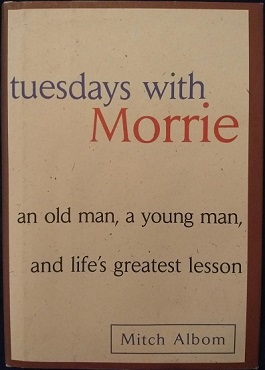
Tuesdays with Morrie (Albom)

Tuesdays with Morrie, by Mitch Albom, 1997

If not for those New Year lists of Reading Challenges, I don't know if I would have picked up this book and held onto it. The copy belonged to my wife, who read it years ago. It was about to go into a donation box, but I rescued it (along with the next book I'm reading, which she suggested).

Mitch Albom went to Brandeis University where his favorite professor was Morrie Schwartz. Upon graduation, Morrie gave Mitch a present and hoped to see him in the future. Albom then got caught up with life and didn't see Schwartz again until by sheer luck, he flipped TV channels and caught the beginning of Nightline with Ted Koppel who was about to interview Schwartz who was still teaching, despite being diagnosed with ALS, or Lou Gehrig's Disease.

What follows are the notes from his first meeting with Schwartz to catch up on old times and discuss life, which then turns into his final class, which will meet every Tuesday. They were "Tuesday people". Albom returns weekly over the course of a few months to discuss life and family and to chronicle his professor's decline in health but not in spirit, with some history lessons and anecdotes from college along the way. Morrie's biggest fear seems to be that one day, he won't be able to wipe his own butt in the bathroom. But even then, he realizes that he's become like a baby again, and there isn't anything wrong with that.

If you know anyone who went through a long decline, it can be heartwarming to read, or it could be gut-wrenching. For me it was the former.

The book did not become a bestseller until three years after it was published, when it was made into a TV movie, which is probably why I didn't notice any awards by the book. It slipped under the radar until it was too late for the accolades.

I thought it was an Oprah Winfrey book club selection, but I can't find a listing for it, so I might have been mistaken. However, she did recommend the book and then produce the movie, so that's close enough for me.

Note: I've tagged this as "Biography" even if it isn't a typical biography. I think it fits that classification.

Thursday, April 7, 2016

Analog's Lighter Side (Schmidt, ed.)

Analog's Lighter Side, by S. Schmidt, ed, 1982

Anytime I get any kind of notice that some online catalog now has magazines, I check it out. Unfortunately, those magazines are usually either scholarly journal-type publications or popular newstand magazines of the slick and glossy variety. They don't ever have, for example, old science-fiction magazines.

One of the first ones I search for is Analog because I had a subscription from the late-80s to the mid-90s. The problem was I never seemed to have time to catch up with them, so I let the subscription lapse. Anyway, while searching for Analog, I found an anthology, Analog's Lighter Side, a collection of humorous stories, edited by Stanley Schmidt, who was the editor I remember (and could possibly still be editing it today).

The anthology is from 1982, which meant I'd likely never read any of the material before. As you can see from the Table of Contents above, most of the stories date from before I was born (and before Schmidt's reign). How these stories in particular were chosen, I don't know. I read Schmidt's introduction where he acknowledges that humor is subjective and even mentions that one story plays it so straight that you won't see the humor until it's done. Whatever. I tried to enjoy it, but it's a bit dated.

For example, the future tech seems silly, even quaint, in earlier stories, given the advances of the last half century (especially the past couple decades). And at least two stories make like of characters with drinking problems -- being drunk is central to the story. Less enlightened times, sure, but they were back-to-back and I worried the rest of the book might follow suit.

Where it fell apart for me was "The Gentle Earth" from 1957. It was an okay story, but it just seemed to go on and on, pointlessly. It could've been half the length. And it wasn't particularly humorous. More like "Funny Things Happened on the Way to the Invasion" as things are misunderstood and keep going wrong. The final payoff wasn't the effort. I should have skipped the story, but I got so far into it, I wanted to know how it ended ... even if I kept falling asleep. I was on this story when I renewed the book, and I finished the story sitting at a table in the library so I could drop it in the bin.

I then skimmed "A !Tangled Web", which was a little more promising, but I hate when sci-fi and fantasy writers put symbols or punctuation into language and then don't give a clue as to how such things are supposed to be pronounced. Amusingly (hey, it's "lighter"!), given my computer background, I alternated between "not" and "bang" to stand in for the exclamation point.

Final verdict: meh. Maybe I'll borrow it again this summer and read the rest. Or not.

Goals: A good part of the book was written before I was born. It's an anthology. And it was intended as humor. So I covered some bases.

Thursday, February 25, 2016

(blog): 100 YA Books to Read in a Lifetime, Part 1

100 Young Adult Books to Read in a Lifetime??

This is my first blog posting about books in general. I felt like writing something, and I'm not done with my current book, so I'm writing about reading itself. I may decide to do this ever so often.

I recently saw a link to Amazon's 100 Young Adult Books to Read in a Lifetime. (Normally, I shy away from free advertising on my blogs, but I've taken most of my images from Amazon, so I guess I've already established the pattern here.)

It's an interesting list to be sure. In fact, it seems to be two lists. The top part of the page shows 60 book covers under the heading "100 Books ..." etc. The bottom parts shows -- I kid you not -- "1-12 of 113 results for Books : 100 Young Adult Books to Read in a Lifetime". It then goes on to list books, only some of which appear in the 60 icons above. I haven't explored beyond those 72 titles yet. There's much to mention here.

For starters, I apparently have No Idea what makes a book Young Adult. Someone once told me that it's a regular book with the violence toned down and the sex removed. That was a tongue-in-cheek definition, but not a bad indicator at the time. Either way, many of the books listed, the ones I'm familiar with at any rate, don't seem to me to be the sorts of books that appeal to young adults. If anything, they are the sort of thing they might get assigned in high school. Forced reading is not fun reading, even if they eventually like the book.

That said, I thought I might give my impressions of the books I have read. (Note: I normally only put reviews/summaries of books I've recently read while the details are still fresh in my mind. I don't usually like to review something I read so long ago that I don't remember the details. One of the reasons for this blog is so that I will remember the details.)

I'm not going to cover all the books, but I'll get to ones I have read, and may have something to say about some of the others.

A Clockwork Orange, Anthony Burgess: never read it, but nothing I know about it (yeah, the film, which, believe it or not, I've never seen either) tell me it's a young adult book. Odd that this is listed first. It is a classic, so I can see its inclusion on some list, but this one? I should make a note to put it on a TBR list.

A Great and Terrible Beauty, Libba Bray: I've actually read it and reviewed it. Yeah, for me! Second book on the list. Fairly recent and a good book, and definitely YA. I'd recommend it if asked.
Reviews of books by Libba Bray.

A Separate Peace, John Knowles: One of the few mandatory reads from high school that I voluntarily reread in college or shorter thereafter. It was still on my bookshelf and I honestly didn't remember too much about it. Plus, I'm sure I didn't "get it" in high school when I likely just read it to be finished. Read it from an older, wiser perspective, I probably thought. I still remember a lot of the crappy parts of it, and don't remember much of the rest. But, hey, it's literature, not fluff or melodrama. It's not like stuff I read today where writers kill characters because they don't know what else to do with them or because they need a plot twist every 20 pages.

Adventures of Huckleberry Finn, Mark Twain: school book, but I'm glad I read it, even if I might not have been back then. Then again, I'd seen enough TV and movies about Tom Sawyer and Huck Finn to know the basic story. Again, it's Americana, and you should go back to the original source rather than an "updated" Hollywood retelling. And Tom Sawyer, too. To this day, I still have the copy from high school in a box of books in the basement. I can probably find a free ebook of it (and Tom Sawyer). This one should be on my reread pile.

Dune, Frank Herbert: Another surprise listing. I had trouble getting in this book post-college. In fact, the first two books were my "Secret Santa" present at my first job. I know it's a classic, and I'm a sci-fi fan, but I just didn't get through it. Oddly, by that point, I had already read "National Lampoon's Doon", which made little sense, having not read the original.

Ender's Game: the Ender Quintet, Orson Scott Card. Another classic, and least Ender's Game is. I'm not sure what the "quintet" is. I have read the novel of Ender's Game, and I have read "First Meetings in the Enderverse" although I apparently didn't blog about it. The first meetings book includes the original novella. Changes were made to get from novella to book. The novella was a little less depressing. It's still a good book, and I'd recommend it. I might even read more in the Enderverse.
Reviews of books by Orson Scott Card.

Fahrenheit 451, Ray Bradbury: Another high school book, mandatory read. I remember having trouble getting through it. I remember not getting it. Was it an alternate history where Ben Franklin started a fire department that started fires? What? I've had people talk to me about it and mention scenes that I have no recollection of. Oddly, those conversations have made me change my thoughts about it. So, yeah, it's something that I should reread. Will I? I don't know. Maybe. Some day.

Go Ask Alice, Anonymous: A high school book that I read on purpose. In fact, I borrowed a copy from someone because I wanted to read it. (The person I got it from was happy to be rid of it -- either he or his sister were assigned to read it. Don't remember which.) I read this book for one reason: I was involved in a one-act play based on the book. It interested me enough that I read it. I felt sorry for the poor girl, whose name was not Alice (even though it was in the play). There's an entry in her diary (the book consists of diary entries) where she makes an "Alice in Wonderland" reference about herself. The only reference to a name in the book is "Carla", and that was likely changed. Interesting read. Not sorry I borrowed it. (In fact, I might still have it.)

Harry Potter box set: J. K. Rowling: Not a cheat listing them all together. I'm glad they did. Obviously Young Adult, and they grew up as their readers did. I wonder how this will affect newer readers. Will the final books be too mature for them if they read them earlier? I don't know. That's what parents are for.
Reviews of Harry Potterbooks.
Reviews of books by J. K. Rowling. (Obviously, there is overlap.)

Hatchet, Gary Paulsen: Never read it, but my daughter has. She couldn't stop taking about not only how much she hated the book, but how stupid she thought it was. I can only think of one other book that she might have liked less. She was older by then, and I wasn't reading books with her, so I can't comment, but I had to pass these comments along.

His Dark Materials, Philip Pullman: I have a copy of it. It's unread. It will probably remain so. My brother gave it to me as a gift. I hadn't heard of it, so he explained it to me. Since it was a gift, I didn't ask, "why the hell would you think that this might interest me?" Your mileage may vary. I listed it here so you can form your own opinion when I could have just ignored it.

Lord of the Flies, William Golding, E. L. Epstein. I was never assigned to read this, but there was a copy on my bookcase at home. (I have older siblings who were readers, along with my parents.) Another classic YA book. Read the original. Don't just watch the movies. I enjoyed it as much as any other classic. (I'm pretty sure that I read it after I saw a movie -- one from the 80s, I think.)

* * *

That's it for this time. I'll check this link again soon.
Friday, February 19, 2016

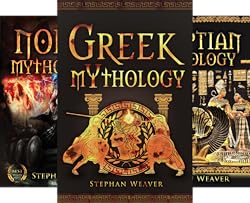
Greek - Norse - Egyptian - Mythology Trilogy (Weaver)

Greek - Norse - Egyptian - Mythology Trilogy, by Stephan Weaver, 2015

These three books were released as a trilogy and I picked it up when they were available for free. Worth every penny I paid, and not a penny more.

You might also note that there is only one date in the title because all three books have a 2015 date. (Amazon lists them all as June to July 2015).

Basically, the three books are poorly organized, somewhat repetitive, and in need of an editor to fix ridiculous inconsistencies. (Like an Egyptian god with, apparently, two right eyes.) I was reading the kindle version and got to the "bonus chapter" of the Greek book -- and immediately wondered how I'd gotten to the bonus chapter already? How short was this book? Short. All of them. You could read the trilogy in an afternoon if you wanted to.

The books aren't very well researched. You could probably do better checking websites online. You'd probably find more information as well.

Thankfully, I didn't spend any money on this. Since I downloaded this on request from a newsgroup I saw a post in (actually, in a "subreddit"), I'll refrain from posting a reivew on Amazon, but there was little to this "trilogy".

Goals 2015: I'm not sure that I could count this toward anything. It was short, and written in the past year. Not much else to classify it.

Thursday, February 18, 2016

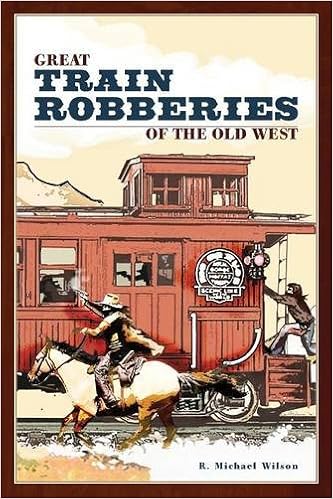
Great Train Robberies of the Old West

Great Train Robberies of the Old West, by R. Michael Wilson, 2006

I walked into Barnes & Nobles in Park Slope and stopped at the closeout books table in the vestibule. Usually, there isn't anything "must have", but this time I saw a slim book on Great Train Robberies of the Old West, which piqued my interest. I flipped through it quickly and thought, "I'll take it." It looked like A Good Read, and it was. Nothing fabulous -- given the subject, the book easily could have been twice the size. But it presented a series of train robberies, brought out the facts and gave some background on the people involved and let you know what happened to the participants after. There was an appendix with references, which weren't just websites, but also primary sources, including hundred-year-old news articles. So the author did his homework.

I've read stuff like this which reads like expanded click-bait articles that you can find online. Others that make me wish I just went to some online encyclopedia and find my own information. This didn't. I was satisfied. That said, I read it for fun, not for research. It might be a good start if I was interested in the topic, but I'd move on to other resources afterward.

The funny thing was I didn't know how I'd feel when I got to Butch Cassidy and Sundance. Would it be skipped? Would it be the back half of the book? Neither. Their train robberies were covered the same way the others were.

My 2016 GOALS: It was a short read (under 200 pages), and it was just about the first book I picked up when I worked into the book store. Nonfiction.

Wednesday, January 6, 2016

Bluebeard (Johnson)

Bluebeard -- And Other Folklore Tales, by Clifton Johnson, 1920

I don't know how long ago I downloaded the free ebook of Bluebeard. I'm not even sure why I did. I probably was looking at the best-selling (or most-downloaded) free classics on Amazon, and it was probably there. I hadn't read it before, so why not.

This was a short, in-between other books, book to read when I didn't have something else available -- or when I was going to sleep and I had the light turned off already. (It disturbs the wife.)

The book is short (Amazon says 52 pages) and I probably could've read it in one sitting. However, the nature of the book and the times when I was reading it caused me to nod off more than once. It is a collection of fairy tales/folk tales from around the world. They might have been children's stories once upon a time, but with all the monsters and mayhem in them, I wouldn't want to read one to any child right before bed. Not unless I wanted them crawling into bed with me in the middle of the night -- or screaming for me to come to them.

The odd thing is that the book is divided up into 19 chapters, but there aren't 19 stories. For example, the story of Bluebeard is two chapters long, and then without any segue or transition, we're into the Goblin in the Bottle, which is a few chapters itself. That's an odd way to compile a book.

The stories seem a little out of time, given that they were written down in this form nearly 100 years ago. But it's a little piece of history.

I enjoyed it.

As for any 2016 GOALS: it is over 90 years old, but not 100. It is a collection of short stories. It was a short read (well under 100 pages). I check the lists later.

Tuesday, January 5, 2016

Reading Goals and Challenges for 2016?

I generally don't like setting reading goals. I always have some in mind, but they always seem to get away from me -- especially when social media and the rest of the Internet are around. (And their great ancestor: the TV set.)

One of the problems is that Goals are generally boring and somewhat non-specific. Read 10, 20, 30 books. Okay, what kind of books? How big? In 5th Grade, I got tired of not having a star next to my mind, so once I finished the 100-page biography I took out of the library, I started reading the chapter books in the back of the classroom, and other things that were probably below my reading level (unlike the biography). I even read a couple of the books more than once because I knew I could reread them in one day. I got a lot of stars, enough to rival the leaders of the class. But I didn't push myself, read anything challenging. (On the other hand, I won't deny that I read stuff that was fun, which is important, too.)

Getting to the point, if I decided I'm reading, say, 24 books this year, there will be a good chance that many of them will be under 200 pages. There's a good quantity of books from only 20-30 years ago that have a decent quality to them that fit into that range. I could through in some free ebooks with low word counts, both of the classic and the only-read-it-because-it-was-free variety.

That's not what I want. And I probably wouldn't try it. Instead, I'd just skip the goal altogether.

But I found a few challenges on line, varying in length. Obviously, the longer one has the same problems as the 24-book goals: there are too many, unless shoot for two checks with one book. A possibility, of course.

So Challenge 1 goes something like this:

  • a book published this year
  • a book you can finish in a day
  • a book you've been meaning to read
  • a book recommended by your local librarian or bookseller
  • a book you should have read in school
  • a book chosen for you by your spouse, partner, sibling, child, or BFF
  • a book published before you were born
  • a book that was banned at some point
  • a book you previously abandoned
  • a book you own but have never read
  • a book that intimidates you
  • a book that you've already read at least once

(I tracked it back to here.)

This one is definitely in the realm of possibility. Twelve books, if I don't double up. For instance, I have many books that I own and have never read AND have been meaning to read. The odd one is rereading a book -- I might be this if another Song of Ice and Fire book (a.k.a. Game of Thrones) comes out, but with so many books to read, re-reading seems silly, unless it's something that I read in high school or college and I want to read again when I might enjoy it more.

Also, anything that I can read in a day, I don't really considering reading a book, but I've posted them in my blog, so I guess I should include them.

The second challenge:

  • a book set in your home state/region
  • a book with your favorite color cover
  • a book recommended by a librarian
  • a book of poetry
  • a book with a main character who has an occupation similar to your own
  • a book that will become a movie this year (watch the movie after and compare)
  • a book published the year you were born
  • a book featuring a protagonist with a lifestyle different from yours (religion, sexuality, education, occupation, politics)
  • a National Book Award winner from years past
  • a book over 500 pages
  • a book under 200 pages
  • a graphic novel
  • books set on each continent
  • a book recommended by someone 30 years older or younger than you
  • a banned book
  • a book you were supposed to read in school but didn't
  • a book by a female author with a female protagonist
  • a book translated from a different language
  • a nonfiction book about science
  • a collection of essays
  • a book by a person of color
  • a famous author's lesser known work
  • a collection of short stories
  • a science fiction book
  • a self-improvement book

(This is the BetterWorldBooks 2016 Challenge).

As you can see, there's some overlap between the two challenges. Some of these are trivial. Color of the cover? Depends on the printing. And if it's an ebook, I may never see the cover. There are a lot of old books under 200 pages, so that's good. I can't say that I've read a lot of movie books recently and I don't even know at the moment what is being made into movies. Female author & protagonists? Kinsey Milhone or that vampire series -- done. Science fiction? Duh.

A little sneaky with "books set on each continent" -- that's seven books! Yes, Antarctica counts. There are books set there. Unless I choose Westeros and Essos.

But it's possible.

I found two more. One is an image that's hard to read, so I'm not retyping it. Some overlap, but it includes read a biography, not a memoir or autobiography, read the first in a series by a person of color (I don't always know that the author of the series is black or Asian or whatever), books in the Middle East, Southeast Asia or historical. A non-superhero comic from the last three years? What's the point of that? It goes on ... I won't.

The last one is for the overachievers, or the Pick-a-Few-Skip-a-Few Crowd. Forty books in all. Not going to happen, unless half of them are pamphlets or matchbook covers.

  • a book based on a fairy tale
  • a National Book Award winner
  • a YA bestseller
  • a book you haven't read since high school
  • a book set in your home state
  • a book translated into English
  • a romance set in the future
  • a book set in Europe
  • a book that's under 150 pages
  • a New York Times bestseller
  • a book that's becoming a movie this year
  • a self-improvement book
  • a book you can finish in a day
  • a book written by a celebrity
  • a political memoir
  • a book at least 100 years older than you
  • a book that's more than 600 pages
  • a book from Oprah's Book Club
  • a science-fiction novel
  • a book recommended by a family member
  • a graphic novel
  • a book that is published in 2016
  • a book with a protagonist who has your occupation
  • a book that takes place during Summer
  • a book and its prequel
  • a murder mystery
  • a book written by a comedian
  • a dystopian novel
  • a book with a blue cover
  • a book of poetry
  • the first book you see in a bookstore
  • a classic from the 20th century
  • an autobiography
  • a book about a road trip
  • a book about a culture you're unfamiliar with
  • a satirical book
  • a book that takes place on an island
  • a book that's guaranteed to bring you joy
This was the ebookfriendly.com reading challenge.

And there you have it, lots of choices and checklists. Some worth the challenge, some silly and frivolous. And a few that seem impossible: "guaranteed to bring you joy"? For that matter, the "first book I see in a bookstore"? Odds are I'm not buying the first thing I see.

On the other hand, the book I'm currently reading was on the Remainder rack in the vestibule as I entered the store -- but I can't swear it was the first one I saw.

Monday, January 4, 2016

What Else Have I Been Reading Besides Books?

Rounding out the things I've read recently:

When I was in the pool, I generally had an old magazine, such as Analog or The Magazine of Fantasy & Science Fiction, which I was might be momentarily upset, but not devastated, by its loss should it slip into the water.

And one point I had, again, picked up the Stars anthology, which contained stories by science fiction authors based on the songs of Janis Ian (At Seventeen). The few I read were a mixed bag. The book was won, not bought, so I can't say that it's something I might've chosen to begin with, but with the line-up, I know why I held onto it. I'm not sure where I put the book, so I didn't get to finish it.

I've also been raiding the library for copies of Phil & Kaja Foglio's Girl Genius series, to find out what all the hubbub was about. So far I've found and read

  • Volume 4: Agatha Heterodyne and the Circus Of Dreams (128 pp)
  • Volume 5: Agatha Heterodyne and the Clockwork Princess (112 pp)
  • Volume 6: Agatha Heterodyne and the Golden Trilobite (150 pp)

The library has a problem with people defacing these. In one book, the splash page was torn out and a character's face was cut out of another page.

Volume 4 was the earliest that I could find (other than looking and reading online), so I started there. Thrown into the middle of things, as it were, but I figured out the storyline as best as I could.

It's an interesting Steampunk tale of Sparks and is vividly illustrated. My only problem with the artwork is that the protagonist, Agatha Heterodyne, seems to go through extreme mood swings from one panel to the next. Indeed, several characters seem to encounter this. Now, a lot is going on very quickly, but sometimes it's abrupt. When I first started reading, I wasn't always sure it was the same character because someone went from, say, devious to innocent, or vice-versa, in the space of someone's word balloon.

I've enjoyed the series and haven't minded people watching me reading it on the subway. In fact, I was reading it at 2 am on a Sunday morning when two young twenty-somethings sat down next to me and started a conversation -- not even about the comic. They were new to Brooklyn, and forgot how to get home. Would've been helpful had they been on the correct train.

Speaking of trains, I'm currently reading a book about great train robberies in history. Hopefully, that will be up on the blog in short order.

Sunday, January 3, 2016

A Great and Terrible Beauty (Bray)

A Great and Terrible Beauty, by Libba Bray, 2003

This book came to me via a book raffle at Lunacon, a general science-fiction convention based, for the most part, in Rye Brook, NY. It's the longest running NYC-area con. The actual winner of this lot had already won a pile of books, so when she walked up, she grabbed a pile and came back and gave them to me. Glancing at the titles, she was more the target demographic than I was.

Anyway, after a year or so of sitting on my shelf, I started going through the pile of books. (Another book in that pile was How to Be a Zombie, which I read earlier in the year.) Reading the description of this and another book, I was afraid that I had a bunch of Teenage Paranormal Romances, a genre that didn't exist all that long ago and now has an entire section in the last remaining Barnes & Nobles locations I visit.

I didn't have to worry.

A Great and Terrible Beauty does have some romance, but it isn't the paranormal kind. And it has its own paranormal/fantasy realm, which can be entered from the Victorian era. Other than that, I don't think it fits the genre much.

If anything, my first thoughts were of A Little Princess, the remake of the Shirley Temple movie, which started in India before moving to a girls academy, with its supernatural elements. Those thoughts were quickly dispelled thankfully.

Normally, at this point, I'd make references to the characters because that was the main purpose of this blog initially: to remind myself about the books, not to review them. However, I read this a few months back and much of it has left my mind. Basically, teen Gemma Doyle, after her mother's murder in India, gets shipped off to Spence Academy in London. She's followed there to make sure she doesn't get involved with what she eventually gets involved with -- magic, the other realm. But are these warnings for her safety or to prevent her from achieving what she's supposed to?

Along the way, she has to deal with the mean clique of popular girls -- or is it the popular clique of mean girls -- and their hangers-on. Before you know it, Gemma has worked her way into their graces and brought along her friend and roommate Ann, completing a foursome with Felicity (the leader) and Pippa.

We learn a little more about their families and why they are how they are, and learn how they plan to cope with their existence being groomed to marry rich, old men (possibly to settle debts) or if they're destined to be spinsters, maids or something trivial and menial.

I enjoyed the book. I can't say that I'm going to run out and look for the sequels, nor is it necessary to do so. Whatever nits I could pick, I forgot about months ago. I think I had one about Gemma's brother showing up at the school in the middle of the book when I didn't recall a mention prior to that. Then I thought Bray would set up a romance between the brother and one of the girls, but he sort of faded back into the background after a scene involving Gemma's family. Again, minor -- I've forgotten the details.

Fun read to pass the time on the train. And despite the cover, I didn't get funny looks from anyone for reading it. Well, no more than the usual funny looks you get on a NYC subway.

Saturday, January 2, 2016

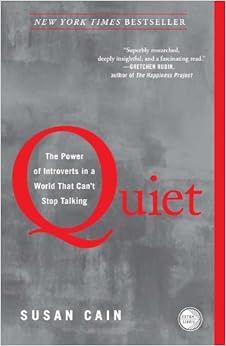
Quiet: The Power of Introverts in a World That Can't Stop Talking (Cain)

Quiet: The Power of Introverts in a World That Can't Stop Talking, by Susan Cain, 2012

This is a book that was given to me by my wife. She told me, "Read this." As that is not something that happens often -- if ever -- I took it and put it on the side to read "next". (I believe the idiom "-ish" might be appropriate here.) She might hand me something that she thinks I might be interested in, but never tells me to read anything in particular.

A couple days after I started it, she let me know it was a library book and asked if I'd finished yet. Whoops. Hadn't occurred to me. However, by that point, I was hooked enough that I reserved electronic copies at both the Brooklyn and New York Public Libraries. I appreciate the NYPL's opinion of my reading ability, but it turned out that this volume was still in their 3-day loan category. Seriously?

So this book has the distinction of my reading it in both paperback form and electronically, on loan from two separate libraries. Yes, I found it that important to finish it.

About the book itself:

Cain talks about "introversion" and "extraversion" (iirc, it's been a while since I read it). She states that the terms she uses aren't the most accurate, but they are the most commonly used (or most popular among the masses, as it were) that she uses them.

I read it with interest because there were plenty of times I identified myself, on both sides of the equation. There have been times in the past that I have referred to myself as an "extroverted introvert". Sure, you can't shut me up once you get to know me -- ah! but getting to know me. Likewise, I have difficulty breaking into a conversation among a group of people. I find myself hanging on the periphery, waiting to be invited in, fearful to invite myself. I don't know how you would categorize this, but I've missed out on contributing to many conversations (and a few parties) because of it. And in many cases, I'd likely have been welcome if I'd either barged or stumbled right in.

On the other hand, her basic definition of introverts, or the basic characteristics of introverts, didn't really describe me all that much. Somewhat, sure, but maybe I'm not as introverted as I thought. Or maybe I am whatever, and I just don't know the word for whatever.

In any case, the book was worth tracking down, and I would recommend it if not to understand yourself a little better than to understand those around you and the challenges that they faced being an introvert in an overly extroverted world.

Some people can function together out in the open, but if they really want to get their work done, they need their Quiet places.

Tuesday, October 6, 2015

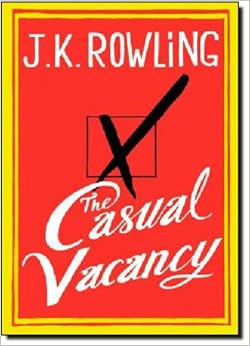
The Casual Vacancy (Rowling)

The Casual Vacancy, by J. K. Rowling, 2012

Had The Casual Vacancy been written by anyone other than J. K. Rowling, I probably would've given up on it a long time ago. Instead I kept coming back to it, and my "enjoyment" might have suffered because of it.

First off, it its neither Harry Potter nor Hogwarts, but I knew that going in. It's not a kids' book either. The language and situations are quite adult, even when it's handling the situations of teens in school from both sides of the tracks.

My biggest problem with the book was that I felt like I'd stumbled into a soap opera with a huge cast of characters, making it difficult to remember who was who and what they were involved in. (Can't tell the players without a scorecard, and all that.) I found it confusing to focus on what make be important because I really didn't know where the story was once I got past Barry Fairbrother passing away, leaving an open seat on the parish council, the term for which is a "casual vacancy". People then go to work scheming for that seat while a whole bunch of other stuff happens, which may or may not be relevant.

I stopped reading this several times, switching to other books and then returning. At one point, I heard that there would be an HBO adaptation, so I waited for that, hoping to get a better handle on the characters. While it worked for some characters, I realized pretty quickly that they'd changed some characters, reduced and/or eliminated others. I figured that they changed the storyline a bit given how much they had to condense it.

The downside to this approach is that after seeing the ending, I didn't know if I even wanted to finish the book. Not because I knew the ending, but because I thought it was a crappy ending and that I'd be wasting my time. But I also realize that they changed the story, so maybe they changed the ending. It turns out that they had, but I still hated it. The entire book seemed to be a pointless exercise, and maybe that was the point.

My reading list was started on paper to remind myself of the details of the books that I've read, to refresh my memory if I want to have a discussion about it, not to be a review blog. However, there isn't much about this that I want to remember that I think I'll need to be reminded of, so I'll leave that stuff out of this one.

I also have to trust my gut, and if I can't get past the second chapter, maybe I shouldn't bother. If it takes me two years, off and on, to read a book, then there are better choices out there, regardless of the name on the cover.

Monday, August 31, 2015

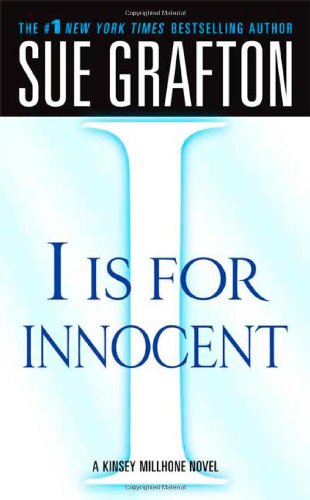
I is for Innocent (Grafton)

I is for Innocent, by Sue Grafton, 1992

Grafton's intrepid private detective has a new job and a new office (after events in the previous book). Kinsey Milhone takes on a new case after the passing of an older P.I., Morley Shine, who Kinsey had a connection to -- he was once the partner of the man who trained her. The case: David Barney had been acquitted of the murder of his wife, and now was being sued in civil court to prevent him from inheriting all her wealth. Morely had done quite a bit of the legwork, but there was information missing and subpoenas not yet delivered. Kinsey has to sort through the unorganized documents before the case makes it to court.

In what could be a callback to the first book in the series, A is for Alibi, where a woman who had already served her time hired Kinsey to clear her name, the title makes you pause to wonder: is David Barney actually innocent? Did someone else kill Isabelle? Kinsey has not been hired by Barney, but she has to check out his story just so she can counter it and so it doesn't blindside Lonnie (attorney Lonnie Kingman) in court. The problem is that too many things don't add up -- not that you would expect them to.

Additionally, for the series' fans, there is some interlude material involving the usual characters, Henry, her landlord, whose brother is visiting, and Rosie, owner of the local tavern. Their storylines have nothing to do with the case -- not even an "aha" moment.

I wasn't certain when I started, but by the time the book was done, I realized that this is one of the entries that I'd listened to on tape back in the 90s, borrowed from the Morristown library when I commuted to work every day. This time, I read an unabridged ebook, also from the library. I only vaguely remembered the plot, but I recognized some of the dialogue at the end. Thankfully, I didn't remember who was in that final scene.

As far as mysteries and detective work go, this was a better book than H is for Homicide, where Kinsey was thrown into a situation and carried along by events. This time, she gets to think everything through and figure out "whodunit".

One other note: I recently told someone that one of the things I liked at Milhone is that she carries a gun and knows how to use it, but she's not involved in a shootout in every book. She could be, if she needed to be. I guessing that when private investigators start firing guns, there's a lot of paperwork to fill out.

I enjoyed reading the book, and I look forward to the next one, which I don't think I've listened to. (However, I'm taken a little break from Kinsey to read some stuff I actually own.)

No link for A is for Alibi -- for whatever reason, I wasn't updating the log when I reread that one.

Fairest of All (Valentino)

Fairest of All by Serena Valentino, Illustrated by Fiona Marchbank (2023) A Villains Graphic Novel Adapted from Serena Valentino's b...