Sunday, September 3, 2017

Brooklyn: A Personal Memoir (Capote) -- Summer Reading Challenge

Brooklyn: A Personal Memoir, With the Lost Photographs of David Attie, Truman Capote (2015)

With an afterword by Eli Attie.

The 800s shelf: Literature, which includes plays, poems and essays. I saw that it was about Brooklyn and then I flipped through and saw the pictures, and I had to check this one out.

First off, I've never read anything by Truman Capote, nor was anything ever assigned to be read. I remember a copy of In Cold Blood sitting on my bookshelf when I was a kid, but I didn't pick it up.

Second, the Afterword was actually the most fascinating part of the book. If you pick up this book, you might want to read it first. Or you can save it for last, and it will change your opinion of the entire book.

From the Introduction, I learned when this essay was originally written and where it was published. From Attie's addendum, I discovered that this Memoir was published as a book in 2002 without the photos. The photography of David Attie, someone you've probably never heard of, were still "lost" at that time.

Eli Attie is David's son and was researching the work his father had done. It turned out that Capote could be credited with launching the elder Attie's career. David even found photos of Capote along with many taken in a walk around Brooklyn Heights in the late 50s (1958, according to the text).

The collected photos (I'll let you read the story) were set to be a book on their own, but as these things go, the set was combined with a second edition of Brooklyn. Both works benefit from this.

Capote had a flair for writing (I guess I'm speaking the obvious to many) which I guess fits what I know of his personality from TV and movie appearances (not to mention impressions by people like Rich Little). However, anyone who walks around Brooklyn Heights and the area down by the Brooklyn Bridge will recognize some of the buildings and streets and structures in these photos. And if you were around there back in, say, the 70s or 80s, you might recognize even more. It's a walk down memory lane to see these places along with the people.

Library reading challenge. Catalogue number 813 C

Friday, September 1, 2017

The Luck Archive (Menjivar) -- Summer Reading Challenge

The Luck Archive: Exploring Belief, Superstition, and Tradition, Mark Menjivar (2015)

The 300s shelf: Social Sciences, which I already did, but I saw another book that looked interesting.

In brief, the author was interested in stories about things, objects, and rituals that people believe are lucky or will bring luck. He even visited stores that had some kind of luck in the title. Many of those stories, along with pictures, are gathered in this one volume. He doesn't try to validate the stories, nor disparage them. More of a simple celebration of the things people do to make luck go their way. (Or to make bad luck just go away.)

A quick little read. I saw it on the shelf, and I thought it might be interesting. It was, but not overly memorable. Nothing much to make a note of.

For fun, here are some of the other options I had, which seemed to have a lot to do with Vampires and Zombies. The English Folk Tales book is one I might revisit later. There was also a book on "Social Q's" as well as a wedding planner (could you imagine me reading that on a train?), as well as some on topics I didn't care to read entire books about.

Library reading challenge. Catalogue number 398.41 M

Thursday, August 31, 2017

Remember the Alamo (Rattle and Vale) -- Summer Reading Challenge

Remember the Alamo: Everything You've Ever Wanted to Know About American History With All the Boring Bits Taken Out, Alison Rattle and Allison Vale(2009)

My summer reading challenge took me to the 900s, which is History and Biography. I went for something short and easy to read. In fact, in researching this book to put on this blog (I already returned it to the library), I discovered another version of it with a shorter title about "Bite-Sized pieces".

Rattle and Vale (who spell their first names differently, so I can't call them "the two Al(l)isons") present snapshots of American history from the Pilgrims to Watergate, all in one-page snippets. Obviously, some topics require more pages to tell the complete story, but it's easy to break things like the Revolution into separate topics and events.

Likewise, one-page biographies of important people are included and inserted into the otherwise chronological narrative at the time it would most sense. Placing Thomas Jefferson's biography, for example, at either the point of his birth or his death would be silly and not relevant to the timeline.

If you just want a primer which the basics, this isn't bad. But it's obviously a starting point if you want to learn more about anything. Also, just reading their take on the first Thanksgiving had me wondering how much I could trust their "slant" with the rest of the book. For the record, the Pilgrims, a group that came over to these shores for religious freedom and who, according to this text, believed that the Church of England hadn't broken far enough away from Roman Catholicism, held their first Thanksgiving to give thanks to God, not to the Indians for helping them through the harsh winter. Now, the authors are the historians here and they could argue the point with me if they wanted to, but God doesn't even get a mention.

What else aren't they telling me? Well, quite a lot, actually, because this is the "Cliff's Notes" version of history. And, oddly, I would have expected a little more about the Alamo, considering the title.

Library reading challenge. Catalogue number 973R.

Tuesday, August 29, 2017

The Bradys and the Girl Smuggler (Doughty)

The Bradys and the Girl Smuggler; or, Working for the Custom House, Francis W. Doughty (1900)

Note: This novel appeared inside the collection 8 Dime Novels.

Back around the turn of the 20th century, there was a series of dime novels named Secret Service about agents who do a lot more than just protect the President. This series featured an agent known as "Old King Brady" who was joined by a sidekick/apprentice who shared his surname even though they were not related. The latter became known as "Young Brady". The stories featured the byline "A New York Detective", which was Francis W. Doughty.

The Bradys had a knack for solving problems when no one else could. At least that's what I figured was the reputation that they had. The novel I read was number 79 in the series.

The story opens in the port of New York in lower Manhattan, an area I've been familiar with since I was a child, but that was long, long after. (Two world wars and then some!) Still, it's amusing when I read the street names as they pursue a suspect that I can make a mental map of the route.

The Custom House of the story has to do with declaring valuables being brought into the country when getting off a steam ship so taxes can be paid on them. Someone has been smuggling diamonds into the country right under the noses of the Custom House agents, and no one seems to know how it is being done. The Bradys are called in to take the case.

The villain of the piece is named La Croix and his French accent is sometimes difficult to work out. ("Eet es deef-e-cult!") He's tricky and won't stop short of trying to kill the agents (bold move for a smuggler -- that's ups the game somewhat). It does become a family affair, as you can tell from the titular "Girl Smuggler".

The story takes them up to Canada and back again, riding trains because that's the fastest method of transportation and communicating through telegrams to places where the other person should be and may go to because that's just the way it was.

With nothing else to compare this story to, I can't say if it's a great example of a dime novel, but I did enjoy it (other than the phonetic accent). Would I read more? If I could download another story in a format that was easier to read, maybe.

One of the interesting things about the book was that it seemed to be reproduced in the manner that it was originally published, complete with the splash page (shown in the photo above). The novelty of that will wear off after a while, particularly with older eyes viewing it.

I don't believe that I'll plan on reading the first 78 to catch up to wear I am.

Sunday, August 27, 2017

8 Dime Novels (Bleiler, ed)

8 Dime Novels, E. F. Bleiler, editor (1974)

I don't remember the circumstances that got me thinking about old "dime novels" a few months ago. It couldn't been because of seeing a roleplaying game online or something similar. I searched both the Brooklyn and New York Public Libraries for information on dime novels, and one of the hits I got was for 8 Dime Novels, edited by and with an introduction written by E. F. Bleiler. Collected in 1974, the stories are much, much older.

I'm not sure when "dime novels" ended and "pulp magazines" began or if the two are somewhat synonymous.

My biggest problem with this book was that it was a big book. Larger in size that a regular magazine, but hardcover. Not something that was easily portable, so I couldn't read it on the train. And not the kind of thing I want to hold onto and catch the lamp light right before bed. Basically, I had to find a comfortable place outside to read, close to home. As a result, I didn't read much of it despite how long I kept it.

Bleiler's introductory essay was interesting and gave me some more background on dime novels and suggestions for others to read. It went into why those 8 were chosen though I suppose a case could've been made for many others. Some of these novels, think "comic books with only words and no pictures", went on for a hundred or more issues. I don't know how many even survive, let alone were read for consideration.

In the end, I read the essay and the first story. I probably would have skipped to the Buffalo Bill story after than, had I more time.

It's not likely that I get this book again, unless I can find an ebook version of it. On the other hand, I've found an entire library of Buffalo Bill stories online that are free to read.

Still I enjoyed that this was available. It's a piece of history. That said, reading books more than a century old, particularly those that are cheaply made, can be a little challenging when you're used to today's pacing and writing style. (I'm saying this as a guy who likes science fiction but had trouble getting into both Dracula and Frankenstein for the first few chapters.)

This was not part of my summer library challenge. I took it out late spring. In fact, I finished it earlier in the summer than the last couple of books, but I forgot to post an entry when I was catching up.

Saturday, August 12, 2017

A Fire In My Hands (Soto) -- Summer Reading Challenge

A Fire In My Hands, Gary Soto, 2005

image coming

Another warm day, another trip of errands briefly interrupted by a stop in the air-conditioned library. Actually, I had time to spare, and I thought I could find something that I could possibly read in a half-hour. (No, that wasn't likely to happen in any case.)

As I walked past the 800s shelf -- Literature -- I looked for something thin that wasn't labeled Young Adult. Yeah, I failed at that as well.

But I did pick out a slim volume by Gary Soto, whom I hadn't heard of before now. Some business to take care of before I continue.

As a child I was fascinated by poetry. By the rhymes and by (although I wouldn't know it at the time) the meter. There would be poems at the start of each section of a reader (or text book?) we had way back when.

I have since fallen out of love with it, particularly in its modern incarnations. Specifically, I hate free verse. I hate random words on paper. I liked the rules, and working in the rules makes a successful poem that much more successful in my mind. When there are no rules, what is success? I read it ... and nothing. In wanting to know these rules, I took a Creative Writing class at Brooklyn College where the teacher (I don't recall if she was a Professor or not) explained the rules and then gave examples that broke all of them, without explaining how and why to break them for effect. (Shout-out to Xaverian High School English teacher John Mucciolo for explaining a bit about breaking the rules with purpose -- I believe he went on to be a principal in Ramapo, NJ.)

What I liked about Soto's collection (some of which dates back to before the 2005 publishing date): he went back to childhood memories, and some adult memories about his children. He told stories without a lot of excessive pretentious verbiage (see what I did there)?

I didn't like the free verse where lines broke sometimes in the middle of a two-word phrase, but I could read it like a story -- not so much prose, but like a guy talking to me. Such conversations can be choppy and disjointed to.

I appreciated the imagery he created without going for crazy allusions and allegory.

And since I'm from the Northeast -- Brooklyn, all my life -- and he's from the Southwest, a Central Valley Mexican, I found the change of viewpoint, scenery and all that to be a refreshing change of pace.

Also, his name to last poem is one that was commissioned by NASA before the Millennium. I didn't know this going in, so it was a happy discovery. Gotta love it.

So if you're a non-poetry person looking for a book of poetry to read, I can recommend this one.

Tuesday, August 8, 2017

Dead Strange (Lamy) -- Summer Reading Challenge

Dead Strange: The Bizarre Truths Behind 50 World-famous Mysteries, Matt Lamy, 2012

I went back to the 000 (General References) shelf of the library and looked through the reference books and the "How To" for different software programs. It looked like I was going to have to take a "supernatural" book.

That said, I like this book. This is the kind of book I would have loved as a kid. I didn't read a lot, and part of the problem in the early grades was that there weren't books like this in my school library. It jumped from the Dr. Seuss level to 100-page novels without any in-between! (I remember discovering chapter books with my children and thinking how wonderful they were.) I remember taking out a book on magic because it interested me, but it was too dense for me to get through.

Anyway, back then, I would have loved books about supernatural stuff, and this book has 50 things in it (although a couple are kind of related). And the best part is that each section is only 2 or 3 pages long. Long enough to give you an idea about the subject. Short enough not to put you to sleep or drag on endlessly.

Using my usual standard, it reads better than a click-bait web article "The Bizarre Truths Behind 50 World-famous Mysteries!! -- (You won't believe Number 23!)". Yes, it could be a little more in-depth, but it's another young adult book meant to get them interested. It's not a college thesis.

Drawbacks? Cross-referencing would've been nice. Also, there's at least one reference to something weird without mentioning that it isn't in the book. A bibliography would've been good, as well as a "for more information..." page.

I read this while sitting in an inner tube floating on my pool on a couple of early summer mornings before the Sun got too high and too hot.

Library reading challenge. Catalogue number YA 001.94L. Young adult.

Some of the choices I had in the 000 series:

Monday, August 7, 2017

Eyes & Spies (Lloyd Kyi) -- Summer Reading Challenge

Eyes & Spies: How You're Tracked and Why You Should Know, Tanya Lloyd Kyi, 2017
Art by Belle Wuthrich

While walking up and down the aisles at my local library branch recently (a cooling center for a hot day), I mused that I should just grab a book from each shelf and see how many I could read this summer. It became sort of a Summer Reading Challenge, but a poorly planned one. For one thing, I originally considered the fiction shelves: grab a mystery, science fiction, historical, young adult, graphic novel/manga, etc. Then I thought about the shelves lining the walls, with numbers corresponding with the Dewey Decimal system. I could try to read on from each leading digit. Now there's the rub. First, I'm not big on non-fiction, and second, a lot of the material was reference-oriented. Also, many of the books were quite large and would likely be pretty dense reading.

And there's the other thing about wanting to enjoy what I'm reading and read some of the things that I've been waiting to get to.

So, yes, I cheated a bit and scanned for some shorter books. And that also meant grabbing some Young Adult material just to increase my chances of getting through the books.

The first book was from the 300s, which is the Social Sciences. I took a picture of some of the options. I settled on Eyes & Spies. I liked the title and I was curious what it had to say.

Since it's non-fiction, there isn't much to review or comment on. I liked some of the historical context it gave, including some information I hadn't known. It didn't say a lot about the state of computers now that I wasn't familiar with, but it's a good primer for middle school students. I don't remember if it had an index or bibliography/list of sources/suggested reading, and I wish I'd made a note of it. (I read this a couple weeks back, and I've already returned it.)

It's definitely more information than you would find in one place on any site on the Internet and it reads quick. You could research this on your own, but you don't have to. That said, you probably should use this book as the beginning not the ending. There are a lot of eyes out there and the technology is constantly changing.

I'd recommend this for any middle schooler who used the Internet a lot -- that is, all of them.

Library reading challenge. Catalogue number YA 323.448K. Young adult.

Some of the choices I had in the 300 series (and a couple of misplaced 400s):

Sunday, August 6, 2017

Dresden Files: Fool Moon (Butcher)

Dresden Files: Fool Moon, Jim Butcher, 2001

The first volume of the Dresden Files had vampires, but it wasn't about vampires, even though they played an important part. The problem there was wizardry, and that was a nice change from what you might expect.

The second volume has werewolves, and it is definitely about them. But there's still a twist to it, and that's the ground rules. Bob, the air spirit Dresden keeps in his cellar, explains about different types of werewolves from folklore and how people become them. Hint: getting bitten by a werewolf won't turn you into one -- otherwise, the world would be overrun with werewolves. (My note: consider that any virus that could spread so easily would either become a mass epidemic or kill everyone, and itself, pretty quickly.)

All the different types are encountered here, including the mysterious Tera West, who Dresden isn't too sure what she is. It's certain that she isn't as human as the others because his soul gaze didn't work on her. She is the fiance of Harley MacFinn, who is a loup-garou, the most powerful werewolf type Bob mentions, and also the least controllable. He has a circle of protection to contain him in his home, but it has been broken. West needs Dresden to contain MacFinn or innocent people will die under the full moon -- or is it that more innocent people will die?

Dresden doesn't have to worry about the White Council in this book as much as he does a greater adversary: Lt. Murphy. She hasn't been pleased with him for keeping secrets from her during investigations. Their working relationship is quite strained as Murphy wants an answer to the investigation while Dresden wants to protect her from the worst of this business. She brings him in on an investigation where bodies looked liked they've been ripped about by wolves. The last was a month ago, during a full month. The latest, another full moon. Doesn't take much to realize a consultant should be brought in. The problem with the latest crime scene is that it's out of Murphy's jurisdiction and the Feds have moved in. She needs this win for the Special Investigations Unit.

And, naturally, Johnny Marcone ends up being involved in all of this.

The action keeps moving, and there's a good cast of characters. Most of them seem to want Harry dead, but some need him alive -- at least for now. This is not a sophomore slump in any way. And there are plot hooks for the future. It should be interesting to see where it goes.

I'm coming back to this series at a later time.

Thursday, August 3, 2017

Dresden Files: Storm Front (Butcher)

Dresden Files: Storm Front, Jim Butcher, 2000

I heard about the Dresden Files many years ago, probably as long ago as they've been around. I've been told I'd probably enjoy them. Whoever said that was probably right.

I don't know what pushed me recently to request Volumes 1-6 as an ebook from the library, but I did and I had a while to wait before my name got to the top. I knew that there was no way I was going to read six books at the end of the school year in the standard loan time/ I "put down" what I was in the middle of and managed to read two volumes. I'll list them as separate entries.

So Harry Blackstone Copperfield Dresden is an actual wizard in the modern world, and that world isn't Harry Potter's with the regular schools and such. Harry's father was a stage magician and named him for famous magicians. Unlike his father, Harry has an aptitude for actual magic. The downside is that magic and technology don't go well together, so he doesn't keep a lot of tech around. This means his old car breaks down often, and he uses a lot of candles.

In Harry's world, he has to make a living, so he works as a private detective and he freelances for the local police department. No one actually believes in magic or that he's anything other than a scam or a fraud. Except that he gets results. Other things that they might not expect to exist are vampires, fairies, air spirits, and other entities from the Nevernever, which while mentioned, we don't get to visit. There's also a ruling White Council, which can hold the power of life or death over Harry. In fact, he's being followed by someone looking for an excuse to kill him, Walden Morgan. Harry has to play by the rules, and magic has a lot of them.

The actual magic spells and potions are interesting. Potions require certain ingredients that appeal to the five senses, and that would include putting a ray of sunshine in. For that matter, sunshine can be held in a handkerchief and shone later.

The two characters who seem to believe in Harry more than the others are Lt Murphy, the head of the Special Investigations unit of Chicago PD (which gets no respect, really) who calls him in to assist her with a case, and Johnny Marcone, the head of the underworld. Marcone has looked Dresden in the eye and not freaked out.

In the first volume, Harry is called in to investigate two gruesome murders where the victims are a wiseguy and a vampire call girl. Right there, you know it's going to be interesting conducting interviews. Especially when Marcone offers to pay Dresden his going rate to take the week off.

At the same time, Harry actually has a reluctant client show up to find her husband. The two cases become intertwined, and before you know it Harry is going to be the next victim -- either of the killer or of Morgan or the White Council. He has to solve the case and stop another wizard from attacking before the next big storm hits Chicago and powers the bizarre rituals behind the killing spree.

As for the review portion of this entry: I enjoyed the book and made sure I had time to squeeze in a second before my loan was over. I liked the interaction between Dresden and the air spirit, Bob, who lives inside a skull in Harry's cellar (underneath his basement apartment) and who knows a lot about creating potions. The fairy, Toot-Toot was meh, a useful creature to move the story along. I like that Harry got a girlfriend, so I don't have to expect a Mulder/Scully thing between him and Murphy, who he considers a friend. And I liked the odd rules for magic, which seems refreshing while sounding archaic in nature.

This is definitely a series I will get back to.

Wednesday, July 19, 2017

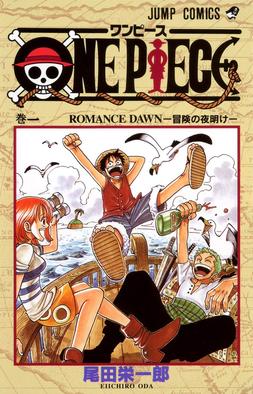
One Piece, Vol 1-29 (Oda)

One Piece, Volumes 1-29, Eiichiro Oda, 1997-2003

Sometime in June 2016, I heard several of my students talking about One Piece. To be honest, I don't know now if they were talking about manga or anime. I can't say for sure that I saw anyone reading One Piece in particular, but manga was popular with the students. I had an epiphany. If this is something that the students like, then maybe I should partake a little myself. And having an excuse to read the stuff was just a bonus. I had a couple of choices, but given the conversation I was listening to, I figured I'd start here.

These 29 volumes were read between June 2016 and June 2017, particularly during those periods I was riding trains to different schools in the city.

It helps that the Brooklyn Public Library has many of the volumes available. (By coincidence, the first volume that they didn't have was one of the few early volumes that the Barnes & Nobles a block from my new school (with different students who don't seem to read manga) did have. I read a few pages at a time, each day.)

There's not much I can say that you can't find in online encyclopedias.

I enjoy the stories and the actions. There are drawbacks, but I don't know if those are peculiar to One Piece or to the medium in general.

Luffy, the main character, wants to be the world's greatest pirate, but he eats the devil fruit of the Gum Gum tree, which gives him stretching powers, but makes him incapable of swimming. This makes him a bit of superhero in this world.

The problem is that these devil fruits aren't as rare as you might think. And they come in many varieties, granting many different powers. I guess they're rare in that I haven't seen any fruit tree duplicated, but it seems that every pirate Luffy and his crew come up against have also eaten devil fruit. So sinking like a stone isn't such a bad thing for pirates.

The books have 11 chapters in each volume, so I've read over 300 chapters. Also, some of these are available in omnibuses containing 3 volumes. I'm currently waiting for volume 30 to become available, so I'm writing this mid-story.

That is one of the problems: the story lines go on forever. There are entire chapters that are devoted to a single fight between two combatants. I add this last clause because the past couple of volumes have been, essentially, one long, drawn-out fight.

Not all the fights make the transition from anime to manga very well. Sometimes I stare at the images trying to see exactly what is happening. It isn't always obvious.

I have to say that it has moved the story along. Luffy filled out his crew (even adding prior enemies). They mentioned the Grand Line, so they went there. It didn't seem as frightening as it should have been, but it was definitely dangerous. At this point, Luffy wanted to find the island in the sky. And so he did. That story line seems to be drawing to a close -- at least I hope it is. Parts of it have been a mess to keep track of as the story shifts points of view.

Problems aside, I'll keep reading it as long as the library keeps supplying me. And I'm likely to move on to other series after. (I'm open to suggestions.)

I'll probably have another entry after I read another 30 or so books.

Wednesday, July 12, 2017

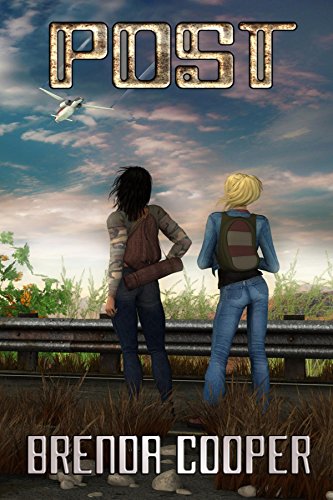
Post (Cooper)

Post, Brenda Copper, 2016

The story is set in the Pacific Northwest after society breaks down, but through disease and natural disasters, not war and bombs as in a typical post-apocalyptic novel. People now live in small communities, growing their own food, hidden for their survival. Walking the roads could be dangerous. Sage, the girl at the center of the story, likes to go outside. She's quick, so she can escape any travelers she encounters, but her constant outings put the Garden in jeopardy, and she's told that the next time she leaves, she won't be allowed back in.

This is actually fine by her, because she wants to go. She wants to see a big city. And she has seen an airplane, so she knows that there must be something. So Sage is sent to Portland, to find what the world is like now.

Sage runs into some trouble on the road and is rescued by a man from another community. She is allowed to stay the night, but in the morning, she is sent off with another girl, Monday, who is given the same job: find if the world has recovered.

They get there, after some missteps, and mistrust, and get involved in an uprising as Portland is in the middle of a power struggle. Sage does find the plane and the pilot.

(There would be more here had I written this entry a few months ago.)

I enjoyed the book. I liked the character development. The kids weren't whiny -- something that bugs me when I read, essentially, young adult novels. (I know I may not be the target audience, but really!) If I had one problem with it, it was too short. It needed another chapter, or an epilogue, just for a little more closure. Yes, I wanted to know what happens next, though not necessarily a sequel.

Actually, I wouldn't mind a sequel set in this world, but I'd want another story, not just "and then this happened".

I got this book from its Kickstarter campaign.

Statistics: ebook, fiction, post-apocalyptic, short

Fairest of All (Valentino)

Fairest of All by Serena Valentino, Illustrated by Fiona Marchbank (2023) A Villains Graphic Novel Adapted from Serena Valentino's b...