Wednesday, September 4, 2019

hook line sinker (Rowe)

Hook Line Sinker: An Online Resource Book for People who Teach Mathematics, John Rowe (2019)

Not really a review, just reminding myself about some of the details of what I read ...

I didn't read this over the summer as much as perused it. As the title says, it's an online resource, meaning each section contains a lot of links to a lot of examples and exercises and lessons and whatnot. It's a great guide for cutting through the Net, and it contains likes to several people I follow online or whom I've actually met in real life, which is a bonus.

The book is listed as free (and should always be free), and you can find it at: https://books.apple.com/au/book/hook-line-sinker/id1452938209
Additionally, all the resources linked in the book are free as well. There is nothing typically be found in textbooks included here.

Hook, line, sinker is an obvious fishing reference for "reeling them in", and it follows a common theme I've encountered in Math PD (professional development) about "Math in 3 Acts". Another allusion would be "Appetizer, Main Course, Dessert", or something similar.

In this case, Rowe goes with: hook, how will you hook them in?; line, how will you build on what they already know; sinker, how will you help them consolidate what they learn?

Engage, Explore/Explain, Elaborate/Evaluate.

So I did go through it, even if I didn't read all the resources -- most of which I could, considering I was reading this on the train, mostly. But I'll still count it as a book read for the year. And a math book.

Monday, August 12, 2019

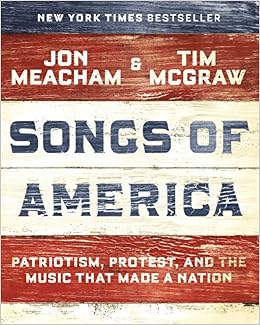
Songs of America (Meacham & McGraw)

Songs of America: Patriotism, Protest, and the Music That Made a Nation, Jon Meacham and Tim McGraw (2019)

Not really a review, just reminding myself about some of the details of what I read ...

A couple months back, I got to see Tim McGraw and Jon Meacham at The Beacon Theater. I put the names in that order because, frankly, I had no clue who Meacham was, and I was going to see and hear Tim McGraw. Yeah, it wasn't that kind of show. Not that it was bad. It was basically an evening of talk and song that promoted their new book, which was conveniently on sale in the lobby. I got my copy from the library. Twice -- there was such a demand that I couldn't renew it without waiting again.

The book analyzes how music has influenced and been influenced by events in American history, going back as far as "The Liberty Song" written by John Dickenson in the years before the first Continental Congress.

Meacham is a presidential biographer, and that experience is on display here, but as he acknowledges in the closing pages, people want to hear Tim sing more than Meacham type. During the show, I didn't think Tim sung enough, and he deferred quite a bit to Meacham during their discussions. So much so that when the two of them appeared on The Late Show, Meacham did most of the talking, and Tim didn't even get to sing.

So Meacham wrote the narrative, which is offset by boxed text where McGraw writes his thoughts and memories concerning specific songs and people who were discussed in the main text. There wasn't enough of that for my taste, but what are you going to do.

I guess it's a case of enjoying the book I got even if it wasn't quite the one I wanted.

Saturday, August 10, 2019

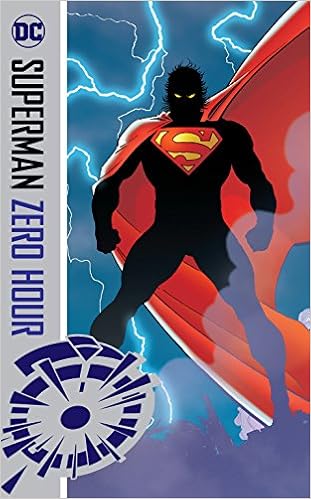
Superman: Zero Hour

Superman: Zero Hour, Writers: Dan Jurgens, Karl Kesel, David Michelinie, Louise Simonson (1994)

Not really a review, just reminding myself about some of the details of what I read ...

I vaguely recall when Zero Hour happened in DC Comics, but if I had to guess it was back in 1994, I would have been way off. I remember the bit where every comic was Issue #0 for that month, but I wasn't regularly reading any comics by that point. This was also sometime after the Doomsday plot line where Superman died and there were suddenly four new Supermen. Again, I never read that story line, but it did make it into the papers and get discussed at a convention. Plus, later on, I listened to an audio presentation of it in my car. (Back in the days of the 50-mile one-way commute.)

The stories up front are connected because of some time storm happening, which causes characters to shift universes. This allows for Batman to appear numerous times, as various incarnations that have been published over the past 80 years (or 55 or so, at that point), and none of them had a broken back. (Note: Bane story line, which made it into the movies. I actually did read some of those books way back when.) Also of interest, Superman has long Hercules-like hair and Clark Kent wears it in a pony tail. That just seemed weird. He and Lois were an item (at least in some realities), and she's also involved with Superman, but no one asks.

Oddly, the core of the Superman portion of the book is taken up by a lengthy piece about a childhood friend of Clark's, one we've never met before, who was born on the same day as Clark (in the post-Crisis DC Universe, Kent was basically hatched on Earth, not rocketed to Earth as an infant or baby), and who always played second fiddle to Clark. Clark's powers didn't manifest until he was nearly an adult, so there was no need to hide his powers when he was younger and feign weakness. He was basically the Olympian ideal, so his competing against humans was really cheating, except that his poor shmoe of a friend, who never had a clue about Clark's extraterrestrial ancestry, still feels cheated, and turns into a jerk, and then into an evil jerk, then super-powered evil jerk.

Side note: the character was so forgettable that I forgot him a week later -- and he wasn't mentioned on the summary pages I found online because he wasn't part of the overall theme of the book despite being such a major part of it. The story should've been one issue, possibly two if you really wanted to build him up. Four parts? And Clark is that stupid throughout, despite Lois stating the obvious.

After all that were a couple of Superboy stories, with his "tactile telekinesis" on full display. Okay to read, and a pleasant distraction after that Superman story. Closing out the book were two stories with Steel, who I'd forgotten about. I knew in the aftermath of Doomsday, one of the comics published was The Man of Steel, but I never saw it. When they first showed the character, I thought it might be a robot or android. Then they showed a villain that looked enough like Clark to make me think that it was a clone (until I realized it was an unrelated villain, and not Steel). The background in the #0 issue refreshed my memory of whatever mention the character got in the audio drama.

I assume Superboy and Steel were included for completeness, but they seemed disconnected to the rest of the book.

That'll probably do it for graphic novels for a while, although there are Manga Classics Illustrated at the library which look interesting (but a little too thick to carry around), and I found a Classics Illustrated book of Romeo & Juliet in my garage that I don't remember acquiring -- or leaving in my garage.

Note: Collects ACTION COMICS #0 and #703, ADVENTURES OF SUPERMAN #0 and #516, SUPERMAN #0 and #93, STEEL #0 and #8, SUPERMAN: MAN OF STEEL #0 and #37 and SUPERBOY #0 and #8.

Sunday, July 28, 2019

Superman Adventures, Vol 4 (Millar, Michelinie, et al)

Superman Adventures, Volume 4, Writers: Mark Millar, David Michelinie; Illustrators: Terry Austin, Aluir Amancio, Neil Vokes, Mike Manley (2018)

In the past, I've complained about graphic novels that weren't novels, but rather collections of comics and sometimes not even cohesively or coherently so. And yet I continue to pick them from the library shelves. This one isn't a novel, and I'm absolutely fine with that. It is what I expected it to be: a bunch of one-off adventures, each self-contained. Basically, it's like watching a three-hour marathon of the show, which, by the way, I have never seen. (I should rectify this.)

Note: I have seen all of Justice League and Justice League Unlimited, which has the same animation, voice actors and a couple of story lines, so I am familiar with it. And because of that, Lobo sounds in my head like Robert from Everybody Loves Raymond (Brad Garrett), and Kalibak sounds like Worf from Star Trek: the Next Generation (Michael Dorn).

Fun quick read for the train, even if I got some amused looked from people watching this gray-hair distinguished fellow reading a comic book. Great appearances by Doctor Fate and Batman.

Note: I found a reference that says the stories came from Superman Adventures #26-35.

Saturday, July 27, 2019

The Way Station (Simak)

The Way Station, Clifford Simak (1963)

Not really a review, just reminding myself about some of the details of what I read ...

I was assigned to a class that met in the library at Lafayette High School earlier this year. They had a shelf of books removed from circulation that were free to be taken. I didn't want to be greedy because these were for students. But on the other hand, some of these books, realistically, would never be taken. On of these was The Way Station, which according to the printing history was produced in 1988, and according to the final circulation card in the back was last taken out four times in 1994. After 25 years, I think I was safe in taking it, particularly considering that it was originally written and won a Hugo Award before I was born.

The only Simak novel I've read (I may have read short stories in old anthologies) was City, which I purchased from the Science Fiction Book Club way back when, on purpose, not as a mistake that was sent in the mail because I forget to send back the preference card. I still remember most of it after a few decades, so that says something.

This book was a little slow getting started, but a lot of older books seem to be that way, most likely because today's books seem to start en media res.

Enoch Wallace was a Civil War soldier. A hundred years later, he's still alive, which draws the attention of the government, including agent Claude Lewis. A number of the locals note something peculiar as well but for the most part keep their distance, except for Winslowe Grant, his delievers his mail. Enoch is the caretaker of a station used for intergalactic travel, similar to a network of Stargates except thirty-plus years earlier. Aliens and artifacts and packages pass through en route to other worlds. They also bring "deceased vegetation" because it known that the gatekeeper collects it. In actuality, Enoch takes the alien wood and gives it to Winslowe, who carved statues. He's curious but not too curious about the wood origin.

Interstellar travel by ship still takes months and years to accomplish, so this is a revolutionary system, and his is as important job, which he was chosen for by an alien Enoch calls "Ulysses". Ulysses, who doesn't object to that moniker, is a member of the galactic council and sort of a supervisor, who checks on from time to time on Enoch. He always visits for the coffee.

Enoch worries for the fate of the world and the coming war, but it's basically the fear from the Cold War of nuclear annihilation, not a war from space. However, he does fear that man's behavior toward man could keep it from entering into the Galactic confraternity.

Other characters of note: Lucy, a deaf mute who has a sensitivity that allows her to operate an alien mechanism (a pyramid of spheres that suddenly lights up) in a way that baffles Enoch. Also, her father, Hank Fisher, who doesn't trust Enoch and assumes he has the devil in him. Finally, there's Mary, an interactive hologram (the shadows) of someone from long ago, who, to be honest, I'd forgotten about by the end of the book, when she came back. I'd originally thought the scene a hallucination rather than a hologram. The man was lonely after all.

I took a picture of my cover because it was better than the images online. It shows a glowing creature by a grave, but it isn't a ghost. It's a "Hazer", which is what Enoch affectionately calls Vegans, those from Vega, not the ones who don't eat animal products. And it's visiting the grave. It hasn't risen out of it.

Overall, an enjoyable book and one that obviously seeds so much of sci-fi that is to come. This is a little bothersome in that if so much sci-fi owes a litle something to this book, why haven't I heard of it before? Maybe I have and forgot that I did? It's not like I didn't know the name. Still, it's curious.

Wednesday, July 24, 2019

Q is for Quarry (Grafton)

Q is for Quarry, Sue Grafton (2002)

Not a review, just reminding myself about some of the details of what I read ...

Q is the 17th letter of the alphabet, so this is the 17th novel in the series, making it the longest series I've read, by far. (I've read maybe a dozen Doc Savage novels, and I should get back to those.) This entry is a little different in that it deals with an actual unsolved murder, although he details were fictionalized, and in the book, the case gets solved. It does have information at the end in case anyone with information wants to come forward.

Kinsey Milhone gets hired by Con Dolan, an old cop from the series who is currently on medical, and Stacey Oliphant, a retired cop in ill health. Those two deserve each, and they each watch out for the other's bad habits. Years ago, they were the officers who found the body of a Jane Doe in a quarry in Lampoc in Santa Barbara County. Not only was the murderer never caught but the body was never identified, even after cross-checking with missing persons. They want to take one more pass at it. And they have a suspect in mind to start with, who was involved in another case which may or may not be related. A lot hinges on a stolen-then-abandoned red convertible in the small town of Quorum, and some abandoned real estate.

There's also more information about Kinsey's mother from another aunt. A little bit of soap opera to offset the hopelessness of the case. I don't know if it's leading to a future reconciliation with the family after decades on her own or not. It drags, but that's the pace that has been set, and to suddenly resolve it would be extremely odd, unless she were to investigate the murder of someone in the family she just met. (I have no idea if this is coming or not in a future book.)

I'll be reading "R" just as soon as I get rid of some of the printed material in my house. Plus other library books pop up occasionally.

Saturday, June 15, 2019

Humble & Kind (McGraw)

Humble & Kind , Tim McGraw (2016)

Not a book between books, but a book in the middle of reading another book ...

Tim McGraw has a new book out, Songs of America, which I put on reserve at the library after seeing his show at the Beacon Theater. While searching the library catalog, this book appeared, and I recognized it as the title of one of his songs. There wasn't much to it. An introduction to the song, and an epilogue by the song writer, the bulk of the book is the lyrics and pictures. Basically, it's a gift book (like the first version I encountered of Everything I Need to Know I Learned in Kindergarten), of the inspirational variety.

Pleasant to read, but has as much meat as a magazine article might. On the other hand, I'm ready for the other book and there's just a few people ahead of me. Which also means I have to finish the other library book I have checked out.

Friday, May 31, 2019

An American Princess: The Many Lives of Allene Tew (Annejet van der Zijl)

An American Princess: The Many Lives of Allene Tew , Annejet van der Zijl, (20`5), translated by Michele Hutchison (2018)

I left the following review on Goodreads:

A fascinating look at high-society and old money meets new at the close of the 19th century, in New York and Pittsburgh, focused on the life of Allene Tew of Jamestown, NY who went on to make the society pages in the 20th century and marry an actual prince (among others) in the course of a turbulent life that weathered two world wars, a market crash, the Depression, and the start of the Cold War. Through it all, she persevered.

Not the kind of book I normally read. It was a suggestion from Amazon (World Book Day). I didn't know at first that it was a biography of an actual person -- I'd never heard of her, but I have heard of many of the names that were dropped. Even more surprising was I thought it would be more about Europe because the author in from the Netherlands. (The author has done a book on Prince Bernhard of Lippe-Biesterfeld, consort of Queen Juliana of the Netherlands, who has a connection with Miss Tew. (I won't share her full name -- spoilers)

Fascinating who this woman was and the lives she led, especially since it opens with her dying days in a small house so far from where she was born.

I was going to give this book 4 stars, but I couldn't think of a reason why I shouldn't give it five.

Friday, May 10, 2019

Go (Kaneshiro)

Go: A Coming of Age Novel , Kazuki Kaneshiro (2000), translated by Takami Nieda (2018)

Not a review. Just a reminder of what I read recently.

I probably would not have read this were it not for Amazon's World Reading Day. As I did last year, I downloaded a bunch of free books from around the world. Last year, I only read two of them (so far).

Once again, I read a book by about a Korean living in Japan, but unlike A River in Darkness, Go wasn't anywhere near as depressing. That said, it wasn't particularly cheery either. The book was from 2000, which is something to keep in mind whenever there are mentions of technology or pop culture. Some references become dated.

The story follows Sugihara, whose family in Korean. When the North Korea had been founded, Koreans in Japan had to choose to register as North or South Korean. The book opens with his parents deciding to switch nationality to South Korean, so they'll be able to go to Hawaii. (At first, I thought they were moving there, but it's just a vacation.) Sugihara takes this opportunity to get out of Korean school and attend a Japanese school.

School life is rough, but Sugihara has an undefeated record beating up all challengers who would make his life miserable. (Not to mention the ones who think that they could make a name for themselves if they get in a lucky punch that takes him down.) Since Sugihara was taught by his father, a one-time professional boxer, who also slaps him around a bit, he isn't easy to take down.

One of his friends is Katou, whose nose Sugihara breaks. No hard feelings, though, because that gives him the excuse to get a nose job. Katou's father is a member of the Yakuza, and he respects Sugihara. Katou throws a big birthday party, and Sugihara meets Sakurai, a bit of mystery girl.

His closest friend in Jong-Il, from the Korean school.

It's a story of love, loss and finding your place in the world, and what nationality has to do with any or all of that. I enjoyed it.

Monday, May 6, 2019

Mermaid Precinct (DeCandido)

Mermaid Precinct , Keith R.A. DeCandido (2019)

Not a review. Just a reminder of what I read recently.

I was lucky enough to be at the book launch party for Mermaid Precinct at Heliosphere in Tarrytown, NY recently. I was even luckier to already have a copy of the ebook from winning a flash fiction contest at eSpec Books, the publisher. The plan was to buy the Tales of book to get signed since I can't sign my ebook.

(Sidebar: my winning story was The Feast of Groggry the Cronaut. )

This is the first one three books to be written for eSpec Books. To expand the series, DeCandido expanded the town. This book takes place a year after Gryphon. In that time, there was a fire in Barlin, and many refugees flooded Cliff's End. As a result, a new neighborhood was built, and while the official name is Albinton, everyone calls it "New Barlin". This neighborhood has been designated Phoenix Precinct. Also, there is now a prison barge offshore, which has been designated Manticore Precinct.

Guess what the next two books will be called. At a sit-down with Keith, I heard that Phoenix should be the next book to be written. It hasn't been started yet, so it'll be a while before I continue this series.

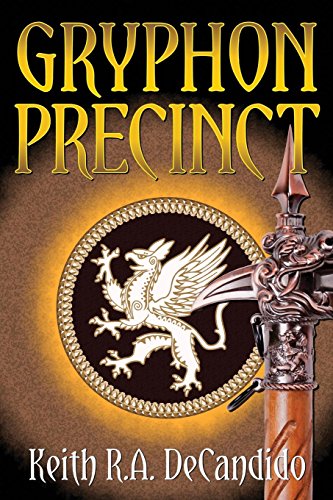
Gryphon Precinct (DeCandido)

Gryphon Precinct , Keith R.A. DeCandido (2013)

Not a review. Just a reminder of what I read recently. Read this a month or so ago.

Spoilers from previous books in the very first paragraph.

The end of Goblin Precinct was marked by the death of Dru's partner, Lieutenant Hawk, as well as the Lord Albin, who had been sick with more than allergies.

Albin's son, Lord Blayk comes in and immediately starts making changes. First, he gives both Captain Osric and Lt Iaian full pensions to retire. Then he makes Grovis the new Captain based purely on his status as the son of a Cliff's End banker. Blayk expects Grovis to be his mouthpiece and do whatever he's told. This doesn't play well with Torin, Danthres, Dru or even the new lieutenants.

Blayk splits up Torin and Danthres, so they can take each train new partners. He also doesn't want them investigating Albin's death. However, his mother overrules this and wants Danthres to investigate.

The entire castle is being upended, and Torin and Danthres figure out why. Grovis, in the meantime, realizes what a pickle he's been put in, to the point that he finds a retired Iaian, living alone now that he bought a nice house for his wife, to talk out his problem. Iaian has always hated Grovis, but can't argue one piece of logic: Grovis can't talk to anyone in the department about what's going on, but he needs to talk to someone who understands the department. That's Iaian, who tells him, basically, keep his head down and mouth shut if he wants to survive. That's how Iaian survived.

Verdict: an improvement over "Goblin".

Friday, May 3, 2019

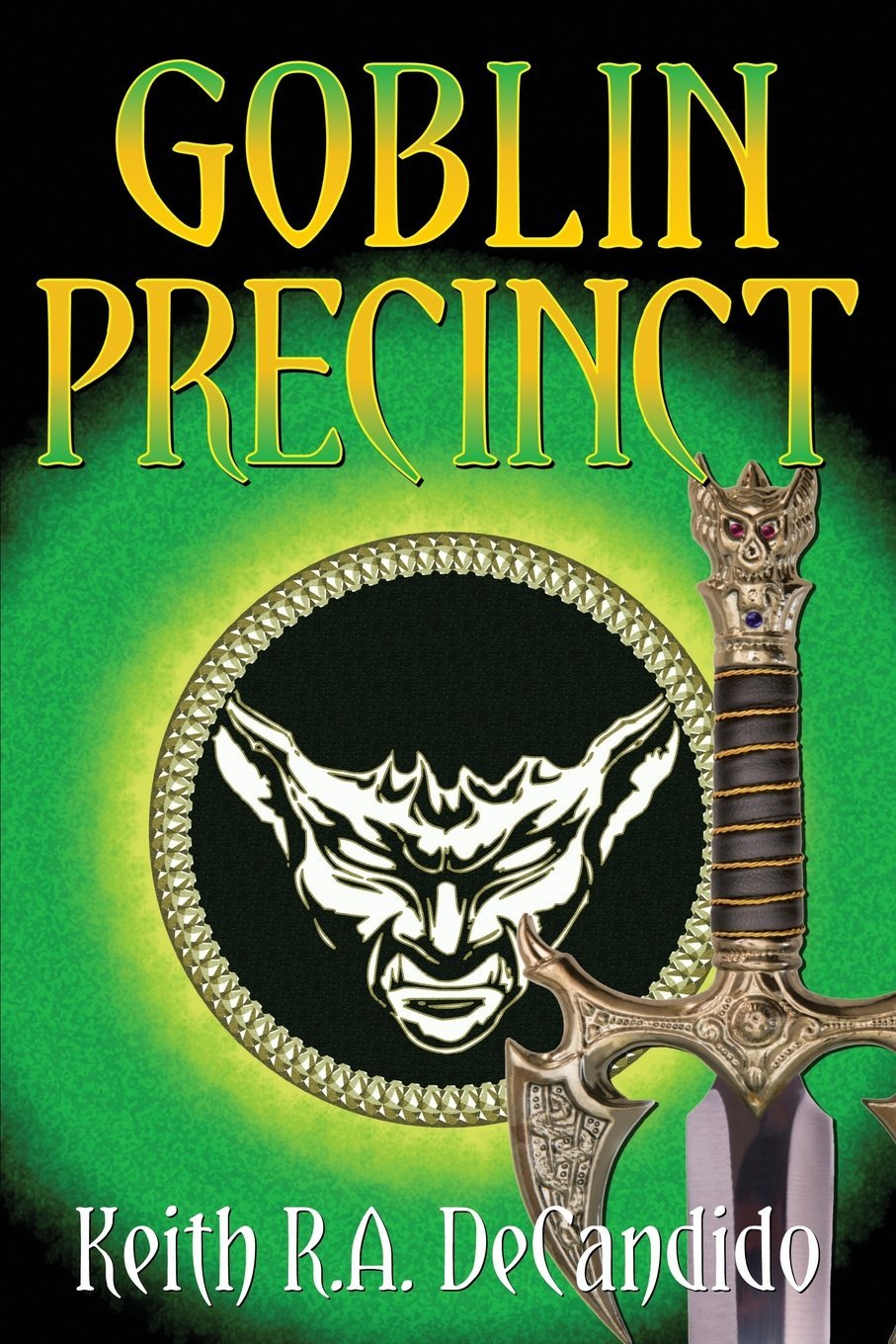
Goblin Precinct (DeCandido)

Goblin Precinct , Keith R.A. DeCandido (2012)

Not a review. Just a plot summary, for future reference. Read this a couple months ago.

The third book in the series brings us to another precinct. The book opens with a former aristocrat in Elven society, one who had been close to the Elf Queen and who fled when the end was near, is now a poor beggar in Cliff's End, having never found a new way to support himself. In the end, he gives in and tries a new drug called "Bliss", which makes the user happy beyond belief. He's instantly hooked, but the high never lasts as long, and it's a short matter of time before he overdoses.

Not exactly murder. And not something that would merit the involvement of the Castle Guard detectives. However, when another Elven aristocrat shows up looking for the first one to try as a war criminal. Using his credentials, he forces the Castle Guard to find the body and prove cause of death, to make sure it wasn't a politically motivated murder. (Note: the reader already knows that it was not.)

The investigation uncovers the fact that the drug, Bliss, was created through magical means. Now the Brotherhood of Wizards will have a problem with this. In fact, the "Brotherhood" will have a bigger problem by the time the whole thing is over.

Among the other revelations, Danthres discovers that Sorlin, the city she sought refuge in as a half-breed, has disbanded because the purity laws elsewhere have been repealed. (In Unicorn, Torin ban Wyvald's father had shown up to bring him home to Myverin. We should be out of homelands now.)

No spoilers for anyone accidentally finding my blog, but there will be staffing changes by the end of the book.

Final take: Goblin suffers from lack of a murder, and from knowing the cause of death from the beginning without any real twist. There is one twist regarding the magical creation of the drug, and even that isn't resolved as well as it should have been.

The Potency of Ungovernable Impulses (Older)

The Potency of Ungovernable Impulses Malka Older (2024) [AUDIO ONLY -- no image] (Not a review, just some notes to help me...