Saturday, October 5, 2019

Star Wars: Jedi Apprentice: The Rising Force (Wolverton)

Star Wars: Jedi Apprentice: The Rising Force , Dave Wolverton (1999)

Not really a review, just reminding myself about some of the details of what I read ...

As soon as I saw the first two books in this series sitting on a shelf in the Teacher Room at the high school I'm currently assigned to, I knew I had to borrow them. The fact that the apprentice was Obi-Wan Kenobi, and the Jedi was Qui-Gon Jinn just made it better. The fact that Scholastic had labeled it RL 4 was less attractive, but it didn't deter me. Actually, that meant that I should be able to read both and return them before anyone notice they were gone. (Or if I was suddenly reassigned, I wouldn't have someone else's property!)

The first book in the series opens about a month before Kenobi's 14th birthday when he'll be asked to leave the Jedi Temple that he's known his whole life if he isn't selected to be a Jedi's padawan before then. He'll be "condemned" to a life as a farmer, a fate he hopes to avoid. His problem is that he is easy to anger, which isn't a good trait for a Jedi Knight.

His main rival at the temple sabotages his chances of meeting with -- and battling in front of -- Qui-Gon, who has been without a padawan for some time now since he lost his last one.

Despite his performance, and the reveal that he'd been set-up, Qui-Gon does not choose to train him, even over prodding from Yoda. Kenobi is to be sent off to a farming world now because there a ship ready to go, and it can't wait for his birthday. As the Force would have it, Qui-Gon is sent on a mission to the same planet and travels on the same ship. And that's where the trouble begins. There are two separate groups of miners on board, one of which is run by the Hutts. They aren't happy with Jedi being on board.

When the ship is attacked by pirates, Qui-Gon battles the boarding party while Obi-Wan steers the ship out of danger, but has to set it down on a planet with dragon-like creatures. (Oddly, these creatures sleep in the air and rest on mountain tops, but there's no other life on land. All other life seems to be water-based. This doesn't make much sense, but we're only getting a snapshot of the world.)

I enjoyed the book, and, geek confession, I still haven't seen Episode 1 in its entirety in one sitting, but this is still a fun read. In some ways, it's like Clone Wars (or a prequel to it), in that Obi Wan is dealing with Anakin's anger issues as well as his impatience, even as Anakin has his own padawan (who is actually better than the other two at this point).

Thursday, October 3, 2019

Speak Thai (Flood)

Speak Thai: The Easiest Way to Learn Thai and Speak Immediately , Daniel Flood (2019)

NO IMAGE ADDED

There are lots of free ebooks out there, so many that I've stopped downloading things just because they were free. But every now and then, a title pops up that intrigues me. If a newsgroup online (okay, it was really a "subreddit"), the author posted a link, stating that the book was free for a short time.

His approach makes sense: you don't need an extensive book that covers everything. ou won't see a zebra in Thailand, so you don't need to say it. On the other hand, there are too many references to "ask a native speaker" because they will be glad to help. I'm not going to find a native speaker (outside of a restauurant), and I'd have to keep asking them to slow down so I can hear how the language is spoken.

Speaking is the problem. There are a few references to how some letters or letter combinations are promounced. There needed to be much more than that. When it gets to the the useful phrase chapter, there are no suggested pronunciations next to any of them. I'd likely try to say them as if they were English words.

So, it's nice that it's short and free, but it needed to be a little longer (or less chatty). And it seems like the "easiest way to learn Thai" is to go there, immerse yourself, and listen to natives. However, that isn't very easy, and it definitely wouldn't be immediate.

Wednesday, October 2, 2019

Tales from Dragon Precinct (DeCandido)

Tales from Dragon Precinct , Keith R. A. DeCandido (2013)

Not really a review, just reminding myself about some of the details of what I read ...

To date, I have read all the Dragon Precinct novels which have been published. I have not read all the stories. As I discovered in a sit-down at Heliosphere (NY) this past spring, Keith has submitted a number of Precinct stories to various anthologies that ask him for stories. Some of those are collected in this volume. Not all, obviously, because it was printed in 2013.

The better stories are the ones that remind me of Barney Miller episodes, even if I don't try to see specific analogues. The only downside was that the "first meeting" story, which concludes the book, was published in one of the actual Precinct books -- or at least in the edition that I purchased. (People who bought it "back in the day" might not have seen it.) The other amusing thing -- and this isn't a criticism, but a hazard of having submitting stories to many outlets -- is that I recognized when DeCandido reused a passage about calling the resident wizard to crime scene. A quibble.

None of these stories are "required reading" to enjoy the novels, but they fill in the gaps. The other books sometimes reference past cases, and some of those are in this book. The funny thing is that some of them were written after of a reference in a novel, not before them.

Fun book. Fills the long gap until either the Phoenix or Manticore books are written. And now I'll have to get More Tales.

Tuesday, October 1, 2019

Buffalo Dogs (Schoen)

Buffalo Dogs (The Amazing Conroy, Book 0) , Lawrence M. Schoen (2001)

Not really a review, just reminding myself about some of the details of what I read ...

Not a book, just a story from 2001, which was republished as a standalone book, available for free. It's a great introduction to the series. And least I hope it is because I haven't read the series, but I would like to.

Disclosure: I've met Schoen at conventions, and while I doubt he'd remember it, we even had dinner together once, as a group of six were trying to eat before other panel appearances. (My brother and I were the only two who were not panelists, but I gave a ride to one of the others.) I also own a small Buffalo Dog stuffed animal that I won at a Reading at a different convention -- there were twelve people in the room, so he rolled a d12. Woo Hoo!

Back to the story. Conroy is a space-traveling hypnotist who works lounges on foreign planets and space stations. He gets into a little bit of trouble after his act one night with some literal-minded aliens who are also somewhat telepathic. The major export on the planet are their buffalo dogs: little animals that could be carried around the way celebrities these days keep one in their purses.

As a result of the mixup, Conroy finds himself forced to become a licensed dealer, who is able to transport one dog off-world at a time. Females cannot be taken unless they are neutered to keep control of the supply. Back when a trader gets arrested for smuggling, Conroy is enlisted because of his license. He puts his hypnosis skills to good use, and likely set up a great future business for himself.

Wednesday, September 11, 2019

They Called Us Enemy (Takei, Eisinger, Scott, Becker)

They Called Us Enemy , George Takei, Justin Eisinger, Steven Scott; Illustraded by Harmony Becker (2019)

IMAGE COMING

Not really a review, just reminding myself about some of the details of what I read ...

Last month, I got an email about an event at the Barnes & Nobles in Union Square. George Takei would be there signing his new book. Advance reservations were needed, and tickets included the price of one book. Everyone was told in advance that he would only signed these books, and did not pose for photos. It was an interesting evening. I just wish I'd picked a different seat. I sat in the center, a little farther back, instead of in a closer row on the side. I didn't know how they would call us up -- section by section or row by row. So I sat for a half hour more than I otherwise might have.

On the bright side, I got to read most of the book while I was waiting.

They Called Us Enemy is a graphic novel of a story I'd heard before. Takei has already published an autobiography, which I listened to many years ago. And I've heard a TED Talk he gave once. I believe this story as told here is based on a TED Talk, if only because there are "present day" scenes of him talking to an audience. (It could also blatantly say in the book that it was based on this, and I'm just not remembering it. Wouldn't be the first time.)

Putting the story in this form brings a new dimension to it, helping the reader to visualize what his family and other families went through. It also opens it up to a new generation who are big on graphic novels, and who might be spurred on to investigate further. (Takei's biography, for example.) And the story goes beyond the war, integrating back into society and fighting for the rights of many Japanese whose rights were trampled during their internment. Fascinating read.

That said, the parallels that they try to draw with current day political situations fall flat. No one will be awakened by the comparison. No opinions will be changed.

The most poignant parts of the book, were the father-son talks, particularly those after the war, when George learned things that he hadn't realized when he was just a child. Another important moment, as Takei started working politically to make the world a better place, he had the chance to meet Eleanor Roosevelt. Unfortunately, his father felt ill and went home early. Only later did he learn that his father faked the illness because he didn't want to shake the hand of the widow of the man who had put him through that ordeal.

Tuesday, September 10, 2019

Writing Science Fiction & Fantasy: 20 Dynamic Essays by the Field's Top Professionals

Writing Science Fiction & Fantasy: 20 Dynamic Essays by the Field's Top Professionals, the Editors of Analog and Isaac Asimov's Science Fiction Magazine (1993)

IMAGE COMING

Not really a review, just reminding myself about some of the details of what I read ...

If this entry seems rushed and uninspired, it's because I spent more than a half hour writing what I wanted to say, added tags and scheduled it to post the following day, and then hit the Publish button -- only for it to vanish into the ether. I just took a long lunch break and I'm trying again. I may hit the Pause button and come back tomorrow, at any time.

This book, from the editors of Analog and Asimov's science fiction magazines, was published in 1993, and it's been in my possession for nearly as long. I don't know where I got it from -- it doesn't appear to be a Book Club edition, or have a reduced price sticker from a book store. Maybe I bought it at a convention?

In any case, this was one of those books in a pile that I decided this past summer needed to be read and passed on.

The book is divided into sections on writing, science, and markets, with the last section being woefully out of date. The essays themselves are old, old even for 1993. Some were published in the magazines in the 80s, but a few stretch back into the 70s. There's even an entry on writing by Robert Heinlein from before I was born. Age doesn't adversely affect most of the book. Writing is writing, and the science is still true, except that we might know more now, and have better ways to express and calculate things. For example, one column, as an aside, explains what a spreadsheet is and how to make a simple one to handle the calculations of the article. Others might have benefited if spreadsheets had been available at the time.

The best of the Science articles is Poul Anderson's entry on how to build a planet, which covered different size stars (and why the largest ones would not have developed life yet) and the distance a planet would have to be away from these stars to have similar luminosity that Earth has. Once that's established, you can calculate the how long one revolution has to be. For the planet itself, the size will dictate the gravity (among other factors), and the axial tilt will give you seasons and habitable zones. You wouldn't have an ice planet, but you might have one where the ice portion was more habitable than the desert areas, for example. won't well for establishing colonies. And he does it will a couple of graphs, but spreadsheets would make the work so much easier.

Colonies, in my opinion, are the way to get around the "Star is too young to have developed life". And there's no reason why a colony couldn't be underground, or in an asteroid belt with a planet for a base or reference point.

A couple other notes: one essay was written by Jane Yolen, whose name only came to my attention maybe 5 or 6 years ago, but whose work I'd already been familiar with. I picket up a collection of fairy tales (some retellings, some continuations, others totally original), which included a story that seemed familiar. Going through some half-finished anthologies, I found a similar story that shared a theme. (It might even have been rewritten for one anthology or the other.) Strangely, I could almost swear that I'd heard another take of a similar tale (or the same one) on tape, but that would have had to have been in the late 90s, so I could be imagining it or mis-remembering.

Asimov's entries about what worked for him are fun to read, even though you know that this would never work for anyone else, especially today.

Again: disjointed because I'm trying to remember the first time I wrote all of this.

The other happy surprise was seeing the name Ian Randal Strock in the Table of Contents. I had the pleasure of sitting next to Ian on a panel at Heliosphere NY this past April. (The topic was "Useless Superpowers".) Just before the panel started, we had been discussing the book he had in front of him, The Presidential Book of Lists: From Most to Least, Elected to Rejected, Worst to Cursed : Fascinating Facts about Our Chief Executives (I wrote that entire name out because I'm making a note to look for a copy of it). Aside: he hated the "worst to cursed" subtitle because everyone asks him, so which one was the worst, and they're all expecting one of two answers -- and both of those people served after the book was published. Note that it is NOT that kind of book. It (as the title says) is a book of lists. Interesting stuff, not demagoguery. Second aside: I was the last one to introduce myself, and I mentioned that I co-authored GURPS Autoduel, 2nd edition in the 90s, and that got an "Oh" from Ian. Nice to know I impressed someone.

Sadly, his entry in the book was just a list of science fiction markets, which while great at the time, is woefully out of date. Many of those magazines no longer exist (although some might have folded and been revived in the past two and a half decades) and the editors of the others had likely moved on. And, of course, most of these publications now accept submissions online instead of via surface mail.

The book closes out with the actual submission guidelines for both Analog and Asimov's, which are great as historical documents, but not much else.

Glad I finally read it. I'll be happy to pass this one on. And I made quite a few notes from Anderson's piece in case I ever try to place things in a hard sci-fi environment. Not likely, but who knows.

Wednesday, September 4, 2019

hook line sinker (Rowe)

Hook Line Sinker: An Online Resource Book for People who Teach Mathematics, John Rowe (2019)

Not really a review, just reminding myself about some of the details of what I read ...

I didn't read this over the summer as much as perused it. As the title says, it's an online resource, meaning each section contains a lot of links to a lot of examples and exercises and lessons and whatnot. It's a great guide for cutting through the Net, and it contains likes to several people I follow online or whom I've actually met in real life, which is a bonus.

The book is listed as free (and should always be free), and you can find it at: https://books.apple.com/au/book/hook-line-sinker/id1452938209
Additionally, all the resources linked in the book are free as well. There is nothing typically be found in textbooks included here.

Hook, line, sinker is an obvious fishing reference for "reeling them in", and it follows a common theme I've encountered in Math PD (professional development) about "Math in 3 Acts". Another allusion would be "Appetizer, Main Course, Dessert", or something similar.

In this case, Rowe goes with: hook, how will you hook them in?; line, how will you build on what they already know; sinker, how will you help them consolidate what they learn?

Engage, Explore/Explain, Elaborate/Evaluate.

So I did go through it, even if I didn't read all the resources -- most of which I could, considering I was reading this on the train, mostly. But I'll still count it as a book read for the year. And a math book.

Monday, August 12, 2019

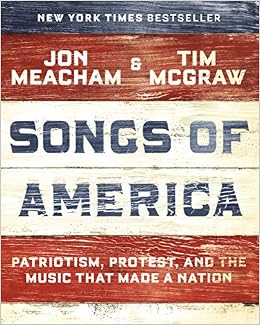
Songs of America (Meacham & McGraw)

Songs of America: Patriotism, Protest, and the Music That Made a Nation, Jon Meacham and Tim McGraw (2019)

Not really a review, just reminding myself about some of the details of what I read ...

A couple months back, I got to see Tim McGraw and Jon Meacham at The Beacon Theater. I put the names in that order because, frankly, I had no clue who Meacham was, and I was going to see and hear Tim McGraw. Yeah, it wasn't that kind of show. Not that it was bad. It was basically an evening of talk and song that promoted their new book, which was conveniently on sale in the lobby. I got my copy from the library. Twice -- there was such a demand that I couldn't renew it without waiting again.

The book analyzes how music has influenced and been influenced by events in American history, going back as far as "The Liberty Song" written by John Dickenson in the years before the first Continental Congress.

Meacham is a presidential biographer, and that experience is on display here, but as he acknowledges in the closing pages, people want to hear Tim sing more than Meacham type. During the show, I didn't think Tim sung enough, and he deferred quite a bit to Meacham during their discussions. So much so that when the two of them appeared on The Late Show, Meacham did most of the talking, and Tim didn't even get to sing.

So Meacham wrote the narrative, which is offset by boxed text where McGraw writes his thoughts and memories concerning specific songs and people who were discussed in the main text. There wasn't enough of that for my taste, but what are you going to do.

I guess it's a case of enjoying the book I got even if it wasn't quite the one I wanted.

Saturday, August 10, 2019

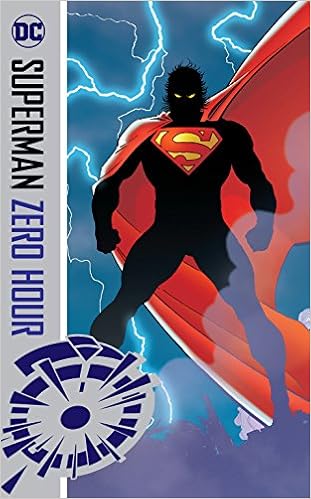
Superman: Zero Hour

Superman: Zero Hour, Writers: Dan Jurgens, Karl Kesel, David Michelinie, Louise Simonson (1994)

Not really a review, just reminding myself about some of the details of what I read ...

I vaguely recall when Zero Hour happened in DC Comics, but if I had to guess it was back in 1994, I would have been way off. I remember the bit where every comic was Issue #0 for that month, but I wasn't regularly reading any comics by that point. This was also sometime after the Doomsday plot line where Superman died and there were suddenly four new Supermen. Again, I never read that story line, but it did make it into the papers and get discussed at a convention. Plus, later on, I listened to an audio presentation of it in my car. (Back in the days of the 50-mile one-way commute.)

The stories up front are connected because of some time storm happening, which causes characters to shift universes. This allows for Batman to appear numerous times, as various incarnations that have been published over the past 80 years (or 55 or so, at that point), and none of them had a broken back. (Note: Bane story line, which made it into the movies. I actually did read some of those books way back when.) Also of interest, Superman has long Hercules-like hair and Clark Kent wears it in a pony tail. That just seemed weird. He and Lois were an item (at least in some realities), and she's also involved with Superman, but no one asks.

Oddly, the core of the Superman portion of the book is taken up by a lengthy piece about a childhood friend of Clark's, one we've never met before, who was born on the same day as Clark (in the post-Crisis DC Universe, Kent was basically hatched on Earth, not rocketed to Earth as an infant or baby), and who always played second fiddle to Clark. Clark's powers didn't manifest until he was nearly an adult, so there was no need to hide his powers when he was younger and feign weakness. He was basically the Olympian ideal, so his competing against humans was really cheating, except that his poor shmoe of a friend, who never had a clue about Clark's extraterrestrial ancestry, still feels cheated, and turns into a jerk, and then into an evil jerk, then super-powered evil jerk.

Side note: the character was so forgettable that I forgot him a week later -- and he wasn't mentioned on the summary pages I found online because he wasn't part of the overall theme of the book despite being such a major part of it. The story should've been one issue, possibly two if you really wanted to build him up. Four parts? And Clark is that stupid throughout, despite Lois stating the obvious.

After all that were a couple of Superboy stories, with his "tactile telekinesis" on full display. Okay to read, and a pleasant distraction after that Superman story. Closing out the book were two stories with Steel, who I'd forgotten about. I knew in the aftermath of Doomsday, one of the comics published was The Man of Steel, but I never saw it. When they first showed the character, I thought it might be a robot or android. Then they showed a villain that looked enough like Clark to make me think that it was a clone (until I realized it was an unrelated villain, and not Steel). The background in the #0 issue refreshed my memory of whatever mention the character got in the audio drama.

I assume Superboy and Steel were included for completeness, but they seemed disconnected to the rest of the book.

That'll probably do it for graphic novels for a while, although there are Manga Classics Illustrated at the library which look interesting (but a little too thick to carry around), and I found a Classics Illustrated book of Romeo & Juliet in my garage that I don't remember acquiring -- or leaving in my garage.

Note: Collects ACTION COMICS #0 and #703, ADVENTURES OF SUPERMAN #0 and #516, SUPERMAN #0 and #93, STEEL #0 and #8, SUPERMAN: MAN OF STEEL #0 and #37 and SUPERBOY #0 and #8.

Sunday, July 28, 2019

Superman Adventures, Vol 4 (Millar, Michelinie, et al)

Superman Adventures, Volume 4, Writers: Mark Millar, David Michelinie; Illustrators: Terry Austin, Aluir Amancio, Neil Vokes, Mike Manley (2018)

In the past, I've complained about graphic novels that weren't novels, but rather collections of comics and sometimes not even cohesively or coherently so. And yet I continue to pick them from the library shelves. This one isn't a novel, and I'm absolutely fine with that. It is what I expected it to be: a bunch of one-off adventures, each self-contained. Basically, it's like watching a three-hour marathon of the show, which, by the way, I have never seen. (I should rectify this.)

Note: I have seen all of Justice League and Justice League Unlimited, which has the same animation, voice actors and a couple of story lines, so I am familiar with it. And because of that, Lobo sounds in my head like Robert from Everybody Loves Raymond (Brad Garrett), and Kalibak sounds like Worf from Star Trek: the Next Generation (Michael Dorn).

Fun quick read for the train, even if I got some amused looked from people watching this gray-hair distinguished fellow reading a comic book. Great appearances by Doctor Fate and Batman.

Note: I found a reference that says the stories came from Superman Adventures #26-35.

Saturday, July 27, 2019

The Way Station (Simak)

The Way Station, Clifford Simak (1963)

Not really a review, just reminding myself about some of the details of what I read ...

I was assigned to a class that met in the library at Lafayette High School earlier this year. They had a shelf of books removed from circulation that were free to be taken. I didn't want to be greedy because these were for students. But on the other hand, some of these books, realistically, would never be taken. On of these was The Way Station, which according to the printing history was produced in 1988, and according to the final circulation card in the back was last taken out four times in 1994. After 25 years, I think I was safe in taking it, particularly considering that it was originally written and won a Hugo Award before I was born.

The only Simak novel I've read (I may have read short stories in old anthologies) was City, which I purchased from the Science Fiction Book Club way back when, on purpose, not as a mistake that was sent in the mail because I forget to send back the preference card. I still remember most of it after a few decades, so that says something.

This book was a little slow getting started, but a lot of older books seem to be that way, most likely because today's books seem to start en media res.

Enoch Wallace was a Civil War soldier. A hundred years later, he's still alive, which draws the attention of the government, including agent Claude Lewis. A number of the locals note something peculiar as well but for the most part keep their distance, except for Winslowe Grant, his delievers his mail. Enoch is the caretaker of a station used for intergalactic travel, similar to a network of Stargates except thirty-plus years earlier. Aliens and artifacts and packages pass through en route to other worlds. They also bring "deceased vegetation" because it known that the gatekeeper collects it. In actuality, Enoch takes the alien wood and gives it to Winslowe, who carved statues. He's curious but not too curious about the wood origin.

Interstellar travel by ship still takes months and years to accomplish, so this is a revolutionary system, and his is as important job, which he was chosen for by an alien Enoch calls "Ulysses". Ulysses, who doesn't object to that moniker, is a member of the galactic council and sort of a supervisor, who checks on from time to time on Enoch. He always visits for the coffee.

Enoch worries for the fate of the world and the coming war, but it's basically the fear from the Cold War of nuclear annihilation, not a war from space. However, he does fear that man's behavior toward man could keep it from entering into the Galactic confraternity.

Other characters of note: Lucy, a deaf mute who has a sensitivity that allows her to operate an alien mechanism (a pyramid of spheres that suddenly lights up) in a way that baffles Enoch. Also, her father, Hank Fisher, who doesn't trust Enoch and assumes he has the devil in him. Finally, there's Mary, an interactive hologram (the shadows) of someone from long ago, who, to be honest, I'd forgotten about by the end of the book, when she came back. I'd originally thought the scene a hallucination rather than a hologram. The man was lonely after all.

I took a picture of my cover because it was better than the images online. It shows a glowing creature by a grave, but it isn't a ghost. It's a "Hazer", which is what Enoch affectionately calls Vegans, those from Vega, not the ones who don't eat animal products. And it's visiting the grave. It hasn't risen out of it.

Overall, an enjoyable book and one that obviously seeds so much of sci-fi that is to come. This is a little bothersome in that if so much sci-fi owes a litle something to this book, why haven't I heard of it before? Maybe I have and forgot that I did? It's not like I didn't know the name. Still, it's curious.

Wednesday, July 24, 2019

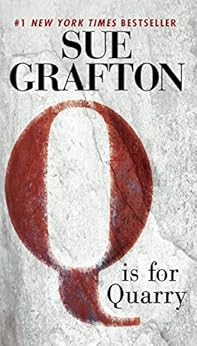
Q is for Quarry (Grafton)

Q is for Quarry, Sue Grafton (2002)

Not a review, just reminding myself about some of the details of what I read ...

Q is the 17th letter of the alphabet, so this is the 17th novel in the series, making it the longest series I've read, by far. (I've read maybe a dozen Doc Savage novels, and I should get back to those.) This entry is a little different in that it deals with an actual unsolved murder, although he details were fictionalized, and in the book, the case gets solved. It does have information at the end in case anyone with information wants to come forward.

Kinsey Milhone gets hired by Con Dolan, an old cop from the series who is currently on medical, and Stacey Oliphant, a retired cop in ill health. Those two deserve each, and they each watch out for the other's bad habits. Years ago, they were the officers who found the body of a Jane Doe in a quarry in Lampoc in Santa Barbara County. Not only was the murderer never caught but the body was never identified, even after cross-checking with missing persons. They want to take one more pass at it. And they have a suspect in mind to start with, who was involved in another case which may or may not be related. A lot hinges on a stolen-then-abandoned red convertible in the small town of Quorum, and some abandoned real estate.

There's also more information about Kinsey's mother from another aunt. A little bit of soap opera to offset the hopelessness of the case. I don't know if it's leading to a future reconciliation with the family after decades on her own or not. It drags, but that's the pace that has been set, and to suddenly resolve it would be extremely odd, unless she were to investigate the murder of someone in the family she just met. (I have no idea if this is coming or not in a future book.)

I'll be reading "R" just as soon as I get rid of some of the printed material in my house. Plus other library books pop up occasionally.

The Mists of Cairn Gorm: A Tale of the Am Fear Liath Mor (Povey)

The Mists of Cairn Gorm: A Tale of the Am Fear Liath Mor by Jennifer R. Povey, J.W. Harp (Illustrator) (2026) (Not a ...