Saturday, July 31, 2021

ANALOG PLUS 50: Analog Science Fiction/Science Fact July 1971

ANALOG PLUS 50: Analog Science Fiction/Science Fact, July 1971

The seventh issue in my Analog Deep Dive. For anyone finding these reviews, my purpose is two-fold: enjoying some "classic" sci-fi, and looking for stories that I think could be adapted for TV broadcast since so much of what shows up on anthology shows is rough to awful.

At some point, I'll stop numbering, but probably not until I do this for at least a year. If I do this for a year.

In this issue:

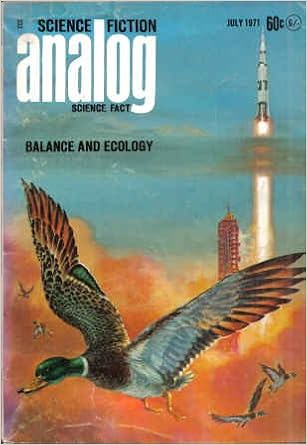
The Editorial: "Balance and Ecology", by John. W. Campbell. John starts by talking about the Saturn V rockets being launched from a nature preserve and the animals don't seem to mind this. Or at the very least, the people that designed these launches didn't mind it. That said, everyone in the press there has to be kept a large distance away. As it is, everyone will become temporarily deaf as the sound of the rocket launching in person (as opposed to televised) is louder than humans can comprehend.

John finds the arguments against the SST silly, as animals ignore the shock waves as they would ignore thunder, thanks to eons of evolution. This leads into balance problems such as the use of DDT vs cases of malaria. Using DDT is Ceylon caused damage to bird eggs and oxygen in the ocean. Not using it caused 2.5 million deaths due to malaria. Which side do you think people would come down on? Likewise, there were too many elephants in one place in Africa for farmers to grow food. Rather than euthanize some of the elephants, they were herded onto a preserve which couldn't sustain them. The pachyderms knocked down trees and stripped them of every piece of nourishment leaving only what could feed termites. It was an ecological disaster that wouldn't be easily remedied.

Sadly, nothing has changed in 50 years where we will still do things for show and because it "feels" right or it "sends a message" that "we care", and then the longer-term effects bite us in the buttocks.

Short Novel: "Zero Sum" by Joseph P. Martino, with an illustration by Kelly Freas, showing a bunch of marble-shaped spaceships in a spherical formation being attached at teardrop-shaped ships, while two men in uniforms (and mohawks) stand on a platform and watch. The caption reads, Any intelligent race will fight on for justice -- particularly when they know they're winning steadily... Until they find they've bled to death!

Commander Arnold Johnson is the Tactics Officer who calculates the best strategy and even using polyhedral dice to add a random element into his decisions, making them harder to guess. The Terrans are at war with the Khorilani, who seem to be an odd race that don't press their advantage or use the best strategies. As a result, Terrans tend to do better than they hypothetically should.

The Terrans learn more about the Khorilani when they take over a mining colony where everyone had committed suicide. They also find a ship where everyone has committed suicide, which they attempt to secure.

Johnson finally figures that they are a group-think culture where individuals are disposable but things, such as ships and planetary resources, have value. In both war and negotiations, the Khorilani were operating from a different set of principles and perspective. Neither side was likely to yield in the war because the way each side calculated a successful campaign, each side thought they were winning.

I don't know how long something has to be to be considered a "short novel" instead of a Novella of a Novellette. This could easily be adpated to television. The sets could be basic and generic. In fact, the Khorilani quarters were literally identical, so they could be reused. THere's enough action and enough cerebral goings-on to keep most happy. The crews can be diversely cast.

Short Story: "The Man with the Anteater" by F. Paul Wilson, with an illustration by Kelly Freas, showing an alien looking anteater in the foreground, with a circle of space and stars in the background, along with a sun with a big dollar sign. An alien landscape is also in the background. The caption reads, Anyone who keeps a pet anteater in a stringently limited society is obviously a crackpot. But some crackpots have highly methodical cracks in their pots ...

Joe Finch has an anteater (ant-bear) named Andy. Some think him a reactionary hero moving at his own pace, and other thought he was stupid, thick-head, etc. Finch wanted to manipulate Chief Adminstrator of Earth, Arthur Gordon, a social idealist or power monger, who likely wanted to manipulate Finch. He wants to promtoe a "right man for the right job" society where people serve in the capacity that they are best fit for. Finch, of course, undermines this because it doesn't take into account what the person might want to do.

You can guess who wins. TV writers would eat this story up. Actually, now that I type that, this story would probably only work if the writers now could control themselvs from tampering with it too badly. Their message is already there but sometimes they can't helpt themselves with the sledgehammer

Science Fact: "Spacewar" by Albert W. Kuhfeld. There is no image. The caption reads, "For nearly a dozen years, I've been trying to get an article on the remarkable educational game invented at MIT. It's a great game, involving genuine skill in solving velocity and angular relation problems -- but I'm afraid it will never be widely popular. The playing 'board' costs about a quarter of a megabuck!"

This is an nteresting account of the "Wayback Machine" because the game described could probably be coded by high school students to play on any household PC -- and probably could've been there 30 years ago! It's two spaceships flying at each other firing a limited supply of missiles, which not being dragged into the sun in the center of the board. And you didn't have to solve any math problems -- kids could pick it up pretty quickly just recognizing the movements of the ships. It was a fun read.

Novelette: "A Little Edge" by S. Kye Boult, with an illustration by Vincent di Fate, showing some retro-futuristic biplanes entering a battle with scaling winged creatures with two very alien-looking creatures with claws and taloned feet, and spears. There are more flying from a circular object in the background. (It looks like a moon, but that wouldn't make sense.) The caption reads, "There can be situations in which War is the only possible answer -- and Peace negotiations completely impossible. Where annihilation of the enemy is the only answer--"

Another war story but this one one a planet with mountains and jungles and islands in mud seas. Baron Amarson leads a group of men (no cubs here) into battle against the Drak using the newest inventions of Ambassador Theiu of the River People to the south. The new flying machines can rapid fire darts to take out the enemy. The mission is to test out the equipment. They fly across the mud sea and encounter more Drak than they expected and they have to fight their way out of there and back home.

This could make a decent TV story if they spent money on the budget, and if they didn't try to make this a story about colonization of new planets, which it isn't.

Serial: "The Outposter" by Gordon R. Dickson, part 3 of 3. Conclusion. "Things are seldom what they seem" and no one ever suggested that Man is the only intelligence to use bluff. But it takes more than a little guts to try to outbluff a race of spacefearing pirates!
I'll get back to this later. As it is by Gordon R. Dickson, I will definitely get back to it.

Short Story: "Poltergeist" by James H. Schmitz, with an illustration by Kelly Freas, showing high cliff walls in the background and a tree and a person being blown over in the foreground. The caption reads, "Any power -- any talent -- anything can be used for good or evil. Sometimes only destruction can be good."

This is another Telzey Amberdon story. (That's two in two months, and the fourth or fifth since January.) This one takes place when she'd only known about her Psi abilities for a few months. It takes place on the bay of a lake on Orado. Telzey finds a man lying face down in the sand, and he warns her away. Immediately, some force tries to kill Telzy with an avalanche. Her boat is wrecked and she's stuck there. Dal Axwen believes he is being haunted by something that wants to mock him and then kill him. This he believes but he doesn't believe is Psis or mind-reading abilities. Go figure.

It's not a hard guess to realize that the man himself is a psi, and the poltergeist of the story is his own subconscious, which Telzey is forced to deal with.

Short, but interesting. I don't know that there's enough for a televised story, but it definitely would be cheaper than many others to put on screen. Out of curiosity, I checked and there were many stories in the years before "Telzey Toy" in January 1971. In fact, many were collected and repacked by Baen Books in the early 2000s. This might be something worth looking into.

The Reference Library , by P. Schuyler Miller.
There's an Australian Science Fiction Index, Nightmare Age, edited by Frederik Pohl, which contains one story that I actually remember reading in high school, "The Marching Morons", which was in a different collection, Chronocules by D. G. Compton, and One Million Tomorrows, by Bob Shaw.

Brass Tacks: Nothing much of interest. There was one two-column letter to which John had a three-column response

Unlisted: "The Lost City of Ledtintell". There's a quick three paragraph story about the ruins of a 22 billion year old structure to accompany the illustration on the next page. This is followed by the reveal that it is a photo of needles of crystal growth of lead-tin-telluride (check the title again) taken with an electron microscope.

Honestly, that set-up could've led to something.

On to August, and whatever else is in the TBR stacks in Kindle, iBooks, and the physical nightstand.


Sunday, July 25, 2021

Anger is a Gift (Oshiro)

Anger is a Gift, by Mark Oshiro (2018)

(Not a review, just some notes to help me remember the things I've read. But written this way because it's the Internet, and some people will stumble across this page.)

A few starter notes:

First, this was a book group monthly pick.

Second, I didn't recognize Mark Oshiro's name until I read the bio at the end of the book and discovered he's the Mark of the Mark Does Stuff blogs. Why this matters is that it is possible that I've met him at a con. I recall "Mark Does Stuff blogs" mentioned in the program of a sci-fi con from a few years back. (I could say that there was a ping of jealousy there at the thought of how many "mrburke" blogs there were at the time, but I don't review the latest anything nor have I ever interviewed anybody.)

Third, if this hadn't been a book club pick, I might've stopped about a third of the way through the book.

Fourth, with topics like this, I prefer nonfiction, or at least something based on a true story. (Licenses may be taken.) The reason for this is with nonfiction, when something "over the top" occurs, you think "Wow! That happened!" With fiction, you may just roll your eyes and say that it doesn't work like that. Granted, much later in the book, it gets explained why it does work like that, but I would've bailed before that explanation if I hadn't wanted to participate in the group chat.

Finally, in the after notes, we find out that this was originally conceived as a science-fiction trilogy. I don't know about three books, but one might've been enjoyable. In this case, the "over the top" nature of some of the scenes would've worked well in some dystopian future city, with shades of "this is happening now". There isn't much more I can say about this without throwing out spoilers, so I won't.

The story revolves around Morris Jeffries, Jr, known as "Moss". We meet him and his best friend Esperanza returning home on BART where they meet Javier. Moss and Javier hit it off and start dating. Moss lives alone him his mother ever since his father was shot by cops outside a store up the street from his house. Esperanza lives with her adoptive white parents. Javier has been alone with his mother since his father just left. Much of the rest of the cast introudced in the first couple of chapters reads like those inclusion checklists editors say not to do. They all get along great and this has to be the most agreeable student body to ever attend a run-down, falling apart, underfunded public high school. About the only contrarian opinion was a mention of a student who wouldn't date a bisexual and get rounded derided as a dinosaur. As a teacher, this doesn't particularly ring true, particularly around the time that this was being written. (Also, about that time, contrary to the text, most of the staff was aware what Tumblr was and kept tabs on what social media platrforms the students used, not that the followed any on them.)

While young romance and social protests are important in the first few chapters, it then moves on to police brutality and police in the schools. One incident leads to metal detectors being installed, but they don't act like any metal detectors who likely have ever encountered. This leads to one of those "over the tops" scenarios that had me rolling my eyes. Maybe with a little more setup, it might've been different. I've worked at high schools with metal detectors for the past dozen years or so. The first one, coincidentally, got them installed after a small riot occured in the school when officials from the district were present. Obviously, they were nothing like the ones depicted in the book. They weren't even permanent. The were portable who they could be put away before the cafeteria got used from lunch. And while school safety ran the equipment, they weren't NYPD and they couldn't do anything without someone from the Dean's office or security there to oversee it.

Anyway, it was an interesting story of what some people have working against them and what lengths they have to go to just have a protest to get things changed. The police respond to charges of police brutality with more brutality. By making it a YA contemporary novel, i.e. set in the real world, only small victories are possible with the hope of bigger changes to come.

Thursday, July 15, 2021

An old Year-end Review for 2004

While cleaning up my hard drive, I found files where I kept track of the books I read for a given year. Someone had given me the idea (back in the 90s, I believe) to open a text file, and add the name of the book I'd read. What follows below looks like an "end of the year" post made to a bulletin board somewhere. It's past my time on Usenet. Many of these may have appeared elsewhere in this blog, if not the entire post itself. I'll post these files one per month.

It looks like 2004 was a banner year for me, but given that many were Lemony Snicket books, it's a little less impressive.

2004: The Year in Review

2004 -- It was a year of catching up on a number of series books. And it was probably the most books I've read in a long time (even if 12 of them were Lemony Snicket)


The Return of the King, J. R. R. Tolkien
The Broken Blade, Ann Marston
The Bad Beginning, Lemony Snicket
The Reptile Room, Lemony Snicket
The Wide Window, Lemony Snicket
The Miserable Mill, Lemony Snicket
The Austere Academy, Lemony Snicket
Cloudbearer's Shadow, Ann Marston
Rogue Pirate, John Gregory Betancourt
The King of Shadows, Ann Marston
The Ersatz Elevator, Lemony Snicket
The Vile Village, Lemony Snicket
The Hostile Hospital, Lemony Snicket
The Carniverous Carnerval, Lemony Snicket
Let Freedom Ring, Sean Hannity
Maybe (Maybe Not), Robert Fulgrum
The Slippery Slope, Lemony Snicket
The Unauthorized Autobiography of Lemony Snicket
Eats, Shoots, & Leaves, Lynne Truss
Tom Clancy's Net Force: Night Moves
Tom Clancy's Net Force: Breaking Point
The Kingdom of Infinite Numbers: A Field Guide, Bryan Bunch
X-Files: Whirlwind, (does it matter who it's by?)
Tom Clancy's Net Force: Point of Impact
The Grim Grotto, Lemony Snicket
Tom Clancy's Net Force: Cybernation (in this one, the title actually had something to do with the story)
Vulcan!, Kathleen Sky
Stars & Stripes Forever, Harry Harrison
Stars & Stripes In Peril, Harry Harrison
Stars & Stripes Triumphant, Harry Harrison


Also
Graphic Novels: (I don't normally get to read these, but I found a stack at the local library and went through them!)
Batman: Terror (good)
Tales of the Slayers (very good, it was worth picking rather than the Buffy books)
Batman: Child of Dreams (pretty good, but pretty long)
Spiderman: The Death of Gwen Stacey (excellent -- even for reprints)
Spyboy/Young Justice (ick)
Batman: The Arrow, the Ring & the Bat (good story, but the splash pages were annoying)
The family had our own little book club, with the Snicket series (so far) divided up amongst family members to be passed around. The Net Force books were a series that I received as a gift, except that the first book in the series wasn't there. Oh well. I picked up one of Harrison books at a book sale, and a friend told me he had the other two.

Sunday, July 11, 2021

They Were the Best of Gnomes ... (Wills)

They Were the Best of Gnomes, They Were the Worst of Gnomes: Tales from a Second Hand Wand Shop (2012)

(Not a review, just some notes to help me remember the things I've read. But written this way because it's the Internet, and some people will stumble across this page.)

Sometime before last Christmas, I was curious about gnomes, trolls and halflings because of a character I'd written a little bio about but had no story for. I was curious what was out there. So I downloaded a few free titles, including A Very Beechwood Christmas and Troll Hunter: Witch for Hire.

I also downloaded three books in this series. Now that summer is here, I started to read the first one. Unlike most books that I usually wait until I'm 10% into before giving up, I bailed at about 2-3%. (I actually went back for that extra 1%.) The writing was distracting, including some ridiculous footnotes to information that either should have been in the text or eliminated completely.

All that aside, it didn't grab me enough to overlook the problems, which I'll do if I enjoy the story being told. That's why I try to use 10% as a threshold (expandable to 20%, if it's on the bubble). This one just didn't do it for me.

If anyone who randomly finds this page in a search result wants to let me know with as little spoilers as possible what would be in store for me if I read on, I might reconsider. But until then, I have a large TBR pile, particularly with ebooks, so I'll move on.

Saturday, July 10, 2021

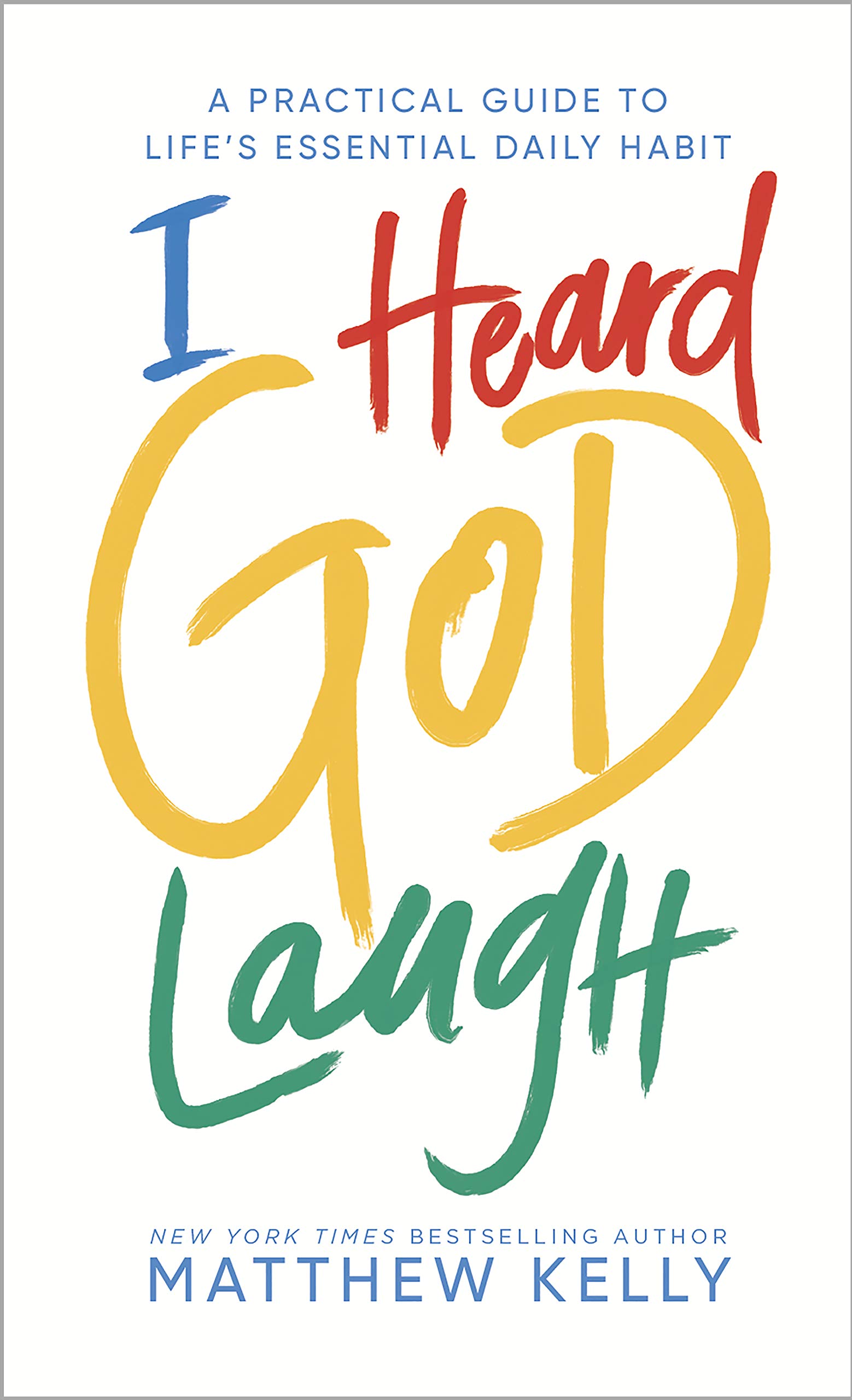
I Heard God Laugh (Kelly)

I Heard God Laugh: A Practical Guide to Life's Essential Daily Habit by Matthew Kelly (2020)

(Not a review, just some notes to help me remember the things I've read. But written this way because it's the Internet, and some people will stumble across this page.)

When I saw the title, I thought of the old joke about telling God your plans and hearing God laugh. The author references this later in the book.

This was an inspirational book that was given to me one Sunday on the way out of Church. I saw the title but didn't actually pay attention to the subtitle. So it didn't turn out to be what I thought it might be. Rather than inspirational stories about life, it was a detailed guide to daily praying. Nice to read, even while floating on a tube in the pool on a summer morning, but not much more that that.

Will I take this to heart? Time will tell. Maybe as my life changes. Maybe I'll plan out the rest of my life first, and listen for the response.

Wednesday, June 30, 2021

ANALOG PLUS 50: Analog Science Fiction/Science Fact June 1971

ANALOG PLUS 50: Analog Science Fiction/Science Fact, June 1971

The sixth issue in my ANALOG PLUS 50 series. For anyone finding these reviews, my purpose is two-fold: enjoying some "classic" sci-fi, and looking for stories that I think could be adapted for TV broadcast since so much of what shows up on anthology shows is rough to awful.

At some point, I'll stop numbering, but probably not until I do this for at least a year. If I do this for a year.

The endo fo the month caught up with me before I finished (what with school ending and all). I shall finish it presently. But I'm posting a partial list.

In this issue:

This will be updated shortly.

The Editorial: "Bargain Spacement", by John. W. Campbell. John watched the Apollo 14 splashdown on color TV and it was astonishing. The pictures were phenomenal because the capsule re-entered the atmosphere almost exactly where it was expected to be. And it comes down to the human factor.

Apollo 13 might have been an argument for an unmanned program, and yet it is a better argument for a manned one. It was the men onboard who took care of the situation, with help from the people on the ground. Because of this, the mission wasn't a total loss. Likewise, some things went wrong on Apollo 14 that would have caused the entire mission to be scrubbed if the crew hadn't handled it. Software on the ground can overcome hardware problems in space if there's a man in space to fix it.

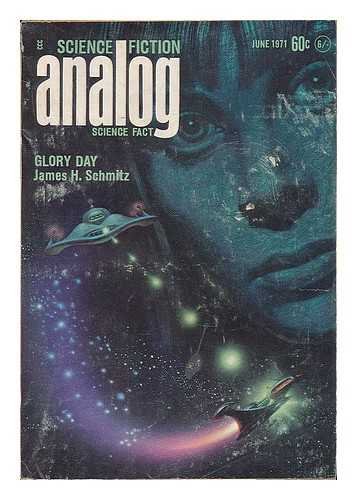
Novelette: "Glory Day" by James H. Schmitz, with an illustration by Kelly Freas, showing the large face of a man screaming, but there are circles coming out of his head, like it's psionic. In the forground on the facing page is a small image of a woman(?) covering her ears to block out noised. The caption on the next page reads, Telzey was in a spot, but she wasn't the type to howl about that. She got someone else to do it for her.

Telzey Amberdon is back! Again! And she's captured again and facing possible or proable death! Just a month later! This is my third Telzey story, and now I'm wondering if there were any in the period before I started reading. I'm also wondering how I didn't pick up on two MAJOR spoilers mentioned above in the image and the caption.

Telzey and her friend Trigger, another psi, were on a space yacht when they were attacked. They woke up in a room with all there belongings. They were on Askanam, in the Balak of Tamandum (planet, "city", name of city). It's the city that Casmard, the owner of the yacht, is the Regent for. There is intrigue to be had as the temporary Regent plans to make Casmard abdicate, and Casmard fears that Telzey and Trigger will be killed in order to get to him. Likewise, the navigator Kewen is imprisoned, and will be thrown into the arena games. There is an attempt on the women's lives which would have killed non-psis, particularly ones not carrying hidden pistols.

It turns out that there are other psis on the planet with differing abilities who are free to use their abilities as long as it plays into the local culture and superstitions. One of them knows Telzey. He lets her know that he's planning on taking over, and she shouldn't interfere. Don't do anything. But like Bugs Bunny says, "I do-ed it!"

Joking aside, I enjoyed this one more than last month's, with the exception that the ending comes a little out of left field and isn't forshadowed at all -- except by the artwork. As far as filming this goes, if the other stories get developed for television, then there isn't a problem getting an hour out of this story. A lot of speaking parts with diverse roles.

Short Story: "The Swan Song of Dame Horse" by Te Thomas, with an illustration by Leo Summers, showing am explosion (most likely figurative) coming from the back on a man's head. The man has his hand at his own throat. There is a man in the background smiling, holding up a bottle. Over that man's head are the letters P.V. The caption reads, Heorin, more than any other thing, is the cause of the collapse of our great cities. But there might be a permanent cure!

Angie Grecca has a herion habit that he manages like clockwork before things get bad enough to make him careless. However, when he shoots up, nothing happens. He believes he was sold a bag of sugar. So he goes to another dealer and buys more. Same thing happens. He can't get a fix and starts to crash. He decides that he's going to turn those two in as crooks because he spent a lot of money for sugar. He winds up at the hospital to detox, and he's not alone. And the morphine isn't doing much to help him.

Angie gets picked up by a "George Raft" type mafiosa who is going to drop Angie in the river. Angie explain what happened. George doesn't buy it but he listens long enough that he lets Angie investigate. He discovers that there's a chemist named Dr. Linden Grey who has come up with a virus, or more correctly a pseudovirion, or P.V., that cab be spread to illegal herion fields which will add a chromosome into the user with will eliminate anything in the morphine family in the body.

This could be filmed except for the slides of Grey's vacation, since no one does that any more. Likewise, they'd need a better reference than George Raft.

Science Fact: "Alpha-wave conditioning" by K. C. Keefe. There is no image. The caption reads, "Or how to "turn on" without drugs, or twenty years practice at Zen meditation!"

There was a bunch of stuff about Yogi and Zen and medication and alpha waves. It didn't hold my interest and I skipped to the end about halfway through. There was one interesting passage that I took a screenshot of that had this summary: the Yogi attempts to withdraw himself from the world of illusion (Maya) for he believes the sensory world to be illusory. The Zen meditator places himself totally within the world and maintains sensitivity toward all of the data presented to him for he blieves that there is no illusion, and that all is real, and that enlightnmnet means to have the entire personlity fully awake to reality. The average subject in a "normal" state of consciousness is one of presonal relevance: if the stimulus isn't going to "do" anything (to me or for me) why pay attention to it?

Novelette: "The Habitat Manager" by S. Kye Boult, with an illustration by Michael Gilbert, showing two very alien-looking creatures, one is down on all six legs and it's head is shadowed, the other is upright (though possibly "rearing up") with four limbs (with 3 starfish-like fingers) and a huge mouth of many small teeth. The caption reads, "They were very helpfully seeing to it that The Scientitst found exactly what he expected. Wasn't that what he'd sought to find?"

A very odd, alien story. Enjoyable, but overly long and unnecessary complications. At the center of it is the story of a alien lander (from an Earth-like planet, presumably) touching down on the planet, but it fails to work. Now, a second lander is on the way. The planet is inhabited with sentient Trees and Bushes and Mosses and Bacteria and Grazers and Runners, along with really alien creatures like a Communicator and the Habitat Manager, who is a flat rectangular piece of living matter. All the creatures on the planets are moving out of the path of the lander's orbit and from the crater where it is supposed to land. Not because they are hiding, but because they think that this is the way the Scientist who sent the experiment expects it to be. So they are providing him with the answers that he is looking for.

This in itself is an amusing idea, but it gets bogged down in the details. Added to the being and the end of the story, the H.M. is getting ready to undergo mitosis, which adds nothing to the story, except for some comments early on that one might mistake for discussion on the abortion debate that would hit the Supreme Court two years later. However, I think I could be reading too much into that.

Were this picked to be filmed, I would strip it down to the story of a lander coming to the planet and all the flora and fauna hiding are hiding from it. Add it the twist that they think they are actually helping. The costume would be ridiculous (or ridiculously expensive), so play it for laughs and leave out the mitosis subplot and possibly the herd of Grazers getting too close to the landing crater only to be chased off by the Runners.

Analytic Library: I recognized the names of the stories from February and March, but for many of them, I've have to go back to my reviews to get the specifics. Well, I guess that's the main reason I keep this blog. The serial got the top slot, followed by Polywater Doodle in February and The Missing Man in March.

Short Story: "With Friends Like These..." by Alan Dean Foster, with an illustration by Leo Summers, showing a farmer behind a plow being pulled by a horse being approached by insect-like humanoids that came from a nearby spaceship. The caption reads, "It is not necessarily ture that the ideal friend is some strong entity who will fight effectively against your common enemy. That needs qualifications!"

There's a Federation in space and it's at war with a culture called the Yop. The aliens are coming to Earth for help. Earth has been locked under a protective shield for tens of thousands of years, since the time of the Old Empire-Terran Wars, when the Earth wouldn't get in line with the rest of the Empire. Since that time, the Empire has fallen, and the Federation has arisen. It turns out that the Terrans have not been idle, and have just been waiting for someone to turn off the shieldl

Serial: "The Outposter" by Gordon R. Dickson, part 2 of 3. "Bluff is well-known as a major factor in winning at poker. It's at least equally important in business and diplomatic deals. But it gets a little tough when your oppositie number is an alien whose psychology and physiology you don't know!"
I'll get back to this later. As it is by Gordon R. Dickson, I will definitely get back to it.

The Reference Library , by P. Schuyler Miller.
There is an intro about Stanislaw Lem, whom I haven't read (to my knowledge), followed by a discussion of the Science Fiction Book Club, which I used to be a member of (in particular, they would release hardcover editions of books only available in paperback). Books reviewed include: Gadget Man by Ron Goulart, The Year of the Cloud by Ted Thomas and Kate Wilhelm, Ringworld by Larry Niven (which I've listened to on cassette), The Year of the Last Eagle by Leona Train Rienow with Robert Rienow, and a couple of checklists.

Brass Tacks: was absent this month.

On to June, and whatever else is in the TBR stacks in Kindle, iBooks, and the physical nightstand.

Tuesday, June 29, 2021

Amora: Stories (Borges)

Amora: Stories by Natalia Borges (2015)

(Not a review, just some notes to help me remember the things I've read. But written this way because it's the Internet, and some people will stumble across this page.)

The cover says "Natalia Borges Polesso, translated by Julia Sanches".

This book was part of Amazon's World Book Day 2021, when I downloaded 10 books. Like in previous years, it is likely that I won't read more than 2 or 3 of them. I still haven't read most of the previous books. This one is from Brazil and is described as An exquisite collection of stories exploring the complexity of love between women.

I'm not the target audience for lesbian literature nor is it something that I would think to seek out. Maybe if a friend gave me a book and asked my opinion, that would be a different matter. Anyway, I didn't let the subject matter prevent me from cracking the electronic cover.

I got about 30% of the way through the book. Maybe I'll come back to it when I'm between books and the file is still on the app. I don't know. I might have gotten hooked had it been one long narrative, but of the first bunch of short stories, none of them grabbed me. I don't know how many were pseudo-autobiographical but it was obvious that Borges was drawing on her past experiences.

If I had one problem with it, it was the continuous stream of thought and text. It may have been an appropriate writing style but a couple of stories just seemed to run on to me and were a drag to read.

Anyway, I gave it a shot, and decided to move on. If you found this page while surfing the Internet, don't take this as anything more than one person's opinion.

After this, I'm reading more Sherlock Holmes and Analog and there's another book club book coming up.

Thursday, June 24, 2021

Learning to Breathe (Stephens)

Learning to Breathe by Robin Stephens (2021)

(Not a review, just some notes to help me remember the things I've read. But written this way because it's the Internet, and some people will stumble across this page.)

A short collection of poetry that I found when the author's spouse posted a link on free ebook board. I don't read a lot of poetry, but I made it all the way through and I didn't hate it. That's saying something, I guess.

I don't particularly care for free verse with no apparent meter or rhyme or reason. Okay, the poem's do have reasons for exisitng, but I couldn't always figure out the feeling or emotion behind them. And after reading the description on the Amazon page, I think I missed out on a bit.

Tuesday, June 22, 2021

Kings of the Wyld (Eames)

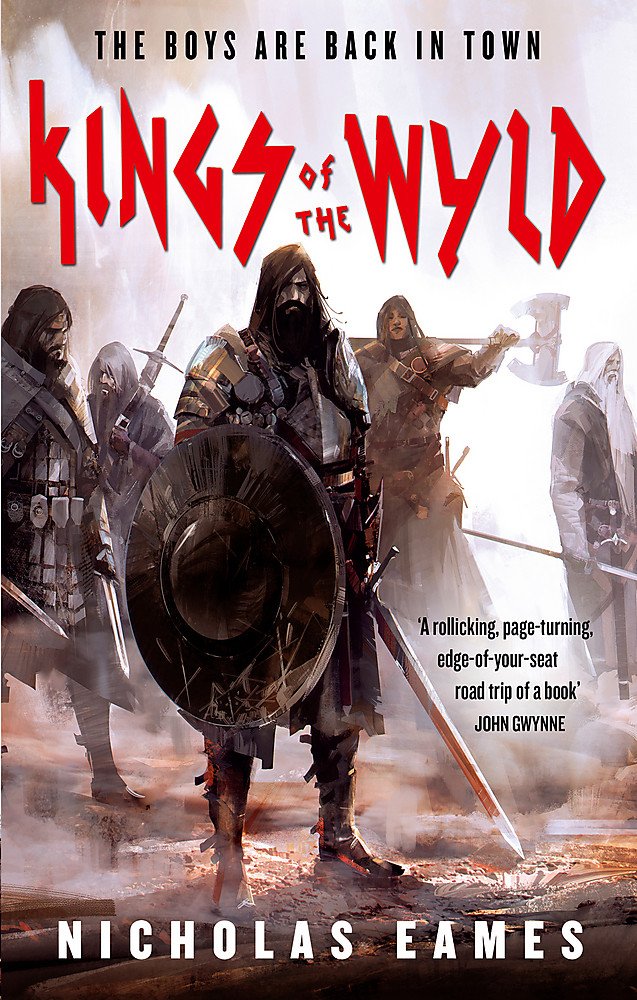
Kings of the Wyld by Nicholas Eames (2017)

(Not a review, just some notes to help me remember the things I've read. But written this way because it's the Internet, and some people will stumble across this page.)

The one thing that absolutely kills me is that this is a first book. There's a lot that went into this. This book was recommonded at a recent virtual convention (I believe it was a panel at Balticaon) when someone asked about humorous books. I like humor.

That said, this book is half humor and and half serious (and seriously dark, at times). The premise is amusing: that the monster-hunting parties of yore was akin to rock stars, and one of the greatest, Saga, has to "get the band back together". I wondered if this was going to be anything like Legend, and it was nothing like that. It went its own way. (I do notice that David Gemmel is listed on the Amazon page as an inspiration, along with the Hitchhikers Guide.)

Twenty years have passed and Clay Cooper now has a simple life spending his days guarding a town gate. He has a wife and young daughter and his killing days are behind him. One night leaving the ale house on his way home, he runs into the former Golden Gabe, leader (or at least "frontman") of Saga. His grown daughter joined a band and she's on the other side of the monster-laden Heartwyld in the town of Castia that is under siege by hordes from the last "druin". He needs to save her.

Clay is reluctant to go, but is convinced by his own daughter. They don't get very far before they are robbed of what they own (including his sandwiches and extra socks). You start to wonder if they're ever going to get where they're going.

The rockstar fandom metaphors came fast and furious, including having bookers to get gigs fighting monsters, and playing arenas (like modern collesiums) instead of hunting in the wild. There were points in the narrative that I wasn't sure that the author knew how he was going to get from point A to point B (and there was a lot of traveling in there). Most of the scenes seemed to sever a purpose other than to add an extra fight for the purpose of fighting. Likewise, added characters usually served some purpose other than being cannon fodder or the "price to be paid" to achieve something.

And unlike that Space Gladiator book, the people here healed in ways that fit the narrative without getting crazy with killing and reviving.

It could've been funnier, and some of the jokes were in places I don't find humor because the topic is either overdone or low-hanging fruit.

An enjoyable read, and I might find the sequel sometime.

Tuesday, June 15, 2021

An old Year-end Review for 2003

While cleaning up my hard drive, I found files where I kept track of the books I read for a given year. Someone had given me the idea (back in the 90s, I believe) to open a text file, and add the name of the book I'd read. What follows below looks like an "end of the year" post made to a bulletin board somewhere. If it's 2003, it's past my time on Usenet. Many of these may have appeared elsewhere in this blog, if not the entire post itself. I'll post these files one per month.

2003: The Year in Review

I know this is a couple of weeks late, but what the hey, I'll post it anyway.

Books read in 2003. Not many as I drove to work for most of the year, losing my prime reading time on the subway. (At bedtime, I'm usually too exhausted to get more than a handful of pages. Teaching will do that.) And getting 12 teaching credits took up a lot of time. (Textbooks are excluded from my list.)

Anyway:

The Lord of the Rings: The Two Towers, J.R.R. Tolkien. I was reading it when the year started, having never read it before.

Congo, Michael Crichton: Library sale book. Enjoyed it.

Mostly Harmless, Douglas Adams: Mostly crap.

Some "Buffy" book about Faeries by the author of Ghost Roads (another Buffy book I read a couple of years back). Actually, it was a good thing that I had read Ghost Roads because the author makes a lot of Buffy references, most of which I think I caught, from the show. When she tossed in a G.R. character reference, I was thrown at first. (Hey, that's non-canon stuff!)

Harry Potter and the Prisoner of Azkaban, J. K. Rowling: Probably my favorite one to date (though subject to change). I was totally taken in by this one, waiting for something so fricking obviously to happen and then have an alternate that I didn't suspect happen.

Destiny's Road, Larry Niven: Enjoyed it, very much. A world-building travelogue with a story wrapped around it so that you dont' realize that you have a world-building travelogue. (That's the way to do it.)

Kingmakers Sword, Ann Marston: First part of a trilogy I stumbled across a few years back. I found part I in the library. Great book, and it didn't matter that I know how some of it would turn out because I had read part II.

The Western King, Ann Marston: I had to reread it after part I. Still as good on the second read-through. Better, because I had part I as an intro this time.

(part three is on reserve at the library)

Holes, Louis Sachar: Saw the movie, so I read the book. I'll rank it as the best movie adaptation of a kids book that I've seen. Enjoyed the book, and appreciated that there was a little more to some of the characters in the book.

Star Trek: The Next Generation: Dyson Sphere: Thought it would be good, but I didn't particularly care for it. Like the use of Hortas, hated the story and the ending. Added Note: I didn't write down the author's name?

Harry Potter & the Goblet of Fire, J. K. Rowling: Didn't thrill me as much as the others. The "one year per book" rule was a little strained as was the Tri-Wizard Tournament. Could've been shorter.

Harry Potter & the Order of the Phoenix, J. K. Rowling: OK, I'm caught up with the Potter books now. Liked it better than four, but I thought that some of it was either forced or unnecessary.

The Harry Potter books weren't a re-read. They were a first read. I was late to the party with those. I was initially turned off by online friends who complained how Scholastic Books had overly "Americanized" the first book.

Monday, May 31, 2021

ANALOG PLUS 50: Analog Science Fiction/Science Fact May 1971

ANALOG PLUS 50: Analog Science Fiction/Science Fact, May 1971

The fifth issue in my ANALOG PLUS 50 series. For anyone finding these reviews, my purpose is two-fold: enjoying some "classic" sci-fi, and looking for stories that I think could be adapted for TV broadcast since so much of what shows up on anthology shows is rough to awful.

At some point, I'll stop numbering, but probably not until I do this for at least a year. If I do this for a year.

Overall, this one was a mixed bag, but maybe it's the novelty of what I'm doing wearing off. If this stops being fun and becomes more of a chore, I'll end it.

In this issue:

This will be updated shortly.

The Editorial: "Pollution Paranoia", by John. W. Campbell. There are three kinds of pollution: actual, political and hysterical. It's the latter two that prevent us from taking care of the first one, or any other problem. Grandiose solutions to non-existant problems (yes, there are problems, but not the PROBLEMS! the hysterical folks point out or the political folks want credit for "doing something" about -- like getting the naturally-occuring amount of mercury in the oceans, and therefore in the sea life like tuna, out of the water) divert resources from actual problems that could have long-term meaningful solutions.

One thing to keep in mind: It is impossible to cheat the Universe. You can balance the laws of the Universe, but you can't break them. The Universe will demand its due. You will pay the cost of time or energy, or the Universe will collect in the end (regardless of unconscionable injustice or evil oppression -- the Universe doesn't care).

Basically, we need good judgment and not paranoia.

Serial: "The Outposter" by Gordon R. Dickson, part 1 of 3.
I'll get back to this later. As it is by Gordon R. Dickson, I will definitely get back to it.

Science Fact: "Men to Mars" by Walter B. Hendrickson, Jr. There is an image of a Space Station Concept of 12-man space station by North American Rockwell's Space Division, Downey, CA. The caption reads, "With the current state of NASA's moth-eaten budget, the hardware for a Mars expedition is not being built. But that doesn't mean thinking and planning about the problem has stopped!"

This was a great read, even if all the dates have passed. You have to figure the windows of opporutnity can be recalculated, and the science may have improved a bit. Then again, for all I know, some of the suggestions may have been shown to be unworkable now that we've had people in space for over a year. It was also ambitious, given that this was printed in 1971, not long after the Apollo 13 incident. Given the lead time required in publishing a magazine, Apollo 14 might not have even launched yet when this was scheduled to be printed. Likewsie, the proposed dates for the mission were only a few years away, in the mid-to-late 70s. But should the need arise for a hard sci-fi setting for any story I'm writing (not likely), I might revisit this one.

Novelette: "Company Planet" by James H. Schmitz, with an illustration by Kelly Freas, showing a woman in a jacket the length of a minidress, walking in the midground, and an alien cityscape in the background. In the lower right, in the foreground, we see a seated woman (covered with tattoos or an elaborately designed skin-tight suit) with a tail. A muscular "man" except he has the head of some other kind of animal (flat head, long snout). There is a woman in a skimpy outfit standing with wild hair that appears somewhat floral. The caption reads, Telzey was generally competent enough to take care of herself -- and her enemies for that matter! But this time she was up against a very stacked deck indeed!

Telzey Amberdon is back, only four months after her first story. (At least, I think it was her first -- it was the first that I saw.) This time she's on the Company Planet of Fermilaur, which consists of a resort area and little else. The resort has a spa where body modifictions can be made, such as the ones shown in the image, or just lengthing the leg bones to make one taller (and then the follow-up procedures to adjust the rest of the body to match). Telzey is there at the behest of the parent's of a friend to convince the friend not to go through with any mods.

It is known that Telzey is a telepath, but not known that she is a psi, which isn't the same. Psis are much more powerful than simple telepaths. She's given a service guide named Uspurul (whom, in my head, I kept calling "Usurpul") to talk up modifications like they were modern time shares but also to get an idea of why she is there. There are things going on on Fermilaur that COS Services wouldn't want known, but what? (By the way, I went through the beginning again, and I'm not exactly sure what "COS" stands for, other than the Company.)

Telzey meets with Keth, an investigative reporter for a newscast service, who is always on the lookout for a story, but not there chasing any story in particular. Now the folks at COS have to worry that the two of them have been sent there to uncover what's really been going on.

Unlike the last story (SPOILER), there's only one Telzey in this story, so if she were played by twins in an adaptation of "The Telzey Toy", only one sister would be needed here. It would make as good a story for TV as the previous one, better, in my opinion. Plenty of speakng parts for a diverse cast. Solve the mystery, get the story, don't get killed before it's over, with a sci-fi backdrop.

Short Story: "Not Stupid Enough" by G. H. Scithers, with an illustration by David Cook, showing a stone statue of a bearded, bald man, with several birds (or bird-like creatures) on it. The caption reads, The fact that an alien's cursons violate the ethics of your people does not prove that they're wrong. It may simply prove they are, indeed, alien!

Novelette: "Culture Shock" by Perry A. Chapdelaine, with an illustration by Leo Summers, showing people in hooded cloaks in the foreground protesting. There's a sign reading, "Death to All Aliens" and another that looks like it starts with "GOD is". There looks like a fire or explosion happened in the background. The caption reads, A man may not be what he thinks he is -- but he can put a lot of effort into trying to be!

There was more going on in this story than I could keep track of or, honestly, wanted to. It didn't help that I fell asleep a few times in the middle of reading this one. Mankind has been visited by aliens from Epsion Eridan (aka Ran, which is not mentioned in this story). They are four feet high, six feet long and four-legged. They are obviously more scientifically advanced than us. There are people who don't want them here, and they are mostly in the GIMITI society: God is Made in Terrain Image. Then there's Dr. Michael O'Hara who is the director of Project Ozma X, which, despite the work it does, will have it's budget slashed by half very soon by the UN President Ownouchai. There's a Communications and Cryptographic (C and C) dept and a special Public Relations and Information (PuR) section. There are a bunch of people who are nonconformists, or nonconies who work for the government. And there's a credible assassination attempt against the Eridanians as they travel around Earth.

A little too much going on, and that isn't all of it. I might've enjoyed a short story based on this novelette. That said, just because I didn't "get it" doesn't mean that there wasn't a good "protect the alien ambassador" story that could be adapted out of it. All the elements for adaptation are there, except that the aliens would require good CGI or puppet work, or get modified into something that could be played by human actors of any particular type. I'd cut a lot of the government bureaucratic stuff, though, mostly because I wasn't particularly interested.

Novelette: "Peace With Honor" by Jerry Pournelle, with an illustration by Vincent Difate, showing a bare-legged, bare-footed man in an overcoat, swinging a sword. There's half a wheel on the ground (with a shadow) and a car heading toward a wooden covered bridge which turns into more of a steel trestle.The caption reads, Given infinite mobility, you have absolute immunity. But if there is a place you want to be -- thereby you're limited!

Politics and dirty tricks, set in a future with a United States and a "Co-Dominium" still in a Cold War with Russia. I'm not exactly sure what makes this science-fiction even with the type of dirty trick to be pulled, or the mention of Lunar bases (non-essential) and other places that could be out there or just someplace on Earth I'm not familiar with. I wonder how much of this some of stuff was known to the public 50 years ago. Now anyone who follows politics just assumes it, especially from the other side, if not from their own political allegiance (where they might excuse it and explain it away).

The longer one stands in office, the more corrupt they become, probably out of necessity, but also just out of tolerance for other corruption. And there's a theme of That's Just How It Is, and the country wouldn't last long under the idealist candidate who doesn't understand how the world works or how the game is played. A bit cynical, and then it gets close to home for the point-of-view character.

This could be filmed, though it's primarily men, and a bit dated and sexist, but some of the men in the room can be gender swapped to bring it up to date. But I don't think it would make a satisfying segment of a sci-fi anthology show unless something else were added in. And I wouldn't be one to presuppose that I could do better than Jerry Pournelle. In any case, I did enjoy the story for the intrigue.

The Reference Library , by P. Schuyler Miller.
Books reviewed include: More Issues at Hand by William Atheling, Jr (aka James Blish), The Universe Makers by Donald Wollheim, The Pulps: Fifty Years of American Pop Culture by Tony Goodstone, Tower of Glass by Robert Silverberg, Mutants by Gordon R. Dickson, Nebula Award Stories Five by James Blish (ed.), Index to the Science Fiction Magazines, 1969 (compiled by Anthony Lewis), Behind the Walls of Terra by Philip Jose Farmer, and Aliens 4 by Theodore Sturgeon.

Brass Tacks: Nothing much to think about except a few lengthy letters about the fallacies of the "Now Generation", which Campbell believes isn't all sweetness and idealism. It also wasn't an age group but a philosophy.

On to June, and whatever else is in the TBR stacks in Kindle, iBooks, and the physical nightstand.
Sunday, May 16, 2021

The Oracle Year (Soule)

The Oracle Year by Charles Soule (2018)

(Not a review, just some notes to help me remember the things I've read. But written this way because it's the Internet, and some people will stumble across this page.)

The was a book group book. Yes, I've somehow become part of a book group.

The book follows Will Dando who becomes known as "The Oracle" because of a Site he operates (it's refered to with a capital S) where he lists some predicitions which come true. Will had a dream where he was told 108 predictions. He writes them in a notebook, but he can't forget them, even after he burns the notebook.

Will has a friend named Hamza who helps him operate the site and sell some of the predictions for more money than they know what to do with. Some of the predicitions seem like nothing, other than obscure bits that will prove to people that his predictions will come true. But after a while, they start to come together in a way that shows that they're interconnected, and Will is afraid what the consequences will be. He can't seem to pull the plug on the Site, and starts to feel that the Site is controlling him, despite his free will to decide his actions. He demonstrates this to Hamza and his wife Miko by blindly walking out into traffic on a busy road and crossing to the other side unharmed. The Site needs him.

Enjoyable story, for the most part. There's a televangelist that decides that the Oracle is a threat to business, and his is probably the weakest part of the story, but some of his decisions will drive later action. He's an easy fall guy. Then there's President Green, who is up for re-election, and can't make any statements on the Oracle until he knows who it is. He's a bit more believable than the televanglist, and the people who work for him as stereotypical government flunkies and operatives. Then there's The Coach, who's a freelancer outside of government who gets things done by any means necessary, including threats of and actual violence, torture and possibly death. Not to mention bringing down the power grid for much of the world, causing many deaths, just to find the name of one person.

This brings to mind (to me) two things in the book, and I'm not sure which annoys me more: that they telegraphed taking out so much of the world's power grid even before they set that into motion, of when they finally get into the code, the hacker sees a programming comment that instantly reveals to him the identity of the woman who set up the Site. If the phrase in the comment had been foreshadowed, I didn't recall it, and there was nothing to suggest that these two should know, or be aware of, each other.

Problems aside, it was a decent enough book which kept my attention mostly. I didn't read the preview of the next book, not am I in a rush to read another one.

Hera (Saint)

Hera Jennifer Saint (2024) [AUDIO ONLY -- no image] (Not a review, just some notes to help me remember the things I'v...