Wednesday, November 16, 2022

Abaddon's Gate (Corey)

Abaddon's Gate by James S. A. Corey (2013)

(Not a review, just some notes to help me remember the things I've read. But written this way because it's the Internet, and some people will stumble across this page.)

As previously noted: I watched the first season of The Expanse when it first aired on Syfy. I have to admit, I was somewhat lost and couldn't follow a lot of lost was going on. I couldn't even understand some of what was being said. Had I thought about it, I might've deleted the timer I had set for the series. However, I forgot to, so it taped the second season, which I watched and enjoyed more. I can now confirm that the third season aired on Syfy before it moved to Amazon, as I remember these episodes.

Comparing the book to the show: the first season of the show did not cover the entire first book. However, it did include characters from the second book, in particular, every character on Earth. The first half of the second season, which I recently rewatched, introduces a couple of Book Two characters in the first episode, setting them up for later, or repurposing them. The person whom I would call the "main" new character of Book Two, Prax, doesn't appear until halfway through the season when Ganymede is attacked (or about to be). Somehow they managed to finish book three by the end of season three. However, since most of it took place while everyone was trapped in one location, it sped things up. They also combined or repurposed existing characters so new ones didn't have to be introduced.

The book opens with the gate already out there in deep space and everyone keeping an eye on it, where it had been for about a year. In the show, it launches from Venus in the middle of season three.

A slingshotter, someone in a ship that slingshots around plantary bodies without crashing or crushing themselves, decides to make a name for himself by slingshotting through the ring. He dies in the attempt because the ring stops his ship, slowing it down to its own speed limit. The gate, now activated, draws even more interest.

Meanwhile, the daughter of Jules Mao decides to seek revenge against James Holden and the crew of the Rocinante. She's had her body augmented so she can kill easily, but needs to rest afterward. With a new identity, she boards a ship heading toward the gate working as a maintenance crew member. (She mostly supervises others' work but she took a crash course in it.)

The Roci crew, meanwhile, has a problem where the ship is locked down because the Martian government is suing to get it back. A documenatry crew shows up to hire the ship to go to the gate and promises that it can use its news connections to get the lockdown order lifted. This happens and Holden and crew are heading where Mao wants them. Added to this, a member of the crew is a saboteur who will allow Mao computer access so that she can fire the Roci's weapons at another ship, making Holden a villain. The ship's communications are also compromised with a spoofed Holden delivering an ultimatum and claiming ownership of the ring.

Miller starts making appearances. He only shows up when Holden is alone and only briefly. This is explained that the protomolecule is talking to him from Venus and it has to trip a lot of switches in Holden's brain for this to happen. It's more difficult if more are present. Miller warns him about doors and corners and rushing in blind.

When everything goes bad, and there's no safe harbor, Holden orders Alex to take the ship into the ring, but slow it down. Ships moving below the speed limit can proceed. Faster ships are halted and drift to the center.

Other ships follow, including the OPA's ship Behemoth, which is the Nauvoo repurposed. It turns out that the Nauvoo was never intended to accelerate forever to create gravity. Rather it has a drum in the center that could spin to provide gravity. However, within the solar system, that isn't necessary, so the ship is used top-down, and what should have been the ground is now a really thick wall. The fact that it can spin will become important will everything goes wrong again later on.

Holden comes to believe that Julie Mao is somehow manipulating him through the protomolecule, not knowing that it's her living sister. He ends up going to the station in the center of the spherical space within the ringspace. The Miller construct tries to help him fix whatever's wrong. Miller also wants answers to what happened to the race that created the protomolecule two billion years ago, and why are all the other exits closed?

Before they can get answers, Martians capture Holden. In the process, one fires off a weapon that the ring decides is bad. The speed limit is suddenly reduced dramatically. This causes a lot of death and injuries on all the ships. Worse, without a fix, none of the ships would survive the months-long voyage out to regular space.

There's a fight for control of the Behemoth to prevent in some setting in motion the destruction of the solar system by the ring, and everything works out. And Miller has plans for Holden.

The story is left wide open for the next book without it being any kind of cliffhanger.

This is the part of the show that I remember the most -- probably because that's when I was finally getting into it and understanding the characters. It seems funny that after spending so much time on each of the first two books that they managed to finish this one in so few episodes without leaving too much out. They hit all the major points that they had to. It's possible that they knew that they weren't being renewed so they needed to finish it, ending with Miller's promise that there's more out there. When the producers found out that Amazon was picking up the series, I couldn't say.

I enjoyed this book. I ordered the next, but barely started it before it was due back because of other book club readings. But I'll get back to it.

I do wish I'd written this sooner because Show "Expanse" is intermingling with book "Expanse", particularly with the minor bits.

Tuesday, November 15, 2022

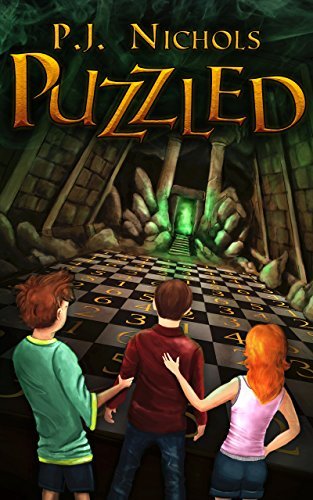
Puzzled (Nichols)

Puzzled by P.J. Nichols (2018)

(Not a review, just some notes to help me remember the things I've read. But written this way because it's the Internet, and some people will stumble across this page.)

This was a freebie in a Book Bub mailing list that I read with an eye on if it might interest my nephew. I think not, but he was his own tastes.

It's a middle-grade book, filled with puzzles and Nichols will at times stop and ask the reader if they've worked out the solution before he reveals it.

The conceit of the book is that Peter has a talent for solving puzzles. He's approached by an older man (I read this two months ago, I don't remember the particulars, which kind of defeats the purpose of this blog) who has him solve a few riddles. The man has an ulterior motive.

It turns out that there's an alien living among us and that alien can control the weather and create tornados that wreak distruction. But the alien would rather solve puzzles. And the older fellow has been creating puzzles for the alien for many years now. He wants Peter to take over. But first he must pass a challenge and he'll need a team to help him because some challenges will be brainy but others will require brawn.

Peter gets the girls he's interested in, and another frend. He also wants his older brother, but he lies to him about the competition because he figures that his brother would never believe him about a tornado-creating alien who likes puzzles. The older brother discovers the lie and quits the team right before the day of the challenge. Oh noes!

The other three go through the puzzles, figuring them all out, only to have a squeaker of a finish where the older brother runs in to save the day (someone managing to avoid all the other puzzles and make it to the finish line).

It was an okay book. I wasn't it's target audience. Your mileage may vary.

Monday, November 14, 2022

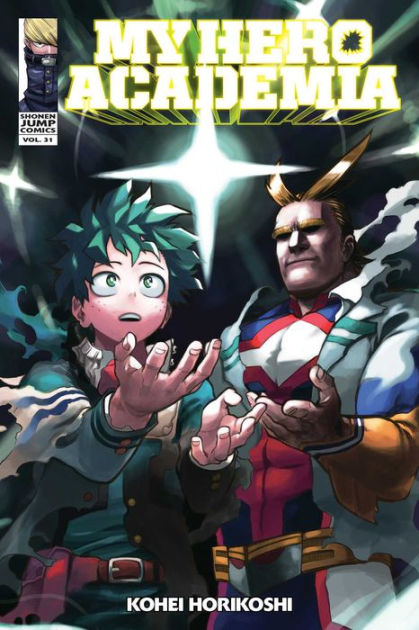
My Hero Academia Volume 31

My Hero Academia Volume 31, by Kōhei Horikoshi (2017-2019)

(Not a review, just some notes to help me remember the things I've read. But written this way because it's the Internet, and some people will stumble across this page.)

This is the most recent issue available, and it merits a separate entry even if it was only 40 minutes of reading.

I'll have a separate entry for the spinoff My Hero Academia: Vigilantes, which I'm also up to date on.

This book came as a little bit of a surprise. I put a hold on it at the library a while back and suddenly there it was.

The series has gotten a bit dark, with its emphasis on the League of Villains and the Paranormal Liberation Front. but now we discover Dabi's true secret, and the revenge that he's been waiting for. No spoiler, but it's dark, and it concerns the new Number 1 Hero.

Despite being on the cover, Izuku Midoriya (Deku) has little to do since he's in the hospital from his battle with All for One's vassal Shiguraki.

So if I had a problem with this series, it's this: it's supposed to be about a high school. While I'm happy Japan's active heroes appear and get showcased, and even happier that a squad of high schoolers do NOT run off and save the world every issue, the focus has shifted. The bigger issues in the world have taken center stage. But we seeing it from the front lines, not through the lens of the teens in training.

And, again, without a spoiler, after 30+ issues that just about got us through a single year, the reveal on the last page with Mioriya was a head scratcher. There's a sudden jump in the timeline (a few months) and a rash decision for someone training to be the world's greatest hero. And it's practically an off-the-cuff aside.

Oh, yeah, I'll have the next issue on hold at the library.

Tuesday, October 11, 2022

Caliban's Way (Corey)

Caliban's Way by James S. A. Corey (2011)

(Not a review, just some notes to help me remember the things I've read. But written this way because it's the Internet, and some people will stumble across this page.)

As previously noted: I watched the first season of The Expanse when it first aired on Syfy. I have to admit, I was somewhat lost and couldn't follow a lot of lost was going on. I couldn't even understand some of what was being said. Had I thought about it, I might've deleted the timer I had set for the series. However, I forgot to, so it taped the second season, which I watched and enjoyed more. I think a third season aired on Syfy before it moved to Amazon.

Comparing the book to the show: the first season of the show did not cover the entire first book. However, it did include characters from the second book, in particular, every character on Earth. The first half of the second season, which I recently rewatched, introduces a couple of Book Two characters in the first episode, setting them up for later, or repurposing them. The person whom I would call the "main" new character of Book Two, Prax, doesn't appear until halfway through the season when Ganymede is attacked (or about to be).

In Book Two, Prax is more the driving force, in my opinion, than Martian Gunnery Sergeant Draper, who is an important character, but more supporting the action than driving it. Having the Russian reverend be a former colleague of the UN Secretary General helped the narrative and allowed the character to be added early and given sufficient backstory for when she's needed in Book Three (which, thanks to the time off from this blog, I have already read).

In Book Two, the crew of the Rocinante is running missions for Fred Johnson for a year or so after the events of Book One. Miller, the dead detective, starts appearing to Holden whenever he's alone, warning about "door and corners" and clearing the room instead of blundering in. Meanwhile, on Ganymede, the largest food plant/greenhouses beyond the Belt, a child is kidnapped by her doctor and a strange woman posing as her mother. Her father Prax is an engineer. There's an attack on Ganymede by an protomolecule engineered soldier. Earth and Mars fight. Satellite mirrors crash. The greenhouse is destroyed. The ecosystem is spiraling into chaos and won't be salvageable.

The Roci crew is trying to bring aid. Prax hires them to find his daughter, who he discovers was kidnapped from the daycare center. His daughter has a genetic condition because of the astronomy of the situation (radiation, etc.), which makes her one of the better candidates to receive the protomolecule, which is still being researched. Meanwhile, stuff is happening on Venus, and the two sets of alien tech are talking to each other.

Cutting to the chase, it was a satisfying read, using some of the threads left from the first book, and adding more that may show up again later. It was worth the wait to get it from the library, but the size of the book put me off pace to finish my book club selection!

Friday, October 7, 2022

When You Had Power (Quinn)

When You Had Power
(Nothing Is Promised #1)
by Susan Kaye Quinn (2020)

(Not a review, just some notes to help me remember the things I've read. But written this way because it's the Internet, and some people will stumble across this page.)

I write. I don't sell a lot of stories but I write as many as I can. When I look at the markets open to me, a couple of trends show. First, lots of people like horror. Unfortunately, I'm not really one of them. Second, there are emerging genres out there that don't havea lot of content in them. The ones that piqued my interest (or at least got my attention) are solarpunk, hopepunk and lunarpunk. I'm not exactly sure what these are, or how the first two differ from the other. I get that "solarpunk" is supposed to be the antithesis of the popular "grimdark" future stories. The idea is that the world can have a bright future, if we work together and work with the Earth instead of against it. There's a streak of environmentalism (and climate change) built in. Side-note: "lunarpunk" doesn't take place on the Moon -- it's similar to solarpunk, only the setting is usually nighttime, and the asthetic should match (neon colors, etc.).

Since it's something relatively new, there's not a lot of stories and writers out there for it. That presents a little window of oppourtunity for writers wanting to jump in. But you have to know (that is, I have to know) something about the genre before I can write in it. And there isn't a lot out there to read. Certianly nothing that I could get from the library. So I did the next best thing, what I usually do, I went looking for freebies.

Susan Kaye Quinn has at least two series, which each one having the first book for free on Amazon (at least they were at the time I was looking). This "Nothing is Promised" series is supposed to be four connected novellas, but the first one is a bit open-ended. Too much was left for the next installment.

The title When You Had Power seems to be an effective play on words, refering to people in power and actually no longer having power in a world affected by climate change. A lot of changes happen in the next few decades. You hardly recognize the place (Earth, that is).

It's been a while, and the details can be found elsewhere on the web, but the main character starts the book being accepted/adopted into a group/family/home. She's working at a power plant on an island nearby. She discovers a problem and is suspended for a day while the problem is cleared up. (Why just a day? They didn't give themselves a lot of time.) She comes back and tries to prove that things have been tampered with, and someone tries to kill her by tampering with her diving suit. She survives, and lives to fight another day, along with her group family.

I wish I'd written soemthing when I read it. I could call this a benchmark story that I could measure others by. I won't judge a genre based on one book. However, I don't feel compelled to bu th enext one, and even though I have the first book in her other series, I might want to read a different author's take. I won't get a feel for the genre and its conventions otherwise.

If you're interested in solarpunk -- or is this hopepunk? -- give it a try. I believe I gave it 3 stars on Good Reads. It was definitely better written than anything I give 2 stars to, but not up there with the 4 star books either.

Thursday, October 6, 2022

Updates Coming

This blog got away from me toward the end of the summer. I was reading quite a few things, trying to get through all of them, and not making headway anywhere.

That's not entirely true. Those Exapnse books are huge and take some time. I've finished 3 of them now.

I've also taken a couple other books from the library, one nonfiction and one an anthology, and I keep going back to them and then putting them aside after a while. However, I intend to finish both of them.

Likewise, I've started other things that were on my phone mostly because they were there. Since I plan to finish these and not abandon them, there won't be entries until I'm done.

That is all for now, except that I hope to start making entries in the next couple days.

Wednesday, August 3, 2022

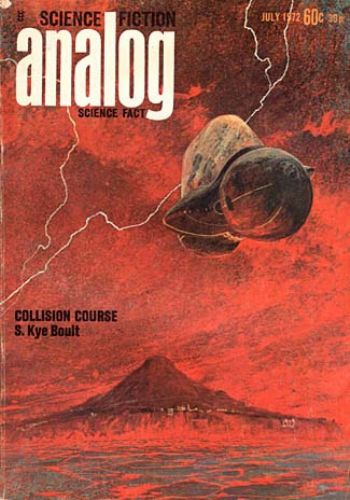
ANALOG PLUS 50: Analog Science Fiction/Science Fact July 1972

ANALOG PLUS 50: Analog Science Fiction/Science Fact, July 1972

Update the photo

July is late which just about guarantees that August will be last. Too many things going on and too many things to read. And, of course, silly as it sounds, I want to get my daily Kindle app reading streak going, and .PDF files don't count toward the daily reading goal.

The July issue of Analog will be reviewed as I read it and get back to this page. That means a lot of what you see hear will be from last month's review until at I get to the point where I've updated the entire thing.

For anyone finding these reviews, my purpose is two-fold: enjoying some "classic" sci-fi, and looking for stories that I think could be adapted for TV broadcast since so much of what shows up on anthology shows is rough to awful. Additional Note: I do NOT work in television. I just watch it.

In this issue:

The Editorial: "The Mystic West". Fifty years ago, a war between science and poetry, technology and the arts. Silly but presented sensibly.

Novellette: "Collision Course", S. Kye Boult with an illustration by John Scoenherr, which is really difficult to make out. I can see a few figures, one standing away from the others, and a couple of structures, but I have no idea what is going on. The caption reads, If you were captian of a fifty-mile long chunk of granite sailing on molten magma and had just been rammed by a floating plateau ... what would you do?

Mental note: check the reviews of stories by S. Kye Boult because I've seen the name a lot in the past two years. But nothing is springing to mind.

Okay, so as far as visual go, this story has it. I can't recall ever reading or seeing a story about a mountain of rock with engines on it being steered like a battleship. (I may have missed the fifty mile long reference.) Even if Hollywood writers throw out everything else to make this "more accessible", this would rock. (Pun not intended at first, but intended after.)

The problem I had with it was it wasn't accessible with the aliens it created and the language and terminology to go with it. It got a little distracting. That said, it was better that this wasn't a bunch of humans mining minerals on a magma-flowing planet. When I finally got to the flat rock that was planning on ramming the mountain, I wasn't sure who or what was ramming or why. The reasons were liking there and I could've just zoned out and skimmed over them. The solution did lie in the dynamics of fluids and heating and cooling magma.

It was interesting enough that I didn't bail on it, but I did slough me my way to the finish.

Short Story: "Klysterman's Silent Violin", by Michael Rogers, with an illustration by John Schoenherr, showing a simple image of a man in the background playing an electronic violin while wearing a pair of headphones. There's the face of a man in the foreground who appears to be annoyed. I don't know if there's something on his forehead or if it's just a bad image of his hairline. The caption reads, "The path of scientific research sometimes takes unexpected turns -- and so does the path of evolution."

The story is told in the form of journal entries. I just scanned the text looking for the name of the writer, who is in charge. I figured that there might be dialogue in one of them. I didn't see it. Klysterman is a scientist who works on his violin in his spare time. There is a female scientist named Ludmila W., and there appears to be a love triangle. Except that it isn't. Klysterman seems interested in her, and she seems interested in him and his violin. The projet leader tries to separate them -- for her sake, of course, because he's a ne'er-do-well, or something -- going so far as to put her on his research project. It doesn't help.

The narrator becomes more erratic in his tale as it goes on and I thought it was going to be beause of the "silent" violin actually driving him mad. Nope. Doesn't happen and that's a missed opportunity.

Instead the plot resolves around augmented wheat rust, which is allowed to germinate so it could be studied. No, I didn't fully understand the reasons for this. Klysterman takes an interest in the project. It appears that the rust has psychedelic properties. And in the end, the rust's mutations expand so far as to cause a mutation of Klysterman and Lucinda W, which they undergo willingly.

This could be interesting visually but I don't know if it could be done cheaply enough such a short story. It could be the last (short) segment of an hourlong anthology show.

Science Fact: "Strong Poison 2", by arl A. Larson

It was long and I didn't read through much of it. It could have ideas to be used in writing, maybe. I don't recall Strong Poison 1, whenever that was published.

Novellette: "The Darkness to Come", by Robert B. Marcus, Jr., with an illustration by John Schoenherr, showing a large black bird-like creature with human-like arms and hands not attached to its wings. The caption reads, In a situation where fats are scarce, faith counts as much as logic. But when the faithful reach the wrong conclusion, they still cling to it stubbornly!

Jans Deriae is an old scientist. He takes pills (which appear to be illegal) to prolong his life. He has calculated that the world (Rangi) is cooling because it is moving away from the primary sun, which would be obviously if the clouds would get out of the way. The population of the world lives underground and most have never seen the sky through gaps in clouds.

Jans Deriae has realized that the world has traveled through the dark of space from one star to another but it has now passed that star. The world won't survive another trip through the darkness.

He's opposed in the scientific community, so none will listen to him, and they ridicule him. He finds a way into Chamber of the Gods, which is off-limits to all. He learns the truth that the "gods" were just men, from a planet called Earth, and they set in motion a plan to save Rangi. But the gods even acknowledged that their machine were fallible and left instructions on what to do if the planet did not enter orbit about the new star on its own. (Diagnostic says that the surface sensors froze.) Now it needs to be fixed before he can be stopped.

An enjoyable story, which could be made with a good budget or an austere one. (Not too austere, make sure they look like bird people, not people with beaks and a few feathers.)

Short Story: "Out, Wit!", by Howard L. Myers, (no initial illustration) The caption reads, As was pointed out long ago, "It ain't what you say, it's the way you that you say it!" that counts.

The story is told in the form of letters between D. R. Dayleman, Editor of the the North American Physical Journal in Virgina and Harmon McGregor, Chairman of the Department of Physics at Grandview University in Ohio. It concerns recommendations of a former student who goes on to make a presentation that includes a joke that is not well-received among his colleagues. He becomes an outcast and the two correspondents are all "woe is me" about it.

As time passes however, science marches on and breakthroughs are made. The chairman is unable to ascertain how he came upon a certain idea, as it doesn't appear in any scientific literature, and assumes that it was just germanating in the back of his mind for a long time. In the end (some ten years later), there's a note about the young man who never amounted to anything in life, going crazy, and they really dodged on, didn't they. Of course, it was the young man's initial idea.

Not only could it be filmed, but it's likely that something of this sort has been. Obviously, there would have to be more than random correspondece. And one would think that the replies to these letters would come much sooner.

I recognized the name, but I couldn't remember from where. The Analytical Library shows that he wrote "War in OUr Time" in March 1972, which I remember had a sequel story a month or two later.

Serial: "A Transatlantic Tunnel, Hurrah!", by Harry Harrison, Part Three of Three.

I'll get to this soon, I hope.


The Reference Library , by P. Schuyler Miller. Reivews include The Lathe of Heaven by Ursula K. LeGuin, A Choice of Gods by Clifford D. Simak, The Devil is Dead by R. A. Lafferty, Russian Science Fiction Literature and Criticism: A Biblioraphy" by Darko Suvin, and Orin by Piers Anthony.

Brass Tacks: Several letters about the illustration of a nude man extending a raised middle finger and the sex that appears in the pages of sci-fi as of later (ie, early 1970s).

I hope I read July's issue before July ends. I also want to read the Harrison serial. On top of this, I seem to have it in my head that I need to keep my daily Kindle reading streak going, and pdf files don't count toward that goal. So other books have to be sprinkled in, even if its only a dozen pages per day.

Wednesday, July 27, 2022

At Wit's End (Bombeck)

At Wit's End by Erma Bombeck (1965)

(Not a review, just some notes to help me remember the things I've read. But written this way because it's the Internet, and some people will stumble across this page.)

This was a paperback that I had for a very long time and which became my in-pool reading book. That is, a book, should it happen to fall in, I wouldn't be too concerned about it. Obviously, this is not something I could do with loaners or books that I'd prefer to hold onto.

I used the Good Reads image because it matches the edition I have. It's old, although not 1965-old. Actually, I was surprised that the book itself dated to 1964. I know Bombeck was a pioneer and that my parents and older siblings read her newspaper columns, but I didn't think she'd started back then. Given the idyllic family life that she takes to task, I should've realized it.

Where this book came from, I couldn't possibly remember. Likely a used book store, or a used whatever store that also had books. It was something that I wanted to read and never got around to reading. Erma Bombeck was one of the names that I remember my high school Creative Writing teacher (Mr. Jon Marc Mucciolo) suggesting that I should read. Her name is the only one of the three or four that I remember now. Probably because I knew who she was. I was trying to write humorously, and these were people who knew how to turn a phrase. Also, "Mooch" was trying to impart upon me the idea that humor needed to be about something. For all I knew, it could be a bunch of one-liners. I didn't write bunches of one-liners, but if someone printed them, I probably would read them!

Last two things before I get to the book: first, I titled my final column for my college newspaper "At Wit's End" -- I had thought about calling it "This Wit's End" but I'd only had four columns published in 2 years, along with one that was held so long that I bumped it myself for my final column; second, the only column of Bombeck's I remember was, unfortunately, a more serious piece -- the kind humorists write when they think an issue is so important that they believe it's okay not to be funny while they talk about it. (For the record, I thought it was a stupid column. It's point was made in the first 50 words and the rest was beating the dead horse. Not her best work.)

Okay, so this book is broken down into sections that are labeled by calendar months. I thought that meant that this was going to be a year's worth of columns. I'm not sure what it is. The months are more thematic, where you'll find stuff about particular holidays, school events, summer vacations, and more holidays. There are some short columns, but then there are longer pieces which I don't know if they're related columns strung together, or if individual columns were expanded for the book. Some of these go one for a while and the tone changes after a couple of pages. In syndication, it's rare for one column to continue to the next, but not uncommon for the topic of a popular piece to be revisited. These revisits are pieced together.

Some of Bombeck's complaints are universal, but others are dated and not very relatable. Keep in mind, I'm old, so I have a greater frame of reference to relate to, but a lot of what she presents would be like if the origin Roseanne series had been made at the same time as Father Knows Best or Ozzie and Harriet. The type of family and situations she writes about where not the typical family of 50s and 60s television. But kids are kids, even if the only entertainment was the single television set and the only phone hung on a wall and was used by everyone.

Anyway, I'm glad I finally read this, even though I started it at least four years ago. I was reading it as a substitute when I was covering classes before I made it the pool book. Now I have to find another pool book. I had used old sci-fi magazines, but the print is small and I don't wear my glasses. I don't think I've ever finished one of those. Maybe, one. I do have some old math books, but I'm not sure I want to get those wet. I'll figure it out before my next morning in the pool.

Tuesday, July 26, 2022

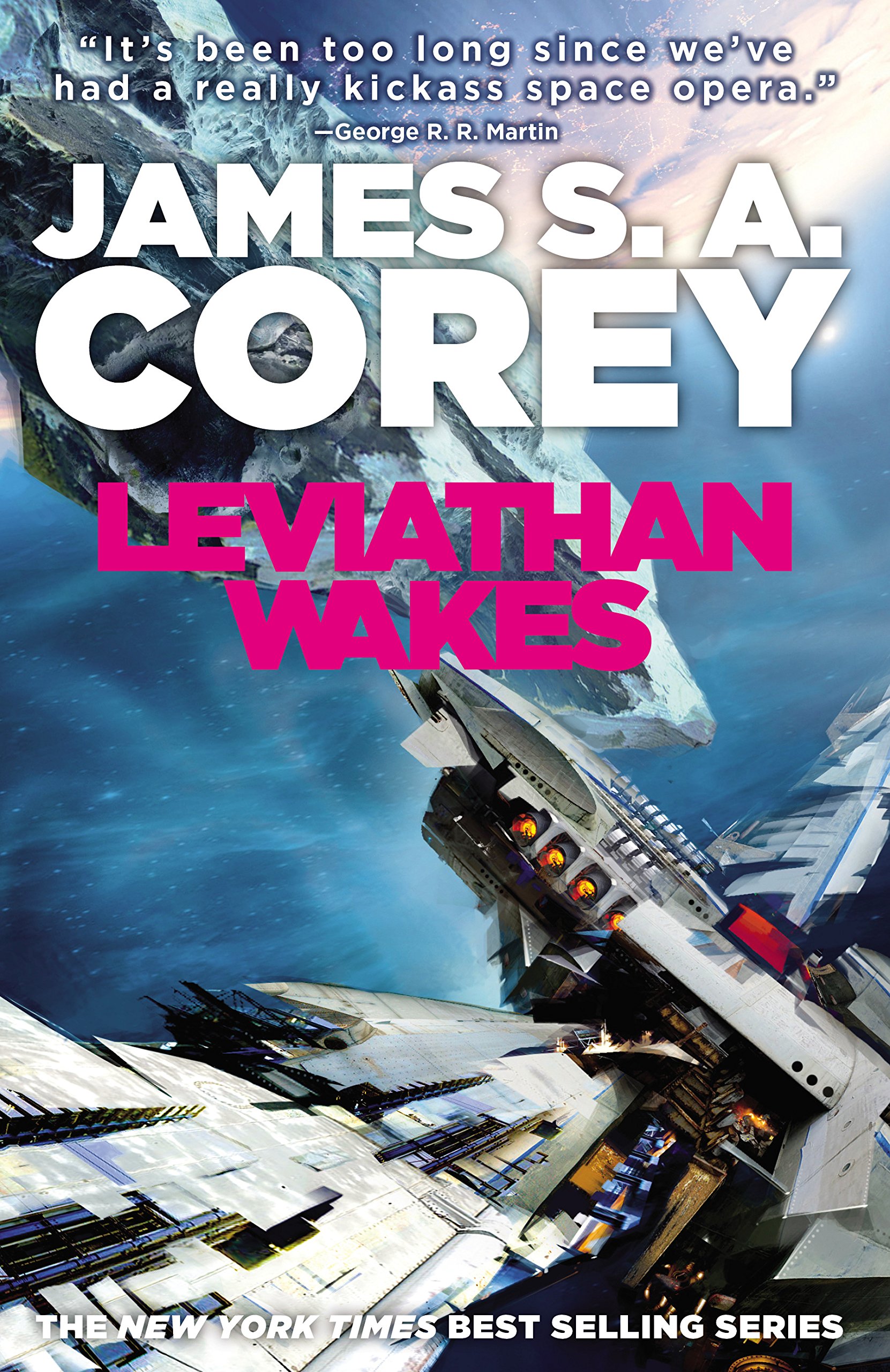
Leviathan Wakes (Corey)

Leviathan Wakes by James S. A. Corey (2011)

(Not a review, just some notes to help me remember the things I've read. But written this way because it's the Internet, and some people will stumble across this page.)

I watched the first season of The Expanse when it first aired on Syfy. I have to admit, I was somewhat lost and couldn't follow a lot of lost was going on. I couldn't even understand some of what was being said. Had I thought about it, I might've deleted the timer I had set for the series. However, I forgot to, so it taped the second season, which I watched and enjoyed more. I think a third season aired on Syfy before it moved to Amazon.

I considered suggesting the first book recently for my book club. I rejected the idea for two reasons: first, since it's been around for a decade, anyone with an interest might've already read it. Second, the length of it -- if I didn't like it, I'd have to slog through 400+ pages before our next chat.

Still, I reserved it from the library. Even after all this time, there is a wait list for the book. Reading it on my own would allow me to bail if I didn't like it.

That was not a problen in the slightest. Yes, the length bothered me -- when is this going to end? But the book moved. It just didn't move by the time my loan was up, so I had to shut the wifi off on my ipad and finish half the book in about three days.

I didn't remember much about the first season of the show, other than the ship and some parts on Earth with Shohreh Aghdashloo. Yes, I just looked up her name, but I remembered her from 24 at the time the show first aired. Oddly, her role is NOT in the book. In fact, none of the book takes place on Earth at all. Earth is only referenced, and we hear reports from there.

In fact, the entire thing, after the prologue with Julie Mao, is told through the perspective of either Holden, the Rocinante captain, or Miller, the Belter cop. It even switches perspective when the two of them are together. Also in the book, Holden's crew, Naomi, Alex, Amos and Shed, don't have a problem with him. He was the XO of the Cant and now he's the captain and Naomi is the XO. Furthermore, he relies on Naomi for a lot. (TV Holden isn't trusted immediately despite having been on the ship for a long time. He's got nowhere else to go.)

Julie is a rich girl who defied her parents and joined the OPA (Outer Planets Alliance, i think). She's on the Scopuli when it's hijacked by terrorists. A fake distress call brings the Canterbury to the rescue. They send a shuttle and a crew of five to check it out. They realize it's a trap. A ship using Martian stealth tech ignores them and destroys the Canterbury. The shuttle is then rescued by the Martian ship Donnager, which is then attacked and destroyed. But not before Holden and his crew get off in a Martian attack shuttle.

Someone is trying to start a war to cover their own tracks, and Julie Mao is in the middle of it.

Miller was given the case to find Mao and drag her home. He discoveres that she isn't on Ceres. He's told to let it go but he can't. He falls in love with Mao from reading her files and her emails.

Space adventures, of the hard sci-fi variety, ensue. The entire story happens "out there" between the Belt and Saturn. It's discovered that the Earth should have been destroyed two billion years ago by a biological weapon that accidentally was caught up in Saturn's gravity well on its way to Earth. The race that created it were already gods then. Scientists here (the ones without morals) want to be able to duplicate the programming of the virus so that the human race could be on equal footing and make our way out into the galaxy.

Saner heads prevail. Mostly.

I enjoyed this and started rewatching the series on Amazon. I immediately noticed differences in the narrative, so which just moved the story along and some that didn't seem to have a point. I assume that the Earth sequences are to set up characters for later books in later seasons. I have the second book on reserve. Hell, at this rate, I should probably put the third book on reserve as well. Or maybe when I'm done with that, I can get the next Sue Grafton book. I think I'm up to T.

Monday, July 25, 2022

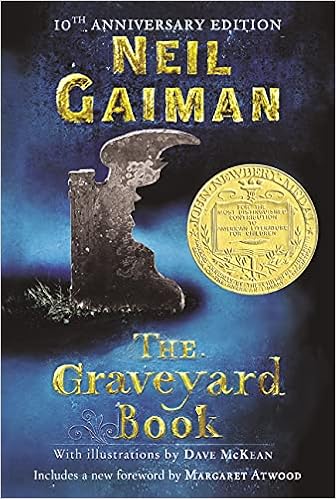
The Graveyard Book (Gaiman)

The Graveyard Book by Neil Gaiman (2008)

(Not a review, just some notes to help me remember the things I've read. But written this way because it's the Internet, and some people will stumble across this page.)

This was a Book Club selection, and it was one of my choices. I was asked to pick three books that I wanted to read. I selected the first of the Murderbot series, and "The Three-Body Problem", both of which I've had in my kindle for quite a while. I considered a few other books but all were well over 400 pages. I didn't want to obligate myself to something that I'd have to slog through. For this reason, I didn't select the first book in The Expanse series (which I've since read on my own). I perused Good Reads for suggestions. Neil Gaiman had quite a few books listed, so I decided to go with one I hadn't heard of, and hoped that the others hadn't either. Less of a chance that they'd already read it.

The Graveyard Book was the clear winner, with Three-Body getting no votes at all.

In the book, a man named Jack (who is referred to in that manner repeatedly) kills a family, but he misses the baby, who had climbed from his crib and toddled up the road to the cemetery. There he is protected by some of the spirits which live there, and one who has taken residence there. The ghost of the baby's mother frantically arrives and implores the spirits to protect her child. She cannot stay because she won't be laid to rest there. But Mr. and Mrs. Owens take charge of the baby and call him Nobody Owens (aka "Bod"). He is given Freedom of the Graveyard like his protector and teacher, Silas, has been given. Silas clouds the mind of the killer to leave when he approaches.

Years pass and Bod gets restless. He wants to go to school and meet people. He outgrows his playmates in the cemetery.

He gets into misadventures and finds but he is protected, and becomes the subject of an ancient prophecy. Meanwhile, the man called Jack returns looking to finish the job he started. We learn more about Bod's family and the fact that Bod's disappearance was covered up.

I enjoyed the book. I expected the ending, and yet I was a little disappointed in it. Bod would eventually have to leave the graveyard and face the world, and he would have to do it alone. However, he seems to be a little young to be doing that at this point. Granted, had I read this as a teen, I might not have thought that was a problem. But as a teen, I didn't have a good grasp at how life worked either.

It was a good read, and I really need to read more of Gaiman's works. I have so many as ebooks from a Humble Bumble years ago. (That's how I found out that I'd actually purchased his first book as a gift -- it was a quickie book about Duran Duran.

Sunday, July 24, 2022

Exactly How I Promote and Sell Books (Dee)

Exactly How I Promote and Sell Books
A 30 Minute Read
(Kathy's Practically Perfect Plan Book 6) by Kathy Dee (2021)

(Not a review, just some notes to help me remember the things I've read. But written this way because it's the Internet, and some people will stumble across this page.)

This was a freebie, probably from r/FreeEBOOKS, so she didn't make money from me selling this book. Kathy Dee has a series of 15-minute reads, but this one, she says, has so much material in it, it's more of a 30-minute read. And it was. Note: I read this a month ago and just didn't get around to posting about it. In truth, I wanted to wait until I finished the next book because I didn't want this to be the top post on my blog for more than 1 day.

There's should good information in here if I want to self-publish books, particularly if I want to use Kindle Unlimited to get more eyes on my pages. Let's face it, at this point, I'm not going to sell books on my name.

But it keeps coming back to this: you need a cover, and covers aren't cheap. You can do it yourself but it won't look all that great. And worse is when I looked for cheap royalty free artwork to use, I couldn't find a way to buy one thing. They wanted to sell a package for more all than I needed or make it a monthly subscription, as if I'd need more for my one book. Granted, it makes sense to use two or more images and blend them just so I'd have an original final cover that couldn't be duplicated by someone looking to make a similar cover with a similar title. That's actually an issue.

Over than that, it was like I read an online article -- the kind I wish I could find on the subject.

Sunday, July 17, 2022

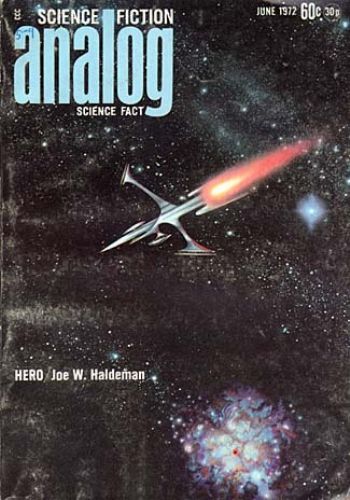
ANALOG PLUS 50: Analog Science Fiction/Science Fact June 1972

ANALOG PLUS 50: Analog Science Fiction/Science Fact, June 1972

Update the photo

June came and went along with the last of the school year and an exess of overtime grading Regents exams. As a result, I fell behind on this blog and have felt too tired to catch up with it along with my math blog. Life happens. I'm back. For now. I'll still be reading even if I'm not posting about it. I don't want to neglect this blog for 4 years, like I did once before.

The June issue of Analog has a noveltte by Joe Haldeman, which was the only name I recognized aside from the serial by Harry Harrison. I'll read that one separately.

For anyone finding these reviews, my purpose is two-fold: enjoying some "classic" sci-fi, and looking for stories that I think could be adapted for TV broadcast since so much of what shows up on anthology shows is rough to awful. Additional Note: I do NOT work in television. I just watch it.

In this issue:

The Editorial: "The Mystic West". Fifty years ago, a war between science and poetry, technology and the arts. Silly but presented sensibly.

Novellette: "Hero", by Joe Haldeman with an illustration by Kelly Freas, showing several men in spacesuits, armed, running across an alien landscape, at night. There's an explosion in the background., A couple have fallen. The caption reads, With a highly-advanced technology, you'd hardly expect warfare to be anything but push-button automation, right? Wrong! The infantry is still the Queen of Battle, even out among the stars."

Taking place in the far future, 1997, the Earth is an war with the Taurans. No one has seen them yet, and they were given that name because they came from somewhere from the constellation Taurus. The military leaders fought in the last earth war, which took place in Asia in the 1970s. The planet that most of the action takes place on is Charon, which is not the moon of Pluto (not discovered yet). For that matter, Pluto is still a planet and probably larger than we now know it to be. Charon in the story is twice as far out as Pluto is. That's where the training is, and mistakes are death. Also, the only ride home is the go the distance with the mission.

The hard science is understandable for me, but that's also because I'm older and reading more of it. It's moralisti at the end where the Taurans aren't as dangerous in a land battle, but they'll likely be ready for us the next time Earth encounters them.

This could be a good movie or shot TV series. Given that the Expanse does so well, it could try to copy its success. Except that this is much smaller. On the other hand, more open-ended. There's a lot of female representation in the military and the role could be any nationality, so you have diversity. Something worth filming but possibly similar to other things that have already been filmed -- particularly after Hollywood writers get through with it.

Short Story: "Klysterman's Silent Violin", by Michael Rogers, with an illustration by John Schoenherr, showing a simple image of a man in the background playing an electronic violin while wearing a pair of headphones. There's the face of a man in the foreground who appears to be annoyed. I don't know if there's something on his forehead or if it's just a bad image of his hairline. The caption reads, "The path of scientific research sometimes takes unexpected turns -- and so does the path of evolution."

The story is told in the form of journal entries. I just scanned the text looking for the name of the writer, who is in charge. I figured that there might be dialogue in one of them. I didn't see it. Klysterman is a scientist who works on his violin in his spare time. There is a female scientist named Ludmila W., and there appears to be a love triangle. Except that it isn't. Klysterman seems interested in her, and she seems interested in him and his violin. The projet leader tries to separate them -- for her sake, of course, because he's a ne'er-do-well, or something -- going so far as to put her on his research project. It doesn't help.

The narrator becomes more erratic in his tale as it goes on and I thought it was going to be beause of the "silent" violin actually driving him mad. Nope. Doesn't happen and that's a missed opportunity.

Instead the plot resolves around augmented wheat rust, which is allowed to germinate so it could be studied. No, I didn't fully understand the reasons for this. Klysterman takes an interest in the project. It appears that the rust has psychedelic properties. And in the end, the rust's mutations expand so far as to cause a mutation of Klysterman and Lucinda W, which they undergo willingly.

This could be interesting visually but I don't know if it could be done cheaply enough such a short story. It could be the last (short) segment of an hourlong anthology show.

Science Fact: "Strong Poison 2", by arl A. Larson

It was long and I didn't read through much of it. It could have ideas to be used in writing, maybe. I don't recall Strong Poison 1, whenever that was published.

Novellette: "The Darkness to Come", by Robert B. Marcus, Jr., with an illustration by John Schoenherr, showing a large black bird-like creature with human-like arms and hands not attached to its wings. The caption reads, In a situation where fats are scarce, faith counts as much as logic. But when the faithful reach the wrong conclusion, they still cling to it stubbornly!

Jans Deriae is an old scientist. He takes pills (which appear to be illegal) to prolong his life. He has calculated that the world (Rangi) is cooling because it is moving away from the primary sun, which would be obviously if the clouds would get out of the way. The population of the world lives underground and most have never seen the sky through gaps in clouds.

Jans Deriae has realized that the world has traveled through the dark of space from one star to another but it has now passed that star. The world won't survive another trip through the darkness.

He's opposed in the scientific community, so none will listen to him, and they ridicule him. He finds a way into Chamber of the Gods, which is off-limits to all. He learns the truth that the "gods" were just men, from a planet called Earth, and they set in motion a plan to save Rangi. But the gods even acknowledged that their machine were fallible and left instructions on what to do if the planet did not enter orbit about the new star on its own. (Diagnostic says that the surface sensors froze.) Now it needs to be fixed before he can be stopped.

An enjoyable story, which could be made with a good budget or an austere one. (Not too austere, make sure they look like bird people, not people with beaks and a few feathers.)

Short Story: "Out, Wit!", by Howard L. Myers, (no initial illustration) The caption reads, As was pointed out long ago, "It ain't what you say, it's the way you that you say it!" that counts.

The story is told in the form of letters between D. R. Dayleman, Editor of the the North American Physical Journal in Virgina and Harmon McGregor, Chairman of the Department of Physics at Grandview University in Ohio. It concerns recommendations of a former student who goes on to make a presentation that includes a joke that is not well-received among his colleagues. He becomes an outcast and the two correspondents are all "woe is me" about it.

As time passes however, science marches on and breakthroughs are made. The chairman is unable to ascertain how he came upon a certain idea, as it doesn't appear in any scientific literature, and assumes that it was just germanating in the back of his mind for a long time. In the end (some ten years later), there's a note about the young man who never amounted to anything in life, going crazy, and they really dodged on, didn't they. Of course, it was the young man's initial idea.

Not only could it be filmed, but it's likely that something of this sort has been. Obviously, there would have to be more than random correspondece. And one would think that the replies to these letters would come much sooner.

I recognized the name, but I couldn't remember from where. The Analytical Library shows that he wrote "War in OUr Time" in March 1972, which I remember had a sequel story a month or two later.

Serial: "A Transatlantic Tunnel, Hurrah!", by Harry Harrison, Part Three of Three.

I'll get to this soon, I hope.


The Reference Library , by P. Schuyler Miller. Reivews include The Lathe of Heaven by Ursula K. LeGuin, A Choice of Gods by Clifford D. Simak, The Devil is Dead by R. A. Lafferty, Russian Science Fiction Literature and Criticism: A Biblioraphy" by Darko Suvin, and Orin by Piers Anthony.

Brass Tacks: Several letters about the illustration of a nude man extending a raised middle finger and the sex that appears in the pages of sci-fi as of later (ie, early 1970s).

I hope I read July's issue before July ends. I also want to read the Harrison serial. On top of this, I seem to have it in my head that I need to keep my daily Kindle reading streak going, and pdf files don't count toward that goal. So other books have to be sprinkled in, even if its only a dozen pages per day.

One Piece, Volumes 30-40 (Oda)

One Piece , Volumes 30-40, Eiichiro Oda, 1997-2003 (Not a review, just some notes to help me remember the things I've read. But ...