Wednesday, May 20, 2026

1634: The Baltic War (Weber / Flint)

1634: The Baltic War, David Weber and Eric Flint (2008)

I found a draft for this entry that was dated Jul 25, 2018.

I found it on May 18, 2018.

Apparently, I read this and never wrote it up. I honestly don't remember reading it. However, as I type this, I vaguely recall how this book had only half the cast of the previous books because this was the point where Flint started publishing multiple books per year -- year as in 1634.

What makes this discovery more amusing is that I picked up a copy of this at Philcon last November. Charles E. Gannon was doing a "coffee talk" that I attended and he had freebies that he gave away. Someone got the "Gazette" before I could reach it -- these have stories by various writers that are set in the world of the Ring of Fire, and some of these stories are incorporated into the main timeline. It's a way to find out what else is happening in the world without burdening the main books. Anyway, with that gone, I went with the book with the earliest date, so I could get to it sooner. It's sitting on my dresser, waiting to be read.

I guess I don't have to read it now.

The funny thing is that I wanted to read more of this series because it is interesting. There was too much of it to absorb to get to write for the shared world portion of it -- and now with Flint gone, I don't know what's going to happen with that anyway. But the books are thick, and it'd be a while before I could reread those first three books to get ready for book four. With a book club and Library Thing plus my own interests (and graphic novels), there just isn't time.

There isn't anything to add. I don't remember the book at all other than that I enjoyed it and planned to read more -- which I haven't done in the past six years.

Tuesday, May 19, 2026

Luminous Beings (Arnold)

Luminous Beings, by David Arnold, illustrated by José Pimienta (2024)

(Not a review, just some notes to help me remember the things I've read. But written this way because it's the Internet, and some people will stumble across this page.)

This was another graphic novel that I picked up at random at the library based on the cover. At this point, I'm looking for interesting panels that I can incorporate into a class slide presentation or worksheet or just something that I could recommend to the students.

This book isn't one of those things. I could use it as an example of poor dialogue placement, but I already have several of those. What I mean by this is that the tails of some word balloons go behind other word balloons to the point that you aren't sure who is speaking.

Other than that, I have no complaints about the layout, which seems to be standard with many graphic novels.

The book is about a "faux-pocalypse". They don't call it that. I just did. It looked like it was going to be about more than it actually was.

The story takes place over the course on one night. There are pink streaks coming out of the sky. Everyone is wearing hazmat suits, or "hazzies". The hoods have face masks that can be opened to use an inhaler (one character has for no stated reason, and it never comes into play) or to take a drink or just about any reason outside. Also, one guy (not shown) urinated behind a dumpster outside a club.

The only thing that this apocalypse seemed to do was turn all the squirrel into zombies with glowing red eyes that attack humans -- except that none are ever struck. The squirrels are always batted down and crushed behind someone's heel.

Of the four main characters, two are budding filmmakers, making a documentary about the squirrels, the end of the world, and a missing friend who went to live off the grid (and claim a reward for finding him). One of them has a secret -- she's decided to move away to go to Brooklyn College to study film-making. (Side note: I am a BC alumni, and I know that BC has one of the two best Film Departments in the city. The other is at NYU, which is about 10-20 times more expensive. One had Robert Redford as an advisor; the other had Paul Newman.)

The other two boys are friends and one of them secretly has a promise ring that he has to work up the nerve to give. As far as B stories go, it's pretty pedestrian. There are no complications, tension, drama in this.

The four follow a few clues and find the guy, who already knew the world wasn't actually ending but wanted to disassociate from the world anyway, and they make it back home by morning.

The artwork is pretty cool, primarily with pinks and purples for the night sky.

One scene that stands out was when two of them are in the club -- the boy who's 18 and the girl who's underage because the club lets in underage girls. The other two boys are outside (by the aforementioned dumpster). The couples are mixed, so everyone is free to spill what's on their mind. And here's were it goes wrong. The writer tries to do a movie trick of intercutting the two scenes and mixing the dialogue. This sometimes works in movies, because the jump cuts are obvious. It's less obvious here with the dark, near empty backgrounds with the "camera" close-up on whichever teen is speaking. It jumps from inside to outside back inside again to give the impression that the outside teen is responding to the inside teen's dialgoue. It doesn't work.

Luminous Beings was an okay read, and not something that I'll recommend. I wouldn't discourage anyone from reading it -- maybe it'll mean more to them.


If you stumbled across my page via the Internet, please check out my short book series, Burke Lore Briefs. A fantastical foursome of flash fiction and short stories.

Monday, May 18, 2026

The Parable of the Sower (1993)

Parable of the Sower
Octavia E. Butler (1993)

[AUDIO ONLY]

(Not a review, just some notes to help me remember the things I've read. But written this way because it's the Internet, and some people will stumble across this page.)

This was a random audiobook suggestion from Libby. I've heard of this book, and of Octavia E. Butler, but hadn't read it. For some reason, I thought this book was older. Then again, I find it hard to believe that 1993 was over 30 years ago.

The book is narrated by Lynne Thigpen. Normally, I don't pay attention to this, but I saw the name and remembered her from TV. She did a great job.

The timing of listening to this book was ironically amusing (it's not supposed to be). The setting is a dystopian California in 2026 where the poor huddle together behind walls for protection against the really poor who will rob, steal, burn, and kill to get want they need and take what they want. (They commit more unspeakable crimes to women as well.) Cops and firemen are next to useless, or worse. Criminals rarely get caught, and innocent people get punished.

In this instance, the country has been ravaged by climate change, wealth inequality, and social collapse. Climate change was a little ahead of its time in the early 90s, but it was typical scifi cannon fodder to set up a novel.

Jobs are hard to come by, particularly ones that pay cash. It's hard to imagine that there are still stores, and that those stores can be supplied, but they have security. Some jobs are basically indentured servants (paid in room and board, so you can never leave). And some pay in "company scrip" which can only be spent at the company store, and worthless elsewhere. The allusions to slavery are noted.

Lauren Olamina starts off as a 15-year-old. (She'll age at least three years over the course of the book.) She's also an empath. She has a condition, as others will have in the book, that she can feel other people's pain to the point where it can be debilitating. If she were to punch someone, she would feel it. This becomes problematic later on when she needs to shoot someone. She hides this condition.

The first part of the book sets up Lauren's home and family life and how bad it is. At the same time, she narrates her discovery of a new religion. She was baptised a Baptist, but she doesn't identify with that God. She writes poetry about her philosophy, which she calls Earthseed, and she refers to her writings as The Book of the Living (as opposed to the Books of the Dead).

People live together for safety. People who live alone are more likely to be robbed and killed (and raped). When a fire starts at one house, the community comes out to help, which leaves houses empty for thieves. Lauren wants to leave, and she has a to go bag. Her father says that to go bags are a bag idea because it puts everything valuable in one place for a thief to steal quickly.

The book switches gear when the really poor, the homeless, attack and burn down the entire community. It's their way of sticking it to the rich. No one here is rich, but some are richer than others.

Lauren escapes with her bag and then returns the next day along with the looters to get more of her stuff. She can't find the rest of her family, who she hopes escapes but comes to belive they're all dead.

The rest of the book concerns escaping and traveling north, trying to find someplace safe. The roads are dangerous and so are the towns. Getting into Oregon will be difficult and getting into Canada would be nearly impossible. Lauren and others that can be trusted try to form a larger group for safety as they travel north.

I enjoyed listening to this. I don't know if I would've stuck with it were I reading it.

I might listen to the sequel at some point.


If you stumbled across my page via the Internet, please check out my short book series, Burke Lore Briefs. A fantastical foursome of flash fiction and short stories.

Friday, May 15, 2026

Remote, Volume 02

Remote, Volume 02, by Seimaru Amagi and illustrated by Tetsuya Koshiba (2005)

(Not a review, just some notes to help me remember the things I've read. But written this way because it's the Internet, and some people will stumble across this page.)

I couldn't find the correct cover online, so I posted the one above from an eBay auction. It looked better than the photo I took.

I believe I found this book in a Little Free Library although I suppose it could've come from Philcom. I saw it was volume 2, but I figured there would be a recap to bring me up to speed. Not really, just a description of the two main characters.

As with all graphic novels I find (and the ones that are donated), I flip though them before I put them into my library. Like Crazy Food Truck, this one had nudity in the first few pages as the young woman from the cover steps out of the shower. Unlike CFT, she's only naked this one time. Unlike CFT, this manga gets its kick with unnecessary, gratuitous upskirt shots. This is a specific camera angle used multiple times, instead of just showing the woman in her underwear or a skimpy bathing suit. If anyone wants to discuss my concerns offline sometime, come find me, possibly at the next convention. (Also, to highlight the fact that she's wired, there is only panel where her clothing is transparent but her body and underwear are not grayed out.)

The crux of the matter: this book is not going into the rotation in my classroom. It's going back into a Little Free Library in my neighborhood -- and not the one in front of the K-5 school!

Kurumi Ayaki is a police officer who is assigned to an elite unit in charge of solving crimes that have been classified as unsolvable. She does the legwork for Kōzaburō Himuro, a recluse, a "guy in the chair", who lives in the basement of his manor and doesn't come out. He's a genius with a tragic, traumatic past.

There are 9 or 10 chapters (I forget) in this book. The first few are dedicated to the crime from the first book, which gets solved here. This segues into a second crime involving students from a local high school. Ayaki goes to investigate -- to ask questions while her boss feeds her questions. While she's there, the school is threatened will bombs in the building, so Ayaki goes under cover as a new student, which catches the interest of a number of possible suspects. (The calls are coming from inside the school.)


If you stumbled across my page via the Internet, please check out my short book series, Burke Lore Briefs. A fantastical foursome of flash fiction and short stories.

Thursday, May 14, 2026

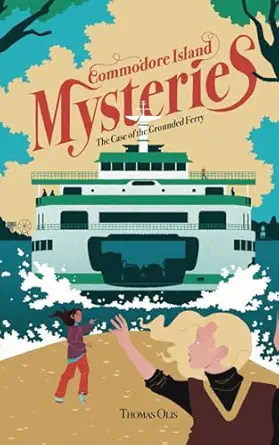
The Case of the Culvert Puppies (Olis)

The Case of the Grounded Ferry
by Thomas Olis (2026)


(Not a review, just some notes to help me remember the things I've read. But written this way because it's the Internet, and some people will stumble across this page.)

When I won "The Case of The Grounded Ferry" a few months ago, the book wasn't ready. The author, Tom Olis, emailed me his first two books in the series to read in the meantime. I actually wasn't planning on doing that. And after reading book three, I wasn't in a hurry to read book one. However, ...

Sometimes the stars align. I'm in between book club books at the moment. I hadn't started another Library Thing book yet. And my reading goal "scavenger hunt" type list includes two entries for two books written by the same author. I had other prospects lined up, but this one was right in front of me.

The first book, The Case of the Culvert Puppies, reads better than the third. Partially, this is because the characters are introduced better here, and partially because Olis doesn't do a good job (or any job?) reintroducing them to new readers in book three. I never got a feel for them. Once again, however, almost everyone is on a first-name basis, which gets confusing, and I forget which parent goes with which child.

Speaking of adults, they play significant roles in this book. It's not all kids saving the day. In fact, they acknowledge that there are parts of the investigation that are grown-up business.

There's a Russian plot to sow discord in the area that involves stealing a dog, which escapes long enough to give birth to puppies in an illegal culvert on a property that's illegally being developed. Then a flash drive is found that has a bunch of files in it. The police and feds step in after this.

It wasn't bad. I liked it better than book three. The back of the book lists five mysteries, but the third one just came out. I hope the author makes corrections to his writing before publishing those next two.


If you stumbled across my page via the Internet, please check out my short book series, Burke Lore Briefs. A fantastical foursome of flash fiction and short stories.

Wednesday, May 6, 2026

The Greatest Pub in the Multiverse (Steuernagel)

The Greatest Pub in the Multiverse
Herman Steuernagel (2025)

[AUDIOBOOK]

(Not a review, just some notes to help me remember the things I've read. But written this way because it's the Internet, and some people will stumble across this page.)

I listened to this book in March, I believe, but apparently, I forgot to review it. I don't even have a draft file.

This is a sequel to The Bartender Between Worlds and is more of what I expected (or wanted?) in the first book. And in many ways, this is better than the first book.

The book opens with James, a computer game designer, going home from the US to the UK because his father died. His latest endeavor fell through, so he has some time. His father and late mother owned an old pub, which has been left to James. Due to the terms of the will, he can't sell it for at least a year. He and his sister give it a go.

While searching in the storeroom, they discover a portal to another world, which has been closed off for 20 years. And not just anywhere in that world, but to a pub called the Pints and Portals. Something about the key that James had opened the P∧P to other realms as well.

It's here that we run into Moira again, and she still have the demon box. They get things going. Moira has a problem that James resembles her James, who now hates her and would hunt her down for being magical. At the same time, she's falling for this James and worried about his reaction were he to find out her past of hunting down magical creatures.

I wish I wrote more of this down while it was fresh in my mind. I enjoyed the book, but it got a little confusing with the different POV chapters (this doesn't usually bother me) and sometimes I'd forget which bar that they were in. I did think it was a great way to expand the universe of the first book, which you don't actually need to read to read this own (but it will have spoilers for book 1, naturally)

If the library ever got the ebooks, I might reread these.


If you stumbled across my page via the Internet, please check out my short book series, Burke Lore Briefs. A fantastical foursome of flash fiction and short stories.

Friday, May 1, 2026

The Man from the Great North (Pratt)

The Man from the Great North
Written by Hugo Pratt (1980) -- (2017, in English)

One Man, One Adventure


(Not a review, just some notes to help me remember the things I've read. But written this way because it's the Internet, and some people will stumble across this page.)

I've been showing some videos in class about the History of Graphic Novels in the 20th century (and their precursors). Wil Eisner's A Contract With God gets a lot of credit at being the first graphic novel, or at least the first to use that term, or the first to popularize that term. It can be argued (and is argued) that none of that is true. Maybe the popularized part.

One video spoke of Italian artist Hugo Pratt and his early work. It then went on to talk about The Man from the Great North. It looked interesting, so I requested it from the library, and it was almost immediately available.

This edition, translated into English, has an important Foreward, which I read both before and after reading the comic. Some of what I read the first time didn't click as much as it did the second time.

Jesuit Joe is a French Metis Indian in Canada in the early 20th century. He's a killer, to be sure, but appears to be a "righteous" one, with his own code of ethics. He finds a Mountie's uniform in a cabin and puts it on. He likes the color. After that, he gets mistaken for a Mountie, despite his obvious heritage. He has answers for any questions about it. The actual Sgt. Fox will come after him, and Joe ends up saving the man's life a couple of times.

The story ends ambiguously in the middle of the book, but then continues. Pratt returned to the book after several years and wrote more of the adventure. It's included here. Also included are storyboards created for a movie about Jesuit Joe, because he was asked to expand certain parts. They look odd because of the rough nature of the story boards compared to the regular artwork.

Not included here is any sort of final ending. Did Pratt not have time? Did he lose interest? Pratt did, years later, write a novelized version of the book, and yet didn't expand upon the ending in any way. (I know this because the foreword says so.)

This was an entertaining book with a focus on the artwork, some of which is violent/grotesque. There isn't a lot of dialogue, so there's not a lot to read, but there's a lot to take in.

I'll have to see what else by Pratt I can find.

I enjoyed this book.


If you stumbled across my page via the Internet, please check out my short book series, Burke Lore Briefs. A fantastical foursome of flash fiction and short stories.

1634: The Baltic War (Weber / Flint)

1634: The Baltic War , David Weber and Eric Flint (2008) I found a draft for this entry that was dated Jul 25, 2018. I fou...