Showing posts with label comics. Show all posts

Tuesday, December 23, 2025

Understanding Comics (McCloud)

Understanding Comics
Scott McCloud (1993)


(Not a review, just some notes to help me remember the things I've read. But written this way because it's the Internet, and some people will stumble across this page.)

Every source, from TED Talks to web pages to actual comic people that I know, tells me that Scott McCloud literally wrote the book on Understanding Comics. He's actually written a few. And he will reference Will Eisner as the guy who wrote the book before him.

Understanding Comics is a book I would've bought back in August if I knew I was going to be teaching two classes in Graphic Novels. I was told on the first day of school and wasn't given any curriculum or guidelines to work with. For the record, I'm a math teacher (and still teach math the rest of the day). I'm neither an English teacher nor art teacher. However, the administration knows that I like to write so this idea occurred to them.

Note that I write prose, not comics. I do (did?) have a webcomic for many years, but that was a joke per day, not a continuing story, and it wasn't anything artistically special. It was loaded with bad puns, and you can't teach that. Maybe you can teach timing for it ... but that's another story. And, let's face it, they weren't aware of the comic.

The book is nonfiction but it's written as a graphic novel or just a giant comic. McCloud illustrates himself and plays with the surrounding to take about what makes comic books work and what makes them "art". He includes reproductions of many old comics and paintings to make his points.

I did get a bit more understanding and comprehension (just to use a different word) of the topics within the subject, so that was good. And if I'm giving this class next fall, I'd juggle some of the earlier vocabulary lessons. This is, I was stumbling in the dark. However, several comments he made make more sense in the order he mentioned them. So maybe I should go that way next time.

If nothing else, the topic of Sequential Art should've come in the first week.

I may buy this paperback as an ebook just so I can take screenshots.

This was a fun read, and I got to read it in my classroom during Free Read Fridays where I allow my students to read graphic novels ... most of which I had to provide, with the help of Little Free Libraries and a couple of nice donations.


If you stumbled across my page via the Internet, please check out my short book series, Burke Lore Briefs. A fantastical foursome of flash fiction and short stories.

Saturday, November 16, 2019

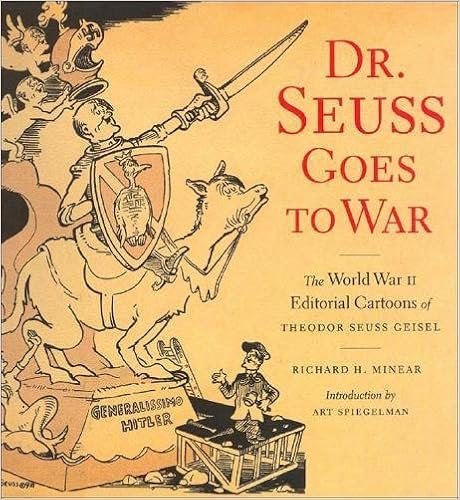
Dr. Seuss Goes to War (Minear)

Dr. Seuss Goes to War: The World War II Editorial Cartoons of Theodor Seuss Geisel, Richard H. Minear (Author), Dr. Seuss (Illustrator), Art Spiegelman (Foreword)

I'm a math teacher but I work as a substitute. One day late last month, I had a coverage in a history class, and as I sat at the teacher's desk as glanced back at his bookcase, one title jumped out at me: Dr. Seuss Goes to War.

I had known that Theodor Geisel (aka, Dr. Seuss) had done war cartoons, but I don't think I've ever seen more than a sample or two. And suddenly here they all were! (Not all of them, actually, which I didn't know until I read the text.)

I couldn't let the opportunity pass, so I took the book back to the teachers' room during my prep period, and by the end of the day, I had read all of the comics. However, I had little time to read the commentary. The good news is that the book was available as an ebook from the public library. The bad news is that this book sucks as an ebook.

Part of the problem with reading just the comics is that there are references to historical people who I hadn't a clue about. I knew (from all things role-playing materials) the Charles Limbaugh became involved in politics after flying across the ocean, but some of the other names meant nothing to me. One was a world leader while others were editorial and opinion writers. Seuss had a problem with the New York Daily News along with some other publications as well.

One of the problems with the ebook is that the comics are grouped by topic, not chronologically. And the text is heavily annotated -- there are links to each of the comics, which is great, but jumping back to the text is a pain in the backside. This is one time where it would be better to have a finger holding one page while you flip to the other. Maybe there are easier ways to do this in Kindle, but that's beyond my current knowledge of its functionality.

Another surprise reading through the book: a Horton-like elephant appears in several comics, with tusks in two of them, even though he's supposed to be an Indian elephant. At first, I thought this was a prototype, but somewhere the text (or possibly, I "googled" it) I discovered that Horton Hatches the Egg was published in 1940, which was before Seuss went to work for P.M., and created these comics. I never read Yertle the Turtle, either as a kid, or to my kids or nieces or nephews, but the proto-Yertle appears in these pages.

A fascinating read, but if you can, go for the paperback.

Post-script: When I searched for the book image and author information, I found out that the paperback was published September 2001. An odd time to be going to war, don't you think?

The Mists of Cairn Gorm: A Tale of the Am Fear Liath Mor (Povey)

The Mists of Cairn Gorm: A Tale of the Am Fear Liath Mor by Jennifer R. Povey, J.W. Harp (Illustrator) (2026) (Not a ...