Showing posts with label book club alternate. Show all posts

Friday, April 17, 2026

The Berry Pickers (Peters)

Nothing to See Here
Amanda Peters (2023)


(Not a review, just some notes to help me remember the things I've read. But written this way because it's the Internet, and some people will stumble across this page.)

This book was a Pandemic Book Club aleternate selection. It was my month to select three books, and I immediately put the books, ebooks, and/or audiobooks on hold at the libraries. I started listening to this before the vote started. It recieved no votes. I listened to the audio (Chapter 1 twice), and I think I will read the book when it becomes available, particularly if it isn't until summer. (For this reason, I included the book cover, which I don't usually do for audiobooks.)

This was not a happy book, and it was a long-term story. Early on, we know that this story is being told by the characters when they are older, but it isn't readily obvious how old they are, and that makes it a little depressing.

The story has two narrators: a woman who was adbucted as a child in 1962 and grows up to realize that something isn't right, and the youngest older brother who blames himself for her disappearance. Of the two, the Ruthie/Norma is more compelling. Joe's story seems almost pointless -- his addiction and his running away from his wife (whom he didn't know was pregnant) don't add to Ruthie's story. It's not like he sees her at any point.

Ruthie is a Mi'kmaq girl from Nova Scotia who vanishes from a berry-picking camp in Maine. The story follows the aftermath for her family and the girl who grows up in a different life, haunted by fragmented memories.

There are some inconsistencies in Norma's story. She realizes things are wrong (she's not in old photos she finds before they disappear and her skin color doesn't match her family), and later reveals that she assumes that she was adopted. But there are other times where it seems that she believes that she's her new mother's daughter, particularly after she miscarries.

Side note: the miscarriage in this book carried some weight and had some fallout, so it wasn't as bad I've complained about in other reviews where it seems like a pointless trope used to generate drama or some kind of emotional earthquake.

Also, when Norma mentions she and Aunt Ruthie cleaning out her mother's house, I got the impression (it might've been stated, or I might've assumed it) that her mother had already died. By the way, this was depressing because this memory happens early in the book. Later, Norma lives the truth before her mother's death.


*** Spoilers: ***

Ruthie doesn't learn the truth until she's in her 50s, so despite being loved by her adbuctors and treated as their real daughter, her entire life was stolen from her. Her mother's problems with having children causes Norma to decide after her miscarriage that she doesn't wish to try for more children. This causes her husband to leave her, and she doesn't remarry.

Joe doesn't get to see Norma until he's on his deathbed. Likewise, he's too embarrassed to go back just to meet his own daughter, who is accepting of him, at least. Ruthie/Norma at least gets to meet some of her birth family, but her father and oldest brother have already passed away by this point.


*** END OF Spoilers: ***

Other than it being depressing, I can't find a reason to hate it or not recommend it, if you like depressing stories like this.


If you stumbled across my page via the Internet, please check out my short book series, Burke Lore Briefs. A fantastical foursome of flash fiction and short stories.

Saturday, August 16, 2025

The Inheritance of Orquídea Divina (Córdova)

The Inheritance of Orquídea Divina
Zoraida Córdova (2021)

[AUDIO BOOK -- I don't include covers for audiobooks unless I've read them as well.]

(Not a review, just some notes to help me remember the things I've read. But written this way because it's the Internet, and some people will stumble across this page.)

This book was a Pandemic Book Club alternate selection. That is, it didn't win the group poll. However, I requested all the books as soon as the poll went up because many times there are holds for these books. The audiobook became available, so I listened to it. I don't remember what the wait was for the ebook, but since it didn't win, I didn't worry about it.

This was an enjoyable book although I might've restarted it early on because sometimes it's difficult to focus on the book while I'm out walking or because there's traffic or overhead trains running by. (I do this often.) I need to be doing something when I listen to audiobooks. I can't just sit there, not even on a subway.

The book bounces around between the past and the present. We learn that Orquidea didn't know who her father was, that she ran away with the circus, and that she had five husbands during his lifetime, so he used different names at different times.

Her grandchildren show up Four Rivers when she's dying to find out about their inheritance. There's more backstory into the grandchildren as well. In particular, we get to know a lot about Marymar, a name that is said many, many times and that I sometimes laughed at how it is pronounced for no reason. (On the other hand, I was a little annoying sometimes, so maybe I was smirking at my own annoyance.) It was later mentioned that her name meant "sea and sea" or "sea to sea", so it's either Marymar or Maramar. It's sounded more like a "y".

The story takes weird turns when Orquidea dies and turns into a tree. This is not metaphorical. And later, SPOILER, there are space aliens involved. I did NOT see that coming.

Would I consider reading this? Yes, but.

The "but" is because I'm so backed up with reading. I have the book club books, the Library Thing books (I'm 2 behind at the moment), books on hold at the library that I keep postponing and saying "deliver later", and books that I just want to read but haven't gotten around to yet. If this is still on hold, then it'll show up at some point. If it isn't on hold, there's a good chance that I'll forget about it until my end-of-year review.


If you stumbled across my page via the Internet, please check out my short book series, Burke Lore Briefs. A fantastical foursome of flash fiction and short stories.

Tuesday, July 23, 2024

52 Loaves (Alexanader)

52 Loaves
by William Alexander (2010)

(Not a review, just some notes to help me remember the things I've read. But written this way because it's the Internet, and some people will stumble across this page.)

This was a pandemic book club runner-up. I put on the books on hold, but this was available right away.

First of all, I enjoyed it much more than the Witches book (no link, if you're interested, go find it). That said, I took a couple of breaks because there were points where I just needed him to get on with it.

Also of note, I'm not sure I realized just how old this book was. There might've been a clue early on, but I obviously forget about it.

So Willaim Alexander has this incredible piece of peasant bread. He decides right then that he's going to learn how to make that exact bread, not that he's ever cooked bread before. His wife and family amuse and tolerate this. He decides that he will bake one loaf of bread a week for a year until he gets it right. The first few weeks are really bad. And those after aren't much better.

Along the way, he learns a bit about flour, yeast, levain, poosh and many other aspects of baking and where these things come from. He learns about the disease pellagra and why niacin is added to flour to enrich it along with other nutrients (and how this was not ordered by the government).

He bakes at a state fair. He contacts people to use their ovens. He grows a field of wheat to make flour in his yard in the Hudson Valley just north of NYC. He travels to Paris and Morrocco and finds himself spending a week in an abbey where he teaches a brother to bake bread after so many years not using the oven.

Informative and many parts were interesting when he was talking about other things. By the time it was over, I'd already forgotten much about the levain, etc. There were recipes from bread, but I didn't copy them down.

Sunday, January 21, 2024

I'm Glad My Mom Died (McCurdy)

I'm Glad My Mom Died
by Jennette McCurdy (2022)

(Not a review, just some notes to help me remember the things I've read. But written this way because it's the Internet, and some people will stumble across this page.)

This was a book club choice, but it got 0 votes, which is surprising because I thought I'd voted for it. It was the first one available for the library. I read it, without the audiobook. I get the feeling that the audio might've been difficult to listen to, both storywise and the way it was told.

Jennette appears to have OCD but she is diagnosed as Mormon. That attempt at humor as about on par with the tone of the book. Her mother dreamed of being a star and wanting that for her daughter. Jennette has older siblings, but she is the one that got pushed into acting. And she always did everything her mother wanted because she loved her mother and her mother loved her and wanted the best for her. Or so she believed to be the case at the time. Much of the narrative is written in the naive voice of a person who came to an ephiphany much later in life.

Unlike other Disney stars who came from wealthier background, McCurdy's family was poor, and her mother, a hoarder, delayed paying bills and kept the creditors away as best as she could. She also leans heavily into the story that she's a cancer survivor. McCurdy's big claim to fame, as far as her resume was concerned, was her ability to cry on command. THis was something casting directors looked for and it got her many parts.

Problems arose at puberty when her body started to develop and she wouldn't be able to play kiddie parts any more. Her mother encouraged her to become anorexic. Other mothers notice and told her mom, not realizing that she was the cause of it. Anorexia later gave way to bullima when McCurdy got more successful and got start binging on food.

Her big break was, of course, iCarly, where I know her from, although I likely saw at least some of her earlier bit parts. She refers to the person in charge there simply as "The Creator" and never names him. The Creator is able to control her with the promise of her own show when "iCarly" wraps up (years in the future). The first time he meets with The Creator alone, without her mother (whose cancer has returned), he gives her an alcoholic beverage, which she drinks because she wants to make him happy, and this is followed by some massaging. Not many details are giving here but when the show ends, her "team" (lawyers, agents, whoever) on a conference call tell her that there's a $300,000 bonus for her so long as she never talks about the Creator's behavior. To her credit, she calls it out as hush money and refuses to take it. To her further credit, in the book she includes her reaction after the call as "did I really just turn down $300,000?" Even after a successful series, McCurdy may be well off but she isn't exactly wealthy.

She goes into details about Sam & Cat, the followup show she did with Arianna Grande when she'd been promised her own show. McCurdy was denied chances to pursue a movie career while shooting "Sam" but Grande was allowed to leave to do singing performances. One time, she missed so many days that the episode was rewritten so that her character was locked inside a box for the duration of the episode. McCurdy had to act opposite a box and Grande's line were dubbed in later. A final straw happened when McCurdy's promised directorial debut was canceled because someone threatened to leave the show if she directed it. (Grande isn't named here, but no one else had that clout.)

Along the way, we read about her first kiss, her real first kiss, her first adult relationship, losing her virginity, and her therapists. The book is divided into Before and After her mother's death, and it's quite a while into the after that she starts to piece everything together.

This was an interesting and a quick read. I don't know if I would've read it if it hadn't come up an option for the book club (and was immediately available). Had it been a different actress, say from any of the children's shows that I didn't watch with my kids, I probably would've returned it to the library as soon as I knew that it had lost the vote.


I also write Fiction!


Thank you for finding and reading my page.
You can now order my newest book Burke's Lore, Briefs: A Heavenly Date / My Damned Best Friend, written by Christopher J. Burke, which contains the aforementioned story and a bonus story.
Order the softcover or ebook at Amazon.

Also, check out In A Flash 2020, by Christopher J. Burke for 20 great flash fiction stories, perfectly sized for your train rides.
Available in softcover or ebook at Amazon.

If you enjoy it, please consider leaving a rating or review on Amazon or on Good Reads.


Monday, May 29, 2023

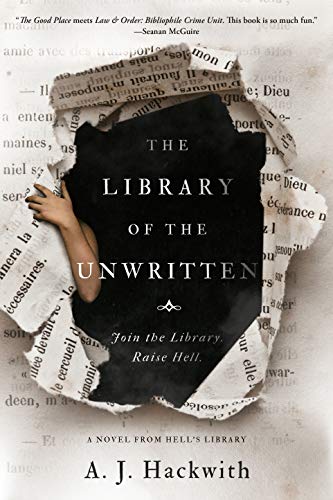
The Library of the Unwritten (Hackwith)

The Library of the Unwritten
(A Novel from Hell's Library)
by A. J. Hackwith (2019)

(Not a review, just some notes to help me remember the things I've read. But written this way because it's the Internet, and some people will stumble across this page.)

This book was one of three that was our book club was to choose from, but it didn't win the vote. After the previous month, where the ebooks were difficult to come by, I placed holds on all three books before we even voted. Since the winning book was short, and since this one seemed to be of interest, I gave it a shot. I'm glad I did. I did have to pause reading this one to read the next month's book, but I immediately came back to it.

There is a library situatied in Hell, but it isn't part of Hell and doesn't serve it. It is filled with books that were never written. It was a librarian, Claire, who used to be human, before she died. And she replaced the previous librarian, Bjorn, who is now in the halls of Valhalla (which will get visited).

Sometimes books get restless, and characters step out of them. They usually have to be sent back. Luckily, characters can't stray to far from their books, but they can take their books with them if they sneak off.

When the novel starts, a book is missing and it's made its way to Seattle. The character, who later takes the name Hero, meets his author and tries to persuade her to finish the book. This works against him because that writer started to fall from him, since she wrote him to an ideal, and when he leaves here (to go back to Hell), he leaves some pages from the manuscript. She burns them. He doesn't feel well after this. Claire attemps to repair the book with fresh pages, hoping that the story will mend/rewrite itself. In the meantime, the book rejects Hero and doesn't let him back in.

Just before they go to Seattle, a man dies but somehow manages to bring a piece of a book to Heaven. Waiting outside of the gates of Heaven, reviewing all of the souls, is the angel Ramiel, who fell with Lucifer. He's tried to redeem himself ever since, but he's been denied Heaven. He recognizes what the fragment is and brings it to an Archangel, in this case, Uriel. Uriel is portrayed as female and somewhat overwrought with emotion because the Creator has gone away (voluntarily, it would seem). The pages are from a codex written by Satan. Uriel sends Ramiel to find the rest of it, believing that the magic encased in such a book would be powerful enough to summon back the Creator to Heaven.

When Ramiel gets to Earth, he crosses paths with the Librarian, who assumes is part of the conspiracy, and depends the book. Claire, Hero, and Leto (a demon in the guise of a human on Earth) are perplexed what the fallen Watcher would want with some romance book. Before they quickly depart, Leto snatches the fragment Ramiel has, and they're back to Hell.

And now the chase is on to find the rest of the codex before its magic can be used to upset the balance of power in the afterlife.

It was an enjoyable read, with only a couple of nitpicks, but they're ones that will always bother me, like a Geometry classmate poking me in the back of the neck with the point of a metal compass.

First, every chapter starts with a journal entry, written by some librarian from present day, going back over two thousand years. Each chapter has a POV character in the title, most of whom, don't author journal excerpts. It's a little bit of a disconnect. The annoying part, for me, is that the entries are dated BCE and CE. I guess Hell has a problem with B.C. and A.D., the latter one being understandable, but the substitituion is silly. It would be just as to use After the Fall or some other metric. Otherwise, why even use Christian dating in the first place.

Moreover, rather than create their own Heaven and Hell, the author simulates a Christian version of it. Ramiel and Uriel appear in apochryphal text, and Ramiel is a fallen Watcher. Uriel can be identified as a cherub or an archangel, usually an angel of repetance, and can be shown to be as pitiless as any demon. Archangels tend to be shown as males=, so switching the gender of one (particularly when maybe they shouldn't have gender) is reasonable. I didn't envy the choice: the Betrayer, or the pitiless, emotion boss lady who seems on the verge of running afoul of a Deadly Sin or two.

Nope, the thing that bothered me, for all the re-creation, was that the "Creator", whom I don't recall ever being mentioned as "God" with a capital "g", is referred times as "she", generally by Uriel. The only God references are the titles of the two archangels who are "______ of God". But not "God" "herself".

Again, that's my nit to pick and many others wouldn't be bothered by it. If I come across this entry at the end of the year, I might think about looking for the next book in the series.

Note: the above was written on May 11. I don't know why I didn't publish it sooner.

Wednesday, March 22, 2023

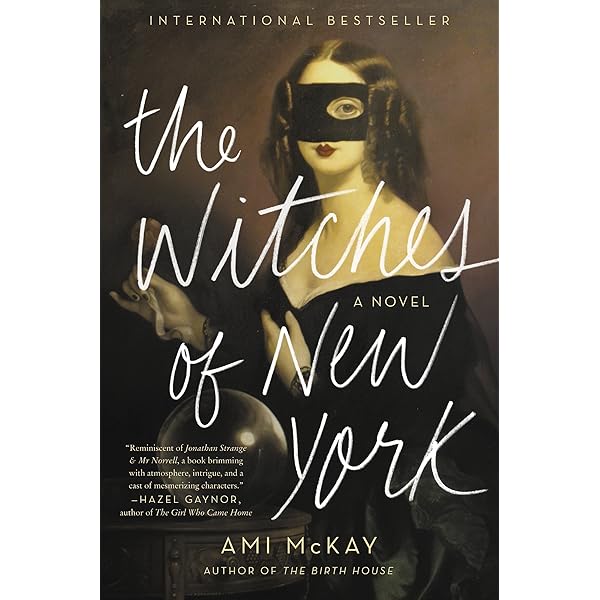
Witches of New York (McKay)

Witches of New York by Ami McKay (2023)

(Not a review, just some notes to help me remember the things I've read. But written this way because it's the Internet, and some people will stumble across this page.)

This book was one of three that was our book club was to choose from, but it didn't win the vote. After the previous month, where the ebooks were difficult to come by, I placed holds on all three books before we even voted. Since the winning book was short, and since this one seemed to be of interest, I gave it a shot. I'm glad I did.

The story takes place in New York City in the 1880s when the Brooklyn Bridge was still under construction, Cleopatra's Needle was on its way to the city (to eventually stand in Central Park) and Lady Liberty's torch, and only her torch, stood in Madison Square Park. Against all this, two witches, Eleanor St. Clair and Adelaide Thom, have a shop called "Tea and Sympathy" where they offer tea and tell fortunes. Both witches have their own specialties and their own histories. They also have a raven named "Perdu". A story from Eleanor's grimoire tells a tale that describes a bird very similar to Perdu and you're to assume that they are the same bird. Moreover, we find from a later ghost, that Perdu isn't really a bird and has an untold secret. In the author interview after the story, when asked Perdu's identity, she says that the clues are in the book, and points back to that story. So that's one mystery solved.

Side note: I learned from Good Reads that Adelaide Thom, who changed her name from Moth, actually appeared in an earlier book by McKay. There were references to her changing her name in this book but nothing came of it. Apparently, it was just to connect the characters together while allowing the character to have a new identity.

Added to this mix is Beatrice Dunn, a young woman from upstate who comes to the city. She touches the obelisk when her train is stopped to allow the obelisk to pass. Beatrice has a natural talent to see ghosts and speak with the dead.

The basic story is that there are some people who are fearful of witches (or pagans) in general, and they have a problem with the tea shop. There is a reverend who is descended from the witch hunters who wants to find one of his own. As a minor character, there is a demon that uses the reverend as a useful idiot to hunt witches so he can feed on their magic (their dead bodies).

There's a love story brewing with Adelaide, who wears a mask because of a previous acid attack that claimed one eye, and Dr. Brody, who wears a prosthetic arm to replace the one he lost in the war (Civil War, that is). Dr. Brody is interested in contacting the beyond and has a device which is, essentially, a mechanical ouija board, that Beatrice will operate blindfolded, where see can't see the responses.

The reverend kidnaps one witch (who takes her own life, after a dream with her mother) and then Beatrice. Everyone is looking for her, but the ghost of the former witch helpd her.

In the end, this is a slice of life piece, because there's no overarching story line. There are competing ones and some of them are left open. That is to say, there isn't a nice pat ending for everything. Perdu is still a bird. And the demon is still out there searching for magic, and the witches have no idea of his existence.

A little heavy at times on the feminism in that it breaks the narration to make its points, but not overly so. Frankly, I've come to expect it. Likewise, if it's a story about witches, I know that there will be an overzealous, possibly evil, priest trying to recreate Salem two centuries after the fact, as if nothing changed.

Speaking of Salem, I have two points: first, the tragedy of Salem was underscored by the fact that none of those innocent woman hanged were actually witches in the literary sense of the word. They may have been pagans, and they made have gathered herbs and brewed potions (or tea), but nothing as powerful as witches are portrayed in the "present" time. If witches had been that powerful back then, would they have been so easily captured and killed. Maybe they weren't and innocents died in their places. (hmmm, that could be a story idea.) And if any of the witches condemned to die were indeed powerful, then doesn't that take some of the stigma away from the ones who opposed them? I hope not, but it gives pause.

The second is that the author discovered in doing researched that she has an ancestor (once removed) that was hanged for witchcraft, and only because laws were changed did that woman's daughter survive. So that makes this story a little more personal.

I enjoyed this book, even more than the actual book club selection. I'm glad I read it.

On Earth as It Is on Television (Jane)

On Earth as It Is on Television Emily Jane (2023) [AUDIO ONLY -- no image] (Not a review, just some notes to help me reme...