Showing posts with label puzzles. Show all posts

Tuesday, November 15, 2022

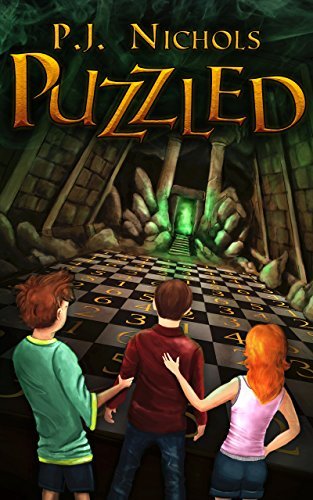
Puzzled (Nichols)

Puzzled by P.J. Nichols (2018)

(Not a review, just some notes to help me remember the things I've read. But written this way because it's the Internet, and some people will stumble across this page.)

This was a freebie in a Book Bub mailing list that I read with an eye on if it might interest my nephew. I think not, but he was his own tastes.

It's a middle-grade book, filled with puzzles and Nichols will at times stop and ask the reader if they've worked out the solution before he reveals it.

The conceit of the book is that Peter has a talent for solving puzzles. He's approached by an older man (I read this two months ago, I don't remember the particulars, which kind of defeats the purpose of this blog) who has him solve a few riddles. The man has an ulterior motive.

It turns out that there's an alien living among us and that alien can control the weather and create tornados that wreak distruction. But the alien would rather solve puzzles. And the older fellow has been creating puzzles for the alien for many years now. He wants Peter to take over. But first he must pass a challenge and he'll need a team to help him because some challenges will be brainy but others will require brawn.

Peter gets the girls he's interested in, and another frend. He also wants his older brother, but he lies to him about the competition because he figures that his brother would never believe him about a tornado-creating alien who likes puzzles. The older brother discovers the lie and quits the team right before the day of the challenge. Oh noes!

The other three go through the puzzles, figuring them all out, only to have a squeaker of a finish where the older brother runs in to save the day (someone managing to avoid all the other puzzles and make it to the finish line).

It was an okay book. I wasn't it's target audience. Your mileage may vary.

Monday, March 23, 2020

Mathematical Puzzles and Pastimes (Bakst)

Mathematical Puzzles and Pastimes, Aaron Bakst (1954)

[No image -- just a blank gray cover]

Another old math book which was fun to read and which didn't give me a headache in the final chapters (although I might've done more skimming out of disinterest).

While the topics are universal, some of the references are out-dated, such as talk of these new computers and what they will be capable of doing.

Also a little old is the first chapter on "match stick" problems. Many people do these puzzles with toothpicks as they are easier to find these days that wooden matches. (We used to have some around the house as a kid because we needed them sometimes to light the stove -- but we weren't supposed to play with them. Not because we might live them and burn ourselves, but because they didn't want them lost, broken, or scattered underfoot! Plus, people smoked.)

Many of these stick problems were familiar from puzzle books of my youth, or maybe even Boys Life, but I can't say for sure. Some of the others were easy, once you know the basics of moving sticks to make bigger, smaller, or overlapping squares. (Plus, there are a few "trick" questions to get you to think outside the box.) After that, it's a bit repetitive: e.g., move six sticks to make five squares; use the same image and move six sticks to make seven squares. Some of these puzzles you may have accidentally solved during trial and error for earlier problems. And by the end of the chapter, it seems less like brain teasers and more like busywork.

The second chapter was the interesting one. It starts with Billiards geometry (bank shot) and segues into Container Problems. Then using principles for the former, it devises an algorithm for solving the latter, or showing that the problem is unsolvable. (Container problems are the ones were you have, for example, a 12-gallon, 9-gallon, and 5-gallon bucket and you need 7 gallons of water.)

After that, it's a couple of chapters about counting systems, which are basically about using other numbers as bases. The unusual one was bi-quinary, which refers to a counting system that uses two sets of five, instead of ten. Why would anyone do this? Well, the Romans did. If you disallow the use of IV for 4 and instead use IIII (and XXXX, etc), you have a bi-quinary system. 5 I = V, 2 V = X, 5 X = L, 2 L = C, etc.

The other "fun" chapter was the "GOESINTOS", which was about divisibility, and showing it mathematically, without getting so bogged down that my eyes spun. (The notation was not standard, and for this I was grateful. Too many subscripts and superscripts combined give me a headache.) The interesting thing here was the explanation why the Divisibility by 9 rule actually works -- why should adding all the numbers and getting a multiple of 9 prove that the number is a multiple of 9? And why doesn't it work for other numbers? (Actually, it does -- in other bases.)

I could go on, but no one wants that. And if they do, they can look for book reviews on my math blog. mrburkemath.blogspot.com.

Sunday, February 22, 2009

Games for the Super-Intelligent, (Fixx)

Games for the Super-Intelligent, James F. Fixx, 1982


Picked it up in the 80s. Not a read, but a re-read, mostly for the barometer and roast beef stories. It has a lot of old puzzles, including a few that I didn't figure out and an IQ test (Mensa test?) that I filled out partially, and I could see how wrong I'd been.
Fun to read. Time to recycle it.


Carl's Doomsday Scenario (Dinniman)

Carl's Doomsday Scenario: Dungeon Crawler Carl Book 2 by Matt Dinniman (2021) (Not a review, just some notes to help...