Showing posts with label essay. Show all posts

Tuesday, September 10, 2019

Writing Science Fiction & Fantasy: 20 Dynamic Essays by the Field's Top Professionals

Writing Science Fiction & Fantasy: 20 Dynamic Essays by the Field's Top Professionals, the Editors of Analog and Isaac Asimov's Science Fiction Magazine (1993)

IMAGE COMING

Not really a review, just reminding myself about some of the details of what I read ...

If this entry seems rushed and uninspired, it's because I spent more than a half hour writing what I wanted to say, added tags and scheduled it to post the following day, and then hit the Publish button -- only for it to vanish into the ether. I just took a long lunch break and I'm trying again. I may hit the Pause button and come back tomorrow, at any time.

This book, from the editors of Analog and Asimov's science fiction magazines, was published in 1993, and it's been in my possession for nearly as long. I don't know where I got it from -- it doesn't appear to be a Book Club edition, or have a reduced price sticker from a book store. Maybe I bought it at a convention?

In any case, this was one of those books in a pile that I decided this past summer needed to be read and passed on.

The book is divided into sections on writing, science, and markets, with the last section being woefully out of date. The essays themselves are old, old even for 1993. Some were published in the magazines in the 80s, but a few stretch back into the 70s. There's even an entry on writing by Robert Heinlein from before I was born. Age doesn't adversely affect most of the book. Writing is writing, and the science is still true, except that we might know more now, and have better ways to express and calculate things. For example, one column, as an aside, explains what a spreadsheet is and how to make a simple one to handle the calculations of the article. Others might have benefited if spreadsheets had been available at the time.

The best of the Science articles is Poul Anderson's entry on how to build a planet, which covered different size stars (and why the largest ones would not have developed life yet) and the distance a planet would have to be away from these stars to have similar luminosity that Earth has. Once that's established, you can calculate the how long one revolution has to be. For the planet itself, the size will dictate the gravity (among other factors), and the axial tilt will give you seasons and habitable zones. You wouldn't have an ice planet, but you might have one where the ice portion was more habitable than the desert areas, for example. won't well for establishing colonies. And he does it will a couple of graphs, but spreadsheets would make the work so much easier.

Colonies, in my opinion, are the way to get around the "Star is too young to have developed life". And there's no reason why a colony couldn't be underground, or in an asteroid belt with a planet for a base or reference point.

A couple other notes: one essay was written by Jane Yolen, whose name only came to my attention maybe 5 or 6 years ago, but whose work I'd already been familiar with. I picket up a collection of fairy tales (some retellings, some continuations, others totally original), which included a story that seemed familiar. Going through some half-finished anthologies, I found a similar story that shared a theme. (It might even have been rewritten for one anthology or the other.) Strangely, I could almost swear that I'd heard another take of a similar tale (or the same one) on tape, but that would have had to have been in the late 90s, so I could be imagining it or mis-remembering.

Asimov's entries about what worked for him are fun to read, even though you know that this would never work for anyone else, especially today.

Again: disjointed because I'm trying to remember the first time I wrote all of this.

The other happy surprise was seeing the name Ian Randal Strock in the Table of Contents. I had the pleasure of sitting next to Ian on a panel at Heliosphere NY this past April. (The topic was "Useless Superpowers".) Just before the panel started, we had been discussing the book he had in front of him, The Presidential Book of Lists: From Most to Least, Elected to Rejected, Worst to Cursed : Fascinating Facts about Our Chief Executives (I wrote that entire name out because I'm making a note to look for a copy of it). Aside: he hated the "worst to cursed" subtitle because everyone asks him, so which one was the worst, and they're all expecting one of two answers -- and both of those people served after the book was published. Note that it is NOT that kind of book. It (as the title says) is a book of lists. Interesting stuff, not demagoguery. Second aside: I was the last one to introduce myself, and I mentioned that I co-authored GURPS Autoduel, 2nd edition in the 90s, and that got an "Oh" from Ian. Nice to know I impressed someone.

Sadly, his entry in the book was just a list of science fiction markets, which while great at the time, is woefully out of date. Many of those magazines no longer exist (although some might have folded and been revived in the past two and a half decades) and the editors of the others had likely moved on. And, of course, most of these publications now accept submissions online instead of via surface mail.

The book closes out with the actual submission guidelines for both Analog and Asimov's, which are great as historical documents, but not much else.

Glad I finally read it. I'll be happy to pass this one on. And I made quite a few notes from Anderson's piece in case I ever try to place things in a hard sci-fi environment. Not likely, but who knows.

Saturday, March 9, 2019

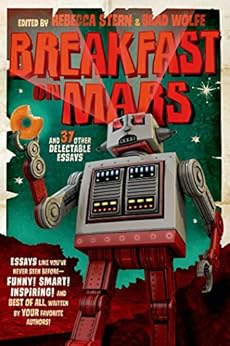
Breakfast on Mars (Stern & Wolfe, ed)

Breakfast on Mars And 37 Other Delectable Essays, Edited by Rebecca Stern & Brad Wolfe (2013)

The cover states "Essays like you've never seen before -- Funny! Smart! Inspiring! And Best of All written by YOUR Favorite Authors"

The last part is overblown in that not only are they not my favorite authors, I don't think I've ever heard of any of them, let alone read any. That said, soe of them were funny and smart. Inspiring? Maybe about my writing, but not about the subject matter.

I picked up this book in a box at a school I was working at in the fall. The idea of the collection is that students tend to be bored with essay writing, and there isn't a lot of inspiring essays out there that are relatable for students. So this book is intended for teachers to use with students, so that the students will respond. Each essay, whether personal, persuasive, or information, is based on a response to a different writing prompt. And each should be fun to read.

Some of them were fun. Some were just odd, but that was okay. But a few seemed like standard essays, and a couple seemed like they'd been written before they even saw the prompt.

The overall affect was like catching up on an eclectic bunch of TED Talk podcasts, with topics all over the place. I enjoy some of those, while I listen to others on double speed, or skip through them entirely.

And while the personal stories were interesting, the introduction promised breakfast on Mars, showering with spiders, and humans needing tales. That's what I wanted to read. "It's on Like Donkey Kong" was a nice bonus. (That phrase is so well-established in my circles that we can parody it into something else). Likewise the comparison of Princess Leia and Queen Amidala. So of the other entries, I've already forgotten, even when I like back at the table of contents page.

I did like reading the prompt at the top of each essay, and I toyed with repeating them either here or on my (private) writing blog, but do I really want to type up 39 prompts? One-handed, while holding the book open with the other? Probably not.

For anyone who stumbled upon my personal reading blog, if this sounds interesting, check it out.

Monday, December 31, 2018

Rocket Fuel (McGovern, Lough)

Rocket Fuel: Some of the Best of Tor.com Non-Fiction , Bridget McGovern and Chris Lough, ed. (2018)

Even though I'm on the mailing list for Tor.com, probably since the first time I downloaded a copy of 1632 or something else, I rarely check out their website unless I see links to specific articles posted elsewhere on social media. One such link brought me to this ebook.

I didn't know what to expect from the title. Well, that's not exactly true. I know what I expected: non-fiction with a name like "rocket fuel" meant that this should've been a lot of stuff about space and planets and stuff like that. That's not what it was. That's not to say what I got was bad, just unexpected.

Even though this is a work of non-fiction, many of the essays deal with fiction, from the perspective of fandom, or just deep analysis of some facet of the work. I enjoyed some more than others, and some I might've enjoyed more had they been about half the size. Seriously, most of the stuff I read on the site is short by comparison to the pieces included in this book. Again, not a problem, but when I realized just how much was being written about Galadriel, I took a break, moved on, planning to get back to it.

Additionally, two back to back essays about Robert Jordan were interesting, but I haven't read anything of his. No, haven't started Wheel of Time, and I've had friends who have warned me away from it -- even as they are drawn into it.

The most interesting piece, at least for quirkiness, has to do with the anatomy and diet of centaurs, taking a scientific look at a fantasy staple, and pondering just how it gets enough nutrition to survive. Digestion problems abound.

A couple of essays started off too well about things I hadn't read, causing me to stop, lest the books or stories be spoiled. Not that I know if I'll read those any time soon.

On the social justice warrior front, there are important notes from affected folks, but overall, stuff I'd heard or read before and I found myself moving on before getting halfway through many of the entries after the first couple.

I guess I was skipping ahead looking for ice volcanoes of Neptune or realistic flying cars for Mars. Or just notes on rocket fuel.

Wednesday, July 25, 2018

On the Decay of the Art of Lying (Twain)

On the Decay of the Art of Lying, Mark Twain (1882)

You can't go wrong reading Twain, essentially if it's just a short essay. People lie, but there is an art to it, and Twain noticed that the Art of it was dying.

In short, lying is polite. Lying is fine when the truth would serve no good purpose, only ill. But imagine it written in a more witty style.

Recommended.

Carl's Doomsday Scenario (Dinniman)

Carl's Doomsday Scenario: Dungeon Crawler Carl Book 2 by Matt Dinniman (2021) (Not a review, just some notes to help...