Showing posts with label nonfiction. Show all posts

Wednesday, July 15, 2026

Everyone Kept Quiet So I Did Too (Djukičin)

Everyone Kept Quiet So I Did Too: Tales of a Reluctant Soldier:
A Graphic Novel About the Balkan Wars of the 1990s
by Đorđe Balmazović (Author), Aleksandar Djukičin (Author) (2026)


(Not a review, just some notes to help me remember the things I've read. But written this way because it's the Internet, and some people will stumble across this page.)

This book was a free Advanced Reader Copy from Library Thing. I'm encouraged (but not required) to leave reviews in exchange for the free books.

I saw that there was a graphic novel, so I requested it even though it's an ebook and not something that I can share with my classroom.

As I noted on the LT page, this is more of an illustrated memoir than it is a graphic novel in the usual sense but it's still enjoyable.

The artwork changes sometimes but it fits the story.


I left the following review on the Library Thing website:

This is more of an illustrated memoir than a proper graphic novel, but that's a minor distinction that doesn't distract from the story at hand, namely the absurdity and futility of war and its effects on the people fighting it. In this case, it's the story of a soldier fighting in the war between Serbia and Croatia in 1990 and managing to survive it.

The artwork isn't as simplistic as the cover might suggest. That style (where the soldiers look almost like bowling pins, or old-style bottles of soda with the tops still on them) is used in certain situations while more traditional artwork is used elsewhere.

This was a quick read and I enjoyed it.


There isn't much more to add. It was a quick read. I was done before sooner than I expected to be.


If you stumbled across my page via the Internet, please check out my short book series, Burke Lore Briefs. A fantastical foursome of flash fiction and short stories.

Thursday, June 11, 2026

Everything Is Ok (Tung)

Everything Is Ok
by Debbie Tung (2022)

(Not a review, just some notes to help me remember the things I've read. But written this way because it's the Internet, and some people will stumble across this page.)

I saw this book listed as a recommended graphic novel. I don't remember where, or if it was in one of the lists of nonfiction that I was scanning (probably). It mentioned it was from the author of "Quiet Girl in a Noisy World", which sounded familiar. I requested both from the library. This one arrived first, but I waited for the first one before reading both. What I didn't realize is that Tung has published several other books in between the two, but this one continues the themes of the first book.

And it takes those themes to a really dark place.

Tung gives an account of living through a panic account and the stress, anxiety, and depression that accompany it. She details the ongoing troubles continuing to work her first job when trying to earn commissions for her artistic work. It goes well beyond just being shy and introverted.

Unlike Quiet Girl in a Noisy World, this book isn't episodic. Each page doesn't have a (self-deprecating) punchline or even a conclusion. The narratives continue for pages at a time, particularly in the beginning of the book. We are included in her therapy sessions, and we are witnesses to her internal thoughts.

I can see why this book came so highly recommended, and I'll add it to my recommended reading list next year if I get to teach this course again. Hopefully, I can acquire a couple of copies.

I'll also check out some of her other books that are more about her life as an introvert. (One is about books.)

Note: I added "memoir" as a tag to this one because the panic attack is central to the book. I didn't add the "biography" tag because it's not really a life story.


If you stumbled across my page via the Internet, please check out my short book series, Burke Lore Briefs. A fantastical foursome of flash fiction and short stories.

Friday, June 5, 2026

Quiet Girl in a Noisy World: An Introvert's Story (Tung)

Quiet Girl in a Noisy World
An Introvert's Story by Debbie Tung (2017)

(Not a review, just some notes to help me remember the things I've read. But written this way because it's the Internet, and some people will stumble across this page.)

I looked for recommendations online for nonfiction graphic novels that I could mention to my class to show them that that not everything is superheroes. I did have an interest in history -- anything that they could tie into their studies. I've mentioned George Takei before. And I was hoping to find examples about the American Revolution with America 250 coming soon. (Side note: anything from that time period would be works of fiction. "Creative nonfiction", whatever that actually is, would be the closest thing. I've seen such books at the Dyker Heights library.)

Among every list are Persepholis and Maus, though it took time for the latter to be nonfiction because of the imagery used. A lot of other nonfiction books seemed to deal with tragic issues like war in their homeland, poverty, emigrating to America, racism. It almost made me wish for run-of-the-mill teen angst -- almost. But, I had to be honest, what tops the nonfiction charts for regular books? Usually issues. Graphic novels combine these with compelling stories to varying degrees, and the trick is to get you to care, even if for only a couple hundred pages.

Quiet Girl in a Noisy World: An Introvert's Story caught my attention as it was something that I thought I could relate to. Most people who know me would say I wouldn't know anything about being an introvert. Some people who really know me, might say otherwise, maybe. There was a period were I thought my awkward extrovert moments were covering up for my introverted tendencies. And sometimes it was the reverse.

However, over the years, I've met some real introverts, and I'm not sure that I could count among their numbers, so maybe there's something else going on.


And that digression brings me back to the book at hand. I actually got the second book first from the library, but I waited to get this one to read either one.

Debbie Tung is a cartoonist. This self-referential book is more episodic than an actual story, but it does move forward with life even if even page (or two) seems to be a standalone strip. It's more cohesive than the recently read Huda F book, Yes, I'm Hot in This. (Side note: I was attracted to the title "Huda F Cares" and then went back to the first book in the series.) The Huda book just seemed with endless "gag" strips, many of which seemed to repeat, at least in theme. Granted, that repetition could stem from the fact that she hears those comments constantly.

In Tung's book, any repetition seems to reinforce what she's already feeling, even as she moves forward with her life, or as she retreats back into the familiar in her life. And she celebrates little victories even while she's completing major achievements.

I enjoyed this book. I might buy a copy of this for my classroom next year if I'm given this class to teach again.


If you stumbled across my page via the Internet, please check out my short book series, Burke Lore Briefs. A fantastical foursome of flash fiction and short stories.

Saturday, April 11, 2026

Class Is in Session: Teaching Through the Chaos (Patt)

Class Is in Session: Teaching Through the Chaos
by Shantel N. Patt (2026)


(Not a review, just some notes to help me remember the things I've read. But written this way because it's the Internet, and some people will stumble across this page.)

This book was a free Advanced Reader Copy from Library Thing. I'm encouraged (but not required) to leave reviews in exchange for the free books.

I left the following review on the Library Thing website:

Ms. Patt's background is not my background, and her experiences are not my experiences. However, I recognize her struggles and her frustrations because they're basically universal for all teachers. (I teach a higher grade level, and in a different part of the country.)

I recognize the signs of burnout and the uselessness of yet another PD (professional development) day. Few of those ever prove helpful because they weren't practical, or because they espoused methods or technology that never got put into practice, or whatever.

The suggestions found in these pages (as opposed to any library of random PD binders) will be more helpful to any new teacher and maybe the experienced ones as well. You're not alone -- there are others around you for support, and they're going through the same things.


Nothing to add. I requested this book because it was a memoir, which is on my 2016 reading list, and because it was about teaching. And it was short. Sad to say, I'm picking a lot of shorter books that aren't in series.


If you stumbled across my page via the Internet, please check out my short book series, Burke Lore Briefs. A fantastical foursome of flash fiction and short stories.

Saturday, February 7, 2026

Clarkesworld Magazine, Issue 208 (January 2024)

Clarkesworld Magazine, Issue 208
edited by Neil Clarke (January 2024)

Online: https://clarkesworldmagazine.com/prior/issue_208/

(Not a review, just some notes to help me remember the things I've read. But written this way because it's the Internet, and some people will stumble across this page.)

Neil Clarke is the editor of a fabulous online science fiction magazine, Clarkesworld. (Note: I have submitted many stories to Clarkesworld. As of this writing, I have not been accepted. That doesn't mean I won't stop trying, nor does that bias this review in any way.)

If I've been informed correctly, when Neil goes to conventions, he brings along paperback copies of his magazine that didn't pass quality control. This book in particular is stamped on the inside front cover: This Is A Misprint. The cover failed quality control but the inside is fine.

This cover evokes a Christmas scene to me, mostly in the covers, but also there's a child and robot. However, a closer look would suggest it's spring because of the birds and the flowers on the bushes. What I thought at first to be lights are actually butterflies.

I must've picked this up soon after it was published because this was a magazine that I was reading in the pool in the summer of 2024! I didn't finish the book, so I brought it to school and assumed that I'd read it during lunch and then leave the book in a Little Free Library during one of my walks. But I never got around to reading that last four-page story. And then I left the book here for summer 2025!

I made a resolution to start reading some of the books that are piling up behind my desk in school as much as they are in my bedroom and basement.

I finished this, but I have to skim the front to remind myself of the other stories because it's been a while. Also, there's a nonfiction article that might be worth reading that isn't an interview.

The stories include: note, I finished this a couple weeks ago and have read other books and start a new issue

  • Nothing of Value by Aimee Ogden. (I know Ogden as an editor that I've submitted to and I believe I've read her work before as well.) This story involves teleportation by "Skip" technology where one body is destroyed and another one is created. It reminded me a little of how it worked in Dark Matter, where a new body was created (except that one was temporary) and when you traveled back the new memories went with you. In this story, the heartbroken and jilted lover comes back to Earth without the new memories, so he's basically forced to repeat his trip because he doesn't know what happened, and it apparently plays out about the same every time. (The narrative bothered me a bit in the way the narrator spoke.)
  • Down the Waterfall by Cécile Cristofari.
  • Binomial Nomenclature and the Mother of Happiness by Alexandra Munckown the Waterfall by Cécile Cristofari
  • tars Don't Dream by Chi Hui, translated by John Chu.
  • Just Another Cat in a Box by E.N. Auslender.
  • Rail Meat by Marie Vibbert.
  • You Dream of the Hive by C. M. Fields.
  • You Cannot Grow in Salted Earth by Priya Chand.


If you stumbled across my page via the Internet, please check out my short book series, Burke Lore Briefs. A fantastical foursome of flash fiction and short stories.

Tuesday, December 23, 2025

Understanding Comics (McCloud)

Understanding Comics
Scott McCloud (1993)


(Not a review, just some notes to help me remember the things I've read. But written this way because it's the Internet, and some people will stumble across this page.)

Every source, from TED Talks to web pages to actual comic people that I know, tells me that Scott McCloud literally wrote the book on Understanding Comics. He's actually written a few. And he will reference Will Eisner as the guy who wrote the book before him.

Understanding Comics is a book I would've bought back in August if I knew I was going to be teaching two classes in Graphic Novels. I was told on the first day of school and wasn't given any curriculum or guidelines to work with. For the record, I'm a math teacher (and still teach math the rest of the day). I'm neither an English teacher nor art teacher. However, the administration knows that I like to write so this idea occurred to them.

Note that I write prose, not comics. I do (did?) have a webcomic for many years, but that was a joke per day, not a continuing story, and it wasn't anything artistically special. It was loaded with bad puns, and you can't teach that. Maybe you can teach timing for it ... but that's another story. And, let's face it, they weren't aware of the comic.

The book is nonfiction but it's written as a graphic novel or just a giant comic. McCloud illustrates himself and plays with the surrounding to take about what makes comic books work and what makes them "art". He includes reproductions of many old comics and paintings to make his points.

I did get a bit more understanding and comprehension (just to use a different word) of the topics within the subject, so that was good. And if I'm giving this class next fall, I'd juggle some of the earlier vocabulary lessons. This is, I was stumbling in the dark. However, several comments he made make more sense in the order he mentioned them. So maybe I should go that way next time.

If nothing else, the topic of Sequential Art should've come in the first week.

I may buy this paperback as an ebook just so I can take screenshots.

This was a fun read, and I got to read it in my classroom during Free Read Fridays where I allow my students to read graphic novels ... most of which I had to provide, with the help of Little Free Libraries and a couple of nice donations.


If you stumbled across my page via the Internet, please check out my short book series, Burke Lore Briefs. A fantastical foursome of flash fiction and short stories.

Friday, August 8, 2025

Write Something (Levenberg)

Write Something
Mitch Levenberg (2015)


This was not the cover of the book that I read, but that image doesn't seem to be available anywhere online

(Not a review, just some notes to help me remember the things I've read. But written this way because it's the Internet, and some people will stumble across this page.)

I'm not sure where this book came from. It either came out of a Little Free Library, or I brought it back from Readercon in Boston. I think Boston is probably the correct answer because I don't think I've had it for very long. It feels like I just got this, and that it hasn't been in my basement for a couple years. There are no stamps to indicate it was owned by a school or a library.

This book is 17 short essays (columns?) about reading, writing, Brooklyn, Flushing, Coffee, Cuban Coffee, Mosquitoes and whatever. Okay to read. Nothing memorable.

That's the summary. There isn't anything more to say about it, other than, if this can be a book, then I can write books, too.


If you stumbled across my page via the Internet, please check out my short book series, Burke Lore Briefs. A fantastical foursome of flash fiction and short stories.

Wednesday, August 6, 2025

In the Margins: They found their place by not fitting in (Shea)

In the Margins: They found their place by not fitting in
John Shea (2012)


This was not the cover of the book that I read, but that image doesn't seem to be available anywhere online

(Not a review, just some notes to help me remember the things I've read. But written this way because it's the Internet, and some people will stumble across this page.)

This was a book that I borrowed from school last summer but didn't read until this one. I found it (and many, many others) shut up in a locker in the back of my classroom that I practically had to pry open.

This book is essentially two half-books. The first half is about Sherman Alexie, author of The Absolutely True Diary of a Part-Time Indian (which I also saw in that classroom locker), his life growing up on and off of the reservation. The second half is about Julia Alvarez, author of In the Time of Butterflies, and her life growing up and leaving the Dominican Republic.

It was a quick, informative read. I can't say I've heard of either one of them before, but I am aware of them now. Ms. Alvarez has quite the bibliography, so I might pick something out to read at a later date.


If you stumbled across my page via the Internet, please check out my short book series, Burke Lore Briefs. The fourth book will be available by the time you see this!

Thursday, July 31, 2025

The Magical Life of Long Tack Sam: An Illustrated Memoir (Fleming)

The Magical Life of Long Tack Sam: An Illustrated Memoir
Ann Marie Fleming (2007)

(Not a review, just some notes to help me remember the things I've read. But written this way because it's the Internet, and some people will stumble across this page.)

I picked up this graphic novel at the same time that I picked up Pedro & Me, which I read back in 2018. I read that one (mostly) in the pool, and I started this one. Then summer ended, and this got pushed to the side and I lost track of it. Both books came from the Port Chester-Rye Brook Public Library, which means I likely acquired them at Lunacon.

Who is Long Tack Sam? That's the question that his granddaughter wanted to answer while writing this book. It contains many images, illustrations, and photos of programs and posters about the famous Chinese magician. And he was famous back in the days of Vaudeville and beyond. So much so that I'm surprised that I never heard of him, particularly when he's picture with so many peope who I have heard of.

It could be because he retired and left the United States, returning to Austria, where his wife was from.

This was an interesting book to read and a good use of the graphic novel format. There were little history lessons in the margins, a chronology of world events so the reader could put Sam's life in context.

If they made a movie about him, I'd watch it.


If you stumbled across my page via the Internet, please check out my short book series, Burke Lore Briefs. The fourth book will be available by the time you see this!

Monday, December 9, 2024

Clarkesworld Magazine, Issue 173 (February 2021)

Clarkesworld Magazine, Issue 173
edited by Neil Clarke (February 2021)

(Not a review, just some notes to help me remember the things I've read. But written this way because it's the Internet, and some people will stumble across this page.)

Neil Clarke is the editor of a fabulous online science fiction magazine, Clarkesworld. (Note: I have submitted many stories to Clarkesworld. As of this writing, I have not been accepted. That doesn't mean I won't stop trying, nor does that bias this review in any way.)

If I've been informed correctly, when Neil goes to conventions, he brings along paperback copies of his magazine that didn't pass quality control. This book in particular is stamped on the inside front cover: This Is A Misprint. The cover failed quality control but the inside is fine.

As with last month's issue, I didn't see anything wrong with the cover I have, which looks like the cover shown above.

Being that this is summer, this book was mostly pool reading.

The stories include: note, I finished this a couple weeks ago and have read other books and start a new issue

  • The Failed Dianas by Monique Laban. In the future, Diana comes down to Earth to a restaurant to meet herself. The original version she was cloned from. The original's parents weren't happy, apparently, at how she turned out, so they made another and another. And they all have their own special interests that they chose instead of what they're parents wanted. She meets DeeDee, 3D and Dr. Diana and they bring her up to speed, just as they were brought up to date. It was a fun little tale.
  • Terra Rasa by Anastasia Bookreyeva, translated by Ray Nayler. Everyone is on the trains to get to the ships to escape the fires to get to the better place. People are scheming to get where they need to. The narrator has a pass to get her through. She's watching people. There are others who could use it. It has a twist ending.
  • Obelisker Adrift in the Desert by K. H. Meridian. Another long one, but fewer than 30 pages. The narrator is an obelisk and gets called Obelisker by Kouya who survives a crash after an attack. The obelisk is an old station. The two have an easy truce. Plus she's wearing tactical gear and has special training. She leaves for a time to visit another village that obelisk watches without letting them know that the obelisk exists and is functional. Then there's an attack that must be repelled. Good story. Not like some of the other longer ones.
  • "Remember the Washington" They Said as They Fed the Ugoxli by Jeff Reynolds. A quirky title, and I had to go look up what an "ugoxli" was because there have been a lot of aliens lately. No, I guess the story didn't resonate enough for me to remember.
  • History in Pieces by Beth Godor. A story told as a series of puzzle pieces, but not all of the pieces are there, nor are they presented in order. The first is 37, with Cassandra stepping onto the surface of the planet, and the last three are 1005, 1006, and 1. It starts with the people on the ship not seeing an Archivist, but Archivist Tan is telling much of the story. It was an interesting approach. (Once again, I am writing this after 3 months after reading it and I rememeber little about it.)
  • Terra Rasa by Anastasia Bookreyeva, translated by Ray Nayler. People on a train are headed to Murmansk, to the bay. They need to get to the ships there. The world is ending and the ships (sea, not space) are taking survivors to a better place, if they have passes. The narrator does, but there are others who do not. And others who will do what they must to get on the ship. The woman decides to stay with a child who has no one. But the ships that sail away aren't going anywhere. There's nothing left out there. An interesting, if not depressing, story.
  • Mercy and the Mollusc by M. L. Clark. Another long one, with chapter titles (or section titles). It plays out like a western on another planet, but the steed in this case is a large mollusk creature name the Oomu, which is very mucusy. It's easy to ride. And one point, it attacks a kid and covers it with a mucus membrane so it can't escape, but it doesn't attempt to eat it either. It then goes off on its way and the rider has to figure out what to do. Again, there's more to it, but I don't remember. It was interesting, but too long. Wish I remembered more.
  • We'll Always Have Two Versions of Pteros by Dominica Phetteplace. A shorter one with section numbers. The sections titles are names, many followed by 1 or 2. Barry believes that he's in the wrong timestream and that he's supposed to be somewhere else, namely on the Pteros. However, the Pteros has been destroyed, in this reality, at least. Lily thinks it's survivor's guilt because Barry knew people on the ship. Barry 2 was lost in space for a year and then he woke up next to Lily. It flows nicely.

The Nonfiction section of the book includes

  • There are two interviews, an article about Peter Pan through the ages, and the 2020 reader's poll finalists. Interesting to note that there were ten stories listed for Best Story because there was a six-way tie for fifth place. Out of then stories, none were in the December issue that I'd read. "The Helicopter Story", which I haven't read but I know about because of the big splash it made in social media before the content was pulled, was nominated. I wonder if it won. I saw (a few months back) that it was available on a different website if I wanted to read it. Maybe at some point, but I'll more likely forget about it.

And that's this issue. An interesting issue, and I'll keep reading. I have at least one more that I've picked up at conventions, and the content is free online. Problem is that I can't read online magazines on the subway. (And, of course, pool weather is over for the year -- not that I'd take my ipad into the pool.)


If you stumbled across my page via the Internet, please check out my short book series, Burke Lore Briefs.

Friday, August 30, 2024

Clarkesworld Magazine, Issue 172 (January 2021)

Clarkesworld Magazine, Issue 172
edited by Neil Clarke (January 2021)

(Not a review, just some notes to help me remember the things I've read. But written this way because it's the Internet, and some people will stumble across this page.)

Neil Clarke is the editor of a fabulous online science fiction magazine, Clarkesworld. (Note: I have submitted many stories to Clarkesworld. As of this writing, I have not been accepted. That doesn't mean I won't stop trying, nor does that bias this review in any way.)

If I've been informed correctly, when Neil goes to conventions, he brings along paperback copies of his magazine that didn't pass quality control. This book in particular is stamped on the inside front cover: This Is A Misprint. The cover failed quality control but the inside is fine.

As with last month's issue, I didn't see anything wrong with the cover I have, which looks like the cover shown above.

Being that this is summer, this book was mostly pool reading.

The stories include:

  • Intentionalities by Aimee Ogden. I recognized the name by it took a moment to place her. I haven't read her before, but Aimee is an editor that I have submited (but not sold) to. The story is of a woman named Sorrel who agrees to have a child to "confer" to the Braxos Corporation for ten years. It's not "slavery", it's training for any job they could want afterward. She's inseminated, has the baby, Abigail April, and raises her for a few years as best as she can with the stipend she got from Braxos to help make ends meet. Naturally, she has regrets about letting Abigail go but can't repay the money. Sorrel joins an advocacy group and searches the dark web, but she doesn't see her daughter for 10 years. Abigail asks her if she's her mother, and Sorrel doesn't believe she deserves that title. Sad, chilling. I prefer happier endings, but there wasn't a way for a happy ending out of this in a short story, just growth and regret.
  • Deep Music by Elly Bangs. Quinn has an "aquid" capture and rehabilitation center. Aquid are watery creatures that get removed from homes like squirrels and stray cats. She keeps them in jars and has one that she's given a keyboard to and that the aquid types on. It becomes obvious partway through that the "gibberish" text is going to start making sense, which it does. There's also an adversary exterminator who wants to wipe out the aquids and cause trouble for Quinn. He's the weak point of the story. It was interesting but predictable, really, though maybe not the exact outcome.
  • Philia, Eros, Sturge, Agaipe, Pragma by R.S.A. Garcia. As the expression goes, once bitten, twice shy. I wasn't sure if I wanted to venture into another novella after left month's novella. This one had a prologue that had Brother-Adita, recon drones, and shells, and I wasn't sure what was going on. Page 2 started the Philia section which subsections of Now, Then, Now, Then, Before, which was a little confusing. When it got to the Eros section, I hadn't noticed a change but by then I realized that people weren't speaking but signing or indicating their language which was why so much of the "speech" was in italics. I lasted 20 pages without much of a clue what was going on or what the timeline was, and I gave up. If it hadn't been for the December novella, I might've stuck it out. But I was getting a headache.
  • The Last Civilian by R. P. Sand is another story that just drops you into the future and leads you to figure out where you are and what you are doing. Literally, in fact, because it employs Second Person storytelling, and I never had a grasp of who this "You" was supposed to be, even though "You" is in every section title. (A lot of section titles in this issue.) You are a generic, genetic soldier, but there are others referenced in the story so it's hard to imagine an unnamed soldier bearing witness to all this and interacting with the characters. The story starts by introducing the reader to the Uilai of Uiloolea, who was flamingo-like with antlers. And then the action shifts to the humans who they are at war with. The humans are clones, developed to be adults at activation, and You are part of the 8th generation, making Your name Eta and a number. It turns out that the war has not been going on for as long as the clones are taught to believe and they aren't as old as they think. Basically, it reminded me of a Donna Noble story.
    In the end, we come full circle and meet the Uilai who has been telling this story to You and seems to know everything You did and whom You talked to and what You said. Sure, the Uilai could know all this, but why bring it all up?
    The story was okay.
  • Aster's Partialities: Vitri's Best Store for Sundry Antiques by Tovah Strong. Syd was a magician and she was executed in multiple ways, but she survived in the mirrors of a house that her death created. The house narrates the story as a "we" that sometimes eats people who visit, and then it has to move afterward. A child (always referred to as "child" and "they") named Mor shows up with one of Syd's talismans, so the house protects Mor. THis is another story with multiple sections and other than the first, I couldn't decode what they referred to. I enjoyed it. Definitely above average.
  • Leaving Room for the Moon by P. H. Lee. Two children, a boy and a girl, are taken from their planet and brought to the world of the Emperor of All Space and Every World. Some 65,000 years have passed since they've left home and everything that they knew of is dead and gone. Meanwhile, the shine came off the palace and the world many millenia ago. They are presented to the emperor who tells them that the demiurgist can create anything that they desire, but the record of what was doesn't match the memories. Not a bad story, but not a great one.

The Nonfiction section of the book includes

  • There are two interviews. The first was with Connie Willis, whom, as much of a fan of scifi that I am, I should've heard of and been more familiar with. The other is with E. Lily Yu, who won a writing contest at 15 and has been writing since. Neil Clarke presents a list of all the stories published in 2021 that are eligible for their own best of awards as well as for the Hugos. Finally, there's a blurb about the cover artist. Once again, I don't believe it goes with any particular story. It shows a girl, probably a fairy, in a sealed jar with flowers and tree and a butterfly. Imagine Tinkerbell in a terrarium, but without wings. Again, this cover would've been considered defective, which is why the issue was given away from free. I don't see any issue with it myself. The online image is a little more vibrant. Also, the back cover, which is a closeup of the front cover without text seems to be off-center, so that might've been the problem.

And that's this issue. Not a great second issue for me. Let's hope February 2021 will be better. And let's hope there's still some pool weather left or this becomes subway reading material.


If you stumbled across my page via the Internet, please check out my short book series, Burke Lore Briefs.

Friday, August 2, 2024

Clarkesworld Magazine, Issue 171 (December 2020)

Clarkesworld Magazine, Issue 171
edited by Neil Clarke (December 2020)

(Not a review, just some notes to help me remember the things I've read. But written this way because it's the Internet, and some people will stumble across this page.)

Neil Clarke is the editor of a fabulous online science fiction magazine, Clarkesworld. (Note: I have submitted many stories to Clarkesworld. As of this writing, I have not been accepted. That doesn't mean I won't stop trying, nor does that bias this review in any way.)

If I've been informed correctly, when Neil goes to conventions, he brings along paperback copies of his magazine that didn't pass quality control. This book in particular is stamped on the inside front cover: This Is A Misprint. The cover failed quality control but the inside is fine.

Personally, I don't see anything wrong with the cover. That said, I just went over to the webiste to look at Issue 171 and I can see that the issue is much sharper.

Being that this is summer, this book was mostly pool reading.

The stories include:

  • The Island of Misfit Toys by Fiona Moore, a tale of an old homeless man who starts to resemble Santa and who used to program AI toys who finds ways to survive until one day he's beat by teens in a prank that goes too far. He finds himself in a junkyard along with some discarded toys and robot dogs, which he sets out to repair. It's a fun little tale.
  • Things That Happen When You Date Your Ex's Accidentally Restored Backup from Before the Breakup by Lisa Nohealani Morton is a mouthful of a title. Once I was able to parse it correctly, I thought it an interesting premise for a story, but it just didn't work for me. As you can guesss, it's set in a future where cloning is a possibility and it's the type of cloning where you can "awaken" or "download" a consciousness from a memory drive of some point (as opposed to having a clone baby). Such a future is not free from bureaucratic errors (transposing numbers) and making mistakes. This much I liked, and applying it to a relationship where the partner doesn't know about the breakup is a fun twist. Unfortunately, other parts don't work for me. The politics, for one thing, with the whole resistance plot. And the other thing I'm on the fence about is that it's written in second person, you, and the ex is always referred to as "they", so you can imagine whatever genders you wish here. Second person stories are difficult to write, but I give it the benefit of the doubt here because it made it by the editor. It was a bit of a slog. Your mileage may vary.
  • The Last Days of Old Night by Michael Swanwick was a fanciful tale of three near-omnipotent beings (Goat-Eater, Bone-Grinder, and the unnamed, mute one) traveling the long night, creating things and clearing obstacles with mere thoughts. A probelm arises when they get to a sea that they can't bridge nor ford. They are then informed by the locals that the old night will soon end because the day is coming which will end them all. The beings manage to turn back time ten years so that the local people can create a boat big enough to beings to escape the day. It reads like an old folktale, and in the end, we learn what inspired it. I did a search in this blog for Swanwick, but I didn't find any results. The name looks familiar (not surprising given the awards he's won). His bio says he's from Philadelphia, so it's possible that I've encountered him at sf/f cons.
    Edit: Not three hours after I typed the above entry, I got a Facebook suggestion of "People You Might Know" for Michael Swanwick. We have 13 mutual friends! LOL.
  • Conversations in the Dark by Robert Reed was not a favorite. Stories are subjective, of course. The problem with novellas is that they take up a lot of the book, and if a novella doesn't pull you in, you can either stick it out until it does, or stick a large chunk of the book. I stuck it out. It was an odd story. There's a tank that can hide a person where nothing would detect it from outside. Then we're on a great ship in space, the greatest prize in the galaxy, an ancient ship. The people on it live for centuries and change appearance and gender when they sleep. And then it turns out that these people are human, so the human race must've evolved a bit and this story must take place really far into the future. I read a couple sections at a time and put it down to read other things. This probably hurt trying to immerse myself in the story, instead of thinking what I'd do with a great ship in a story. But I made it through.
    Reading the bio, I see that Robert Reed has written over 300 stories, including several "Great Ship" stories, so maybe I needed to know more background for this to have made more sense to me. And I'm guessing that the editor is better read than I am.
  • No Way Back by Chi Hui, translated by John Chu, was an interesting story. Xia Xuejano isn't who she seems to be, and neither is her talking cat Aksha. It's in a future where talking cats aren't unusual as science has advanced there. But not as much as the online world has advanced. A man comes looking for Xuejano because he wants her to find her daughter. The daughter's body in in a hospital ICU but the person inside isn't her. In the future, not only can individuals jack into the net, they can abandon their bodies and live on the net. They usually regret this, if they live long enough and aren't carved up for data. That's why someone else would welcome the chance to jump into her body with some of her memories, without being her daughter. It doesn't have a particularly happy ending but does raise some interesting issues.
  • Forward Momentum and a Parallel Toss by Ana Maria Curtis takes place in a small town (Madrid) where football and farming are a big thing. Matching bands are now automatons. And farming equipment is protected IP. Lacey and her students want to do something about that. Alex, Lacey's former boyfriend now works for the "enemy". I don't know if this is steampunk or hopepunk or some other kind of punk. She succeeds but it ends befrore we find out where one character stands -- but that's okay because either choice would be unsatisfying to some part of the audience, and it could feel like a coin flip by the author. It's not pivotal to the story.
  • Songs of Activation by Andy Dudak is an interesting story with great worldbuilding, but in the end, I really have no idea want it was about except something to do with revolutionaries and counterrevolutionaries. The students memorize Odes and Sagas, passage of which activate something or other. And then there's Sinecure, which has caused people to commit suicide. Told well, but I don't know what I read. Note: I had to look up "Aestivation", which is the name given to a period of summer dormancy. Summer dormancy is often exhibited by animals when conditions become unfavourable. Had I known this sooner, it might've meant something, but I wasn't reading an electronic copy with a built-in dictionary. I had a paperback in the pool.

The Nonfiction section of the book includes

  • Ghosts of Christmas Past: The Victorian Christmas Ghost Story Tradition by Carrie Sassarego was an interesting article about the popularity of ghost stories around Christmas times and how they brought some Victorian elements into them. "A Christmas Carol" wasn't the first, but it is perhaps the best known. And the tradition continues if you think about Christmas movies having ghosts or moving into horror.
  • After that were two interviews. The first was with Stina Leicht ("sTINA Lite"), author of Persephone Station and the second was with Tim Pratt, author of Doors of Sleep. I didn't get far through the second one. Instead I skipped to the end of year editorial "Don't Let Go of the Future" by Neil Clarke. Finally, there's a blurb about the cover artist. I like the artwork but I'm not sure what story it goes with, if any.

And that's this issue. I made a blog entry for magazines, and Clarkesworld is one of them, so if I venture out without a copy of one of the magazines, I can go to the archives online.

Now, on to the January 2021 issue, which I picked up at the same Heliosphere convention.


If you stumbled across my page via the Internet, please check out my short book series, Burke Lore Briefs.

Tuesday, July 23, 2024

52 Loaves (Alexanader)

52 Loaves
by William Alexander (2010)

(Not a review, just some notes to help me remember the things I've read. But written this way because it's the Internet, and some people will stumble across this page.)

This was a pandemic book club runner-up. I put on the books on hold, but this was available right away.

First of all, I enjoyed it much more than the Witches book (no link, if you're interested, go find it). That said, I took a couple of breaks because there were points where I just needed him to get on with it.

Also of note, I'm not sure I realized just how old this book was. There might've been a clue early on, but I obviously forget about it.

So Willaim Alexander has this incredible piece of peasant bread. He decides right then that he's going to learn how to make that exact bread, not that he's ever cooked bread before. His wife and family amuse and tolerate this. He decides that he will bake one loaf of bread a week for a year until he gets it right. The first few weeks are really bad. And those after aren't much better.

Along the way, he learns a bit about flour, yeast, levain, poosh and many other aspects of baking and where these things come from. He learns about the disease pellagra and why niacin is added to flour to enrich it along with other nutrients (and how this was not ordered by the government).

He bakes at a state fair. He contacts people to use their ovens. He grows a field of wheat to make flour in his yard in the Hudson Valley just north of NYC. He travels to Paris and Morrocco and finds himself spending a week in an abbey where he teaches a brother to bake bread after so many years not using the oven.

Informative and many parts were interesting when he was talking about other things. By the time it was over, I'd already forgotten much about the levain, etc. There were recipes from bread, but I didn't copy them down.

Thursday, June 20, 2024

In Defense of Witches (Chollet)

In Defense of Witches
Witch Hunts and Why Women Are Still on Trial
by Mona Chollet (2022)

(Not a review, just some notes to help me remember the things I've read. But written this way because it's the Internet, and some people will stumble across this page.)

This was a pandemic book club selection. I listened to it as well as read it.

The club decided that we would try our luck with nonfiction for a month. It didn't go much better.

The Introduction was over 40 pages. That in itself tells you that the book was going to drag. The overall sentiment was that this book should've been an essay. I wouldn't been fine with a Buzzfeed article, or if the 40 page introduction had been the entire book. Not much to add afterward.

The book was short on witches and long on generic feminism, and also the fact that all women are witches, so every woman is still on trial. Not something I buy, but the author made an effort to make the case. Granted, you had to get through a lot of the book before there were more mentioned of Gloria Steinem than there were of Donald Trump or Rush Limbaugh. The author also states that feminists aren't out to kill all the children and then spends dozens of pages supporting the assertion that women would do better for themselves if they don't have children.

Speaking of children, there could've been more about the midwives delivering babies. Now these were women who were accused of being witches if for no other reason than more of their babies lived while those delivered by doctors had a higher mortality rate. The answer was simple: hand-washing. And cleaning in general. Cleanliness is next to godliness after all. Actually, that last statement was NOT made in the book. That was something I read decades ago in an article that mentioned that many of the midwives in question were, in fact, nuns. Mothers wanted the nuns delivering their babies and not doctors.

Even leaving out the religious connection, more about this would've been more about the defense of witches.

An extra chapter about some of the witches killed in Salem or in England, France and the rest of Europe might've been appreciated.

At our meeting, the book didn't get higher than an average rating. Some good ideas but rambled too much. For the record, there were 4 women and 2 men in the webspace.

Sunday, January 21, 2024

I'm Glad My Mom Died (McCurdy)

I'm Glad My Mom Died
by Jennette McCurdy (2022)

(Not a review, just some notes to help me remember the things I've read. But written this way because it's the Internet, and some people will stumble across this page.)

This was a book club choice, but it got 0 votes, which is surprising because I thought I'd voted for it. It was the first one available for the library. I read it, without the audiobook. I get the feeling that the audio might've been difficult to listen to, both storywise and the way it was told.

Jennette appears to have OCD but she is diagnosed as Mormon. That attempt at humor as about on par with the tone of the book. Her mother dreamed of being a star and wanting that for her daughter. Jennette has older siblings, but she is the one that got pushed into acting. And she always did everything her mother wanted because she loved her mother and her mother loved her and wanted the best for her. Or so she believed to be the case at the time. Much of the narrative is written in the naive voice of a person who came to an ephiphany much later in life.

Unlike other Disney stars who came from wealthier background, McCurdy's family was poor, and her mother, a hoarder, delayed paying bills and kept the creditors away as best as she could. She also leans heavily into the story that she's a cancer survivor. McCurdy's big claim to fame, as far as her resume was concerned, was her ability to cry on command. THis was something casting directors looked for and it got her many parts.

Problems arose at puberty when her body started to develop and she wouldn't be able to play kiddie parts any more. Her mother encouraged her to become anorexic. Other mothers notice and told her mom, not realizing that she was the cause of it. Anorexia later gave way to bullima when McCurdy got more successful and got start binging on food.

Her big break was, of course, iCarly, where I know her from, although I likely saw at least some of her earlier bit parts. She refers to the person in charge there simply as "The Creator" and never names him. The Creator is able to control her with the promise of her own show when "iCarly" wraps up (years in the future). The first time he meets with The Creator alone, without her mother (whose cancer has returned), he gives her an alcoholic beverage, which she drinks because she wants to make him happy, and this is followed by some massaging. Not many details are giving here but when the show ends, her "team" (lawyers, agents, whoever) on a conference call tell her that there's a $300,000 bonus for her so long as she never talks about the Creator's behavior. To her credit, she calls it out as hush money and refuses to take it. To her further credit, in the book she includes her reaction after the call as "did I really just turn down $300,000?" Even after a successful series, McCurdy may be well off but she isn't exactly wealthy.

She goes into details about Sam & Cat, the followup show she did with Arianna Grande when she'd been promised her own show. McCurdy was denied chances to pursue a movie career while shooting "Sam" but Grande was allowed to leave to do singing performances. One time, she missed so many days that the episode was rewritten so that her character was locked inside a box for the duration of the episode. McCurdy had to act opposite a box and Grande's line were dubbed in later. A final straw happened when McCurdy's promised directorial debut was canceled because someone threatened to leave the show if she directed it. (Grande isn't named here, but no one else had that clout.)

Along the way, we read about her first kiss, her real first kiss, her first adult relationship, losing her virginity, and her therapists. The book is divided into Before and After her mother's death, and it's quite a while into the after that she starts to piece everything together.

This was an interesting and a quick read. I don't know if I would've read it if it hadn't come up an option for the book club (and was immediately available). Had it been a different actress, say from any of the children's shows that I didn't watch with my kids, I probably would've returned it to the library as soon as I knew that it had lost the vote.


I also write Fiction!


Thank you for finding and reading my page.
You can now order my newest book Burke's Lore, Briefs: A Heavenly Date / My Damned Best Friend, written by Christopher J. Burke, which contains the aforementioned story and a bonus story.
Order the softcover or ebook at Amazon.

Also, check out In A Flash 2020, by Christopher J. Burke for 20 great flash fiction stories, perfectly sized for your train rides.
Available in softcover or ebook at Amazon.

If you enjoy it, please consider leaving a rating or review on Amazon or on Good Reads.


Thursday, January 5, 2023

Eating to Extinction (Saladino)

Eating to Extinction:
The World's Rarest Foods and Why We Need to Save Them
by Dan Saladino (2022)

(Not a review, just some notes to help me remember the things I've read. But written this way because it's the Internet, and some people will stumble across this page.)

Note that this was finished a couple months ago, in 2022, but for some reason didn't write the blog entry.

WOW I actually read a 2022 book in 2022. It must've been brand-new when I heard about it on NPR and first got it from the library.

I heard Saladino interviewed on NPR on Saturday morning (on The Splendid Table, I believe -- I was out walking). THe book sounded interesting so I reserved a copy. The ebook might not have been available yet, so I had the hardcover, which I carried back and forth to work for a while and even sat in my yard over the summer reading it. Then I learned that the ebook existed, and I finished the book faster after that.

Basically, the book traces the history of food (grains, animals, sweets, beer, etc) over the past 12,000 years. There are "landrace" grains that have survived for millenia that are being squeezed out and destroyed by development and by the Green Revolution of the 20th century, which meant to maximize food output by specializing in just a handful of seeds at the expanse of existing foods. Once seeds are lost, we can never get them back. There have been attempts over the past century to save and catalogue these food varieties.

By homogenizing our food system, we not only lose variety, but we open the food supply up to blights and other diseases that could spread like wildfire. Meanwhile, the displaced seeds survived hardships for 12,000 years.

Wednesday, November 23, 2022

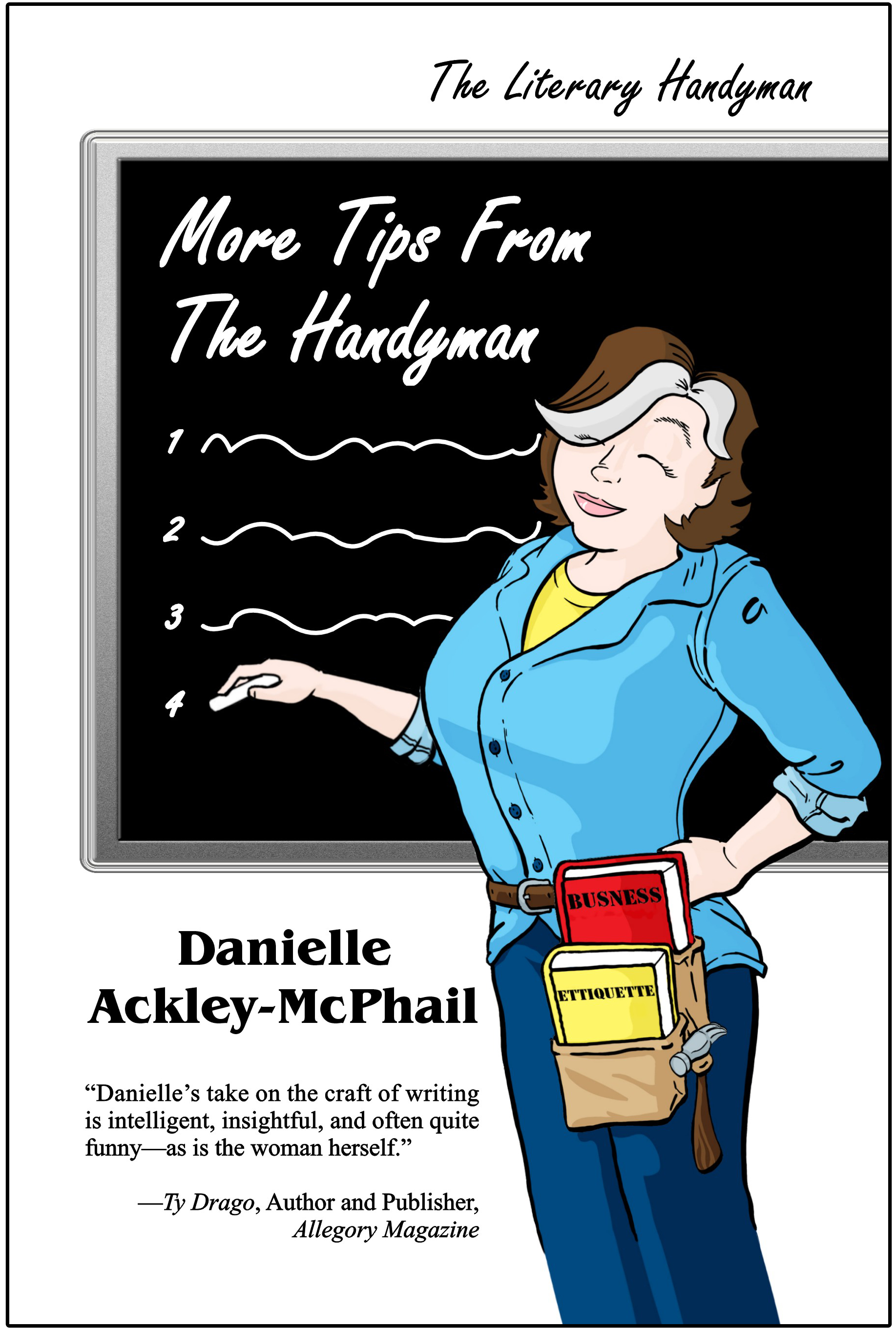
The Literary Handyman: More Tips from the Handyman (Ackley-McPhail)

The Literary Handyman: More Tips from the Handyman by Danielle Ackley-McPhail (2021)

(Not a review, just some notes to help me remember the things I've read. But written this way because it's the Internet, and some people will stumble across this page.)

Why would a published author need more tips on writing? Honestly, I don't remember if I got this one free in a Kickstarter campaign, or if I bought it extra. But the advice is worth the price.

Disclaimer: Danielle Ackley-McPhail is the editor of my book In A Flash 2020 and is the publisher of eSpec Books, which published my book.

Amsuing anecdote: This past weekend, I was at Philcon in Cherry Hill, NJ (across the river from Philadelphia). I did show her that I was reading her book. It had been in my kindle app for a while. While I was there, I mentioned a story of mine that a mutual acquaitance had read as the assistant editor of a magazine. She sent me an email saying she liked it and was passing it to the editor for review. In the end, unfortunately, the editor didn't agree, and I didn't make the cut. But I when I discovered that she (the one who liked it) was at a con, I introduced myself and thanked her for the kind words. She actually seemed to remember the story from a comment she'd made. (That had been six months earlier, at least.) Anyway, Danielle told me to send her the story. They (that is, eSpec) is planning their next anthology, whatever it may be. When I got home from the weekend trip, I did just that.

The next day, I'm reading about shooting yourself in the foot by not doing everything you can to help yourself and your manuscript, and to not give the editor an excuse to reject your manuscript without reading it. (They get a lot, and sometimes they're overwhelmed.) One of her pet peeves were when authors leave out the personal information on the top of the first page. Sometimes authors she's friends with and has worked with before are guilty of this, too, not just newbies.

When I got home from work, I updated the file to include that information, and resent it. I later realized that I don't know if I included page numbers or not. I usually don't. I think I turned them off when one editor mentioned it in their guideines, and I don't think I ever put them back on again. It's something that was obvious when I was typing manuscripts, as opposed to using a word processor.

Anyway, rookie mistakes like this are good reasons to reason "how to" books occasionally, just to make sure you're still doing what you should be doing.

Ackley-McPhail includes numerous examples of what she's talking about, both from her own works and new entries created for this text.

A great guide. I reccomend both editions.

She also has one for book publishing, but I'm not "there" yet. And I would really only be interested in electronic publishing, not print copies, first because print would take even more of an investment, and I would more likely be aiming for the Kindle Unlimited audience if I went that way.

Wednesday, July 27, 2022

At Wit's End (Bombeck)

At Wit's End by Erma Bombeck (1965)

(Not a review, just some notes to help me remember the things I've read. But written this way because it's the Internet, and some people will stumble across this page.)

This was a paperback that I had for a very long time and which became my in-pool reading book. That is, a book, should it happen to fall in, I wouldn't be too concerned about it. Obviously, this is not something I could do with loaners or books that I'd prefer to hold onto.

I used the Good Reads image because it matches the edition I have. It's old, although not 1965-old. Actually, I was surprised that the book itself dated to 1964. I know Bombeck was a pioneer and that my parents and older siblings read her newspaper columns, but I didn't think she'd started back then. Given the idyllic family life that she takes to task, I should've realized it.

Where this book came from, I couldn't possibly remember. Likely a used book store, or a used whatever store that also had books. It was something that I wanted to read and never got around to reading. Erma Bombeck was one of the names that I remember my high school Creative Writing teacher (Mr. Jon Marc Mucciolo) suggesting that I should read. Her name is the only one of the three or four that I remember now. Probably because I knew who she was. I was trying to write humorously, and these were people who knew how to turn a phrase. Also, "Mooch" was trying to impart upon me the idea that humor needed to be about something. For all I knew, it could be a bunch of one-liners. I didn't write bunches of one-liners, but if someone printed them, I probably would read them!

Last two things before I get to the book: first, I titled my final column for my college newspaper "At Wit's End" -- I had thought about calling it "This Wit's End" but I'd only had four columns published in 2 years, along with one that was held so long that I bumped it myself for my final column; second, the only column of Bombeck's I remember was, unfortunately, a more serious piece -- the kind humorists write when they think an issue is so important that they believe it's okay not to be funny while they talk about it. (For the record, I thought it was a stupid column. It's point was made in the first 50 words and the rest was beating the dead horse. Not her best work.)

Okay, so this book is broken down into sections that are labeled by calendar months. I thought that meant that this was going to be a year's worth of columns. I'm not sure what it is. The months are more thematic, where you'll find stuff about particular holidays, school events, summer vacations, and more holidays. There are some short columns, but then there are longer pieces which I don't know if they're related columns strung together, or if individual columns were expanded for the book. Some of these go one for a while and the tone changes after a couple of pages. In syndication, it's rare for one column to continue to the next, but not uncommon for the topic of a popular piece to be revisited. These revisits are pieced together.

Some of Bombeck's complaints are universal, but others are dated and not very relatable. Keep in mind, I'm old, so I have a greater frame of reference to relate to, but a lot of what she presents would be like if the origin Roseanne series had been made at the same time as Father Knows Best or Ozzie and Harriet. The type of family and situations she writes about where not the typical family of 50s and 60s television. But kids are kids, even if the only entertainment was the single television set and the only phone hung on a wall and was used by everyone.

Anyway, I'm glad I finally read this, even though I started it at least four years ago. I was reading it as a substitute when I was covering classes before I made it the pool book. Now I have to find another pool book. I had used old sci-fi magazines, but the print is small and I don't wear my glasses. I don't think I've ever finished one of those. Maybe, one. I do have some old math books, but I'm not sure I want to get those wet. I'll figure it out before my next morning in the pool.

Sunday, July 24, 2022

Exactly How I Promote and Sell Books (Dee)

Exactly How I Promote and Sell Books
A 30 Minute Read
(Kathy's Practically Perfect Plan Book 6) by Kathy Dee (2021)

(Not a review, just some notes to help me remember the things I've read. But written this way because it's the Internet, and some people will stumble across this page.)

This was a freebie, probably from r/FreeEBOOKS, so she didn't make money from me selling this book. Kathy Dee has a series of 15-minute reads, but this one, she says, has so much material in it, it's more of a 30-minute read. And it was. Note: I read this a month ago and just didn't get around to posting about it. In truth, I wanted to wait until I finished the next book because I didn't want this to be the top post on my blog for more than 1 day.

There's should good information in here if I want to self-publish books, particularly if I want to use Kindle Unlimited to get more eyes on my pages. Let's face it, at this point, I'm not going to sell books on my name.

But it keeps coming back to this: you need a cover, and covers aren't cheap. You can do it yourself but it won't look all that great. And worse is when I looked for cheap royalty free artwork to use, I couldn't find a way to buy one thing. They wanted to sell a package for more all than I needed or make it a monthly subscription, as if I'd need more for my one book. Granted, it makes sense to use two or more images and blend them just so I'd have an original final cover that couldn't be duplicated by someone looking to make a similar cover with a similar title. That's actually an issue.

Over than that, it was like I read an online article -- the kind I wish I could find on the subject.

Saturday, May 21, 2022

The Geometry of Pasta (Hilderbrand, Kenedy, Vandy)

The Geometry of Pasta, Caz Hildebrand, Jacob Kenedy, Lisa Vandy (Illustrator) (2010)

(Not a review, just some notes to help me remember the things I've read. But written this way because it's the Internet, and some people will stumble across this page.)

I saw a picture of the book cover on Twitter. Without knowing anything about it, I searched both the Brooklyn and New York Public Libraries for a copy. I found a hardcover, which I'm not used to reading any more.

First off, it's a cookbook. Yes, I read it. I skipped the recipes and read all the introductions.

The book is organized by pasta type, listing over 100 of them, many that I never heard of, and some that are likely only available in Italy (or in heavily-Italian neighborhoods in NYC, of course). Some of them are only good if they can be made fresh (which I'll never do, nor am I likely to go buy them freshly made).

The introductions mention the shape and what sauces would be good with them. Some shapes scoop up sauce better than others. Some have to be cooked in a certain manner because the thinner parts might be overdone before the thicker parts are cooked.

Interesting read, and I'm glad I got a copy of it. I took photos of a couple of the sauces that seem easy to make, and of a few recipes for more common pastas that I could attempt on my own. I didn't bother with "simple" ones that called for ingredients I'm not likely to buy, like salmon or boar meat (or boar fat).

On Earth as It Is on Television (Jane)

On Earth as It Is on Television Emily Jane (2023) [AUDIO ONLY -- no image] (Not a review, just some notes to help me reme...