Showing posts with label magazine. Show all posts

Wednesday, September 2, 2026

Bourbon Penn 30, August 2023

Bourbon Penn 21, July 2020


(Not a review, just some notes to help me remember the things I've read. But written this way because it's the Internet, and some people will stumble across this page.)

As previously mentioned, I've been aware of Bourbon Penn from the Submissions Grinder, but I hadn't actually seen a copy until a couple of conventions ago. Now I have three print editions (perfect for pool reading). A quick check tells me that the stories in this issue are available online for free (https://www.bourbonpenn.com/issue/30), so I could read these whenever I'm at my desk, which isn't quite as good as in the pool.

This was another interesting collection (over 150 pages long), and I enjoyed most of them (as well as pool time). Not all of these stories had "speculative elements". Some were just odd.

A quick rundown of the stories:


  • "The Demon Lord of Broken Concrete" by Alex Irvine seems to be a standard white-trash, coming-of-age story of a young man, Zack, who gets smacked around too much by life and his father. There's a slow kid named Tim that Zack knows, and Tim is killed by the second page. The story isn't about Tim. It's about life sucking. There is no real Demon Lord of Broken Concrete, but you can see why someone would create him along with the Marquess of Daddy's Eighth Beer, Our Lady of What Did You Just Say to ME?, He Who Reigns over White Panel Vans, Our Lord of Kindly Men Who Want to Show You a Puppy, the Archfiend of This Will Hurt Me More Than It Does You, the Earl of The Looks You Get When You Use Food Stamps at the Grocery Store, the Duke of Home from School to an Empty Fridge. Also mentioned are the Viscount of Rust and the Baroness of Shattered Glass.
    I'm not making fun with that passage. Actually, I admired how creative it was and how smoothly it read despite extending the metaphor well past the point other writers might've stopped. It shows both the mindset of Zack and the life of those around him. Unfortunately, there wasn't much more to the story. I didn't hate it, but there isn't much I remember about it a couple of weeks later.

  • "Polar Shift" by Mir Seidel also is less speculative and more weird. Unless I missed something, it's about two Russians who are stationed in a cabin near the magnetic north pole who have to track the pole whenever it shifts. Their relief has been delayed and their are freezing and starving. The only thing speculative is that one of them is convinced that he's met the other before, and I didn't understand what was going on there.

  • "Bachelard Forgets the Kitchen" by Cedric May is another odd entry that isn't exactly speculative. It stats with a woman (she tries out a few names) having a bad dream, which is what "He" grunts before rolling over and going back to sleep. The narrator that philosopizes about Jorge Louis Borges who belived that the waking world and the dream world were pages of the same book. The woman ponders how things would be better it we knew what kind of book it was and if we could jump around the pages. (This actually is a decent setup for an urban fantasy story, but alas...) Seven scenes follow, and she doesn't like what she sees. She's awoken by the man, who says, "Holy sh*t, Janie. You're were screaming." He goes back to sleep and (oops, spoiler), she goes to the kitchen to get a knife. (The implied subtext is that she's going to stab her husband who's obviously the root of all evil in her life.) I had to look up Bachelard to find out what kind of philosopy he practiced and wrote about, and it wasn't anything that I could summarize in two sentences.

  • "Strange Eons" by Keira Perkins gives us a Lovecraftian horror in the sky. Time has stopped except for the things that haven't stopped without rhyme or reason (or whatever doesn't fit into the story, which actually doesn't bother me, but it's addressed). Again, a good setup, and then it goes into something about abortion -- the narrator (I scanned for a name, I didn't see one) had an abortion and she believes the monsters in the sky are her punishment. Since time is frozen, she hasn't fully healed and she's still bleeding. This leads her to believe that her blood is feeding the cicadas that are waking up and flourishing way ahead of schedule. They swarm of to join the elder god. Her boyfriend, Jaxon, arrives and protests that he could've taken care of her and the baby even though he's going away to college -- he's basically shallow and clueless. The author works in a dig at Lovecraft calling him "a racist and giant weenie" who got some things right about giant space aliens that drive you a little mad. I guess people like to write Lovecraftian but if they acknowledge him, the disclaimer needs to be added.
    Shockingly, I've never read any Lovecraft. (I once picked up a book of "Lovecraftian horror" and it turned out to be an essay about what makes good horror along with a collection of stories he mentioned or ones that were similar in nature.) I will at some point.

  • "Partial Transcript from the Great Brexit Baking Show" by Rich Larson: when I saw the title, I thought that there's no way that this isn't going to be something political and that there's little chance this might be some middle-of-the-road, burn-all-sides, screwball comedy. Well, it wasn't exactly. It was supposed to be a future reality baking show when the heat outside is ridiculously hot and where one of the judges is a spheroid AI version of a deceased judge. No one is allowed to criticize anything British nor complement France or other places. The story is told in script form, which I compliment the magazine for accepting (although you can't accept these often), but the story itself is of an unscripted bake-off. A "transcript" would've made more sense.
    As for the story itself, like the competition itself, falls flat and leaves a bad taste. It just ends with a random fire and some smoke.

  • "It Tastes of Rot" by Margaret Roach is the second "experimental" format story in a row, this one being told as journal entries starting at Day 40 since she last left his apartment to venture out into the declining state of the outside world. She makes an allusion to the Lord in the desert, and that sets the stage. Her husband (the wonderful Mr. Wright!) is long absent and returns wearing a hazmat suit that he doesn't remove.
    The woman, who later becomes Jezebel, is the quintessential unreliable narrator as she is slowly going nuts from her isolation, which could've been inspired by Covid as much as by environmental disaster. (There's black sludge.) In the beginning of the story, she's making bread and considers the dough her son. The son grows and even bites a finger off her hand, which the "mother" gives up willingly. She gets a job with an orgazination with the acronym SATAN, which has nothing to do with newts. She is supposed to release the rot onto the world. This is the way her live is supposed to be. Until it isn't.
    It was an interesting story as her sanity flees and the threat increases. It actually ends before one year passes, which is something I expected, so points for subverting expectations there.
  • "Clown’s Balloons" by Sam Rebelein is the kind of story that I'm glad I didn't read when I was younger. It starts off well enough with its premise: a clown shows up one day on the corner across the street from Selene's office on her birthday. She assumes its an office prank, but no one admits to it. The clown has three helium balloons he holds all day and just stares at her all day. Others can see the clown, and people on the street walked around the clown to avoid it. He continues to appear daily, and she can't explain something -- maybe he's getting helium every night, and maybe he can train himself to stand there, but he doesn't ever blink. Selene takes time to figure out how he's doing everything to the point that she can almost do this herself (at her office, mind you), but her solution to the non-blinking is a bit extreme and thankfully happens off-camera. She does return to the office (at this point one wonders how she still has a job) to "watch" the clown. Along the way, we discover from the clown's POV that it's an alien and it isn't even biological, at least in the alien sense. When it landed, it thought trains were sentient and the passengers were parasites. Its world has been destroyed by worms. Anyway, it started off interesting but didn't have a payoff, or rather, it did, but not one that I was looking for.

Once again, I didn't recognize any of the authors' names from any other magazines or from conventions. (One of them had a story adapted for an episode of Love, Death, Robots, which won an Emmy.)

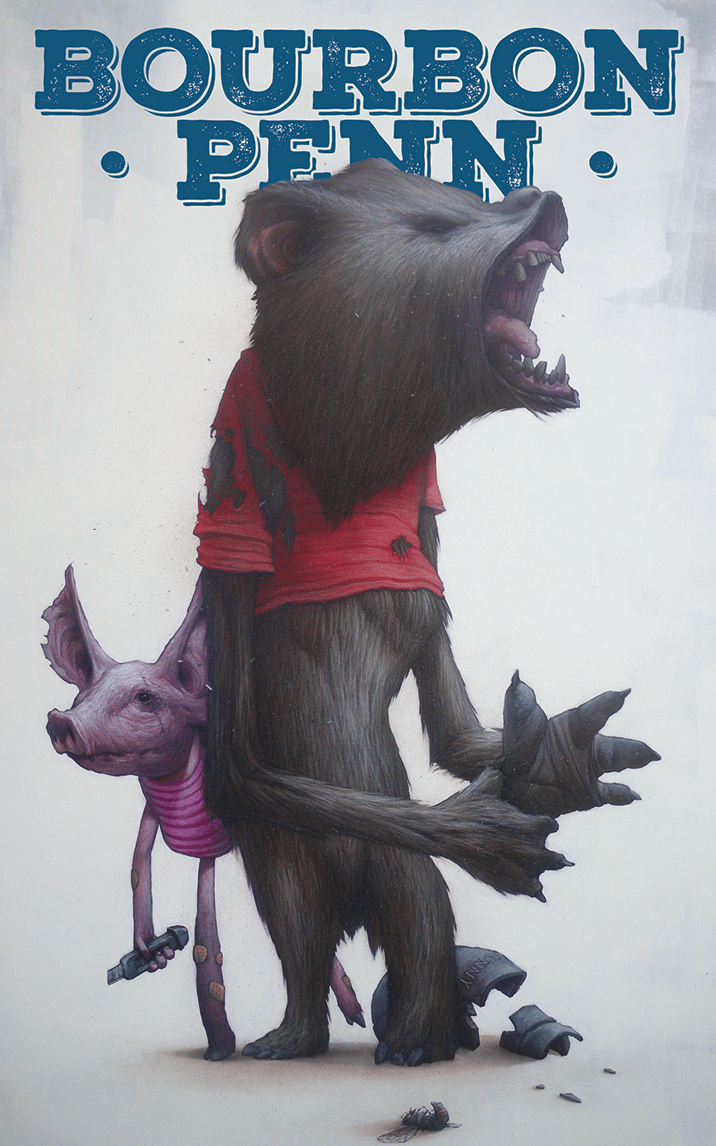
Once again, the cover doesn't go with any story. Amusingly, I was so focuses on the bear's face as it growled (and I wasn't exactly sure that it was a bear) that I never noticed that the creature hiding behind it was a piglet standing on its hind legs wearing a pink jumper. And the bear is wearing a short ill-fitting red shirt. Bom K.'s cover art is entitled "The Real Winnie" as Winnie the Pooh entered into the public domain in (I'm inferring) 2023, and the artist wanted to get a horror feel for the characters. (Piglet's holding a sharp, pointy weapon.) This is a little confusing because the clothing indicates the Disney versions, which are NOT PD yet.

Final words: I started writing up stories as I read them, so I wouldn't forget the details (which is part of the point of this blog in the first place).

I almost read this issue first because, I think, it was the first one I picked up. Then I realized that one of the others came first sequentially, not that it should matter. However, in this case, it might have because this issue was not for me. Had I read this first, I would've put the others on the bottom of the TBR pool magazines pile. (So to be a Subway TBR pile, or a pile that gets shoved away until next summer.)

I have one more of these, but I'll probably switch magazines.

This one will be going into a Little Free Library in the neighborhood, but not the one in front of the elementary school.


If you stumbled across my page via the Internet, please check out my short book series, Burke Lore Briefs. A fantastical foursome of flash fiction and short stories.

Tuesday, August 11, 2026

Bourbon Penn 21, July 2020

Bourbon Penn 21, July 2020


(Not a review, just some notes to help me remember the things I've read. But written this way because it's the Internet, and some people will stumble across this page.)

I've been aware of Bourbon Penn from the Submissions Grinder, but I hadn't actually seen a copy until a couple of conventions ago. Now I have three print editions (perfect for pool reading). A quick check tells me that the stories are available online for free (https://www.bourbonpenn.com/issue/21), so I could read these whenever I'm at my desk.

This was an interesting collection (over 150 pages long, so I can count it as a book) of odd science fiction and fantasy, and I enjoyed most of them (as well as pool time).

A quick rundown of the stories:


  • "To Inherit Hunger" by Crystal Lynn Hilbert starts off with a child being able to see her mother's hallucinations. It's a condition that her mother inherited from her father. They become more real and tangible as time goes on, causing brain damage and finally death. Jillian starts to figure out that her mother's condition could be something else, and she tries to solve it logically, but her mother doesn't cooperate. At one point, she forces her mother's hands above her hand to see if she can touch the birds flying overhead -- and her mother tells her that there's nothing there. Jillian is showing symptons. There is a puzzle to solve and a twist in the conclusion.
  • "Patchwork" by Maria Dones confused me a little, switching between two worlds: a princess and a dragon, and the popular girl sitting on the bus next to a dorky kid who can help with an assignment. The ending left me scratching my head a little as to which was which.
  • "Unnamed Government Agency" by Josh Pearce suffered from my reading it in two parts over two days. The second day, I was having trying remembering the first. You have "Men" in black, codenamed Eye, Ear, and Voice, which name the function that the mainly serve, investigating some weirdness or other. There were also characters named Aural and Iris, unless they were Ear and Eye, or maybe a different Ear and Eye. I didn't follow this one, and it left me confused but not in a good way. It wasn't quite as X-Files as I would've liked. But I did like that someone was Eyes of the group, etc.
  • "Carrion Coast Highway" by Barton Aikman is a post-apocalyptic tale (I assume) with the two main characters searching for a farm that they'd heard about. There's a bit about beached whales and another with animals on the mountains jumping off and ascending (which was unexplained, except that it doesn't work for humans). It just ends in a less than satisfying way. It also ends with a plot hole, or a plot gaffe. It mentions in the closing pages that they stole the car, and that they used a rock to break a window. However, when they arrive, they say they don't need the car any more and toss the key on the seat. Okay, so then why did they need to break a window if they had a key? This was also just a subplot to show that they weren't nice people. (In fact, they're bad people.)
  • "Blow Flies" by Erin K. Wagner doesn't seem to have an obvious speculative element in it unless I'm oblivious, or unless the guy that I thought was dead was actually undead. A woman gets a message for her husband from his parents that he never wants to see that see to come quick because there isn't much time. She goes instead. She isn't exactly welcome as it isn't her house and the note wasn't for her. This one didn't do anything for me.
  • "Disappearer" by Jason Baltazar had it's good points and dull points. It did manage to go in a direction that I didn't expect, which was nice, but the plot after we learn of Maddox's condition -- he accidentally makes things disappear -- is a bit cliche to the point of embarrasment. Granted, the author is Salvadoran, so I can assume he's writing the half-white, half-Salvadoran Maddox from some kind of experience, but the behavior of the drunk cop in the story (who used to date Maddox's mother) would've been over the top in the 1950s. Maddox has a smart mouth, and Officer Ferrin isn't just going to arrest him, he's ready to put bullets into him for resisting arrest. The officer even calls in that Maddox is armed without giving a location. I don't remember him taking a backup weapon from anywhere (glove compartment?) to plant as evidence of that. The bright spot is that Maddox doesn't make Ferrin disappear, which one might expect as he's trying to escape.

I didn't recognize any of the author's names from any other magazines or from conventions. Their bios indicate that they've all been published elsewhere in magazines that I've heard of although not necessarily have read.

The cover doesn't go with a story. It's by Fintan Magee and is titled "The Plague". There's no story (meaning an explanation) behind it, but Magee does get a much longer bio than the authors do.

Final words: I enjoyed a few of these, but it didn't really give me any idea what kinds of stories to write for this magazine, but I'm pretty sure that the ones I have available wouldn't be accepted if I sent them. (They are a lower paying market, but they do pay.)

And I'll probably read the next one of these instead of switching magazines.

This one will be going into a Little Free Library in the neighborhood.


If you stumbled across my page via the Internet, please check out my short book series, Burke Lore Briefs. A fantastical foursome of flash fiction and short stories.

Saturday, February 7, 2026

Clarkesworld Magazine, Issue 208 (January 2024)

Clarkesworld Magazine, Issue 208
edited by Neil Clarke (January 2024)

Online: https://clarkesworldmagazine.com/prior/issue_208/

(Not a review, just some notes to help me remember the things I've read. But written this way because it's the Internet, and some people will stumble across this page.)

Neil Clarke is the editor of a fabulous online science fiction magazine, Clarkesworld. (Note: I have submitted many stories to Clarkesworld. As of this writing, I have not been accepted. That doesn't mean I won't stop trying, nor does that bias this review in any way.)

If I've been informed correctly, when Neil goes to conventions, he brings along paperback copies of his magazine that didn't pass quality control. This book in particular is stamped on the inside front cover: This Is A Misprint. The cover failed quality control but the inside is fine.

This cover evokes a Christmas scene to me, mostly in the covers, but also there's a child and robot. However, a closer look would suggest it's spring because of the birds and the flowers on the bushes. What I thought at first to be lights are actually butterflies.

I must've picked this up soon after it was published because this was a magazine that I was reading in the pool in the summer of 2024! I didn't finish the book, so I brought it to school and assumed that I'd read it during lunch and then leave the book in a Little Free Library during one of my walks. But I never got around to reading that last four-page story. And then I left the book here for summer 2025!

I made a resolution to start reading some of the books that are piling up behind my desk in school as much as they are in my bedroom and basement.

I finished this, but I have to skim the front to remind myself of the other stories because it's been a while. Also, there's a nonfiction article that might be worth reading that isn't an interview.

The stories include: note, I finished this a couple weeks ago and have read other books and start a new issue

  • Nothing of Value by Aimee Ogden. (I know Ogden as an editor that I've submitted to and I believe I've read her work before as well.) This story involves teleportation by "Skip" technology where one body is destroyed and another one is created. It reminded me a little of how it worked in Dark Matter, where a new body was created (except that one was temporary) and when you traveled back the new memories went with you. In this story, the heartbroken and jilted lover comes back to Earth without the new memories, so he's basically forced to repeat his trip because he doesn't know what happened, and it apparently plays out about the same every time. (The narrative bothered me a bit in the way the narrator spoke.)
  • Down the Waterfall by Cécile Cristofari.
  • Binomial Nomenclature and the Mother of Happiness by Alexandra Munckown the Waterfall by Cécile Cristofari
  • tars Don't Dream by Chi Hui, translated by John Chu.
  • Just Another Cat in a Box by E.N. Auslender.
  • Rail Meat by Marie Vibbert.
  • You Dream of the Hive by C. M. Fields.
  • You Cannot Grow in Salted Earth by Priya Chand.


If you stumbled across my page via the Internet, please check out my short book series, Burke Lore Briefs. A fantastical foursome of flash fiction and short stories.

Monday, December 9, 2024

Clarkesworld Magazine, Issue 173 (February 2021)

Clarkesworld Magazine, Issue 173
edited by Neil Clarke (February 2021)

(Not a review, just some notes to help me remember the things I've read. But written this way because it's the Internet, and some people will stumble across this page.)

Neil Clarke is the editor of a fabulous online science fiction magazine, Clarkesworld. (Note: I have submitted many stories to Clarkesworld. As of this writing, I have not been accepted. That doesn't mean I won't stop trying, nor does that bias this review in any way.)

If I've been informed correctly, when Neil goes to conventions, he brings along paperback copies of his magazine that didn't pass quality control. This book in particular is stamped on the inside front cover: This Is A Misprint. The cover failed quality control but the inside is fine.

As with last month's issue, I didn't see anything wrong with the cover I have, which looks like the cover shown above.

Being that this is summer, this book was mostly pool reading.

The stories include: note, I finished this a couple weeks ago and have read other books and start a new issue

  • The Failed Dianas by Monique Laban. In the future, Diana comes down to Earth to a restaurant to meet herself. The original version she was cloned from. The original's parents weren't happy, apparently, at how she turned out, so they made another and another. And they all have their own special interests that they chose instead of what they're parents wanted. She meets DeeDee, 3D and Dr. Diana and they bring her up to speed, just as they were brought up to date. It was a fun little tale.
  • Terra Rasa by Anastasia Bookreyeva, translated by Ray Nayler. Everyone is on the trains to get to the ships to escape the fires to get to the better place. People are scheming to get where they need to. The narrator has a pass to get her through. She's watching people. There are others who could use it. It has a twist ending.
  • Obelisker Adrift in the Desert by K. H. Meridian. Another long one, but fewer than 30 pages. The narrator is an obelisk and gets called Obelisker by Kouya who survives a crash after an attack. The obelisk is an old station. The two have an easy truce. Plus she's wearing tactical gear and has special training. She leaves for a time to visit another village that obelisk watches without letting them know that the obelisk exists and is functional. Then there's an attack that must be repelled. Good story. Not like some of the other longer ones.
  • "Remember the Washington" They Said as They Fed the Ugoxli by Jeff Reynolds. A quirky title, and I had to go look up what an "ugoxli" was because there have been a lot of aliens lately. No, I guess the story didn't resonate enough for me to remember.
  • History in Pieces by Beth Godor. A story told as a series of puzzle pieces, but not all of the pieces are there, nor are they presented in order. The first is 37, with Cassandra stepping onto the surface of the planet, and the last three are 1005, 1006, and 1. It starts with the people on the ship not seeing an Archivist, but Archivist Tan is telling much of the story. It was an interesting approach. (Once again, I am writing this after 3 months after reading it and I rememeber little about it.)
  • Terra Rasa by Anastasia Bookreyeva, translated by Ray Nayler. People on a train are headed to Murmansk, to the bay. They need to get to the ships there. The world is ending and the ships (sea, not space) are taking survivors to a better place, if they have passes. The narrator does, but there are others who do not. And others who will do what they must to get on the ship. The woman decides to stay with a child who has no one. But the ships that sail away aren't going anywhere. There's nothing left out there. An interesting, if not depressing, story.
  • Mercy and the Mollusc by M. L. Clark. Another long one, with chapter titles (or section titles). It plays out like a western on another planet, but the steed in this case is a large mollusk creature name the Oomu, which is very mucusy. It's easy to ride. And one point, it attacks a kid and covers it with a mucus membrane so it can't escape, but it doesn't attempt to eat it either. It then goes off on its way and the rider has to figure out what to do. Again, there's more to it, but I don't remember. It was interesting, but too long. Wish I remembered more.
  • We'll Always Have Two Versions of Pteros by Dominica Phetteplace. A shorter one with section numbers. The sections titles are names, many followed by 1 or 2. Barry believes that he's in the wrong timestream and that he's supposed to be somewhere else, namely on the Pteros. However, the Pteros has been destroyed, in this reality, at least. Lily thinks it's survivor's guilt because Barry knew people on the ship. Barry 2 was lost in space for a year and then he woke up next to Lily. It flows nicely.

The Nonfiction section of the book includes

  • There are two interviews, an article about Peter Pan through the ages, and the 2020 reader's poll finalists. Interesting to note that there were ten stories listed for Best Story because there was a six-way tie for fifth place. Out of then stories, none were in the December issue that I'd read. "The Helicopter Story", which I haven't read but I know about because of the big splash it made in social media before the content was pulled, was nominated. I wonder if it won. I saw (a few months back) that it was available on a different website if I wanted to read it. Maybe at some point, but I'll more likely forget about it.

And that's this issue. An interesting issue, and I'll keep reading. I have at least one more that I've picked up at conventions, and the content is free online. Problem is that I can't read online magazines on the subway. (And, of course, pool weather is over for the year -- not that I'd take my ipad into the pool.)


If you stumbled across my page via the Internet, please check out my short book series, Burke Lore Briefs.

Friday, August 30, 2024

Clarkesworld Magazine, Issue 172 (January 2021)

Clarkesworld Magazine, Issue 172
edited by Neil Clarke (January 2021)

(Not a review, just some notes to help me remember the things I've read. But written this way because it's the Internet, and some people will stumble across this page.)

Neil Clarke is the editor of a fabulous online science fiction magazine, Clarkesworld. (Note: I have submitted many stories to Clarkesworld. As of this writing, I have not been accepted. That doesn't mean I won't stop trying, nor does that bias this review in any way.)

If I've been informed correctly, when Neil goes to conventions, he brings along paperback copies of his magazine that didn't pass quality control. This book in particular is stamped on the inside front cover: This Is A Misprint. The cover failed quality control but the inside is fine.

As with last month's issue, I didn't see anything wrong with the cover I have, which looks like the cover shown above.

Being that this is summer, this book was mostly pool reading.

The stories include:

  • Intentionalities by Aimee Ogden. I recognized the name by it took a moment to place her. I haven't read her before, but Aimee is an editor that I have submited (but not sold) to. The story is of a woman named Sorrel who agrees to have a child to "confer" to the Braxos Corporation for ten years. It's not "slavery", it's training for any job they could want afterward. She's inseminated, has the baby, Abigail April, and raises her for a few years as best as she can with the stipend she got from Braxos to help make ends meet. Naturally, she has regrets about letting Abigail go but can't repay the money. Sorrel joins an advocacy group and searches the dark web, but she doesn't see her daughter for 10 years. Abigail asks her if she's her mother, and Sorrel doesn't believe she deserves that title. Sad, chilling. I prefer happier endings, but there wasn't a way for a happy ending out of this in a short story, just growth and regret.
  • Deep Music by Elly Bangs. Quinn has an "aquid" capture and rehabilitation center. Aquid are watery creatures that get removed from homes like squirrels and stray cats. She keeps them in jars and has one that she's given a keyboard to and that the aquid types on. It becomes obvious partway through that the "gibberish" text is going to start making sense, which it does. There's also an adversary exterminator who wants to wipe out the aquids and cause trouble for Quinn. He's the weak point of the story. It was interesting but predictable, really, though maybe not the exact outcome.
  • Philia, Eros, Sturge, Agaipe, Pragma by R.S.A. Garcia. As the expression goes, once bitten, twice shy. I wasn't sure if I wanted to venture into another novella after left month's novella. This one had a prologue that had Brother-Adita, recon drones, and shells, and I wasn't sure what was going on. Page 2 started the Philia section which subsections of Now, Then, Now, Then, Before, which was a little confusing. When it got to the Eros section, I hadn't noticed a change but by then I realized that people weren't speaking but signing or indicating their language which was why so much of the "speech" was in italics. I lasted 20 pages without much of a clue what was going on or what the timeline was, and I gave up. If it hadn't been for the December novella, I might've stuck it out. But I was getting a headache.
  • The Last Civilian by R. P. Sand is another story that just drops you into the future and leads you to figure out where you are and what you are doing. Literally, in fact, because it employs Second Person storytelling, and I never had a grasp of who this "You" was supposed to be, even though "You" is in every section title. (A lot of section titles in this issue.) You are a generic, genetic soldier, but there are others referenced in the story so it's hard to imagine an unnamed soldier bearing witness to all this and interacting with the characters. The story starts by introducing the reader to the Uilai of Uiloolea, who was flamingo-like with antlers. And then the action shifts to the humans who they are at war with. The humans are clones, developed to be adults at activation, and You are part of the 8th generation, making Your name Eta and a number. It turns out that the war has not been going on for as long as the clones are taught to believe and they aren't as old as they think. Basically, it reminded me of a Donna Noble story.
    In the end, we come full circle and meet the Uilai who has been telling this story to You and seems to know everything You did and whom You talked to and what You said. Sure, the Uilai could know all this, but why bring it all up?
    The story was okay.
  • Aster's Partialities: Vitri's Best Store for Sundry Antiques by Tovah Strong. Syd was a magician and she was executed in multiple ways, but she survived in the mirrors of a house that her death created. The house narrates the story as a "we" that sometimes eats people who visit, and then it has to move afterward. A child (always referred to as "child" and "they") named Mor shows up with one of Syd's talismans, so the house protects Mor. THis is another story with multiple sections and other than the first, I couldn't decode what they referred to. I enjoyed it. Definitely above average.
  • Leaving Room for the Moon by P. H. Lee. Two children, a boy and a girl, are taken from their planet and brought to the world of the Emperor of All Space and Every World. Some 65,000 years have passed since they've left home and everything that they knew of is dead and gone. Meanwhile, the shine came off the palace and the world many millenia ago. They are presented to the emperor who tells them that the demiurgist can create anything that they desire, but the record of what was doesn't match the memories. Not a bad story, but not a great one.

The Nonfiction section of the book includes

  • There are two interviews. The first was with Connie Willis, whom, as much of a fan of scifi that I am, I should've heard of and been more familiar with. The other is with E. Lily Yu, who won a writing contest at 15 and has been writing since. Neil Clarke presents a list of all the stories published in 2021 that are eligible for their own best of awards as well as for the Hugos. Finally, there's a blurb about the cover artist. Once again, I don't believe it goes with any particular story. It shows a girl, probably a fairy, in a sealed jar with flowers and tree and a butterfly. Imagine Tinkerbell in a terrarium, but without wings. Again, this cover would've been considered defective, which is why the issue was given away from free. I don't see any issue with it myself. The online image is a little more vibrant. Also, the back cover, which is a closeup of the front cover without text seems to be off-center, so that might've been the problem.

And that's this issue. Not a great second issue for me. Let's hope February 2021 will be better. And let's hope there's still some pool weather left or this becomes subway reading material.


If you stumbled across my page via the Internet, please check out my short book series, Burke Lore Briefs.

Friday, August 2, 2024

Clarkesworld Magazine, Issue 171 (December 2020)

Clarkesworld Magazine, Issue 171
edited by Neil Clarke (December 2020)

(Not a review, just some notes to help me remember the things I've read. But written this way because it's the Internet, and some people will stumble across this page.)

Neil Clarke is the editor of a fabulous online science fiction magazine, Clarkesworld. (Note: I have submitted many stories to Clarkesworld. As of this writing, I have not been accepted. That doesn't mean I won't stop trying, nor does that bias this review in any way.)

If I've been informed correctly, when Neil goes to conventions, he brings along paperback copies of his magazine that didn't pass quality control. This book in particular is stamped on the inside front cover: This Is A Misprint. The cover failed quality control but the inside is fine.

Personally, I don't see anything wrong with the cover. That said, I just went over to the webiste to look at Issue 171 and I can see that the issue is much sharper.

Being that this is summer, this book was mostly pool reading.

The stories include:

  • The Island of Misfit Toys by Fiona Moore, a tale of an old homeless man who starts to resemble Santa and who used to program AI toys who finds ways to survive until one day he's beat by teens in a prank that goes too far. He finds himself in a junkyard along with some discarded toys and robot dogs, which he sets out to repair. It's a fun little tale.
  • Things That Happen When You Date Your Ex's Accidentally Restored Backup from Before the Breakup by Lisa Nohealani Morton is a mouthful of a title. Once I was able to parse it correctly, I thought it an interesting premise for a story, but it just didn't work for me. As you can guesss, it's set in a future where cloning is a possibility and it's the type of cloning where you can "awaken" or "download" a consciousness from a memory drive of some point (as opposed to having a clone baby). Such a future is not free from bureaucratic errors (transposing numbers) and making mistakes. This much I liked, and applying it to a relationship where the partner doesn't know about the breakup is a fun twist. Unfortunately, other parts don't work for me. The politics, for one thing, with the whole resistance plot. And the other thing I'm on the fence about is that it's written in second person, you, and the ex is always referred to as "they", so you can imagine whatever genders you wish here. Second person stories are difficult to write, but I give it the benefit of the doubt here because it made it by the editor. It was a bit of a slog. Your mileage may vary.
  • The Last Days of Old Night by Michael Swanwick was a fanciful tale of three near-omnipotent beings (Goat-Eater, Bone-Grinder, and the unnamed, mute one) traveling the long night, creating things and clearing obstacles with mere thoughts. A probelm arises when they get to a sea that they can't bridge nor ford. They are then informed by the locals that the old night will soon end because the day is coming which will end them all. The beings manage to turn back time ten years so that the local people can create a boat big enough to beings to escape the day. It reads like an old folktale, and in the end, we learn what inspired it. I did a search in this blog for Swanwick, but I didn't find any results. The name looks familiar (not surprising given the awards he's won). His bio says he's from Philadelphia, so it's possible that I've encountered him at sf/f cons.
    Edit: Not three hours after I typed the above entry, I got a Facebook suggestion of "People You Might Know" for Michael Swanwick. We have 13 mutual friends! LOL.
  • Conversations in the Dark by Robert Reed was not a favorite. Stories are subjective, of course. The problem with novellas is that they take up a lot of the book, and if a novella doesn't pull you in, you can either stick it out until it does, or stick a large chunk of the book. I stuck it out. It was an odd story. There's a tank that can hide a person where nothing would detect it from outside. Then we're on a great ship in space, the greatest prize in the galaxy, an ancient ship. The people on it live for centuries and change appearance and gender when they sleep. And then it turns out that these people are human, so the human race must've evolved a bit and this story must take place really far into the future. I read a couple sections at a time and put it down to read other things. This probably hurt trying to immerse myself in the story, instead of thinking what I'd do with a great ship in a story. But I made it through.
    Reading the bio, I see that Robert Reed has written over 300 stories, including several "Great Ship" stories, so maybe I needed to know more background for this to have made more sense to me. And I'm guessing that the editor is better read than I am.
  • No Way Back by Chi Hui, translated by John Chu, was an interesting story. Xia Xuejano isn't who she seems to be, and neither is her talking cat Aksha. It's in a future where talking cats aren't unusual as science has advanced there. But not as much as the online world has advanced. A man comes looking for Xuejano because he wants her to find her daughter. The daughter's body in in a hospital ICU but the person inside isn't her. In the future, not only can individuals jack into the net, they can abandon their bodies and live on the net. They usually regret this, if they live long enough and aren't carved up for data. That's why someone else would welcome the chance to jump into her body with some of her memories, without being her daughter. It doesn't have a particularly happy ending but does raise some interesting issues.
  • Forward Momentum and a Parallel Toss by Ana Maria Curtis takes place in a small town (Madrid) where football and farming are a big thing. Matching bands are now automatons. And farming equipment is protected IP. Lacey and her students want to do something about that. Alex, Lacey's former boyfriend now works for the "enemy". I don't know if this is steampunk or hopepunk or some other kind of punk. She succeeds but it ends befrore we find out where one character stands -- but that's okay because either choice would be unsatisfying to some part of the audience, and it could feel like a coin flip by the author. It's not pivotal to the story.
  • Songs of Activation by Andy Dudak is an interesting story with great worldbuilding, but in the end, I really have no idea want it was about except something to do with revolutionaries and counterrevolutionaries. The students memorize Odes and Sagas, passage of which activate something or other. And then there's Sinecure, which has caused people to commit suicide. Told well, but I don't know what I read. Note: I had to look up "Aestivation", which is the name given to a period of summer dormancy. Summer dormancy is often exhibited by animals when conditions become unfavourable. Had I known this sooner, it might've meant something, but I wasn't reading an electronic copy with a built-in dictionary. I had a paperback in the pool.

The Nonfiction section of the book includes

  • Ghosts of Christmas Past: The Victorian Christmas Ghost Story Tradition by Carrie Sassarego was an interesting article about the popularity of ghost stories around Christmas times and how they brought some Victorian elements into them. "A Christmas Carol" wasn't the first, but it is perhaps the best known. And the tradition continues if you think about Christmas movies having ghosts or moving into horror.
  • After that were two interviews. The first was with Stina Leicht ("sTINA Lite"), author of Persephone Station and the second was with Tim Pratt, author of Doors of Sleep. I didn't get far through the second one. Instead I skipped to the end of year editorial "Don't Let Go of the Future" by Neil Clarke. Finally, there's a blurb about the cover artist. I like the artwork but I'm not sure what story it goes with, if any.

And that's this issue. I made a blog entry for magazines, and Clarkesworld is one of them, so if I venture out without a copy of one of the magazines, I can go to the archives online.

Now, on to the January 2021 issue, which I picked up at the same Heliosphere convention.


If you stumbled across my page via the Internet, please check out my short book series, Burke Lore Briefs.

Thursday, July 25, 2024

Some Online Magazine to Read

This is a (non-exhaustive) list of online science-fiction and fantasy magazines that are free to read the current issue, and which may or may not have archives. Almost all are currently publishing. I may add to this list.

Monday, March 27, 2023

ANALOG PLUS 50: Analog Science Fiction/Science Fact March 1973 (not much read)

ANALOG PLUS 50: Analog Science Fiction/Science Fact, March 1973

Update the photo

I had a lot of books to read in March, and I enjoyed most of them. Consequently, I didn't start Analog until March 27, so not much of it got read.

The usual explaination: For anyone finding these reviews, my purpose is two-fold: enjoying some "classic" sci-fi, and looking for stories that I think could be adapted for TV broadcast since so much of what shows up on anthology shows is rough to awful. Additional Note: I do NOT work in television. I just watch it.

In this issue: There's part two of a serial, two novellettes, and two short stories, one of which is really flash. The kind of thing that would one day be called "Probability: Zero" in Analog.

Editorial: "Law & Order" by Ben Bova. The 15th anniversary of Sputnik had passed without notice. Satellites are now orbiting the Earth. The Russians established the rule of "Freedom of Space" by launching over countries airspace and not asking permission, as when flying planes. This harkens back to the old "Freedom of the Seas" which was enforced by the British and then the U.S. Navy, and was kept in effect as long as it benefits those with the most power. Once laws are no longer beneficial, they tend to get ignored and fall be the wayside. Could that happen in space? (In the 50 years since, you know that it has, with space-based weapons platforms.)

Novelette: "Who Steals My Purse", John Brunner, with an illustration by John Scoenherr showing . The caption reads,

I haven't read it yet. John Brunner is a name that I could find in my basement, but I can't say that I've actually read anything. I hope to get to it, even in April.

Short Story: "Death of God", by Herbie Brennan, with an illustration by Kelly Freas, showing a background banner that says (one supposes) Peace of Earth, with a couple of cartoony, happy people walking with flowers in their hands. More prominent is the large round thing with a scaly belly, wings and a long bill, plodding along. The caption reads, "Sometimes a demonstration can be unexpectedly successful. And when it is, the need for such demonstratons disappears -- even though something else will soon be "bugging" the demonstrators."

Wilbur Hines works in a lab. Protestors smash the lab, calling him "Biological swine" and "bacteriological pig". Hines is studying gnats, and they escape as if Pandora's Box had been opened. He thought that they wouldn't be a problem but he was wrong. They mutated.

They were fruitful and multiplied, and have become a nuisance. More people stayed at home, avoiding going out. Some people are immune (unappetizing).

At some point, she was given the name Westbrook because that's the location were she lives.

Romee has to go to the jungle to get roots to sell to the Earth people to get money for the damn-TV and to buy chocolate. She's addicted. The new government wants to ban the sale of chocolate because they think it's unhealthy for the Notcid, and it could be why so many are dying in the jungle.

Romee meets a woman who is looking for people for a series of tests on response to envrionmental stimuli for a modest stipend. Romee applies.

The test turns out to be a little cruel. It uses the machine-sounding noises that the Noctid hear in the jungle and usually don't survive. Most of the time, their response is to jump away from the noise. By the time she's heard the noise twice, she's flattened to the ground, scared out of her wits. This continues until the experiment is stopped by a senior official who is not amused. He mentions "damage money" that Romee will be awarded ... but that won't be for quite a while.

Since she still needs money, she goes off the jungle and finds some of the roots she needs. While she's crawling around, she hears the noises roaring above her. She flattens to the ground and waits for the end to come. But nothing happens. The noise keeps repeating, over and over, until there are new sounds, a creak and a crack. It was a swinging tree limb, and it kept swinging so long that it finally cracked and fell. Worse for the tree, it fell into the very trap the limb would have pushed Romee into had she jumped into the air instead of flattening to the ground.

She now knew how to beat the tree. She wanted to tell others but their instinct would still be to jump. So she starts by training her family the way she was trained.

This was a cute story and should be easily filmable. Hollywood would likely screw it up because makes the capitalists friendly but hardly ever polite, while the government people are polite but hardly ever friendly. Too much of the current output leans in favor of the government over any private enterprise, even when it acknowledges government's shortcomings.

Casting, as written, there are two big parts for women, but you only need a few background characters in hairy suits, one main character and four humans. I'd watch it.

Howard L. Myers has written several stories that I've read already.

Short Story: "The Guy with the Eyes", by Spider Robinson, with an illustration by Vincent di Fate, showing a bartender (Callahan)behind his bar, some glasses and decanter on the bar, and two patrons. There are some spheres odd to the side, which could be taken as planets that are meant to be inferred but not actually in the scene. The caption reads, The job of a scout is difficult and dangerous. He must determine the nature and disposition of the enemy, its weak points, and its strengths. But when the scout starts to feel sorry for the enemy...

I was hyped to read an early Callahan story. I took the paperback Time Travelers Strictly Cash from the library back in high school. My oldest brother enjoyed it immensely. I read about half of it. I wasn't the greatest of readers back then, which is why I'd take multiple books out -- I'd hope one would "click" with me. I also playtested the GURPS supplement. "Mild Hangover" Advantage? That was mine. "No Hangover" was already there.

Anyway, I haven't read a lot of Spider, even though I'm always meaning to. This story seems like it's set in his universe and there's more going on. It gives the general location and the setup of the bar routines. Doc Webster is there telling bad puns. And people get up to make toasts.

There's stuff with "this Janssen kid" whose known for trouble. There's mention of heroin (he toasts "skag") and the war (it's 1973). But he's not the guy with the eyes. He's over in the corner listening, but has no answers.

Some pontificating happens, as is wont to happen in 70s stories and beyond.

The man with the eyes wore a black suit, a Joliet Special and his shoes didn't look right. He orders 10 drinks, makes 10 toasts to his profession, and then announces that he's an advance scout from many light-years away. Callahan knows he's neither drunk nor lying. A message is going to his Masters that he can't prevent, and for the first time, he has regrets. He's surprised when the bar regulars don't attack and kill him on the spot.

It petered out toward the end with a Mickey Finn reference but no solution to either problem.

Obviously, filming this would be a big deal because Callahan's is a long running series of stories and books. It could be a series of its own about a bar where everyone knows your name or something, but in Long Island, NY. Why it hasn't been made, who can say? (Well, Spider could, and probably folks who follow Spider on social media...) I don't know who I'd cast for any of the parts. And, of course, the storylines would have to be updated since they started in the 70s and lasted for many years after.

Short Story: "Modus Vivendi", by William Walling, with an illustration by Vincent di Fate, showing a large planet (Jupiter, there's a spot), some moons and a ship. The caption reads, The most critical step in any medical experiment is going from test animals to human trials. Usually this step is taken very carefully. But sometimes ...

I read the caption a while back before I read the story. It's funny reading it now as it telegraphs the ending in a way.

Clancy Bevvins, Lee Gresham, and Thaddeus Frye are scientists and researchers on a space-based station orbiting Jupiter. There's a base on Ganymede. Much of the research is of the hush-hush variety, so most have nothing to say about their work to the others. The one thing is that Bevvins has three gibbons with him. He says he's in deep space to avoid radiation and to be in zero g.

There's an accident that pushes them out of their orbit and whatever it is has breached both oxygen systems. The three of them and the gibbons are the only survivors. Time is against them. They won't spin into Jupiter before Ganymede is in range to call for help but they will run out of oxygen with no way to recycle it. There isn't enoug for one man let alone three

That's where the gibbons come in. One of them has something in their system (I was a little murky on the details) that allows her to recycle the carbon dioxide or breathe oxygen. Bevvins uses his experiment to keep the three of them alive. But there are consequences.

This was a good story, and only require a cast of 3 that can be as fiverse as you want them to me. It would also need three gibbons, briefly, which could be trained animals or could be cgi. Probably cheaper to get an animal trainer for a day of shooting, but what do I know? Only a couple of interior sets are needed, but the wreckage, and exterior would likely require CGI. I'd watch it.

Science Fact: "The Third Industrial Revolution" by G. Harry Stine, with an illustration of industry on the Moon that appears to be credited to "General Electric". The caption reads Conclusion. When you want to have our cake and eat it too, you're in a dilemma. When you want to continue a high-level technolog without further gutting Mother Eart for resources, you have to move your industrial base out of this world.

I followed a bit of this and then skimmed the rest. Gravity wells are issues for get resources and materials up into space. Slingshoting from the Moon or Mars would be easier, as would be mining asteroids. And you wouldn't have to worry about heating the environment.

If I knew enough about manufacturing in general, let alone space manufacturing, this could be a good resource to revisit for writing. The problem is that unless I want to write hard science fiction, most of this can be hand-waved.

Novellette: "Force Over Distance", by Tak Hallus, with an illustration by Jack Gaughan, showing a man working at a table, where there's a large box and a vertical ring. On either side of him are men with sombreros and guns. In the forground, there appears to be an object floating in a ball of light. The caption reads, The military-industrial state can sometimes amount to nothing more than two or three men with a common purpose. They don't even have to like each other.. just have a common purpose.

I've read Tak Hallus before at least twice. (I did a quick blog search.) This story is filled with Mexican banditos and revolutionaries.

Federico Jenson is a physicist who goes to Mexico and has his tire shot. He discovers this when he replaces it with the spare. As soon as he's done, the banditos steal the car and intend to strand him on the roadside. He wants his briefcase with his life's work in it. They refuse. So he says that he's going, too. So he's a hostage for ransom that he basically agreed to (insisted upon).

He tries to work out a math eqaution in the dust because he doesn't have paper but he insists on continuing his work. Juan, the guard, asks about it, calls him crazy for all the work he does to get a "cero" (the sequence should converge to zero). This sums up the opening illustration.

Jenson is being held prisoner by the revolutionary el Buitre, the Vulture. El Buitre isn't dumb -- he is good at strategizing and planning. He has Jenson demonstrate his transporter, which moves something to the other end of a table. El Buitre wants him to build a "beeg one", as big as a room. Jenson says what that would require.

This is no problem for El Buitre because his people can steal whatever they need. People die along the way. Jenson isn't happy about this, but on the other hand, he doesn't want their deaths to mean nothing. They're already dead and the project can move forward. He's almost as obsessed about his life work as El Buirtre is about his revolution.

His men make it into Tucson to get tantalum, and they kidnap construction engineer Harold Wright. Wright refuses to opperate for several days. El Buitre is about to kill him when Jensen intervenes. So El Buitre decides to kill him first. At this point, Wright agrees to help (although he nearly gets himself killed for calling El Buitre "Buzz").

The two complete the machine even though Wright is trying to stall it because he believes that they'll be killed before it's done. Finally they plan to escape through the device, with Wright worrying that Jenson might stay behind for "science" and his life work. Their plan is thwarted by the fact that Juan is smarter than he's been letting on.

The banditos go through the device (which seems like a large stargate) but they're in for a surprise when they get there.

An enjoyable story. It could fill an hour-long episode of an anthology show. I don't know how well the Mexican bandito angle would play unless it's done in a retro style, as in this actually happened in the 70s. The cast would require a handful of revolutionaries, El Buitre, and a physicist and an engineer. Women don't have a lot to do in this story. The ending requires a lot of extras and motorcycles, but it could just be a handful, and then cut away to Jenson and use a lot of sound effects and smoke and rattling boards.

Note: there is a very odd interior art piece which looks like El Buitre is riding a motorized unicycle. There's smoke to obscure the missing parts of the bike (and his arms because there are no handlebars) but you can see the far legs which should be on the other side of the motorcycle, out of sight. I found it amusing.

Short Story: "Trade-Off", by R. A. Beaumont

This entry appears to have been deleted. I must've typed it at work and didn't "save" it. Or it was lost the last time my computer froze and I had to do a hard boot.

Until it's restored: I wasn't thrilled with this story. It's filmable, but I don't it could/would be made into a segment on an anthology series.

Short Story: "Trade-Off", by R. A. Beaumont with an oval-shaped illustration by John Schoenherr, showing what appears to be a bunch of silos (or cylindrical objects) on a field at night and there are lots of bubble. The caption reads, There are times when the cure is worse than the disease. But when the cure triggers other diseases ...

I just started reading this. It appears to be told in a series of top secret memos. I didn't get far.

I have libary books to finish, so I may or may not get back to this.


The Reference Library , by P. Schuyler Miller. Opens with a discussion of books about on-screen SF. Reviews include The Overman Culture, by Edmund Cooper; The Wrong End of Time, by John Brunner; The Reality Trip, by Robert Silverberg; Pstalement, by Lester del Rey; and The Darkness of Diamondia, by A.E. van Vogt.

Brass Tacks: In July, there was an article on the future of automotive plants. Analog received a lot of responses, so they printed a reply by the writer, R. G. Cleveland first. I don't remember the article and the issues involved are 50 years old, so I didn't miss much skimming this.

I got an early start on this, whih was good, but then my book club and other library books took my attention away for a couple weeks, and February ended before you knew it.

Tuesday, February 28, 2023

ANALOG PLUS 50: Analog Science Fiction/Science Fact February 1973

ANALOG PLUS 50: Analog Science Fiction/Science Fact, February 1973

Update the photo

January went well, so let's do it again.

A new serial (maybe I'll get to it) and a Spider Robinson story.

The February 1973 issue of Analog has a new serial (maybe I'll get to it) and a Spider Robinson story.

The usual explaination: For anyone finding these reviews, my purpose is two-fold: enjoying some "classic" sci-fi, and looking for stories that I think could be adapted for TV broadcast since so much of what shows up on anthology shows is rough to awful. Additional Note: I do NOT work in television. I just watch it.

In this issue:

Guest Editorial: "Beyond the Citizen" by R. G. Cleveland. I haven't read it yet. I'll get back to it.

Serial: "The People of the Wind" (Part One of Three Parts), Poul Anderson, with an illustration by John Scoenherr showing a man with a tennis racket bending over to get something from a bag and a large round floating robot with three arms. The back hand has a tennis ball, the second has a racket and the third is stetching off to the top of the opposite page. After reading the story, I'm wondering if that's a cable to the ceiling. The caption reads, The most difficult thing to understand in the universe of man is -- the mind of man!

I hope I get to read this.

Short Story: "Biological Peacefare", by W. Macfarlane, with an illustration by Kelly Freas, showing a background banner that says (one supposes) Peace of Earth, with a couple of cartoony, happy people walking with flowers in their hands. More prominent is the large round thing with a scaly belly, wings and a long bill, plodding along. The caption reads, "Sometimes a demonstration can be unexpectedly successful. And when it is, the need for such demonstratons disappears -- even though something else will soon be "bugging" the demonstrators."

Wilbur Hines works in a lab. Protestors smash the lab, calling him "Biological swine" and "bacteriological pig". Hines is studying gnats, and they escape as if Pandora's Box had been opened. He thought that they wouldn't be a problem but he was wrong. They mutated.

They were fruitful and multiplied, and have become a nuisance. More people stayed at home, avoiding going out. Some people are immune (unappetizing).

At some point, she was given the name Westbrook because that's the location were she lives.

Romee has to go to the jungle to get roots to sell to the Earth people to get money for the damn-TV and to buy chocolate. She's addicted. The new government wants to ban the sale of chocolate because they think it's unhealthy for the Notcid, and it could be why so many are dying in the jungle.

Romee meets a woman who is looking for people for a series of tests on response to envrionmental stimuli for a modest stipend. Romee applies.

The test turns out to be a little cruel. It uses the machine-sounding noises that the Noctid hear in the jungle and usually don't survive. Most of the time, their response is to jump away from the noise. By the time she's heard the noise twice, she's flattened to the ground, scared out of her wits. This continues until the experiment is stopped by a senior official who is not amused. He mentions "damage money" that Romee will be awarded ... but that won't be for quite a while.

Since she still needs money, she goes off the jungle and finds some of the roots she needs. While she's crawling around, she hears the noises roaring above her. She flattens to the ground and waits for the end to come. But nothing happens. The noise keeps repeating, over and over, until there are new sounds, a creak and a crack. It was a swinging tree limb, and it kept swinging so long that it finally cracked and fell. Worse for the tree, it fell into the very trap the limb would have pushed Romee into had she jumped into the air instead of flattening to the ground.

She now knew how to beat the tree. She wanted to tell others but their instinct would still be to jump. So she starts by training her family the way she was trained.

This was a cute story and should be easily filmable. Hollywood would likely screw it up because makes the capitalists friendly but hardly ever polite, while the government people are polite but hardly ever friendly. Too much of the current output leans in favor of the government over any private enterprise, even when it acknowledges government's shortcomings.

Casting, as written, there are two big parts for women, but you only need a few background characters in hairy suits, one main character and four humans. I'd watch it.

Howard L. Myers has written several stories that I've read already.

Short Story: "The Guy with the Eyes", by Spider Robinson, with an illustration by Vincent di Fate, showing a bartender (Callahan)behind his bar, some glasses and decanter on the bar, and two patrons. There are some spheres odd to the side, which could be taken as planets that are meant to be inferred but not actually in the scene. The caption reads, The job of a scout is difficult and dangerous. He must determine the nature and disposition of the enemy, its weak points, and its strengths. But when the scout starts to feel sorry for the enemy...

I was hyped to read an early Callahan story. I took the paperback Time Travelers Strictly Cash from the library back in high school. My oldest brother enjoyed it immensely. I read about half of it. I wasn't the greatest of readers back then, which is why I'd take multiple books out -- I'd hope one would "click" with me. I also playtested the GURPS supplement. "Mild Hangover" Advantage? That was mine. "No Hangover" was already there.

Anyway, I haven't read a lot of Spider, even though I'm always meaning to. This story seems like it's set in his universe and there's more going on. It gives the general location and the setup of the bar routines. Doc Webster is there telling bad puns. And people get up to make toasts.

There's stuff with "this Janssen kid" whose known for trouble. There's mention of heroin (he toasts "skag") and the war (it's 1973). But he's not the guy with the eyes. He's over in the corner listening, but has no answers.

Some pontificating happens, as is wont to happen in 70s stories and beyond.

The man with the eyes wore a black suit, a Joliet Special and his shoes didn't look right. He orders 10 drinks, makes 10 toasts to his profession, and then announces that he's an advance scout from many light-years away. Callahan knows he's neither drunk nor lying. A message is going to his Masters that he can't prevent, and for the first time, he has regrets. He's surprised when the bar regulars don't attack and kill him on the spot.

It petered out toward the end with a Mickey Finn reference but no solution to either problem.

Obviously, filming this would be a big deal because Callahan's is a long running series of stories and books. It could be a series of its own about a bar where everyone knows your name or something, but in Long Island, NY. Why it hasn't been made, who can say? (Well, Spider could, and probably folks who follow Spider on social media...) I don't know who I'd cast for any of the parts. And, of course, the storylines would have to be updated since they started in the 70s and lasted for many years after.

Short Story: "Modus Vivendi", by William Walling, with an illustration by Vincent di Fate, showing a large planet (Jupiter, there's a spot), some moons and a ship. The caption reads, The most critical step in any medical experiment is going from test animals to human trials. Usually this step is taken very carefully. But sometimes ...

I read the caption a while back before I read the story. It's funny reading it now as it telegraphs the ending in a way.

Clancy Bevvins, Lee Gresham, and Thaddeus Frye are scientists and researchers on a space-based station orbiting Jupiter. There's a base on Ganymede. Much of the research is of the hush-hush variety, so most have nothing to say about their work to the others. The one thing is that Bevvins has three gibbons with him. He says he's in deep space to avoid radiation and to be in zero g.

There's an accident that pushes them out of their orbit and whatever it is has breached both oxygen systems. The three of them and the gibbons are the only survivors. Time is against them. They won't spin into Jupiter before Ganymede is in range to call for help but they will run out of oxygen with no way to recycle it. There isn't enoug for one man let alone three

That's where the gibbons come in. One of them has something in their system (I was a little murky on the details) that allows her to recycle the carbon dioxide or breathe oxygen. Bevvins uses his experiment to keep the three of them alive. But there are consequences.

This was a good story, and only require a cast of 3 that can be as fiverse as you want them to me. It would also need three gibbons, briefly, which could be trained animals or could be cgi. Probably cheaper to get an animal trainer for a day of shooting, but what do I know? Only a couple of interior sets are needed, but the wreckage, and exterior would likely require CGI. I'd watch it.

Science Fact: "The Third Industrial Revolution" by G. Harry Stine, with an illustration of industry on the Moon that appears to be credited to "General Electric". The caption reads Conclusion. When you want to have our cake and eat it too, you're in a dilemma. When you want to continue a high-level technolog without further gutting Mother Eart for resources, you have to move your industrial base out of this world.

I followed a bit of this and then skimmed the rest. Gravity wells are issues for get resources and materials up into space. Slingshoting from the Moon or Mars would be easier, as would be mining asteroids. And you wouldn't have to worry about heating the environment.

If I knew enough about manufacturing in general, let alone space manufacturing, this could be a good resource to revisit for writing. The problem is that unless I want to write hard science fiction, most of this can be hand-waved.

Novellette: "Force Over Distance", by Tak Hallus, with an illustration by Jack Gaughan, showing a man working at a table, where there's a large box and a vertical ring. On either side of him are men with sombreros and guns. In the forground, there appears to be an object floating in a ball of light. The caption reads, The military-industrial state can sometimes amount to nothing more than two or three men with a common purpose. They don't even have to like each other.. just have a common purpose.

I've read Tak Hallus before at least twice. (I did a quick blog search.) This story is filled with Mexican banditos and revolutionaries.

Federico Jenson is a physicist who goes to Mexico and has his tire shot. He discovers this when he replaces it with the spare. As soon as he's done, the banditos steal the car and intend to strand him on the roadside. He wants his briefcase with his life's work in it. They refuse. So he says that he's going, too. So he's a hostage for ransom that he basically agreed to (insisted upon).

He tries to work out a math eqaution in the dust because he doesn't have paper but he insists on continuing his work. Juan, the guard, asks about it, calls him crazy for all the work he does to get a "cero" (the sequence should converge to zero). This sums up the opening illustration.

Jenson is being held prisoner by the revolutionary el Buitre, the Vulture. El Buitre isn't dumb -- he is good at strategizing and planning. He has Jenson demonstrate his transporter, which moves something to the other end of a table. El Buitre wants him to build a "beeg one", as big as a room. Jenson says what that would require.

This is no problem for El Buitre because his people can steal whatever they need. People die along the way. Jenson isn't happy about this, but on the other hand, he doesn't want their deaths to mean nothing. They're already dead and the project can move forward. He's almost as obsessed about his life work as El Buirtre is about his revolution.

His men make it into Tucson to get tantalum, and they kidnap construction engineer Harold Wright. Wright refuses to opperate for several days. El Buitre is about to kill him when Jensen intervenes. So El Buitre decides to kill him first. At this point, Wright agrees to help (although he nearly gets himself killed for calling El Buitre "Buzz").

The two complete the machine even though Wright is trying to stall it because he believes that they'll be killed before it's done. Finally they plan to escape through the device, with Wright worrying that Jenson might stay behind for "science" and his life work. Their plan is thwarted by the fact that Juan is smarter than he's been letting on.

The banditos go through the device (which seems like a large stargate) but they're in for a surprise when they get there.

An enjoyable story. It could fill an hour-long episode of an anthology show. I don't know how well the Mexican bandito angle would play unless it's done in a retro style, as in this actually happened in the 70s. The cast would require a handful of revolutionaries, El Buitre, and a physicist and an engineer. Women don't have a lot to do in this story. The ending requires a lot of extras and motorcycles, but it could just be a handful, and then cut away to Jenson and use a lot of sound effects and smoke and rattling boards.

Note: there is a very odd interior art piece which looks like El Buitre is riding a motorized unicycle. There's smoke to obscure the missing parts of the bike (and his arms because there are no handlebars) but you can see the far legs which should be on the other side of the motorcycle, out of sight. I found it amusing.

Short Story: "Trade-Off", by R. A. Beaumont

This entry appears to have been deleted. I must've typed it at work and didn't "save" it. Or it was lost the last time my computer froze and I had to do a hard boot.

Until it's restored: I wasn't thrilled with this story. It's filmable, but I don't it could/would be made into a segment on an anthology series.

Short Story: "Trade-Off", by R. A. Beaumont with an oval-shaped illustration by John Schoenherr, showing what appears to be a bunch of silos (or cylindrical objects) on a field at night and there are lots of bubble. The caption reads, There are times when the cure is worse than the disease. But when the cure triggers other diseases ...

I just started reading this. It appears to be told in a series of top secret memos. I didn't get far.

I have libary books to finish, so I may or may not get back to this.


The Reference Library , by P. Schuyler Miller. Opens with a discussion of books about on-screen SF. Reviews include The Overman Culture, by Edmund Cooper; The Wrong End of Time, by John Brunner; The Reality Trip, by Robert Silverberg; Pstalement, by Lester del Rey; and The Darkness of Diamondia, by A.E. van Vogt.

Brass Tacks: In July, there was an article on the future of automotive plants. Analog received a lot of responses, so they printed a reply by the writer, R. G. Cleveland first. I don't remember the article and the issues involved are 50 years old, so I didn't miss much skimming this.

I got an early start on this, whih was good, but then my book club and other library books took my attention away for a couple weeks, and February ended before you knew it.

Friday, February 17, 2023

ePulp Sampler, Vol 1

ePulp Sampler, Vol 1 created by John Picha (2013)

(Not a review, just some notes to help me remember the things I've read. But written this way because it's the Internet, and some people will stumble across this page.)

This was a freebie online while I was searching for "dieselpunk". I didn't realize how old it was. It says "edited by Kilroy" but everything online credits it to John Picha. The splash page says created by John Picha, Matthew J. Davies and Russ Bopp, and N. R. Grabe. The copyright notice show those four wrote the five stories (Picha writing two).

There are five stories contained of varying lengths, with may be launchpads for other series. I haven't gotten to the point of checking that out yet.

"Rurik of the Demonwatch: Arena of Death", Russ Bopp. We never really find out what the demon watch do (other than watch and battle demons). Rurik is traveling through someone's realm when he's captured and put into the arena for the queen's amusement. He defeats one foe and is about to be beset with more with the queen's son jumps into the ring to challenge the queen. Rurik is told to leave but not come back through the realm again. Not much to it.

"Dead Reckoner: October 21, 1917", Matthew J. Davies. A man falls victim to an African tribe and its with doctor and suddenly finds himself in WWI (decades later). Trench warfare and mustard gas. He seems to die at the end. I thought he would go from battlefield to battlefield, continually suffering. It seemed incomplete.

"Wild Marjoram: The Pill", John Picha. In an alternate timeline, WWI lasted a lot longer, so science and innvation continued. Basically, dieselpunk. The Germans have taken over parts of New York City, and the French have a stronger presence in Canada. Majoram is a mechanic in Chicago where there are still gangs, including one for women. THis makes sense because most of the young men are needed for the war effort. It seems that women are also needed to have babies for the war effort, which seems to imply that no one believes that the war will end in the next two decades. The Pill in the title refers to an actual birth-control pill, but its one made of heavier metals, so it has side effects of discoloring eyes to gray, and well as providing something akin to Popeye eating spinach (to a lesser extent) and damaging bones. Women who take the pill won't have children, which is helpful when the gang girls work in a brothel. The "anti-Slates" attack, and there are moves by foreign gangs to take over Chicago, so a group makes their way to Canada.

Maybe it was less convulted than I'm making it sound, or maybe it's more. It seems more of an excerpt of a bigger story rather than a standalone story. I would've ended it sooner. I didn't hate it.

"Pandora Driver: Blind Luck", John Picha. The Green Hornet, but a girl in black, like a black cat. The story follows a Charm School girl who sneaks out of a dance with a charming boy who turns out to be a serial killer who can get away with what he does (he's interested on how a body's insides work) because no one interferes. No one responds to screams. Pandora arrives and fires a tranq gun but it doesn't penetrate the guy's coat. He flees and Pandora has to get the girl to the hospital. Meanwhile, a nearly blind homeless man hears the screams, is aware of the fleeing man, and fires a flare gun at him that wounds the man in the shoulder. The two end up at the same hospital. The girl doesn't know the boy's real name, but the police bring him in, telling the nurse that he's important (son of a senator or somesuch). Pandora gets lucky. The girl survives, gets to meet the homeless vet, and decides to give up on charm school.

Interesting story. I could read more of them before I decide. There was something there.

"Skyracos: Set Adrift", N. R. Grabbe. Rocketmen versus alien bugs. I skimmed to the end. A lot of action but I lot interest.

The collection was a mixed bag. I did appreciate the intros to all the stories by whoever "killroy" is. If he's one of the authors included, that would make some sense. If there are more free samplers available, I might check them out before I spend money on any of them. These are "old" now, so it's possible.

Sunday, January 29, 2023

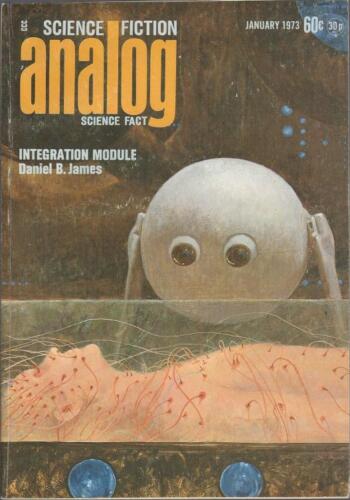
ANALOG PLUS 50: Analog Science Fiction/Science Fact January 1973

ANALOG PLUS 50: Analog Science Fiction/Science Fact, January 1973

Update the photo

I am trying this again. I gave up in July because I couldn't keep up with it and read other things -- in particular, I started the Expanse series. And if there's a double whammy to be found, it's this: I currently have a 500+ day streak of reading on my Kindle app. I know, it's stupid to track this, but it is being tracked and I want to see how long I can keep it up. Keep in mind, I have be away to weekend conventions and keep the streak going. However, the app doesn't seem to count reading PDF files as reading. I thought that had changed, but I found out a few days ago that I was mistaken. Luckily, I discovered this by 11:30 pm, so I had some time left.

As for the issues that I missed, I imagine that they are going to stay missed. The most likely -- and it isn't very likely -- is that I skim through for familiar names and read a handful of stories from the six previous issues. Serials are right out, I think.

The January 1973 issue of Analog ...

The usual explaination: For anyone finding these reviews, my purpose is two-fold: enjoying some "classic" sci-fi, and looking for stories that I think could be adapted for TV broadcast since so much of what shows up on anthology shows is rough to awful. Additional Note: I do NOT work in television. I just watch it.

In this issue:

The Editorial: "With friends like these". Basically, the experts are the last people who want to go to with a brand-new ideas. They'll tell you why it can't be done. The new guys, who don't know that it can't be done, will do it. Or at the very least, will come up with some interesting ideas. (Note: I've only read half so far. It continues at the end of the magazine.)

After the break, at the end of the magazine, this segues into the SALT talks, destroying nations, and the fact that numerical limits on weapons put an emphasis on having the best weapons possible under that limit, and to have weapons not covered by the treaty.

Novellette: "Integration Module", Daniel B. James, with an illustration by John Scoenherr showing a man with a tennis racket bending over to get something from a bag and a large round floating robot with three arms. The back hand has a tennis ball, the second has a racket and the third is stetching off to the top of the opposite page. After reading the story, I'm wondering if that's a cable to the ceiling. The caption reads, The most difficult thing to understand in the universe of man is -- the mind of man!

Joseph has just beaten Beta two matches out of three. Joseph has worked at the Beta Project for 23 years now, and given that the year is 2047, he's going to get hired soon! Beta isn't you're typical robot/android/artificial intellignece. In fact it has the mind of a man. Literally. This is stated very early on, and we even check in on the body of the man who lies there, integrated into Beta. We meet Joseph's wife, Eleanor, and a reporter named Mullroy, who tries to get the scoop on the project, questioning it in every way. Beta, can be very sarcastic with reporters. He learned from a book. Beta is schedule to be expanded and used more by the government. Beta calls Joseph with a concern. The integration has figure out that if he is present in so many places and only has access to certain data, then there has to be a certain repository, a device that is certral to his being, to his consciousness. He doesn't know where it is, but he knows that it must exist. He convinces Joseph to bring him to it.

I enjoyed this story. A quick search of my blog didn't turn up a mention of Daniel B. James.

This is ripe for an adaptation, given the moral and philosophical questions involved. It can be played as retro future or adapted for the past 50 years. Casting is wide open for Joseph and the reporter. The spouse could be expanded or removed for time. But hopefully not a funny voice for the robot. I don't see any problems there.

Science Fact: "The Third Industrial Revilution", by G. Harry Stine, with an illustration of industry on the Moon that appears to be credited to "General Electric". The caption reads Part One of Two Parts. The first industrial revolution freed man from physical slavery. The second is beginning to liberate man's mind from the numbing drudgery of repetitive tasks. And the third ...

This was interesting and I stuck with it longer than I do with a lot of science articles. The unfortunate thing is that I expected something about the computer revolution and the coming Information Age, which was forseeable in the early 70s, at least by visionaries. This is not that article.

Stine refers to industrialization in SPACE. We are running out of room here and we will run out of material, but there is plenty of material in space ripe for the picking and the vacuum will hardly notice our waste heat. What is unfortunate is where he predicts that we could be in the next 50 years, when costs and time will be cut dramatically.

Sigh.

The reasons for it stand out. The best vacuum you can find it up there. And you can get extreme temperatures cheap. The Earth can produce really hot, but making really cold is expensive.

I'll read part two next month.

Short Story: "Health Hazard", by Howard L. Myers, with an illustration by John Schoenherr, showing the back of a hairy biped with a sack in its left hand and what looks like a square monitor or CRT under its right arm. There are three others (an adult and two children?) in the background. They all seem to be heading for some kind of hut or mound. The caption reads, "Sometimes high-minded scientists with the best of good will, can be remarkably obtuse -- while by mistake doing something useful!"

The main character is Romee, a chimee from Notcid. The chimos and chimees are just about as human as men and women of Earth.

Romee Westbrook wants to get her "damn-TV" set working and goes to the Trading Center, or the Cultural Exchange Center. There are new Earth people running things now. The old ones were the exploiters (the traders/capitalists), and the new government people are here to help. Most of the traders are gone, but people like the repair guy aren't important enough to bother with.

At some point, she was given the name Westbrook because that's the location were she lives.

Romee has to go to the jungle to get roots to sell to the Earth people to get money for the damn-TV and to buy chocolate. She's addicted. The new government wants to ban the sale of chocolate because they think it's unhealthy for the Notcid, and it could be why so many are dying in the jungle.

Romee meets a woman who is looking for people for a series of tests on response to envrionmental stimuli for a modest stipend. Romee applies.

The test turns out to be a little cruel. It uses the machine-sounding noises that the Noctid hear in the jungle and usually don't survive. Most of the time, their response is to jump away from the noise. By the time she's heard the noise twice, she's flattened to the ground, scared out of her wits. This continues until the experiment is stopped by a senior official who is not amused. He mentions "damage money" that Romee will be awarded ... but that won't be for quite a while.

Since she still needs money, she goes off the jungle and finds some of the roots she needs. While she's crawling around, she hears the noises roaring above her. She flattens to the ground and waits for the end to come. But nothing happens. The noise keeps repeating, over and over, until there are new sounds, a creak and a crack. It was a swinging tree limb, and it kept swinging so long that it finally cracked and fell. Worse for the tree, it fell into the very trap the limb would have pushed Romee into had she jumped into the air instead of flattening to the ground.

She now knew how to beat the tree. She wanted to tell others but their instinct would still be to jump. So she starts by training her family the way she was trained.

This was a cute story and should be easily filmable. Hollywood would likely screw it up because makes the capitalists friendly but hardly ever polite, while the government people are polite but hardly ever friendly. Too much of the current output leans in favor of the government over any private enterprise, even when it acknowledges government's shortcomings.

Casting, as written, there are two big parts for women, but you only need a few background characters in hairy suits, one main character and four humans. I'd watch it.

Howard L. Myers has written several stories that I've read already.

Short Story: "A Thing of Beauty", by Norman Spinrad, with an illustration by Kelly Freas, showing a slight, bent, bald man in a silk robe in the foreground, overlooking in the back a Japanese village, and behind that, a headless Statue of Liberty. The caption reads, "Lo, all our pomp of yesterday is one with Nineveh and Tyre ..." Days of greatness may fade just as London Bridge came tumbling down. But enterprising men can still make life worthwhile, and even enjoyable.

This takes place in far enough in the future that the Insurrectionists have brought the US low, and possibly elsewhere as well. There are a lot of ruins and things are for sale.

Mr. Ito of Ito Freight Boosters is a very rich man and can spend as much as the national debt with blinking. He comes to visit Mr. Harris, the POV character. Harris works for the government, and sells things including landmarks to people who have the money.

Ito wants something to be a centerpiece of his garden, something big and obstentatious to run in the face of his wife and in-laws who look down upon his industrialist standing as unrefined, even though he could buy and sell them a thousand times over.

A hover-car (jumper) takes them around the city. First, we see the Statue of Liberty, but that's too sad to take, and the UN, but that's an insult to Japan, and finally Yankee Stadium. Ito spends hours telling Harris all about Yankee history. He then declines because his wife and in-laws wouldn't be impressed over baseball. Harris is dejected because he wasted a day, and any other landmarks are outside of his territory, and he won't get a commission.

They hang a lampshade on what he finally does sell him. In the epilogue, Ito sends Harris a bonus gold brick. Harris says he doesn't get the reference Ito is trying to make.

Enjoyable story, except for the last line. If he didn't get the joke, why even mention that there was a joke there he wasn't getting. Just acknowledge it like the other one.

This story could be entertaining, but I don't know what could be done with matte work and what needs CGI. That could bring the costs up. Otherwise, it's basicaly two people talking and flying around inside of jumper.

I know that I've read some Norman Spinrad in the past, but I couldn't say what. There isn't anything in this blog.

Short Story: "Proud Guns to the Sea", by Norman Spinrad, with an illustration by Kelly Freas, showing a pirate ship with Jolly Roger flying and sails unfurled, in the background. In the foreground, there's a bumpy, lizardy humanoid with a large jaw with extended teeth. He appears to be holding a space gun. The caption reads, The necessary characteristic of a troubleshooter is his ability to solve insoluble problems -- even if he does it with his own neck!

This story didn't do much for me. Nothing wrong with it, and others might enjoy it, but it didn't do much. The pirate ship in the illustration doesn't exist. It's space pirates.

In the 26th century, there's a colony world called Hallway, which seems to be a stopover point from Terran space to Keroni space (and there's a conflict?). It goes through Sheekathyrn space, and there are colonies a few light year from the star bridge. All interesting, if I kept it straight.

Jack Kellney is in charge of the colony of a few thousand people when they get word (though a message torpedo) of a pirate attack. Not an invasion, but piracy. Jack takes a ship and goes into space, and while he's gone, the ship attacks Hallway and takes Jack's girlfriend hostage.

With know options, he plays on the honor of the species attacking to declare that their captain issued a personal challenge when he kidnapped the girlfriend. It gets to the point where there's supposed to be a duel, but then there isn't one. And the two get away.

Anyway, it didn't do much for me, and I'm probably not doing it justice. Big shock there.

Is it filmable? Yes, but it'd need several sets. Something for the interiors of the colony base and of two ships. Plus the hull of the ship (docking footage?) and establishing shots. Most of the people would be dressed as lizard men, except the two humans.

Short Story: "One Plus One Equals Eleven", by G. C. Edmondson, with an illustration by Leo Summers, showing a man in coveralls with tools in each hand, kneeling next to a tool box, apparently working on some kind of circuitry. There are images of computer memory boards and light displays in the air, giving the impression of big computer. The caption reads, Even though they've been called "thinking machines," computers can't think. At least not on the human level. But, there are some forms of human endeavor that don't require thinking -- on a human level.

I wondered at first if this was going to be a story of the computer developing some kind of literate intelligence, similar to a story I read last year. It went a different way.

There are two characters in the story, and the best I can tell through scanning, neither are actually named. (It's in first person.)

So the narrator is a technician who puts on his coveralls and goes inside a super computer to clean it out and keep it running. Interestingly enough, the references might seem dated but there's no reason to believe that this story couldn't have taken place 50 years ago inside one of the nation's supercomputers that many users paid a lot of money to get a little bit of time on, and sometimes had to wait for a lull in processing to get their jobs executed.

While cleaning the "idiot machine" out, there's a printout which appears to have poetry lacking meter and rhyme. The narrator isn't much for poetry, but thinks this is terrible. He doesn't know who would be wasting valuable resources inputing this stuff. More starts coming out. He tries to inquire who is writing this, going as far as to shut down all input. If he can't fix this (I'm not sure what needs fixing), he'll lose his weekend fixing the machine.

It starts getting better, but still seems odd, even with a title. Then later it turns into more gibberish. In the end, a secondary character comes in. The "poetry" is pieces of his essay. He can't get a PhD without remedial English. He thought all this had been deleted, but shows a printout of the later essay draft. (It still reads badly, honestly. It's about the race of spermatozoa and people saying they didn't volunteer to be born.)

Not a lot of bang for the buck with this one. It might have had more of bite 50 years ago, but doesn't seem to offer much. It could be rewritten to make the POV character a little paranoid about the AI getting smarter and more creative -- and the story does suggest that the computer did edit some of what it had to work with.

Otherwise, not a top candidate for adapting for my hypothetical anthology series.

Short Story: "Proud Guns to the Sea", by Duncan Luna

This entry appears to have been deleted. I must've typed it at work and didn't "save" it. Or it was lost the last time my computer froze and I had to do a hard boot.

Until it's restored: I wasn't thrilled with this story. It's filmable, but I don't it could/would be made into a segment on an anthology series. The pirate ship in the illustration has nothing to do with the pirates in the story.

There's a corridor in space between to regions, and there is a colony called Hallway. Pirates come to take over. Meh.

Short Story: "Year 3 of the Shark", by Joel S. Witkin with an illustration by Jack Gaughan, showing a man in black with folders/papers in each hand, walking among the rubble of a building of some kind. (There could be a rank and insignia on his arm and shoulder). The caption reads, Some soldiers are not warriors. But it takes all types to make an army -- or a world.

Chief Master Sergeant Miltner is more than a pencil pusher. He's an eight-stripe pencil pusher. The war is in its third year (Year 3 of the Shark), and Miltner is one who is keeping it organized. He does his duty because he must. His former CO said as much. That man didn't care about work because he joined to avoid the draft. He knew that Miltner couldn't not do it, and knew that when he rose up he'd still do the job because he needed to be doing his job.

Miltner even reorganizes the troops as the strength dwindles in certain units. His voice has more weight than a major's. He meets with Tech Sergeant Donalo and Sergeant Cruze who mostly humor Miltner is his obsession to keep doing his duty, with the folders and the filing.

A colonel comes in asking about troop strength of Unit Four. It's been deleted and 17 men have been reassigned to Unit Eight. But 300 men are needed to fill a gap. There's probably 50 and possibly a few more. Miltner has some difficult decisions to make, and after he makes one, the colonel comes in to say that the war is over.

Cruze and Donalo leave. Miltner is ready to leave to ... but he can't because he can't leave the paperwork half done.

Quick little story about behind the scenes in a war. I enjoyed it. Filming it would require a couple of exterior shots, and the rest can be shot on a couple of sets. It needs a five-person cast, which could even be four if you combine Cruze and Donalo. Easily filmable. The futility of war is a universal concept.


The Reference Library , by P. Schuyler Miller. Opens with the Hugo Awards. Reivews include Flash Gordon: Into the Water World of Mongo by Alex Raymond, The Edge of Forever by Chad Oliver, The Outposter by Gordon R. Dickson, which was serialized in Analog, and which I read the novelization of, The Infinite Cage" by Keith Laumer (a new I've seen before in these reviews), The Molecule Men by Fred Hoyle and Geoffrey Hoyle, The EGorgon Festival by John Boyd, Other Eyes, Other Days by Bob Shaw, and The Byworlder by Poul Anderson (apparently a hard-shelled conservative, but not so much here).

Brass Tacks: A letter proposing a hp tax on cars to fight pollution, a proposal for a canal (730 feet wide, 50 feet deep) from Lake Superior to the Pacific Coast (30 years, $100B) -- Ben Bova responds that more Congressional support could be had if the canal wound through as many states as possible, but the Rockies and the environmental effects could be a problem), corrections to the editorial about McCarthy, a complaint about the change in tone of the editorials and the editorial tone since Campbell's passing, and more.

This seemed to be a quicker read than usual. I finished before the end of the month, after a late start, and I'm usually rushing to finish. I'll continue for another month.

Carl's Doomsday Scenario (Dinniman)

Carl's Doomsday Scenario: Dungeon Crawler Carl Book 2 by Matt Dinniman (2021) (Not a review, just some notes to help...