Showing posts with label Analog. Show all posts

Monday, March 27, 2023

ANALOG PLUS 50: Analog Science Fiction/Science Fact March 1973 (not much read)

ANALOG PLUS 50: Analog Science Fiction/Science Fact, March 1973

Update the photo

I had a lot of books to read in March, and I enjoyed most of them. Consequently, I didn't start Analog until March 27, so not much of it got read.

The usual explaination: For anyone finding these reviews, my purpose is two-fold: enjoying some "classic" sci-fi, and looking for stories that I think could be adapted for TV broadcast since so much of what shows up on anthology shows is rough to awful. Additional Note: I do NOT work in television. I just watch it.

In this issue: There's part two of a serial, two novellettes, and two short stories, one of which is really flash. The kind of thing that would one day be called "Probability: Zero" in Analog.

Editorial: "Law & Order" by Ben Bova. The 15th anniversary of Sputnik had passed without notice. Satellites are now orbiting the Earth. The Russians established the rule of "Freedom of Space" by launching over countries airspace and not asking permission, as when flying planes. This harkens back to the old "Freedom of the Seas" which was enforced by the British and then the U.S. Navy, and was kept in effect as long as it benefits those with the most power. Once laws are no longer beneficial, they tend to get ignored and fall be the wayside. Could that happen in space? (In the 50 years since, you know that it has, with space-based weapons platforms.)

Novelette: "Who Steals My Purse", John Brunner, with an illustration by John Scoenherr showing . The caption reads,

I haven't read it yet. John Brunner is a name that I could find in my basement, but I can't say that I've actually read anything. I hope to get to it, even in April.

Short Story: "Death of God", by Herbie Brennan, with an illustration by Kelly Freas, showing a background banner that says (one supposes) Peace of Earth, with a couple of cartoony, happy people walking with flowers in their hands. More prominent is the large round thing with a scaly belly, wings and a long bill, plodding along. The caption reads, "Sometimes a demonstration can be unexpectedly successful. And when it is, the need for such demonstratons disappears -- even though something else will soon be "bugging" the demonstrators."

Wilbur Hines works in a lab. Protestors smash the lab, calling him "Biological swine" and "bacteriological pig". Hines is studying gnats, and they escape as if Pandora's Box had been opened. He thought that they wouldn't be a problem but he was wrong. They mutated.

They were fruitful and multiplied, and have become a nuisance. More people stayed at home, avoiding going out. Some people are immune (unappetizing).

At some point, she was given the name Westbrook because that's the location were she lives.

Romee has to go to the jungle to get roots to sell to the Earth people to get money for the damn-TV and to buy chocolate. She's addicted. The new government wants to ban the sale of chocolate because they think it's unhealthy for the Notcid, and it could be why so many are dying in the jungle.

Romee meets a woman who is looking for people for a series of tests on response to envrionmental stimuli for a modest stipend. Romee applies.

The test turns out to be a little cruel. It uses the machine-sounding noises that the Noctid hear in the jungle and usually don't survive. Most of the time, their response is to jump away from the noise. By the time she's heard the noise twice, she's flattened to the ground, scared out of her wits. This continues until the experiment is stopped by a senior official who is not amused. He mentions "damage money" that Romee will be awarded ... but that won't be for quite a while.

Since she still needs money, she goes off the jungle and finds some of the roots she needs. While she's crawling around, she hears the noises roaring above her. She flattens to the ground and waits for the end to come. But nothing happens. The noise keeps repeating, over and over, until there are new sounds, a creak and a crack. It was a swinging tree limb, and it kept swinging so long that it finally cracked and fell. Worse for the tree, it fell into the very trap the limb would have pushed Romee into had she jumped into the air instead of flattening to the ground.

She now knew how to beat the tree. She wanted to tell others but their instinct would still be to jump. So she starts by training her family the way she was trained.

This was a cute story and should be easily filmable. Hollywood would likely screw it up because makes the capitalists friendly but hardly ever polite, while the government people are polite but hardly ever friendly. Too much of the current output leans in favor of the government over any private enterprise, even when it acknowledges government's shortcomings.

Casting, as written, there are two big parts for women, but you only need a few background characters in hairy suits, one main character and four humans. I'd watch it.

Howard L. Myers has written several stories that I've read already.

Short Story: "The Guy with the Eyes", by Spider Robinson, with an illustration by Vincent di Fate, showing a bartender (Callahan)behind his bar, some glasses and decanter on the bar, and two patrons. There are some spheres odd to the side, which could be taken as planets that are meant to be inferred but not actually in the scene. The caption reads, The job of a scout is difficult and dangerous. He must determine the nature and disposition of the enemy, its weak points, and its strengths. But when the scout starts to feel sorry for the enemy...

I was hyped to read an early Callahan story. I took the paperback Time Travelers Strictly Cash from the library back in high school. My oldest brother enjoyed it immensely. I read about half of it. I wasn't the greatest of readers back then, which is why I'd take multiple books out -- I'd hope one would "click" with me. I also playtested the GURPS supplement. "Mild Hangover" Advantage? That was mine. "No Hangover" was already there.

Anyway, I haven't read a lot of Spider, even though I'm always meaning to. This story seems like it's set in his universe and there's more going on. It gives the general location and the setup of the bar routines. Doc Webster is there telling bad puns. And people get up to make toasts.

There's stuff with "this Janssen kid" whose known for trouble. There's mention of heroin (he toasts "skag") and the war (it's 1973). But he's not the guy with the eyes. He's over in the corner listening, but has no answers.

Some pontificating happens, as is wont to happen in 70s stories and beyond.

The man with the eyes wore a black suit, a Joliet Special and his shoes didn't look right. He orders 10 drinks, makes 10 toasts to his profession, and then announces that he's an advance scout from many light-years away. Callahan knows he's neither drunk nor lying. A message is going to his Masters that he can't prevent, and for the first time, he has regrets. He's surprised when the bar regulars don't attack and kill him on the spot.

It petered out toward the end with a Mickey Finn reference but no solution to either problem.

Obviously, filming this would be a big deal because Callahan's is a long running series of stories and books. It could be a series of its own about a bar where everyone knows your name or something, but in Long Island, NY. Why it hasn't been made, who can say? (Well, Spider could, and probably folks who follow Spider on social media...) I don't know who I'd cast for any of the parts. And, of course, the storylines would have to be updated since they started in the 70s and lasted for many years after.

Short Story: "Modus Vivendi", by William Walling, with an illustration by Vincent di Fate, showing a large planet (Jupiter, there's a spot), some moons and a ship. The caption reads, The most critical step in any medical experiment is going from test animals to human trials. Usually this step is taken very carefully. But sometimes ...

I read the caption a while back before I read the story. It's funny reading it now as it telegraphs the ending in a way.

Clancy Bevvins, Lee Gresham, and Thaddeus Frye are scientists and researchers on a space-based station orbiting Jupiter. There's a base on Ganymede. Much of the research is of the hush-hush variety, so most have nothing to say about their work to the others. The one thing is that Bevvins has three gibbons with him. He says he's in deep space to avoid radiation and to be in zero g.

There's an accident that pushes them out of their orbit and whatever it is has breached both oxygen systems. The three of them and the gibbons are the only survivors. Time is against them. They won't spin into Jupiter before Ganymede is in range to call for help but they will run out of oxygen with no way to recycle it. There isn't enoug for one man let alone three

That's where the gibbons come in. One of them has something in their system (I was a little murky on the details) that allows her to recycle the carbon dioxide or breathe oxygen. Bevvins uses his experiment to keep the three of them alive. But there are consequences.

This was a good story, and only require a cast of 3 that can be as fiverse as you want them to me. It would also need three gibbons, briefly, which could be trained animals or could be cgi. Probably cheaper to get an animal trainer for a day of shooting, but what do I know? Only a couple of interior sets are needed, but the wreckage, and exterior would likely require CGI. I'd watch it.

Science Fact: "The Third Industrial Revolution" by G. Harry Stine, with an illustration of industry on the Moon that appears to be credited to "General Electric". The caption reads Conclusion. When you want to have our cake and eat it too, you're in a dilemma. When you want to continue a high-level technolog without further gutting Mother Eart for resources, you have to move your industrial base out of this world.

I followed a bit of this and then skimmed the rest. Gravity wells are issues for get resources and materials up into space. Slingshoting from the Moon or Mars would be easier, as would be mining asteroids. And you wouldn't have to worry about heating the environment.

If I knew enough about manufacturing in general, let alone space manufacturing, this could be a good resource to revisit for writing. The problem is that unless I want to write hard science fiction, most of this can be hand-waved.

Novellette: "Force Over Distance", by Tak Hallus, with an illustration by Jack Gaughan, showing a man working at a table, where there's a large box and a vertical ring. On either side of him are men with sombreros and guns. In the forground, there appears to be an object floating in a ball of light. The caption reads, The military-industrial state can sometimes amount to nothing more than two or three men with a common purpose. They don't even have to like each other.. just have a common purpose.

I've read Tak Hallus before at least twice. (I did a quick blog search.) This story is filled with Mexican banditos and revolutionaries.

Federico Jenson is a physicist who goes to Mexico and has his tire shot. He discovers this when he replaces it with the spare. As soon as he's done, the banditos steal the car and intend to strand him on the roadside. He wants his briefcase with his life's work in it. They refuse. So he says that he's going, too. So he's a hostage for ransom that he basically agreed to (insisted upon).

He tries to work out a math eqaution in the dust because he doesn't have paper but he insists on continuing his work. Juan, the guard, asks about it, calls him crazy for all the work he does to get a "cero" (the sequence should converge to zero). This sums up the opening illustration.

Jenson is being held prisoner by the revolutionary el Buitre, the Vulture. El Buitre isn't dumb -- he is good at strategizing and planning. He has Jenson demonstrate his transporter, which moves something to the other end of a table. El Buitre wants him to build a "beeg one", as big as a room. Jenson says what that would require.

This is no problem for El Buitre because his people can steal whatever they need. People die along the way. Jenson isn't happy about this, but on the other hand, he doesn't want their deaths to mean nothing. They're already dead and the project can move forward. He's almost as obsessed about his life work as El Buirtre is about his revolution.

His men make it into Tucson to get tantalum, and they kidnap construction engineer Harold Wright. Wright refuses to opperate for several days. El Buitre is about to kill him when Jensen intervenes. So El Buitre decides to kill him first. At this point, Wright agrees to help (although he nearly gets himself killed for calling El Buitre "Buzz").

The two complete the machine even though Wright is trying to stall it because he believes that they'll be killed before it's done. Finally they plan to escape through the device, with Wright worrying that Jenson might stay behind for "science" and his life work. Their plan is thwarted by the fact that Juan is smarter than he's been letting on.

The banditos go through the device (which seems like a large stargate) but they're in for a surprise when they get there.

An enjoyable story. It could fill an hour-long episode of an anthology show. I don't know how well the Mexican bandito angle would play unless it's done in a retro style, as in this actually happened in the 70s. The cast would require a handful of revolutionaries, El Buitre, and a physicist and an engineer. Women don't have a lot to do in this story. The ending requires a lot of extras and motorcycles, but it could just be a handful, and then cut away to Jenson and use a lot of sound effects and smoke and rattling boards.

Note: there is a very odd interior art piece which looks like El Buitre is riding a motorized unicycle. There's smoke to obscure the missing parts of the bike (and his arms because there are no handlebars) but you can see the far legs which should be on the other side of the motorcycle, out of sight. I found it amusing.

Short Story: "Trade-Off", by R. A. Beaumont

This entry appears to have been deleted. I must've typed it at work and didn't "save" it. Or it was lost the last time my computer froze and I had to do a hard boot.

Until it's restored: I wasn't thrilled with this story. It's filmable, but I don't it could/would be made into a segment on an anthology series.

Short Story: "Trade-Off", by R. A. Beaumont with an oval-shaped illustration by John Schoenherr, showing what appears to be a bunch of silos (or cylindrical objects) on a field at night and there are lots of bubble. The caption reads, There are times when the cure is worse than the disease. But when the cure triggers other diseases ...

I just started reading this. It appears to be told in a series of top secret memos. I didn't get far.

I have libary books to finish, so I may or may not get back to this.


The Reference Library , by P. Schuyler Miller. Opens with a discussion of books about on-screen SF. Reviews include The Overman Culture, by Edmund Cooper; The Wrong End of Time, by John Brunner; The Reality Trip, by Robert Silverberg; Pstalement, by Lester del Rey; and The Darkness of Diamondia, by A.E. van Vogt.

Brass Tacks: In July, there was an article on the future of automotive plants. Analog received a lot of responses, so they printed a reply by the writer, R. G. Cleveland first. I don't remember the article and the issues involved are 50 years old, so I didn't miss much skimming this.

I got an early start on this, whih was good, but then my book club and other library books took my attention away for a couple weeks, and February ended before you knew it.

Tuesday, February 28, 2023

ANALOG PLUS 50: Analog Science Fiction/Science Fact February 1973

ANALOG PLUS 50: Analog Science Fiction/Science Fact, February 1973

Update the photo

January went well, so let's do it again.

A new serial (maybe I'll get to it) and a Spider Robinson story.

The February 1973 issue of Analog has a new serial (maybe I'll get to it) and a Spider Robinson story.

The usual explaination: For anyone finding these reviews, my purpose is two-fold: enjoying some "classic" sci-fi, and looking for stories that I think could be adapted for TV broadcast since so much of what shows up on anthology shows is rough to awful. Additional Note: I do NOT work in television. I just watch it.

In this issue:

Guest Editorial: "Beyond the Citizen" by R. G. Cleveland. I haven't read it yet. I'll get back to it.

Serial: "The People of the Wind" (Part One of Three Parts), Poul Anderson, with an illustration by John Scoenherr showing a man with a tennis racket bending over to get something from a bag and a large round floating robot with three arms. The back hand has a tennis ball, the second has a racket and the third is stetching off to the top of the opposite page. After reading the story, I'm wondering if that's a cable to the ceiling. The caption reads, The most difficult thing to understand in the universe of man is -- the mind of man!

I hope I get to read this.

Short Story: "Biological Peacefare", by W. Macfarlane, with an illustration by Kelly Freas, showing a background banner that says (one supposes) Peace of Earth, with a couple of cartoony, happy people walking with flowers in their hands. More prominent is the large round thing with a scaly belly, wings and a long bill, plodding along. The caption reads, "Sometimes a demonstration can be unexpectedly successful. And when it is, the need for such demonstratons disappears -- even though something else will soon be "bugging" the demonstrators."

Wilbur Hines works in a lab. Protestors smash the lab, calling him "Biological swine" and "bacteriological pig". Hines is studying gnats, and they escape as if Pandora's Box had been opened. He thought that they wouldn't be a problem but he was wrong. They mutated.

They were fruitful and multiplied, and have become a nuisance. More people stayed at home, avoiding going out. Some people are immune (unappetizing).

At some point, she was given the name Westbrook because that's the location were she lives.

Romee has to go to the jungle to get roots to sell to the Earth people to get money for the damn-TV and to buy chocolate. She's addicted. The new government wants to ban the sale of chocolate because they think it's unhealthy for the Notcid, and it could be why so many are dying in the jungle.

Romee meets a woman who is looking for people for a series of tests on response to envrionmental stimuli for a modest stipend. Romee applies.

The test turns out to be a little cruel. It uses the machine-sounding noises that the Noctid hear in the jungle and usually don't survive. Most of the time, their response is to jump away from the noise. By the time she's heard the noise twice, she's flattened to the ground, scared out of her wits. This continues until the experiment is stopped by a senior official who is not amused. He mentions "damage money" that Romee will be awarded ... but that won't be for quite a while.

Since she still needs money, she goes off the jungle and finds some of the roots she needs. While she's crawling around, she hears the noises roaring above her. She flattens to the ground and waits for the end to come. But nothing happens. The noise keeps repeating, over and over, until there are new sounds, a creak and a crack. It was a swinging tree limb, and it kept swinging so long that it finally cracked and fell. Worse for the tree, it fell into the very trap the limb would have pushed Romee into had she jumped into the air instead of flattening to the ground.

She now knew how to beat the tree. She wanted to tell others but their instinct would still be to jump. So she starts by training her family the way she was trained.

This was a cute story and should be easily filmable. Hollywood would likely screw it up because makes the capitalists friendly but hardly ever polite, while the government people are polite but hardly ever friendly. Too much of the current output leans in favor of the government over any private enterprise, even when it acknowledges government's shortcomings.

Casting, as written, there are two big parts for women, but you only need a few background characters in hairy suits, one main character and four humans. I'd watch it.

Howard L. Myers has written several stories that I've read already.

Short Story: "The Guy with the Eyes", by Spider Robinson, with an illustration by Vincent di Fate, showing a bartender (Callahan)behind his bar, some glasses and decanter on the bar, and two patrons. There are some spheres odd to the side, which could be taken as planets that are meant to be inferred but not actually in the scene. The caption reads, The job of a scout is difficult and dangerous. He must determine the nature and disposition of the enemy, its weak points, and its strengths. But when the scout starts to feel sorry for the enemy...

I was hyped to read an early Callahan story. I took the paperback Time Travelers Strictly Cash from the library back in high school. My oldest brother enjoyed it immensely. I read about half of it. I wasn't the greatest of readers back then, which is why I'd take multiple books out -- I'd hope one would "click" with me. I also playtested the GURPS supplement. "Mild Hangover" Advantage? That was mine. "No Hangover" was already there.

Anyway, I haven't read a lot of Spider, even though I'm always meaning to. This story seems like it's set in his universe and there's more going on. It gives the general location and the setup of the bar routines. Doc Webster is there telling bad puns. And people get up to make toasts.

There's stuff with "this Janssen kid" whose known for trouble. There's mention of heroin (he toasts "skag") and the war (it's 1973). But he's not the guy with the eyes. He's over in the corner listening, but has no answers.

Some pontificating happens, as is wont to happen in 70s stories and beyond.

The man with the eyes wore a black suit, a Joliet Special and his shoes didn't look right. He orders 10 drinks, makes 10 toasts to his profession, and then announces that he's an advance scout from many light-years away. Callahan knows he's neither drunk nor lying. A message is going to his Masters that he can't prevent, and for the first time, he has regrets. He's surprised when the bar regulars don't attack and kill him on the spot.

It petered out toward the end with a Mickey Finn reference but no solution to either problem.

Obviously, filming this would be a big deal because Callahan's is a long running series of stories and books. It could be a series of its own about a bar where everyone knows your name or something, but in Long Island, NY. Why it hasn't been made, who can say? (Well, Spider could, and probably folks who follow Spider on social media...) I don't know who I'd cast for any of the parts. And, of course, the storylines would have to be updated since they started in the 70s and lasted for many years after.

Short Story: "Modus Vivendi", by William Walling, with an illustration by Vincent di Fate, showing a large planet (Jupiter, there's a spot), some moons and a ship. The caption reads, The most critical step in any medical experiment is going from test animals to human trials. Usually this step is taken very carefully. But sometimes ...

I read the caption a while back before I read the story. It's funny reading it now as it telegraphs the ending in a way.

Clancy Bevvins, Lee Gresham, and Thaddeus Frye are scientists and researchers on a space-based station orbiting Jupiter. There's a base on Ganymede. Much of the research is of the hush-hush variety, so most have nothing to say about their work to the others. The one thing is that Bevvins has three gibbons with him. He says he's in deep space to avoid radiation and to be in zero g.

There's an accident that pushes them out of their orbit and whatever it is has breached both oxygen systems. The three of them and the gibbons are the only survivors. Time is against them. They won't spin into Jupiter before Ganymede is in range to call for help but they will run out of oxygen with no way to recycle it. There isn't enoug for one man let alone three

That's where the gibbons come in. One of them has something in their system (I was a little murky on the details) that allows her to recycle the carbon dioxide or breathe oxygen. Bevvins uses his experiment to keep the three of them alive. But there are consequences.

This was a good story, and only require a cast of 3 that can be as fiverse as you want them to me. It would also need three gibbons, briefly, which could be trained animals or could be cgi. Probably cheaper to get an animal trainer for a day of shooting, but what do I know? Only a couple of interior sets are needed, but the wreckage, and exterior would likely require CGI. I'd watch it.

Science Fact: "The Third Industrial Revolution" by G. Harry Stine, with an illustration of industry on the Moon that appears to be credited to "General Electric". The caption reads Conclusion. When you want to have our cake and eat it too, you're in a dilemma. When you want to continue a high-level technolog without further gutting Mother Eart for resources, you have to move your industrial base out of this world.

I followed a bit of this and then skimmed the rest. Gravity wells are issues for get resources and materials up into space. Slingshoting from the Moon or Mars would be easier, as would be mining asteroids. And you wouldn't have to worry about heating the environment.

If I knew enough about manufacturing in general, let alone space manufacturing, this could be a good resource to revisit for writing. The problem is that unless I want to write hard science fiction, most of this can be hand-waved.

Novellette: "Force Over Distance", by Tak Hallus, with an illustration by Jack Gaughan, showing a man working at a table, where there's a large box and a vertical ring. On either side of him are men with sombreros and guns. In the forground, there appears to be an object floating in a ball of light. The caption reads, The military-industrial state can sometimes amount to nothing more than two or three men with a common purpose. They don't even have to like each other.. just have a common purpose.

I've read Tak Hallus before at least twice. (I did a quick blog search.) This story is filled with Mexican banditos and revolutionaries.

Federico Jenson is a physicist who goes to Mexico and has his tire shot. He discovers this when he replaces it with the spare. As soon as he's done, the banditos steal the car and intend to strand him on the roadside. He wants his briefcase with his life's work in it. They refuse. So he says that he's going, too. So he's a hostage for ransom that he basically agreed to (insisted upon).

He tries to work out a math eqaution in the dust because he doesn't have paper but he insists on continuing his work. Juan, the guard, asks about it, calls him crazy for all the work he does to get a "cero" (the sequence should converge to zero). This sums up the opening illustration.

Jenson is being held prisoner by the revolutionary el Buitre, the Vulture. El Buitre isn't dumb -- he is good at strategizing and planning. He has Jenson demonstrate his transporter, which moves something to the other end of a table. El Buitre wants him to build a "beeg one", as big as a room. Jenson says what that would require.

This is no problem for El Buitre because his people can steal whatever they need. People die along the way. Jenson isn't happy about this, but on the other hand, he doesn't want their deaths to mean nothing. They're already dead and the project can move forward. He's almost as obsessed about his life work as El Buirtre is about his revolution.

His men make it into Tucson to get tantalum, and they kidnap construction engineer Harold Wright. Wright refuses to opperate for several days. El Buitre is about to kill him when Jensen intervenes. So El Buitre decides to kill him first. At this point, Wright agrees to help (although he nearly gets himself killed for calling El Buitre "Buzz").

The two complete the machine even though Wright is trying to stall it because he believes that they'll be killed before it's done. Finally they plan to escape through the device, with Wright worrying that Jenson might stay behind for "science" and his life work. Their plan is thwarted by the fact that Juan is smarter than he's been letting on.

The banditos go through the device (which seems like a large stargate) but they're in for a surprise when they get there.

An enjoyable story. It could fill an hour-long episode of an anthology show. I don't know how well the Mexican bandito angle would play unless it's done in a retro style, as in this actually happened in the 70s. The cast would require a handful of revolutionaries, El Buitre, and a physicist and an engineer. Women don't have a lot to do in this story. The ending requires a lot of extras and motorcycles, but it could just be a handful, and then cut away to Jenson and use a lot of sound effects and smoke and rattling boards.

Note: there is a very odd interior art piece which looks like El Buitre is riding a motorized unicycle. There's smoke to obscure the missing parts of the bike (and his arms because there are no handlebars) but you can see the far legs which should be on the other side of the motorcycle, out of sight. I found it amusing.

Short Story: "Trade-Off", by R. A. Beaumont

This entry appears to have been deleted. I must've typed it at work and didn't "save" it. Or it was lost the last time my computer froze and I had to do a hard boot.

Until it's restored: I wasn't thrilled with this story. It's filmable, but I don't it could/would be made into a segment on an anthology series.

Short Story: "Trade-Off", by R. A. Beaumont with an oval-shaped illustration by John Schoenherr, showing what appears to be a bunch of silos (or cylindrical objects) on a field at night and there are lots of bubble. The caption reads, There are times when the cure is worse than the disease. But when the cure triggers other diseases ...

I just started reading this. It appears to be told in a series of top secret memos. I didn't get far.

I have libary books to finish, so I may or may not get back to this.


The Reference Library , by P. Schuyler Miller. Opens with a discussion of books about on-screen SF. Reviews include The Overman Culture, by Edmund Cooper; The Wrong End of Time, by John Brunner; The Reality Trip, by Robert Silverberg; Pstalement, by Lester del Rey; and The Darkness of Diamondia, by A.E. van Vogt.

Brass Tacks: In July, there was an article on the future of automotive plants. Analog received a lot of responses, so they printed a reply by the writer, R. G. Cleveland first. I don't remember the article and the issues involved are 50 years old, so I didn't miss much skimming this.

I got an early start on this, whih was good, but then my book club and other library books took my attention away for a couple weeks, and February ended before you knew it.

Sunday, January 29, 2023

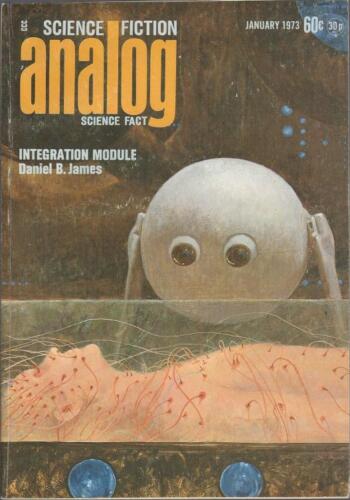
ANALOG PLUS 50: Analog Science Fiction/Science Fact January 1973

ANALOG PLUS 50: Analog Science Fiction/Science Fact, January 1973

Update the photo

I am trying this again. I gave up in July because I couldn't keep up with it and read other things -- in particular, I started the Expanse series. And if there's a double whammy to be found, it's this: I currently have a 500+ day streak of reading on my Kindle app. I know, it's stupid to track this, but it is being tracked and I want to see how long I can keep it up. Keep in mind, I have be away to weekend conventions and keep the streak going. However, the app doesn't seem to count reading PDF files as reading. I thought that had changed, but I found out a few days ago that I was mistaken. Luckily, I discovered this by 11:30 pm, so I had some time left.

As for the issues that I missed, I imagine that they are going to stay missed. The most likely -- and it isn't very likely -- is that I skim through for familiar names and read a handful of stories from the six previous issues. Serials are right out, I think.

The January 1973 issue of Analog ...

The usual explaination: For anyone finding these reviews, my purpose is two-fold: enjoying some "classic" sci-fi, and looking for stories that I think could be adapted for TV broadcast since so much of what shows up on anthology shows is rough to awful. Additional Note: I do NOT work in television. I just watch it.

In this issue:

The Editorial: "With friends like these". Basically, the experts are the last people who want to go to with a brand-new ideas. They'll tell you why it can't be done. The new guys, who don't know that it can't be done, will do it. Or at the very least, will come up with some interesting ideas. (Note: I've only read half so far. It continues at the end of the magazine.)

After the break, at the end of the magazine, this segues into the SALT talks, destroying nations, and the fact that numerical limits on weapons put an emphasis on having the best weapons possible under that limit, and to have weapons not covered by the treaty.

Novellette: "Integration Module", Daniel B. James, with an illustration by John Scoenherr showing a man with a tennis racket bending over to get something from a bag and a large round floating robot with three arms. The back hand has a tennis ball, the second has a racket and the third is stetching off to the top of the opposite page. After reading the story, I'm wondering if that's a cable to the ceiling. The caption reads, The most difficult thing to understand in the universe of man is -- the mind of man!

Joseph has just beaten Beta two matches out of three. Joseph has worked at the Beta Project for 23 years now, and given that the year is 2047, he's going to get hired soon! Beta isn't you're typical robot/android/artificial intellignece. In fact it has the mind of a man. Literally. This is stated very early on, and we even check in on the body of the man who lies there, integrated into Beta. We meet Joseph's wife, Eleanor, and a reporter named Mullroy, who tries to get the scoop on the project, questioning it in every way. Beta, can be very sarcastic with reporters. He learned from a book. Beta is schedule to be expanded and used more by the government. Beta calls Joseph with a concern. The integration has figure out that if he is present in so many places and only has access to certain data, then there has to be a certain repository, a device that is certral to his being, to his consciousness. He doesn't know where it is, but he knows that it must exist. He convinces Joseph to bring him to it.

I enjoyed this story. A quick search of my blog didn't turn up a mention of Daniel B. James.

This is ripe for an adaptation, given the moral and philosophical questions involved. It can be played as retro future or adapted for the past 50 years. Casting is wide open for Joseph and the reporter. The spouse could be expanded or removed for time. But hopefully not a funny voice for the robot. I don't see any problems there.

Science Fact: "The Third Industrial Revilution", by G. Harry Stine, with an illustration of industry on the Moon that appears to be credited to "General Electric". The caption reads Part One of Two Parts. The first industrial revolution freed man from physical slavery. The second is beginning to liberate man's mind from the numbing drudgery of repetitive tasks. And the third ...

This was interesting and I stuck with it longer than I do with a lot of science articles. The unfortunate thing is that I expected something about the computer revolution and the coming Information Age, which was forseeable in the early 70s, at least by visionaries. This is not that article.

Stine refers to industrialization in SPACE. We are running out of room here and we will run out of material, but there is plenty of material in space ripe for the picking and the vacuum will hardly notice our waste heat. What is unfortunate is where he predicts that we could be in the next 50 years, when costs and time will be cut dramatically.

Sigh.

The reasons for it stand out. The best vacuum you can find it up there. And you can get extreme temperatures cheap. The Earth can produce really hot, but making really cold is expensive.

I'll read part two next month.

Short Story: "Health Hazard", by Howard L. Myers, with an illustration by John Schoenherr, showing the back of a hairy biped with a sack in its left hand and what looks like a square monitor or CRT under its right arm. There are three others (an adult and two children?) in the background. They all seem to be heading for some kind of hut or mound. The caption reads, "Sometimes high-minded scientists with the best of good will, can be remarkably obtuse -- while by mistake doing something useful!"

The main character is Romee, a chimee from Notcid. The chimos and chimees are just about as human as men and women of Earth.

Romee Westbrook wants to get her "damn-TV" set working and goes to the Trading Center, or the Cultural Exchange Center. There are new Earth people running things now. The old ones were the exploiters (the traders/capitalists), and the new government people are here to help. Most of the traders are gone, but people like the repair guy aren't important enough to bother with.

At some point, she was given the name Westbrook because that's the location were she lives.

Romee has to go to the jungle to get roots to sell to the Earth people to get money for the damn-TV and to buy chocolate. She's addicted. The new government wants to ban the sale of chocolate because they think it's unhealthy for the Notcid, and it could be why so many are dying in the jungle.

Romee meets a woman who is looking for people for a series of tests on response to envrionmental stimuli for a modest stipend. Romee applies.

The test turns out to be a little cruel. It uses the machine-sounding noises that the Noctid hear in the jungle and usually don't survive. Most of the time, their response is to jump away from the noise. By the time she's heard the noise twice, she's flattened to the ground, scared out of her wits. This continues until the experiment is stopped by a senior official who is not amused. He mentions "damage money" that Romee will be awarded ... but that won't be for quite a while.

Since she still needs money, she goes off the jungle and finds some of the roots she needs. While she's crawling around, she hears the noises roaring above her. She flattens to the ground and waits for the end to come. But nothing happens. The noise keeps repeating, over and over, until there are new sounds, a creak and a crack. It was a swinging tree limb, and it kept swinging so long that it finally cracked and fell. Worse for the tree, it fell into the very trap the limb would have pushed Romee into had she jumped into the air instead of flattening to the ground.

She now knew how to beat the tree. She wanted to tell others but their instinct would still be to jump. So she starts by training her family the way she was trained.

This was a cute story and should be easily filmable. Hollywood would likely screw it up because makes the capitalists friendly but hardly ever polite, while the government people are polite but hardly ever friendly. Too much of the current output leans in favor of the government over any private enterprise, even when it acknowledges government's shortcomings.

Casting, as written, there are two big parts for women, but you only need a few background characters in hairy suits, one main character and four humans. I'd watch it.

Howard L. Myers has written several stories that I've read already.

Short Story: "A Thing of Beauty", by Norman Spinrad, with an illustration by Kelly Freas, showing a slight, bent, bald man in a silk robe in the foreground, overlooking in the back a Japanese village, and behind that, a headless Statue of Liberty. The caption reads, "Lo, all our pomp of yesterday is one with Nineveh and Tyre ..." Days of greatness may fade just as London Bridge came tumbling down. But enterprising men can still make life worthwhile, and even enjoyable.

This takes place in far enough in the future that the Insurrectionists have brought the US low, and possibly elsewhere as well. There are a lot of ruins and things are for sale.

Mr. Ito of Ito Freight Boosters is a very rich man and can spend as much as the national debt with blinking. He comes to visit Mr. Harris, the POV character. Harris works for the government, and sells things including landmarks to people who have the money.

Ito wants something to be a centerpiece of his garden, something big and obstentatious to run in the face of his wife and in-laws who look down upon his industrialist standing as unrefined, even though he could buy and sell them a thousand times over.

A hover-car (jumper) takes them around the city. First, we see the Statue of Liberty, but that's too sad to take, and the UN, but that's an insult to Japan, and finally Yankee Stadium. Ito spends hours telling Harris all about Yankee history. He then declines because his wife and in-laws wouldn't be impressed over baseball. Harris is dejected because he wasted a day, and any other landmarks are outside of his territory, and he won't get a commission.

They hang a lampshade on what he finally does sell him. In the epilogue, Ito sends Harris a bonus gold brick. Harris says he doesn't get the reference Ito is trying to make.

Enjoyable story, except for the last line. If he didn't get the joke, why even mention that there was a joke there he wasn't getting. Just acknowledge it like the other one.

This story could be entertaining, but I don't know what could be done with matte work and what needs CGI. That could bring the costs up. Otherwise, it's basicaly two people talking and flying around inside of jumper.

I know that I've read some Norman Spinrad in the past, but I couldn't say what. There isn't anything in this blog.

Short Story: "Proud Guns to the Sea", by Norman Spinrad, with an illustration by Kelly Freas, showing a pirate ship with Jolly Roger flying and sails unfurled, in the background. In the foreground, there's a bumpy, lizardy humanoid with a large jaw with extended teeth. He appears to be holding a space gun. The caption reads, The necessary characteristic of a troubleshooter is his ability to solve insoluble problems -- even if he does it with his own neck!

This story didn't do much for me. Nothing wrong with it, and others might enjoy it, but it didn't do much. The pirate ship in the illustration doesn't exist. It's space pirates.

In the 26th century, there's a colony world called Hallway, which seems to be a stopover point from Terran space to Keroni space (and there's a conflict?). It goes through Sheekathyrn space, and there are colonies a few light year from the star bridge. All interesting, if I kept it straight.

Jack Kellney is in charge of the colony of a few thousand people when they get word (though a message torpedo) of a pirate attack. Not an invasion, but piracy. Jack takes a ship and goes into space, and while he's gone, the ship attacks Hallway and takes Jack's girlfriend hostage.

With know options, he plays on the honor of the species attacking to declare that their captain issued a personal challenge when he kidnapped the girlfriend. It gets to the point where there's supposed to be a duel, but then there isn't one. And the two get away.

Anyway, it didn't do much for me, and I'm probably not doing it justice. Big shock there.

Is it filmable? Yes, but it'd need several sets. Something for the interiors of the colony base and of two ships. Plus the hull of the ship (docking footage?) and establishing shots. Most of the people would be dressed as lizard men, except the two humans.

Short Story: "One Plus One Equals Eleven", by G. C. Edmondson, with an illustration by Leo Summers, showing a man in coveralls with tools in each hand, kneeling next to a tool box, apparently working on some kind of circuitry. There are images of computer memory boards and light displays in the air, giving the impression of big computer. The caption reads, Even though they've been called "thinking machines," computers can't think. At least not on the human level. But, there are some forms of human endeavor that don't require thinking -- on a human level.

I wondered at first if this was going to be a story of the computer developing some kind of literate intelligence, similar to a story I read last year. It went a different way.

There are two characters in the story, and the best I can tell through scanning, neither are actually named. (It's in first person.)

So the narrator is a technician who puts on his coveralls and goes inside a super computer to clean it out and keep it running. Interestingly enough, the references might seem dated but there's no reason to believe that this story couldn't have taken place 50 years ago inside one of the nation's supercomputers that many users paid a lot of money to get a little bit of time on, and sometimes had to wait for a lull in processing to get their jobs executed.

While cleaning the "idiot machine" out, there's a printout which appears to have poetry lacking meter and rhyme. The narrator isn't much for poetry, but thinks this is terrible. He doesn't know who would be wasting valuable resources inputing this stuff. More starts coming out. He tries to inquire who is writing this, going as far as to shut down all input. If he can't fix this (I'm not sure what needs fixing), he'll lose his weekend fixing the machine.

It starts getting better, but still seems odd, even with a title. Then later it turns into more gibberish. In the end, a secondary character comes in. The "poetry" is pieces of his essay. He can't get a PhD without remedial English. He thought all this had been deleted, but shows a printout of the later essay draft. (It still reads badly, honestly. It's about the race of spermatozoa and people saying they didn't volunteer to be born.)

Not a lot of bang for the buck with this one. It might have had more of bite 50 years ago, but doesn't seem to offer much. It could be rewritten to make the POV character a little paranoid about the AI getting smarter and more creative -- and the story does suggest that the computer did edit some of what it had to work with.

Otherwise, not a top candidate for adapting for my hypothetical anthology series.

Short Story: "Proud Guns to the Sea", by Duncan Luna

This entry appears to have been deleted. I must've typed it at work and didn't "save" it. Or it was lost the last time my computer froze and I had to do a hard boot.

Until it's restored: I wasn't thrilled with this story. It's filmable, but I don't it could/would be made into a segment on an anthology series. The pirate ship in the illustration has nothing to do with the pirates in the story.

There's a corridor in space between to regions, and there is a colony called Hallway. Pirates come to take over. Meh.

Short Story: "Year 3 of the Shark", by Joel S. Witkin with an illustration by Jack Gaughan, showing a man in black with folders/papers in each hand, walking among the rubble of a building of some kind. (There could be a rank and insignia on his arm and shoulder). The caption reads, Some soldiers are not warriors. But it takes all types to make an army -- or a world.

Chief Master Sergeant Miltner is more than a pencil pusher. He's an eight-stripe pencil pusher. The war is in its third year (Year 3 of the Shark), and Miltner is one who is keeping it organized. He does his duty because he must. His former CO said as much. That man didn't care about work because he joined to avoid the draft. He knew that Miltner couldn't not do it, and knew that when he rose up he'd still do the job because he needed to be doing his job.

Miltner even reorganizes the troops as the strength dwindles in certain units. His voice has more weight than a major's. He meets with Tech Sergeant Donalo and Sergeant Cruze who mostly humor Miltner is his obsession to keep doing his duty, with the folders and the filing.

A colonel comes in asking about troop strength of Unit Four. It's been deleted and 17 men have been reassigned to Unit Eight. But 300 men are needed to fill a gap. There's probably 50 and possibly a few more. Miltner has some difficult decisions to make, and after he makes one, the colonel comes in to say that the war is over.

Cruze and Donalo leave. Miltner is ready to leave to ... but he can't because he can't leave the paperwork half done.

Quick little story about behind the scenes in a war. I enjoyed it. Filming it would require a couple of exterior shots, and the rest can be shot on a couple of sets. It needs a five-person cast, which could even be four if you combine Cruze and Donalo. Easily filmable. The futility of war is a universal concept.


The Reference Library , by P. Schuyler Miller. Opens with the Hugo Awards. Reivews include Flash Gordon: Into the Water World of Mongo by Alex Raymond, The Edge of Forever by Chad Oliver, The Outposter by Gordon R. Dickson, which was serialized in Analog, and which I read the novelization of, The Infinite Cage" by Keith Laumer (a new I've seen before in these reviews), The Molecule Men by Fred Hoyle and Geoffrey Hoyle, The EGorgon Festival by John Boyd, Other Eyes, Other Days by Bob Shaw, and The Byworlder by Poul Anderson (apparently a hard-shelled conservative, but not so much here).

Brass Tacks: A letter proposing a hp tax on cars to fight pollution, a proposal for a canal (730 feet wide, 50 feet deep) from Lake Superior to the Pacific Coast (30 years, $100B) -- Ben Bova responds that more Congressional support could be had if the canal wound through as many states as possible, but the Rockies and the environmental effects could be a problem), corrections to the editorial about McCarthy, a complaint about the change in tone of the editorials and the editorial tone since Campbell's passing, and more.

This seemed to be a quicker read than usual. I finished before the end of the month, after a late start, and I'm usually rushing to finish. I'll continue for another month.

Wednesday, August 3, 2022

ANALOG PLUS 50: Analog Science Fiction/Science Fact July 1972

ANALOG PLUS 50: Analog Science Fiction/Science Fact, July 1972

Update the photo

July is late which just about guarantees that August will be last. Too many things going on and too many things to read. And, of course, silly as it sounds, I want to get my daily Kindle app reading streak going, and .PDF files don't count toward the daily reading goal.

The July issue of Analog will be reviewed as I read it and get back to this page. That means a lot of what you see hear will be from last month's review until at I get to the point where I've updated the entire thing.

For anyone finding these reviews, my purpose is two-fold: enjoying some "classic" sci-fi, and looking for stories that I think could be adapted for TV broadcast since so much of what shows up on anthology shows is rough to awful. Additional Note: I do NOT work in television. I just watch it.

In this issue:

The Editorial: "The Mystic West". Fifty years ago, a war between science and poetry, technology and the arts. Silly but presented sensibly.

Novellette: "Collision Course", S. Kye Boult with an illustration by John Scoenherr, which is really difficult to make out. I can see a few figures, one standing away from the others, and a couple of structures, but I have no idea what is going on. The caption reads, If you were captian of a fifty-mile long chunk of granite sailing on molten magma and had just been rammed by a floating plateau ... what would you do?

Mental note: check the reviews of stories by S. Kye Boult because I've seen the name a lot in the past two years. But nothing is springing to mind.

Okay, so as far as visual go, this story has it. I can't recall ever reading or seeing a story about a mountain of rock with engines on it being steered like a battleship. (I may have missed the fifty mile long reference.) Even if Hollywood writers throw out everything else to make this "more accessible", this would rock. (Pun not intended at first, but intended after.)

The problem I had with it was it wasn't accessible with the aliens it created and the language and terminology to go with it. It got a little distracting. That said, it was better that this wasn't a bunch of humans mining minerals on a magma-flowing planet. When I finally got to the flat rock that was planning on ramming the mountain, I wasn't sure who or what was ramming or why. The reasons were liking there and I could've just zoned out and skimmed over them. The solution did lie in the dynamics of fluids and heating and cooling magma.

It was interesting enough that I didn't bail on it, but I did slough me my way to the finish.

Short Story: "Klysterman's Silent Violin", by Michael Rogers, with an illustration by John Schoenherr, showing a simple image of a man in the background playing an electronic violin while wearing a pair of headphones. There's the face of a man in the foreground who appears to be annoyed. I don't know if there's something on his forehead or if it's just a bad image of his hairline. The caption reads, "The path of scientific research sometimes takes unexpected turns -- and so does the path of evolution."

The story is told in the form of journal entries. I just scanned the text looking for the name of the writer, who is in charge. I figured that there might be dialogue in one of them. I didn't see it. Klysterman is a scientist who works on his violin in his spare time. There is a female scientist named Ludmila W., and there appears to be a love triangle. Except that it isn't. Klysterman seems interested in her, and she seems interested in him and his violin. The projet leader tries to separate them -- for her sake, of course, because he's a ne'er-do-well, or something -- going so far as to put her on his research project. It doesn't help.

The narrator becomes more erratic in his tale as it goes on and I thought it was going to be beause of the "silent" violin actually driving him mad. Nope. Doesn't happen and that's a missed opportunity.

Instead the plot resolves around augmented wheat rust, which is allowed to germinate so it could be studied. No, I didn't fully understand the reasons for this. Klysterman takes an interest in the project. It appears that the rust has psychedelic properties. And in the end, the rust's mutations expand so far as to cause a mutation of Klysterman and Lucinda W, which they undergo willingly.

This could be interesting visually but I don't know if it could be done cheaply enough such a short story. It could be the last (short) segment of an hourlong anthology show.

Science Fact: "Strong Poison 2", by arl A. Larson

It was long and I didn't read through much of it. It could have ideas to be used in writing, maybe. I don't recall Strong Poison 1, whenever that was published.

Novellette: "The Darkness to Come", by Robert B. Marcus, Jr., with an illustration by John Schoenherr, showing a large black bird-like creature with human-like arms and hands not attached to its wings. The caption reads, In a situation where fats are scarce, faith counts as much as logic. But when the faithful reach the wrong conclusion, they still cling to it stubbornly!

Jans Deriae is an old scientist. He takes pills (which appear to be illegal) to prolong his life. He has calculated that the world (Rangi) is cooling because it is moving away from the primary sun, which would be obviously if the clouds would get out of the way. The population of the world lives underground and most have never seen the sky through gaps in clouds.

Jans Deriae has realized that the world has traveled through the dark of space from one star to another but it has now passed that star. The world won't survive another trip through the darkness.

He's opposed in the scientific community, so none will listen to him, and they ridicule him. He finds a way into Chamber of the Gods, which is off-limits to all. He learns the truth that the "gods" were just men, from a planet called Earth, and they set in motion a plan to save Rangi. But the gods even acknowledged that their machine were fallible and left instructions on what to do if the planet did not enter orbit about the new star on its own. (Diagnostic says that the surface sensors froze.) Now it needs to be fixed before he can be stopped.

An enjoyable story, which could be made with a good budget or an austere one. (Not too austere, make sure they look like bird people, not people with beaks and a few feathers.)

Short Story: "Out, Wit!", by Howard L. Myers, (no initial illustration) The caption reads, As was pointed out long ago, "It ain't what you say, it's the way you that you say it!" that counts.

The story is told in the form of letters between D. R. Dayleman, Editor of the the North American Physical Journal in Virgina and Harmon McGregor, Chairman of the Department of Physics at Grandview University in Ohio. It concerns recommendations of a former student who goes on to make a presentation that includes a joke that is not well-received among his colleagues. He becomes an outcast and the two correspondents are all "woe is me" about it.

As time passes however, science marches on and breakthroughs are made. The chairman is unable to ascertain how he came upon a certain idea, as it doesn't appear in any scientific literature, and assumes that it was just germanating in the back of his mind for a long time. In the end (some ten years later), there's a note about the young man who never amounted to anything in life, going crazy, and they really dodged on, didn't they. Of course, it was the young man's initial idea.

Not only could it be filmed, but it's likely that something of this sort has been. Obviously, there would have to be more than random correspondece. And one would think that the replies to these letters would come much sooner.

I recognized the name, but I couldn't remember from where. The Analytical Library shows that he wrote "War in OUr Time" in March 1972, which I remember had a sequel story a month or two later.

Serial: "A Transatlantic Tunnel, Hurrah!", by Harry Harrison, Part Three of Three.

I'll get to this soon, I hope.


The Reference Library , by P. Schuyler Miller. Reivews include The Lathe of Heaven by Ursula K. LeGuin, A Choice of Gods by Clifford D. Simak, The Devil is Dead by R. A. Lafferty, Russian Science Fiction Literature and Criticism: A Biblioraphy" by Darko Suvin, and Orin by Piers Anthony.

Brass Tacks: Several letters about the illustration of a nude man extending a raised middle finger and the sex that appears in the pages of sci-fi as of later (ie, early 1970s).

I hope I read July's issue before July ends. I also want to read the Harrison serial. On top of this, I seem to have it in my head that I need to keep my daily Kindle reading streak going, and pdf files don't count toward that goal. So other books have to be sprinkled in, even if its only a dozen pages per day.

Sunday, July 17, 2022

ANALOG PLUS 50: Analog Science Fiction/Science Fact June 1972

ANALOG PLUS 50: Analog Science Fiction/Science Fact, June 1972

Update the photo

June came and went along with the last of the school year and an exess of overtime grading Regents exams. As a result, I fell behind on this blog and have felt too tired to catch up with it along with my math blog. Life happens. I'm back. For now. I'll still be reading even if I'm not posting about it. I don't want to neglect this blog for 4 years, like I did once before.

The June issue of Analog has a noveltte by Joe Haldeman, which was the only name I recognized aside from the serial by Harry Harrison. I'll read that one separately.

For anyone finding these reviews, my purpose is two-fold: enjoying some "classic" sci-fi, and looking for stories that I think could be adapted for TV broadcast since so much of what shows up on anthology shows is rough to awful. Additional Note: I do NOT work in television. I just watch it.

In this issue:

The Editorial: "The Mystic West". Fifty years ago, a war between science and poetry, technology and the arts. Silly but presented sensibly.

Novellette: "Hero", by Joe Haldeman with an illustration by Kelly Freas, showing several men in spacesuits, armed, running across an alien landscape, at night. There's an explosion in the background., A couple have fallen. The caption reads, With a highly-advanced technology, you'd hardly expect warfare to be anything but push-button automation, right? Wrong! The infantry is still the Queen of Battle, even out among the stars."

Taking place in the far future, 1997, the Earth is an war with the Taurans. No one has seen them yet, and they were given that name because they came from somewhere from the constellation Taurus. The military leaders fought in the last earth war, which took place in Asia in the 1970s. The planet that most of the action takes place on is Charon, which is not the moon of Pluto (not discovered yet). For that matter, Pluto is still a planet and probably larger than we now know it to be. Charon in the story is twice as far out as Pluto is. That's where the training is, and mistakes are death. Also, the only ride home is the go the distance with the mission.

The hard science is understandable for me, but that's also because I'm older and reading more of it. It's moralisti at the end where the Taurans aren't as dangerous in a land battle, but they'll likely be ready for us the next time Earth encounters them.

This could be a good movie or shot TV series. Given that the Expanse does so well, it could try to copy its success. Except that this is much smaller. On the other hand, more open-ended. There's a lot of female representation in the military and the role could be any nationality, so you have diversity. Something worth filming but possibly similar to other things that have already been filmed -- particularly after Hollywood writers get through with it.

Short Story: "Klysterman's Silent Violin", by Michael Rogers, with an illustration by John Schoenherr, showing a simple image of a man in the background playing an electronic violin while wearing a pair of headphones. There's the face of a man in the foreground who appears to be annoyed. I don't know if there's something on his forehead or if it's just a bad image of his hairline. The caption reads, "The path of scientific research sometimes takes unexpected turns -- and so does the path of evolution."

The story is told in the form of journal entries. I just scanned the text looking for the name of the writer, who is in charge. I figured that there might be dialogue in one of them. I didn't see it. Klysterman is a scientist who works on his violin in his spare time. There is a female scientist named Ludmila W., and there appears to be a love triangle. Except that it isn't. Klysterman seems interested in her, and she seems interested in him and his violin. The projet leader tries to separate them -- for her sake, of course, because he's a ne'er-do-well, or something -- going so far as to put her on his research project. It doesn't help.

The narrator becomes more erratic in his tale as it goes on and I thought it was going to be beause of the "silent" violin actually driving him mad. Nope. Doesn't happen and that's a missed opportunity.

Instead the plot resolves around augmented wheat rust, which is allowed to germinate so it could be studied. No, I didn't fully understand the reasons for this. Klysterman takes an interest in the project. It appears that the rust has psychedelic properties. And in the end, the rust's mutations expand so far as to cause a mutation of Klysterman and Lucinda W, which they undergo willingly.

This could be interesting visually but I don't know if it could be done cheaply enough such a short story. It could be the last (short) segment of an hourlong anthology show.

Science Fact: "Strong Poison 2", by arl A. Larson

It was long and I didn't read through much of it. It could have ideas to be used in writing, maybe. I don't recall Strong Poison 1, whenever that was published.

Novellette: "The Darkness to Come", by Robert B. Marcus, Jr., with an illustration by John Schoenherr, showing a large black bird-like creature with human-like arms and hands not attached to its wings. The caption reads, In a situation where fats are scarce, faith counts as much as logic. But when the faithful reach the wrong conclusion, they still cling to it stubbornly!

Jans Deriae is an old scientist. He takes pills (which appear to be illegal) to prolong his life. He has calculated that the world (Rangi) is cooling because it is moving away from the primary sun, which would be obviously if the clouds would get out of the way. The population of the world lives underground and most have never seen the sky through gaps in clouds.

Jans Deriae has realized that the world has traveled through the dark of space from one star to another but it has now passed that star. The world won't survive another trip through the darkness.

He's opposed in the scientific community, so none will listen to him, and they ridicule him. He finds a way into Chamber of the Gods, which is off-limits to all. He learns the truth that the "gods" were just men, from a planet called Earth, and they set in motion a plan to save Rangi. But the gods even acknowledged that their machine were fallible and left instructions on what to do if the planet did not enter orbit about the new star on its own. (Diagnostic says that the surface sensors froze.) Now it needs to be fixed before he can be stopped.

An enjoyable story, which could be made with a good budget or an austere one. (Not too austere, make sure they look like bird people, not people with beaks and a few feathers.)

Short Story: "Out, Wit!", by Howard L. Myers, (no initial illustration) The caption reads, As was pointed out long ago, "It ain't what you say, it's the way you that you say it!" that counts.

The story is told in the form of letters between D. R. Dayleman, Editor of the the North American Physical Journal in Virgina and Harmon McGregor, Chairman of the Department of Physics at Grandview University in Ohio. It concerns recommendations of a former student who goes on to make a presentation that includes a joke that is not well-received among his colleagues. He becomes an outcast and the two correspondents are all "woe is me" about it.

As time passes however, science marches on and breakthroughs are made. The chairman is unable to ascertain how he came upon a certain idea, as it doesn't appear in any scientific literature, and assumes that it was just germanating in the back of his mind for a long time. In the end (some ten years later), there's a note about the young man who never amounted to anything in life, going crazy, and they really dodged on, didn't they. Of course, it was the young man's initial idea.

Not only could it be filmed, but it's likely that something of this sort has been. Obviously, there would have to be more than random correspondece. And one would think that the replies to these letters would come much sooner.

I recognized the name, but I couldn't remember from where. The Analytical Library shows that he wrote "War in OUr Time" in March 1972, which I remember had a sequel story a month or two later.

Serial: "A Transatlantic Tunnel, Hurrah!", by Harry Harrison, Part Three of Three.

I'll get to this soon, I hope.


The Reference Library , by P. Schuyler Miller. Reivews include The Lathe of Heaven by Ursula K. LeGuin, A Choice of Gods by Clifford D. Simak, The Devil is Dead by R. A. Lafferty, Russian Science Fiction Literature and Criticism: A Biblioraphy" by Darko Suvin, and Orin by Piers Anthony.

Brass Tacks: Several letters about the illustration of a nude man extending a raised middle finger and the sex that appears in the pages of sci-fi as of later (ie, early 1970s).

I hope I read July's issue before July ends. I also want to read the Harrison serial. On top of this, I seem to have it in my head that I need to keep my daily Kindle reading streak going, and pdf files don't count toward that goal. So other books have to be sprinkled in, even if its only a dozen pages per day.

Tuesday, May 31, 2022

ANALOG PLUS 50: Analog Science Fiction/Science Fact May 1972

ANALOG PLUS 50: Analog Science Fiction/Science Fact, May 1972

Update the photo

The may issue of Analog has stories by Clifford D. Simak and Isaac Asimov, as well as the continuation of the serial by Harry Harrison.

For anyone finding these reviews, my purpose is two-fold: enjoying some "classic" sci-fi, and looking for stories that I think could be adapted for TV broadcast since so much of what shows up on anthology shows is rough to awful. Additional Note: I do NOT work in television. I just watch it.

In this issue:

The Editorial: "Life Cycles". There are complex carbon molecules in interstellar space. Not life, not even pre-life, but the building blocks for life.

Short Novel: "Solo Kill", by S. Kye Boult. with an illustration by Leo Summers showing a winged creature with a beak, carapace, and taloned feet is on the ground in the foreground. There's a small plane flying over some high mountains on the left page. On the right page, there is another plane flying lower and trailing something. There are more winged creatures, including on taking off. The caption reads, Competing species may battle each other until one of them is driven into extinction. An intelligent species can speed the process -- but pays a cost of guilt.

I saved this for the end of the month to read. Halfway through I was losing interest but still reading. Actually, I didn't expect to get past the first few pages where there is a battle between two different winged creatures, neither of which is in a plane. The one that wins is the protagonist for the story, Baron Amarson, who can fly a plane. The other creature was one of "The Drak" which seem to be more animalistic in nature. This was a battle of honor for the Baron.

We're later introduced to the Rivermen, who appear to be the scientists. They have machines that measure celestial movements. There's one large red sun and a smaller yellow sun distant from the planet.

I'm not sure if I will finish this because as I went back to review the text to type some things above, I couldn't remember reading some of the pages that he passed by. Did I forget them? Did I skip them while I was falling asleep and didn't notice?

I was also distracted by continued references to flying above the mole where "mole" was obviously a place. Apparently, the fifth definition in Websters is a place formed by masonry and large stones, and the sixth is a harbor formed by a mole. Also, the machine I described above is apparently called an "orrery".

Maybe I should've known these things, but they were distractions. And since I was reading a PDF, the dictionary wasn't an option.

Anyway, it's a long story with different sets and winged creatures, so I don't know if this is something that an anthology series would want to take on. It could be a movie in its own right if a screenwriter could make it interesting and accessible.

Serial: "A Transatlantic Tunnel, Hurrah!", by Harry Harrison, Part Two of Three.

I'll get to this next month.

Short Story: "Lunch Box", by Howard Waldrop with an illustration by Kelly Freas showing an alien landscape and a lunar lander of some kind. The caption reads, Intelligent creatures can recognize the benefits of high tenchology -- even if it's not their own!

I didn't make note of Myers name when I started reading this, but it became obvious with the mention of Radge Morimet and a reference to "war in our time" that this was a sequel last month's story.

Science Fact: "Celestial Mechanics", by Rowland E. Burns. The caption reads, If you wonder why the astronauts don't whip out their trusty slide rules and quickly compute a new orbit when something goes a little wrong -- try this basic course in "Celestial Mechanics and why it drives people nuts." There *is* a solution to the three-body problem ... only it can't be worked out. To catch up to a ship ahead of you in orbit, you must slow down! Rowland E. Burns is a NASA orbital mechanics mathematician and knows the frutstations of which he speaks.

Sounds like it'll be over my head. If I can get back to it, great, but it's 27 pages long, so maybe not.

Short Story: "The Observer", by Clifford D. SImak with an illustration by Kelly Freas showing a volcano in the background with a large Sun-like object with a human eyeball in the center of it. There is what looks like a snake-like staff or the underside of some kind of creature. There are weird looking trees which look like vertical stalks with large tomatoes on top of them. The caption reads, To make a workable data-gathering system, you must understand what kind of information is being sought, why it's being sought, and -- ultimately -- who is the seeker.

The first of two "big names" that I wanted to read. It seemed like the story was going to be about an AI that became self-aware. It later seemed to be an actual person, or something that used to be a person, which has its memory erased after every mission. It remembers things and then realizes that it has remembered things.

In the end, it senses that it has been cut off from whoever launched it because it knew too much and was no longer of any use to them.

This could be a quick short story. It doesn't need much except a studio backlot or a remote section in the desert. A little cerebral though.

Short Story: "Mirror Image", by Isaac Asimov with an illustration by Leo Summers a seated man and another standing near him, both looking at a giant robotic head, which seems to be speaking. The caption reads, Lije Bailey could understand how two humans could tell exactly equal but opposite stories -- one of them was lying. But robots can't tell lies, it's a violation of the Laws of Robotics. And here were two robots telling exactly the same story ... except that they contradicted each other on every point.

With the exception of the I, Robot, I have not read any of Asimov's robot novels. (Amusingly, I used picked up a used copy of a book thinking it was Caves of Steel when it was in fact The Currents of Space, which is an Empire novel, and I was wondering where the robots were.)

I know of Elijah Bailey and R. Daneel Olivaw, but not much about them. (Like, I might've guessed that the R. stood for "Robot", but I didn't know that for a fact.)

The robot has worked with the private detective before, and he contacts him about a Spacer problem -- a case of theft among two Spacer academics, old elderly and ready to retire, and one young and new in the field. Each has a robotic assistant that supports their master's claim. Olivaw is allowed to contact Bailey, who must solve the problem from his living room because Spacers would never allow an Earthman on their ship.

Bailey figures out that under the Laws of Robotics a robot could lie to protect its master's career and public image. He even applies enough logic to the situation to get one of the robots to recant its testimony. Olivaw is pleased. However, Bailey tells him that he isn't done because the robot might've changed his testimony from truthful to falsehood for a logical reason.

Bailey figures out the problem based on human nature, and the fact that the young academic would be much more likely to consult the older fellow than vice versa, while the older academic would want one last hurrah while his younger college would have over a century ahead to make a name for himself. (Spacers live long lives in space.)

This requires one set, two humans, and a couple of retro-looking robot masks. It could be filmed tomorrow except that Asimov stories probably cost more to option. This one could be a good test to see of filming a novel might be successful.


The Reference Library , by P. Schuyler Miller. Reivews include Riverworld by Philip Jose Farmer, many years after the fact as Miller had always assumed it to be fantasy and not sci-fi, The Transvection Machine by Edward D. Hoch, Science Fiction: The Future by Dick Allen, 20 Years of Analog/Astounding Science Fiction Science Fact compiled by Jan A. Lorenzen.

Brass Tacks: A letter from Leslyn Campbell Randazzo, John W. Campbell's youngest daughter. A couple of readers sound off about a January letter. Someone else liked "Ecology Now" after thinking that they wouldn't. A letter about "Galactic Geopolitics", a complaint about an illustration of a vessel that should've had a gaff and boom on each of two masts, and a couple more round out the column.

Can I keep up with June? It depends if I read other things as well. I already figured out that reading more than one magazine a month wouldn't work unless I quit my book club and deleted most of my kindle library.

Thursday, March 31, 2022

ANALOG PLUS 50: Analog Science Fiction/Science Fact March 1972

ANALOG PLUS 50: Analog Science Fiction/Science Fact, March 1972

Update the photo

This March issue of Analog has stories by Frederick Pohl and Larry Niven. What more could you ask?

For anyone finding these reviews, my purpose is two-fold: enjoying some "classic" sci-fi, and looking for stories that I think could be adapted for TV broadcast since so much of what shows up on anthology shows is rough to awful. Additional Note: I do NOT work in television. I just watch it.

In this issue:

The Editorial: "Born to Lose". The Attica Prison riots occurred in September 1971. This editorial is likely a response to that. (It is referenced.) Ben argues that orgazined crime pays pretty well because professional criminals rarely go to jail. It's the amateurs that go to jail, over and over. And even though every inmate thinks of nothing before getting out, so many of them want back in as soon as they are out. This leads to jail referm without the stone walls and iron bars. Jails could be most like military bases with high-tech surveillance. And inmates could be taught to code. And more stuff that I've heard over the past 50 years. But this would be one of the earliest arguments I've encountered.

Novelette: "The Gold at the Starbow's End", by Frederick Pohl with an illustration by John Schoenherr showing a spaceship rocketing through space. The caption reads, The only way to save the world was to create a group of supermen. But supermen see things very differently from mortals.

A scientist named Knefhausen has discovered a planet named Aleph-Aleph which is orbiting Alpha Centauri. He has a government backed project to send 8 scientists on a ten-year mission to get there. To alleviate boredom along the way, they are supposed to work on math problems to keep their minds sharp. They would get tired of chess fairly quickly.

It starts off that they work on these things to the point of solving the Goldbch Conjecture (which Knefhausen isn't familiar with, but this is progress). The doctor, who apparently came over after WWII, wants the men and women to expand their minds so the universe can do so as well.

Several things go wrong with this project: first, the scientists on board seem to be more interested in sex and drugs -- they use the contraception pills along with byproducts of waste filtration to make mind-altering substances. At some point, they are amputating toes for bone dust. A second problem is that they don't have the power to append large amounts of data to the transmission, so they send an equation which would yield a huge number that is a Godel cipher, which will take twenty years to crack. Important scientific discoveries are buried in there.

The biggest problem, however, is that There Is No Planet. Knefhausen sent them to their deaths for the good of mankind. The president is aware of this. Along the way, the Constitution is amended so the president can stay in office for the entire ten years.

If reads as though the scientists are going crazy and will likely be dead before they make it there. Knefhausen, however, believes that they are advancing. In the end, the ship sends back a beam of particles that causes the ice caps to melt, on purpose. Global castrophe. The final transmission says they got there and established a new planet and will return in three days time. It appears that they have actually become superhuman.

It was interesting until it stopped being hard science fiction and made the leap to fantasy. I have read a lot of Pohl in many years, so I can't compare this to anything.

As for filming this, it has all the tension and drama you would want, with limited sets and limited CGI. Plus it has sex and drugs. The only problem is that I would think audiences would think that they "Hollywood-ed" the ending. But that would be the payoff TV audiences would want.

Short Story: "War in Our Time", by Howard L. Myers with an illustration by Vincent DiFate showing a man in the air in the foreground against a background of buildings and a night sky. The caption reads, Ever seen square gears? Or elliptical gears? They mesh just fine and for some purposes, a weirdo gear in a complex machine works wonders!

Radge Morimet is on the High Board of Trade. He's also a little insane and if he wasn't who he was, he'd have been sent for a "psych-release" long ago. Everyone in society can communicate psychically, so they can reach consensuses.

There's a war with the Lontaste Federation going on, and Radge's side is losing. They have a new creature, dubbed "Monte", who is apparently as big as a mountain.

To combat this, and even out the war, the Board enacts Morimet's idea for an Executive who can make decisions (with help from a mental suggestion that he wants to be on the winning side) to speed up decision processes. That man does a great job, until he defects.

And there's the rub, Morimet wanted him to defect because now they have the Executive and Monte, so they now have a committee, which is bad. The "good guys" now elect a new Executive with a different suggestion so he won't defect. And the war continues for our time. The next generation can deal with it in theirs.

A little too cerebreal for TV as everything is mental.

Science Fact: "when the sky falls" by Ben Bova, with an illustration of something by somebody (no name and no idea what I'm looking at -- Rorshach test). The caption reads, What goes up must come down." Whether it's a gentle little star like our Sun, or a whole galaxy.

On the nature of quasars and the Big Bang Theory vs Steady State. Quasars are either really distant objects, or they're a lot closer than we believed. I get the feeling we've learned a lot more about them in the past 50 years.

Novelette: "Cloak of Anarchy", by Larry Niven with an illustration by Jack Gaugan showing a guy swinging a large stick and two others throwing rocks at large spheres in the sky. On the facing page is someone else throwing something or possibly controlling the balls. The caption reads, TThe concep "Complete individual freedom" means, to every individual, "what I mean by right and proper freedom". But since individuals don't agree...

There's a Freedom Park where everyone is free to do as they wish. You are free to build whatever you want, but everyone else is free to take it apart. The only thing you can't do is attack someone. If you do, you and the victim will each be zapped by a flying, basketball-sized copseye.

Some people throw rocks at them, and occasionally take one down.

The Freedom Park is an abandoned stretch of California highway that's been turned into a greenway. The exits are where the old exits were. People are free to walk about fully or partially nude, if that is there choice and no one will bother them.

An anarchist who asked some guys to take down a copseye takes it apart to see what makes it tick. He's a proponent of anarchy as a form of government. He managed to shut down all the copseyes. And then mayhem ensues.

Suddenly the nude feel exposed. People can strike anyone they disagree with, including a psych major carrying a blank protest sign (which is taken and broken) for an experiment. But the exits closed at sundown and people are still inside. Folks group together, but there are idiots guarding the fountain because they are bored and won't let anyone near them.

Violence ensues until more copseyes appear. Maybe anarchy isn't a good model after all.

This is filmable. It just needs a little CGI for the flying balls. Also, it would probably be better to have skimpy outfits instead of nudity.

Short Story: "The Long Silence", by Donald Noakes with an illustration by Leo Summers showing a couple people in the foreground (to the left) yelling/arguing. In the background is a police officer with a bullhorn, standing in front of a futuristic police scooter. The caption reads, Silence is golden, eh? Always? For everyone?

Either I didn't read this or I forgot everything about it. I'll give it a (re)read and get back to you.

Science Fact: "Skylab", by Joseph Green with illustrations from NASA (I think). The caption reads, With the Salyut space station the Russians have once again beaten the United States to a "first" in space. The tragic deaths of the three cosmonauts overshadowed the technological success they achieved. But the Unitid States program will, as usual, be bigger and better!

Obviously, this article will be of interest to me because I have vague memories of Skylab going up ... and better memories of it coming down. And where it falls nobody knows. (It fell across the Pacific and Australia.)

I want to get back to this one, also, but I read the fiction first.


Novelette: "Child of the Gods", by James Schmitz with an illustration by Kelly Freas showing a woman (Telzey) from the waist up (below seems to be buried or just disappearing) with her wrists tied to two poles on either side of her. In the distance is a giant bubble (like Rover?) or sphere of some kind. The caption reads, Telzey found that being under someone else's control wasn't pleasant ... but the question was who is controlling whom?

I'm recognizing James Schmitz' name and knowing a Telzey story is coming. I've enjoyed all the ones I read, although the one that wasn't broken into two parts a little less so.

The story opens with Telzey already under someone else's influence. In today's parlance, she was conning by a phishing email of the psionic kind. A powerful psi gets hold of her and wants her to investigate something for him. He's afraid to show himself, and wants her to be his proxy. He puts safeguards on her to prevent her from using psi bolts and makes it so she will always take actions that are in his best interest.

The man's name is Alicar and he runs a small mining operation. He was mining a particular crystal when they can open djeel oil (or whatever gets refined into that). No one knows what it's good for (other than blowing things up good) but the Federation confiscates all supplies. Alicar has been stashing everything on random asteroids that only he knows about.

It turns out that only the people that know about the djeel oil remain in the area. The rest are gone. They find that those three have been converted to believe in the Soad, the Child of the Gods, who appears as a giant round blob of water, and who only comes out at night because the radiation from daylight it too much for him. Soad wants all the djeel oil, including what Alicar has taken. He needs it to get back to wherever he belongs. (Another galaxy?) Soad is also psionic in his own way.

It turns out that Soad likely influenced Alicar to pick the spot where he started mining and convinced him to start refining the djeel oil in the first place. However, whatever Alicar did after that is on him, as far as Telzey is concerned.

Telzey manages to get out from under Alicar's control when he's wounded and Soad is on the move. She is under orders to do what she needs to that's in his best interest. At the time, that meant being able to dismantle all the blocks he put on her so she would have her defenses, her offensive power, and would not be hesitant to take action while deciding what's the best course of action.

Soad is defeated at the end, and the two wake up in a hospital run by Psychological Services.

All of Telzey's stories (so far) are great source material for television (or even a series of one-shot films). This one doesn't have too many characters in it, and the CGI shouldn't be too complicated.


Short Story: "BCL 362" by Vernon W. Glasser with no illustration (the color of the title is inverted). The caption reads, How honestly just would a real race be in allowing such an experiment to continue freely?

Let me just to the end here. This is an experimental type story in the form that it is written. It's a Civil Memorandum Opinion and Order of a complaint against Bio-Chem Labs, Inc brought by Society for Prevention of Cruelty to Life Forms. The opinion contains testimony of several individuals.

This is film-ready. The opinion equates to the narration and the testimony is the dialogue. Most of this could be in a court room (of any kind), with the rest being shot in a lab or on a planet with aliens that look like humans (should be easy to cast, no?)

The story involves experimenting on a race of non-humans that was created by the labs and forced to evolve so that they are on par with humanity now. And they are being held back so they don't evolve too far too fast because then they're usefulness in predicting human behavior would be gone. The laws only apply to humans, but how close are these creatures? Is there anything significant about them that differs from actual humans?

As a written story, it's a little lacking. It's fairly obvious where it's going. The unique thing is the format (and at least it isn't told in letters). But it could be filmed very easily.

The Reference Library , by P. Schuyler Miller. Reivews include Science Fiction Story Index: 1950-1968 by Frederick Siemon, and Camp Concentration by Thomas M. Disch. The intro contains a long review of "A Time of Changes", which is an "inner space" story, whoever coined that term.

Brass Tacks: A letter about the movement to put John W. Campbell on a stamp. Someone brings up the ecological problmes with the ill-fated SST. (Ben says no one is certain about the effects. I remember when they wouldn't let them land in certain places. By I know they were still flying in the early 2000s because one flew over me every afternoon on the highway.) There's a letter about Kelly Freas's artwork and the science articles, and a few more about a story with a Freas illustration that contained a middle finger and a naked butt, and the readers were not amused. (Note that J.W.C. bought both the story and the artwork.)

Now onto April. I hope it's as good. I don't know if I'll read a second old magazine. I'm behind on the others.

Sunday, February 27, 2022

ANALOG PLUS 50: Analog Science Fiction/Science Fact February 1972

ANALOG PLUS 50: Analog Science Fiction/Science Fact, February 1972

This February issue of Analog was not a favorite. I'm glad it wasn't one of the first that I read, or I would've decided that this was too much of a chore. As it was, I didn't read any other magazines this month. Last month, I overdid the magazines and didn't leave time for much else. So as much as I wanted to read a Stainless Steel Rat story by Harry Harrison in IF, I just didn't get to it. I might still read that story and skip the rest of the magazine.

For anyone finding these reviews, my purpose is two-fold: enjoying some "classic" sci-fi, and looking for stories that I think could be adapted for TV broadcast since so much of what shows up on anthology shows is rough to awful. Additional Note: I do NOT work in television. I just watch it.

In this issue:

The Editorial: "Popular Wisdom". Ben Bova's first editorial mentions the legacy of John W. Campbell and then talks about the popular wisdom held by "experts" which doesn't always hold. Also, John believed that the US would cease to exist by 1963 because 50 years is as long as any democracy lasts and the passing of the 17th Amendment for the popular election of Senators was the start date of the democracy (according to Campbell).

Novelette: "Fido", by William J. Frogge with an illustration by John Schoenherr showing a very very large stick-like object hovering over an airbase. The caption reads, True charity is among the most laudable of emotions. But suppose the recipient doesn't want your help..."

A long story but it breezed through. An interstellar object comes into contact with Earth and comes to a halt just over a US Air Force base in Italy. (It took a moment to realize that USAFE was United States Air Force Europe.) Everything around it is frozen still. No one is answering the phones. Two pilots are scrambled to fly over and see if there's anything unusual. Other than the stick, nothing is unusual -- except that nothing is moving either. There should be more activity.

One of the two pilots isn't affected, probably because he flew through the sphere of influence too quickly. They take him to approach it on foot (which is where the cover illustration comes in). He's yanked out five minutes later. Someone else tries going in with the mask on and is frozen in place. This guy (I read it a week ago, and I already forget the names. I think they called him "Pappy" for things his Pappy used to say.) seems to be immune, so he's sent in to measure it, investigate it, try to communicate with it. The thing tells him that it's trying to improve people, make them better. It doesn't ask people first, of course.

The Italians claim the object because the U.S. just leases the space. The Russians aren't happy. And the US wants to convince it to fly to America -- because there's no way they could move it if they wanted to. In the end, it flies north into the sea, equidistant from all borders where none could claim it or even find it. No word on whether it stopped trying to fix people or if it just found another way.

So this could be adapted as a movie of some kind, or a one-hour episode of some drama. The budget might be high with jets and air bases, not to mention a very large CGI object. But it could work.

Short Story: "Genesis 500", by Robert F. Young with an illustration by Kelly Freas showing a man in what could be a space suit with a weird looking helmet pulling a hover-sled filled with what could be Science Stuff. In the background are trees and hills and what could be the finger of a seated man carved into the mountain. Very large fingers are in the foreground. Its hair and beard appear to be pine trees. The caption reads, Before we can say "God is Dead!" we must define just what is meant by the term "God". For a primitive people it's a simple, primitive term -- and very real!

There are superbeings in the galaxy, created by primitive civilizations. Getting rid of them is akin to winning the Indianapolis 500 (an ancient race).

Starbrook needs to evict a "god" from the planet Love and send him to the twin planet Light (or vice versa?). The god will cease to exist anyway because all of his followers have been sent to the new planet. He has a transmitter to send him to another transmitter on the other planet. The relative positions of the planets and their rotations doesn't seem to be addressed.

The fun part of the story is that the civilization and the gods have names composed of special characters. The god in particular is %radic;(.(./ (this parenthetical expression is here because I didn't want to add another period there). The people that created him (after some interference with Judeo-Christians from Earth) are the ∠ 0 7 -- except that the 7 is actually the angle symbol rotated 180 degrees. (I can't find a hex code for it.)

More amusing, with all the allusions to Eden, but evicting the god instead of Adam, the superbeing creates a female to lure Starbrook. The females name is ( * ∠ * ) which looks like a face in Smiley mode. At least the author didn't go with something that looked like boobs.

After some tries, the superbeing is evicted.

This is filmable, but the naked female needs to be covered for film. And the number of attempts Starbrook makes needs to be cut down a little. And the character doesn't have to be a god or a manifestation that will fade any way, but it can still be evicted. The girl needs to fade though.

Quirky story, but not bad.

Science Fact: "when the sky falls" by Ben Bova, with an illustration of something by somebody (no name and no idea what I'm looking at -- Rorshach test). The caption reads, What goes up must come down." Whether it's a gentle little star like our Sun, or a whole galaxy.

On the nature of quasars and the Big Bang Theory vs Steady State. Quasars are either really distant objects, or they're a lot closer than we believed. I get the feeling we've learned a lot more about them in the past 50 years.

Novelette: "The Sword of Cain", by Henry Sauter with an illustration by Kelly Freas showing a man with a sword and two leopards in the foreground, on a hill with snowy pine trees. In the background, there's the semblance of a city on the hills. The caption reads, The inevitable answer to street crimes against individuals is individual self-defense. Which then leads to ...

This is the first story in over a year that made me say, "Why am I reading this?" I was more than halfway through and I really wasn't sure what was going on, nor did I care about a single person in the story.

So there's a guy whose old and all his parts are working, which is bad because within six weeks to six months, all those parts will fail at once. Those can't be replaced. Besides more people are being born than are dying, so there aren't enough "spare parts" out there. There are rumors that another scientist is growing spare parts though. So this guy is told by his doctor that a brain transplant into a new body is possible but he needs to get a new body, alive. And the price for performing this procedure is a second body because the doctor is tired of his own. How the doctor plans to perform his own brain transplant? I don't know.

So he goes out, walks across roofs, gets into fights and kills people with swords, flies off in a helicopter, and finds an underage kid who carries a weapon like his older. And there's a helicopter chase ... I think. Then, about a third of the way through the story, we switch over to the guy with the leopards, who spies a helicopter landing wherever they are. He kills the guy and then reports in to the doctor. It's the doctor who grows the spare parts and this guy is the titular Cain, who job is to kill people. And I kept reading ...

And then I asked myself. "Why?". A long time ago, I used to give up on texts if I found them difficult. As I got older, I forced myself to continue to read books. Then I got to an age where I realized that I had a lot of books that I wanted to read, why am I torturing myself with books that I'm not interested in?It's not worth another 13 pages.

Since I'm not being paid for these reviews -- although I thought of approaching a magazine with a feature idea -- it occurred to me: I don't have to read stories that bore me!

So I stopped and moved on.

Short Story: "One Man Game", by Joseph Green with an illustration by John Schoenherr showing a very large bird-creature standing in on white earth against a dark background next to a scantily-clad woman who has her arms stretched out (like the bird). She is stading up and is shorter than the bird's wing. The caption reads, It's not always easy to tell the players from the fauna without a program ...

Fun little story but the ending is a little out of left field honestly. There are 8 crew members and a score of scientist on the Explorer checking out stars and planets. They send a probe down to a planet which has a twin on the other side of the sun as well as three moons that rotate so that at least one is always visible in the sky. The probe notices the birdmen who look right into the camera.

The captain orders a two-week vacation for all the scientists and one week for all the crew (half at a time). The beach explains the scantily-clad woman. The bird isn't as big as the picture would believe, making me think that a "parent" who show up. The birds are too quick to be caught and one of the scientists is ready to shoot one of the birds to study. A second scientist (the swimwear one, I believe) interferes. While they argue, the birds steal the weapons. They aren't called Fasties for nothing. Toward the end of the story a predator attacks a Fastie. It escapes quicker than any could imagine. The scientists evacuate the planet. One of them supposes that the aside from being naturally quick, she thinks the bird teleported to one of the moons and returned. She also believes that these birds are actually from the other planet but they are over on this one as it is some sort of game where they run around naked. The arrival of the scientists might have interfered with it, but it's all taken in stride.

While that ending could make sense, I don't know what transmission were monitored to reach that conclusion. Seems like a bit of a jump to me, especially since they didn't investigate if it was true.

Anyway, space scientists taking a vacation on a planet where strange things happen? Well, Star Trek already had done it by then. Still, it could be an amusing episode, depending on how realistic or goofy they went with the bird costumes (or the CGI). They might want to drop more hints about it being some kind of game that they've fallen in the middle of, though.


Serial: "A Spaceship for the King" by Jerry Pournelle (Part Three of Three Parts) with an illustration by Kelly Freas showing (parts of) two people and a very stylized dagger.. The caption reads, They'd come light-years, but how do you get across a continent of pirates and barbarians when you can't use weapons the enemy hasn't got and you're outnumbered ten thousand to one?

I'll get to this next month and make a separate entry for it. Apparently, a later version of it was published as King David's Spaceship in 1980. The novel is part of his Future History, and takes place late in the series that starts with The Mote in God's Eye. So maybe I'll read the serial instead.

The Reference Library , by P. Schuyler Miller. Reivews include The Hugo Winners: Volume Two edited by Isaac Asimov, Abyss by Kate Wilhelm, Android at Arms by Andre Norton, and Gray Matter by William Hjortsberg

Brass Tacks: No letters this month. This paragraph is a placeholder.

Now onto March. Maybe. I'm starting to have doubts about this.

On Earth as It Is on Television (Jane)

On Earth as It Is on Television Emily Jane (2023) [AUDIO ONLY -- no image] (Not a review, just some notes to help me reme...