Showing posts with label Grafton. Show all posts

Friday, October 20, 2023

U is for Undertow (Grafton)

U is for Undertow
Sue Grafton (2009)

Audio only

Image withheld under the book is read.

(Not a review, just some notes to help me remember the things I've read. But written this way because it's the Internet, and some people will stumble across this page.)

I needed another book to listen to while I was walking, and I selected the next Sue Grafton book. I haven't had a chance to actually read it yet. Last time, I listened and read together. I will update this entry after I read it.

I'm not sure what "undertow" refers to in this title. It's metaphorical, having nothing to do with the ocean or the beach.

Like recent books, there was a prologue taking place years ago. And like Trespass, this one has chapters that center on other characters, but in this case there are more characters to take center stage. On top of that, there are more flashbacks mixed in. It got a little confusing keeping track of all of these before they all got tied together. It's like Grafton went out of the way to leave out information so that it could be revealed at the correct time.

The story follows a man having a suppressed memory when he was a kid, he saw two "pirates" digging a hole in the vicinity of where a young girl disappeared. He thought that they might've been burying that girl. The police send him to Kinsey to look into it. She does, and miraculously finds the burial site. There's a dog buried there.

But there's more going on, and the "pirates" have grown and still live in the area. Also in the area is the young woman who was kidnapped weeks before the dead girl was kidnapped. She remembers Santa Claus and having a fun time before she was returned. Kinsey looks into her hippie parents as having something to do with it, but they did not.

It was a little convoluted and all over the place. Not one of my favorites, but not down there with "L is for Lawless", which I believe was the one where Kinsey was just along for the ride. (I might be misremembering.) On the other hand, we learn more about her family and her grandmother's attempt to actually be a part of Kinsey's life, even if it would've been a controlling part. I hope that this part of Kinsey's story gets resolved by "Y" because there is no "Z".

I do plan on reading the book at some point, at which point, I'll update this entry.

Friday, June 30, 2023

T is for Trespass (Grafton)

T is for Trespass
by Sue Grafton (2007)

(Not a review, just some notes to help me remember the things I've read. But written this way because it's the Internet, and some people will stumble across this page.)

I freely admit that I'm backdating this review to June 30 because I read it last month, and I want it in my tally for the first six months of the year.

Back to this series for the first time in a while. It was so long that I checked out the wrong book first. I listened to the prologue and thought, I'd heard this before.

I listened for a bit and then I picked up the ebook and caught up to where I had listened to. I take walks, and I sometimes listen to books on tape during the walks, but I got to the point where I shot ahead with the text, so I abandoned the audiobook.

This was an interesting book because it has a lot of "pays the bills" work going on while there is a problem brewing right under Kinsey's nose. By the time she realizes it, it might be too late.

Kinsey's neighbor Gus takes a fall and winds up in the hospital. He needs home care. Kinsey finds a niece in New York who comes out to make arrangements. Kinsey's does an overview background check (nothing deep) and gives Solana Rojas a pass. The problem is that Solana Rojas is a fake who has assumed the identity of the real Solana Rojas who is also a nurse, but one with better qualifications, and who earns better pay because of it.

I was a little confused at first, because I thought that they were both named Solana Rojas before the identity assumption happened, but that was just an editorial way to not divulge her real name then. It also seems that there was another case where she scammed an elderly client, but it seems like she had had an assumed identity then as well, so Solana wasn't the first time she'd decided to do this. Maybe I heard it and read it wrong.

The other patient was mentioned early on, but later becomes a little "deus ex machina" for the story. Every time Kinsey thinks of something, Solana has outmaneuvered her. But then luck comes in the form of the former client's granddaughter (or daughter? I don't remember), seeing Solana at the mall. She pursues her and starts to investigate herself. After that, she runs into Kinsey and offers to help, which is vital to rescuing Gus.

One other thing that does happen: Solana Rojas gets a restraining order against Kinsey, but at no time does it come up that it isn't valid because she's not Solana Rojas. Granted, I don't know the law, and if that would invalidate a restraining order of one party against a second party.

Of the minor cases she's working to pay the bills, one is a couple that needs to be evicted for non-payment. Kinsey is supposed to do a walkthrough for the security deposit. The couple bails, destroying the apartment along the way. It will turn out that Solana Rojas lives in this complex later one.

And then there's a car accident where Kinsey is trying to locate a witness who could corroborate one driver's testimony. The car accident was definitely a setup with a car speeding up and crashing into another that pulled out in front of it. What was never mentioned was that Kinsey pulled a similar stunt in an earlier book, but not for the same reasons, and not with the same results. Again, a little bit of luck broke the case with the insurance fraud, but the kindly old gentleman turned out to not be a kind person after all.

I enjoyed this one because we get a sense of what else Kinsey does between books. And because this was another mystery that she investigated and solved that she wasn't getting paid for. If there was a downside, it was that she didn't contact Det. Nolan (or the police) because of her past relationship. She didn't want to go running to her ex-boyfriend, even though she should have. She knows this, because she mentions it in the text, basically hanging a lampshade on the mistake she made.

I have other things to read before I get to U. (As of this writing, I listened to the opening chapter, and that was about it before the audiobook went back to the library.)

Friday, October 15, 2021

An old year-end Review for 2007

While cleaning up my hard drive, I found files where I kept track of the books I read for a given year. Someone had given me the idea (back in the 90s, I believe) to open a text file, and add the name of the book I'd read. What follows below looks like an "end of the year" post made to a bulletin board somewhere. It's past my time on Usenet. Many of these may have appeared elsewhere in this blog, if not the entire post itself. I'll post these files one per month.

It looks like 2007 was the last year that I have a file for. But that point, I was using a small notebook. Plus, I started this blog in December 2008.

2007: The Year in Review

The History of the Pelopennean War, Thucydides -- Intro, Books 1 and 2. Gave up. I'll be back

Knights of Dark Renown, Dave Gemmell -- loved it.

Asimov's Sherlockian Limericks, Isaac Asimov (1978) -- more of a chapter book, really. One limerick per adventure of Sherlock Holmes. Quick read

The Life and Times of R. Crumb: Comments from Contemporaries, edited by Monte Beauchamp, intro by Matt Groening (1998) -- Fanboy praise from writers and artists about a guy I'd barely heard of who created comics that I never read.

Harry Potter and the Order of the Phoenix, J. K. Rowling (2004) -- re-read prior to the movie and the new book.

The Enjoyment of Mathematics, Hans Rademacher and Otto Toeplitz (1957) -- sucked all the "joy" out of the subject. Tedious.

Harry Potter and the Half-Blood Prince, J. K. Rowling (2006) --

Mathematical Recreations, Maurice Kraitchik, (1953)

C is for Corpse, Sue Grafton (1986)

D is for Deadbeat, Sue Grafton (1987)

At this point, I was still catching up with the Harry Potter series --- it looks like I found another "reread" for my list. And decided to read the Alphabet mysteries at a rate of 2 per year, just because I didn't want to get bogged down with an entire series. (Plus, it gives you something to look forward to.) The math books may have come from the library, or they may have been tossed out from my high school's library (or by the Math Dept). The R. Crumb book, I wasn't familiar with although I had vague recollections of my older brothers reading some of his stuff when I was younger. I won that in a raffle and might've traded it away if someone had something worth trading for.

Note that in the past 14 years, I have NOT gotten back to Thucydides and it's highly unlikely that I ever will. I gave it that second chance, so many years after college, and now I've put it behind me. That said, if it turns out that the paperback is still in my closet and I one day find it, then who knows. But I wouldn't count on it when there are so many other things to read which aren't challeges and when there's little chance of me using the "History" as research for some writing project.

Saturday, December 5, 2020

S is for Silence (Grafton)

S is for Silence, by Sue Grafton (2005)

(Not a review, just some notes to help me remember the things I've read. But written this way because it's the Internet, and some people will stumble across this page.)

After R is for Ricochet was a little disappointing, I decided I wanted to read another one before closing out the year. S is for Silence is another cold case for Kinsey Milhone. It's set in 1987 but she is looking into a mystery from the thirty four years earlier (1953).

Violet Sullivan, big on the violet theme with the color of her clothes and the smell of her perfume, left her house on the night of the Fourth of July, 1953, leaving her young daughter home with a babysitter. She was never seen again. Some thought she'd been murdered by her abusive husband, Foley. Others thought she'd fled her abusive husband. Either way, there had been no sign of her, dead or alive, since. Her daughter, Daisy, hires Kinsey's to find some answers. Kinsey is hesitant but agrees to look around for five days and report back, and let her decide if there is any reason to continue. Four slashed tires tell her that she's getting close to something and uncovering things that people want kept buried.

The book is a bit different in that it has dual narratives from 1953 and 1987. It's a little jarring at times. The narratives are not parallel. The flashbacks are usually centered on one person, and take place the weekend Violet disappeared. A couple events are retold from the opposite perspective. Nearly all center around Violet or involve her tangentially.

There are too many characters to get into, particularly since there are people back then who aren't around now. And honestly, since I didn't read straight through, I kind of lost track of who was who or how they were connected to the others either through family or work. Most of the guys are connected to Violet in some way because she chased after and slept with many of them.

Take all flashbacks with a grain of salt because of unreliable narrators. The only point of view we don't get is Violet's, which would be cheating if we knew. And nobody really knew her anyway. The rest of the flashbacks aren't told as flashbacks to Kinsey. They're outside of her story line.

I was surprised that there would be a new cold case so soon after a different one. One could imagine that writing in 2005 about 1987 about a 1953 disappearance that emerging technologies could track down some who tried to disappear and didn't want to be found. It was reasonable that Violet could be either dead or alive.

Cheney gets mentioned, but either he's busy or Kinsey is away. The retired guys Dolan and Oliphant also rate a mention early on. They would love this kind of case, but they aren't available, which is fine. The book didn't need to two of them arguing and babysitting each other. A consult with them might've been nice.

Again, for all the talk of family, there was none about Kinsey's family. It seems as if she dropped that thread, as surely as she reduced the "12 to 15 workings cases" Kinsey has at any one time to answering mail and paying bills. Just an occasional mention of filing a report, answering a call with a little more specificity or something would help.

That said, I enjoyed the book and finished it in just a few days. There will probably be a break before I borrow the next one.

It occurred to me, at this point, all the books are new to me. I stopped listening to books on tape by 2001, and probably sometime before that. It was a commuting thing. I never got past the middle of the alphabet, and they were usually in random order.

Wednesday, November 25, 2020

R is for Ricochet (Grafton)

R is for Ricochet, by Sue Grafton (2004)

(Not a review, just some notes to help me remember the things I've read. But written this way because it's the Internet, and some people will stumble across this page.)

I took a break from old anthologies and freebie downloads to revisit something more familiar. I haven't read an Alphabet book in over a year, so I was due. That said, this was a free download from the library, but it was a loan of a book that would've cost money to download from somewhere else.

It's still the 80s, around 1987, because "I Want Your Sex" is a new song on the radio. (There were other references earlier on, but that was one of the last ones, and it stuck with me.) She didn't use her portable typewriter at all, but there was ample use of payphones. Not a cellphone in sight. There were some big clunky computers and floppy disks but the action is taking place nearly 20 years before publication, which was about 14 years ago.

I don't know what the "Ricochet" of the title is supposed to refer to, except that Kinsey is just bouncing around a lot in this one.

Not that this is a review, but this wasn't one of the better ones. I still enjoyed it, but it was a bit light with several subplots working. Plus there was a note in the acknowlegdements that there was another subplot that was dropped.

For one thing, there's no case. Kinsey is hired by a rich guy, Nord Lafferty, to escort his spoiled, wayward daughter Reba home from the womens prison she's spent the last couple of years at for stealing from her employer. She's also supposed to watch over her for a few days while she gets settled in. (For one thing, Reba's driver's license has expired while in jail.)

Within three chapters, we have our subplots. Vera, from California Fidelity, and whose wedding Kinsey attended after being swept up in events from another adventure, which wasn't exactly a case, calls Kinsey and invites her to a gathering she's having. It doesn't take much to figure out that Vera is trying to set her up. She goes, there's so little chemistry that we don't even get much of a description of the guy or even a line of dialogue, and she heads out. Two things happen: one, we don't really hear from Vera for the rest of the book; two, Kinsey runs into Lt. Cheney Philips. The two have previously et, and kinsey might've been romantically interested but Cheney had run off and married some woman he hardly knew. Kinsey has sworn off married men after things didn't work out with Jonah. (And they didn't work out for Jonah, either, apparently.) Also, Dietz is in the wind, and she's okay with that. They had an unusual relationship.

Cheney ends up looking for Kinsey (and this might be my memory already fading, but he might've been the reason Vera really invited Kinsey, because Cheney lives next door). He has two things on his mind: first, the feds are looking into Beck, the guy who Reba stole from and they want to get her involved; second, he split from his wife and he wants to get involved with Kinsey. Kinsey's all for the latter, not fond of the former.

She finds herself playing friend and mother hen to Reba, watching her and trying to gauge whether she'd turn on Beck who she's obviously in love with, even though he's married. Unfortunately, some new guy at the FBI trying to make a name for himself tips Reba off to the investigation be showing her pictures of Beck leaving a motel with her best friend Onni, who is *not* Beck's wife.

Reba starts spiraling and doing what's she's going to do. Kinsey follows along to try to keep her from violating parole or destroying the feds case. At this point, she's pretty much along for the ride. About the only detective work to happen after this was tracking down a stripper in Reno who did time with Reba.

Oddly, Grafton, through Milhone, makes a comment herself that sometimes you're just a bit player along for the ride. I almost feel like Henry's family had more to do than Kinsey did. Unlike the Cheney romance, Henry's love triangle could've been removed from the book entirely. Or replaced with another story. Henry is set in his ways, and his family is going to be his family.

Speaking of family, the other branch of Kinsey's family (on the mother's side, so I can't call them Milhones) doesn't make an appearance or even rate a mention. She didn't think about them at all, despite all the family issues going on in this book.

This was a quick read for me. Practically a speed read. My last entry was only 20 days ago. I don't think I decided that quickly to download this book. In fact, I think I downloaded a freebie that I read three chapters of and told the guy that it wasn't for me. I didn't leave any reviews because no reason to be mean. He'd asked, I told him. He was grateful that I tried it out, and quite pleasant. Another thing, I haven't gotten a notice that the loan was going to expire soon, so it was probably two weeks to read, with all this other stuff I have going on.

Wednesday, July 24, 2019

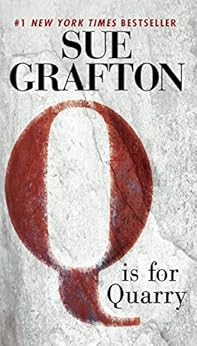
Q is for Quarry (Grafton)

Q is for Quarry, Sue Grafton (2002)

Not a review, just reminding myself about some of the details of what I read ...

Q is the 17th letter of the alphabet, so this is the 17th novel in the series, making it the longest series I've read, by far. (I've read maybe a dozen Doc Savage novels, and I should get back to those.) This entry is a little different in that it deals with an actual unsolved murder, although he details were fictionalized, and in the book, the case gets solved. It does have information at the end in case anyone with information wants to come forward.

Kinsey Milhone gets hired by Con Dolan, an old cop from the series who is currently on medical, and Stacey Oliphant, a retired cop in ill health. Those two deserve each, and they each watch out for the other's bad habits. Years ago, they were the officers who found the body of a Jane Doe in a quarry in Lampoc in Santa Barbara County. Not only was the murderer never caught but the body was never identified, even after cross-checking with missing persons. They want to take one more pass at it. And they have a suspect in mind to start with, who was involved in another case which may or may not be related. A lot hinges on a stolen-then-abandoned red convertible in the small town of Quorum, and some abandoned real estate.

There's also more information about Kinsey's mother from another aunt. A little bit of soap opera to offset the hopelessness of the case. I don't know if it's leading to a future reconciliation with the family after decades on her own or not. It drags, but that's the pace that has been set, and to suddenly resolve it would be extremely odd, unless she were to investigate the murder of someone in the family she just met. (I have no idea if this is coming or not in a future book.)

I'll be reading "R" just as soon as I get rid of some of the printed material in my house. Plus other library books pop up occasionally.

Thursday, December 6, 2018

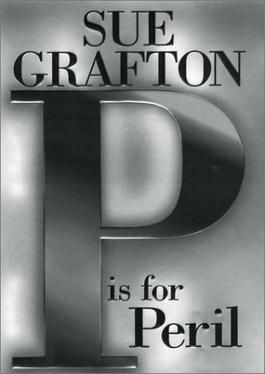
P Is For Peril (Grafton)

P is for Peril, by Sue Grafton (2001)

The sixteenth installment of the Kinsey Milhone series finds Kinsey mixed up in two mysteries, as the background 'B' story takes up a good portion of the book.

The main mystery involves a missing persons case. Dr. Dowan Purcell disappeared nine weeks earlier and hasn't been located yet. His first wife is started to get worried now because he had gone missing once before but eventually returned. Kinsey briefly ponders if he'd faked his own death, as happened in an earlier case of hers. But Fiona, the first wife, believes that he may still be alive because his passport is missing, along with a bit of money.

Add in possible trouble at home with wife number two, Crystal, and mounting evidence of medical billing fraud, and it doesn't look good.

While all this is going on, Kinsey is once again looking for a new office. She's been renting space from Lonnie Kingman, but they are relocating. She finds a space at a reasonable rate nearby -- she can literally see it from her current office building -- and agrees to lease it from two brothers. They turn out to be bad news, as they were suspected in the fiery death of their parents. Investigators have been watching them as they blew through their insurance settlement to see if they'll fence any of the jewelry believed to be in their possession that would provide the evidence linking them to the crime. One of the brothers takes a liking to Kinsey and tries to attach himself in a way that a soon-to-be abusive boyfriend might, despite the difference in their ages.

Of the two plot lines, the main one wraps up neatly enough, although not spectacularly, with answers to the location of Dr. Purcell, the missing money, billing fraud, and, without saying too much, "who did it" and why. The other involving the sons along with a woman who is trying to use Kinsey to investigate them is a little underwhelming.

Friday, January 5, 2018

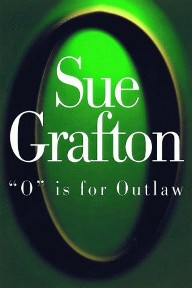
O is for Outlaw (Grafton)

O is for Outlaw Sue Grafton (1999)

Up until now, we've only had glimpses into the earlier life lived by Kinsey Milhone before she became a detective, and we've even discovered, as she did, that what we knew wasn't totally true. We know she'd been orphaned, and raised by her aunt. We know that she'd been a cop, and married twice. We thought we knew that she had no other living relatives, until they suddenly showed up and we learned more about them.

Now we get to learn more about her ex-husband from her short-lived first marriage. First off, his name is Michael Macgruder, aka Mickey, and secondly, well, we learn about his past more than his present. He doesn't get to say much in the here and now.

Kinsey doesn't have a case this time. She's on her own. In fact, she'll even be a suspect before it's over. The novel opens with Kinsey getting a call from someone who has a box of her old possessions, report cards, yearbooks and the like. The caller had bid on the contents of an unpaid storage locker in the hopes of finding treasure, and now he's offering to sell Kinsey back her stuff so he can make back what he overpaid. Kinsey realizes that the locker must've belonged to Mickey, her first husband, who she walked out on. This bothers Kinsey because Mickey was always good with managing money, so, she believes, he must've fallen on hard times. This spurs her on to investigate, if she can just get a fix on where he's living, because he's also good at hiding in plain sight.

To further complicate matters, in with her possessions is a note from an old acquaintance from 15 years earlier, pretty much admitting that she had had an affair with Mickey during their brief marriage, but also that it coincided with an infamous incident that got Mickey kicked off the police force. Mickey had an alibi for a death that Kinsey thought he might've had a hand in. Mickey even wanted her to lie for him regarding the events (without telling her the truth of where he was). That was the end of the marriage.

Now feeling guilty, she starts tracking down the folks who hung out at the old bar back then. It isn't long she finds out that Mickey has been shot with a gun that he had bought her but that she had left behind. He's on life support, and she is a suspect. Now she has more reason to find out what happened to Benny Quintero, a Vietnam vet, that night 14 years earlier.

As with the rest of Grafton's books, you have to keep in mind when they take place. Even though it was 1999 when published, it takes place in the mid-80s. In fact, there's even a reference to the events of L is for Lawless happening only a few months earlier. In this case, the action takes place 14 years after some events that occurred during the Viet Nam War.

Go with it, and you won't find yourself "doing the math" when she's in Louisville, Ky (on her own dime), looking through high school yearbooks.

As with her other books, I enjoyed reading it. I did put it down for a couple of weeks in the middle (due to real world events, really). I would have liked a little more information about Mickey, maybe some exchange between him and Kinsey, closure or whatever, but I won't complain about what we got.

On a sad note, I finished it one night at the end of December, right before bed, and the next day, I read that Sue Grafton had passed away. I don't know if she had planned a finale for the characters in any way, or if "Z is for Zero" would have been just another case, but now we'll never know. I wouldn't want Kinsey's swan song ghost-written by someone else. Better than it remain unpublished.

Wednesday, December 6, 2017

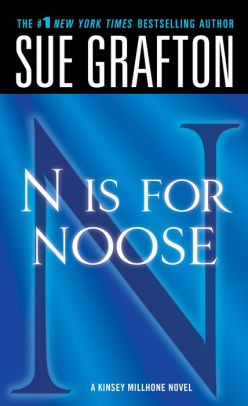
N is for Noose (Grafton)

N is for Noose Sue Grafton (1998)

After a couple of false starts going through some "between books" books, I returned to Sue Grafton, starting the second half of the alphabet. (I'd say the end is in sight, but, of course, the last two books have yet to be written.) As always, the action takes place a few months after the previous installment, so even though the book was published in 1998, the action takes place sometime in the 80s. Specific dates aren't mentioned, but you have to keep in mind the technology. Granted, even if it were 1998, Kinsey likely would not have had a cellphone (or even a Blackberry) and pay phones would still be around. The Internet, as we know it, would be in its infancy. But that doesn't exist here.

The story opens in Nevada, for a change, as Kinsey Millhone is caring for her boyfriend, Robert Dietz, who is recovering from surgery. Once he's able to get around on his own, there isn't any need for Kinsey to play the domestic, so she prepares to drive home to Santa Teresa, California. On the way back, she stops at Nota Lake, California to check in with a possible client, referred to her by Dietz.

Selma Newquist is a recent widow after her husband, Tom, who worked for the local sheriff's department, died out on the road. There's no murder mystery here -- Tom died of a heart attack. There isn't anything to suggest it was anything more that that. However, Selma is convinced that something was bothering Tom in recent months, and she hires Kinsey to investigate to see if she could find what troubled him. She reluctantly agrees, figuring that if no leads turn up in a few days, she'd call it off and go home.

Her inquiry has two sides: interviewing friends, family members and coworkers at the Sheriff's department, and going through the papers and bills in his office at home. The interviews review that Tom was well-liked, but Selma? Not so much. Also, there may or may not have been another woman involved. People are happy to help, but in a small town, no one likes a snoop.

The main clues are phone bills showing out-of-town calls, a missing police notebook and some doodles and numbers on a desk blotter, which include a noose, as in the title. Coincidentally, the odd phone calls go to Santa Theresa, giving Kinsey reason to go home. Another reason to go home: someone follows her car around the neighborhood one night, and then breaks into her rented room and breaks her fingers. So there's definitiely something there that someone doesn't want found, likely dealing with Tom's last case, but his notes are missing -- not in his house, the car, the scene of his death, or the sheriff's office.

There are minimal appearances by the usual Santa Teresa players, and the newfound family members don't get a mention this time. No weddings or any personal, non-investigation events of any consequence.

A murder in Santa Teresa links up with another five years earlier in Nota Lake. The victim in the second case was a person of interest in the first. But by the time Tom got there, he'd already run off. Next anyone heard, his body was found, months after his death.

So I enjoyed this one like I enjoy most Kinsey Millhone stories. Grafton usually finds a different take on a story instead of a straightforward procedural. (Her first novel in this series had her solving a crime for someone who had already been found guilty and served the sentence.) However, this one seems to lead Kinsey around until the facts fall into place when they're needed to. For instance, she interviews one hotel clerk, who has some information about another man who visited, but she didn't get to talk to the other one before being called back to Nota Lake. So a key piece of information isn't gathered -- in this case, a description of the man, where even knowing black or white could telegraph the ending. Likewise, when the notebook is finally found, along with the phrase "the key is on the desk", it's readily apparent that the "key" is a cipher key, not a physical one to a lockbox somewhere. (Because any physical key or physical safe would have been previously found and vetted by this point.)

Kinsey also "hangs a lampshade" on the fact that so many of the people she'd met in Nota Lake had five-letter names. I wish she hadn't. While she's trying to figure out want this string of coded numbers might mean, it might've been neon lights saying, It's a Name!

And I may not be the greatest sleuth, but I crack the code using the info provided at least a chapter before Kinsey. Granted, she might not have been at 100% at the time.

As with the last book, when the ending came, i thought it unraveled a little too quickly, and I might've like a little bit more of an epilogue. Sure, the case is over, but for all the added info in the middle of the story unrelated to the case, maybe a little explanation after the fact would be nice. Or even just a deputy showing up and making arrests? Maybe that's just television bias.

Moving on to O is for Outlaw soon. I'll check the library for an ebook.

Sunday, October 15, 2017

M is for Malice (Grafton)

M is for Malice Sue Grafton (1996)

Each summer, I try to revisit the Sue Grafton series? Why just the summer? Because I don't think I could stick with a series through 26 volumes (even if only 24 are published at this time). This series is popular enough that I had over a monthlong wait for the ebook from the public library even though it's over 20 years old!

I discovered the series on audiobooks when I was commuting an hour each way back in the 90s, listening to whichever volumes were available. At some point in this century, I decided I would read them in order, unabridged. There's a slightly dated feel to the books because each one takes place a few months after the prior entry even though they are written a year or two apart. On top of that, Kinsey is a little behind the times with her portable typewriter and lack of technology. Even the fact that she doesn't have a cell phone seems a little jarring, but it was the 90s.

I've started to notice a turn in the storytelling in the past few volumes. Kinsey is a private investigator and former cop, but has decided not to carry a weapon any longer. She has used a gun in earlier novels, but thankfully they didn't all end up in shoot-em-ups with the suspect dead or dying. The other change is the presence of previously unknown family members trying to work their way into her life. It's a slow process that will play out over the next few entries, I'm sure.

The biggest difference about this book is the case itself. Kinsey's cousin Tasha is an attorney and hires Kinsey to locate a missing heir to a local businessman, Bader Malek, who passed away. The son, Guy, was constantly in trouble and left home 20 years ago. His father gave him his inheritance at the time and wrote him out of the will. Problem is that the new will is missing, so the prior one, with Guy included, will be entered into probate. His share of the estate will be worth millions now.

Finding Guy turns out not to be a difficult task. He would have been reasonably easy to find, but no one looked for him. Guy was happy to know that a PI was hired to find him, but saddened that it was for the wrong reasons. All of this occurs within the first third of the book, so you can imagine things aren't going to end well for the family.

There's still some bad blood between Guy and his brothers Donovan, Bennet and Jack. Guy goes to visit them, against Kinsey's advice. Soon after, Guy is dead, the brothers are implicated. Kinsey gets attorney Lonnie Kingman, from whom she rents office space, on the case, and Lonnie hires her to investigate. And so we're back on the case.

The ending plays out well, and the pieces do fall into place, explaining everything. However, when it finally does all unravels, it seems a little abrupt. Also missing is the usual "respectfully submitted", which makes sense given that there were really two different cases going on here. An enjoyable read, and I learned a little bit about rock quarries. Book "N" will be in the "to be read" pile very soon.

Tuesday, September 13, 2016

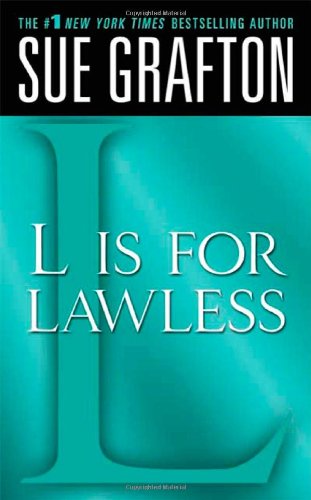
L is for Lawless (Grafton)

L is for Lawless, Sue Grafton, 1995

This is the 12th book in the series, in case you're counting letters of the alphabet on your fingers. After being a little disappointed by the ending of the K is for Killer, I went straight into the next book. I knew from the start, it wasn't going to be a good time for Kinsey, but at least this time, that fact is telegraphed in the opening comments before the story begins.

For the second time in four novels, Kinsey is involved in a wedding party. (You can't say always a bridesmaid, never a bride, because she'll bring up her two past marriages.) And as with the last time, she gets caught up in events that take her away despite the upcoming event. The last time, it was against her will and she wasn't free to go.l This time, she's following a duffel bag of stolen goods and she can't let her only lead vanish.

And as Kinsey points out at the start, for everything she's going through, she's not even getting paid.

The story begins with landlord Henry Pitts asking Kinsey to help out the family of a deceased neighbor down the street. The family has been trying to get death benefits paid for the grandfather, who had served in World War II. The only problem is that the military keeps saying that they've never heard of him. She volunteers to help look for information in his records that might provide some missing key information that would identify to prove to military service, so they can claim the few hundred dollars they believe he's entitled to.

While searching through old military books, she meets Ray Rawson, an old acquaintance of the deceased Johnny Lee from back East. Ray is looking to move to California and wants to rent the apartment. It doesn't told long to figure out that both Johnny and Ray are full of secrets, the first of which being that Johnny was never in the military -- that's just the story that was told to cover up his two-year absence.

After the apartment is later ransacked, Kinsey follows the thief all the way to the airport, where he gives a duffel bag to a woman who is boarding a plane for Florida. Kinsey buys a ticket and follows, with only what personal items she has in her bag, and a credit card that's nearly maxed out after the airfare. A wrench gets puts in the plans when the woman gets off the plane in Texas.

The mysteries unfold as we find out where Johnny had been, how Ray knows him and the connection to Gilbert Hays, who is both ruthless and persistent.

A satisfying read, and while the ending wasn't given away in the intro, you know it's not going to be the best outcome for Kinsey. On the other hand, it's probably the only one that would make sense, as it extricates her from some events of dubious legality.

As for the continuing elements: obviously there's the wedding between Rosy and Henry's brother, and his whole family is present for it. Also, there's some movement on Kinsey's newfound relatives.

This was an ebook loan from the libary.

Sunday, September 4, 2016

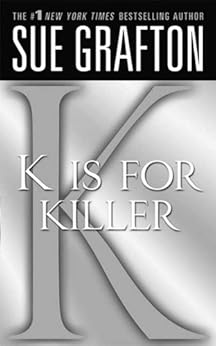
K is for Killer (Grafton)

K is for Killer, Sue Grafton, 1994

This is probably the fastest I've read any book in the series to date, having extra time on my hand. (I finished a few days ago, but I had connectivity problems.) It's also the first one where I was disappointed in the ending. I won't give it away because there are a few people besides me reading this blog.

One thing I can say for the series is that they don't all end the same way. There isn't a shoot-out in every book. The guilty party doesn't end up always end up dead (although truth be told, I do prefer mysteries where the guilty party is named and caught, and not left flying in the wind).

Let me back up a bit. This novel takes places less than a year after the events of J is for Judgment. Kinsey takes on a cold case after she gets a visit in her office from a woman who a support group that meets in the same building after the woman spotted Kinsey's name on the building's directory.

Janice Kepler's daughter, Lorna, was found dead ten months earlier in an isolated cabin located some distance behind the main house on the owners' property. Her body was discovered a couple weeks after her death, and the state of the corpse made determining cause of death impossible. They couldn't even tell if it was a murder or an accident.

What makes the mother seek answers now is that she suddenly received a video in the mail, a professionally-made porno film, in which Lorna was the star. Why did someone send it to her now after all this time? And did it have something to do with her death?

Kinsey isn't sure that there is anything that she can do after all this time, but she agrees to look into the investigation (which is technically still open), going so far as traveling to San Francisco to talk to the people who made the movie. Likewise, finding out that Lorna was a prostitute, Kinsey finds and befriends another lady of the evening who knew the dead woman.

And to top it off, Lorna worked part-time at the water treatment plant, which was a cover for all her other activities. She had to make some honest money somewhere -- although she made sure to pay the IRS taxes on everything!

There's plenty to follow in the story, but it takes a sideways turn when a mysterious, shadowy figure is introduced who you know will play some part in the ending either for good or for ill. The character gets mentioned so little in the rest of the novel that it could have been excised entirely.

But that brings me back to the ending, where Chekov's Mysterious Figure must return. That in itself might not be so bad, but how he comes back bothered me.

I don't think Grafton wrote herself into a corner and chose to add this extra character to handle things. Other resolutions were possible, even some which wouldn't copy what she's done before. Likewise, I can't say that it was a lazy ending. After all, this is the eleventh book in the series and she plans to write fifteen more. I just not happy where the characters went.

On the continuing saga parts of the story, Rosie and William (Henry's brother) move things along, but Kinsey's newfound family don't make any appearances.

This was a library e-book loan, which I finished in just a few days. Record time for me.

I still enjoyed the book, even if I questioned its resolution. Hoping for better next time.

Next up, installment 12. L. I've already started it.

Thursday, August 25, 2016

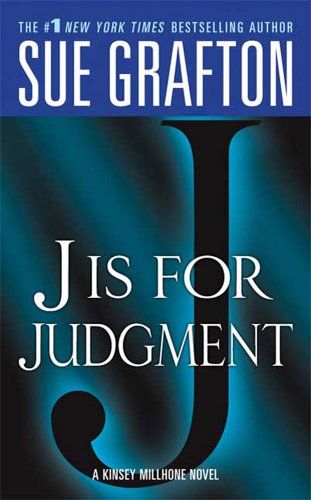
J is for Judgment (Grafton)

J is for Judgment, Sue Grafton, 1993

Summer's here, so I'm back to reading a couple more Sue Grafton Alphabet mysteries, featuring Kinsey Millhone, although had I been keeping up, I probably should be nearly up to date by now.

I'm pretty sure that J is for Judgment was totally new to me. That is, it's not one of the novels I heard on tape back in the 90s. It takes place a few months after the events of I is for Innocent although it was released a year later. This will probably become a timing issue somewhere down the line, particularly with Kinsey lugging around her portable typewriter and not owning a cell phone. She even uses pay phones on occasion.

Okay, so the plot goes something like this: she no longer works for California Fidelity, but they hire her to investigate whether or not a person spotted in Mexico is someone who disappeared five years ago. When he was declared dead, CF had to pay out half a million on his life insurance. They want to know if he's still alive and if the wife is part of a long-term scam. Wendell Jaffe ran a Ponzi scheme (Bernie Madoff, two decades earlier, but not quite as rich) and disappeared when it collapsed, leaving his partner holding the bags, and his wife and two sons with lives in ruins. His boat was found after an apparent suicide.

Kinsey goes to Mexico, finds the man who looks somewhat like Jaffe's pictures, allowing for aging and surgery. He's also traveling with a woman, Renata Huff, posing as her husband. Kinsey's investigation involves a little breaking and entering, and Wendell is scared off -- or was it the news that his troubled son has broken out of prison and has been recaptured. Figuring that Wendell would check on his family, Kinsey moves her investigation. Until now, she has no proof that Dean Dewitt Huff is actually Wendell Jaffe.

Family plays another role in Judgment: while canvassing the neighborhood, she meets someone who recognizes her last name and thinks she looks familiar. Before you know it, Kinsey discovers that she's not as alone as she was always led to believe. This will be a thread that will play out over successive novels, similar to the romance that sparked in the last installment between the brother of Henry, the landlord, and Rosie, the local Hungarian restaurateur.

Another fun, quick read. I'm a little biased: I like this series.

This was a library e-book loan, which amusingly ran out while I was reading the last chapter. I had to borrow it a second time.

Next up, installment 11. K.

Monday, August 31, 2015

I is for Innocent (Grafton)

I is for Innocent, by Sue Grafton, 1992

Grafton's intrepid private detective has a new job and a new office (after events in the previous book). Kinsey Milhone takes on a new case after the passing of an older P.I., Morley Shine, who Kinsey had a connection to -- he was once the partner of the man who trained her. The case: David Barney had been acquitted of the murder of his wife, and now was being sued in civil court to prevent him from inheriting all her wealth. Morely had done quite a bit of the legwork, but there was information missing and subpoenas not yet delivered. Kinsey has to sort through the unorganized documents before the case makes it to court.

In what could be a callback to the first book in the series, A is for Alibi, where a woman who had already served her time hired Kinsey to clear her name, the title makes you pause to wonder: is David Barney actually innocent? Did someone else kill Isabelle? Kinsey has not been hired by Barney, but she has to check out his story just so she can counter it and so it doesn't blindside Lonnie (attorney Lonnie Kingman) in court. The problem is that too many things don't add up -- not that you would expect them to.

Additionally, for the series' fans, there is some interlude material involving the usual characters, Henry, her landlord, whose brother is visiting, and Rosie, owner of the local tavern. Their storylines have nothing to do with the case -- not even an "aha" moment.

I wasn't certain when I started, but by the time the book was done, I realized that this is one of the entries that I'd listened to on tape back in the 90s, borrowed from the Morristown library when I commuted to work every day. This time, I read an unabridged ebook, also from the library. I only vaguely remembered the plot, but I recognized some of the dialogue at the end. Thankfully, I didn't remember who was in that final scene.

As far as mysteries and detective work go, this was a better book than H is for Homicide, where Kinsey was thrown into a situation and carried along by events. This time, she gets to think everything through and figure out "whodunit".

One other note: I recently told someone that one of the things I liked at Milhone is that she carries a gun and knows how to use it, but she's not involved in a shootout in every book. She could be, if she needed to be. I guessing that when private investigators start firing guns, there's a lot of paperwork to fill out.

I enjoyed reading the book, and I look forward to the next one, which I don't think I've listened to. (However, I'm taken a little break from Kinsey to read some stuff I actually own.)

No link for A is for Alibi -- for whatever reason, I wasn't updating the log when I reread that one.

Monday, August 3, 2015

H is for Homicide (Grafton)

H is for Homicide, by Sue Grafton, 1991

I first discovered Sue Grafton's Alphabet series back in the late 90s when I had picked up a few on tape for my daily commute from NYC to Parsippany. (I'd heard about them earlier, probably in a magazine.) I listened to a handful of abridged editions, in a mixed-up order.

A few years back, I decided that I was going to catch up with the series, reading a couple each summer. Sorry, but I'd get bored with any series if I went through 15 or 20 books straight. However, as luck and laziness would have it, I haven't made any blog entries for these books since I started the re-read. Bad timing, I guess. (There is an entry for B is for Burglar from 2009, but that is actually copied from my old paper reading log from many years earlier. That was the first book of the series I'd actually read.)

H is for Homicide brings private investigator Kinsey Milhone into a new role. She finds herself doing undercover work, without any training despite her police background. The book starts with Kinsey returning home early from an investigation and stopping by her office, only to find a co-worker had been killed in the parking lot, his car stolen. Nothing much comes of it over the weeks that follow, but one of the victim's cases for California Fidelity is flagged as questionable. Kinsey does some detective work that gets her caught up in a bigger crime ring than she could have imagined.

It was a fun, quick read and I breezed through it. (This might be because I sort of remember listening to an abridged version of this one, but that would've been -- ack! -- twenty years ago!) There weren't too many soap-opera elements for the continuing characters from book to book, but there was enough to satisfy people who like that kind of thing in series books. None of it gets in the way of this story.

Crazy thing about the story is how dated it is. Published in the early 90s, no one had a cell phone and only one car had a car phone. Finding a telephone (and hiding the house phone) were important to the plot. Even for a throwback like me, that seemed crazy, but that's how life was not that long ago, and shows you how things have changed.

Onto I is for Innocent.

Tuesday, February 24, 2009

"B" is for Burglar (Grafton)

B is for Burglar, Sue Grafton, 1985


I've listened to several Kinsey Milhone books, but this (I believe) is the first one I've read (and it isn't one of the ones that I've listened to).
About average for the series and a good read. Nothing spectacular in the way of a mystery novel, but they'd be a good basis for a movie-of-the-week series for sweeps months.
(My wife didn't find it to be anything special. Her sister, on the other hand, has read most, or all, of the books available at the library.)


I like the series. I've picked more of them up since then.

Bourbon Penn 21, July 2020

Bourbon Penn 21, July 2020 (Not a review, just some notes to help me remember the things I've read. But written this way ...