Showing posts with label demons. Show all posts

Wednesday, December 31, 2025

Audio: Krampus: The Yule Lord (Brom)

Krampus: The Yule Lord
Brom (2012)

[Audiobook]

(Not a review, just some notes to help me remember the things I've read. But written this way because it's the Internet, and some people will stumble across this page.)

This book was a Pandemic Book Club selection.

The meeting was pushed back because of the holidays and because some members had trouble getting a hold of the book.

We just read Slewfoot, and this book was recommended. I wasn't looking forward to it because I'm not a fan of Christmas horror stories (scary, sure, but not outright horror).

The book wasn't bad in that regard although there was one torture scene (with only humans) that was a little too intense for me. The rest was calm by comparision.

The audiobook got off to a rough start because the voice of Krampus was a little loud and irritating. (It got better, or I got used to it.) The next chapter had Jesse, the main human character, contemplating suicide, and I contemplated bailing on the book.

Krampus has been imprisoned for 500 years and is now free. He wants to get revenge on the one who imprisoned him, which is the Norse god Baldr who later took on the guise of Santa Claus. Along the way, Jesse gets hold of Santa's sack which produces any toy he thinks of, or toy versions of anything else he thinks of.

Jesse is mixed up with the drug market in his town and wants to get out of it. The General tells him he's going to keep doing his job or he'll kill his estranged wife and child. Things later go sideways when bellsnickels show up and the outlaws think that Jesse set them up with a rival gang from another town. This leads to the aforementioned torture scene.

Jesse winds up in the service of Krampus, which has the side benefit of his body healing. Krampus promises to help Jesse with his problems but he first has to help Krampus bring joy to children first and regain his title as Yule Lord.

The pace picks up as Jesse and Krampus have their redemption arcs, but Baldr gets his revenge with the help of a pair of angels.

I enjoyed the book more than I expected to, and I liked the ending better than Slewfoot. I have to say, given the previous book, I thought the ending could go another way.

I don't think I'll read the acutal book, but if I remember to reserve it at the library around October 2026, maybe I'll have it in time for Christmas.


If you stumbled across my page via the Internet, please check out my short book series, Burke Lore Briefs. A fantastical foursome of flash fiction and short stories.

Wednesday, November 5, 2025

Slewfoot (Brom)

Slewfoot
Brom (2021)


(Not a review, just some notes to help me remember the things I've read. But written this way because it's the Internet, and some people will stumble across this page.)

This book was a Pandemic Book Club selection.

The meeting was a couple weeks ago, but this post slipped through the cracks as I caught up with Library Thing books and Graphic Novels for my class.

Abitha is a young English woman who'd been sent by her father to a Puritan colony in Connecticut that's looking for wives. She's married to Edward who is ten years older than her and in some ways more of a fatherly figure. Edward is also a little on the slower side and easily dominated by his older brother Wallace, who inherited all the property from their father.

Edward has worked a farm owned by his brother for nearly 10 years and has only one payment left to make. Wallace informs him that he is given the farm away to pay a debt rahter than give away the family homestead that their father founded. Abitha is furious with the both of them and finds it difficult to mind her place in this Puritan society. (She could end up in the stocks or worse.)

Abitha coaches Edward so that he can make the case that the farm was promised to him first and that he has met his part of the bargain. The reverend, who is the final say in this community, agrees with Edward, as do as two associates -- including the one who is friendly to Wallace.

Life then gets turned upside down. Abitha leaves the gate open, and their one billy goat, Samson, wanders off into a cave and falls down a deep hole. Edward later goes to find the goat and disappears into the same hole (tricked by voices from down below). Unbeknownst to any of them, there are spirits underground, Forest, Sky, and Pond, who are trying to awaken "Father" to protect the woods and the special magic tree from the newcomers who have settled in the area. "Father" is supposed to be the destroyer of all, the slayer.

He doesn't wish to be. He doesn't know who or what he is, but he knows there's more to it.

When he is spotted, he is called the Devil, Satan, and Slewfoot. I have to admit that Slewfoot was a new one on me. When he finally meets Abitha, she names him Samson, after the goat. Side note: there is stunning artwork by Brom in the book and there is different artwork for Samson and Slewfoot. The question remains, are Samson and Slewfoot the same or is he just assuming the identity of Slewfoot for this story?

Seriously, I assumed that he wasn't really Slewfoot, but I was waiting for Slewfoot to actually appear, if for no other reason than the painting. But he doesn't. So is Samson actually Slewfoot? Or are such matters in this story beneath Slewfoot's notice?

In any event, Abitha doesn't want to find herself beholden to Wallace, her only family by law, and invokes her rights as a widow to champion the affairs of her late husband. She only need deliever the corn on time and the farm would be hers. But the rain said otherwise. And she's a frail and poor widow.

Samson helps her and soon there is enough corn to pay off the debt. Wallace is perplexed and decides to steal the corn with the help of some local Indians. They wind up burning it, and one man is dead.

Along the way, Abitha, who is a cunning woman like her mother, makes charms and salves for some of the girls and goodwives of the community. It is because of this (and because of the ghost of Edward and the site of Samson) that Wallace accuses Abitha of witchcraft. It doesn't help that when Abitha is attacked, Edward's bees fly out and sting only Wallace.

So while we get to root for Abitha beating Wallace and saving her farm, there was no way that this wasn't going to end with a Witch Trial. And being that it's Brom who wrote it, we were going to get an accurate trial, which wasn't going to go well for the accused witch. And it doesn't.

When all is said and done, she is tortured and condemned. Samson can take her away to live the rest of her life somewhere else, likely in pain, or he can make her like him where she might live a few hundred years.

And then the revenge tour begins. The downside to all this is that now everything that the others said about her when it wasn't true, is now true. This causes her only friend to curse and condemn her because she herself feels condemned and doomed now. (These are Puritans after all, even if Abitha wasn't one.)

A Book Club note: several members of my book club thought that she didn't go hard enough on Wallace. Everything she did was over too soon. (I want to say half a page but it was probably longer.)

Myself: I thought the revenge tour went on too long. I got it -- she Big Mad and now she has powers. And I could note that there was plenty of exposition to say that Samson was more of a Force of Nature than a Force of Evil, but this vengeance was purely evil. At one point, I wondered if Samson was going to tell Abitha to tone it down a little (at least until she got the hang of her powers or something), but he didn't.

Also by the end, they were identifying themselves as a witch and the Devil.

This didn't take away from my enjoyment (much) because I expected this.

I realized early on that Edward wasn't going to be saved. He wasn't coming back. He wasn't "inside" Samson -- actually, he sorta was. Edward moves on to the great beyond without Abitha, and now it seems that Abitha, though she tried to love Edward, has closed the door on following him. But she has Samson.

There's an epilogue that takes place 300 years later (the 1960s), which for some reason takes place in a wooded area in Virginia. I guess Connecticut is too settled or something. It didn't really add much except to show that she and Samson (who is mentioned, I believe, but not in the scene) are still around even though they left that wood, the farm, and the Puritans behind. Abitha should be near the end of her lifespan but she appeared as vibrant as ever.

I listened to about half this book but couldn't renew it. I started reading from the beginning again (which was probably a good move -- you miss stuff listening while out walking), and I plowed through it.

A good read.


If you stumbled across my page via the Internet, please check out my short book series, Burke Lore Briefs. A fantastical foursome of flash fiction and short stories.

Wednesday, August 30, 2023

A Terrible Fall of Angels (Hamilton)

A Terrible Fall of Angels
by Laurell K. Hamilton (2009)

(Not a review, just some notes to help me remember the things I've read. But written this way because it's the Internet, and some people will stumble across this page.)

This was a book club pick. It received mixed reviews. I listened to it while walking, and then read the ebook when I was done with the previous one. This made the reading go a little faster. Reading it did clear up one point, a little.

I've previously read a single book in Hamiltion's Anita Blake series, which may or may not be in this blog. (There was a several year gap when I didn't maintain this page.) But I was game to start a new series.

The book started strong and introduced a lot of elements. Then it dropped the ball on most of them. I slogged through the middle to get to the end. If this book had been a ten-episode Netflix series, the beginning would've been two episodes, the ending would've been two episodes and the six episodes in between would've been a lot of world-building and filler.

Don't get me wrong: I liked the world-building, but it seem like much of it was presented for future use. Likewise, many of the characters we're introduced to in the beginning just fade into the background. Others we just wished had do soon. (In particular, no one in the book club liked his estranged wife. While we all appreciated the break in the action to have couples' counseling, the wife didn't come off as a likeable character after that.) Another problem with the worldbuilding (as pointed out but a book club member) is that she retconned the rules in the same book. She didn't wait until, say, book three or four to change the rules.

Personally, I thought it got a bit repetitive, sometimes repeating information within the same chapter. A couple of those chapters, with side characters out of nowhere, just dragged on too long.

One thing, I won't forget that the main character's name is Havelock, because I was reading the Expanse book where a different Det. Havelock made an appearance. (He's in books 1 and 4 of the Expanse, and that's as far as I've gotten there.) I wouldn't say the other characters aren't important enough to list, but I've fallen behind in posting these mini-reviews (it's September, but I'm backdating it to the month I read it in for my own personal records), and if I really needed to know, I'm sure I can find it on that wiki -- you know the one.

Would I read another one? Maybe, but I would hope it's a little tighter than this one was.

Monday, May 29, 2023

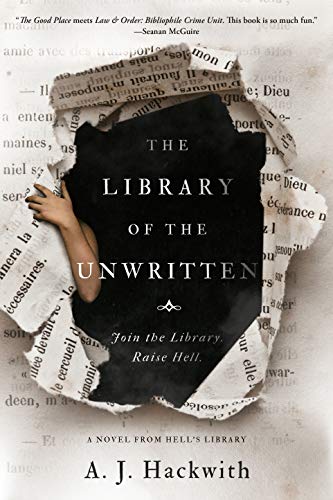
The Library of the Unwritten (Hackwith)

The Library of the Unwritten
(A Novel from Hell's Library)
by A. J. Hackwith (2019)

(Not a review, just some notes to help me remember the things I've read. But written this way because it's the Internet, and some people will stumble across this page.)

This book was one of three that was our book club was to choose from, but it didn't win the vote. After the previous month, where the ebooks were difficult to come by, I placed holds on all three books before we even voted. Since the winning book was short, and since this one seemed to be of interest, I gave it a shot. I'm glad I did. I did have to pause reading this one to read the next month's book, but I immediately came back to it.

There is a library situatied in Hell, but it isn't part of Hell and doesn't serve it. It is filled with books that were never written. It was a librarian, Claire, who used to be human, before she died. And she replaced the previous librarian, Bjorn, who is now in the halls of Valhalla (which will get visited).

Sometimes books get restless, and characters step out of them. They usually have to be sent back. Luckily, characters can't stray to far from their books, but they can take their books with them if they sneak off.

When the novel starts, a book is missing and it's made its way to Seattle. The character, who later takes the name Hero, meets his author and tries to persuade her to finish the book. This works against him because that writer started to fall from him, since she wrote him to an ideal, and when he leaves here (to go back to Hell), he leaves some pages from the manuscript. She burns them. He doesn't feel well after this. Claire attemps to repair the book with fresh pages, hoping that the story will mend/rewrite itself. In the meantime, the book rejects Hero and doesn't let him back in.

Just before they go to Seattle, a man dies but somehow manages to bring a piece of a book to Heaven. Waiting outside of the gates of Heaven, reviewing all of the souls, is the angel Ramiel, who fell with Lucifer. He's tried to redeem himself ever since, but he's been denied Heaven. He recognizes what the fragment is and brings it to an Archangel, in this case, Uriel. Uriel is portrayed as female and somewhat overwrought with emotion because the Creator has gone away (voluntarily, it would seem). The pages are from a codex written by Satan. Uriel sends Ramiel to find the rest of it, believing that the magic encased in such a book would be powerful enough to summon back the Creator to Heaven.

When Ramiel gets to Earth, he crosses paths with the Librarian, who assumes is part of the conspiracy, and depends the book. Claire, Hero, and Leto (a demon in the guise of a human on Earth) are perplexed what the fallen Watcher would want with some romance book. Before they quickly depart, Leto snatches the fragment Ramiel has, and they're back to Hell.

And now the chase is on to find the rest of the codex before its magic can be used to upset the balance of power in the afterlife.

It was an enjoyable read, with only a couple of nitpicks, but they're ones that will always bother me, like a Geometry classmate poking me in the back of the neck with the point of a metal compass.

First, every chapter starts with a journal entry, written by some librarian from present day, going back over two thousand years. Each chapter has a POV character in the title, most of whom, don't author journal excerpts. It's a little bit of a disconnect. The annoying part, for me, is that the entries are dated BCE and CE. I guess Hell has a problem with B.C. and A.D., the latter one being understandable, but the substitituion is silly. It would be just as to use After the Fall or some other metric. Otherwise, why even use Christian dating in the first place.

Moreover, rather than create their own Heaven and Hell, the author simulates a Christian version of it. Ramiel and Uriel appear in apochryphal text, and Ramiel is a fallen Watcher. Uriel can be identified as a cherub or an archangel, usually an angel of repetance, and can be shown to be as pitiless as any demon. Archangels tend to be shown as males=, so switching the gender of one (particularly when maybe they shouldn't have gender) is reasonable. I didn't envy the choice: the Betrayer, or the pitiless, emotion boss lady who seems on the verge of running afoul of a Deadly Sin or two.

Nope, the thing that bothered me, for all the re-creation, was that the "Creator", whom I don't recall ever being mentioned as "God" with a capital "g", is referred times as "she", generally by Uriel. The only God references are the titles of the two archangels who are "______ of God". But not "God" "herself".

Again, that's my nit to pick and many others wouldn't be bothered by it. If I come across this entry at the end of the year, I might think about looking for the next book in the series.

Note: the above was written on May 11. I don't know why I didn't publish it sooner.

Monday, November 21, 2022

My Best Friend's Exorcism (Hendrix)

My Best Friend's Exorcism by Grady Hendrix (2016)

(Not a review, just some notes to help me remember the things I've read. But written this way because it's the Internet, and some people will stumble across this page.)

This was a Book Club selection. it was also a it of an odyssey in finding a copy of the book. The novel has been made into a movie, so copies are hard to come by. I was told by two libraries that the estimated wait time would to 10-12 weeks for a copy .

As a result, I started to use the Internet Archive, which had a copy, but I was only able to borrow it for one hour at a time, until a 14-day copy became available. Adding to the insanity, the Internet Archive is, naturally on the Internet. I couldn't download anything to read on the subway. As a result, before getting on the train, I needed to buffer the next dozen pages or so to read until I got somewhere I could buffer more. And I couldn't launch any other apps that might've cleared memory.

And it was a quick read, so I flew through chapters faster than I expected to.

So the story ... It takes place in the 90s and a lot of 80s reference are sprinkled throughout the text, some of them carefully placed with a sledgehammer. I lived through the 80s, and it wasn't all that 80s-ish that much all the time. Basically, it's product placement with 80s refs instead of actual ads. The chapter titles are 80s songs, which usually fit the chapters thematically, so it's occasionally a stretch. The funny thing about this is that the book reads like one of those 80s "TV Movies of the Week" that the networks would use to fill out their schedules. The fact that it's a current movie is a little more boggling.

When Abby was 10, she had a birthday party, but only Gretchen came because Margaret announces her party on the same day and its at a horse-riding ranch. None of their classmates make it back, but Gretchen didn't go because Abby asked first. References to E.T. abound.

Fast-forward a bunch of years and they are in high school. Abby's father is out of work, so they live in the poor part of town in a scary-looking house, but Abby has a scholarship to her private school. She's still friends with Gretchen, along with Margaret and another girl Glee. They're popular.

While at Margaret's lake house, the girls try LSD. Gretchen goes skinny dipping in the dark and disappears. The others look for her in the woods, and Abby finds a creepy cabin and runs off. They find Gretchen the next day.

Over time, it's obvious that the experience changed her, but Abby starts to believe that Gretchen is possessed by a demon thanks to a cult in the building. And, in fact, she was. At first, she creepy, but suddenly she seems fine and normal, and Abby is the one on the outs. Demon Gretchen is set on destroying the girls' futures and almost succeeds.

The fancy prep school has many assemblies, and one of them is a family of exorcists. One of the sons recognizes the demon within Gretchen. At some point after, Abby contacts him about saving Gretchen. This should be the strongest part of the book, given the title, but it becomes the goofiest. Christian doesn't bring his father because he doesn't believe his father is strong enough to do this any more. But Christian has performed an exorcism and he has lots of notes (which turn out to be useful to Abby). His attempts to force the demon out would result in serious harm to and the possible death of the host, and he has to be forced to back it down a little. Before it's over, he abandons the girls, leaving Abby to save Gretchen before the police arrive.

This is where it get really over-the-top Movie of the Week. When viewed in that light, it makes up for the less than stellar exorcism scene. However, it doesn't end there, as the movie might have. It tells us what happens for the rest of their lives and how the two friends drift apart. (The other two girls will never be the same again.) None of that is necessary except to comment how difficult it is to stay from forever, particularly if someone moves away and put physical as well as emotional distance between them.

So this wasn't scary, and it wasn't funny. It was pretty much straight-forward about the girls and fitting in, especially with Abby suddenly being poor.

The book wasn't terrible, which doesn't sound like much, but I had a sense of dread going into it because I didn't know what kind of graphic demonic possession would be in the forefront. That part wasn't so bad. Parts of it were clever, but I won't spoil those.

I've been told my several members of the book club that the movie is awful an I should skip it.

Note: I didn't use the "Teen" tag, because even though the characters are teens, I wouldn't recommend this book for teens. They wouldn't appreciate all the 80s references anyway. At least when I watch Happy Days, the 50s were only 20 years earlier.

Wednesday, April 20, 2022

Envy of Angels

Envy of Angels, Matt Wallace (2015)

(Not a review, just some notes to help me remember the things I've read. But written this way because it's the Internet, and some people will stumble across this page.)

This book was a freebie from the Tor dot com reading club.

For the record, my first mention online of "The Sin Cafe" came in a closed writing blog, which was open at that time, back in 2011. It had its origins in a trip to Punta Cana, in the Dominican Republic, several years before that. I mention this because "Sin du Jour" appears to be a series. However, I will continue to write Hell's Diner stories as the moods strike. I have at least two more in mind for whenever I work them out.

I started it a couple months ago. It had my attention but I wasn't sure I wanted to go where it was going. But I went back to it. It was actually a quick read and a short book. (It's actually a novella.)

Lena and Darren are out-of-work chefs in NYC and can't get a job. They get to try-out as substitutes at Sin-du-Jour (which along with the cover should be a massive hint). They are given a hands-on interview by someone who could make Gordon Ramsey cry, but they manage to pass while creating things they've never made before using the hottest of spices and ingredients that they've never tasted before. It's a bit exotic. And there's a forbidden food pantry. If you need something, ask the person authorized to go in there.

Well, they go in there, and all Hell breaks loose. Sort of. A creature is released from a jar that instantly starts growing in size and wreaking havoc.

Rather than fire them, the Chef tells them that their exclusive clientele is rivals groups of demons, and that these get-togethers are funded by the U.S. government, which mediates and helps keep the peace between the factions.

They it starts getting interesting when demons arrive with a special dish that they want prepared -- it's an angel, a spellbound, living angel, although more akin to one of ancient writings than of popular paintings. The crew is split on this because they don't want to slaughter an angel. But they can't refuse, so the best that they can do is fake what an angel tastes like. The crew discovers that angel tastes like Chicken Nuggies from Henley's (a fictional food chain). This leads to some industrial espionage, which leads to something else fantastical. It gets crazy from there.

One thing that doesn't make sense in the resolution is this: [SPOILER] Although the Nuggies have been created through fantastical methods for decades, the magicked Nuggies were based on an actual original recipe. How did those turn out to taste like angel? I guess I would've had an easier time believing that angels taste like "magic chicken" more than that they taste enough like chicken to form a demon.

Bourbon Penn 21, July 2020

Bourbon Penn 21, July 2020 (Not a review, just some notes to help me remember the things I've read. But written this way ...