Saturday, December 12, 2020

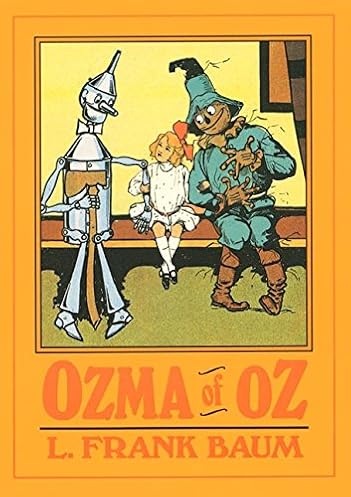
Ozma of Oz (Baum)

Ozma of Oz, by L. Frank Baum (1907)

(Not a review, just some notes to help me remember the things I've read. But written this way because it's the Internet, and some people will stumble across this page.)

I've read The Wizard of Oz as an ebook in the past few years. I read The Land of Oz as a paperback many, many years ago, and then again more recently as a rather interesting set of graphic novels. Next up in the series is Ozma of Oz. The fact that I was looking for short reads to pad out the year is not exactly coincidental.

Many years ago, I saw the movie Return to Oz when it was first released (at Radio City Music Hall, no less). I recognized a lot of the characters from "Land", except that it had Dorothy, and not Tip. Also, it had different villains, namely the Nome King (an underground rock creature of sorts, not a gnome) and the Wheelers (creatures with wheels for hands and feet, and long arms, too.)

This book starts with Dorothy and Uncle Ben on the boat going to Australia. Dorothy gets washed overboard in a storm and clings to a chicken coop for safety. In the morning, she finds a hen has also survived. The hen's name is Bill, and Dorothy calls her "Billina" instead. She discovers this because the hen is able to talk because they are close a a fairy land. Except that Oz doesn't border any oceans. Instead they wash up on the land of Ev, where their adventure begins.

Ozma and the rest of the gang from Land of Oz (except Pumpkinhead) show up in the second part of the book. They rescue Dorothy, and then take her with them to rescue the royal family of Ev from the Nome King, who has turned them into knickknacks in his palace. The King gives every member of the party (including each soldier) a chance to rescue the royal family -- and each other. If they fail to find anyone, then the searcher will also be turned into a knickknack in the palace.

If I remember the movie, Dorothy discovered the secret to finding the rest of the party. Here, it's Billina who is the King's undoing.

Tuesday, December 8, 2020

Celts: A Captivating Guide to Ancient Celtic History and Mythology (Captivating History)

Celts: A Captivating Guide to Ancient Celtic History and Mythology, Including Their Battles Against the Roman Republic in the Gallic Wars , by Captivating History (2019)

(Not a review, just some notes to help me remember the things I've read. But written this way because it's the Internet, and some people will stumble across this page.)

Downloaded this freebie earlier in the year. It was an interesting read on my phone, but I put it aside for some reason or other. I picked it up to finish mostly because it was short and half-finished, and I wanted another entry before the year was done.

According to a webpage, Captivating History has nearly 200 books out about different cultures or people. Any number of them are free at a given time. This was interesting to read, and I wouldn't be opposed to downloading another if the subject matter appealed to me.

There is interesting stuff about the Celts, and I may go into more detail if I edit this entry later -- mostly so I can have that information closer at hand.

At one point in the first millenium B.C., (the book uses BCE, I, like one of the sources in the bibliography, do not), Celtic tribes populated most of Europe, north of Italy and Greece, and through Gaul and Iberia. And they were feared by the Greeks and Romans

Unfortunately, they didn't have a written language, so most of what we know of them comes from the Greeks and Romans. Some of this is, of course, biased. And the best you can say is that it gives us a snapshot into their culture.

Some takeaways: they were warrirors, but they were also farmers. They were raiders, but also traders. They were taller than the Romans and Greeks and fiercer. They had chieftans, but would follow another if the chieftan was defeated or fell from grace or whatever. They were loud in battle to show their fierceness.

Saturday, December 5, 2020

S is for Silence (Grafton)

S is for Silence, by Sue Grafton (2005)

(Not a review, just some notes to help me remember the things I've read. But written this way because it's the Internet, and some people will stumble across this page.)

After R is for Ricochet was a little disappointing, I decided I wanted to read another one before closing out the year. S is for Silence is another cold case for Kinsey Milhone. It's set in 1987 but she is looking into a mystery from the thirty four years earlier (1953).

Violet Sullivan, big on the violet theme with the color of her clothes and the smell of her perfume, left her house on the night of the Fourth of July, 1953, leaving her young daughter home with a babysitter. She was never seen again. Some thought she'd been murdered by her abusive husband, Foley. Others thought she'd fled her abusive husband. Either way, there had been no sign of her, dead or alive, since. Her daughter, Daisy, hires Kinsey's to find some answers. Kinsey is hesitant but agrees to look around for five days and report back, and let her decide if there is any reason to continue. Four slashed tires tell her that she's getting close to something and uncovering things that people want kept buried.

The book is a bit different in that it has dual narratives from 1953 and 1987. It's a little jarring at times. The narratives are not parallel. The flashbacks are usually centered on one person, and take place the weekend Violet disappeared. A couple events are retold from the opposite perspective. Nearly all center around Violet or involve her tangentially.

There are too many characters to get into, particularly since there are people back then who aren't around now. And honestly, since I didn't read straight through, I kind of lost track of who was who or how they were connected to the others either through family or work. Most of the guys are connected to Violet in some way because she chased after and slept with many of them.

Take all flashbacks with a grain of salt because of unreliable narrators. The only point of view we don't get is Violet's, which would be cheating if we knew. And nobody really knew her anyway. The rest of the flashbacks aren't told as flashbacks to Kinsey. They're outside of her story line.

I was surprised that there would be a new cold case so soon after a different one. One could imagine that writing in 2005 about 1987 about a 1953 disappearance that emerging technologies could track down some who tried to disappear and didn't want to be found. It was reasonable that Violet could be either dead or alive.

Cheney gets mentioned, but either he's busy or Kinsey is away. The retired guys Dolan and Oliphant also rate a mention early on. They would love this kind of case, but they aren't available, which is fine. The book didn't need to two of them arguing and babysitting each other. A consult with them might've been nice.

Again, for all the talk of family, there was none about Kinsey's family. It seems as if she dropped that thread, as surely as she reduced the "12 to 15 workings cases" Kinsey has at any one time to answering mail and paying bills. Just an occasional mention of filing a report, answering a call with a little more specificity or something would help.

That said, I enjoyed the book and finished it in just a few days. There will probably be a break before I borrow the next one.

It occurred to me, at this point, all the books are new to me. I stopped listening to books on tape by 2001, and probably sometime before that. It was a commuting thing. I never got past the middle of the alphabet, and they were usually in random order.

Friday, December 4, 2020

Another Dozen "Dozen" Game Books (Reed)

Another Dozen "Dozen" Game Books, Philip J. Reed (2020)

Below is a list of gaming supplements I've read through over the past few months. Mostly short, which is why there's a bunch of them, and mostly part of the A Dozen... line by Phil Reed, which is why there are about a dozen of them. Some of these might be rereads. I've added more description because this is as good a place as any to make some sort of catalogue so I can locate a supplement when I remember some unusual item that I could use in a game or a story.

The image above came from the last one I read. I noted the Elmore signature. I can't say that I'm overly familiar with Larry Elmore's work, but he did the art used on some of the cards in the old Guardians CCG from FPG, Inc.


  • A Dozen Strange Encounters (14 pages)
    some doomsday scenarios and planar gates
  • A Dozen Dungeon Hazards (7 pages, 2004)
    Open Game Content (OGC) for Ronin Arts: Fogs, Fungi, Molds & Slimes (12 examples)
    My "favorite: was my accidentally misreading "Necromantic Frog"
    But the Harmonic Mushrooms could fit into a story very easily.
    I remember oozes/slimes just damaging ("consuming") bodies, but never taking them over. Not good from roleplay, I guess.
  • A Dozen Planar Gates and Storms (8 pages, 2005)
    OGC. Ronin Arts: Fogs, Fungi, Molds & Slimes (12 examples)
    Interesting ways of how to get there, but not what you'll find there, which is a book of its own.
    Good ideas. The "storms" are things like the tornado in the "Wizard of Oz" or (not mentioned) "The Final Countdown".
    The gates are always gate-shaped like the Guardian (Star Trek), or Stargates, or Pylons (Land of the Lost).
  • Six Planar Gates (5 pages, 2005)
    Companion to the previous one. This one had more tradition gateways, although one was a carriage reminiscent of the Cóiste Bodhar, the Death Coach featured in Irish legend, not to mention Darby O'Gill and the Little People. The difference is that this one travels all the planes and will take you where you actually want to go.
  • A Dozen City Encounters (14 pages, 2020)
    Some ideas to use when the party is staying in town. Some of them might make good story prompts.
    There's a pied piper type who tells stories as a way of getting info out of kids. A half-giant leather worker who lives outside of town who will happily chat, and could be persuaded to make things. A couple other NPCs that I should make a list of. A summer festival (which might attract thieves) and an ominous fog.
  • A Dozen Adventurous Rivals (14 pages, 2020)
    Other recurring characters the heroes might meet, whether experienced or novice. Many races and classes are covered, along with what notable treasure they might be carrying. The heroes shouldn't be fighting them directly, for the most part.
  • 13 Starship Cargoes (12 pages, 2005)
    A baker's dozen, if you will. This supplement has d20 game mechanics, which are basically a foreign language to me, but I know enough that I can compare things to each other, and get a general sense.
    This is useful because my friend keeps encouraging me to write Dieselpunk, or whichever *punk that covers 1930s era spaceships that should have some plausibility to them. Thus my mind goes to cargo haulers and space cops.
    Of particular interest, the Voracious Monstrous Mantis and the Magnetic Slime, as well as the general description of the Mecha suits, which are more Aliens than Robotech. The last two pages are printable maps for cargo holds, which make me think about looking for the rest of the ship.
  • A Dozen Documents and Papers (7 pages, 2004)
    The legalise is reduced in size, taking only a fraction of the last page.
    This was a freebie extra for backing many of Reed's current projects. Some ideas might spring to mind, but mostly it was just an interesting read. Would I use any of this were I to create a story? I don't know. Includes d20 rules.
    Also included is a page and a half about Smithfield's Chocolate House, with information about real-world historical parallels. This was originally printed on his website, but after nearly two decades, who knows if it's still there. (No, I didn't feel the need to check.)
  • A Dozen Unusual Articles of Clothing (5 pages, 2004)
    Contains some examples of mundane clothing, but not the usual mundane clothing, and then some fine or enchanted versions. There's a list of garment colors by class, meaning upper or lower, along with clergy or wizard.
    The Dark Cowl of the Necromancer could spur a story by itself. Also, I learned about things like lirapipes (liripipe, when I searched online), gorgets, chaperons, great coats (okay, I knew about these), supertunics, houppelandes, tippets, and pelisses.
    Imaginary creatures mentioned include Tangtals (magical cats which could be skinned) and Thundershrikes (magical birds with colorful feathers).
    This is a little more than 4 pages, with the open-gaming license taking up most of the fifth page.
  • A Dozen Unusual Bracers and Guantlets (6 pages, 2006)
    What was likely the last of the "Dozen" series, until Phil Reed revived it last year (at least according to the intro page). Entries include BONENEEDLE GAUNTLETS (mitten-style with venomus teeth from a large spidery thing), BRACERS OF THE THIEF (handy item I could've used in a story, maybe in edits), CEREMONIAL GAUNTLETS OF THE DRAGON (valuable, but useless items, like a dragon puppet for followers of cults, with penalities to Dex), CLERIC’S GAUNTLETS OF HOLY MIGHT (holy mittens that lock a weapon in place, but no modifier?), FISTS OF THE BLOOD WIGHT (unholy mittens, basically the hands and claws of a blood wight, which bleed unceasingly, though from no detectable source [my phrasing]), GAUNTLETS OF THE ANGELIC CHOIR (shiny, feathery, extra protection but heavy so Dex penalty, do they have Luck in them?), GAUNTLETS OF THE GRAVE (clamshell design for holding polearms, dex penalty, they have arcance runes and an aura or death or fear, and usually worn by skeletons and undead soldiers ... but they're fur-lined), GAUNTLETS OF THE OOZE CHAMPION (ooze mittens that will fuse with the wearer's arms but could be removed with hot water, part of a set that gives command over oozes), HARD, SPIKED BRACERS (made by dwarves for a human, they're what they say on the tin, good in close combat for wounding and disarming), SEPULCHRAL FINGER GAUNTLETS (a sepulchral guardian, an unusual type of construct created from the remains of dead humanoids that are encased in iron, with spikes, dwarven masterwork), SKULL BRACERS (nothing special, but well-made, used by rogues), SPELLCASTER’S BRACERS (like a magician's trick, they can pull something out one's sleeve, such as a material component).
    This is actually 5 pages, with the open-gaming license taking up the last page.
  • A Dozen Unusual Materials (5 pages, 2004)
    Entries include ARCANE STONE (rare black stone from deep beneath the ocean used in jewelry and arrow heads, faintly naturally enchanted), BLACKWORK SILK (A powerful, uncommon silk woven from the web of an enchanted giant spider, blackwork has the strength of steel and the lightness of the finest natural silk), BONE OF THE UNDEAD (a powerful necromantic tool, could be useful in that Potions story I'm trying to write), DARKEST OBSIDIAN (black, volcanic glass, used artistically only), DRAGONNEL'S HIDE (the dragonnel, a foul beast that may be related to the abomination of a dragon and pteranodon, an evil creature with a massive wingspan and long, serpentine body -- sounds, familiar, I think I read this before. Oh, well.), HORROR CRYSTAL (sliver of a dead crystalline horror – an unnatural evil humanoid that’s made of crystal and glass, used artistically -- or is it?), GOLEM METAL (enchanted metals of a destroyed iron golem can, molten down and reforged into weapons or armor), GREEN (Emerald) MITHRAL (variation of the usual stuff), MOONRED HEART (a type of tree that grows deep beneath the surface world, a masterwork that will wither if brought to the surface), SCREAMING GOLD (when immersed in water, useful for alarms or diversions), SPIDER'S CARAPACE (hard deep black shell of a rare, underground spider used by drow for armor or wizard's for spell book covers), TROLL'S IRON (greenish metal from deep underground, below where dwarves dwell-- I wonder if those trolls would be tinier).
    The more I read, the more I realized that I'd seen this one before, even if I hadn't read the one before it. (The files are sorted alphabetically.) It must've been in the last list.f
    This is actually 4 pages, with the open-gaming license taking up the last page.
  • All Fall Down (4 pages, 2004)
    An independent storytelling game with random elements (dice and voting), plus counters. A little on the mark with talk of disease and depression in these days of Covid.


By this point, I have a separate directory on my hard drive, filled with Phil Reed files, so there will definitely be more to come ...

Wednesday, November 25, 2020

R is for Ricochet (Grafton)

R is for Ricochet, by Sue Grafton (2004)

(Not a review, just some notes to help me remember the things I've read. But written this way because it's the Internet, and some people will stumble across this page.)

I took a break from old anthologies and freebie downloads to revisit something more familiar. I haven't read an Alphabet book in over a year, so I was due. That said, this was a free download from the library, but it was a loan of a book that would've cost money to download from somewhere else.

It's still the 80s, around 1987, because "I Want Your Sex" is a new song on the radio. (There were other references earlier on, but that was one of the last ones, and it stuck with me.) She didn't use her portable typewriter at all, but there was ample use of payphones. Not a cellphone in sight. There were some big clunky computers and floppy disks but the action is taking place nearly 20 years before publication, which was about 14 years ago.

I don't know what the "Ricochet" of the title is supposed to refer to, except that Kinsey is just bouncing around a lot in this one.

Not that this is a review, but this wasn't one of the better ones. I still enjoyed it, but it was a bit light with several subplots working. Plus there was a note in the acknowlegdements that there was another subplot that was dropped.

For one thing, there's no case. Kinsey is hired by a rich guy, Nord Lafferty, to escort his spoiled, wayward daughter Reba home from the womens prison she's spent the last couple of years at for stealing from her employer. She's also supposed to watch over her for a few days while she gets settled in. (For one thing, Reba's driver's license has expired while in jail.)

Within three chapters, we have our subplots. Vera, from California Fidelity, and whose wedding Kinsey attended after being swept up in events from another adventure, which wasn't exactly a case, calls Kinsey and invites her to a gathering she's having. It doesn't take much to figure out that Vera is trying to set her up. She goes, there's so little chemistry that we don't even get much of a description of the guy or even a line of dialogue, and she heads out. Two things happen: one, we don't really hear from Vera for the rest of the book; two, Kinsey runs into Lt. Cheney Philips. The two have previously et, and kinsey might've been romantically interested but Cheney had run off and married some woman he hardly knew. Kinsey has sworn off married men after things didn't work out with Jonah. (And they didn't work out for Jonah, either, apparently.) Also, Dietz is in the wind, and she's okay with that. They had an unusual relationship.

Cheney ends up looking for Kinsey (and this might be my memory already fading, but he might've been the reason Vera really invited Kinsey, because Cheney lives next door). He has two things on his mind: first, the feds are looking into Beck, the guy who Reba stole from and they want to get her involved; second, he split from his wife and he wants to get involved with Kinsey. Kinsey's all for the latter, not fond of the former.

She finds herself playing friend and mother hen to Reba, watching her and trying to gauge whether she'd turn on Beck who she's obviously in love with, even though he's married. Unfortunately, some new guy at the FBI trying to make a name for himself tips Reba off to the investigation be showing her pictures of Beck leaving a motel with her best friend Onni, who is *not* Beck's wife.

Reba starts spiraling and doing what's she's going to do. Kinsey follows along to try to keep her from violating parole or destroying the feds case. At this point, she's pretty much along for the ride. About the only detective work to happen after this was tracking down a stripper in Reno who did time with Reba.

Oddly, Grafton, through Milhone, makes a comment herself that sometimes you're just a bit player along for the ride. I almost feel like Henry's family had more to do than Kinsey did. Unlike the Cheney romance, Henry's love triangle could've been removed from the book entirely. Or replaced with another story. Henry is set in his ways, and his family is going to be his family.

Speaking of family, the other branch of Kinsey's family (on the mother's side, so I can't call them Milhones) doesn't make an appearance or even rate a mention. She didn't think about them at all, despite all the family issues going on in this book.

This was a quick read for me. Practically a speed read. My last entry was only 20 days ago. I don't think I decided that quickly to download this book. In fact, I think I downloaded a freebie that I read three chapters of and told the guy that it wasn't for me. I didn't leave any reviews because no reason to be mean. He'd asked, I told him. He was grateful that I tried it out, and quite pleasant. Another thing, I haven't gotten a notice that the loan was going to expire soon, so it was probably two weeks to read, with all this other stuff I have going on.
Thursday, November 5, 2020

A Dead Djinn in Cairo, and The Haunting of Tram Car 015 (Clark)

A Dead Dinn in Cairo, by P. Djeli Clark (2016)
The Haunting of Tram Car 015, by P. Djeli Clark (2019)

(Not a review, just some notes to help me remember the things I've read. But written this way because it's the Internet, and some people will stumble across this page.)

First off, these are both novellas. The two of them together merit a separate entry as a single unit. The second book was released as part of Tor.Com's book of the month club almost impossibly coincidentally right after I read the original novella. Out of nowhere, I decided to look at my iBooks app instead of the Kindle app, then I opened Some of the Best of Tor.Com 2016, which I presumably downloaded close to four years ago. (It was likely released in early 2017.) And I started reading that novella even though I had skipped over an earlier novella in the collection because of the length. (I'll get back to it.) By the time I realized my mistake, I was committed to the story.

That book will get an entry when (and if) I finish it.

"Djinn" tells the story of Fatma el-Sha’arawi, special investigator with the Egyptian Ministry of Alchemy, Enchantments, and Supernatural Entities, who has to solve the mystery surrounded a large dead djinn. (I just looked up the department name to make sure I got it right.) She dresses "exotically" in English clothes, rather than standard Egyptian wear. Her partner for the case is Inspector Aasim Sharif, police liason with the Ministry.

The story is set in an alternate Cairo, 1912, some decades after the walls connecting realities was punctured and djinn and other supernatural creatures were able to come through. The other creatures include things that call themselves Angels but aren't really Angels. And there's something called The Rising that seem about to happen, but would be a good idea to prevent.

"Tram Car" is set in the same universe, but is not a sequel.It takes place a few months after the previous story, with a backdrop on a women's suffrage movement. Fatma gets mentioned early on, but doesn't get involved with this case. The Ministry of Alchemy, Enchantments and Supernatural Entities has to deal with a haunted tram car. Alternate Cairo has a very complex system of semi-intelligent tram cars running about the city, thanks to the presence of supernatural djinn. However, one of the cars appears to be haunting and attacked a mechanic and a female passenger. Agent Hamed Nasr and his new partner Agent Onsi Youssef are assigned to check it out. They soon learn that it's something that hasn't been catalogued before. Hamed is the department veteran, while Onsi is the new guy, who has his own unusual background and talents. Hamed tolerates most of that.

Their plan to exorcise the creature involves hiring a djinn, who don't work cheaply. The minister of transportation declines to pay for it and then informs them of the change in the law that requires MAESE needs to bear the cost. This sends Hamed and Onsi looking for alternatives as that would take a huge chunk out of their budget and leave them behind a desk for months. (The djinn haven't introduced air conditioning.)

Twists and turns lead to the discovery of what this creature is, where it came from, and how it got there -- and who is responsible for it getting there. Then there's the matter of getting rid of it, which leads to some interesting undercover work.

Both were interesting reads which immerse you into the setting. Of the two, I prefer the second, so they get better as you go.

Wednesday, October 28, 2020

A Sick Life (Watkins)

A Sick Life: TLC 'n Me: Stories from On and Off the Stage, by Tionne Watkins (2017)

(Not a review, just some notes to help me remember the things I've read. But written this way because it's the Internet, and some people will stumble across this page.)

The title "A Sick Life" is has a double meaning in that it is "sick" (slang) the life that being a part of a successful singing trio leads to, while at the same time acknowledging the struggles that Tionne Watkins (I assume Tionne is pronounced like Dionne) had with a crippling disease that she didn't have a diagnosis for her until she was an adult. She has a rare form of sickle-cell and had been told that she would live until adulthood, nor would she ever have children. She proved the doctors wrong.

The book covers the birth of her daughter, Chase, her marriage and divorce, the crazy life and sudden death of Lisa "Left Eye" Lopes, and discovering, on top of everything else, the presence of a brain tumor. All against the backdrop of her music career with TLC.

The final chapters of the book deal with doing The Apprentice where she clashed with a couple of the people, and didn't care for Donald Trump (she had spoken highly of his hotels earlier in the book). She raised money for sickle research, and managed to get herself off the show. After that, it's the final album for TLC and the adoption of her son Chance, and living life.

Hardcover book, read on subways and in school. Approx 230 pages. Not sure where the book came from -- it was likely a giveaway from a talk show that Tionne Watkins appeared on, either to promote the book or to promote awareness afterward. At some point, it came into my possession.

Thursday, October 1, 2020

The Supervillain Field Manual (Wilson)

The Supervillain Field Manual: How to Conquer (Super) Friends and Incinerate People, by King Oblivion, PhD, as told to Matt D. Wilson (2013)
Illustrated by Adam Wallenta

(Not a review, just some notes to help me remember the things I've read. But written this way because it's the Internet, and some people will stumble across this page.)

This will be short because I wrote this up and it dissovled in the digital round file.

Every now and then, I check what's free on Amazon, and this appeared. It looked interesting, and it was. I thought it might be a graphic novel. It was not. It's a humor book, and it was sufficiently amusing.

The first thing I noticed was the reviews, starting with one by Stan Lee and moving on to other comic industry professionals. This told me something worth reading was coming. (You have to watch out for free things.)

The second thing I disovered, as was mentioned many times throughout the text that this was a sequel. This was a little odd. Usually the first book in a series is the free one. It could have been just a matter of timing.

The conceit of the book is that King Oblivion is sharing his wisdom and telling the reader how to succeed as a supervillain. And he knows if you are understanding him because (as he reminds you constantly) he is reading your mind. The text covers announcing yourself, winning, losing, making alliances, dissolving alliances (sometimes with acid), acquiring power and wealth, keeping power and wealth, weilding power and spending wealth, and preparing for destruction. There's a lot of killing everyone involved.

Worth reading, even if it was sometimes repetitive. Some of the jokes fall flat, but Wison does turn some funny phrases. And if you're planning on being a supervillain, it isn't a bad guide book to have.

I labeled this "How To" just because. Maybe it's fictional, but it's not you're usual fiction.

Wednesday, September 30, 2020

Unidentified Funny Objects, Volume 1 (Shvartsman, ed.)

Unidentified Funny Objects, Volume 1, by Alex Shvartsman, ed (2012)

(Not a review, just some notes to help me remember the things I've read. But written this way because it's the Internet, and some people will stumble across this page.)

Okay, maybe this is a little bit of a review because I'm not really going to make notes about the stories.

UFO is an annual humore anthology. Number 8 was "Kickstarter-ed" earlier this year. I participated (and submitted a story unsuccessfully) and as an add-on, I bought Volumes 1, 2 and 3.

The first volume contains nearly 30 stories of fantasy, sci-fi, and "real life" (in a somewhat warped way). The stories are not necessarily UFO or alien in nature. That's just a cool title.

The humor ranged from mildly amusing to irreverently hysterical to what the hell did I just read? There were a couple I couldn't remember by the time I finished them -- particularly if I was reading them at bedtime and they knocked me out.

That's not a big criticism though. It's reflective of the nature of humor. No two stories are alike, so there's bound be some that you won't find funny. They may not be the same ones that I didn't find funny. And it's probably the reason that I read it from cover to cover without a break. Many times, I put anthologies down for a while after a few stories.

Sunday, September 13, 2020

Fantastic Voyage (Asimov)

Fantastic Voyage, by Isaac Asimov (1966)

(Not a review, just some notes to help me remember the things I've read. But written this way because it's the Internet, and some people will stumble across this page.)

Note: the book is a novelization of a science-fiction film directed by Richard Fleischer and written by Harry Kleiner, based on a story by Otto Klement and Jerome Bixby. The novel was printed first, but Asimov didn't create the story behind it. He just made some "smart writing" out of it.

As the pandemic was just gearing up and teachers were required to report to school, even as the children were not, I found myself in an Englsih/Language Arts classroom. The teacher had left some books "to be taken". Yes, they were meant for kids, but I left all the ones that kids would read. I don't believe that Fantastic Voyage would have been taken by anyone other than an adult of similar age to my own. A hardcover book, it still has the label from the school library shelves.

I've never seen the movie, though I remember parts of it on TV when I was younger -- my older brothers might've been watching it, and clips might've appeared on shows about movies and special effects. I remember picking up a copy of the paperback a long time ago as well. Probably in high school. I didn't get very far into it. Perhaps had I seen the movie, I might've done better.

The same is true now: I would've gotten through it faster had I seen the movie and been more familiar with the story. As it was, the first few pages were a little tedious introducing the characters mostly through dialogue. After that, it sailed pretty well. The pun wasn't intended, but what they hell, I'll own it.

The story is set in a backdrop of the Cold War, but no enemy is mentioned. Just "them" or "the other side". A defecting scientist is attacked en route to a secret base and suffers a brain clot. It's inoperable and he's going to die if something drastic isn't done. The problem is that not only does no one know his secret, but they don't know if the "other side" knows it.

Pioneering research has been done in miniaturization, with a semi-reasonable explanation for where the extra mass goes. Now the limit is being pushed to shrink a team to the size of a bacteria, but it can only be sustained for an hour. After that, it will undo itself automatically. The team has that one hour to save Bendes' life and make their way to safety.

Actually, it's fairly routine, and the mission could be completed in under ten minutes without complications. But, of course, there are complications. Those complications could be accidents, or they could be the work of a saboteur working for the "other side".

The team consists of Capt. Owens who controls the sub; Dr. Michaels, who is mentioned as a pilot but is basically the navigator; Dr. Peter Duval, who is going to operate on the blood clot with a laser; Miss Cora Peterson, Duval's assistant; and agent Charles Grant, a soldier who is put in charge of the mission

Michaels scanned as much of the circulatory system as time allowed, and he navigates the sub through its journey. Miss Peterson -- I went back to double-check this -- is only a year out of graduate school with her Masters degree, so she isn't a "doctor" or anything, but she is Duval's assistant, and he won't procede without her.

Grant is put in charge to make final decisions after getting input from all concerned because any one of the crew -- even Grant himself, but he knows he's okay -- could be working for the "other side" to make the mission a failure, so that the patient dies. There are many times when the doctors think they fail have failed and should call to extracted, but Grant doesn't abort a mission until he sure that every avenue for sucess has been tried. Grant also serves as the non-scientist (like many of the readers) who has things explained to him.

At 180 pages, it was a quick read. It gave a brief tour of the circulatory system without being bogged down in technical terms. There was a sample chapter of Forward the Foundation which I didn't bother reading. (I listened to Prelude to Foundation and remember little of it.)

This was my "pool read", the book I took to read in the pool in the yard, not worried if it got wet.

Sunday, August 23, 2020

A New Look at Arithmetic (Adler)

A New Look at Arithmetic, by Irving Adler (1964)

(Not a review, just some notes to help me remember the things I've read. But written this way because it's the Internet, and some people will stumble across this page.)

This was another math book removed from the libary of William E. Grady High School, which would have been disposed of by the Math Dept had I not rescued it. (Said rescue will likely end when scifi conventions start again, at which point, I will attempt to "pass it on.")

It has diagrams by Ruth Adler. When I taught at Grady, the Math Coach was named Jill Adler. Had I read this book sooner, I might've inquired if she were related. You never know.

I found this book amusing to begin with because it was geared to folks who needed to learn the "new math" of the 60s, as opposed to the new math of the past decade. The one reason that I was aware that there was new math in the 60s was because of a Tom Lehrer song.

In any case, the first chapter goes into great detail about sets. What's funny is that I remember learning about sets in early years of grade school, but they sort of fell of the radar after a while. And when I began teaching, students weren't too sure about what a set was. They only knew Venn diagrams from English classes where there would compare and contrast texts.

There isn't much to see about this book because I've covered a lot of the same material with the prior math books. If I could say one thing, it's that I found myself skimming and skipping ahead not because it was becoming confusing and unreadable but because it was very familiar material and tended to plod on longer than I needed.

If I had to say something else, the negative would be the confusing things about naming sets after numbers (or vice versa?) and then summing 2 + 3 to get 5, when the examples until then should give you 3. The positive would be seeing the method for finding square roots by hand that I had to do way back when. Obviously, this got very tedious for more than 3 significant digits.

I acutally have a couple more math books, but I have regular books that need to be read, in print and ebook formats, including one I don't mind taking into the pool with me. Those are next.

Friday, August 21, 2020

Wolf's Empire: Gladiator (Christian and Buchanan)

Wolf's Empire: Gladiator, by Claudia Christian and Morgan Grant Buchanan (2016)

(Not a review, just some notes to help me remember the things I've read. But written this way because it's the Internet, and some people will stumble across this page.)

In the spring of 2019, I attended a science-fiction convention, Heliosphere NY. The announcement for 2020 stated that Claudia Christian of Babylon 5 fame was going to be one of the two Author Guests of Honor the following year. I was unaware that she cowrote a book, but I immediately signed up for 2020 and put the book on reserve at the library.

Fast forward a bunch of months, and the library deletes the request and says it doesn't have the book. A few months after that, Christian and Buchanan cancel because of a "scheduling conflict". Shortly after that, the con goes online because of the pandemic, and the library finds the book and sends it to my local branch.

And then the libraries closed, so I had plenty of time to read the hefty tome. I needed it. Especially because I put it down a few times.

The quick review, even though this isn't really a review, is that it's way too long. And I knew it would be a saga from the colon in the title.

The story is set in a future where the Roman Empire never fell. Instead, it grew and took over the galaxy, which got divided into the seven houses, like the seven hills of Rome, with each house still having a presence on Earth. Throughout all that time, it's still a patriarchal society, although women can pursue many occupations and be fighters and gladiators.

Accala Viridius is a noblewoman who becomes a gladiator, training with a semi-intelligent boomeranging super-discus, which also appears to be one of a kind, because nobody else uses one despite how amazingly useful it is. Her mother and brother are killed when the planet they were on was bombed by another house. Now she wants revenge against that house. Her father just wants her to not bring shame to the family. She tries to enter the Imperial Games where she confront and even kill her enemies. Her father prevents this from happening. In the end, the Sertorian house, which bombed that far-away planet and murdered her family, wants her to join their side. After some convincing from her uncle, a high muckety-muck in House Wolf, she becomes a mock-Hawk. As the action unfolds, you would think it was a Hawk's Empire, not the Wolf's. And that is what that house aspires to.

The Imperial Games, which are supposed to settle any civil war, are set to take place on that same planet Accala's family perished on. There's a long trip with training and proving herself, and then a gruelling race. The race makes absolutely no sense.

Each house sports a team with 8 players for the entire gladitoral combat. But first there's a gruelling trek across the hostile planet with combat between the houses. One wouldn't expect all the combatants to survive the trip to the arena in the first place. In fact, many don't, but more survive that you might expect. Granted, the Sertorian team is cheating through the use of ambrosia to make them superhuman, and it's still difficult.

Not even halfway through the book and you're screaming to get to the arena already, or just blow the whole thing up. Okay, so the latter happens.

If I have another problem with the basic story it'd be this: in many tales, the protagonist loses everything but then rises to become a hero in spite of it. In others, the hero has to lose everything before they can truly become great. This is the latter, where so much is lost, you have to stop and wonder -- "Wouldn't a real hero have been able to prevent some of this? Any of this?"

Many characters lose everything near and dear to them, friends, relatives, limbs, their lives ... but some of them get better. It gets to the point where they could literally be taken apart and put back together again. But are they still human?

I couldn't wait to get to the end of this, and I don't feel any need to run out and get the next book. Since the library didn't list another book, that would be another strike against it.

Note: over 500 pages.

The Greatest Pub in the Multiverse (Steuernagel)

The Greatest Pub in the Multiverse Herman Steuernagel (2025) [AUDIOBOOK] (Not a review, just some notes to help me remembe...