Thursday, April 30, 2020

Redshirts (Scalzi)

Redshirts, John Scalzi (2012)

(Not a review, just some notes to help me remember the things I've read. But written this way because it's the Internet, and some people will stumble across this page.)

I heard about this book when it came out, and those whom I trust with book recommendations found it to be hysterical, without telling me too much about it. I assumed it was going to be a Star Trek parody told from the view of the "red shirts", the folks who seem to get kidded off the most. (I say seem because people have done statistical analysis on episodes of Star Trek to see which color uniform has the highest death rate, and it apparently isn't red. But let's go with the raw numbes and the series that existed before the trope was named ...)

While I expected a little deconstruction and trope awareness, it went a little further to invoke "Star Trek" as a TV show, and then have the characters figure out that they were also on a TV show, and a bad one at that. And then they decide, using the tropes from the show, to do something about it. They had to use the show's trope lest actual physics take over and kill them all "off-screen".

The prologues started with an away team consisting of the senior officers and a couple of redshirts, pinned down on rock piles in a cave, with alien creatures tunneling beneath them. One crew member has already died, and the other is the point-of-view character, and also the son of an admiral (or whatever), who is a friend of Captain Abernathy. I thought that this was going to be his story about just how crazy everything is. But he doesn't make it out of the prologue, and I didn't bother scanning back for his name to write this. The senior officers lament his death, and I'm wondering how much of a bloodbath this is going to be.

Not much of one, as it turns out. And there's a reason that was just a prologue and not Chapter one.

The novel then starts at a space station with new crew members waiting to board the Intrepid: Ensigns Dahl, Duvall, Hanson, Hester, and Finn. The Intrepid is the flagship of the Universal Union, which is called the "Dub U" for short, which is better than "Double U", "U U", or the mathematical "U2" or "U-squared". (None of those are mentioned. I'm rambling.)

Things are odd and work in ways that they shouldn't, defying logic and physics, back conforming to established storytelling tropes, or, as it's come to be called, the "Narrative", which rules over all.

The Narrative is deadly to minor characters while saving the stars of the ship. People around them seem to die more often, while astrogator Anatoly Kerensky seems to suffer life-debilitating injuries every week, but manages to pull through, ready to go on another away mission within a week's time.

Though all this, the ensigns encounter Officer Jenkins, who has managed to stay off everyone's radar every since his wife passed away. He's the one who has figured out what's going on, and warns the newcomers. The problem is that they can't avoid their horrible fates. They can only foist it onto others for so long before the Narrative catches up with them and ends their story arc.

It wasn't what I expected, but I enjoyed what I got. Interesting to note is that the story ends about two-thirds to three-quarters of the way through the ebook, and is followed by three separate scenes, told in first-, second- and third-person, respectively, featuring minor 21st-century characters, showing how the story in the future affected them in the present. Saying more about them just leads to more spoilers than I've mentioned.

This wasn't Galaxy Quest level Star Trek, but it was up there.

Monday, March 23, 2020

Mathematical Puzzles and Pastimes (Bakst)

Mathematical Puzzles and Pastimes, Aaron Bakst (1954)

[No image -- just a blank gray cover]

Another old math book which was fun to read and which didn't give me a headache in the final chapters (although I might've done more skimming out of disinterest).

While the topics are universal, some of the references are out-dated, such as talk of these new computers and what they will be capable of doing.

Also a little old is the first chapter on "match stick" problems. Many people do these puzzles with toothpicks as they are easier to find these days that wooden matches. (We used to have some around the house as a kid because we needed them sometimes to light the stove -- but we weren't supposed to play with them. Not because we might live them and burn ourselves, but because they didn't want them lost, broken, or scattered underfoot! Plus, people smoked.)

Many of these stick problems were familiar from puzzle books of my youth, or maybe even Boys Life, but I can't say for sure. Some of the others were easy, once you know the basics of moving sticks to make bigger, smaller, or overlapping squares. (Plus, there are a few "trick" questions to get you to think outside the box.) After that, it's a bit repetitive: e.g., move six sticks to make five squares; use the same image and move six sticks to make seven squares. Some of these puzzles you may have accidentally solved during trial and error for earlier problems. And by the end of the chapter, it seems less like brain teasers and more like busywork.

The second chapter was the interesting one. It starts with Billiards geometry (bank shot) and segues into Container Problems. Then using principles for the former, it devises an algorithm for solving the latter, or showing that the problem is unsolvable. (Container problems are the ones were you have, for example, a 12-gallon, 9-gallon, and 5-gallon bucket and you need 7 gallons of water.)

After that, it's a couple of chapters about counting systems, which are basically about using other numbers as bases. The unusual one was bi-quinary, which refers to a counting system that uses two sets of five, instead of ten. Why would anyone do this? Well, the Romans did. If you disallow the use of IV for 4 and instead use IIII (and XXXX, etc), you have a bi-quinary system. 5 I = V, 2 V = X, 5 X = L, 2 L = C, etc.

The other "fun" chapter was the "GOESINTOS", which was about divisibility, and showing it mathematically, without getting so bogged down that my eyes spun. (The notation was not standard, and for this I was grateful. Too many subscripts and superscripts combined give me a headache.) The interesting thing here was the explanation why the Divisibility by 9 rule actually works -- why should adding all the numbers and getting a multiple of 9 prove that the number is a multiple of 9? And why doesn't it work for other numbers? (Actually, it does -- in other bases.)

I could go on, but no one wants that. And if they do, they can look for book reviews on my math blog. mrburkemath.blogspot.com.

Wednesday, March 18, 2020

Rediscover the Saints (Kelly)

Rediscover the Saints: Twenty-Five Questions That Will Change Your Life, Matthew Kelly (2019)

A gift I received one Sunday morning as I walked out of Church after Mass. I thought it to be a book about the lives of some of the saints. It is not.

It is a collection of inspirational missives from the author, reflecting on life, and invoking different saints. Each essay is a few pages long and ends with a short prayer/invocation.

I didn't even realize it at first because each entry because with the name of a saint (and because I didn't give the subtitle a second glance). But underneath there is a guiding question about the nature of our daily lives and our relationships with each other, our selves, and God.

Not my typical read, but I had no reason to discard it once I began. You can't go wrong reading a book like this once in a year, or even just once per year or so.

Saturday, March 14, 2020

The Highly Sensitive Person (Aron)

The Highly Sensitive Person, Elaine N. Aron, Ph.D. (1996)

Subtitled How to Thrive When the World OverWhelms You
Additional material added in 2016.

I was given a copy of this book to read, not because I was the target audience, but so I could have a better understanding of them and to help me interact with them in a more beneficial manner.

Along the way, I saw soe traits that could apply to me, when many others did not. Am I a sensitive person? I think so. Have people told me on occasional that I'm overly sensitive? Yes, but they're wrong! Okay, maybe not, but not as much as they think. (And I think this book would lend credence to my argument.)

But I definitely wouldn't categorize myself as a "highly sensitive" individual.

Nothing else really to say about the book, except that it's interesting reading. Also, if you think that you are HSP, you should pick up a copy of the book. Keep a pencil handy for highlighting and writing in margins.

Friday, February 14, 2020

The Soviet Nuclear Weapons Program

The Soviet Nuclear Weapons Program: The History and Legacy of the USSR’s Efforts to Build the Atomic Bomb, Charles River Editors

Another freebie with an interesting title, so I downloaded it. Not a terrible read, but bored me a little, so I took over a month to read it, because I started playing with my phone during the morning commute instead of reading.

The book runs from the Germans in the 1930s through the fall of the Soviet Union in the early 1990s. Russia got most of its knowledge through espionage, but that isn't to say that they didn't have scientists of their own working on nuclear weapons. It's just that they came late to the game.

Not much for me to say, except that I recognized some of the Soviet names from history (both reading and living it), while others were new to me.

The book had pages of links to references in the back, so you can check out its sources.

I couldn't tell from the Amazon page what year this was published. I'm guessing 2019.

Saturday, January 25, 2020

Fun With Mathematics (Meyer)

Fun With Mathematics, Jerome S. Meyer (1952)

[IMAGE COMING]

Two “fun” things about this Fun with Mathematics book I rescued from my old school library are that it was checked out only twice - due dates in 1966 & 1975 - and that despite it being read, some pages were bound together. Bound, as in, they weren’t properly cut. I had to use scissors to separate some pages. (Someone, at some distant point in the past, attempted to tear them, but stopped.)

This actually was a "fun" book to read. It covered some of the fun things in mathematics, and it kept the conversation at about a high school level, even when it explored higher topics.

It started by talking about really big numbers and really small ones, and getting close approximations of numbers that aren't quite there.

How big the Romans multiply and divide using their numbers? Likely on an abacus, not in a column format. I don't know how true the explanation that a V for 5 is because your hand forms a V when you have all five fingers raised. Or that if you have one hand up and one pointed down below it, it will look like an X for all ten fingers.

Another thing that wasn't meant to be amusing, but was still interesting, was the explanation of log tables and how they were created. They were basically made to be accurate to three decimals places using approximations and the rules for logs and exponents. No one back in the old days could work all these values out. Ironically, we can work out a lot more 70 years later. (Hell, we could have done it even 30 or 40 years later!)

The fun stuff also covered Magic Squares (like seems to be a standard thing), but this went further to makes ones that only included 0, 1, 6, 8 and 9, so that we they were rotated 180 degrees, they were still magic squares. (One such square is pictured on the cover.) There were also some equations that could be reflected or rotated because of these numbers.

The odder things were the chapter on a "nomograph", which looked like a circular slide rule, and a chapter on making a slide rule out of regular rulers. (I used to have one a long time ago before I had any clue what to do with one.)

I skimmed over the "interesting problems", mostly because they seemed like the kind that I knew how to do, but I needed time to just sit there and work them out. I figured out how to make 20 out of just two 3s, so I'm good.

Sunday, January 19, 2020

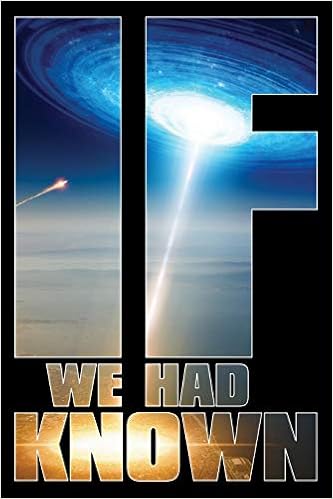
If We Had Known (McPhail, ed)

If We Had Known, Mike McPhail, ed (2017)

(Not a review, just some notes to help me remember the things I've read. But written this way because it's the Internet, and some people will stumble across this page.)

First book of the year. (Okay, so I started it last year.) And look at the cool cover!

If We Had Known is a collection of cautionary tales of the future: what we might find out there, and what may happen to us right here. My fear going in was that it would be a collection of depressing stories, like those episodes of The Twilight Zone where that final twist just kills you. Thankfully, that isn't the case. They aren't all cheery, either, to be sure, but humanity doesn't get wiped out over and over from mistakes made because we didn't know.

The book starts off with an essay on having a necessary enemy, which turns into a fictional account before it's over, that goes through the space race and the Cold War, and pondering should we lie about an alien invasion coming, if only to get us off the planet? The greatest threat to humanity may be never leaving our planet's surface.

It's the next two stories that really get the book rolling: "The Steady Drone of Silence" by Danielle Ackley-McPhail, and "The Last Man on Earth" by Jody Lynn Nye. The former is a military sci-fi rescue/recovery mission to uncover what went wrong, where we learn that science and the military may have different end goals for any discovery or new technology. If the latter, the cumulative effect of genetic manipulation over generations may eventually reach an evolutionary dead end. (Those shouldn't be spoilers -- they're really starting points.)

Note: Danielle Ackley-McPhail is the Publisher of eSpec Books, which published this anthology, and also the spouse of the editor. Neither of those facts were the reason her story is included. Jody Lynn Nye is listed elsewhere in this blog for co-writing The Death of Sleep.

Most of the stories deal with encounters with alien races or cultures when either we go out there, or they come to us (or our colonies).

The final entry, "The Third Heaven" by Robert Greenberger, was more of a character piece than a story, but I enjoyed it, and thought it ended the book well. It was mostly a conversation between the ship's AI and a religious scientist. During the long boring months in space transit, the main character starts questioning her religious beliefs and looks to the AI for guidance. It doesn't speak down or mock in any way, which I appreciated.

There is a follow-up book, with a similar looking cover, that I have to purchase before the month is out.

Friday, January 3, 2020

2019: The Year in Review

For a year without a Challenge checklist, I had a pretty eclectic year. Granted, I didn't read as much as I would have liked, and I lost a lot of my reading time this past summer due to ... reasons. Also, at least two crossword puzzle books factored in, as I needed a diversion every now and then.

There were over three dozen posts last year, almost all of them about completed books. Only two about books that I gave the old college try before abandoning them for not being good, enjoyable, or even well-written.

There were fiction books and nonfiction, sci-fi and foreign translations, graphic novels and self-help, math book and game books, long and short.

In the graphic novel category: I discovered the series Amulet at my last school, before discovering that each issue was published about a year or more apart -- and that the final issue had not been published yet. Indeed, at the time, it probably hadn't been written yet, as #8 was not that old. There were summer comic books, most of which were disjointed collections of monthly titles, which shared a theme, but not a coherent story line because too many parts were left out. (And different included titles had different side plots.)

The odd thing was that I made no entry for One Piece and haven't since 2017 when I listed the first 27 books. I know I'm somewhere in the 30s, possibly low 40s, so I need to find out which was the last book I read, so I can catch up and make another entry. Honestly, I don't remember if I read any last year. I would have had to have put them on hold at the library. (Note: that's actually not a bad way to check on it.)

I will plug Amazon only because I tend to use their images, but because of their annual "World Book Day" where I get to download a bunch of free translations, and then proceed to read one or two of them. This year, I read another Japanese book, Go (even though I should have gone to another part of the world), and a Dutch book, An American Princess: The Many Lives of Allene Tew. The amazing thing about the Dutch book was that it took place, for the most part, in the United States, in New York and Pennsylvania. Allene Tew was born in New York at the fringes of high society, rose up and eventually married actually royalty in Europe. She died in Holland, and the author worked backward from there -- no spoilers, as the story starts with her final days, far from the place where she was born. Had I had more time to go walking this year, I thought about a tour of places she'd lived (or were mentioned in the book) -- the Manhattan ones, at least. Fascinating book, and there were some copies of original society pages included.

In the fantasy category: last year's eSpec Books sale gave me a collection of Precinct books, by Keith R. A. DeCandido (I recently found out it's "de Candid o"), except for Mermaid Precinct, which I selected after winning a flash fiction contest. (Those are gone now.) I liken it to a fantasy Barney Miller with its cast of characters that originated in roleplaying games, but are three-dimensional.

Nonfiction, other than the translation, included essay books ("Writing Science Fiction", and "Breakfast on Mars" which is NOT science fiction) and self-help. Humble and Kind was a gift book with the lyrics to the Tim McGraw song (which he didn't write) along with a short essay introduction (which he did). Speak Thai was just a quickie free ebook, which I read as a curiosity -- it didn't achieve its goal. I don't need to break up with my phone -- in fact, I need to get a better phone -- but reducing screen time wouldn't be a bad idea. And, of course, there were two math books.

Finding a challenge for 2020 may be difficult. Many are boring, or just have dumb things added. I think I did okay last year. Plus, I have a whole lot TBR.

Tuesday, December 31, 2019

2100: What Does the Future of Healthcare Look Like?

2100: What Does the Future of Healthcare Look Like?, (no editor information available) (2019?)

Update to entry pending

Normally, I start off these entries saying like "not a review, just some notes to help me remember what I read". In this case, I'm not sure I wish to remember. I'm deliberately leaving out names, so anything negative I have to say won't get associated with them in any web searches. Also, the book contains no copyright information other than the authors retain the rights to their own stories which have not been published elsewhere. I'm assuming this book is from 2019, but there is no way to know.

Update: I just discovered that all of these stories are available to be read online from the foundation that hosted the contest. I guess a link would be helpful.

I was recently at a book reading/book launch party for an anthology that I wanted to participate in. (Maybe I'll write about this some day.) There was a raffle, and I won two books. This was one of them. I figured that it was a skinny collections of short fiction (flash fiction, really) and I could squeeze it in by the end of the year.

It didn't look too promising, to be honest, as it turned out to be a compilation of stories that were the winners of a competition about health care in the future. I didn't recognize any of the names of the authors, and glancing through the full-page bios padding the end of the book didn't help any.

A few stories in, and I couldn't help but wonder if the stories were chosen because of the messages they contained, and not because they were written particularly well. (They are not.) If this was the best of the competition, then there was just about literally no competition.

The theme of the book is "What will healthcare look like in the year 2100"? But it reads like, imagine the worse problems of today (again "imagine" if you want), and multiply them -- not exponentiate them 80 years into the future. But leave everything as it is -- or again, as you imagine it is -- today.

The lead-off story began in the recovery room after a baby had been delivered and taken to the nursery, and we find that the mother is married to another woman and that 90 years from now, this is still a problem with both sets of parents. Okay, let's get to the health care now. The entire plot revolves around an AI doctor's assistant and a bed-ridden doctor (who just gave birth) telling the other a bunch of things that the other already knows. Then there's a sudden complication out of nowhere, and we hear how healthcare still sucks 80 years from now. About the only thing interesting in the story is that the baby, Ava, tests positive for the Sickle Cell gene, which the black mother knew she carried, but was unaware that the Hispanic mother also carried.

Stop and think about that for a second. The baby inherited a gene from both mothers. Okay, now this is science fiction. That is your starting point -- THAT IS YOUR STORY. How did they edit those genes together? How did they overlook this? How can they fix the baby?

Nope. Instead we get that black mothers are still (in 2100) three times as likely to die in childbirth, even though they are not a minority any more. (And you know something? There's a better story in that sentence than the one we got.) But I'm not going to critique the story I didn't get. This one, however, is terrible.

Follow this with a story that takes place in a climate change dystopia with a main character who is one of the lucky ones, one of the survivors, and who owns firewood made from the last of the redwoods. (The goal is to replant them.) He's also 100 years old, lived through the Health Care Riots, and cured many horrible illnesses, which, once again, insurance companies never pay for.

This is another story which is two characters drinking brandy and talking to each, explaining the previous century. Worse -- do not read if you are tired -- the author switching between first and last names of the two characters so often that a couple of times I forgot which was which. They both sounded the same, after all.

...more to come ... or maybe not ...

Monday, December 30, 2019

A Dozen "Dozen" Game Books

A Dozen Dozen Game Books, Philip J. Reed (2019)

Entry pending

I spent a lot of time reading gaming material in the latter part of the year. Altogether, those pages could comprise a book the size of many others I'd read this past year. And they were better written than some of the things I subjected myself to (particularly things I didn't bother to list on the blog).

The title of this post doesn't mean that I read 144 books. It means that I read many of the books in the A Dozen Adjective Nouns series by Philip J. Reed (@philipjreed on Twitter). There will eventually be more than a dozen of these, and many are already available for preview by the backers of two separate Kickstarter campaigns. (And I'm one of them.)

Here are some of the coming PDF files:

On top of this, there was an additional Kickstarter for Delayed Blast Gamemaster #2, which had issues #1 as an add-on. These were each 48 pages of well-thought-out source material.

I thought all of this merited an entry before the end of the year. The question, in my mind, is how to count them. Definitely as one. Maybe even two -- one for Delayed, and one for the Dozens.

Below is a list of the supplements I've read already read, mostly presented here so I'll know what to put next year:

  • Delayed Blast Gamester, issue 1 (48 pages)
  • Delayed Blast Gamester, issue 2 (48 pages)
  • The Book of Unusual Potions (64 pages)
  • A Dozen Ancient Dragons (14 pages)
  • A Dozen Arcane Spell Components
  • A Dozen Sinister Rumors
  • A Dozen Dreadful Rumors
  • more to come ...

Sunday, December 29, 2019

Classics Illustrated: Romeo & Juliet (Shakespeare)

Classics Illustrated: Romeo & Juliet, William Shakespeare (Author), (Illustrator)

[image pending]

I don't know where I got this graphic novel from -- probably from the library. It's been in the basement for a while. I didn't read illustrated classics as a kid because they seemed to dense. I picked up a few when I started teaching (they were in the class library), but those seemed very thin. If you didn't already know the story, you might not know what was going on. Then again, if you did know the story, you'd see how much was left out.

So... Romeo & Juliet. I've watched the Franco Zeffirelli film from 1968 with Olivia Hussey and ... other people that I could google. And I've seen the modernized version with Leonardo DiCaprio and Claire Danes, which kept the dialogue but modernized everything else. I prefer the former. There are also a billion adaptations -- skip those.

What I didn't know about this comic -- even though it's on the front cover in the lower corner, and explained on the back -- is that this was a "Quick Text" version, which leaves a bit out. There is a "Classic Text" version, which I may or may not have liked (even if that's want I might have wanted), and a Plain Text version of the same comic (which I probably would have enjoyed the most).

The downside of this is that most of the Shakespearean language is discarded, and when it is included, it sticks out oddly.

Another problem of the Quick Text is the artwork. The art was created and framed to allow for large word balloons. Without them, there are many tall panels with people's heads and shoulders at the bottom of the frame and a lot of empty space above them. It looks weird, and you wonder what the artists (and the editors) were thinking.

As for the story, you know it. Not much to say, except that the review of the material helped when I covered a drama class and they had to do a reading of the sword fight between Mercutio, Tybalt and Romeo. At least I knew enough what was going on (and who was who) to explain to the students.

TL/DR: go for the Plain Text or the Classic Text. Skip the Quick Text. Or just read the play.

Friday, December 27, 2019

Mathematical Recreations (Kraitchik)

Mathematical Recreations , Richard H. Minear (Author), Maurice Kraitchik (1944)

[Image pending == its just a green cover with a geometric pattern]

I have too many old math books in my basement. Years ago, I made a practice of attempting to read one math book each summer, and to see how far I got before I gave up. Reasons for giving up: the math moved beyond me, or the notation became tiresome to figure out.

There are times when I might prefer a sentence to a nifty equation. Consider the difference between four or five lines of programming, and a single line of "clever code" that can accomplish the entire thing. Or even a paragraph explaining just what is going on.

Sometimes I feel I'm not the audience for these books, which is usually a 1940s grad student or above, or a 21st-century math professor (and above).

This book has been in my possession for at least a decade, and was taken from a pile of discards in the William E. Grady Technical-Vocational High School teacher center, which was formerly the Math Dept office. The book had been removed from circulation from the school library years earlier.

The title Recreations caught my attention, because I thought it might be more fun and games and puzzles. Not exactly, but still interesting. The problem with math puzzles is that once you work one out, they lose a little of the magic. And repetition of similar problems start to feel like homework. On the other extreme, problems that are impossible to figure out (or just behind your capability) are too frustrating.

That said, there was some interesting "stuff" in the books, including an old sheet of paper containing a list of scholastic websites on one side (they're probably all dead links by this point), and calculations on the back, mostly related to Pythagorean Theorem. I had several posts about those over a decade ago.

When I picked up this book at the beginning of the month, I thought I could possible knock off a chapter every day or two, and then write about it on my math blog. Rather than link all the individual posts, here is the link to the "Books" tag.

https://mrburkemath.blogspot.com/search/label/books

All the posts relating to this book are in December 2019. There will possibly be a wrap-up post in 2020, but I don't have time to think about it and write it now. Other projects are coming up with deadlines.

This book will probably be left on a table at the next Heliosphere science fiction convention in NY in April. Hopefully, there will be another math book there to join it. I hope to tackle another one (also with a page of notes as a bookmark) after I finish a couple other things.

Bourbon Penn 21, July 2020

Bourbon Penn 21, July 2020 (Not a review, just some notes to help me remember the things I've read. But written this way ...