Friday, April 30, 2021

A Bushel of eSpec stories

(Not a review, just some notes to help me remember the things I've read. But written this way because it's the Internet, and some people will stumble across this page.)

I've particpated in a bunch of Kickstarters over the past few years. As a result, I wind up with not only a bunch of books to read, but bonus stories and gaming pdfs as nice little extras. These get sorted into folders on my hard drive. So I decided to knock off a few of them while I'm between books.

Since my last foray in reading short stories was a "peck" of eSpec, I'll call this one a "bushel", but don't expect four times as many stories, or even four times the length. It'll be until whenever I stop and post it. The batch should all be from eSpec Books bonuses and stretch goals, unless something else sneaks in.

In order that I read them:

  • Feeding the Mouth that Bites Us by L. Jagi Lamplighter was originally published in Dreams of Decadnece (date?). No spoiler, that mouth belongs to a vampire. The story is told from the perspective of Hannah, the lovestruck victim who despite giving up only a cup of blood every other week to her lover Ambrose, has lost all of her energy of the past year. While out walking by Central Park, she encounters a group of nuns handing out flyers. She reads it later to discover that they have a clinic that specializes in the very collection of symptons which Hannah suffers from and which no doctor has been able to diagnose. This leads her to the Order of St. George's Clinic, where she's finally able to breathe freely, and where she learns more about the nature of vampires. A fun read.

  • The Wedding Night: a Death and the Crone vignette by Megan Mackie. It's porn. Maybe the kind you'd find on HBO or Netflix, as opposed to other outlets, but that's what I found myself reading. It's literally the wedding night of the subtitular couple, and you're a witness to all the action. There's no plot, or as my editor might point out, no conflict. I assume these two characters, and perhaps this scene itself, were plucked from other works. I haven't read any Mackie that I recall (and this I would recall). Both characters are old and have been married before, but both have a youthfulness about them.

  • Seeing Red by Danielle Ackley-McPhail was originally published in In All Their Glory (2010). Samantha is a faerie who freezes when you sees the color red, particularly red caps. "Redcaps" are a type of malevolent, murderous goblin found in Border folklore, and they want to murder her. To overcome her hesitation, she organizes a game of capture the flag, using red banners, but soon she has to confront her fears head on.

  • The Fiber of Being by Jodie Lynn Nye was originally published in Heaven and Hell (2002). Jasper is dead, and Michael and Gabriel given him lessons on being an angel. Raphael shows up at one point, too. The Fiber of being is that piece of humanity that Jasper retains that angels do not have. It's what will allow people to rise higher than angels, who are as they were created. It takes Jasper a while to get the hang of it. (Nye cowrote The Death of Sleep with Anne McCaffrey, which I read quite a while ago.)

  • Alien Invasion of Earth by Keith R. A. DcCandido, Special eSpec Books Kickstarter Reward Edition (date?). Dr. Phillips P. Phillips, PhD meets with General Blunt at the Pentagon to discuss an unnatural object in space heading toward Earth. What follows is 7 pages of farce or satire, except those are usually funny. (Note: humor is subjective.) It isn't until the middle of the story that we learn that the story takes place during the Eisenhower Administration, which "explains" the use of the word "Negro" earlier. It also become alternate history very soon after this point. Phillips might seem progressive by having a black (Negro) and a female graduate student working for him, who he insists be brought along with him to assist him, but he berates them and treats them poorly to the point of being annoyed that they involved the gerneral about the UFO without telling him (even though they got him to sign the letter they sent). The general later mistakes the two of them (Lamont Johnson and Maria Chen) for an errand boy and a secretary, because, you know, it's the 50s. The one thing that is universal about the story is the higher-ups getting credit (and rewarded) for work of their underlings. I had an Assistant Principal who was quite smugly proud of himself at the bonus he got from his department doing more work.

  • On Rocky Ground by L. Jagi Lamplighter was originally published in Bad-Ass Faeries (2006). It starts This story is dedicated to the Freeman Children. It features the Prospero brothers, Erasmus and Mephisto, as they scale Monte Musine in the Italian Alps, along with Mab Boreas, who is an Aerie One. (I don't know what the Prospero brothers are, but they've lived a long time.) They are lugging ground giant bones and salamander poo as a payment to the Oreads, who are feminine rock-type creatures. They run into problems with a grumpy gnome. Hilarity ensues.

  • Reflections of Amontillado by Ty Drago was a special eSpec Kickstarter Rewards edition (????). It starts With respectful apologies to the master. The narrator is Antonio Santino Argestelli Fortunato, a merchant and a student of no art but business, who happens to love wine. He is married to the Lady Fortunato, who doesn't appear in the story. The tale takes place in northern Italy, where he is approached at a carnival by Monstresor, whom in the opening of the story was refer to as a friend and a foul murderer. Monstresor is the last of a family of wine makers as swamp has overtaken his lands and spoiled his vintage, forcing him to sell off land and let go of his servants. He lures Fortunato there with the promise of an Amontillado (which I had no idea what that was, other than a wine of no particular note). From there it plays out like Poe, in a tale I was first exposed to in a Bradbury story, similarly in a House of Ghosts comic (or another series of that ilk), and even in an episode of Dark Shadows. However, this tale doesn't end there.

  • A Brief Battle for the Throne by Jeffrey Lyman was originally published in Bad-Ass Faeries: In All Their Glory (2011). The story starts in London, 1850, when Lord Broggon of the Hobgoblin Tribe tries to go through the Door to Fairie but something is blocking it. The building the Door had been attached to has been demolished and the Door should just attach itself to the new structure. Unfortunately, the new building is the King's Cross station for the new iron rails being laid along the ley lines in England. They are blocked off from King Oberon. What to do? A Council meeting of hobgobins, elves, ogres, pixies and others try to come up with a solution. Instead, the tribes end up taking sides and a ninety-year war commences.

  • Undine the Boardwalk by Keith R.A. DeCandido was originally published in It's Elemental (2013). I don't get the pun of the title, if it's supposed to a play on "Under the Boardwalk". The story is set in Key West, mostly at Mayor Fred's Saloon, where a band named 1812 plays. The main character is named Cassie, who we find about about a quarter of the way through the story that she is a "Disir", a fate goddess, and sometimes referred to as a "Dis". She learned this from the king of the Norse gods, and previously had to stop Loki. So this is a series story. Only a couple of people know about Cassie's background. One is Bobbi, a member of 1812, and Rance, an FBI special agent. Jana, a friend of Bobbi's since childhood, and a friend of Cassie's since she moved there, doesn't know. Jana is also in the band. Jana has a new love in her life named Russ and everyone seems to love this guy, except Cassie, Bobbi and the old curmudgeonly Larry. Cassie doesn't know know why she doesn't like him, but she doesn't, and that's good enough for Bobbi. (There's also a crack about Russ having two middle initials -- so "pretentious".) By day, Cassie is a diver at Seaclipse.

    Rance runs a background check and finds that Russ lives on a boat with his mother, so Rance, Cassie and Bobbi take a trip. The boat has "rusalka" etched on the prow. Looking that up, I found that a "rusalka" is a Slavic water elemental, usually malicious. Cassie can see its ugly true form through its glamour while the other two see an older woman who can still pull off a bikini look. Russ, however, looks human, so they figure that his father (who wasn't listed on his birth certificate) is also human. The mother, who goes by the hman name Anne, is horrified that her son is going to marry a human because it will only end in tragedy for both of them, and she speaks from experience. So they have to break up the couple, and get Jana out from under Russ's spell before it's too late. And then we find out more about Russ's parentage.

  • Tag Team Match with Hell by Patrick Thomas, C. J. Henderson, and John L. French. Kickstarter Rewards edition (????). It is listed as A DMA Casefile, which stands for Department of Mystic Affairs. The copyrights and trademarks list Murphy's Lore and "Bullfinche's Pub" gets a shout-out in the first paragraph. Bianca Jones is listed as a trademark of John L. French; she appeared in the story "Cold Iron", which I read recently. I don't recall reading any story including Lai Won, by C. J. Henderson. This is more of a CW crossover (not of "Crisis" propotions) than the Avengers getting together. Lai Won is a "psychometrist", which is mentioned often, but I wasn't exactly sure what that meant. (I was on the train, so I didn't have a dictionary available. It turns out that it's a real thing, someone who administers psychological tests. Yeah, that's not what she does.)

    The story leaves NYC quickly (no Bullfinche) and heads down to Baltimore, which is Jones's home turf. Jones had worked with Agent Karver once before but not his partner Maddi Cobb, or Lai Wan. Wan has called in a marker because of something horrible that she experienced when she accidentally touched a DVD. From there is gets disturbing in subject matter as it involves a demon granting a bunch of people eternal youth 50 years ago, and they end up as children. They make money by making black-maret pornography. It's enough to make everyone sick, including the reader, which is, I guess, the point. On the cosmic reading balance scale, this tips the story so heavily that no amount of light-hearted banter is going to lift it back up again. (And the banter between Karver and Cobb seemed a bit forced, but it was also tossed out there for the benefit of the two other occupants in the car.)

    I was only familiar with Bianca Jones before this story, and she had the least to do with it, even though it took place in Baltimore. Maybe that's why they decided to set it in Baltimore.

  • Vein Glory by Christopher L. Bennet, Kickstarter Reward edition (????). Not surprisingly, it's a vampire story. Vincent Shahan wakes up after a couple centuries in cryo-suspension, having been misplaced during the upheavals in the past. This is understandble. His doctor, Dr. Corazon Lee, is a vampire, and is most of the population. That's a little less understandable. Advancements have led vampires to suffer fewer ill effects and not require fresh human blood. The only cure for disease is vampirism and medical research has come to a halt. But there's more than meets the eye with Shahan

  • The Inner Light by John L. French, Kickstarter Reward edition (????). John L. French is the editor of an upcoming angels & devils anthology that I will be included in. This story takes place in Bethlehem on the night of the birth of Jesus from the perspective of the angel, Nika, who was sent to watch over Maryam during childbirth. Nika faces off against five of the Fallen. Any doubts are met with a voice reminding her to "TRUST YOUR INNER LIGHT."

  • Thursday, April 29, 2021

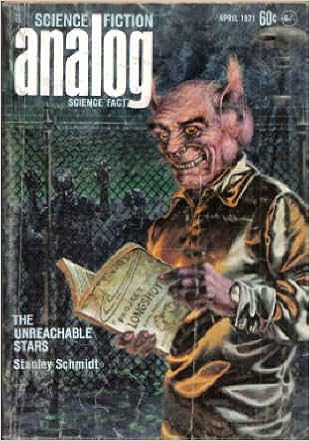
    ANALOG PLUS 50: Analog Science Fiction/Science Fact April 1971

    ANALOG PLUS 50: Analog Science Fiction/Science Fact, April 1971

    The fourth issue in my ANALOG PLUS 50 series.

    At some point, I'll stop numbering, but probably not until I do this for at least a year.

    This was a less impressive issue than the past few.

    In this issue:

    The Editorial: "Ecological Collapse", by John. W. Campbell. An ecology can collapse but Ecology keeps going, albeit in a different form. Campbell starts by talking about one of the greatest Earth-changing elements ever: oxygen. It altered the atmosphere and what life could live on this planet forever. From there, it's on to other types of pollution, like thermal pollution from nuclear reactions. They can heat rivers, and that could kill off the current wildlife in those rivers, but it could spark other life to move into those rivers. There are lots of side effects to consider, good and bad.

    Novelette: "The Unreachable Stars" by Stanley Schmidt, with an illustration by Kelly Freas, showing a background of skyscrapers against a night sky and the outline of people in the midground. Above to the left is what appears to be the head of some kind of feline animal humanoid species. The caption reads, There are choices which, once made can't be reversed -- and typical of these is the choice of immediate desire over long-term need!

    First thoughts: the title, to me, invokes "The Impossible Dream" from Man of La Mancha, which was a 1965 musical, but the movie didn't come out until 1972.

    The story is set in a far (at least I hope far) future when space has been abandoned and forgotten, and Earth is overpopulated. Anthon Hillar goes to the Regional Planning Director Olaf Karper about a discovery. He's unearthed some books from a crypt of a 21st century eccentric at one of the new energy and food complexes in Kaliforn. Bypassing his chain of command, he showed them to Mylo Gotfry, a professor of Ancient English in a government school. He thinks they are important. They are books about the stars and other worlds. Olaf doesn't seem interested and Anthon is afraid a coverup will take place instead of talking about going out there (not that there's money to go out there when there are people to feed and house). Anthon goes AWOL trying to figure out what to do next, wondering if the books are a hoax, when a voice in his head tells him, "They're not a hoax." Ozrlag, the feline-like alien, is trying to influence Anthon mentally, much to the consternation of Mizhjar. They're trying to get information about Earth, and they already know about Mylo. They want him to go to the crypt and get the other books. In the end, Ozrlag has to join Anthon and they are confronted by Karper, who predicted their movements. There's a little twist in the epilogue.

    Interesting story, without a lot of speaking parts, and only two short, feline aliens needed, which could be either male or female. None of the speaking parts are tied to any race or gender. Despite the grand scale of the story, most of the sets would be simple, and everything else could be handled with establishing shots and montages to suggest overpopulation and the brink of starvation. It could be adaptable, but from these past four months, it woouldn't be one of my top choices.

    Science Fact: "Real Science for Real Problems" by John R. Pierce. The caption reads, It isn't obvious that Bell Laboratories runs a major educational "univeristy" -- but it does, because it has to. Educational psychology is, consequently, highly important to the Labs. And because it is a business -- utility commissions and stockholders alike want expenses down! -- Bell Labs has been applying the "Schwartzberg test" to educational psychology for years. Any theories have to work! [(P)] In the process of learning how to learn, the "University of Bell Labs" has developed solid proof that students should not be allowed to determine how they are to be taught, and what is "relevant"! The Editor

    Fifty years old, and still relevant when it comes to student learning. At the time, the Bell System was the largest university instituation in the country after the U.S. Government itself. By applying research, Bell was able to shrink one course from 7 weeks to 7 days, and they had better results. And through tests, they discovered that students didn't always choose the best methods for learning and retaining information. Credit for programmed instruction is credited to B. F. Skinner, whom I learned about somewhat in an Educational Psychology course a long time ago.

    There's some information that's interesting, at least as a historical note, so it's worth finding a copy of the article.

    Bell increasing relied on programmed instruction instead of lecture and text books. In front, when the programs, there often wasn't a teacher in the room. It also showed that if there were breaks in the text to asks relevant questions about what they just read or saw, there was better retention of the material. Of course, just because programmed instruction can be evaluated doesn't mean that a course has been appropriately assessed. It's possible that people will score well on the test questions without taking the course at all. Or that seasoned employees will do better than recent graduates just starting. That shows that the course didn't work as advertised.

    One outdated piece of trivia, people remembered phone numbers longer if the chunks were reversed. Most people would make calls to the same area code and usually to one of a handful of exchanges. It was only the last four digits that changed the most. And yet, as you dial, those are the four digits that get forgotten by the time you dial them.

    Novelette: "Heart's Desire and Other Simple Wants" by W. Macfarlane, with an illustration by Vincent Difate, showing a bare-legged, bare-footed man in an overcoat, swinging a sword. There's half a wheel on the ground (with a shadow) and a car heading toward a wooden covered bridge which turns into more of a steel trestle.The caption reads, Given infinite mobility, you have absolute immunity. But if there is a place you want to be -- thereby you're limited!

    I honestly have no idea what was going on in this story. Despite a line like, "I thought my operation was secure with baffles, dead ends, double bluffs and a chain of command trustworthy as a paperclip necklace. I figured I was safe as the nissing side of a Mobius strip", I'm not sure where it went off the rails. Maybe if I reread the portion in the middle.

    Arleigh Ravenshaw takes his order from General Craddock, who tells him he's a marked man. It seems to be an X-Files situation where they investiage alien artifacts, witchcraft and odd occurrences. Craddock sends Ravenshaw on a cross-country trip that starts in Saratoga Springs and leads him down South and then out West. His first stop seems to be a couple of New Age hippies (but, again, this is written in 1970) and it's long on conversation, and then it moves on, and on, and on. Maybe I was dulled by this and didn't pick up the common thread. When he gets to a town called Nak-a-tosh, he phones a woman named Mrs. Aubray Chalmers, which brings him to a coven and a ceremony that he's about to take part in. One of the women involved was named Nell Rowley whom Ravenshaw managed to not ogle ("goggle") by ogling another woman instead. It wasn't until I was writing this up that I realized that Nell Rowley was mentioned very early in the story and is known to both Ravenshaw and Craddock. I missed this.

    Anyway, Rowley grabs Ravenshaw and pulls him out of the coven before anything stupid happens. They flee in a car, and the coven gives chase. And some point, this road trip takes a major detour as they start hopping, leaping, jumping or sliding between dimensions and realities. Start thinking about something (like a bridge) and it appears. This causes problems as they are moving around in alternate realities acting odder than a $2.50 bill, which actually exists. They finally figure a way back, but I really haven't a clue what was going on. If someone wanted to adapt it, they'd need to leave out a lot of the beginning and explain what was going on better.

    Serial: "The World Menders" by Lloyd Biggle, Jr., with an illustration by Kelly Freas, showing a line of hairy humanoids walking, one with a torch, two carrying another who seems to be passed out or injured, and a female seems to be dancing. The caption reads, Third of Three Parts. One of the problems that has never been adequately considered is "When is a slave not a slave, so freeing him is impossilbe." That unconsidered problem presents aspects that make it inherently insoluble.

    This Part 3 of 3, so I chose to wait to read this. I may do a separate entry for two or three serials.

    Short Story: "Higher Centers" by F. Paul Wilson, with an illustration by Vincent Di Fate, showing a dog looking at two people, one standing, and one getting up, on top of some kind of platfrom, and a second platform has a lamp that looks to be projecting the title "higher centers", and there's a flat skyline and two moons. The caption reads, The efficient way of doing things is to have a strong, centralized Center of Command that makes all the decisions. Well-l . . . at least as long as the thing works at all . . .

    The higher centers refer to parts of the brain. Spoiler: unraveling a mystery on another as to why some people are having trouble breathing, and can't sleep for more than an hour at a time. Side effects include the government screwing everything up because affected employees cannot function properly, and people are starting to riot. Due to some kind of accident (I'm not sure what), the people suffering have a problem where their higher centers have taken control over some body functions that the lower centers should handle, such as breathing. No solution is offered, and the problem with be passed onto another authority.

    This story is too cerebral to make a good sci-fi story. Even as a medical drama, it fails because there is no solution to the problem.

    The Analytical Library: The top five stories from January 1971, when I started reading. Gordon R. Dickson's serial takes the top spot with an incredibly low score (low is good), and "The Telzey Toy" was next. I liked that one. I couldn't argue with the placement of the rest of the stories. I had to think about the titles a moment to remember much about them.

    The Reference Library , by P. Schuyler Miller.
    Books reviewed include: Dread Companion (Andre Norton), The House in November (Keith Laumer), The Dark Symphony, and Anti-Man (both by Dean R. Koontz), and The Stainless Steel Rat's Revenge (Harry Harrison). Also there are mini reviews of books reprinted in hardback: The Stainless Steel Rat (Harry Harrison), The Wanderer (Fritz Lieber), I Am Legend (Richard Matheson), A Gift From Earth (Larry Niven), Nightwings (Robert Silverberg), and Rebirth (John Wyndham).

    Brass Tacks:
    Stan was incorrect to assert that 3,000 tons of coal dust could cause a 3 kiloton explosion -- it's closer to 33, but since it isn't efficient, at a 10% rate, he'd be close. Rick Cook gave an update to his bacteria article published in November 1970. (I haven't seen the article but I skimmed then skipped most of the letter.) Drugs are bad enough when they're good, but when they're cut with arsenic, rat poison or such, they're even worse, and the users don't know what they're getting. (Sounds like getting pharmaceuticals over the Internet!) Pot and alcohol are also menaces. And a couple more editorial responses.

    On to May, and whatever else is in the TBR stacks in Kindle, iBooks, and the physical nightstand.

    Friday, April 16, 2021

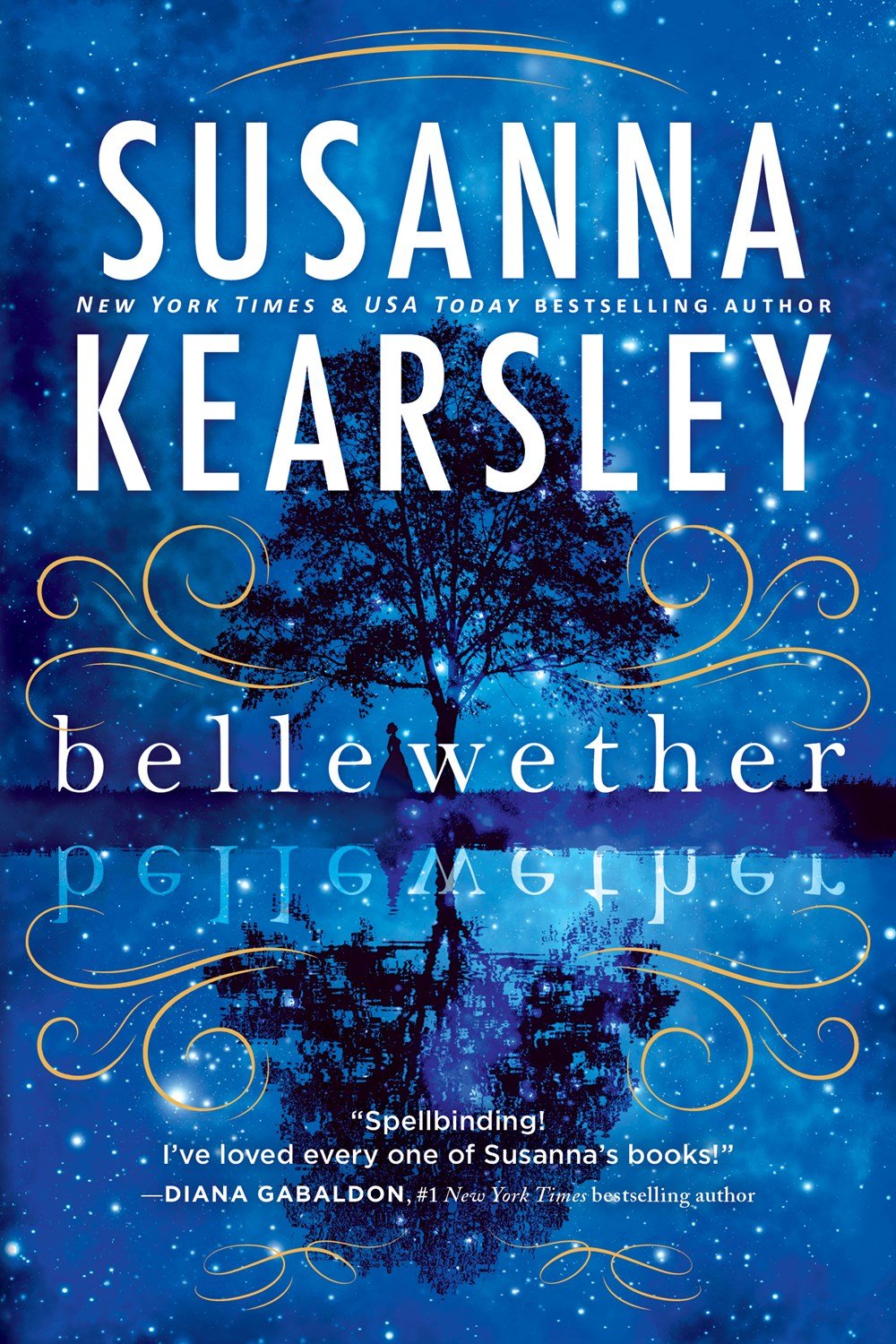
    Bellewether (Kearsley)

    Bellewether by Susanna Kearsley (2018)

    (Not a review, just some notes to help me remember the things I've read. But written this way because it's the Internet, and some people will stumble across this page.)

    The was a book group book. Yes, I've somehow become part of a book group.

    The spelling of "Bellewether" is a pun on the French "belle", and it is the name of a ship and an estate in the book.

    There are dual storylines taking place during the Seven Years (French & Indian) War and current day at a home above Snug Cove on the northern shore of Long Island, which is becoming a museum dedicated to the the life of a Revolutionary War hero. The hero will become Captain Benjamin Wilde, but he is still just one of the brothers of Lydia Wilde in the earlier narrative. There is also the story that a ghost haunts the museum and the woods about it, and the tale that it is a French soldier, killed by the one of the Wilde sons, when he attempted to run off with Lydia Wilde.

    Charley is a descendant of the Wilde family, whose family fled to Canada during the Viet Nam War, but has come back to Long Island to look after her niece when her brother dies. She becomes the curator of the museum, much to the chagrin of a couple of board members, but she has the credentials for the job. She encounters the ghost early on and also starts to learn more of the history of the Wilde family as she goes to retrive items that were in the house according to an Inventory List made during British occupation (during the American Revolution). She also tries to find inormation behind the ghost story, which would allow them to expand the mandate of the museum. Some information is not welcome to be found. In particular, no one wanted to discover that the Captain was raised in a house with slaves. (Note that I don't think the current-day historians uncovered the entire story.)

    The pre-Revolutionary story was of more interest to me. I can't say that I've read much of the Seven Years War era. Usually, it's from the 1770s onward. As for the modern-day story, most of my interest lay in uncovering the stories of the past. The ghost, which you can be certain early on is in fact a ghost even if you don't know whose, doesn't add much to the story, except as an aid to steering Charley in the right direction at times. The love stories/triangles are for anotehr demographic than me but didn't affect my enjoyment of the book either way.

    Kearsley adds some historical notes at the end of the book which are of some interest, which events actually happened with real people, and how her characters and composites fit in.

    Monday, March 29, 2021

    Books I've Read Twice

    Every now and then, I see posts online, or hear people in real life, talk about favorite books. I really can't say that I have a favorite book any more than I can say I have a favorite movie.

    And then comes the silly part: they talk about how many times that they've read a particular book. Or that they've lost track of the number of times that they've read them. It's like returning to an old friend.

    In a similar vein, there are people out there who will reread entire series of books. This becomes a case of triangular numbers as they reread from Book 1 to Book (N - 1) whenever Book N is published. My wife bought Harry Potter and the Deathly Hallows on the day of its release, and then proceeded to let it sit on the shelf until she had reread the first six books. And, no, no one else was allowed to touch it first. (*) Likewise, some online acquaintances reread every book in A Song of Ice and Fire before A Dance With Dragons came out, and will do so again whenever (ha ha!) The Winds of Winter is released. (And some people read them all annually, any way.)

    I am the first to admit: I am not the world's greatest reader. I don't read quickly. I get easily distracted. And I don't retain a lot of what I read, particularly if I try to speed-read through or just "soldier on" to the finish. This is part of the reason for this blog, like someone with a speech impediment taking singing lessons.

    There are just so many books that I would like to read either because I have an interest in them, or because I want to know what other people are talking bout, that I just couldn't find the time to reread the same books over and over. Granted, sometimes a reread is much quicker. But only sometimes.

    So I reflected on it, and I tried to think of what books I have read more than once. This is tricky. There are books that I have returned to that I didn't get through the first time. There were books from high school and college that I thought back then, if I ever have a chance to read these at leisure, and not "by next Tuesday", I might try this agin.

    As best as I can recollect, in my entire life, I have only reread five books total. These fit into two categories: I wanted to read a series from the beginning, or I wanted to read an assigned book because I wanted to not because I was told to. There could also be a third category: I forgot that I had read it before until I was halfway through.

    This is the List I came up with:


    • B is for Burglar, Sue Grafton. In the 90s, I listened to quite a few of the alphabet series on tape while commuting from Brooklyn to Parsippany. I believe I picked up Burglar before that as a used book store. Sometime in the 2000s, I started reading the series. I don't count books on tape as rereads because those are abridged, excerpts of the real books. (The same goes for the other books, like Tom Clancy novels.) After A is for Alibi, I happily picked up Burglar again. I probably still had my original copy, as this was before I started downsizing my library of mostly unread books.
      Honorable mention for, I think, G is for Gumshoe. I started reading 2 or 3 books in this series per summer, and somehow, I picked up the same book I had read the previous year. But I don't remember which was it was.

    • The King Beyond the Gate, David Gemmel. In the late 80s, my brother and I attended a science fiction convention in Rye, NY known as Lunacon. One of the panels was about new books coming out, and there were freebies at the end. They asked everyone to limit themselves to one of the three books. We both passed on the one that had the most copies, figuring that there would be leftover copies, and we'd grab an extra. I don't remember what my brother took, but I got this book. I still have it. (The third book was garbage.)

      After reading it, I went to exchange with Thomas, and I told him, "Remember when I said that other book was kind of dopey with a video-game mentality set-up and didn't hold my interest?" I handed him King and said, "This. Book. Is. Good!" He took my meaning and read it immediately. What I didn't expect was that he would buy the other three books that were (then) currently in release, read those and pass them along.

      The story of Druss the Legend is mentioned in King, without being spoiled. It takes place about a generation later, and is an enjoyable standlone book. The second read added to the enjoyment.


    • The Western King, Ann Marston. For a while, I wasn't sure if there actually was an Ann Marston, or if it was a psuedonym used by multiple writers in the series. Actually, I still don't know, but I don't think I care any more.

      There was a time in the 90s that you can buy remainder paperbacks off racks in drugstores for 69 cents or so. Keep in mind, you usually get what you pay for, and there's a reason why these books were remaindered. On the other hand, if you bought 3 or 4 books and struck pay dirt with one, you could toss the others and be satisfied. Such was the case with The Western King, which was book two in The Kingmaker's Sword trilogy (which later became two trilogies, and I wasn't particularly happy about that). There was some stuff up front that I didn't follow as well as I could, but everything I needed to know was summed up early on. The rest was the story of the sons of Red Kian of Skye.

      Some time later, after not encountering the first book anywhere, it dawned on me to try the library, and inter-lirbrary loans. I enjoyed the first book as much as the second, and then I went on to enjoy Western King more than the first time. The series unfortunately went a little sideways after that, and I'm glad I didn't spend $7-10/book to buy them online. Oddly, I was able to borrow the last book from a library in Florida. The librarian in Brooklyn was quite helpful. However, when she mentioned that she knew who Ann Marston was and enjoyed her work, I'm sure she was confuing authors. Marston is credited with these six books, and that's the end of the publishing history.


    • A Separate Peace, John Knowles. Techinically, this would've been the first book I reread. Sometime in the late 80s, after college, I took this high school assigned book off the shelf and wondered if it was as bad as I remembered it. Yeah, it was. It might be the reason I haven't reread other books.


    • The Mysterious Affair at Styles, Agatha Christie. Back in December of 2020, I saw that I could download an ebook collection of Agatha Christie novels for free. So I did. Back in high school, I had to read this and Curtain. I might've struggled with it a little back then, but as a more accomplished reader, I figured I wouldn't have much trouble with it now. Actually, I did. I fell asleep more than a few nights before reading another two pages. I didn't remember much about the story other than "It wasn't strychnine, was it?"

      Ironically, my thinking was to read this novel quickly so I could up my count for the end of the year. I almost didn't finish it by the end of the year. However, I am not opposed to revisiting the collection when I have other books taken care of.

  • Update: Harry Potter and the Order of the Phoenix, J. K. Rowling (2004). I found a note that said I reread this prior to seeing the movie.

    Other possibilities

    At some point, I may update this post, or just make a second one. It seems to me that there should be a few -- not many, but a few -- more books. One that comes to mind is Dracula. I bought a copy in the early 90s when I participated in a Dracula-themed musical production with Xaverian Alumni Community Theater. However, I can't swear to the fact that I had read it before that. Similarly, Frankenstein I know I tried once before but couldn't get past the first few chapters.

    Tom Sawyer and Huckleberry Finn were once each.

    Anthem was assigned to be read the summer before high school. To say that the point of the book was lost on me would be putting it kindly. I remember joking to classmates that the character's names were all phone numbers. Um, yeah. I might have read it again during college but I honestly don't remember if I ever did.

    I can't think of any Asimov books I've done twice, or any other author. The Doc Savage books in the basement (another series) was once each, for the ones I got to. When it comes to that series, I stopped reading because I started reading books that I was going to get rid of afterward. I don't plan on getting rid of those. Silly reason not to read them, I know.

    (*) (Side note: I was away camping that week. As I had picked up The Half-Blood Prince a few minutes after midnight when it came out, I assumed it was my obligation to pick up the final book as well. So we had two copies.)

  • Saturday, March 27, 2021

    ANALOG PLUS 50: Analog Science Fiction/Science Fact, March 1971

    ANALOG PLUS 50: Analog Science Fiction/Science Fact, March 1971

    The third issue in my ANALOG PLUS 50.

    At some point, I'll stop numbering, but probably not until I do this for at least a year.

    In this issue:

    The Editorial: "The Stay-Home Bodies", by John. W. Campbell. Written at the height of the Apollo program, Campbell writes about the opposition toward the manned space program coming from liberal-arts-type folks who don't want to spend the money and from scientists that just don't want to spend so much on that while neglecting their own very special research, when automated drones would suffice and leave the science to scientists and not engineers.

    There are two basics truths: The Truth of the Universe, and Truth by Consensus. The latter one is as problematic as deciding who is to judge, and what happens if consensus changes. Also, the Universe doesn't care about your consensus.

    Novelette: "The Missing Man" by Katherine Maclean, with an illustration by Kelly Freas, showing a cityscape in the background of mixed architecture, seeming to span centuries, and in the foreground, there is a silhouette of a man with a nuclear detonation superimposed on his body, along with some starbursts. The caption reads, The trouble with complex automation is that it follows blindly any order to its logical catastrophe!

    Maclean builds an incrediby dystopic world set in a distant future New York City, and then proceeds to tear it asunder. This story would've been written in 1969 or 1970, and I'm wondering the author's frame of mind. It was out there. The mixed architecture in the illustration represents how the city had been broken down into communes and kingdoms of people. The population is dispersed and balanced. Things run fine without any panic of the populace. Until a fellow by the name of Carl Hodges disappears. He's a city programmer who not only knows how the city operates but his maintenance predictions can anticipate ways in which catastrophes could happen by something as small as a refrigerator failure in the lunchroom of a power plant which gives the crew food poisoning, which causes an exposion along a fault line. Big consequences continue from small mistakes. Hodges walks through the wrong kingdom and gets kidnapped by a teener gang, a nihilistic bunch that doesn't see much of a future for anyone who isn't a tech. In this dystopian nightmare, there are many obstacles to having children, and many are encouraged to give up that right, selectively breeding those undesirable to society out of existence.

    Enter George Sanford, who works for the Rescue Squad, and who uses Predictive Behavior to find people. He also seems to be telepathic and empathic, which both helps and hinders his efforts. George gets close to finding Hodges, up to meeting the same teener gang. Instead of kidnapping or killing George, they give him a warning beating and leave him tied up on the sidewalk. George runs off and climbs the ironwork under the GWB to get away for a while.

    The gang realizes what they have, and they managed to exploit a weakness that causes the destruction of the underwater Brooklyn Dome. George is called back in by his supervison, Ahmed Kosavakats, who has George tune in Hodges again. They are on the trail when they are called to the Jersey Dome for fear that it will meet a similar fate. Once there, they try to avoid spreading panic, while panic is spreading. They are "admiring architecture" more than looking for flaws, but human error (both deliberate and careless) can worsen the situation. They make it out of the Dome before calamity strikes again.

    In the end, Hodges is found because of George tunes into him. Ahmed questions Hodges through this connection, and they figure where he is. Then it's just a mater of getting him out without him being moved or killed.

    Could this be televised? I don't know. It's a bit cerebral, and a little "out there" for a general audience. On the other hand, genre-loving folks might like it, if done well, but it likely won't have broad appeal. I would think that this could be a budget buster, even for an hour of television, and I don't think the story merits the expanse. As for casting, there are four main characters, and a number of minor speaking parts, which could go any which way. The only restricition I would set is that George and Carl should be somewhat similar, but not overly so.

    Amusing side-note: in the future there will be public telephones with video screens, courtesy of Bell Telephone. The story was about a little more than a decade before the break-up of Ma Bell.

    Science Fact: "Celestial X-Rays" by Margaret L. Silbar. The caption reads, It's long been obvious that these immense fusion generators, the stars, were bound to radiate X-rays, and that no Earth-bound observer would ever "see" them. throught he shielding atmosphere. But the things that have been found by X-ray astronomy wasn't expected.

    An interesting article and I kept up with the gist of it, even if the Science was beyond me (or just not anything I've ever followed). Astronomy had been an optical science an optical science until the 1930s when radio waves were detected. These are the only other electromagnetic radiation that penetrates the atmosphere, and this gave rise to radio telescopes.

    It was only "recently" (particularly 50 years ago) that astrophysicists could use rockets to launch detection equipment into the air. At the time, scientists suspected that the Sun emitted a few X-rays. They weren't prepared for the huge amounts they found being emitted from elsewhere. The article goes on to discuss tracking the sources. It is amusing to read this knowing that it was likely written before Apollo 14 launched, and it's mentioned the upcoming eclipse of the Crab Nebula by the Moon in 1972, which only occurs every six years, to get another five minutes of data recorded. Now we have telescopes in space gathering data continuously.

    Fun fact 1: the Sun has a diameter of nearly a million miles but it has about the same mass as a white dwarf with a 6,000-mile diameter or a neutron star with a 10-mile diameter.

    Fun fact 2: Californium 254 was discovered among the products of the first man-made fusion explosion at Bikin Atoll. A quick Internet search says it has a half-life of about 55 days. The article implies a long decay process. Cf 251 is closer to 900 years (which is close to the 1,000 years mentioned in the article), and Cf 252 has a half-life of 2600+ years.

    Fun word: other than repeating the phrase "iron ion" in my head a bunch of times, there was a reference to a process called bremsstrahlung, a German word for "breaking radiation". I could see that as the title of a short story, or the name of a ship (or both).

    Novelette: "The Operator" by Chirstopher Anvil, with an illustration by George Wilson, showing a man, wearing an outfit reminiscent old space serials, coming out of a hatch of some kind next to a long-barrelled mounted weapon. He's being attacked by a bear-like creature. Two more of those creatures are approaching in the background. The caption reads, In a harsh environment, you find tough organisms. In a really savage environment, the only ones left are also smart!

    Dave Hunsacker and Jim Fielding are two colonists in a settlement on a planet that is experiencing a very cold winter. Their cabin barely has enough heat. Worse, they're both experiencing an illness that is characterized by "dirt" on their faces, which leads to feverish delusions. Other dangers include termite-like greevils, which are bad news for wooden cabins, and badgers, which are bad news for your supplies should they get inside the cabin. Worst would be the packberas, with teeth like daggers, which are currently hibernating. As the two recuperate, they go in search of a young woman that Jim spotted in the forest. Getting to the edge of a bluff, they spot a couple of tents and a space yacht camped near the base, right outside a cave of bears, and the temperature is warming up. They wind up counting 8 women among the group. The first time they try to make contact, they are fired upon. They come back again, with a third colomist to try again. This time, two skimmers filled with young men (outlandishly dressed under bubble protection) show up to bother the ladies, who aren't interested. The guys make enough noise to rouse the bears. Tragedy ensues. The three do what they can to scare away the bears and kill any bear that gets near the tent. None of the young men survive.

    I enjoyed the story up until this point, but it is here that it goes off the rails a little. The first is a complication that Dave wished could've been avoided and I wished was left out of the story because it was a little to deus ex machina: two Space Polic skimmers show up. They're like Space Patrol, but Police. Except that they aren't even from the planet. So where did they come from? Did they answer a distress beacon? And they came that quickly? This is such a harsh environment, you'd think that more people would've called for help by now!

    Dave then manages to scare off the Space Police with talk of the Pox, but before they race away, they basically quarantine the planet and give salvage right to the men's yacht to whoever claims it first. Rounding out the oddities: they check out the men's yacht to find a smelly mess and a giant frog statue (huh?). There's also a mention of another distant settlement on the planet, but it doesn't matter to much at all. Finally, they head back to their settlement, mindful of giant, killer birds.

    This is probably the first story in this 50-Year Deep Dive that I both liked and found problematic. It definitiely has outdated views. For starters, one of the reasons that Dan and Jim are cabin mates is that neither has a woman in his life right now. (People have died.) They got together to save resources, and so that the empty cabin could be used by a family whose cabin was ruined, and which can't be repaired so easily in the middle of winter. It's a new settlement, and it needs people to survive. Moreover, they need women. Here are a bunch of young ladies. Keep in mind, the title is "The Operator", which is what Dave is.

    While you could make everyone in those space yachts a bunch of rich, spoiled college-aged brats on a leisure trip, the fact that they are getting marooned on a planet because the settlement needs women is troublesome. The fact that Dan lies (through omission, but still) makes it worse. Were this to be brought to be brought to the small screen, the final act would need a rewrite, including a decent reason for some of the women to stay, while others left in the other ship. And it would need to leave out the "Space Police". Beyond that, this could be filmed cheaply enough anywhere in Canada with a hill, trees, a bit of snow and space to build a space yacht.

    Serial: "The World Menders" by Lloyd Biggle, Jr., with an illustration by Kelly Freas, showing a man on a throne, flanked by two more people, one on other side. There is a line of people queued up to present gifts. The caption reads, Second of Three Parts. The problem of the olz might be dominant -- but there are plenty of others in understanding Branoff IV. And part of the trouble was they'd never done a real cultural analysis of the people!

    This Part 2 of 3, so I chose to wait to read this. I may do a separate entry for two or three serials.

    Short Story: "May The Best Man Win" by Stanley Schmidt, with an illustration by Leo Summers, showing a girl, in front of a man, in front of a voting poster. There is also a sword with a blade that melts into the background. Edit: it wasn't the hilt of a sword. It was a rocketship, with a trail of smoke. The caption reads, There are many ways to measure a man's age--and most are pretty meaningless. There's only one important measure of a man.

    Stanley Schmidt would later be the editor of Analog.

    Story takes place in a hotel room where the 2076 nominating convention is taking place. It represents a return to an old process of nominating the candidate at the convention, not knowing who it will be in advance. Matthew Kilroy is the odds-on favorite. The leader of the first mission to Epsilon Eridani is beloved nationwide, but there's a problem. As he keeps telling his friend Pete, his birth certificate may say he's fifty, but chronologically, he's only 34 and will be 34 at the time of the inauguration. The people don't seem to care. What to make of this dilemma?

    I don't know if this plot has been used in science-fiction television before, particularly in reference to an election. It's a fun little tale that could easily fill the last 10-15 minutes of an hourlong anthology series, and it can be filmed on a budget. You basically need a hotel room and a conference room full of extras. Pete and Killroy are generic enough for diverse casting.

    The Analytical Library: The top five stories from December 1970. Gordon R. Dickson's serial takes the top spot. The only other name I recognize is Christopher Anvil, and only because he's in this issue as well. Two stories published in Analog three months apart? I could only dream!

    The Reference Library , by P. Schuyler Miller. The intro talks about regional cons, including my gone and lamented Lunacon. This reference would've been abotu 15 years before my first one (even my friends hadn't been there yet). Books reviews are The Atlas of the Universe (an actual atlas), Dimension X, compiled by Damon Knight, The Science Fiction Hall of Fame, edited by Robert Silverberg, and I Will Fear No Evil, by Robert Heinlein. Miller really didn't care for Heinlein's novel.

    Brass Tacks: There is a very lengthy letter about nuclear power, which I had to choose to slog or skim the latter half. Then there's an interesting letter from a member of the 19th Special Forces regarding psionics and the U.S. Army codifying the use of a "sixth sense" with snipers.

    On to April, and whatever else is in the TBR stacks in Kindle, iBooks, and the physical nightstand.

    Thursday, March 25, 2021

    A Peck of eSpec Stories

    (Not a review, just some notes to help me remember the things I've read. But written this way because it's the Internet, and some people will stumble across this page.)

    I've particpated in a bunch of Kickstarters over the past few years. As a result, I wind up with not only a bunch of books to read, but bonus stories and gaming pdfs as nice little extras. These get sorted into folders on my hard drive. So I decided to knock off a few of them while I'm between books.

    How many is a "peck" of stories? However many it is that I decide will fit into this post. The batch should all be from eSpec Books bonuses and stretch goals. Update: I gave a "peck" is 12 in this particular instance, but these were mostly the shorter stories.

    In order that I read them:

  • Cold Iron by John L. French was originally published in Here There Be Monsters (2006), which is a Bianca Jones collection. The story begins in Tir no nOg, home of Tuatha de Danann, and quickly moves to Baltimore, and Morgan's Rare Books and Collectibles. There's been a baby swap between our world and Faerie. Bianca Jones is a detective with the Baltimore Police Department, also known as the Watch. When magical means reach a dead end, Bianca puts the BPD resources to work. The differences in the flow of time don't help much.

  • The Case of the Cursed Weenie by John L. French was originally published in Hellfire Lounge 2 (date?), and is another Bianca Jones story. This tale begins with the statement: The story you are about to read is somewaht true, and could have only happened in Baltimore. A riff on the Dragnet opening? I assume the true part of the story is the fact that no matter whatever else goes down in Baltimore, if some puts lawn chairs in the street to hold a spot, you respect the lawn chairs. Gregory Tanner is new to town and isn't aware of the rule, and when he can't find parking amidst the massive amounts of snow, he takes a space that was reserved with lawn chairs. He gets a warning that the spot belongs to Miss Solomon, who practices witchcraft. Soon after there's a confrontation between the two, and when Tanner refuses to apologize, Solomon curses him. The titular curse refers to neither dachshund nor frankfurter. It's what you think. However, the story isn't played for laughs. Bianca Jones and her crew, which appears to be comprised of people from other stories, are on the case.

  • Endgame by Patrick Thomas is "a tale of Terrorbelle" and was originally published in Bad-Ass Faeries (2006). I've read Patrick Thomas before in other anthologies, plus his first Murphy's Lore book. I hadn't heard of Terrorbelle before. Thomas takes the "badass" theme to heart with a villain named Badass who has ... what it says on the tin. It's humorous in its own way, but not the humor I go looking for. Terrorbelle is another bad-ass faerie, but only in toughness. And both faeries are described as having hourglass figures with emphasis on where most of the sand is. This one takes place on the streets of Manhattan.

  • Henkin's Last Lies by James Chambers was originally published in Bad Cop, No Donut (date?). It opens with Detective Gary Henkin giving someone bad news about a case, and he has to lie to do it. Dennis Brancusi is a writer with a nose for racketeering and rooting out crooked cops, and who saw his parents and pregnant sister blown up in by a bomb that was intended for him. They both knew who was responsible for it, a man named Bruno with a nice hideaway overlooking Long Island Sound. My favorite of this batch so far, but also the first non-fantasy story in the bunch.

  • The Street of All Designs by Brenda Cooper was originally published in Cracking the Sky (date?). There's a brief introduction to the story that mentions "Fremont", which I assume is a reference to Cooper's other works, which I haven't read yet. The story is set on a strange planet called Silver's Home. Bryan and Alicia are walking around the city talking in the strange sites. They are brought by a woman named Induan to the Street of All Designs, which is a like a shopping mall for body mods like wings, extra arms, a camera in the back of your head. Bryan doesn't know what kind of mod he wants as he can't picture himself afterward. By the way, wings are a bad idea. The flyers never seem to be happy.

  • The Piece at the Fulcrum by Jeff Young was originally published in Realms and then Tales of Indiscretion Special Edition 2: Diversiforms (dates?). Dom Perival and the pregnant Jyn are playing chess. Jyn is a mistress of M'Lord Chanden and looks to Dom Perival for protecting, and bastard heirs tend not to live long, and she wants to keep the baby safe. Aside from teaching chess, Dom Perival tells her a parable before taking his leave. She's been secretive about the pregnancy until the time is right and she can plan to escape. Until that tell, she does her best to collect gold, even though it isn't enough. When Chanden discovers the situation, he isn't happy. I missed the foreshadowing of whatever catalyst set events in motion during the endgame. That said, I still enjoyed the story. (And I might reread the beginning later to find what I missed.) (Okay, I think I got it.)

  • Child of the Wood by Jeff Young, Special eSpec Books Kickstarter Rewards Edition (date?). Once there was an 8-year-old boy named Jeremy who wanted to be special, so he bizzarely decided to cut off his pinky with garden shears and bury it in the woods. When he woke up in the hospital, it was too late to reattach it, and he couldn't remember where he'd buried it anyway. He and his family move away. In the wood itself, there were only two houses, one owned by widowed Mrs. Hollerbush and other by the nosy Miss Rive (who owns telescopes to spy on people). One night, a dirty, naked boy wanders into Mrs. Hollerbush's home. And it's a bit of a fairy tale from there, but it gets a little Grimm.

  • Sunday in the Park with Spot by Keith R. A. DeCandido, Special eSpec Books Kickstarter Rewards Edition (date?). This is the tale of two humans, Bob and Sue, who live in a magical place called Riverdate, the Bronx, New York, and is told as a bedtime story between two beings that are neither human nor from the Bronx. Bob and Sue take care of a cat named Mittens, who is a Chaos Wrangler, and a dog named Spot, who is thick as a stump because dogs are even less smart than humans. Humans aren't capable of noticing that when a cat is scratching an itch and dancing around, it is really tracing a sigil, which is important for wrangling chaos. Mittens sometimes sneaks out to give instructions to other animals. However, Bob is taking Spot to the park, a grassland where dogs are free to run about, so Mittens trusts Spot with a mission, giving explicit details so he can't muck it up. Or can he? He is a dog after all. (Funny, I type "god" the first three attempts.) Cute tale. I liked it, and not just because my "Dog Listener" story has simple-minded dogs running around a park. I didn't think to add a cat to my story -- I probably could've gotten another thousand words out of that!

  • Towfish Blues by John A. Pitts, originally appeared in Talebones Magazine (2008). A dirigible in a lightning storm flying low over the water. What could go wrong? When they do, making EVA repairs can be tricky. A survey team, the low bidders on a contract, are gathering data on a new planet. The storm causes difficulties, and the captain and crew cause some more. The survey people need the money as they are low on funds. Marta, who suffers from migraines, leads the team consisting of Mitch, Robert, Susan and Steve. There's an intro by Brenda Cooper.

  • Trainer of Whales by Brenda Cooper, originally appeared in The Future We Wish We Had (date?). Kitha is an deep-sea kelp farmer for Downbelow Dome, which gets supplies delivered by blue whale. After an earthquake, the dome is in trouble become a large metal structure fell across three of the dome's six air scrubbers. Communication has been cut off. She's too far to swim back on the remaining air in her tank, so she swims to the break station with her shift-mate Jai. No one is getting in or out of the Dome, as it is reserving all resources. They travel to the dome using a motorized bed used for medical transport. Once there, they encounter a small pod of whales, which have been trained to make deliveries. The problem is that there is no one to remove their harnesses, so they are swimming about the Dome. Using a translation device, Kitha must bond with one of the whales to get them assist in freeing the scrubbers from the debris, before they swim away.
    Fun little story.

  • Damned Inspiration by Hildy Siverman, originally published in Bad-Ass Faeries (2010). A member of the Tuatha De Danann, missing her wings, serves as a muse to a poet in New Orleans, Gabriel Lanier, who writes songs of the sidhe. Time passes (weeks or months), and the faery encounters Gabriel again at a coffee shop in the French Quarter. He chants the tale, but it's now gone terribly wrong, even though the audience enjoys it. Gabriel has been corrupted by a member of the Unseelie Court, who promises him fame but is sucking his life of its energy. He is fine with this arrangement. The narrator is not. (Okay, if there's a name in here, I missed it. Quickly skimming the text isn't helping me.)

  • Faerie Ring Blues by James Chambers, originally published in In All Their Glory (2011). Rollin' Joe Linnet works six steel strings like no mortal should be able to, and Gorge, exiled from the Faerie Kingdoms, knows it. And what sounds wonderful to mortals is grating to faerie who knows what those songs should sound like when played properly on proper enchanted instruments, by an enchanted person, in an enchanted world. He wants to know the source of Rollin' Joe's abilities. He made a pact with Nick, the Devil, or at least someone or something pretending to be. Gorge and his human companion and soulmate Delilah go off in search of it and find an faerie ring and an old acquaintance, Rade. A showdown ensues.

  • Thursday, March 11, 2021

    The Literary Handyman: Tips on Writing From Someone Who's Been There (Ackley-McPhail)

    The Literary Handyman: Tips on Writing From Someone Who's Been There by Danielle Ackley-McPhail, with introduction by Ty Drago (2011)

    (Not a review, just some notes to help me remember the things I've read. But written this way because it's the Internet, and some people will stumble across this page.)

    Why would a published author need tips on writing? Like sharpening the tools in your toolbox, honing one skills is an ongoing process.

    The Literary Handyman (besides being a woman) provides bite-sized tips for the craft of writing, as well as the business end. And while no book is going to guarantee sales, I did review the sections on good dialogue right before I submitted a piece that was accepted for publication.

    The middle of the book is filled with writing prompts, with plenty of space to jot down your thougths and ideas... unless you're like me and can't write in a book even if it was made for that purpose. But I can use a journal or a blog because I love my writing prompts.

    Soft-cover book, first in a series. I have a digital copy of one of the later books. I picked this up at a Book Release event (for a different book) at HeliosphereNY a couple years ago, purchased directly from the author.

    Full-disclosure: Danielle Ackley-McPhail is not only a writer, but an edior and a publisher. Moreover, she is my editor and publisher for In A Flash 2020, and In A Flash 2016 before that.

    Wednesday, March 10, 2021

    Scythe ( Shusterman)

    Scythe by Neal Shusterman (2016)

    (Not a review, just some notes to help me remember the things I've read. But written this way because it's the Internet, and some people will stumble across this page.)

    I almost labeled this one fantasy as well as sci-fi, but it's just a sufficiently adnaced society. There was anything "magical" about it. This was another book recommended by a friend who wants to have a pandemic book club.

    In the future, the Cloud becomes self-aware and becomes known by humans as The Thunderhead, which becomes the arbiter of all laws and disputes. Soon, diesase and death are eradicated as every human has nanites that will eventual heal them no matter how badly they are hurt. The only exception, it seems, is when the body is burned beyond recognition and cannot be repaired. On the other hand, "splatting" from a tall building dozens of stories high leads to only temporary deadification until you're body is repaired in a few days. Even old age can be reversed by "turning the corner", and moving the body's clock back to its 40s or 30s or 20s.

    In a world without death, population control falls to an orgazination of Scythes, who operate separate from the Thunderhead. Scythes chose people to be gleaned, killed irrevocably. Scythes themselves cannot be killed permanently, except through self-gleaning (and I had a question about that but I'll leave it).

    Citra Terranova and Rowan Damisch are both picked to be apprentices to Scythe Faraday. It's unusal to pick two but Faraday is not the usual scythe. He intends to let them compete for the spot, with one becoming a scythe and the other returning to their "normal" life. Neither wants the job, but they find out that this is the first qualification to getting it.

    Scythes take the names of patrons, giving up their birth names, but I don't see this dictating behavior much, except that Curie is one of the good ones. Goddard is the bad guy trying to upend everything "scythedom" stands for and usher in a new age for scythes.

    It was a quick read despite its length (400+ pages) and entertaining despite its dark subject matter. It seemed that rules got broken a few times, and I wasn't sure how this competitition survived a few plot twists. By the end, it seems that both had earned the right to be scythes except for a judgment from months earlier.

    Other tidbits that I could mention just so I don't forget them, but after the next book club meeting, I don't know if I'll be talking about this any more. There are a couple of sequels, and I wouldn't rule out reading one, if the thought to do so crosses my mind a few months from now.

    Tuesday, March 9, 2021

    ANALOG PLUS 50: Analog Science Fiction/Science Fact, Feb 1971

    ANALOG PLUS 50: Analog Science Fiction/Science Fact, Feb 1971

    The second issue in my ANALOG PLUS 50.

    I was neither bored nor disappointed by my first foray in the Analog vault, as it were. So I decided to continue with this venture. As a reminder, I read these with an eye toward televising the stories. No, I'm not a producer. I'm a fan that sees so much poorly-written sci-fi developed for TV (particularly anthology shows), when there are so many existing stories that can mined, and, if necesary, updated for the science and technology, or to make the cast more diverse.

    In this issue:

    The Editorial: "Traditioanl Values", by John. W. Campbell. It starts with "Any fundamentally sound idea can be carried too far and become a fanaticism -- and the essense of any fanaticism is, simply, that there is One One Right Way and We've Got It." I can hear echoes of current events in the background even though this is 50 years old.

    Applied to science, a researcher who works solely in a lab might start to believe that only labratory evidence is sound data. But this is really limiting is some fields of study.

    Serial: "The World Menders" by Lloyd Biggle, Jr., with an illustration byKelly Freas, showing a man seated in a chair, showing a long curved whip, a naked man holding a skull, and a backdrop of pyramids, the Sphinx and buildings of various architectural styles. The caption reads, That a planet's culture had problems was obvious -- but finding out what the root nature of the problem was, so it could be cured, was NOT easy!

    This Part 1 of 3, so I chose to wait to read this. I may do a separate entry for two or three serials.

    The Analytical Library: The top five stories from November 1970. Apparently, lower values are better? I may have misunderstood this last month. Two of them are Gordon Dickson and Vernor Vinge. The other names I don't recognize.

    Short Story: "Wrong Attitude" by Joseph Green, with an illustration by Vincent di Fate, showing a man in full spacesuit, carrying a briefcase or box, on a lunar (or similar) landscape. A ship is resting behind him, along with something that looks like a helicopter, without an overhead propeller. The caption reads, Many a time, it's what a man knows that keeps him from learning!

    Buzz Baxter is the physicist, and Ed Alderman is the commander and back-up physicist. They're onboard a crashed spaceship belonging to a race that was thinner and taller than humans. Buzz is examining a fusion engine that's smaller than they thought could be possible, but he can't get it to work

    This is the first instellar mission to Alpha Centauri, which has been going on for six years, and it'll be another before they get home. They investigated the wreck, hoping to find something. It was deviod of any lifeforms. However, the fusion drive got there attention. The problem is that it's too big to be taken back with them, so they have to figure out how it works now, with only the supplies avialable in the shuttle (that includes food) because there's only enough fuel for this one trip. And they want to bring back something, or this first interstellar trip may be the last.

    Despite personality profile matches, Buzz and Ed don't get along well.

    Working with Ed is his wife Jan. (There are six altogether on this mission, and another rocket is mentioned.) It is Jan that eventually stumbles onto a clue that gives Ed the answer he's been looking for. Since Ed "knows" how things should work, he doesn't seem how other things might work. Jan, on the other hand, not knowing how an engine should operate, is free to observe other things in the engine room.

    This could make a good TV story visually, but it's basically people talking inside a box. There's a puzzle to work out. With the right script, it could be made, but it wouldn't be one of my top picks to adapt.

    Novelette: "Polywater Doodle" by Howard L. Myers, with an illustration by Vincent di Fate, showing a star/planetary map, the backs of two men along with a woman facing the reader. The man in the foreground seems to have a shield or turtle shell on his back, and could be kneeling before the woman. The caption reads, Sometimes a man doesn't know what's good for him -- like being marooned by a couple of crooks on a desert planet. But you can learn some useful things that way . . .

    Around the time this story was published -- possibly even more likely around the time it was written -- I might've found myself singing the words "polly waddle doodle", as my age was in the mid-single digits. That's what the title evokes to me now. In actuality, through an online search, I discovered that "polywater" is a thing (which the spell-checker acknowledges), and was big in the late 60s. It was the idea that water polymers could be formed, joining water molecules together into something with unusual properties. In reality, it turned out that the samples were contaminated, but that discovered probably happened after this story was published.

    The story opens with escaped prisoners on a patrol ship, one of whom is a former "proxad", and it was half the story before I discovered that meant "Proxy Admiral". Events that happened prior to the open include their jailbreak, their trip to a pot planet to get some "super-pot" to feed their habits and to sell at the Dusty Roost, a region of space controlled by outlaws or all kinds, in competition with each other, and an onboard fire caused by faulty circuits which destroyed all the super-pot. It's at this point that Omar Olivine realizes that his psychological profile in the Patrol computers could've predicted all of his moves, and this escape was a set-up, an excuse to raid the pot planet, Douthit Three. Olivine is frozen to the point of inaction wondering how many steps ahead the Patrol computers have thought. He finally releases command of the ship to fellow fugitive Icy Lingrad, who decides to get some sleep before making a decision.

    Olivine climbs into a sleep pod himself, and wakes up marooned on the planet Flandna, which isn't very hospitable. Settlements probably wouldn't last long. He believes rescue is likely as long as he survives, so he needs to find some food and water. He was left with survival gear because the third criminal, Holbien, insisted. The main item is an improved rationmaker, which can take animal or vegetable matter and convert it to edible proteins and carbohydrates. Plus it purifies water, but also separates out the polywater. After being attacked by a shrub with tentacle-like vines that only ensnare prey, waiting for it to rot and enrich the soil, Olvine defeats it by shoving the vines piece by piece into the ratiomaker until finally stump and all has been converted. At a later time, when he has a chance to open the polywater compartment, he discovers that the polywater is somewhat sentient and moves around like a plant tentacle. This is one thing that could not be predicted, and it becomes a bit of a wild card.

    How he goes about training it isn't exactly clean to me, even in a scene where he's actually trying. If this were made into a TV show, I would hope the writers make some kind of mental connection between him and the plant, and then the diddle. He refers to the thing as a diddle, and it's made of polywater. Thus the title. Olivine gets arrested by another Patrol officer whom he knows and who is someone who doesn't care for him in the slightest. He's brought aboard a cargo ship that will eventually bring him back to prison. But before then, he and the diddle have to make a plan.

    There are a total of five people in the story, four male, one female, but a couple of these can be switched for casting. Plus many bit parts by people flying ships that will get "blowed up real good". It's a good story, and could fill a half or full hour of television.

    Science Fact: "Ptolemy's Red Sirius", by Robert S. Richardson. One of the great difficulties in astrophysics is that we have such a short time-span of observation. Even the ephemeral stars -- the super-giants that last only a million years or so -- last far longer than human history. But it my be that some phenomena have been observed and misunderstood--

    This article may have influenced the editorial.

    In Ptolemy's great work, the Almagest, published about A.D. 140, he refers to Sirius as blood red, not as a diamond in the night sky. What might have caused this? Did it look different then, or maybe he had vision problems. You can check the latter by noting how he described other stars, remembering that no color at all would mean it appeared white. But rainbow flashing colors could be explained by light rays passing through the atmosphere like a prism, which happens with stars viewed near the horizon.

    The earliest evidence that is was Not red came in the tenth century, by a Persian astronomer.

    This discussion leads into one about "brightness" of stars and their "apparent magnitude" (as opposed their absolute magnitude.)

    Ptolemy classified the brightest stars he could see as magnitude 1 and the faintest one as magnitude 6. Each magnitude is 2.512 brighter than the next one, which comes from the fifth root of 100. (Seriously.) Why this gives Sirius -1.42, I'm not sure. I understand the negative values for the Moon (-12.5), Venus(-4.2) and the Sun(-26.5).

    To get the Absolute Brightness, you would have to consider how bright an object appears at the same distance, using the Sun as Brightness of 1 for convenience.

    The article next gets into stellar evolution from birth to red superiants and white dwarfs. The universe isn't old enough for there to be a black dwarf, but if there was one, it would be hard to find. Side-note: look up Herschel's "Loch im Himmel". Something about the space between stars have more matter than the stars themselves, and instead holes, there are vast obscuring clouds.

    Could Sirius B have evolved from red giant to white dwarf? Is it possible that the companion star itself has a companion star?

    Some interesting information if I ever wanted to write something with more science in the fiction.

    Short Story: "The Claw and the Clock" by Christopher Anvil, with an illustration by Leo Summers, showing a large crab-like creature talking to another on a viewscreen on the control panel in front of him (it). The caption reads, So many people confuse "He doesn't!..." with "He can't..." And that can be Step One to a total disaster. ...

    The crab race (or they could be lobsters) is introduced to us as having rescued a merchant ship and then killing its crew, and blaming the deaths on the crew. Had the met the crabs wearing armor, the crab's kill instinct would not have kicked in, becuase no one wants to break a claw. However, the humans assumed the rescue craft was friendly because it gave a Ursoid call signal. From the brief interrogation, they learned of a planet called "Faith", that Earthmen called "Storehouse".

    Faith was founded by a religious sect that managed to wipe out violent tendencies from their race, on that planet, which is independent of the Earth Federation. It's refered to Storehouse because they've achieve a method of storing privisions for long periods with zero loss.

    Iadrubel Vire, head crab, plans to establish contact in the hopes of being slighted enough to claim provocation, which would necessitate retaliation against a peaceful world.

    There are numerous back and forth messages, with Elder Hugh Phillips trying to be as diplomatic as possible. Naturally, the crabs continue to escalate until they are in a state of war. Faith announces that they will not tolerate war above or around the planet.

    It doesn't end well for the crabs. There's more to it, but that means spoilers.

    This would have to be an entire hour of television. First, there's the expanse of the Crab/Lobster race, the space ships and the invasion and the end result. There is enough story here, complete with the B story (not mentioned here) that is actually essential to the narrative.

    Short Story: "The Pickle Barrel" by Jack Wodhams, with an illustration by Leo Summers, showing three men apparently floating weightlessly inside a ship. There's a console and a window. The caption reads, There is a difference between taking care of every known hazard -- and taking care of every hazard . . .

    This line sums up the story "This vessel is a stagnant pool, filtrated ever more perniciously by the accumuation of contaminat juices." Filters working at 98% aren't going to be sufficient. And cleaning up contanimants, like expected an fungus, require using solvents that might add to a smell that won't go away completely for the next 15 months.

    This story is basically a series of unfortunate events that compound every time the system recycles the reserve tanks. Simple organisms, such as the plants they're eating, will start to adapt and not be as useful. This would be a little too depressing for TV, particularly since it's just three people sharing 100 cubic feet of space, more of a larger 1970s capsule than recent sci-fi TV. Side note: it would have to be 3 guys, or 3 women, on this first trip to swing around Mars. A co-ed trip would just add extra problems that aren't in the story. If filmed, this would have to be played for laughs, right up to the conclusion, and then an off-screen character at mission control, could fill in for the story's narrator.

    Filler: Deadly Poisons A half-page post-script (I don't think it's related to the story) that docuents that useful things can be dangerous and deadly at certain times in certain quantities.

    The Reference Library , by P. Schuyler Miller. There's a long discussion about how hard it was to find good sci-fi films in 1970, aside from 2001 and Planet of the Apes. Part of this is because back then in towns like Philadelphia, a hit move would play for a few weeks, and be replaced with another. In smaller towns, films might come and go every few days. But there was another problem there. Sometimes they'd change the titles or advertise them as something they weren't, so potential viewers might've been turned away.

    Another problem is that the general movie-going audience feels the same way about sci-fi movies told as a sci-fi story as sci-fi fans feels about sci-fi movies that aren't told that way.

    Next is a list of the 1970 Hugo winners, and I've heard of most of the stuff that mentioned (yay!) but haven't read much of them (aw!).

    Books reviewed: Time And Again by Jack Finney (set in 1882 New York), The Organ Bank Farm by John Boyd, And Chaos Died by Joanna Russ, and a couple of fan-made bibliographies for sale. Also mentioned are four Arthur C. Clarke novels, which were rereleased to libraries after "2001": Reach for Tomorrow, Prelude to Space, Expedition to Earth, and Tales from the White Hart. I've read none of those. (I think I've read three Clarke books: Fountains of Paradise, Imperial Earth and 3001.)

    Brass Tacks: Again, I'm reading the letters to the editor because they're fun, or at least interesting. And because I read them every issue back when I had a subscription, even before I read some of the stories. And what could be more interesting than a letter from L. Sprague deCamp, complete with a home address, asking readers if they know the whereabouts of groups of original letters of Howard Phillips Lovecraft, which are not at Brown University. Side note: on my one trip to Brown, I took an excursion to the cemetery and stopped at H.P.'s grave. "I Am Providence." A response to a population/pollution editorial states "If we're lucky, those dirty, messy old power plants which will 'fuel' our electric cars will be replaced by fusion-powered stations, following a major breakthrough." There's a claim, which Campbell agrees with, that Mozart's Cosi fan tutte ("And So Do They All", they meaning women) rates as science fiction because the speculation that a huge horeshoe magnet could revive the dead. And a reader elaborates on V.P. Spiro Agnew "giving expression to the feeling that something is wrong with the information conveyed by our news media."

    On to March, and a couple other things.

    Sunday, February 28, 2021

    The Anomaly (Ruger)

    The Anomaly by Michael Rutger (2018)

    (Not a review, just some notes to help me remember the things I've read. But written this way because it's the Internet, and some people will stumble across this page.)

    One of the quickest reads in quite a while. I was trying to finish before an online book club meeting that a colleague was organizing, but I just wasn't able to get there in time. It started a little slow for me but picked up quickly. I spent a few hours Friday and Saturday finishing off about half the book. Not a usual thing for me. I also nearly dropped my iPad reading the same page at bedtime. This, unfortunately, is usual for me, and why I really should read on my phone more often.

    The story is basically what if The X-Files was actually a bunch of You-Tubers with their own show and a handful of conspiracy viewers. There's probably a better analogy, but the closest I thought of was "Ghost Hunters", which I don't watch, and I couldn't tell you the names of others.

    You could also toss in a little bit of Indiana Jones.

    Nolan Moore is the "hero" of the piece. He's the on-air talent, explaining conspiracies, and looking for answers, which the crew doesn't usually find. But that's fine, so long as people kept searching. Once things are known, people will stop searching.

    The crew goes to the Grand Canyon to search for a cave found a century ago by another explorer, G. E. Kincaid, who reported findings to the Smithsonian, but everything there has been retracted, buried or denied. The crew consists of Ken and Molly (I forget their exact roles, Ken is the producer?) and Pierre (the cameraman). Along with them are Gemma, a reporter doing a story on Nolan, and Feather, a young hippie-type representative from the new sponsor of the program that's paying for the second season. Finally, there's Dylan, who pilots their raft down the river.

    The story unfolds slowly and the group is about to give up when Pierre spots a discoloration in the rock, purely by accident. They climb up and in and eventually find a shaft, bringing them up to the level when Kincaid said the cave should be. The entrance is sealed with rocks and mortar. They didn't want this place to be found.

    This level, and the shaft that brought them up here were not natural but the works of man ... or someone. This is an important find, and Nolan is content to let the "big boys" have at it to preserve the integrity of the site. But it wouldn't hurt to have a little look, right? They earned it, and the camera is rolling. And they need footage.

    They find a corridor into a large chamber. And then thanks to an accident, they get sealed in. They have little food and water with them. And things are about to get strange.

    It gets weird and creepy after that, and you're never too sure if someone will lie or die. (Spoiler: it's not an absolute, to-the-last-man bloodbath.) You wonder if Nolan will develop feelings for the no-nonsense, this-is-all-bunk Gemma, especially since he's split from his wife Kristy. And you wonder who, or what, is working against them.

    I enjoyed this more than I thought I would. Glad I read it. There's a sequel, that maybe I'll look into.

    Library e-book.

    Saturday, February 20, 2021

    The Man From the Other Side (Orlev)

    The Man From the Other Side by Uri Orlev (1989)

    (Not a review, just some notes to help me remember the things I've read. But written this way because it's the Internet, and some people will stumble across this page.)

    The cover text reads, "He found himself in a world he never knew existed," and the illustration is a confrontation of three people in a water-filled tunnel. (It's a sewer.)

    This is not a book that I might normally have picked up, but I'm glad I did. And I'm glad I finally got around to reading it. (My TBR piles are terrible.)

    This a the third book I picked up from a high school library shelf that was "Books for Free, Please Take." It was okay with the librarian if I took a couple. The Man From the Other Side was mixed in with fantasy and science-fiction books, so you can imagine that the cover and the blurb put a different kind of story in my mind.

    Still, it was a fascinating read.

    Briefly, the author met a man named Marek, who told him the story of when he was a child in Poland. The Germans had already invaded and had set up a Jewish ghetto. Marek would go with his step-father Antony through a hatch in the basement, through the sewers, to bring aid to the Jews. The image on the cover takes place early in the book when they are confronted, and their secret will be revealed. Marek learns right then how committed to the cause Antony is, even if he's doing it for money.

    The Poles don't like the Germans, but can't resist them. Many don't like the Jews either, but they wouldn't wish death upon them. Some risk everything to hide some in the house, but they must be extremely careful not to be found out. The neighbors might turn them in.

    Marek is out one morning and he runs into two older boys. They convince him to go along with them as they shake down a Jew for his money. Many of the Jews walking around Warshaw carry a lot of money because they either have to pay for protection, escape, or just basic necessities. Marek feels guilty about this, and tells his mother who takes his share of the money.

    Marek later befriends a man he sees at Church who had been hiding there until the priest took ill and his sister came to stay. Marek decides to help Pan Jozek (Pan being like "Mister" or "Don", I'm guessing) and wants to give him the money. A friendship starts to form as he tries to hide him, and keep this from Antony.

    When there is an uprising in the ghetto and the Jews are fighting back, Pan Jozek wants to find his way back into the ghetto, and Marek agrees to take him there. Marek experiences the war up close after that.

    The author stated that Marek didn't want the story published, because it would get back to Poland (even though it was originally written in Yiddish) and embarass his family. The two agreed that he could publish the story after his death. Fate stepped in, and Marek died two months later in a plane crash on the way to Warsaw.

    It was weird having an actual book in my hands again. I had a problem reading at bedtime, as I would conk out after 2 pages. (The darkened pages probably played a roll on eyestrain.) I had to find time during the day to knock off 10 pages or so.

    Based on a true story, 184 pages.

    Friday, February 5, 2021

    ANALOG PLUS 50: Analog Science Fiction/Science Fact, Jan 1971

    ANALOG PLUS 50: Analog Science Fiction/Science Fact, Jan 1971

    This is something that I wanted to start doing a year ago. I even downloaded a couple of issues during the summer, but I didn't get around to reading them. PDF files take up a lot of room, so I usually read them on my PC.

    Why 50 years ago? There are a couple reasons that come to mind. First, I had a discussion online a couple years back saying that they could find good science-fiction stories for anthology shows on streaming platforms if they just went back to these old magazines. Yes, some are dated, and the ones with bad Science can be skipped over. Yes, some may not hold up to today's sensibilities, but, again, some of these might be rewritten with better characers and dialogue. I'm thinking about the main story ideas, not a wholesale adaptation.

    Funnily enough, the title of the editorial by John W. Campbell is "The Baby in the Bath Water". That's pretty much the main idea of the previous paragaph. Dump out the dirty bath water, but keep the clean baby and nurture it.

    In this issue:

    The Editorial: In "The Baby in the Bath Water", John W. Campbell essentially rails against the cancel culture of the 70s. The mindset is that the Baby has been contaminated by the dirty Bath Water, so it must be gotten rid of. In particular, people (especially college students) want to shut down military-funded research. He goes on at length providing examples, military or otherwise, why this would be a bad idea. It can be extrapolated for today's banish and boycott world. I appreciate the argument he makes.

    Novelette: "The Telzey Toy", by James H. Schmitz, with an illustration by Kelly Freas of two women tied like marionettes, being watched by a man wearing a dome-shaped hat with a spire, sitting in a chair by a control panel. The caption reads: It wasn't so that Telzey bit off more than she could chew -- but that somebody took her teeth away!

    This is also the cover story. The cover shows a large man, no hat, with one hand to a full wall panel of dials and counters, while holding what appears to be a glass of wine. He's observing a holocube, which displays two women, blondes in translucent clothing, running through a field. The colors are distorted. This is the more realistic of the two illustrations, with the other being symbollic. That said, while it's implied that he has ways of keeping tabs on the women, I don't remember mention of any 3-D viewing device.

    The story opens in Orado City, where Telzey, a psi, spots a familiar-looking woman. She realizes that she resembles a player in a Matri-drama. Matri are a kind of near-human marionette, with limited functionability. One shouldn't be able to walk around in public unattended. Telzey uses her psi abilities to read the Matri's mind, but finds no conclusive evidence that it isn't a real person. (People can shield themselves from intrusion.)

    First, Telzey tries tailing her, even having her airtaxi followed, but loses her in traffic. Her curiosity getting the better of her, she investigates Matridramas and finds the name of Wakote Ti, a local scientist and industrial tycoon. She meets with him and his assistant Lindsay, and inquire about the possibility of a runaway puppet. She learns more about how the Matri are created and programmed, and how the matridramas are written and acted out. After her visit, she decides to travel to see a drama elsewhere, instead of a local show, but she doesn't make it there.

    Telzey wakes up in a room, wearing different clothes. Or maybe she woke up in a different room wearing the same clothes. She is confronted with a duplicate of herself, and both think that they are Telzey. They are informed by Wakote Ti, who kidnapped her, that one of them may be Telzey, and one or both may be puppets of Telzey. He made a duplicate, while suppressing her psi ability. Her ability will return in time, but this is an experiment to see if the psi ability will be duplicated as well. And if they can be controlled.

    They are given freedom to move about the island complex. (Most of the island is inhabited by experiements that didn't work out well.) The two of them have not been programmed yet because he thinks that they will be useful or valuable as they are. In the meantime, based on a coin flip, he calls one Telzey and the other Galiel, the name of the puppet who was made into a copy.

    Now the two must figure out who is who, and how to escape the island. There are complications when Ti's dead wife, Challis, returns. She is a puppet that the computer generates on its own every now and then. She doesn't last long, but she doesn't have a message from the computer to Telzey and her copy.

    I enjoyed this this story, especially with some of its retro-future eccountrement. (It wasn't retro future then.) And if my original mandate was to find stories that could be made into anthology television episodes for streaming services, then this is a winner, right out of the gate. There is a story that can be shortened to an hour, albeit leaving out a lot, or lengthened to a six-part arc, if necessary. Just waking up and finding her duplicate screams "End of Episode 1". However, it would have to come much earlier if it was only a two-parter.

    Overall, there aren't that many roles to fill. Telzey can be one actress in a dual role, or twin actresses dividing the workload. Ti and Lindsay are the bad guys. Challis, who can also be the runaway puppet early on. A handful of extras with speaking parts besides.

    I'd watch it.

    The Analytical Library: The poll score are shown for five stories in the September and Ocober 1970 issues. Oddly, the three lowest ranked stories are written by Gordon R. Dickson, Hal Clement, and Stanley Schmidt. Why this is notable is because those are the only 3 out of 10 whose names I've heard of. Clement and Dickson suffer from the fact that there stories were serialized, only being a last part, and the other the first of a new serial. In fact, the conculsion of Dickson's piece is in this issue. I'll likely skip that until I have time to read them all.

    Short Story: "Homage" by Tak Hallus, with an illustration by Vincent di Fate, showing a man seated in a chair, a second standing facing away, and an oddly-drawn horse with a spiked tail. There is a moon or a planet in the night sky. The caption reads, Just because it was something any normal child learned did not mean a normal adult could do it!

    Jacob had been brought by his parents from Earth to Xenos when he was a child. Now he is making a return visit. The trip has been problematic for him as he caught mumps, measles and chicken pox, in succession. Dr. Hurley has run tests and sends the results to Earth for analysis before Jacob can visit the grown sister who had stayed behind on Earth with her husband.

    It turns out that Jacob has developed immunities to conditions on Earth, and that has affected his abilities to fight off the childhood illnesses of Earth. What will this do fir his visit?

    On a scale of 1-5, I'd give it a 3.5., maybe a 4. Nothing wrong with it, but not much to it.

    In terms of filming it, it would be simple, but it's lacking in the visual storytelling department. It all takes place in a couple of rooms on a ship, with exterior shots of the Moon and the Earth. The horse creature, a poison-tailed totenpferd, only appears in a fever-induced dream, and is basically a metaphor. If you are going to go to the trouble of including it, you'd need some flashbacks to Xenos. There are basically two speaking parts, and all they really do it speak. That's not to say a story couldn't be based on this on, or even on Xenos itself. With the horses.

    Science Fact: "The Scientitific Gap In Law Enforcement", by James Vandiver. With the wide variety of fields of research covered by Analog's readers, some of you should be able to come up with useful answers to these real, here-and-now-problems.

    There are three types of fingerprints, loosely grouped: visible, or contaminated prints, left by a hand or foot covered with paint, blood, dirt or the like; plastic prints, left in soft materials like putty, wax, butter, dust or dist; latents, which are invisible but the body oils and perspiration that make them can often been seen, especially on nonporus surfaces. For plastic prints, impressions can be made, usually with silicone or another casting material. Most crime scene prints are latent, which require processing before they can be photographed.

    Making prints visible can be done with cigarette or cigar ashes or with commercial powders. Chemist's Gray is a mix of chalk and mercury. Also used are lampblack and aluminum dust. Dragon's blood is a brown resin from the rattan palm used in varnishes, and rosin is another. (Keep these in mind when writing fantasy.) Some 50 substances have been used, including types of carbon, talcs, kaolin, sulphur, gold and aluminum bronzes, powdered zinc, iron and platinum, feldspar, lead carbonate (on fruit skins), calcium sulphates, magnetic iron oxides, mercury salts, manganese and titanium dioxides.(At this point, I'm just copying large blocks of text, so I'll stop.)

    Except to mention there are a few paragraphs about Xerox toner.

    Something I didn't know. Some people don't have friction ridges, which are required for fingerprints.

    The article goes into deatials about body oils which cause and can be detected in prints, and possibly developed different powders that turn different colors when detected. (I have no clue if any such thing has been developed in the past 50 years.) There's also the problem of different powders working better on different surfaces, and the fact that powders can danage the surfaces with the prints.

    I read through the rest of it, but the talk of new types of brushes and development of new brushes was not anything of interest to me, particularly when realizes how out of date it all is.

    Short Story: "The Enemy" by M. R. Anver, with an illustration by David Cook, showing two men fighting with fists, as a third man with a filter mask and some kind of snub pistol flees. Below the title is a furry, six-legged beaked creature with eyestalks. The caption reads, The greatest danger from aliens is that we haven't evolved with them -- and haven't evolved defenses against their special attack methods!

    In the years after a conflict, a Cadosian is working with Terran scientists at a Comsearch station on Signa II. Comsearch is a private firm because government resources are stretched too thin already. The Cadosian, Faon, wakes up in pain. The research station has been attacked, with localized damage, and everyone inside is dead, except for him and George, an autochthonous species, conventional endotherm. The humans adopted it as a mascot. Faon doesn't remember what happened.

    He is rescued by two Terrans, named Evans and Jel'Shtein, who are a bit wary of the alien and former enemy of Earth.

    Now they want to investigate the mystery into all the deaths. Was it an infection? If so, it could spread with them to other planets? Was it an attack from above? The damage is too local and minimal. So what could have happened?

    In the end, Faon figures out the caused of the madness that caused the researchers to kill each other (as hinted at in the illustration).

    As for as dramatization goes, you need 3 actors (or actresses), and a number of extras. The animal could be a trained cat with CGI overlaid, or purely CGI. I'll leave that for smarter minds that me. The theme of mistrust of aliens along with the murder mystery is perfect for an episode of a TV anthology series.

    Serial: "Tbe Tactics of Mistake" by Gordon R. Dickson, conclusion. Illustrated by Kelly Freas

    I'm skipping this to read at a later time. I haven't read any Dickson in quite a while, but I remember enjoying what I did read, and that was back at a time when I wasn't reading a lot of books at all.

    Novelette: "Sprog", by Jack Wodhams, with an illustration by Leo Summers of a guy sitting in front of a 60s-style computer (complete with reel tape), getting a printout. There's an older man behind him in what appears to be a tweed or checkered jacket. To the side is a man dressed like a driver. On the facing page, there's a horse race. (Two horse stories!) The caption reads: It wouldn't make a bit of difference what method was used, as long as it worked. But, of course, if it worked, it would have to be useless...

    The strat of this story reminded me of when editors say "the story just didn't grab me" because this one didn't. But I stuck with it. Johan Schmidt was trying to cash in on his invention, which he overworked for precision, but no one is interested. He can't even demonstrate it for free, and even when he pays for marketing, few are interested. Or worse, the wrong people. Apparently, it was not geared toward the population of youthful and older women he was attracting. And they found it disgraceful.

    What was disgraceful? Well, I didn't rightly know. Wodhams appeared to be talking in circles and generalities. There's a bit of technobabble with the Assistant to the Assistant to the Secretary to the Minister of Industry about the sensory instruments and their infallibilty for projections. The government lackey comes to believe that Schmidt has a crystal ball to sell, and sends him on is way.

    Schmidt decides to try the Defense Ministry next, and after showing up day after day, first thing in the morning and waiting until nighttime, they finally give him an audience so he'll go away. This is when we find that he read information about people and can determine things that will happen months from now. A senior clerk listens to Schmidt's description and sums up the paradox of his machine.

    Similar to some Twilight Zone episodes, it's a device that can predict the future, but knowing that the future can be predicted can affect that future. The clerk realizes that if he tells them something will happen in six months, either they can take steps to prevent it, and therefore there would be no way to prove the device's effectiveness, or they would be helpless to prevent it, in which case the device would still be useless to them. Being forewarned is not the advantage it seems to be.

    From here, Schmidt is approached by an enemy agent named Tuic, who has noticed his long daily visits to the Defense Ministry. He takes an interest in SPROG, the Scientific Prognosticator. He reveals information about himself to get a reading, and Schmidt details things that happened to Tuic in his past. When he tries to predict what will happen next Monday, the machine is blank. Friday is blank as well. Tuic is going to die. He leaves Schmidt and his machine, and is run down by car, and dies.

    The car is driven by a man named Gimmidge who works for Sir George Poncefoot. Sir Geroge takes an interest in Schmidt's prediction, and has him figure out Gimmidge's future. He will come into money, move away and live a long life. (Gimmidge is displeased to know the age at which he'll die.) Sir George wants to know about the happiness he'll experience only for the coming weekend. He finds out that no joy is coming. And when he loses every bet on every horse that Saturday, he starts to believe in Schmidt.

    He then comes up with a plan to have ten workers place bets so he can find out which will experience moments of happiness. But the readings don't seem to make sense. Or do they?

    This is a long entry for a long story that I initially wasn't too interested in, but I made it through. Granted, had I read it in the 70s or 80s, I might have likely given up.

    Could this be made? Maybe, but I would condense it greatly. The audience is pretty savvy to the paradox involved, so that scene could be simplified. In fact, the first third of the story should likely be only a few minutes of time. You would need Schmidt, a couple of clerks or ministers, the spy, Sir George and Gimmidge. Lots of extras would be needed for the assistants and the crowds at the race track. It's workable. The prediction paradox has been done before, but this time, it has horses. This has a nice twist in the end, and a good resoltuion for Schmidt.

    The Reference Library , by P. Schuyler Miller. Yes, I read through the book reviews for books that came out in 1970, even though I probably will never see these books, even the ones by Andre Norton, Poul Anderson, or Michael Moorcock. There was also a long introduction to a survey for the best short science fiction, both new and old (with some overlap). I am curious as to how that all worked out. Maybe in a future issue.

    Brass Tacks: The letters to the editor were intersting because it started off with a response to the editorial "Cliff-Hanger" which was written in response to Apollo 13. I might have to look that one up. This was followed by letters about fertilizer runoff (there isn't), a wife of an engineer who discovered science fiction while looking for new things to read, and this amusing bit:

    "It's almost amusing to hear pseudo-Liberal politicians in government and elsewhere describe themselves as the saviors of humanity and their enemies as Facists. For years, in their political campaigns, they've denounced their opponents ..."

    Some things never change.

    And there was something about biological warfare.

    I missed all that stuff, but you have to start reading somewhere.

    On to February, as soon as I finish another book I've been reading away from the PC.

    The Fourth Consort (Ashton)

    The Fourth Consort Edward Ashton (2025) [AUDIO ONLY -- no image] (Not a review, just some notes to help me remember the t...